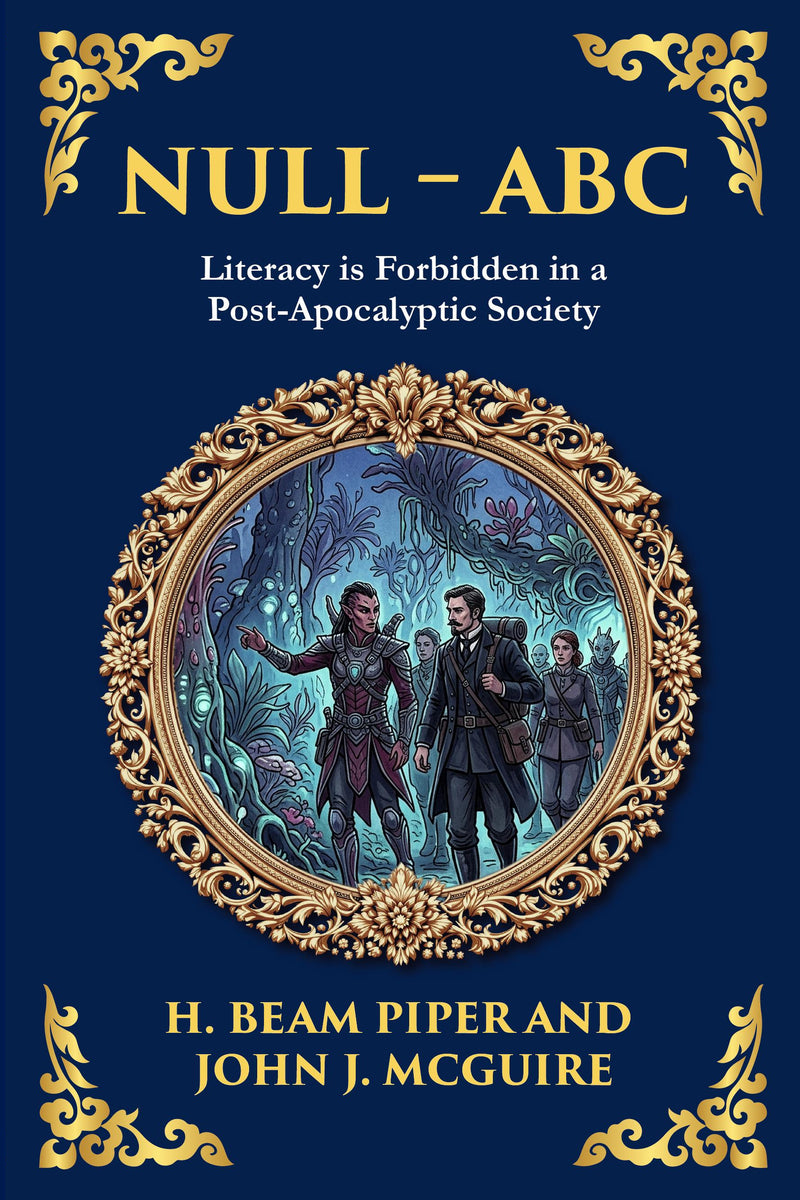
Null-ABC — Large Print
H. Beam Piper In a fractured world recovering from catastrophic ruin, a startling truth governs society: reading and writing are illegal.
or free app
10,000+ hrs library
30-day guarantee
The complete Null-ABC appears in modern English through Library of Alexandria Press, available online with audiobook narration included for members.
Have you ever wondered why knowledge might become the greatest threat to power? In Null-ABC, legendary science fiction duo H. Beam Piper and John J. McGuire unveil a dystopian future where reading is not just discouraged—it’s outlawed. Set generations after a devastating apocalypse, the story paints a chilling portrait of a society where “abcy” (illiteracy) is the norm, and “readies” (those who can read) are hunted as criminals.
The Department of Education is no longer a beacon of learning—it’s an enforcer of ignorance. With printed words banned and written language viewed as a tool of the old corrupt world, truth has been replaced by slogans, dogma, and manipulated belief. But deep in the shadows, a movement grows.
Rebels, scientists, and rogue scholars risk everything to bring literacy back to humanity.
What you’ll discover in this modern edition
- A Terrifyingly Plausible Future – Enter a world where knowledge has become forbidden and truth is redefined by the powerful.
| Formats | eBook (EPUB + PDF) · Audiobook · Paperback · Hardcover · Large Print |
| Language | English |
| Trim size (print) | 6 × 9 in |
| Binding | Paperback — perfect-bound · Hardcover — casewrap |
| Large Print edition | Same text in a larger, easy-read type — a larger font, not a larger trim |
| Print pricing | Every physical book at our true cost — at-cost, no profit (members) |
| Library | 873 restored titles, always growing |
| Length | 37,268 words · ~2 hr 29 min reading |
| Reading level | Grade 3 · an easy, flowing read (this modern-English edition) |
| Edition | Modern English translation · 2026 |
Member reviews for this edition are collected as readers finish it — be the first. Across the library: 12,000+ books shipped, every plan covered by a 365-day print guarantee.
About this edition
A faithful, unabridged modern-English edition by The Library of Alexandria — carefully rendered for today's reader and verified paragraph-by-paragraph against the public-domain source. Available as eBook, audiobook, paperback, hardcover, and large print.
- Complete & unabridgedVerified paragraph by paragraph against the source — never a scan, never abridged.
- Modern English, faithfulReadable today, with the author’s meaning kept intact. Readable — not simplified.
- Every format, one membershipRead in your browser or the free app, or listen to the full audiobook.
Included free with your membership
Cancel anytime, one click · 30-day money-back guarantee
Edition last updated July 2026
What’s inside
Null-ABC — Large Print — complete and unabridged, included in full with membership, plus the full audiobook.
Begin reading Null-ABC — Large Print
In clear modern English — the complete text is included with membership.
Introduction
There is a particular kind of unease that grips us when we imagine a world that has forgotten how to read. Not a world that has chosen ignorance, exactly, but one in which the very act of decoding marks on a page has become rare, suspect, even dangerous. NULL-ABC, the collaborative work of H. Beam Piper and John J. McGuire, takes precisely this premise and runs with it into territory both unsettling and provocative. The title itself is a kind of riddle—a coded shorthand for a society in which the alphabet has been deliberately suppressed, where the simple competence most of us take for granted has become a closely guarded privilege, a source of power, and a flashpoint for conflict.
This modern translation, adapted for the contemporary reader, has been prepared with the intention of bringing one of mid-century science fiction’s more pointed social experiments to a new generation. The story belongs to a tradition of speculative fiction that uses an exaggerated, almost satirical premise to hold a mirror up to our own anxieties about knowledge, education, expertise, and the slow erosion of cultural foundations we assume to be permanent. What happens to a civilization when the skills that bind it together are allowed to decay? Who benefits from that decay, and who fights to reverse it? These are the questions that animate the pages ahead, and they are questions that, if anything, have only grown more urgent in the decades since the story first appeared.
Before you turn to the first chapter, it is worth taking a few moments to consider where this work comes from, why it was written, and how best to approach it so that your reading experience is as rich as possible. Science fiction from this period rewards a certain kind of attentiveness. It was written for readers who were accustomed to extrapolating, to filling in the gaps, to taking a single startling idea and following its logical consequences through an entire imagined society. The pleasures of such fiction are not always the same as those offered by contemporary thrillers or character studies. They are the pleasures of the thought experiment, the satisfaction of watching a premise unfold with internal consistency, and the quiet jolt of recognition when a fictional future suddenly illuminates something true about our present.
H. Beam Piper is a name that ought to be far better known than it is. Born in 1904 in Pennsylvania, Piper came to writing relatively late and largely outside the formal channels of higher education. He was, in many respects, a self-made intellectual—a voracious reader who absorbed history, languages, firearms, mythology, and the sweep of human civilization through sheer appetite rather than institutional training. This background is significant, because it shaped the kind of fiction he wrote. Piper was endlessly fascinated by the rise and fall of civilizations, by the cyclical nature of history, and by the question of what holds societies together and what tears them apart. His most celebrated creation, the sprawling “Terro-Human Future History,” traced humanity’s expansion across the galaxy over thousands of years, complete with empires, collapses, dark ages, and renaissances. It is no accident that a man so preoccupied with the machinery of civilization would be drawn to a story about literacy—the very technology of cultural memory.
Piper’s prose is lean, confident, and often laced with a dry wit. He had a journalist’s economy and a craftsman’s respect for structure. He believed, deeply, in competence as a virtue. His heroes tend to be people who know how to do things, who understand how the world works at a practical level, and who are willing to take responsibility when others abdicate it. This is a thread that runs through almost everything he wrote, and it is very much present in the work before you. The struggle over literacy in this story is not merely an abstract political question; it is bound up with Piper’s abiding conviction that knowledge and skill are the foundations upon which any functioning society must rest.
His tragic personal story casts a long shadow over his legacy. Believing himself a commercial failure and beset by financial difficulties and personal misfortune, Piper took his own life in 1964. The cruel irony is that much of his work was selling well even as he despaired, and in the years since, his reputation has only grown. Readers and critics alike have come to appreciate the intelligence, the moral seriousness, and the sheer entertainment value of his fiction. To read Piper now is to encounter a writer who deserved far more recognition in his lifetime than he received, and who has, belatedly, been welcomed into the canon of significant twentieth-century science fiction.
John J. McGuire was Piper’s collaborator on several works, including this one. Collaboration in science fiction is a delicate art, and the partnership between these two writers produced fiction that bears Piper’s unmistakable stamp while benefiting from the friction and refinement that comes from a second creative mind. The collaborative process often sharpens a premise, forcing both authors to defend their choices and to think through the implications of their imagined world more rigorously than either might alone. The result, in this case, is a story that feels carefully thought out—a society constructed with attention to its political, economic, and social mechanisms, rather than merely sketched in as a backdrop for adventure.
To understand the world from which this story emerged, it helps to recall the cultural moment of mid-twentieth-century America. This was an era profoundly shaped by anxieties about education, mass culture, and the future of literacy itself. The expansion of radio and television, the rise of mass advertising, the worry that visual and aural media might displace the printed word—all of these were live concerns. Educators and intellectuals fretted about declining standards, about whether a population increasingly fed on images and sound bites would retain the capacity for sustained, critical reading. At the same time, the Cold War cast a long shadow, and with it came fears of social collapse, of nuclear devastation, of the fragility of the civilization that had been built up over centuries. The post-apocalyptic genre flourished in this climate precisely because it allowed writers to externalize these fears, to imagine the worst, and to ask what might survive and what might be lost.
Against this background, the premise of a society in which literacy has become forbidden, rare, or socially dangerous takes on a particular resonance. It is at once a warning and a thought experiment. What if the trends so many feared—the displacement of reading, the decline of educational standards, the concentration of knowledge in the hands of a few—were carried to their logical extreme? What kind of society would result, and what would it mean to be one of the few who could still read in such a world?
One of the great pleasures of returning to a work of mid-century science fiction is learning to read it on its own terms, and this requires a small adjustment of expectations. The fiction of this era operated under different conventions than much contemporary writing. Plots tended to move briskly, driven by ideas and incident rather than by extended interior monologue. Characters were often defined by their roles, their competencies, and their relationships to the central problem of the story, rather than by the kind of granular psychological excavation that modern literary fiction tends to favor. This is not a deficiency; it is a different aesthetic, one suited to a literature of ideas. The reader’s attention is directed outward, toward the workings of the imagined society and the unfolding of its central conflict, rather than inward, toward the labyrinth of a single consciousness.
This particular story rewards readers who enjoy thinking about systems—about how a society organizes itself, how power is distributed, how institutions defend their privileges, and how social change either happens or is prevented. The premise of suppressed literacy is not merely a colorful backdrop; it is the engine that drives everything. Ask yourself, as you read, who benefits from the state of affairs you are observing. Consider how a society might arrive at such a condition, and what forces would work to maintain it. The authors have thought carefully about these matters, and part of the satisfaction of the reading lies in watching the logic of the premise play out across the various strata of the imagined world.
It is also worth attending to the satirical and cautionary dimensions of the work. Like much of the best science fiction, this is a story that uses the future—or an alternate version of it—to comment on the present. The anxieties about education, about the dumbing-down of culture, about the way knowledge can become a tool of social control, are all woven into the fabric of the narrative. Piper and McGuire were not writing in a vacuum; they were responding to real concerns about the direction of their society, and they invite the reader to draw connections between the fictional world and our own. This is fiction with an argument, though it never sacrifices entertainment for the sake of the message. The ideas are embedded in the story, dramatized through conflict and character, rather than delivered as lectures.
The matter of language deserves a word as well. This edition has been prepared as a modern translation, adapted for the contemporary reader. What does this mean in practice? It means that the text has been carefully attended to so that idioms, references, and turns of phrase that might have presented obstacles to a present-day reader have been smoothed without sacrificing the flavor and integrity of the original. The aim throughout has been to honor the authors’ voice and intentions while ensuring that the prose reads cleanly and naturally for someone encountering it today. Mid-century writing sometimes carries the marks of its time in ways that can trip up the modern eye—a dated turn of phrase here, an assumption there—and the work of adaptation is to clear these small obstacles so that the story’s genuine strengths can shine through unobstructed. You should find the reading experience fluid and engaging, the ideas accessible, the narrative propulsive.
At the same time, it is important to read with a degree of historical generosity. This is a work of its era, and it reflects the assumptions, the social arrangements, and sometimes the limitations of the time in which it was written. The roles assigned to various characters, the texture of the social world, the implicit attitudes that surface from time to time—all of these are artifacts of the mid-twentieth century. Rather than judging them by the standards of our own moment, the more rewarding approach is to read them as windows into how people of that period imagined the future, and into the concerns that preoccupied them. There is a kind of double vision involved in reading older science fiction: we see the future the authors imagined, and we also see, refracted through it, the present in which they were writing. Both views are illuminating.
For readers new to H. Beam Piper, this work serves as an excellent introduction to his sensibility. You will find here his characteristic respect for competence, his interest in the mechanics of social organization, his brisk and confident storytelling, and his underlying seriousness of purpose. For those already familiar with his more famous works—the Little Fuzzy novels, the alternate-history Lord Kalvan of Otherwhen, the sprawling future history—this story offers a different but complementary vision, one focused tightly on a single, provocative idea and its ramifications. In either case, you are in the hands of a writer who knew exactly what he was doing, who built his imagined world with care, and who never lost sight of his obligation to entertain even as he provoked thought.
Cancel anytime, one click · 30-day money-back guarantee
Founding annual rate available now — your price locks for life when you join.
Not ready? Get this free chapter by email — read it anytime.
✓ Sent — check your inbox for Null-ABC — Large Print.
Questions about Null-ABC — Large Print
What is Null-ABC about?
H. Beam Piper In a fractured world recovering from catastrophic ruin, a startling truth governs society: reading and writing are illegal. In Null-ABC, literacy is outlawed, and knowledge is tightly controlled by those who fear its power. Amid a post-apocalyptic backdrop where ignorance is enforced and superstition replaces science, a new struggle for truth ignites.
Is Null-ABC free to read?
The opening chapter is free to read on this page. Members read and listen to the complete work — and the entire library — free, and can order any physical book at our true print cost.
How long is Null-ABC?
2 chapters (~37,268 words) — about 2 hr 29 min of reading in this modern-English edition.
Is this an abridged version of Null-ABC?
No. This is the complete, unabridged Null-ABC, carefully rendered into clear modern English and verified paragraph-by-paragraph against the public-domain source — nothing is cut or summarised.
What formats does Null-ABC come in?
Null-ABC is available as eBook, paperback, hardcover and large print. eBook and audiobook are included with membership; printed editions ship at our true print cost.
Shipping & returns
Billing & membership
More from the library


Explore Science Fiction
- The Island of Doctor Moreau · H. G. Wells
- A Midsummer Night’s Dream · William Shakespeare
- The Invisible Man: A Grotesque Romance · H. G. Wells
- The War of the Worlds · H. G. Wells
- The Strange Case of Dr. Jekyll and Mr. Hyde · Robert Louis Stevenson
- Limanora: the island of progress · Godfrey Sweven
- The Book of Dragons · E. Nesbit
- She · H. Rider Haggard
- Dorothy and the Wizard in Oz · L. Frank Baum
- The Princess and the Goblin · George MacDonald
- Gawayne and the Green Knight: A Fairy Tale · Charlton M. Lewis
- Lucian’s True History · Lucian of Samosata
- The Willows · Algernon Blackwood
- The Call of Cthulhu · H. P. Lovecraft
- The Life-Eater · Harold Ward
- The Marvelous Land of Oz · L. Frank Baum
- Mars is My Destination · Frank Belknap Long
- The Black Kiss
- The Beasts in the Void · Paul W. Fairman
- John Jones’s Dollar · Harry Stephen Keeler
- Subversive · Mack Reynolds
- The Mississippi Saucer · Frank Belknap Long
- Man of Distinction · Michael Shaara
- Spawn of the Comet · H. Thompson Rich
- The Golden Judge · Nathaniel Gordon
- Final Weapon · Everett B. Cole
- The Big Fix · George O. Smith
- Last Enemy · H. Beam Piper
- Time and Time Again · H. Beam Piper
- Sabotage in Space · Carey Rockwell
Null-ABC — Large Print
Null-ABC — Large Print
Literacy is Forbidden in a Post-Apocalyptic Society
Anonymous
Contents
- Introduction
- Null-ABC
Introduction
There is a particular kind of unease that grips us when we imagine a world that has forgotten how to read. Not a world that has chosen ignorance, exactly, but one in which the very act of decoding marks on a page has become rare, suspect, even dangerous. NULL-ABC, the collaborative work of H. Beam Piper and John J. McGuire, takes precisely this premise and runs with it into territory both unsettling and provocative. The title itself is a kind of riddle—a coded shorthand for a society in which the alphabet has been deliberately suppressed, where the simple competence most of us take for granted has become a closely guarded privilege, a source of power, and a flashpoint for conflict.
This modern translation, adapted for the contemporary reader, has been prepared with the intention of bringing one of mid-century science fiction’s more pointed social experiments to a new generation. The story belongs to a tradition of speculative fiction that uses an exaggerated, almost satirical premise to hold a mirror up to our own anxieties about knowledge, education, expertise, and the slow erosion of cultural foundations we assume to be permanent. What happens to a civilization when the skills that bind it together are allowed to decay? Who benefits from that decay, and who fights to reverse it? These are the questions that animate the pages ahead, and they are questions that, if anything, have only grown more urgent in the decades since the story first appeared.
Before you turn to the first chapter, it is worth taking a few moments to consider where this work comes from, why it was written, and how best to approach it so that your reading experience is as rich as possible. Science fiction from this period rewards a certain kind of attentiveness. It was written for readers who were accustomed to extrapolating, to filling in the gaps, to taking a single startling idea and following its logical consequences through an entire imagined society. The pleasures of such fiction are not always the same as those offered by contemporary thrillers or character studies. They are the pleasures of the thought experiment, the satisfaction of watching a premise unfold with internal consistency, and the quiet jolt of recognition when a fictional future suddenly illuminates something true about our present.
H. Beam Piper is a name that ought to be far better known than it is. Born in 1904 in Pennsylvania, Piper came to writing relatively late and largely outside the formal channels of higher education. He was, in many respects, a self-made intellectual—a voracious reader who absorbed history, languages, firearms, mythology, and the sweep of human civilization through sheer appetite rather than institutional training. This background is significant, because it shaped the kind of fiction he wrote. Piper was endlessly fascinated by the rise and fall of civilizations, by the cyclical nature of history, and by the question of what holds societies together and what tears them apart. His most celebrated creation, the sprawling “Terro-Human Future History,” traced humanity’s expansion across the galaxy over thousands of years, complete with empires, collapses, dark ages, and renaissances. It is no accident that a man so preoccupied with the machinery of civilization would be drawn to a story about literacy—the very technology of cultural memory.
Piper’s prose is lean, confident, and often laced with a dry wit. He had a journalist’s economy and a craftsman’s respect for structure. He believed, deeply, in competence as a virtue. His heroes tend to be people who know how to do things, who understand how the world works at a practical level, and who are willing to take responsibility when others abdicate it. This is a thread that runs through almost everything he wrote, and it is very much present in the work before you. The struggle over literacy in this story is not merely an abstract political question; it is bound up with Piper’s abiding conviction that knowledge and skill are the foundations upon which any functioning society must rest.
His tragic personal story casts a long shadow over his legacy. Believing himself a commercial failure and beset by financial difficulties and personal misfortune, Piper took his own life in 1964. The cruel irony is that much of his work was selling well even as he despaired, and in the years since, his reputation has only grown. Readers and critics alike have come to appreciate the intelligence, the moral seriousness, and the sheer entertainment value of his fiction. To read Piper now is to encounter a writer who deserved far more recognition in his lifetime than he received, and who has, belatedly, been welcomed into the canon of significant twentieth-century science fiction.
John J. McGuire was Piper’s collaborator on several works, including this one. Collaboration in science fiction is a delicate art, and the partnership between these two writers produced fiction that bears Piper’s unmistakable stamp while benefiting from the friction and refinement that comes from a second creative mind. The collaborative process often sharpens a premise, forcing both authors to defend their choices and to think through the implications of their imagined world more rigorously than either might alone. The result, in this case, is a story that feels carefully thought out—a society constructed with attention to its political, economic, and social mechanisms, rather than merely sketched in as a backdrop for adventure.
To understand the world from which this story emerged, it helps to recall the cultural moment of mid-twentieth-century America. This was an era profoundly shaped by anxieties about education, mass culture, and the future of literacy itself. The expansion of radio and television, the rise of mass advertising, the worry that visual and aural media might displace the printed word—all of these were live concerns. Educators and intellectuals fretted about declining standards, about whether a population increasingly fed on images and sound bites would retain the capacity for sustained, critical reading. At the same time, the Cold War cast a long shadow, and with it came fears of social collapse, of nuclear devastation, of the fragility of the civilization that had been built up over centuries. The post-apocalyptic genre flourished in this climate precisely because it allowed writers to externalize these fears, to imagine the worst, and to ask what might survive and what might be lost.
Against this background, the premise of a society in which literacy has become forbidden, rare, or socially dangerous takes on a particular resonance. It is at once a warning and a thought experiment. What if the trends so many feared—the displacement of reading, the decline of educational standards, the concentration of knowledge in the hands of a few—were carried to their logical extreme? What kind of society would result, and what would it mean to be one of the few who could still read in such a world?
One of the great pleasures of returning to a work of mid-century science fiction is learning to read it on its own terms, and this requires a small adjustment of expectations. The fiction of this era operated under different conventions than much contemporary writing. Plots tended to move briskly, driven by ideas and incident rather than by extended interior monologue. Characters were often defined by their roles, their competencies, and their relationships to the central problem of the story, rather than by the kind of granular psychological excavation that modern literary fiction tends to favor. This is not a deficiency; it is a different aesthetic, one suited to a literature of ideas. The reader’s attention is directed outward, toward the workings of the imagined society and the unfolding of its central conflict, rather than inward, toward the labyrinth of a single consciousness.
This particular story rewards readers who enjoy thinking about systems—about how a society organizes itself, how power is distributed, how institutions defend their privileges, and how social change either happens or is prevented. The premise of suppressed literacy is not merely a colorful backdrop; it is the engine that drives everything. Ask yourself, as you read, who benefits from the state of affairs you are observing. Consider how a society might arrive at such a condition, and what forces would work to maintain it. The authors have thought carefully about these matters, and part of the satisfaction of the reading lies in watching the logic of the premise play out across the various strata of the imagined world.
It is also worth attending to the satirical and cautionary dimensions of the work. Like much of the best science fiction, this is a story that uses the future—or an alternate version of it—to comment on the present. The anxieties about education, about the dumbing-down of culture, about the way knowledge can become a tool of social control, are all woven into the fabric of the narrative. Piper and McGuire were not writing in a vacuum; they were responding to real concerns about the direction of their society, and they invite the reader to draw connections between the fictional world and our own. This is fiction with an argument, though it never sacrifices entertainment for the sake of the message. The ideas are embedded in the story, dramatized through conflict and character, rather than delivered as lectures.
The matter of language deserves a word as well. This edition has been prepared as a modern translation, adapted for the contemporary reader. What does this mean in practice? It means that the text has been carefully attended to so that idioms, references, and turns of phrase that might have presented obstacles to a present-day reader have been smoothed without sacrificing the flavor and integrity of the original. The aim throughout has been to honor the authors’ voice and intentions while ensuring that the prose reads cleanly and naturally for someone encountering it today. Mid-century writing sometimes carries the marks of its time in ways that can trip up the modern eye—a dated turn of phrase here, an assumption there—and the work of adaptation is to clear these small obstacles so that the story’s genuine strengths can shine through unobstructed. You should find the reading experience fluid and engaging, the ideas accessible, the narrative propulsive.
At the same time, it is important to read with a degree of historical generosity. This is a work of its era, and it reflects the assumptions, the social arrangements, and sometimes the limitations of the time in which it was written. The roles assigned to various characters, the texture of the social world, the implicit attitudes that surface from time to time—all of these are artifacts of the mid-twentieth century. Rather than judging them by the standards of our own moment, the more rewarding approach is to read them as windows into how people of that period imagined the future, and into the concerns that preoccupied them. There is a kind of double vision involved in reading older science fiction: we see the future the authors imagined, and we also see, refracted through it, the present in which they were writing. Both views are illuminating.
For readers new to H. Beam Piper, this work serves as an excellent introduction to his sensibility. You will find here his characteristic respect for competence, his interest in the mechanics of social organization, his brisk and confident storytelling, and his underlying seriousness of purpose. For those already familiar with his more famous works—the Little Fuzzy novels, the alternate-history Lord Kalvan of Otherwhen, the sprawling future history—this story offers a different but complementary vision, one focused tightly on a single, provocative idea and its ramifications. In either case, you are in the hands of a writer who knew exactly what he was doing, who built his imagined world with care, and who never lost sight of his obligation to entertain even as he provoked thought.
Chester Pelton pulled his stomach in as much as the breakfast nook allowed; the table, preceded by a wave of mouth-watering smells, slid silently out of the pantry and clicked into place before him.
“Is everything okay, Miss Claire?” a voice called out from the other side. “Do you need anything else?”
“Everything is great, Mrs. Harris,” Claire answered. “I imagine Mr. Pelton will want seconds, and Ray will probably want thirds and fourths of everything.” She waved her hand over the sensor to close the pantry door and sat down across from her brother, who already had a glass of fruit juice in one hand and was lifting the lids off the platters with the other.
“Real eggs!” the boy exclaimed. “Bacon. Wheat toast.” He looked closer. “Hey, Sis, is this actual butter from a cow?”
Chester Pelton thought that Ray hardly needed the encouragement as he watched his son use the largest spoon available to dump huge globs of honey onto his toast. While Chester served himself some bacon and eggs, he heard Ray shout with a full mouth, “This is real honeycomb honey, too!” That made him happy. The boy was a true Pelton; it only took one bite for him to tell the difference between real and synthetic food.
“I bet this breakfast cost at least five credits,” Ray continued, speaking a bit louder between bites.
That was another Pelton trait; even at fifteen, the boy was learning the value of money. Claire, however, seemed to disagree.
“Oh, Ray, try not to always think about the price of things,” she scolded.
“If I had all the money she spends on natural food, I could afford a new model hover-bike, like Jimmy Hartnett has,” Ray replied.
End of the free sample
Keep reading, free
Members read and listen to the complete book — and the entire library. Cancel anytime, one click · 30-day money-back guarantee.