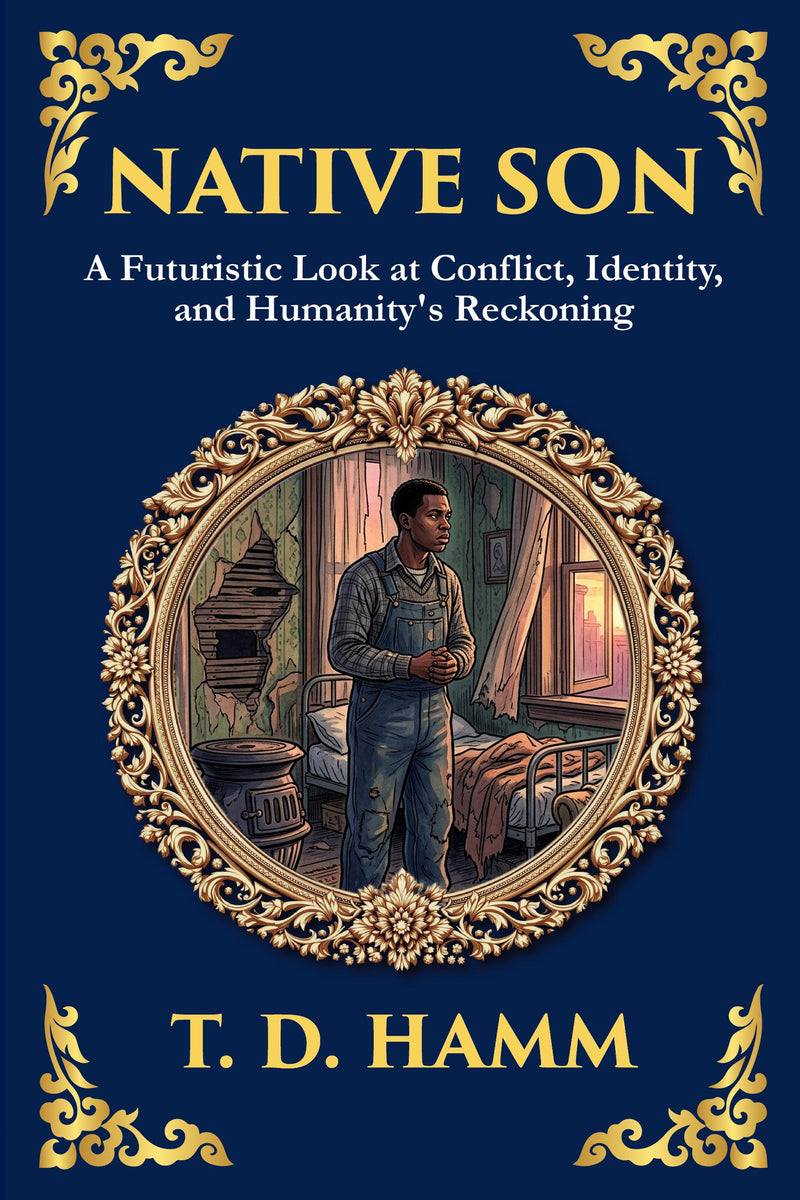
Native Son
In a future where Earth’s surface is scorched and survival depends on harsh decisions, what does it mean to truly belong?
or free app
10,000+ hrs library
30-day guarantee
The complete Native Son appears in modern English through Library of Alexandria Press, available online with audiobook narration included for members.
Have you ever wondered why home can feel most foreign to those who’ve fought to defend it? In Native Son, T. D. Hamm crafts a chilling and thought-provoking tale set in a fractured future where war has left more than just ruins—it has scattered identities, reshaped alliances, and forced a reevaluation of what it means to be human. The story follows a soldier returning to a planetary colony after years of war.
But the world he once called home is not the same—and neither is he. Distrusted by settlers and haunted by his own past, he becomes a living question: who belongs in a world born of conflict? With tight prose and relentless emotional tension, Hamm delivers a story that’s both classic science fiction and brutally contemporary, exploring timeless themes of exile, guilt, and belonging through the lens of a wounded future.
What you’ll discover in this modern edition
- A Vision of Tomorrow’s Moral Struggles – The aftermath of war is never clean. Explore the complexities of rebuilding society after destruction.
- A Deep Dive into Identity and Otherness – What does “native” mean in a world where everyone is a descendant of displacement?
- A Soldier’s Return to a World That Moved On – Uncover the inner conflict of those who return from war to a home that no longer welcomes them.
- A Stark Reflection of Today’s Global Tensions – Though futuristic, Hamm’s story is grounded in the psychological toll of modern conflict and displacement.
| Formats | eBook (EPUB + PDF) · Audiobook · Paperback · Hardcover · Large Print |
| Language | English |
| Trim size (print) | 6 × 9 in |
| Binding | Paperback — perfect-bound · Hardcover — casewrap |
| Large Print edition | Same text in a larger, easy-read type — a larger font, not a larger trim |
| Print pricing | Every physical book at our true cost — at-cost, no profit (members) |
| Library | 873 restored titles, always growing |
| Length | 5,765 words · ~23 min reading |
| Reading level | Grade 10 · a comfortable read (this modern-English edition) |
| Edition | Modern English translation · 2026 |
Member reviews for this edition are collected as readers finish it — be the first. Across the library: 12,000+ books shipped, every plan covered by a 365-day print guarantee.
About this edition
A faithful, unabridged modern-English edition by The Library of Alexandria — carefully rendered for today's reader and verified paragraph-by-paragraph against the public-domain source. Available as eBook, audiobook, paperback, hardcover, and large print.
- Complete & unabridgedVerified paragraph by paragraph against the source — never a scan, never abridged.
- Modern English, faithfulReadable today, with the author’s meaning kept intact. Readable — not simplified.
- Every format, one membershipRead in your browser or the free app, or listen to the full audiobook.
Included free with your membership
Cancel anytime, one click · 30-day money-back guarantee
Edition last updated July 2026
What’s inside
Native Son — complete and unabridged, included in full with membership, plus the full audiobook.
Begin reading Native Son
In clear modern English — the complete text is included with membership.
Introduction
There are certain stories that refuse to remain confined to the era of their birth. They press against the walls of their own time, asking questions that grow only more urgent as the decades pass. The book you are about to read belongs to this rare category of literature—works that seem less like artifacts of a particular moment and more like mirrors that keep returning, generation after generation, to reflect back the anxieties, the contradictions, and the unresolved tensions of whatever age happens to be gazing into them. What you hold now is a reimagining, a translation across time as much as across language, an attempt to carry the essential fire of a foundational narrative into a landscape that the original author could scarcely have imagined: a future shaped by technology, by surveillance, by accelerated change, and by the same eternal human hungers that have always driven us toward both destruction and transcendence.
To approach this work is to step into a conversation that began long before any of us were born and will, in all likelihood, continue long after we are gone. It is a conversation about who belongs and who does not. It is a conversation about the invisible architecture of power—the systems we build, often without realizing it, that determine whose lives are seen and whose are erased, whose fears are validated and whose are dismissed. And above all, it is a conversation about the self: how identity is forged in the crucible of circumstance, how the world around us shapes the contours of our inner lives, and how a single human being, pressed by forces vastly larger than himself, must somehow find a way to remain whole. These are not small concerns. They are, in fact, the largest concerns there are, and the achievement of this adaptation lies in its willingness to confront them without flinching, without simplification, and without the false comfort of easy answers.
This introduction is offered not to interpret the story for you—that would rob you of the privilege of discovery that every reader deserves—but rather to prepare the ground, to clear away certain obstacles to understanding, and to invite you into the book with your senses sharpened and your expectations properly calibrated. A great work demands a certain kind of reader: one who is willing to sit with discomfort, to suspend the reflex toward judgment, and to allow the narrative to do its slow, patient, sometimes painful work upon the imagination. If you are willing to be that kind of reader, then what awaits you is not merely a story but an experience—one that may unsettle you, challenge you, and ultimately, if you let it, change the way you see the world.
Every act of adaptation is, in its own way, an act of devotion. To take a story that has already proven its power and to render it anew is to declare that the original possessed something so essential, so resistant to the erosion of time, that it deserved to live again in a fresh form. But adaptation is also an act of courage, because it invites comparison, scrutiny, and the inevitable question: why do this at all? Why not simply return to the source? The answer lies in the peculiar way that meaning shifts as the world around a story changes. A narrative that once spoke to the conditions of factories and tenements, of rigid social hierarchies and the brutal machinery of exclusion, finds itself addressing, in our own moment, the conditions of algorithms and data, of digital identities and the new and subtle ways that human beings are sorted, categorized, surveilled, and judged.
What T. D. Hamm has undertaken here is something more ambitious than a simple modernization of language, though the prose has indeed been rendered into a contemporary idiom that will feel immediate and alive to the present-day reader. The deeper project is to ask what happens when the eternal themes of the original—the desperate struggle for selfhood within a hostile environment, the way that fear breeds violence and violence breeds fear, the tragic collision between individual longing and systemic constraint—are transposed into a future setting. This is not science fiction in the conventional sense, with its gadgets and its spectacle. It is something subtler and, in many ways, more disturbing: a speculative landscape that feels uncomfortably plausible, a world that is recognizably an extension of our own, in which the old human dramas play out against a backdrop of new technologies and new forms of control.
The decision to set this reckoning in a futuristic frame is not arbitrary. There is a profound logic to it. The original story emerged from a recognition that environment shapes destiny—that a human being cannot be fully understood apart from the conditions that produced him, and that to ignore those conditions is to render a false and cruel verdict upon his actions. By projecting these dynamics into a future where the systems of control are even more pervasive, even more deeply woven into the fabric of daily life, the adaptation throws this insight into sharper relief. We are forced to ask: if a person’s life is increasingly mediated by forces he can neither see nor comprehend—by the invisible hand of automated systems, by the cold logic of optimization, by the relentless pressure of a world that measures and categorizes without mercy—then how much of his fate is truly his own? Where does responsibility lie? And what becomes of the human spirit when it is hemmed in on every side?
These questions are not new. They are, in fact, among the oldest questions of philosophy and literature. But the genius of this reimagining is to dress them in the clothing of tomorrow, to make them feel not like abstractions debated in lecture halls but like the lived, breathing, immediate concerns of characters whose struggles we come to feel as our own. The future setting does not distance us from the human drama; paradoxically, it brings us closer to it, because we recognize in that imagined world the seeds of our own present, the trajectories we are already living, the consequences we are already beginning to face.
There is also, in this adaptation, a deep respect for the architecture of the original narrative—the careful way that tension accumulates, the inexorable momentum that carries the story forward like a river approaching a waterfall. Readers familiar with the foundational work will recognize the bones beneath the new flesh, the structural integrity that has been preserved even as the surface has been transformed. And readers encountering this story for the first time, with no knowledge of what came before, will find themselves swept along by a narrative that needs no prior context to exert its full force. This is the mark of a successful adaptation: it stands on its own, complete and self-sufficient, while also offering deeper rewards to those who bring a knowledge of its lineage. Whichever kind of reader you are, the story is built to hold you.
It is worth pausing here to consider what it means to translate not only words but worlds. The translator’s task, in the conventional sense, is to carry meaning across the gulf between languages, finding equivalences where exact correspondence is impossible, making judgments about what to preserve and what to sacrifice. But the translation undertaken here is of a more expansive kind. It carries meaning across the gulf between epochs, between sensibilities, between the assumptions of one generation and the lived reality of another. This requires not only linguistic skill but historical imagination, moral seriousness, and a willingness to inhabit the consciousness of characters whose circumstances may be radically different from our own. The result is a work that honors its origins while speaking with full authority to the present, a bridge between what was and what is becoming.
Themes That Will Follow You Long After the Final Page
At the heart of this narrative lies an exploration of conflict—not merely the external conflict of one character against another, or one group against another, but the deeper, more corrosive conflict that takes place within a single human soul when it is asked to bear more than any soul should have to bear. The title itself gestures toward this idea: the notion of being native to a place, of belonging to it by birth and yet remaining, somehow, a stranger within it. This is the central paradox that animates the story. What does it mean to be born into a world that has already decided who you are before you have had any chance to decide for yourself? What does it mean to be a son of a society that refuses to acknowledge you as its own? These questions ripple outward through every page, and the answers, when they come, are neither comforting nor simple.
The theme of identity is perhaps the most resonant for contemporary readers, who live in an age preoccupied—sometimes to the point of obsession—with questions of who we are and how we come to be ourselves. We are surrounded by tools and technologies that promise to define us, to categorize us, to reduce the irreducible complexity of a human life to a profile, a score, a set of data points. The story examines what happens to a person when the world insists on seeing him only through such reductive lenses, when his humanity is flattened into a category, when the rich and contradictory truth of his inner life is overwritten by the projections and fears of those around him. This is a profoundly modern predicament, and yet it is also as ancient as the first time one human being looked upon another and saw not a fellow soul but a threat, an obstacle, an Other.
The reckoning promised in the subtitle is not a single event but a process, a slow unveiling of consequences that have been building for a long time beneath the surface of an apparently ordered world. There is a sense throughout the narrative that something is owed, that a debt has been accumulating, that the systems and structures that govern this future society are running up against the hard limits of what they can contain. The reckoning is both personal and collective: it is the reckoning of an individual confronting the truth of his own situation, and it is the reckoning of a society confronting the consequences of the choices it has made, the cruelties it has tolerated, the human beings it has discarded. This dual movement—the intimate and the epic, the singular life and the vast social machinery—gives the story its remarkable scope and its emotional power.
One of the most striking aspects of the narrative is its refusal to offer easy heroes or simple villains. The characters who populate this world are complex, contradictory, capable of both tenderness and brutality, shaped by forces they only dimly understand. Even the figures who seem, at first glance, to embody the systems of oppression are revealed to be themselves trapped within those systems, acting out roles they did not write, fearful in their own ways, blind in their own ways. This moral complexity is one of the great gifts of serious literature: it refuses to let us off the hook, refuses to allow us the comfort of clear-cut judgments, and instead forces us to grapple with the uncomfortable truth that the line between good and evil runs not between groups of people but through the heart of every individual.
The theme of fear deserves particular attention, because it is the engine that drives so much of the story’s tragedy. Fear is contagious; it spreads from person to person, from group to group, distorting perception, hardening attitudes, justifying cruelties that would otherwise be unthinkable. The narrative shows us, with painful clarity, how fear can become a self-fulfilling prophecy: how the fear of a particular kind of person can create the very conditions that produce the behavior that was feared in the first place. This is one of the deepest insights of the work, and it is an insight with enormous relevance to our own moment, in which fear—of the stranger, of the future, of forces beyond our control—seems to be reshaping our politics, our communities, and our individual lives in ways both subtle and profound.
Cancel anytime, one click · 30-day money-back guarantee
Founding annual rate available now — your price locks for life when you join.
Not ready? Get this free chapter by email — read it anytime.
✓ Sent — check your inbox for Native Son.
Questions about Native Son
What is Native Son about?
In a future where Earth’s surface is scorched and survival depends on harsh decisions, what does it mean to truly belong? Native Son is a powerful and haunting science fiction short that interrogates identity, displacement, and the brutal realities of post-war humanity. When a lone soldier returns to a colony torn by conflict, his arrival reopens old wounds and forces new reckonings.
Who wrote Native Son?
Native Son was written by T. D. Hamm. This edition presents the complete work in clear modern English, faithfully rendered from the public-domain original by Library of Alexandria Press.
Is Native Son free to read?
The opening chapter is free to read on this page. Members read and listen to the complete work — and the entire library — free, and can order any physical book at our true print cost.
How long is Native Son?
2 chapters (~5,765 words) — about 23 min of reading in this modern-English edition.
Is this an abridged version of Native Son?
No. This is the complete, unabridged Native Son, carefully rendered into clear modern English and verified paragraph-by-paragraph against the public-domain source — nothing is cut or summarised.
What formats does Native Son come in?
Native Son is available as eBook, paperback, hardcover and large print. eBook and audiobook are included with membership; printed editions ship at our true print cost.
Shipping & returns
Billing & membership
More from the library


Explore Science Fiction
- The Island of Doctor Moreau · H. G. Wells
- A Midsummer Night’s Dream · William Shakespeare
- The Invisible Man: A Grotesque Romance · H. G. Wells
- The War of the Worlds · H. G. Wells
- The Strange Case of Dr. Jekyll and Mr. Hyde · Robert Louis Stevenson
- Limanora: the island of progress · Godfrey Sweven
- The Book of Dragons · E. Nesbit
- She · H. Rider Haggard
- Dorothy and the Wizard in Oz · L. Frank Baum
- The Princess and the Goblin · George MacDonald
- Gawayne and the Green Knight: A Fairy Tale · Charlton M. Lewis
- Lucian’s True History · Lucian of Samosata
- The Willows · Algernon Blackwood
- The Call of Cthulhu · H. P. Lovecraft
- The Life-Eater · Harold Ward
- The Marvelous Land of Oz · L. Frank Baum
- Mars is My Destination · Frank Belknap Long
- The Black Kiss
- The Beasts in the Void · Paul W. Fairman
- John Jones’s Dollar · Harry Stephen Keeler
- Subversive · Mack Reynolds
- The Mississippi Saucer · Frank Belknap Long
- Man of Distinction · Michael Shaara
- Spawn of the Comet · H. Thompson Rich
- The Golden Judge · Nathaniel Gordon
- Final Weapon · Everett B. Cole
- The Big Fix · George O. Smith
- Last Enemy · H. Beam Piper
- Time and Time Again · H. Beam Piper
- Sabotage in Space · Carey Rockwell
Native Son
Native Son
A Futuristic Look at Conflict, Identity, and Humanity’s Reckoning
T. D. Hamm
Contents
- Introduction
- Native Son
Introduction
There are certain stories that refuse to remain confined to the era of their birth. They press against the walls of their own time, asking questions that grow only more urgent as the decades pass. The book you are about to read belongs to this rare category of literature—works that seem less like artifacts of a particular moment and more like mirrors that keep returning, generation after generation, to reflect back the anxieties, the contradictions, and the unresolved tensions of whatever age happens to be gazing into them. What you hold now is a reimagining, a translation across time as much as across language, an attempt to carry the essential fire of a foundational narrative into a landscape that the original author could scarcely have imagined: a future shaped by technology, by surveillance, by accelerated change, and by the same eternal human hungers that have always driven us toward both destruction and transcendence.
To approach this work is to step into a conversation that began long before any of us were born and will, in all likelihood, continue long after we are gone. It is a conversation about who belongs and who does not. It is a conversation about the invisible architecture of power—the systems we build, often without realizing it, that determine whose lives are seen and whose are erased, whose fears are validated and whose are dismissed. And above all, it is a conversation about the self: how identity is forged in the crucible of circumstance, how the world around us shapes the contours of our inner lives, and how a single human being, pressed by forces vastly larger than himself, must somehow find a way to remain whole. These are not small concerns. They are, in fact, the largest concerns there are, and the achievement of this adaptation lies in its willingness to confront them without flinching, without simplification, and without the false comfort of easy answers.
This introduction is offered not to interpret the story for you—that would rob you of the privilege of discovery that every reader deserves—but rather to prepare the ground, to clear away certain obstacles to understanding, and to invite you into the book with your senses sharpened and your expectations properly calibrated. A great work demands a certain kind of reader: one who is willing to sit with discomfort, to suspend the reflex toward judgment, and to allow the narrative to do its slow, patient, sometimes painful work upon the imagination. If you are willing to be that kind of reader, then what awaits you is not merely a story but an experience—one that may unsettle you, challenge you, and ultimately, if you let it, change the way you see the world.
Every act of adaptation is, in its own way, an act of devotion. To take a story that has already proven its power and to render it anew is to declare that the original possessed something so essential, so resistant to the erosion of time, that it deserved to live again in a fresh form. But adaptation is also an act of courage, because it invites comparison, scrutiny, and the inevitable question: why do this at all? Why not simply return to the source? The answer lies in the peculiar way that meaning shifts as the world around a story changes. A narrative that once spoke to the conditions of factories and tenements, of rigid social hierarchies and the brutal machinery of exclusion, finds itself addressing, in our own moment, the conditions of algorithms and data, of digital identities and the new and subtle ways that human beings are sorted, categorized, surveilled, and judged.
What T. D. Hamm has undertaken here is something more ambitious than a simple modernization of language, though the prose has indeed been rendered into a contemporary idiom that will feel immediate and alive to the present-day reader. The deeper project is to ask what happens when the eternal themes of the original—the desperate struggle for selfhood within a hostile environment, the way that fear breeds violence and violence breeds fear, the tragic collision between individual longing and systemic constraint—are transposed into a future setting. This is not science fiction in the conventional sense, with its gadgets and its spectacle. It is something subtler and, in many ways, more disturbing: a speculative landscape that feels uncomfortably plausible, a world that is recognizably an extension of our own, in which the old human dramas play out against a backdrop of new technologies and new forms of control.
The decision to set this reckoning in a futuristic frame is not arbitrary. There is a profound logic to it. The original story emerged from a recognition that environment shapes destiny—that a human being cannot be fully understood apart from the conditions that produced him, and that to ignore those conditions is to render a false and cruel verdict upon his actions. By projecting these dynamics into a future where the systems of control are even more pervasive, even more deeply woven into the fabric of daily life, the adaptation throws this insight into sharper relief. We are forced to ask: if a person’s life is increasingly mediated by forces he can neither see nor comprehend—by the invisible hand of automated systems, by the cold logic of optimization, by the relentless pressure of a world that measures and categorizes without mercy—then how much of his fate is truly his own? Where does responsibility lie? And what becomes of the human spirit when it is hemmed in on every side?
These questions are not new. They are, in fact, among the oldest questions of philosophy and literature. But the genius of this reimagining is to dress them in the clothing of tomorrow, to make them feel not like abstractions debated in lecture halls but like the lived, breathing, immediate concerns of characters whose struggles we come to feel as our own. The future setting does not distance us from the human drama; paradoxically, it brings us closer to it, because we recognize in that imagined world the seeds of our own present, the trajectories we are already living, the consequences we are already beginning to face.
There is also, in this adaptation, a deep respect for the architecture of the original narrative—the careful way that tension accumulates, the inexorable momentum that carries the story forward like a river approaching a waterfall. Readers familiar with the foundational work will recognize the bones beneath the new flesh, the structural integrity that has been preserved even as the surface has been transformed. And readers encountering this story for the first time, with no knowledge of what came before, will find themselves swept along by a narrative that needs no prior context to exert its full force. This is the mark of a successful adaptation: it stands on its own, complete and self-sufficient, while also offering deeper rewards to those who bring a knowledge of its lineage. Whichever kind of reader you are, the story is built to hold you.
It is worth pausing here to consider what it means to translate not only words but worlds. The translator’s task, in the conventional sense, is to carry meaning across the gulf between languages, finding equivalences where exact correspondence is impossible, making judgments about what to preserve and what to sacrifice. But the translation undertaken here is of a more expansive kind. It carries meaning across the gulf between epochs, between sensibilities, between the assumptions of one generation and the lived reality of another. This requires not only linguistic skill but historical imagination, moral seriousness, and a willingness to inhabit the consciousness of characters whose circumstances may be radically different from our own. The result is a work that honors its origins while speaking with full authority to the present, a bridge between what was and what is becoming.
Themes That Will Follow You Long After the Final Page
At the heart of this narrative lies an exploration of conflict—not merely the external conflict of one character against another, or one group against another, but the deeper, more corrosive conflict that takes place within a single human soul when it is asked to bear more than any soul should have to bear. The title itself gestures toward this idea: the notion of being native to a place, of belonging to it by birth and yet remaining, somehow, a stranger within it. This is the central paradox that animates the story. What does it mean to be born into a world that has already decided who you are before you have had any chance to decide for yourself? What does it mean to be a son of a society that refuses to acknowledge you as its own? These questions ripple outward through every page, and the answers, when they come, are neither comforting nor simple.
The theme of identity is perhaps the most resonant for contemporary readers, who live in an age preoccupied—sometimes to the point of obsession—with questions of who we are and how we come to be ourselves. We are surrounded by tools and technologies that promise to define us, to categorize us, to reduce the irreducible complexity of a human life to a profile, a score, a set of data points. The story examines what happens to a person when the world insists on seeing him only through such reductive lenses, when his humanity is flattened into a category, when the rich and contradictory truth of his inner life is overwritten by the projections and fears of those around him. This is a profoundly modern predicament, and yet it is also as ancient as the first time one human being looked upon another and saw not a fellow soul but a threat, an obstacle, an Other.
The reckoning promised in the subtitle is not a single event but a process, a slow unveiling of consequences that have been building for a long time beneath the surface of an apparently ordered world. There is a sense throughout the narrative that something is owed, that a debt has been accumulating, that the systems and structures that govern this future society are running up against the hard limits of what they can contain. The reckoning is both personal and collective: it is the reckoning of an individual confronting the truth of his own situation, and it is the reckoning of a society confronting the consequences of the choices it has made, the cruelties it has tolerated, the human beings it has discarded. This dual movement—the intimate and the epic, the singular life and the vast social machinery—gives the story its remarkable scope and its emotional power.
One of the most striking aspects of the narrative is its refusal to offer easy heroes or simple villains. The characters who populate this world are complex, contradictory, capable of both tenderness and brutality, shaped by forces they only dimly understand. Even the figures who seem, at first glance, to embody the systems of oppression are revealed to be themselves trapped within those systems, acting out roles they did not write, fearful in their own ways, blind in their own ways. This moral complexity is one of the great gifts of serious literature: it refuses to let us off the hook, refuses to allow us the comfort of clear-cut judgments, and instead forces us to grapple with the uncomfortable truth that the line between good and evil runs not between groups of people but through the heart of every individual.
The theme of fear deserves particular attention, because it is the engine that drives so much of the story’s tragedy. Fear is contagious; it spreads from person to person, from group to group, distorting perception, hardening attitudes, justifying cruelties that would otherwise be unthinkable. The narrative shows us, with painful clarity, how fear can become a self-fulfilling prophecy: how the fear of a particular kind of person can create the very conditions that produce the behavior that was feared in the first place. This is one of the deepest insights of the work, and it is an insight with enormous relevance to our own moment, in which fear—of the stranger, of the future, of forces beyond our control—seems to be reshaping our politics, our communities, and our individual lives in ways both subtle and profound.
Tommy hated Earth, knowing his mother might go home to Mars without him. Worse, would a robot secretly take her place?...
During his first visit to Earth, Tommy Benton found the wonders of twenty-first-century New York thrilling for the first week. By the second week, he was bored and miserable, and by the end of the third, he was definitely ready to go home.
The constant noise of traffic was torture for his unusually sensitive ears. The higher atmospheric pressure made his chest and stomach feel strange. And while he was quick and agile on Mars, he struggled with the heavy gravity here, which made him feel clumsy and uncoordinated.
The endless canyons of skyscrapers and their connecting skywalks felt oppressive and suffocating. He remembered the wide-open rabbara fields next to a canal that looked like an inland sea, and a wave of homesickness washed over him.
He hated the way people stared at him, whether they were openly amused or trying to hide it. His Aunt Bee, for example, looked him up and down with clear disapproval and said loudly, “For heaven’s sake, Helen! Take him to a good tailor and get those bones covered up!”
Was it his fault that he was six inches taller than other boys his age, with long, thin arms and legs? Or that his chest was larger to help him breathe in a thin atmosphere? I’d like to see her, he thought angrily, out on the Flatlands; she’d be gasping for air like a fish out of water.
Even his parents, who were enjoying the social scene on Earth after eleven years in the Martian flatlands, didn’t seem to understand how he felt.
“Don’t you like Earth, Tommy?” his mother asked anxiously.
End of the free sample
Keep reading, free
Members read and listen to the complete book — and the entire library. Cancel anytime, one click · 30-day money-back guarantee.