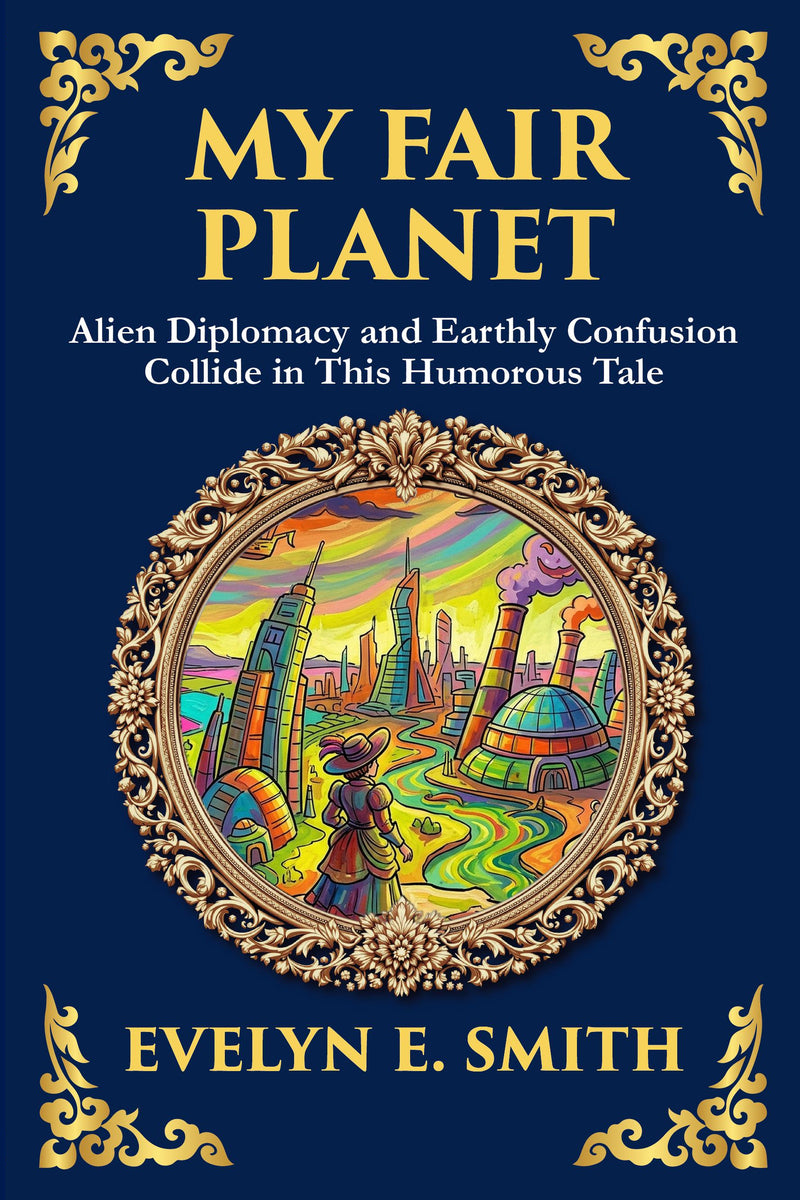
My Fair Planet
When an alien diplomat arrives on Earth, cultural misunderstandings spiral into chaos in this witty, satirical science fiction comedy.
or free app
10,000+ hrs library
30-day guarantee
The complete My Fair Planet appears in modern English through Library of Alexandria Press, available online with audiobook narration included for members.
Have you ever wondered why aliens might find humans the strangest species of all? In My Fair Planet, Golden Age author Evelyn E. Smith turns her sharp wit toward a tale of interplanetary diplomacy gone wildly awry. When emissaries from another world attempt to negotiate peace and partnership with Earth, the results are anything but orderly.
As aliens try to mimic human customs—and humans fumble with the unfamiliar culture of their visitors—the clash produces comedy, satire, and pointed reflection on the absurdities of our own civilization. This delightful, tongue-in-cheek novel combines lighthearted science fiction with biting social critique, offering readers both laughter and food for thought. With echoes of classic works like The Hitchhiker’s Guide to the Galaxy, Smith’s story proves that sometimes the best way to examine human flaws is through alien eyes.
What you’ll discover in this modern edition
- Alien Diplomacy Gone Wrong – Watch as extraterrestrial ambassadors struggle to navigate the baffling customs of Earth.
- Humans as the “Odd Ones Out” – Experience society from an alien perspective and see how strange we truly are.
- Evelyn E. Smith’s Trademark Wit – A masterful blend of humor, irony, and sharp social commentary.
- A Comedy of Misunderstandings – From misinterpreted gestures to bureaucratic blunders, chaos is guaranteed.
- A Timeless Reflection on Human Nature – Laugh while questioning politics, culture, and the fragile idea of “civilization.”
| Formats | eBook (EPUB + PDF) · Audiobook · Paperback · Hardcover · Large Print |
| Language | English |
| Trim size (print) | 6 × 9 in |
| Binding | Paperback — perfect-bound · Hardcover — casewrap |
| Large Print edition | Same text in a larger, easy-read type — a larger font, not a larger trim |
| Print pricing | Every physical book at our true cost — at-cost, no profit (members) |
| Library | 873 restored titles, always growing |
| Length | 8,827 words · ~35 min reading |
| Reading level | Grade 6 · an easy, flowing read (this modern-English edition) |
| Edition | Modern English translation · 2026 |
Member reviews for this edition are collected as readers finish it — be the first. Across the library: 12,000+ books shipped, every plan covered by a 365-day print guarantee.
About this edition
A faithful, unabridged modern-English edition by The Library of Alexandria — carefully rendered for today's reader and verified paragraph-by-paragraph against the public-domain source. Available as eBook, audiobook, paperback, hardcover, and large print.
- Complete & unabridgedVerified paragraph by paragraph against the source — never a scan, never abridged.
- Modern English, faithfulReadable today, with the author’s meaning kept intact. Readable — not simplified.
- Every format, one membershipRead in your browser or the free app, or listen to the full audiobook.
Included free with your membership
Cancel anytime, one click · 30-day money-back guarantee
Edition last updated July 2026
What’s inside
My Fair Planet — complete and unabridged, included in full with membership, plus the full audiobook.
Begin reading My Fair Planet
In clear modern English — the complete text is included with membership.
Introduction
There is a particular kind of pleasure that comes from picking up a story written in an earlier decade, one that imagined the future or the strange with such conviction that its hopes, anxieties, and humor still shimmer just beneath the surface of every sentence. My Fair Planet by Evelyn E. Smith is exactly that kind of story. It belongs to a tradition of science fiction that was less interested in dazzling readers with hardware and more delighted by the comedy of contact — the awkward, hilarious, and surprisingly tender collisions that happen when two utterly different intelligences attempt to make sense of one another across a gulf of assumptions. This adaptation, prepared for the contemporary reader, aims to preserve all the charm and wit of the original while smoothing the small frictions of dated phrasing and reference that can occasionally trip up a modern audience. What follows is not a rewrite that strips away the author’s voice, but a careful translation across time, intended to let Smith’s playful intelligence reach you as freshly as it reached readers when it first appeared.
To approach this book well, it helps to know something about the spirit in which it was written, the woman who wrote it, and the literary world that produced it. It also helps to arrive with the right expectations — to understand that this is a comedy of manners dressed in the costume of a space-age fable, and that its greatest delights are found not in plot twists but in the gentle absurdities of human behavior viewed, as it were, from a great and slightly bewildered distance. Consider this introduction a companion to your reading, a way of tuning your ear before the music begins. I will not spoil the events of the story, because half the joy of a tale like this lies in discovering where its logic carries you. Instead, I want to prepare the ground so that when you turn to the first page, you can settle in fully, alert to the textures and pleasures that make this such a rewarding read.
A Writer of Wit in the Golden Age of Science Fiction
Evelyn E. Smith occupies a distinctive and, frankly, undervalued place in the history of twentieth-century science fiction. She wrote during a period often called the genre’s golden age, a time when magazines with names like Galaxy and The Magazine of Fantasy and Science Fiction were the engines of imaginative literature, and when the field was crowded with writers who treated the future as a vast playground for ideas. Many of those writers leaned toward the technical, the grand, and the heroic — tales of conquering the stars, of grim survival, of ideas weighed and tested with engineering precision. Smith belonged to a quieter, sharper, and more mischievous strain. She wrote with a satirist’s eye and a humorist’s timing, and she understood that the most reliable comedy in any science fiction story comes not from the alien but from the human.
This sensibility set her apart. Where some of her contemporaries built their reputations on extrapolating the consequences of new technologies, Smith was more interested in social comedy — in manners, pretensions, snobberies, and the small vanities that govern everyday life. She had a particular gift for what we might call the comedy of incongruity: the placing of something utterly ordinary beside something utterly extraordinary, and then watching, with a wry and affectionate smile, as the two refuse to fit together. An alien with impeccable logic confronting the inexplicable rituals of human society; a perfectly sensible person trying to maintain decorum in a situation that has spun entirely out of any reasonable control — these are the raw materials of her best work, and they are very much on display here.
It is worth noting that Smith was also a prolific writer outside of science fiction. She wrote mysteries, she contributed crossword puzzles and word games, and she possessed exactly the sort of mind one would expect from a person who delighted in the architecture of language. That love of words, of their slipperiness and their precision, hums throughout her fiction. She was attentive to how people talk, to the gap between what they say and what they mean, and to the way that language itself can become a source of confusion and comedy. When you read her, you are in the company of a writer who clearly relished the act of writing — who took pleasure in a well-turned phrase, a perfectly timed misunderstanding, a character whose dialogue reveals far more than the character intends.
Reading Smith today, one is struck by how modern her humor feels. The science fiction of her era could sometimes be earnest to the point of stiffness, but her work has an ironic lightness that translates effortlessly across the decades. She did not take herself too seriously, and she did not expect the future to take itself too seriously either. There is a generosity in this attitude, a refusal to be pompous, that makes her stories feel like good company. She is the kind of author who seems to be sitting beside you, raising an eyebrow at the absurdity of it all, inviting you to share the joke.
The title of this book, My Fair Planet, signals her intentions with a knowing wink. The echo of a beloved musical and the play it was based upon is no accident; it announces immediately that we are in the territory of transformation, of education, of one party attempting to refine, instruct, or civilize another. The whole comic engine of that famous story — the project of taking someone deemed unpolished and remaking them according to a standard of supposed sophistication — is precisely the kind of social premise that Smith loved to turn inside out. By transposing such a premise onto the meeting of worlds, she invites us to ask which party, exactly, is in need of refinement, and by whose standards, and whether the very notion of one culture improving another might be more comical, and more dubious, than it first appears. That question, posed so lightly that you may laugh before you realize you are being asked it, is one of the quiet gifts the book offers.
The Pleasures of Alien Diplomacy and Earthly Confusion
The subtitle of this edition promises “Alien Diplomacy and Earthly Confusion,” and it is a fair description of the comic machinery at work. There is a long and honorable tradition of using the figure of the outsider — the stranger, the foreigner, the visitor from elsewhere — as a device for holding up a mirror to a society and revealing its absurdities. Satirists have done this for centuries, sending innocents into corrupt courts or naive travelers into supposedly civilized lands, all so that the reader might see, through fresh eyes, what familiarity had rendered invisible. Science fiction gave this old technique a thrilling new costume: instead of a traveler from a distant country, the outsider could now be a being from another world entirely, free of every human assumption, capable of questioning even the most basic premises that we take for granted.
Smith uses this device with a deft and affectionate touch. The comedy in a story like this comes from a beautiful kind of double vision. We watch the human characters struggle to comprehend and accommodate the alien, and we laugh at their flailing attempts to seem composed, in control, and dignified. But we also watch the alien struggle to comprehend the humans, and here the comedy turns reflective, because the things that baffle a visitor from another world are precisely the things we never think to question. Why do we do the things we do? Why do we attach such importance to status, to appearance, to the elaborate codes of social behavior that no one ever explained but everyone is expected to obey? An alien observer, applying clear and disinterested logic to human custom, becomes an unwitting critic, and the result is laughter laced with a faint, pleasant sting of recognition.
What makes this approach so satisfying in Smith’s hands is that she never lets the satire curdle into cynicism. Her humor is warm. She is fond of her characters, even when they are being foolish, and she finds in their confusion something endearing rather than contemptible. This is an important distinction, and it shapes the entire experience of the book. There are writers who use the alien-observer device as a scalpel, cutting humanity down to size with cold precision. Smith uses it more like a feather, tickling us into self-awareness, allowing us to laugh at ourselves without feeling lectured. The effect is genial and humane. You come away not feeling chastised but feeling, somehow, more affectionate toward the muddled, well-meaning, perpetually confused species to which you belong.
The diplomacy of the title is worth dwelling on as well, because diplomacy is, at heart, a comic subject. It is the art of saying one thing while meaning another, of maintaining cordial relations while pursuing entirely divergent interests, of papering over enormous differences with elaborate courtesies. When the parties to a diplomatic encounter come from the same culture, the comedy is subtle. When they come from different planets — when they do not share so much as a common assumption about what a greeting is, or what an insult is, or what counts as polite — the comedy becomes glorious. Every gesture is a potential pitfall. Every word might mean its opposite. The simplest interaction becomes a minefield of possible misunderstanding, and Smith, with her sharp ear for the gap between intention and reception, mines this material for all it is worth.
You will find, as you read, that the misunderstandings pile up in a way that feels almost musical — a comedy of escalating complications, each new confusion building upon the last until the whole situation teeters delightfully on the edge of chaos. This is farce in the best sense, the kind that depends not on slapstick but on the relentless internal logic of a situation gone wrong. Each character behaves entirely reasonably according to their own understanding, and yet the collision of their reasonable behaviors produces magnificent absurdity. There is a craftsmanship to this kind of comedy that is easy to underestimate. It requires the writer to keep many balls in the air at once, to track exactly who knows what and who believes what, and to release the tension at precisely the right moments. Smith manages this with the assurance of someone who understands comedy from the inside.
It is also worth saying that beneath the laughter, the book has things to say about tolerance, about the difficulty and necessity of seeing the world through another’s eyes, and about the foolishness of assuming that one’s own way of doing things is the only sensible way. These themes are never preached; they emerge naturally from the comedy, which is the mark of a writer who trusts her readers to draw their own conclusions. In an age when we are all, in our various ways, navigating encounters with people whose assumptions differ wildly from our own, there is something quietly timely about a story that treats such encounters as occasions for laughter rather than alarm, and for curiosity rather than fear.
Reading This Modern Translation with Fresh Eyes
A word, now, about the nature of this edition and how to make the most of it. This is described as a modern translation, adapted for the contemporary reader, and it is important to understand what that means and why it matters. When a story was written in a particular decade, it inevitably carries the fingerprints of its time — in its slang, its references, its assumptions about everyday life, and sometimes in turns of phrase that have simply fallen out of use. None of this is a flaw; it is the natural patina of age, and for some readers, encountering it unaltered is part of the pleasure. But for many readers, especially those coming to this kind of fiction for the first time, those small period frictions can interrupt the flow of the story, pulling attention away from the comedy and toward the puzzle of what a particular dated expression was supposed to mean.
Cancel anytime, one click · 30-day money-back guarantee
Founding annual rate available now — your price locks for life when you join.
Not ready? Get this free chapter by email — read it anytime.
✓ Sent — check your inbox for My Fair Planet.
Questions about My Fair Planet
What is My Fair Planet about?
When an alien diplomat arrives on Earth, cultural misunderstandings spiral into chaos in this witty, satirical science fiction comedy. With a sharp eye for human folly, Evelyn E. Smith delivers a story that blends interplanetary politics, laugh-out-loud misunderstandings, and a biting commentary on our own society.
Who wrote My Fair Planet?
My Fair Planet was written by Evelyn E. Smith. This edition presents the complete work in clear modern English, faithfully rendered from the public-domain original by Library of Alexandria Press.
Is My Fair Planet free to read?
The opening chapter is free to read on this page. Members read and listen to the complete work — and the entire library — free, and can order any physical book at our true print cost.
How long is My Fair Planet?
2 chapters (~8,827 words) — about 35 min of reading in this modern-English edition.
Is this an abridged version of My Fair Planet?
No. This is the complete, unabridged My Fair Planet, carefully rendered into clear modern English and verified paragraph-by-paragraph against the public-domain source — nothing is cut or summarised.
What formats does My Fair Planet come in?
My Fair Planet is available as eBook, paperback, hardcover and large print. eBook and audiobook are included with membership; printed editions ship at our true print cost.
Shipping & returns
Billing & membership
More from the library


Explore Science Fiction
- The Island of Doctor Moreau · H. G. Wells
- A Midsummer Night’s Dream · William Shakespeare
- The Invisible Man: A Grotesque Romance · H. G. Wells
- The War of the Worlds · H. G. Wells
- The Strange Case of Dr. Jekyll and Mr. Hyde · Robert Louis Stevenson
- Limanora: the island of progress · Godfrey Sweven
- The Book of Dragons · E. Nesbit
- She · H. Rider Haggard
- Dorothy and the Wizard in Oz · L. Frank Baum
- The Princess and the Goblin · George MacDonald
- Gawayne and the Green Knight: A Fairy Tale · Charlton M. Lewis
- Lucian’s True History · Lucian of Samosata
- The Willows · Algernon Blackwood
- The Call of Cthulhu · H. P. Lovecraft
- The Life-Eater · Harold Ward
- The Marvelous Land of Oz · L. Frank Baum
- Mars is My Destination · Frank Belknap Long
- The Black Kiss
- The Beasts in the Void · Paul W. Fairman
- John Jones’s Dollar · Harry Stephen Keeler
- Subversive · Mack Reynolds
- The Mississippi Saucer · Frank Belknap Long
- Man of Distinction · Michael Shaara
- Spawn of the Comet · H. Thompson Rich
- The Golden Judge · Nathaniel Gordon
- Final Weapon · Everett B. Cole
- The Big Fix · George O. Smith
- Last Enemy · H. Beam Piper
- Time and Time Again · H. Beam Piper
- Sabotage in Space · Carey Rockwell
My Fair Planet
My Fair Planet
Alien Diplomacy and Earthly Confusion Collide in This Humorous Tale
Evelyn E. Smith
Contents
- Introduction
- My Fair Planet
Introduction
There is a particular kind of pleasure that comes from picking up a story written in an earlier decade, one that imagined the future or the strange with such conviction that its hopes, anxieties, and humor still shimmer just beneath the surface of every sentence. My Fair Planet by Evelyn E. Smith is exactly that kind of story. It belongs to a tradition of science fiction that was less interested in dazzling readers with hardware and more delighted by the comedy of contact — the awkward, hilarious, and surprisingly tender collisions that happen when two utterly different intelligences attempt to make sense of one another across a gulf of assumptions. This adaptation, prepared for the contemporary reader, aims to preserve all the charm and wit of the original while smoothing the small frictions of dated phrasing and reference that can occasionally trip up a modern audience. What follows is not a rewrite that strips away the author’s voice, but a careful translation across time, intended to let Smith’s playful intelligence reach you as freshly as it reached readers when it first appeared.
To approach this book well, it helps to know something about the spirit in which it was written, the woman who wrote it, and the literary world that produced it. It also helps to arrive with the right expectations — to understand that this is a comedy of manners dressed in the costume of a space-age fable, and that its greatest delights are found not in plot twists but in the gentle absurdities of human behavior viewed, as it were, from a great and slightly bewildered distance. Consider this introduction a companion to your reading, a way of tuning your ear before the music begins. I will not spoil the events of the story, because half the joy of a tale like this lies in discovering where its logic carries you. Instead, I want to prepare the ground so that when you turn to the first page, you can settle in fully, alert to the textures and pleasures that make this such a rewarding read.
A Writer of Wit in the Golden Age of Science Fiction
Evelyn E. Smith occupies a distinctive and, frankly, undervalued place in the history of twentieth-century science fiction. She wrote during a period often called the genre’s golden age, a time when magazines with names like Galaxy and The Magazine of Fantasy and Science Fiction were the engines of imaginative literature, and when the field was crowded with writers who treated the future as a vast playground for ideas. Many of those writers leaned toward the technical, the grand, and the heroic — tales of conquering the stars, of grim survival, of ideas weighed and tested with engineering precision. Smith belonged to a quieter, sharper, and more mischievous strain. She wrote with a satirist’s eye and a humorist’s timing, and she understood that the most reliable comedy in any science fiction story comes not from the alien but from the human.
This sensibility set her apart. Where some of her contemporaries built their reputations on extrapolating the consequences of new technologies, Smith was more interested in social comedy — in manners, pretensions, snobberies, and the small vanities that govern everyday life. She had a particular gift for what we might call the comedy of incongruity: the placing of something utterly ordinary beside something utterly extraordinary, and then watching, with a wry and affectionate smile, as the two refuse to fit together. An alien with impeccable logic confronting the inexplicable rituals of human society; a perfectly sensible person trying to maintain decorum in a situation that has spun entirely out of any reasonable control — these are the raw materials of her best work, and they are very much on display here.
It is worth noting that Smith was also a prolific writer outside of science fiction. She wrote mysteries, she contributed crossword puzzles and word games, and she possessed exactly the sort of mind one would expect from a person who delighted in the architecture of language. That love of words, of their slipperiness and their precision, hums throughout her fiction. She was attentive to how people talk, to the gap between what they say and what they mean, and to the way that language itself can become a source of confusion and comedy. When you read her, you are in the company of a writer who clearly relished the act of writing — who took pleasure in a well-turned phrase, a perfectly timed misunderstanding, a character whose dialogue reveals far more than the character intends.
Reading Smith today, one is struck by how modern her humor feels. The science fiction of her era could sometimes be earnest to the point of stiffness, but her work has an ironic lightness that translates effortlessly across the decades. She did not take herself too seriously, and she did not expect the future to take itself too seriously either. There is a generosity in this attitude, a refusal to be pompous, that makes her stories feel like good company. She is the kind of author who seems to be sitting beside you, raising an eyebrow at the absurdity of it all, inviting you to share the joke.
The title of this book, My Fair Planet, signals her intentions with a knowing wink. The echo of a beloved musical and the play it was based upon is no accident; it announces immediately that we are in the territory of transformation, of education, of one party attempting to refine, instruct, or civilize another. The whole comic engine of that famous story — the project of taking someone deemed unpolished and remaking them according to a standard of supposed sophistication — is precisely the kind of social premise that Smith loved to turn inside out. By transposing such a premise onto the meeting of worlds, she invites us to ask which party, exactly, is in need of refinement, and by whose standards, and whether the very notion of one culture improving another might be more comical, and more dubious, than it first appears. That question, posed so lightly that you may laugh before you realize you are being asked it, is one of the quiet gifts the book offers.
The Pleasures of Alien Diplomacy and Earthly Confusion
The subtitle of this edition promises “Alien Diplomacy and Earthly Confusion,” and it is a fair description of the comic machinery at work. There is a long and honorable tradition of using the figure of the outsider — the stranger, the foreigner, the visitor from elsewhere — as a device for holding up a mirror to a society and revealing its absurdities. Satirists have done this for centuries, sending innocents into corrupt courts or naive travelers into supposedly civilized lands, all so that the reader might see, through fresh eyes, what familiarity had rendered invisible. Science fiction gave this old technique a thrilling new costume: instead of a traveler from a distant country, the outsider could now be a being from another world entirely, free of every human assumption, capable of questioning even the most basic premises that we take for granted.
Smith uses this device with a deft and affectionate touch. The comedy in a story like this comes from a beautiful kind of double vision. We watch the human characters struggle to comprehend and accommodate the alien, and we laugh at their flailing attempts to seem composed, in control, and dignified. But we also watch the alien struggle to comprehend the humans, and here the comedy turns reflective, because the things that baffle a visitor from another world are precisely the things we never think to question. Why do we do the things we do? Why do we attach such importance to status, to appearance, to the elaborate codes of social behavior that no one ever explained but everyone is expected to obey? An alien observer, applying clear and disinterested logic to human custom, becomes an unwitting critic, and the result is laughter laced with a faint, pleasant sting of recognition.
What makes this approach so satisfying in Smith’s hands is that she never lets the satire curdle into cynicism. Her humor is warm. She is fond of her characters, even when they are being foolish, and she finds in their confusion something endearing rather than contemptible. This is an important distinction, and it shapes the entire experience of the book. There are writers who use the alien-observer device as a scalpel, cutting humanity down to size with cold precision. Smith uses it more like a feather, tickling us into self-awareness, allowing us to laugh at ourselves without feeling lectured. The effect is genial and humane. You come away not feeling chastised but feeling, somehow, more affectionate toward the muddled, well-meaning, perpetually confused species to which you belong.
The diplomacy of the title is worth dwelling on as well, because diplomacy is, at heart, a comic subject. It is the art of saying one thing while meaning another, of maintaining cordial relations while pursuing entirely divergent interests, of papering over enormous differences with elaborate courtesies. When the parties to a diplomatic encounter come from the same culture, the comedy is subtle. When they come from different planets — when they do not share so much as a common assumption about what a greeting is, or what an insult is, or what counts as polite — the comedy becomes glorious. Every gesture is a potential pitfall. Every word might mean its opposite. The simplest interaction becomes a minefield of possible misunderstanding, and Smith, with her sharp ear for the gap between intention and reception, mines this material for all it is worth.
You will find, as you read, that the misunderstandings pile up in a way that feels almost musical — a comedy of escalating complications, each new confusion building upon the last until the whole situation teeters delightfully on the edge of chaos. This is farce in the best sense, the kind that depends not on slapstick but on the relentless internal logic of a situation gone wrong. Each character behaves entirely reasonably according to their own understanding, and yet the collision of their reasonable behaviors produces magnificent absurdity. There is a craftsmanship to this kind of comedy that is easy to underestimate. It requires the writer to keep many balls in the air at once, to track exactly who knows what and who believes what, and to release the tension at precisely the right moments. Smith manages this with the assurance of someone who understands comedy from the inside.
It is also worth saying that beneath the laughter, the book has things to say about tolerance, about the difficulty and necessity of seeing the world through another’s eyes, and about the foolishness of assuming that one’s own way of doing things is the only sensible way. These themes are never preached; they emerge naturally from the comedy, which is the mark of a writer who trusts her readers to draw their own conclusions. In an age when we are all, in our various ways, navigating encounters with people whose assumptions differ wildly from our own, there is something quietly timely about a story that treats such encounters as occasions for laughter rather than alarm, and for curiosity rather than fear.
Reading This Modern Translation with Fresh Eyes
A word, now, about the nature of this edition and how to make the most of it. This is described as a modern translation, adapted for the contemporary reader, and it is important to understand what that means and why it matters. When a story was written in a particular decade, it inevitably carries the fingerprints of its time — in its slang, its references, its assumptions about everyday life, and sometimes in turns of phrase that have simply fallen out of use. None of this is a flaw; it is the natural patina of age, and for some readers, encountering it unaltered is part of the pleasure. But for many readers, especially those coming to this kind of fiction for the first time, those small period frictions can interrupt the flow of the story, pulling attention away from the comedy and toward the puzzle of what a particular dated expression was supposed to mean.
As Paul Lambrequin was climbing the stairs of his boarding house, he ran into a man whose face looked completely wrong. “Good evening,” Paul said politely. He was about to keep going when the man stopped him.
“You are the first person I’ve met here who didn’t recoil at the sight of me,” the man said in a flat voice with an accent Paul had never heard before.
“Really?” Paul asked, snapping out of one of the daydreams he used to shield himself from a harsh reality. “I guess that’s because I’m a bit nearsighted.” He squinted at the stranger, then jumped back in surprise.
“What exactly is wrong with me?” the stranger demanded. “Don’t I have two eyes, one nose, and one mouth, just like everyone else?”
Paul studied him. “Yes, but somehow they seem to be put together all wrong. Not that you can help it, of course,” he added apologetically, since he hated hurting people’s feelings.
“Actually, I can, because I’m the one who put myself together. What did I do wrong?”
Paul looked at him thoughtfully. “I can’t quite put my finger on it, but you’ve missed some of the subtle details. If you want my professional advice, you should just copy a real person until you get the hang of it.”
“Like this?” The stranger’s outline shimmered and blurred into a shapeless cloud, which then shifted into the form of a tall, beautiful young man with the face of an innocent demon. “There, is that better?”
“Oh, much better!” Paul reached up to fix a stray lock of hair, then realized he wasn’t looking in a mirror. “The problem is—well, I’d rather you chose someone else to copy. In my line of work, it’s important to look as unique as possible so people remember you. I’m an actor, you see. I’m unemployed at the moment, but a couple of years ago—“
End of the free sample
Keep reading, free
Members read and listen to the complete book — and the entire library. Cancel anytime, one click · 30-day money-back guarantee.