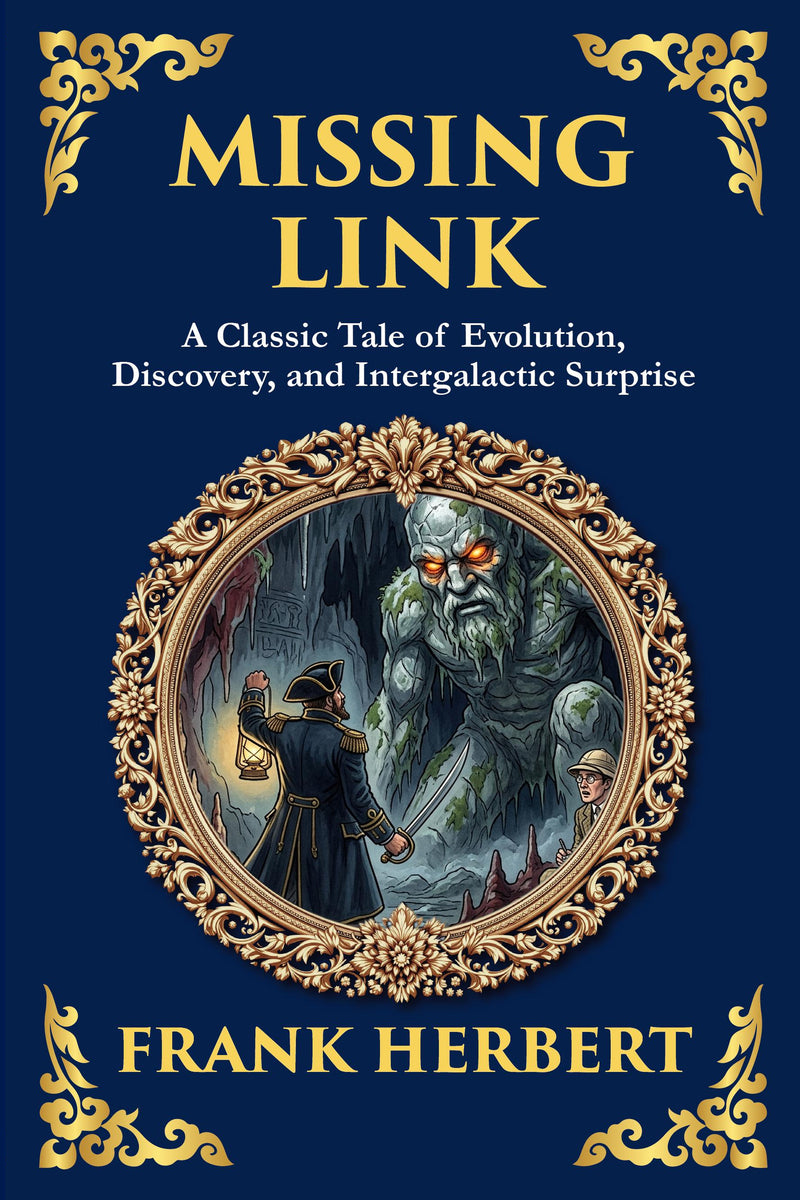
Missing Link
What if you weren’t as evolved as you think? In Missing Link, legendary science fiction author Frank Herbert offers a razor-sharp and ironic tale of evolution, deception, and cosmic curiosity.
or free app
10,000+ hrs library
30-day guarantee
The complete Missing Link appears in modern English through Library of Alexandria Press, available online with audiobook narration included for members.
Have you ever wondered why we assume we’re the most advanced species—without ever being tested? Missing Link is a sharp, thought-provoking, and darkly witty novella by Dune author Frank Herbert that challenges the very core of human exceptionalism. A brilliant fusion of evolutionary theory, alien anthropology, and sociological satire, this short classic explores what happens when humankind is no longer the observer—but the observed.
On a routine return to Earth, planetary scout Lewis Orne finds himself unexpectedly taken aboard an alien ship—inhabited by calm, analytical beings who seem more curious than aggressive. But as their questions grow more personal, their knowledge more precise, and their conclusions more unsettling, Orne begins to realize: the captors aren’t looking for information. They’re testing a theory.
As the alien crew dissects not just his biology but his beliefs, Orne becomes a reluctant ambassador for the human race—one that may not pass the test. Is he a link to something greater—or the final echo of something outdated?
What you’ll discover in this modern edition
- A chilling and clever tale of human evaluation by superior alien minds
- Themes of evolution, intelligence, and the illusion of dominance
| Formats | eBook (EPUB + PDF) · Audiobook · Paperback · Hardcover · Large Print |
| Language | English |
| Trim size (print) | 6 × 9 in |
| Binding | Paperback — perfect-bound · Hardcover — casewrap |
| Large Print edition | Same text in a larger, easy-read type — a larger font, not a larger trim |
| Print pricing | Every physical book at our true cost — at-cost, no profit (members) |
| Library | 873 restored titles, always growing |
| Length | 9,322 words · ~37 min reading |
| Reading level | Grade 5 · an easy, flowing read (this modern-English edition) |
| Edition | Modern English translation · 2026 |
Member reviews for this edition are collected as readers finish it — be the first. Across the library: 12,000+ books shipped, every plan covered by a 365-day print guarantee.
About this edition
A faithful, unabridged modern-English edition by The Library of Alexandria — carefully rendered for today's reader and verified paragraph-by-paragraph against the public-domain source. Available as eBook, audiobook, paperback, hardcover, and large print.
- Complete & unabridgedVerified paragraph by paragraph against the source — never a scan, never abridged.
- Modern English, faithfulReadable today, with the author’s meaning kept intact. Readable — not simplified.
- Every format, one membershipRead in your browser or the free app, or listen to the full audiobook.
Included free with your membership
Cancel anytime, one click · 30-day money-back guarantee
Edition last updated July 2026
What’s inside
Missing Link — complete and unabridged, included in full with membership, plus the full audiobook.
Begin reading Missing Link
In clear modern English — the complete text is included with membership.
Introduction
There are writers who tell you what to think, and there are writers who teach you how to think. Frank Herbert belonged firmly to the second camp, and it is this quality—this insistence on the reader as an active participant rather than a passive consumer—that makes returning to his early short fiction such a rewarding experience. Long before he constructed the sprawling desert empire that would make his name a permanent fixture in the literary firmament, Herbert was sharpening his tools in the pages of the science fiction magazines that flourished in the middle of the twentieth century. These stories, written under deadline pressure and the demands of a competitive market, were the laboratory in which he developed the ideas, obsessions, and narrative techniques that would later bloom into something monumental. To read them now is to watch a great mind at the moment of its formation, testing its instruments, asking its first questions, and discovering—sometimes with evident delight—just how far a clever premise could be pushed.
The story you are about to read belongs to that crucial period of apprenticeship and emergence. It is a tale of contact and consequence, of the unsettling moment when human beings encounter something genuinely alien and must reckon with the gap between what they expected to find and what actually awaits them. The title itself is a small act of provocation. A “missing link” is a phrase loaded with assumptions—it implies a chain, an orderly progression, a series of stages connecting one form of life to another in tidy succession. We use the term casually, as though evolution were a ladder climbing neatly toward some predetermined summit, with each rung clearly labeled and accounted for. Herbert, characteristically, takes that comfortable assumption and turns it over in his hands, examining it from angles that most of us never consider. What if the link we are looking for is not where we expect it to be? What if the very idea of a “link” is itself a trap, a projection of our own desire for order onto a universe that owes us no such courtesy?
This is the kind of question that animated Herbert throughout his career, and it is on full display in the pages that follow. He was, at his core, a writer fascinated by systems—biological, political, ecological, psychological—and by the ways in which intelligent beings deceive themselves about the systems they inhabit. He understood, perhaps better than any of his contemporaries, that the greatest dangers we face are rarely the obvious monsters lurking in the dark. They are the assumptions we carry without examining them, the conclusions we reach before we have gathered our evidence, the confidence we mistake for knowledge. In this story, as in so much of his finest work, the real adversary is not some snarling extraterrestrial threat but the limitations of the human mind itself—its tendency to see what it wishes to see, to fill in the blanks with comfortable fictions, and to mistake its own cleverness for wisdom.
To understand why this story matters, it helps to understand the man who wrote it and the moment in which he was writing. Frank Herbert was born in 1920 in Tacoma, Washington, into a world that was about to be remade by technology, war, and the dizzying acceleration of scientific discovery. He came of age during the Great Depression, served in the Navy during the Second World War, and spent much of his life working as a journalist—a profession that left a permanent mark on his fiction. Journalism teaches a writer to observe, to question, to follow a thread of evidence to its conclusion regardless of where it leads. It teaches skepticism toward official explanations and a healthy suspicion of those who claim to have all the answers. These were the instincts Herbert brought to his fiction, and they explain a great deal about why his stories feel so different from those of his peers.
The science fiction of the 1950s, when this story first reached its audience, was a genre in transition. The pulp era, with its ray guns and bug-eyed monsters and square-jawed heroes rescuing damsels from alien clutches, was giving way to something more sophisticated. A new generation of writers and editors was pushing the field toward greater intellectual ambition, demanding that stories engage seriously with science, sociology, psychology, and philosophy. The questions that interested these writers were not merely “What happens next?” but “What does this mean?” and “What does this reveal about who we are?” Herbert thrived in this environment. His mind was restless and omnivorous, drawn to ecology before ecology was a household word, fascinated by the interplay between human consciousness and the environments that shaped it, captivated by the question of how power operates and how it corrupts.
What set Herbert apart, even among the talented company of his contemporaries, was his refusal to make things easy for the reader. He did not believe in spoon-feeding. He trusted his audience to keep up, to follow complex chains of reasoning, to tolerate ambiguity, and to do some of the imaginative work themselves. This can make his prose demanding—there are passages in his fiction that require a second reading, ideas that reveal their full implications only after you have turned them over in your mind for a while. But it also makes his work uniquely satisfying, because the rewards are earned rather than handed over. When you finish a Herbert story, you do not feel that you have been entertained and then released; you feel that you have been changed, even slightly, that your sense of the possible has been stretched.
The story before you was written during the years when Herbert was still finding his voice, still publishing in magazines and building the reputation that would eventually allow him to undertake larger projects. It bears all the hallmarks of his developing genius: the fascination with first contact and its complications, the interest in how intelligent beings misread one another, the dry humor that runs beneath even his most serious passages, and above all the conviction that the universe is far stranger and more surprising than our theories about it can ever fully capture. This is not a story content to deliver a single thrill and move on. It is a story that wants you to think, to anticipate, to second-guess yourself, and to arrive at its conclusion with the satisfying jolt of recognition that comes from having been led somewhere you did not expect to go.
It is worth pausing here to note something about the relationship between these early stories and Herbert’s later, more famous achievements. Readers who know him only through his grand epics sometimes assume that those works sprang fully formed from his imagination, like a monument carved in a single inspired session. Nothing could be further from the truth. The themes that would later receive such monumental treatment—the dangers of charismatic leadership, the unintended consequences of well-meaning intervention, the way that ecological and biological forces shape destiny, the unreliability of prophecy and prediction—were all rehearsed and refined in shorter works like this one. Reading these stories is like discovering the preliminary sketches of a great painter: you can see the master’s hand at work, can recognize the gestures and preoccupations that would later be developed on a vaster canvas, and can appreciate the economy and precision with which he worked when constrained by the discipline of the short form.
That discipline is itself worth celebrating. A novel can afford to wander, to develop subplots, to luxuriate in detail. A short story has no such luxury. Every word must count; every scene must advance the whole; every line of dialogue must do double or triple duty, revealing character while moving the plot and seeding ideas that will pay off later. Herbert was a master of this compression. In the space of a few thousand words, he could establish a vivid setting, populate it with believable characters, raise profound questions, and deliver a conclusion that recontextualizes everything that came before. There is a particular pleasure in watching a writer of his caliber operate within these constraints, like watching a great athlete perform within the strict rules of a demanding sport. The limitations do not diminish the achievement; they amplify it.
A Story of Contact, Confidence, and Comeuppance
Without revealing the turns this tale takes—for half its pleasure lies in discovering them for yourself—it is fair to say that it concerns the encounter between human explorers and the unknown, and the dangerous gap between human assumptions and alien reality. This is one of the oldest and richest themes in all of science fiction, and for good reason. The question of what we might find out there among the stars is also, inescapably, a question about what we are down here on Earth. Every imagined alien is a mirror, reflecting back some aspect of ourselves—our fears, our hopes, our blind spots, our hubris. When Herbert sends his characters out to make contact with the unknown, he is really sending them on a journey toward self-knowledge, though they may not realize it, and the recognition, when it comes, may not be comfortable.
The genius of Herbert’s approach lies in his understanding that intelligence and folly are not opposites. His characters are not stupid. On the contrary, they are often highly trained, technically proficient, and confident in their expertise. They have studied, they have prepared, they have theories and protocols and procedures. And it is precisely this confidence, this expertise, that sets them up for their downfall. Herbert understood something that we are still learning, painfully, in our own era of overwhelming information and overconfident authority: that the smartest people in the room are sometimes the most dangerous, precisely because their cleverness blinds them to the limits of their own understanding. They know so much that they forget how much they do not know. They are so accustomed to being right that they cannot conceive of being wrong.
This theme resonates with particular force when we consider the scientific and philosophical questions at the heart of the story. The notion of evolution—of life developing, changing, adapting over vast stretches of time—is one of the most profound ideas humanity has ever produced. But it is also an idea that we routinely misunderstand. We tend to think of evolution as a story with a direction, a narrative climbing inexorably toward complexity, intelligence, and ultimately toward us. We imagine ourselves as the destination, the point of the whole exercise. Herbert, with his characteristic skepticism, invites us to question this self-flattering assumption. What if evolution has no direction, no destination, no preference for the kinds of life we happen to value? What if the forms of intelligence and adaptation we encounter in the universe bear no resemblance to our own, and refuse to fit into the categories we have prepared for them?
These questions are not merely academic. They go to the heart of how we understand our place in the cosmos and how we are likely to behave when—or if—we ever encounter forms of life that did not arise on our own planet. The history of human exploration is, after all, a sobering catalog of misunderstanding, misjudgment, and catastrophe. When human beings have encountered the unfamiliar, whether in the form of other peoples or other ecosystems, they have rarely done so with the humility and caution that wisdom would dictate. They have assumed, projected, imposed, and conquered, often with disastrous results for all concerned. Herbert, writing in the shadow of a century that had seen the worst excesses of human arrogance, was acutely aware of this pattern, and his fiction is in many ways a sustained meditation on it. This story extends that meditation to the stars, asking what might happen when our species’ habitual overconfidence collides with a reality that does not care about our expectations.
Cancel anytime, one click · 30-day money-back guarantee
Founding annual rate available now — your price locks for life when you join.
Not ready? Get this free chapter by email — read it anytime.
✓ Sent — check your inbox for Missing Link.
Questions about Missing Link
What is Missing Link about?
What if you weren’t as evolved as you think? In Missing Link, legendary science fiction author Frank Herbert offers a razor-sharp and ironic tale of evolution, deception, and cosmic curiosity. When a human crew is detained by an alien surveyor ship, they expect interrogation.
Who wrote Missing Link?
Missing Link was written by Frank Herbert. This edition presents the complete work in clear modern English, faithfully rendered from the public-domain original by Library of Alexandria Press.
Is Missing Link free to read?
The opening chapter is free to read on this page. Members read and listen to the complete work — and the entire library — free, and can order any physical book at our true print cost.
How long is Missing Link?
2 chapters (~9,322 words) — about 37 min of reading in this modern-English edition.
Is this an abridged version of Missing Link?
No. This is the complete, unabridged Missing Link, carefully rendered into clear modern English and verified paragraph-by-paragraph against the public-domain source — nothing is cut or summarised.
What formats does Missing Link come in?
Missing Link is available as eBook, paperback, hardcover and large print. eBook and audiobook are included with membership; printed editions ship at our true print cost.
Shipping & returns
Billing & membership
More from the library


Explore Science Fiction
- The Island of Doctor Moreau · H. G. Wells
- A Midsummer Night’s Dream · William Shakespeare
- The Invisible Man: A Grotesque Romance · H. G. Wells
- The War of the Worlds · H. G. Wells
- The Strange Case of Dr. Jekyll and Mr. Hyde · Robert Louis Stevenson
- Limanora: the island of progress · Godfrey Sweven
- The Book of Dragons · E. Nesbit
- She · H. Rider Haggard
- Dorothy and the Wizard in Oz · L. Frank Baum
- The Princess and the Goblin · George MacDonald
- Gawayne and the Green Knight: A Fairy Tale · Charlton M. Lewis
- Lucian’s True History · Lucian of Samosata
- The Willows · Algernon Blackwood
- The Call of Cthulhu · H. P. Lovecraft
- The Life-Eater · Harold Ward
- The Marvelous Land of Oz · L. Frank Baum
- Mars is My Destination · Frank Belknap Long
- The Black Kiss
- The Beasts in the Void · Paul W. Fairman
- John Jones’s Dollar · Harry Stephen Keeler
- Subversive · Mack Reynolds
- The Mississippi Saucer · Frank Belknap Long
- Man of Distinction · Michael Shaara
- Spawn of the Comet · H. Thompson Rich
- The Golden Judge · Nathaniel Gordon
- Final Weapon · Everett B. Cole
- The Big Fix · George O. Smith
- Last Enemy · H. Beam Piper
- Time and Time Again · H. Beam Piper
- Sabotage in Space · Carey Rockwell
Missing Link
Missing Link
A Classic Story of Evolution, Discovery, and Intergalactic Surprises
Frank Herbert
Contents
- Introduction
- Missing Link
Introduction
There are writers who tell you what to think, and there are writers who teach you how to think. Frank Herbert belonged firmly to the second camp, and it is this quality—this insistence on the reader as an active participant rather than a passive consumer—that makes returning to his early short fiction such a rewarding experience. Long before he constructed the sprawling desert empire that would make his name a permanent fixture in the literary firmament, Herbert was sharpening his tools in the pages of the science fiction magazines that flourished in the middle of the twentieth century. These stories, written under deadline pressure and the demands of a competitive market, were the laboratory in which he developed the ideas, obsessions, and narrative techniques that would later bloom into something monumental. To read them now is to watch a great mind at the moment of its formation, testing its instruments, asking its first questions, and discovering—sometimes with evident delight—just how far a clever premise could be pushed.
The story you are about to read belongs to that crucial period of apprenticeship and emergence. It is a tale of contact and consequence, of the unsettling moment when human beings encounter something genuinely alien and must reckon with the gap between what they expected to find and what actually awaits them. The title itself is a small act of provocation. A “missing link” is a phrase loaded with assumptions—it implies a chain, an orderly progression, a series of stages connecting one form of life to another in tidy succession. We use the term casually, as though evolution were a ladder climbing neatly toward some predetermined summit, with each rung clearly labeled and accounted for. Herbert, characteristically, takes that comfortable assumption and turns it over in his hands, examining it from angles that most of us never consider. What if the link we are looking for is not where we expect it to be? What if the very idea of a “link” is itself a trap, a projection of our own desire for order onto a universe that owes us no such courtesy?
This is the kind of question that animated Herbert throughout his career, and it is on full display in the pages that follow. He was, at his core, a writer fascinated by systems—biological, political, ecological, psychological—and by the ways in which intelligent beings deceive themselves about the systems they inhabit. He understood, perhaps better than any of his contemporaries, that the greatest dangers we face are rarely the obvious monsters lurking in the dark. They are the assumptions we carry without examining them, the conclusions we reach before we have gathered our evidence, the confidence we mistake for knowledge. In this story, as in so much of his finest work, the real adversary is not some snarling extraterrestrial threat but the limitations of the human mind itself—its tendency to see what it wishes to see, to fill in the blanks with comfortable fictions, and to mistake its own cleverness for wisdom.
To understand why this story matters, it helps to understand the man who wrote it and the moment in which he was writing. Frank Herbert was born in 1920 in Tacoma, Washington, into a world that was about to be remade by technology, war, and the dizzying acceleration of scientific discovery. He came of age during the Great Depression, served in the Navy during the Second World War, and spent much of his life working as a journalist—a profession that left a permanent mark on his fiction. Journalism teaches a writer to observe, to question, to follow a thread of evidence to its conclusion regardless of where it leads. It teaches skepticism toward official explanations and a healthy suspicion of those who claim to have all the answers. These were the instincts Herbert brought to his fiction, and they explain a great deal about why his stories feel so different from those of his peers.
The science fiction of the 1950s, when this story first reached its audience, was a genre in transition. The pulp era, with its ray guns and bug-eyed monsters and square-jawed heroes rescuing damsels from alien clutches, was giving way to something more sophisticated. A new generation of writers and editors was pushing the field toward greater intellectual ambition, demanding that stories engage seriously with science, sociology, psychology, and philosophy. The questions that interested these writers were not merely “What happens next?” but “What does this mean?” and “What does this reveal about who we are?” Herbert thrived in this environment. His mind was restless and omnivorous, drawn to ecology before ecology was a household word, fascinated by the interplay between human consciousness and the environments that shaped it, captivated by the question of how power operates and how it corrupts.
What set Herbert apart, even among the talented company of his contemporaries, was his refusal to make things easy for the reader. He did not believe in spoon-feeding. He trusted his audience to keep up, to follow complex chains of reasoning, to tolerate ambiguity, and to do some of the imaginative work themselves. This can make his prose demanding—there are passages in his fiction that require a second reading, ideas that reveal their full implications only after you have turned them over in your mind for a while. But it also makes his work uniquely satisfying, because the rewards are earned rather than handed over. When you finish a Herbert story, you do not feel that you have been entertained and then released; you feel that you have been changed, even slightly, that your sense of the possible has been stretched.
The story before you was written during the years when Herbert was still finding his voice, still publishing in magazines and building the reputation that would eventually allow him to undertake larger projects. It bears all the hallmarks of his developing genius: the fascination with first contact and its complications, the interest in how intelligent beings misread one another, the dry humor that runs beneath even his most serious passages, and above all the conviction that the universe is far stranger and more surprising than our theories about it can ever fully capture. This is not a story content to deliver a single thrill and move on. It is a story that wants you to think, to anticipate, to second-guess yourself, and to arrive at its conclusion with the satisfying jolt of recognition that comes from having been led somewhere you did not expect to go.
It is worth pausing here to note something about the relationship between these early stories and Herbert’s later, more famous achievements. Readers who know him only through his grand epics sometimes assume that those works sprang fully formed from his imagination, like a monument carved in a single inspired session. Nothing could be further from the truth. The themes that would later receive such monumental treatment—the dangers of charismatic leadership, the unintended consequences of well-meaning intervention, the way that ecological and biological forces shape destiny, the unreliability of prophecy and prediction—were all rehearsed and refined in shorter works like this one. Reading these stories is like discovering the preliminary sketches of a great painter: you can see the master’s hand at work, can recognize the gestures and preoccupations that would later be developed on a vaster canvas, and can appreciate the economy and precision with which he worked when constrained by the discipline of the short form.
That discipline is itself worth celebrating. A novel can afford to wander, to develop subplots, to luxuriate in detail. A short story has no such luxury. Every word must count; every scene must advance the whole; every line of dialogue must do double or triple duty, revealing character while moving the plot and seeding ideas that will pay off later. Herbert was a master of this compression. In the space of a few thousand words, he could establish a vivid setting, populate it with believable characters, raise profound questions, and deliver a conclusion that recontextualizes everything that came before. There is a particular pleasure in watching a writer of his caliber operate within these constraints, like watching a great athlete perform within the strict rules of a demanding sport. The limitations do not diminish the achievement; they amplify it.
A Story of Contact, Confidence, and Comeuppance
Without revealing the turns this tale takes—for half its pleasure lies in discovering them for yourself—it is fair to say that it concerns the encounter between human explorers and the unknown, and the dangerous gap between human assumptions and alien reality. This is one of the oldest and richest themes in all of science fiction, and for good reason. The question of what we might find out there among the stars is also, inescapably, a question about what we are down here on Earth. Every imagined alien is a mirror, reflecting back some aspect of ourselves—our fears, our hopes, our blind spots, our hubris. When Herbert sends his characters out to make contact with the unknown, he is really sending them on a journey toward self-knowledge, though they may not realize it, and the recognition, when it comes, may not be comfortable.
The genius of Herbert’s approach lies in his understanding that intelligence and folly are not opposites. His characters are not stupid. On the contrary, they are often highly trained, technically proficient, and confident in their expertise. They have studied, they have prepared, they have theories and protocols and procedures. And it is precisely this confidence, this expertise, that sets them up for their downfall. Herbert understood something that we are still learning, painfully, in our own era of overwhelming information and overconfident authority: that the smartest people in the room are sometimes the most dangerous, precisely because their cleverness blinds them to the limits of their own understanding. They know so much that they forget how much they do not know. They are so accustomed to being right that they cannot conceive of being wrong.
This theme resonates with particular force when we consider the scientific and philosophical questions at the heart of the story. The notion of evolution—of life developing, changing, adapting over vast stretches of time—is one of the most profound ideas humanity has ever produced. But it is also an idea that we routinely misunderstand. We tend to think of evolution as a story with a direction, a narrative climbing inexorably toward complexity, intelligence, and ultimately toward us. We imagine ourselves as the destination, the point of the whole exercise. Herbert, with his characteristic skepticism, invites us to question this self-flattering assumption. What if evolution has no direction, no destination, no preference for the kinds of life we happen to value? What if the forms of intelligence and adaptation we encounter in the universe bear no resemblance to our own, and refuse to fit into the categories we have prepared for them?
These questions are not merely academic. They go to the heart of how we understand our place in the cosmos and how we are likely to behave when—or if—we ever encounter forms of life that did not arise on our own planet. The history of human exploration is, after all, a sobering catalog of misunderstanding, misjudgment, and catastrophe. When human beings have encountered the unfamiliar, whether in the form of other peoples or other ecosystems, they have rarely done so with the humility and caution that wisdom would dictate. They have assumed, projected, imposed, and conquered, often with disastrous results for all concerned. Herbert, writing in the shadow of a century that had seen the worst excesses of human arrogance, was acutely aware of this pattern, and his fiction is in many ways a sustained meditation on it. This story extends that meditation to the stars, asking what might happen when our species’ habitual overconfidence collides with a reality that does not care about our expectations.
The Romantics once claimed that the eyes are the windows to the soul. A skilled Alien Xenologist might not describe it so poetically, but if they are observant, they can learn a great deal just by looking into someone’s eyes!
“We should wipe every single living thing off this planet,” muttered Umbo Stetson, the section chief of Investigation & Adjustment.
Stetson paced across the landing control bridge of his scout cruiser. His footsteps scraped against the floor, which usually served as the bridge’s back wall during flight. Now, however, the ship rested on its tail fins—all four hundred meters of it, shimmering in red and black. The open ports of the bridge looked down on the jungle canopy of Gienah III, about one hundred fifty meters below. A butter-yellow sun hung just above the horizon, likely an hour away from setting.
“Clean as an egg!” he shouted. He stopped during his lap of the bridge, glared out the right-side port, and spat into the charred circle the cruiser’s jets had burned into the jungle.
The I-A section chief had dark hair and a gangly build, with a large head and prominent features. He stood in his usual slouch, a posture made worse by his baggy, patched blue fatigues. Although he held the rank of a division admiral for this operation, his clothes bore no insignia. He had a generally messy, disheveled appearance.
Lewis Orne, a junior I-A field agent who had just graduated, stood at the opposite port, studying the jungle horizon. Every so often, he glanced at the bridge control console, the clock above it, and the large translucent map of their position tilted on the opposite wall. Born on a heavy planet, he felt slightly uncomfortable on Gienah III, where the gravity was only seven-eighths of the Terran Standard. The surgical scars on his neck, where the micro-communication gear had been implanted, itched terribly. He scratched them.
End of the free sample
Keep reading, free
Members read and listen to the complete book — and the entire library. Cancel anytime, one click · 30-day money-back guarantee.