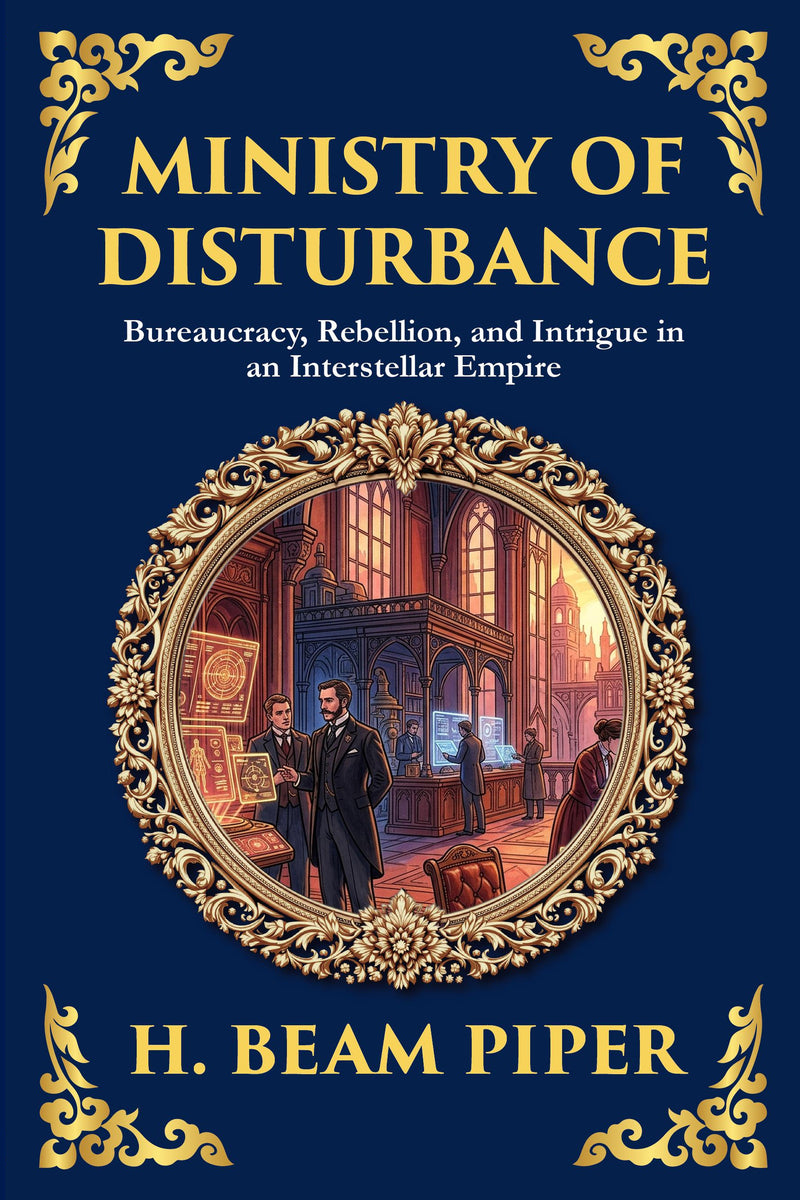
Ministry of Disturbance — Large Print
In Ministry of Disturbance, H. Beam Piper explores the darkly comical chaos behind the facade of a stable galactic empire.
or free app
10,000+ hrs library
30-day guarantee
The complete Ministry of Disturbance appears in modern English through Library of Alexandria Press, available online with audiobook narration included for members.
Have you ever wondered why the greatest threat to an empire might not be rebellion—but red tape? In Ministry of Disturbance, acclaimed author H. Beam Piper delivers a satirical and suspenseful look at the fragile machinery of power in a far-future galactic empire. Set within the seemingly impenetrable walls of the Imperial Palace on Odin, this novella follows Emperor Paul XXII as he tries to make sense of alarming—and contradictory—reports of unrest within his dominion.
The threat? A supposed planetary rebellion. The real problem?
A bureaucratic tangle so dense that even an emperor struggles to cut through it. As Paul navigates layers of self-interested ministers, conniving aides, and overworked civil servants, he begins to suspect the rebellion may not be the true crisis. Something deeper, more insidious, is shaking the foundations of his empire—an erosion of purpose, clarity, and truth.
What you’ll discover in this modern edition
- An Insider’s Look at Galactic Power – Explore how a seemingly omnipotent emperor becomes entangled in the very bureaucracy he commands.
| Formats | eBook (EPUB + PDF) · Audiobook · Paperback · Hardcover · Large Print |
| Language | English |
| Trim size (print) | 6 × 9 in |
| Binding | Paperback — perfect-bound · Hardcover — casewrap |
| Large Print edition | Same text in a larger, easy-read type — a larger font, not a larger trim |
| Print pricing | Every physical book at our true cost — at-cost, no profit (members) |
| Library | 873 restored titles, always growing |
| Length | 19,441 words · ~1 hr 18 min reading |
| Reading level | Grade 3 · an easy, flowing read (this modern-English edition) |
| Edition | Modern English translation · 2026 |
Member reviews for this edition are collected as readers finish it — be the first. Across the library: 12,000+ books shipped, every plan covered by a 365-day print guarantee.
About this edition
A faithful, unabridged modern-English edition by The Library of Alexandria — carefully rendered for today's reader and verified paragraph-by-paragraph against the public-domain source. Available as eBook, audiobook, paperback, hardcover, and large print.
- Complete & unabridgedVerified paragraph by paragraph against the source — never a scan, never abridged.
- Modern English, faithfulReadable today, with the author’s meaning kept intact. Readable — not simplified.
- Every format, one membershipRead in your browser or the free app, or listen to the full audiobook.
Included free with your membership
Cancel anytime, one click · 30-day money-back guarantee
Edition last updated July 2026
What’s inside
Ministry of Disturbance — Large Print — complete and unabridged, included in full with membership, plus the full audiobook.
Begin reading Ministry of Disturbance — Large Print
In clear modern English — the complete text is included with membership.
Introduction
There is a particular kind of pleasure in reading a story about an empire that has lasted so long it has nearly forgotten how it works. The machinery still turns, the ceremonies are still observed, the titles are still bestowed and inherited, and yet somewhere beneath all that polished surface a question begins to stir: who, exactly, is keeping this magnificent thing alive, and what happens when the people responsible for it grow tired, complacent, or simply human? This is the territory into which H. Beam Piper invites us, and it is territory he understood better than almost any other writer of his generation. The work you are about to read is a meditation disguised as an adventure, a political drama wrapped in the trappings of interstellar spectacle, and above all a deeply intelligent examination of how power is held, transferred, and quietly subverted across the vast distances of space and time.
Piper belonged to a tradition of science fiction that took its ideas seriously while never losing sight of the fact that ideas, on their own, do not make a story. People do. His finest writing is populated by men and women who feel the weight of their responsibilities, who scheme and second-guess and occasionally surprise themselves with their own decency or their own ruthlessness. He had a gift for placing such characters inside enormous structures — empires, federations, planetary governments — and then watching what happened when individual human nature collided with the impersonal demands of institutions. The result, in this case, is a narrative that manages to be both intimate and grand, concerned simultaneously with the fate of worlds and with the private hesitations of the people who must govern them. That balance is rare, and it is worth savoring.
This modern translation has been prepared with a single guiding purpose: to allow a contemporary reader to encounter Piper’s work with the same immediacy and excitement that its first audience felt. The science fiction of the mid-twentieth century was written in a particular idiom, full of conventions, assumptions, and turns of phrase that can occasionally feel like a barrier rather than a doorway. Where the original language has grown stiff or obscure with the passage of decades, it has been gently smoothed; where a reference might puzzle rather than illuminate, it has been clarified. None of this has been done to flatten Piper’s voice or to dilute the substance of his vision. On the contrary, the aim has been to clear away the small frictions that stand between you and the story, so that what remains is the pure pleasure of a master storyteller doing what he did best. You will still hear Piper’s wit, his irony, his cool intelligence, and his surprising warmth. You will simply hear them more clearly.
To understand why this story carries the particular flavor it does, it helps to know something about the man who wrote it. Henry Beam Piper was, in many ways, an unlikely figure to become one of the most respected names in classic science fiction. He was largely self-educated, a voracious and disciplined reader who built his own intellectual foundation out of history, mythology, anthropology, and politics. He worked for years in unglamorous jobs, writing in his spare hours, accumulating knowledge and craft with a patience that would eventually show in the density and confidence of his fiction. By the time he was producing the work for which he is now remembered, he had developed a worldview that was at once romantic and hard-headed, optimistic about human capability and yet entirely unsentimental about human folly.
Piper was fascinated by history, and not in the casual way that many writers profess to be. He read history as a living system, a vast experiment in which the same patterns recurred across centuries and civilizations. He believed that the rise and fall of nations, the consolidation and dissolution of power, the cyclical drama of order and chaos, were not random but followed discernible rhythms. This conviction runs through nearly everything he wrote. His galaxies are not blank canvases onto which he paints whatever pleases him; they are constructed with an almost scholarly attention to how societies actually behave over long spans of time. When he describes an empire that has endured for many generations, he is drawing on a genuine understanding of what such longevity does to a culture — how it breeds both stability and decay, how it produces administrators rather than visionaries, how it can sustain itself through inertia long after its original purpose has faded.
This historical sensibility is precisely what makes his political fiction so satisfying. Piper understood that the most dangerous moment for any great structure is not the moment of crisis but the moment of complacency. A threatened civilization mobilizes; a comfortable one drifts. He understood too that the people who occupy the highest positions of power are rarely the monstrous tyrants or shining heroes of simpler fiction. More often they are intelligent, weary, divided individuals trying to do a difficult job under impossible constraints, surrounded by advisers with their own agendas, hemmed in by traditions they did not create and cannot easily change. To read Piper is to be reminded that government is, at bottom, a human activity, performed by fallible people, and therefore endlessly vulnerable to the small frailties and small ambitions that those people bring to it.
There is also, threaded through all his work, a recognizable political temperament. Piper was deeply suspicious of unchecked authority and bureaucratic overreach, and he had a libertarian streak that made him celebrate competence, self-reliance, and individual initiative. Yet he was no naive idealist about freedom either. He recognized that complete disorder is as destructive as complete tyranny, and that the perennial challenge of any civilization is to find the unstable equilibrium between liberty and order. His stories often dramatize exactly this tension. The empires and governments he depicts are neither pure evil nor pure good; they are attempts, more or less successful, to solve the eternal problem of how human beings can live together across enormous scales without either crushing one another or descending into chaos. This refusal to take easy sides gives his fiction a moral seriousness that has aged remarkably well.
It is worth noting, too, that Piper wrote during a period when science fiction was beginning to grow up. The genre was moving beyond its pulpy origins, beyond ray guns and bug-eyed monsters, into something more thoughtful and more literary. Piper was very much part of that maturation. He brought to his work a respect for craft and structure, a willingness to engage with ideas of genuine weight, and a confidence that his readers were intelligent enough to follow him into complexity. The story before you reflects all of this. It is not a simple tale of good triumphing over evil. It is a layered, textured examination of what happens inside the corridors of power when those corridors have grown very long indeed, and when the people walking them have begun to lose sight of why they were built in the first place.
The title itself is worth pausing over, for it tells you something essential about the spirit of what follows. A “ministry of disturbance” is a paradoxical thing — an official body, presumably part of the very apparatus of government, devoted not to maintaining calm but to creating its opposite. This paradox sits at the heart of the book’s central preoccupation. What does a civilization need more, at any given moment: stability or disruption? Comfort or challenge? The smooth continuation of what already exists, or the painful and dangerous shock of change? These are not abstract questions in the world Piper has built. They are matters of survival, and they fall on the shoulders of people who must decide, with imperfect knowledge and limited time, whether to let the great machine continue its placid rotation or to throw something into the gears.
Without revealing the particulars of the plot — for half the joy of this book lies in watching its developments unfold at their own deliberate, gathering pace — it can be said that you are entering a world that has known peace for a very long time. This peace is the central fact of the story’s universe and also its central problem. An empire that has not faced a serious threat in generations is an empire that has stopped exercising certain muscles. Its institutions have grown elaborate and self-perpetuating. Its leaders have grown skilled at managing the present rather than imagining the future. The very success of the system has bred a kind of dangerous tranquility, a collective drowsiness from which it may be difficult to wake. Into this setting Piper introduces the disturbances — the intrigues, the rebellions, the unexpected pressures — that will test whether the great structure is still alive or merely preserved.
What makes the book so compelling is the way Piper refuses to let these conflicts resolve into simple oppositions. The figures who scheme and plot are not cartoon villains; they often have understandable motives, and some of them genuinely believe they are acting for the good of all. The figures who hold legitimate authority are not flawless guardians; they are burdened, divided, and at times dangerously out of touch. The reader is asked to think, to weigh, to consider the genuine difficulty of the choices being made. This is political drama of a high order, the kind that respects the intelligence of its audience and trusts them to navigate ambiguity. You will find yourself drawn into the calculations of multiple parties, understanding each in turn, recognizing that there are no perfectly clean hands in the game of governing a civilization.
Piper’s pacing in a work like this deserves special mention, because it is one of the qualities that a modern reader, accustomed to relentless acceleration, may need to attune themselves to in order to fully enjoy. The story does not begin with explosions. It begins, as great political dramas often do, with conversations — with the patient establishment of a world, its hierarchies, its customs, its underlying tensions. Piper takes his time setting the board before he begins to move the pieces, and this is a feature rather than a flaw. The slow accumulation of detail, the gradual revelation of how power actually flows through this society, creates a foundation upon which the later developments land with real force. When the disturbances finally arrive, they matter precisely because we have come to understand the world they threaten to disrupt. Patience, here, is richly rewarded. Give the early chapters your attention, allow yourself to inhabit the rhythms and routines of this empire, and you will find that the stakes have quietly become enormous before you even noticed them rising.
There is a particular intelligence in the way Piper handles the theme of bureaucracy, which the subtitle of this edition rightly highlights. Bureaucracy is rarely treated as a subject worthy of dramatic attention; it is the unglamorous machinery of administration, the paperwork and procedure that most fiction skips over in its hurry to get to the action. But Piper understood that bureaucracy is where power actually lives in a mature civilization. It is the connective tissue that holds vast domains together, the means by which decisions made at the center are transmitted to the periphery, the slow but mighty apparatus that can either implement a ruler’s will or quietly frustrate it. By taking bureaucracy seriously, by showing us how it functions and how it can be manipulated, Piper achieves a kind of realism that more flamboyant space adventures never reach. He shows us that the true levers of control are not always the obvious ones, and that the person who understands the system most deeply may wield more genuine influence than the person who merely sits atop it.
Cancel anytime, one click · 30-day money-back guarantee
Founding annual rate available now — your price locks for life when you join.
Not ready? Get this free chapter by email — read it anytime.
✓ Sent — check your inbox for Ministry of Disturbance — Large Print.
Questions about Ministry of Disturbance — Large Print
What is Ministry of Disturbance about?
In Ministry of Disturbance, H. Beam Piper explores the darkly comical chaos behind the facade of a stable galactic empire. The Terro-Human Galactic Empire seems invincible from the outside, but deep within its sprawling bureaucracy, corruption festers and tensions rise. When Emperor Paul XXII begins receiving reports of rebellion and conspiracy within his own court and administration, the very machinery of imperial order threatens to unravel.
Who wrote Ministry of Disturbance?
Ministry of Disturbance was written by H. Beam Piper. This edition presents the complete work in clear modern English, faithfully rendered from the public-domain original by Library of Alexandria Press.
Is Ministry of Disturbance free to read?
The opening chapter is free to read on this page. Members read and listen to the complete work — and the entire library — free, and can order any physical book at our true print cost.
How long is Ministry of Disturbance?
2 chapters (~19,441 words) — about 1 hr 18 min of reading in this modern-English edition.
Is this an abridged version of Ministry of Disturbance?
No. This is the complete, unabridged Ministry of Disturbance, carefully rendered into clear modern English and verified paragraph-by-paragraph against the public-domain source — nothing is cut or summarised.
What formats does Ministry of Disturbance come in?
Ministry of Disturbance is available as eBook, paperback, hardcover and large print. eBook and audiobook are included with membership; printed editions ship at our true print cost.
Shipping & returns
Billing & membership
More from the library


Explore Science Fiction
- The Island of Doctor Moreau · H. G. Wells
- A Midsummer Night’s Dream · William Shakespeare
- The Invisible Man: A Grotesque Romance · H. G. Wells
- The War of the Worlds · H. G. Wells
- The Strange Case of Dr. Jekyll and Mr. Hyde · Robert Louis Stevenson
- Limanora: the island of progress · Godfrey Sweven
- The Book of Dragons · E. Nesbit
- She · H. Rider Haggard
- Dorothy and the Wizard in Oz · L. Frank Baum
- The Princess and the Goblin · George MacDonald
- Gawayne and the Green Knight: A Fairy Tale · Charlton M. Lewis
- Lucian’s True History · Lucian of Samosata
- The Willows · Algernon Blackwood
- The Call of Cthulhu · H. P. Lovecraft
- The Life-Eater · Harold Ward
- The Marvelous Land of Oz · L. Frank Baum
- Mars is My Destination · Frank Belknap Long
- The Black Kiss
- The Beasts in the Void · Paul W. Fairman
- John Jones’s Dollar · Harry Stephen Keeler
- Subversive · Mack Reynolds
- The Mississippi Saucer · Frank Belknap Long
- Man of Distinction · Michael Shaara
- Spawn of the Comet · H. Thompson Rich
- The Golden Judge · Nathaniel Gordon
- Final Weapon · Everett B. Cole
- The Big Fix · George O. Smith
- Last Enemy · H. Beam Piper
- Time and Time Again · H. Beam Piper
- Sabotage in Space · Carey Rockwell
Ministry of Disturbance — Large Print
Ministry of Disturbance — Large Print
Bureaucracy, Rebellion, and Intrigue in an Interstellar Empire
H. Beam Piper
Contents
- Introduction
- Ministry of Disturbance
Introduction
There is a particular kind of pleasure in reading a story about an empire that has lasted so long it has nearly forgotten how it works. The machinery still turns, the ceremonies are still observed, the titles are still bestowed and inherited, and yet somewhere beneath all that polished surface a question begins to stir: who, exactly, is keeping this magnificent thing alive, and what happens when the people responsible for it grow tired, complacent, or simply human? This is the territory into which H. Beam Piper invites us, and it is territory he understood better than almost any other writer of his generation. The work you are about to read is a meditation disguised as an adventure, a political drama wrapped in the trappings of interstellar spectacle, and above all a deeply intelligent examination of how power is held, transferred, and quietly subverted across the vast distances of space and time.
Piper belonged to a tradition of science fiction that took its ideas seriously while never losing sight of the fact that ideas, on their own, do not make a story. People do. His finest writing is populated by men and women who feel the weight of their responsibilities, who scheme and second-guess and occasionally surprise themselves with their own decency or their own ruthlessness. He had a gift for placing such characters inside enormous structures — empires, federations, planetary governments — and then watching what happened when individual human nature collided with the impersonal demands of institutions. The result, in this case, is a narrative that manages to be both intimate and grand, concerned simultaneously with the fate of worlds and with the private hesitations of the people who must govern them. That balance is rare, and it is worth savoring.
This modern translation has been prepared with a single guiding purpose: to allow a contemporary reader to encounter Piper’s work with the same immediacy and excitement that its first audience felt. The science fiction of the mid-twentieth century was written in a particular idiom, full of conventions, assumptions, and turns of phrase that can occasionally feel like a barrier rather than a doorway. Where the original language has grown stiff or obscure with the passage of decades, it has been gently smoothed; where a reference might puzzle rather than illuminate, it has been clarified. None of this has been done to flatten Piper’s voice or to dilute the substance of his vision. On the contrary, the aim has been to clear away the small frictions that stand between you and the story, so that what remains is the pure pleasure of a master storyteller doing what he did best. You will still hear Piper’s wit, his irony, his cool intelligence, and his surprising warmth. You will simply hear them more clearly.
To understand why this story carries the particular flavor it does, it helps to know something about the man who wrote it. Henry Beam Piper was, in many ways, an unlikely figure to become one of the most respected names in classic science fiction. He was largely self-educated, a voracious and disciplined reader who built his own intellectual foundation out of history, mythology, anthropology, and politics. He worked for years in unglamorous jobs, writing in his spare hours, accumulating knowledge and craft with a patience that would eventually show in the density and confidence of his fiction. By the time he was producing the work for which he is now remembered, he had developed a worldview that was at once romantic and hard-headed, optimistic about human capability and yet entirely unsentimental about human folly.
Piper was fascinated by history, and not in the casual way that many writers profess to be. He read history as a living system, a vast experiment in which the same patterns recurred across centuries and civilizations. He believed that the rise and fall of nations, the consolidation and dissolution of power, the cyclical drama of order and chaos, were not random but followed discernible rhythms. This conviction runs through nearly everything he wrote. His galaxies are not blank canvases onto which he paints whatever pleases him; they are constructed with an almost scholarly attention to how societies actually behave over long spans of time. When he describes an empire that has endured for many generations, he is drawing on a genuine understanding of what such longevity does to a culture — how it breeds both stability and decay, how it produces administrators rather than visionaries, how it can sustain itself through inertia long after its original purpose has faded.
This historical sensibility is precisely what makes his political fiction so satisfying. Piper understood that the most dangerous moment for any great structure is not the moment of crisis but the moment of complacency. A threatened civilization mobilizes; a comfortable one drifts. He understood too that the people who occupy the highest positions of power are rarely the monstrous tyrants or shining heroes of simpler fiction. More often they are intelligent, weary, divided individuals trying to do a difficult job under impossible constraints, surrounded by advisers with their own agendas, hemmed in by traditions they did not create and cannot easily change. To read Piper is to be reminded that government is, at bottom, a human activity, performed by fallible people, and therefore endlessly vulnerable to the small frailties and small ambitions that those people bring to it.
There is also, threaded through all his work, a recognizable political temperament. Piper was deeply suspicious of unchecked authority and bureaucratic overreach, and he had a libertarian streak that made him celebrate competence, self-reliance, and individual initiative. Yet he was no naive idealist about freedom either. He recognized that complete disorder is as destructive as complete tyranny, and that the perennial challenge of any civilization is to find the unstable equilibrium between liberty and order. His stories often dramatize exactly this tension. The empires and governments he depicts are neither pure evil nor pure good; they are attempts, more or less successful, to solve the eternal problem of how human beings can live together across enormous scales without either crushing one another or descending into chaos. This refusal to take easy sides gives his fiction a moral seriousness that has aged remarkably well.
It is worth noting, too, that Piper wrote during a period when science fiction was beginning to grow up. The genre was moving beyond its pulpy origins, beyond ray guns and bug-eyed monsters, into something more thoughtful and more literary. Piper was very much part of that maturation. He brought to his work a respect for craft and structure, a willingness to engage with ideas of genuine weight, and a confidence that his readers were intelligent enough to follow him into complexity. The story before you reflects all of this. It is not a simple tale of good triumphing over evil. It is a layered, textured examination of what happens inside the corridors of power when those corridors have grown very long indeed, and when the people walking them have begun to lose sight of why they were built in the first place.
The title itself is worth pausing over, for it tells you something essential about the spirit of what follows. A “ministry of disturbance” is a paradoxical thing — an official body, presumably part of the very apparatus of government, devoted not to maintaining calm but to creating its opposite. This paradox sits at the heart of the book’s central preoccupation. What does a civilization need more, at any given moment: stability or disruption? Comfort or challenge? The smooth continuation of what already exists, or the painful and dangerous shock of change? These are not abstract questions in the world Piper has built. They are matters of survival, and they fall on the shoulders of people who must decide, with imperfect knowledge and limited time, whether to let the great machine continue its placid rotation or to throw something into the gears.
Without revealing the particulars of the plot — for half the joy of this book lies in watching its developments unfold at their own deliberate, gathering pace — it can be said that you are entering a world that has known peace for a very long time. This peace is the central fact of the story’s universe and also its central problem. An empire that has not faced a serious threat in generations is an empire that has stopped exercising certain muscles. Its institutions have grown elaborate and self-perpetuating. Its leaders have grown skilled at managing the present rather than imagining the future. The very success of the system has bred a kind of dangerous tranquility, a collective drowsiness from which it may be difficult to wake. Into this setting Piper introduces the disturbances — the intrigues, the rebellions, the unexpected pressures — that will test whether the great structure is still alive or merely preserved.
What makes the book so compelling is the way Piper refuses to let these conflicts resolve into simple oppositions. The figures who scheme and plot are not cartoon villains; they often have understandable motives, and some of them genuinely believe they are acting for the good of all. The figures who hold legitimate authority are not flawless guardians; they are burdened, divided, and at times dangerously out of touch. The reader is asked to think, to weigh, to consider the genuine difficulty of the choices being made. This is political drama of a high order, the kind that respects the intelligence of its audience and trusts them to navigate ambiguity. You will find yourself drawn into the calculations of multiple parties, understanding each in turn, recognizing that there are no perfectly clean hands in the game of governing a civilization.
Piper’s pacing in a work like this deserves special mention, because it is one of the qualities that a modern reader, accustomed to relentless acceleration, may need to attune themselves to in order to fully enjoy. The story does not begin with explosions. It begins, as great political dramas often do, with conversations — with the patient establishment of a world, its hierarchies, its customs, its underlying tensions. Piper takes his time setting the board before he begins to move the pieces, and this is a feature rather than a flaw. The slow accumulation of detail, the gradual revelation of how power actually flows through this society, creates a foundation upon which the later developments land with real force. When the disturbances finally arrive, they matter precisely because we have come to understand the world they threaten to disrupt. Patience, here, is richly rewarded. Give the early chapters your attention, allow yourself to inhabit the rhythms and routines of this empire, and you will find that the stakes have quietly become enormous before you even noticed them rising.
There is a particular intelligence in the way Piper handles the theme of bureaucracy, which the subtitle of this edition rightly highlights. Bureaucracy is rarely treated as a subject worthy of dramatic attention; it is the unglamorous machinery of administration, the paperwork and procedure that most fiction skips over in its hurry to get to the action. But Piper understood that bureaucracy is where power actually lives in a mature civilization. It is the connective tissue that holds vast domains together, the means by which decisions made at the center are transmitted to the periphery, the slow but mighty apparatus that can either implement a ruler’s will or quietly frustrate it. By taking bureaucracy seriously, by showing us how it functions and how it can be manipulated, Piper achieves a kind of realism that more flamboyant space adventures never reach. He shows us that the true levers of control are not always the obvious ones, and that the person who understands the system most deeply may wield more genuine influence than the person who merely sits atop it.
Sometimes landing a job is harder than the work itself—and sometimes quitting a job is the hardest part of all!
The symphony was coming to an end, with the final triumphant anthem climbing higher and higher until it was too high to hear. For a moment after the last notes faded, Paul sat perfectly still, as if a part of him had drifted away with the music. Then he shook himself awake and finished his coffee and cigarette. He looked out the wide window at the city below—a landscape of treetops, towers, roofs, domes, and curving sky-bridges, with swarms of aircars glittering in the early morning sun. Very few people enjoyed João Coelho’s music these days, and they liked the Eighth Symphony even less. It was music from another era, written a thousand years ago when the Empire was first rising from a long dark age and pushing back the Neobarbarians from one world after another. Today, people found it unsettling.
He gave a faint smile to the empty chair across from him and lit another cigarette. He placed his breakfast dishes on the serving robot’s tray and eventually realized the robot was still standing by his chair, waiting for him to dismiss it. He told it to call the cleaning robots and sent it on its way. He could have easily called the cleaners himself, or let the guards who checked the room do it, but he thought that perhaps a robot felt trusted and important when it was asked to pass orders to other robots.
Then he smiled again, this time mocking himself. A robot couldn’t feel important, or feel anything at all. A robot was nothing more than steel, plastic, magnetic tape, and photo-micro-positronic circuits. A human—like His Imperial Majesty Paul XXII—was nothing more than tissues, cells, colloids, and electro-neuronic circuits. There was a difference; everyone knew that. The problem was that he had never met anyone—including physicists, biologists, psychologists, psionicists, philosophers, or theologians—who could explain that difference in clear, exact terms. He watched the robot spin on its treads and glide away, steam trailing from its coffee pot. It might be silly to treat robots like people, but that wasn’t as bad as treating people like robots, a trend that was becoming far too common. If only so many people didn’t act like robots themselves!
End of the free sample
Keep reading, free
Members read and listen to the complete book — and the entire library. Cancel anytime, one click · 30-day money-back guarantee.