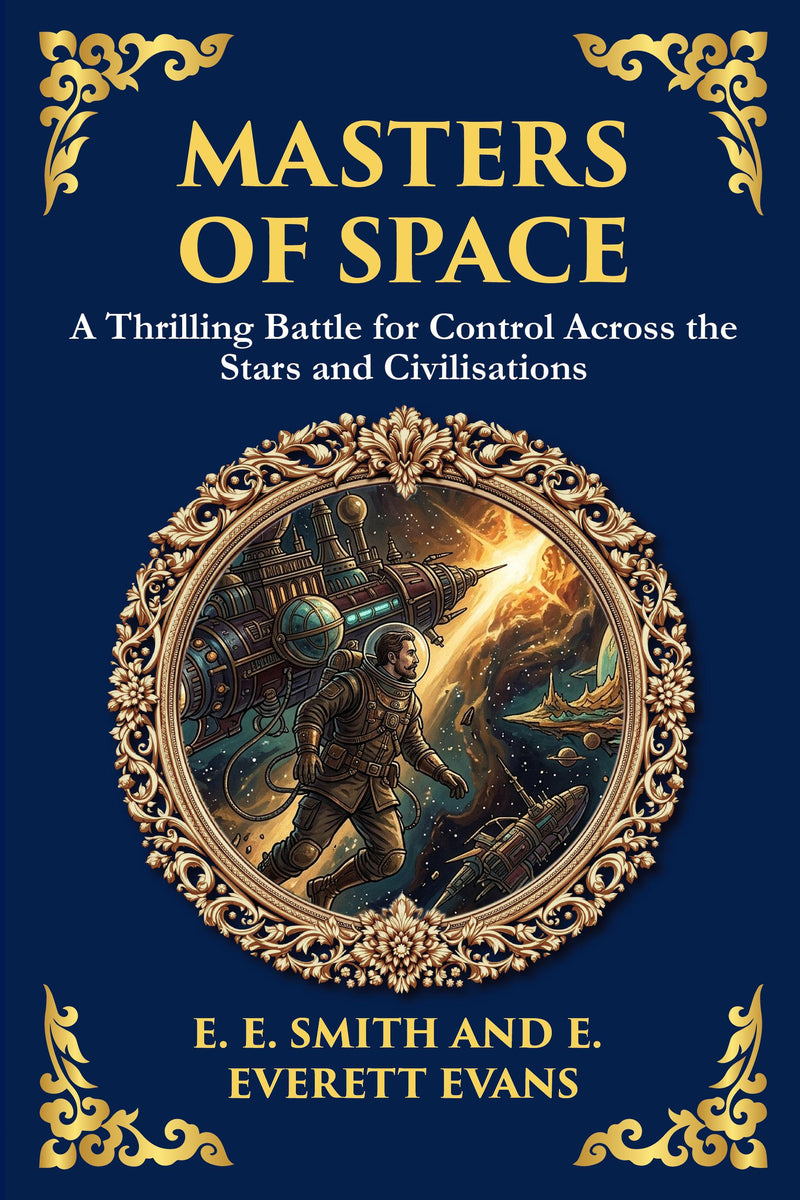
Masters of Space
E. E. Smith In a universe of interstellar empires and unimaginable technology, power is the ultimate prize. Masters of Space takes readers on a pulse-pounding journey across galaxies where humanity and alien civilizations collide in a high-stakes struggle for dominance.
or free app
10,000+ hrs library
30-day guarantee
The complete Masters of Space appears in modern English through Library of Alexandria Press, available online with audiobook narration included for members.
Have you ever wondered why humanity’s future among the stars is always tied to the battle for power and survival? Masters of Space is a thrilling space opera classic that plunges readers into a cosmic war of intrigue, exploration, and rebellion. From towering alien civilizations to humanity’s desperate bid to carve out its destiny, this masterpiece of science fiction pushes the boundaries of imagination while raising questions about morality, leadership, and survival in the farthest reaches of space.
Co-authored by legendary science fiction writers E. E. “Doc” Smith and E. Everett Evans, this novel is a dazzling showcase of bold ideas, riveting battles, and groundbreaking visions of future technology. Readers will journey across galaxies, explore mysterious alien worlds, and witness humanity’s resilience against overwhelming odds.
What you’ll discover in this modern edition
- An Epic Space Opera at Its Best – Experience an electrifying tale of cosmic strategy, interstellar conflict, and humanity’s quest to dominate the stars.
- Alien Civilizations and Advanced Technology – Encounter breathtaking worlds, advanced science, and alien species that challenge humanity’s understanding of power.
- Legendary Science Fiction Collaboration – See how the combined brilliance of E. E. Smith and E. Everett Evans forged one of the genre’s most enduring works.
- Themes of Morality, Power, and Exploration – Reflect on leadership, ethics, and survival as humanity battles for its place in the universe.
- A Cornerstone of Classic Sci-Fi Literature – Perfect for fans of Lensman, Skylark, and other foundational works of interstellar adventure.
| Formats | eBook (EPUB + PDF) · Audiobook · Paperback · Hardcover · Large Print |
| Language | English |
| Trim size (print) | 6 × 9 in |
| Binding | Paperback — perfect-bound · Hardcover — casewrap |
| Large Print edition | Same text in a larger, easy-read type — a larger font, not a larger trim |
| Print pricing | Every physical book at our true cost — at-cost, no profit (members) |
| Library | 873 restored titles, always growing |
| Length | 52,521 words · ~3 hr 30 min reading |
| Reading level | Grade 5 · an easy, flowing read (this modern-English edition) |
| Edition | Modern English translation · 2026 |
Member reviews for this edition are collected as readers finish it — be the first. Across the library: 12,000+ books shipped, every plan covered by a 365-day print guarantee.
About this edition
A faithful, unabridged modern-English edition by The Library of Alexandria — carefully rendered for today's reader and verified paragraph-by-paragraph against the public-domain source. Available as eBook, audiobook, paperback, hardcover, and large print.
- Complete & unabridgedVerified paragraph by paragraph against the source — never a scan, never abridged.
- Modern English, faithfulReadable today, with the author’s meaning kept intact. Readable — not simplified.
- Every format, one membershipRead in your browser or the free app, or listen to the full audiobook.
Included free with your membership
Cancel anytime, one click · 30-day money-back guarantee
Edition last updated July 2026
What’s inside
Masters of Space — complete and unabridged: all 17 sections included with membership, plus the full audiobook.
Begin reading Masters of Space
In clear modern English — the complete text is included with membership.
Introduction
There are certain books that do not merely tell a story but capture the precise temperature of an era—the hopes, the anxieties, the wild ambitions of a moment in human history when it suddenly seemed possible that we might one day leave the cradle of Earth entirely and stride confidently into the cosmos. Masters of Space, the collaborative work of two giants of mid-century science fiction, E. E. “Doc” Smith and E. Everett Evans, is exactly such a book. It arrives to the modern reader like a transmission from a more optimistic frontier, a time when the stars were not distant abstractions but the next great destination, waiting just beyond the reach of humanity’s outstretched hand. To open these pages is to step into a universe drawn in bold, primary colors—a universe of vast distances conquered by ingenuity, of menacing alien intelligences, of courage tested under impossible circumstances, and of the unshakable conviction that the human spirit, properly armed with knowledge and will, can prevail against anything the void might throw at it.
This modern translation and adaptation has been prepared with a single guiding purpose: to make the experience of reading this classic adventure as immediate, as vivid, and as effortlessly enjoyable for the contemporary reader as it was for those who first encountered it generations ago. The bones of the story remain untouched—the daring, the spectacle, the inventiveness, and the unmistakable voice of its authors are all preserved. What has been refreshed is the surface: the occasional archaic turn of phrase, the dated idiom, the syntactical knots that can sometimes trip up a reader more accustomed to the rhythms of twenty-first-century prose. The goal was never to rewrite or to modernize the soul of the work, which would be a betrayal of everything that makes it worth reading. Rather, it was to clear away the small accumulations of time that can stand between a reader and a great story, so that what remains is pure, propulsive adventure. Think of it as the careful restoration of a beloved painting: the image is the same, but the grime of decades has been gently lifted away so that the original colors can shine through once more.
To understand Masters of Space, it helps to understand the two remarkable men whose imaginations gave it life. Edward Elmer Smith—universally known to fans and fellow writers as “Doc” Smith, a nickname earned through his doctorate in chemical engineering—occupies a place of genuine reverence in the history of science fiction. He is frequently and rightly called the father of the “space opera,” that grand subgenre of interstellar adventure characterized by sweeping scope, planet-shaking conflicts, and heroes whose deeds echo across galaxies. Before Smith, science fiction had largely confined itself to the immediate neighborhood of Earth and the Moon, to cautious extrapolations and modest speculations. Smith blew the doors off the entire enterprise. His imagination operated on a cosmic scale that had simply never been attempted before. He gave readers civilizations spanning thousands of worlds, weapons capable of extinguishing suns, and chases that stretched across the unimaginable gulfs between stars. He did not merely raise the ceiling of the genre; he removed it entirely and pointed his readers toward infinity.
Smith’s influence is difficult to overstate. The towering edifices of modern science fiction and fantasy—the galactic empires, the epic confrontations between good and evil played out on a stellar canvas, the very idea that a story might encompass the fate of entire species—all owe a profound debt to the pioneering work he did across his celebrated Skylark and Lensman series. Generations of writers, filmmakers, and dreamers grew up steeped in the wonder he manufactured, and the lineage of that wonder runs directly through some of the most beloved adventure stories of our own time. When you watch a fleet of starships engage in battle across a movie screen, or read of a brave band of explorers venturing into uncharted regions of the galaxy, you are, in a very real sense, witnessing the descendants of ideas that Doc Smith first dared to commit to the page.
E. Everett Evans, his collaborator on this work, was a writer and devoted fan whose own contributions to the field were considerable, even if his name shines less brightly in the popular memory. Evans came to professional science fiction writing later in life, but he brought to it a deep love of the genre and a thoughtful sensibility that complemented Smith’s exuberant grandeur. He was, by all accounts, a warm and generous figure in the science fiction community of his day, a man who cared deeply about the craft and about the people who shared his passion for the literature of the possible. The collaboration between Smith and Evans was a meeting of kindred spirits—two men who believed in the storytelling power of the cosmic adventure and who shared a fundamental optimism about where human curiosity and courage might one day take us.
What emerges from their partnership is a work that carries the unmistakable fingerprints of Smith’s grand vision while benefiting from a slightly more intimate, character-focused touch. Masters of Space is space opera in the classic mode, but it is also a story interested in the people who populate its vast stage—their relationships, their loyalties, their moments of doubt and resolve. This blend gives the novel a particular flavor, one that rewards the reader who comes to it not only for the spectacle but for the human drama playing out against the spectacle’s enormous backdrop.
It is worth pausing here to appreciate the context in which these men wrote. The era that produced this kind of fiction was one of extraordinary technological ferment and cultural transformation. The world had been reshaped by enormous conflicts and astonishing scientific advances. The atom had been split. Rockets that had once been instruments of war were being reconceived as vehicles of exploration. The notion that humanity might soon break free of its terrestrial bonds was no longer the exclusive province of dreamers; it was becoming a serious topic of discussion among scientists, engineers, and ordinary citizens alike. Science fiction was, in this environment, far more than mere entertainment. It was a kind of collective rehearsal for the future—a way for an entire civilization to imagine what it might become, to test the moral and practical dimensions of possibilities that were rushing toward it with breathtaking speed. Writers like Smith and Evans were not simply spinning yarns; they were participating in one of the great imaginative projects of their century, helping to chart the contours of a future that felt, for the first time, genuinely within reach.
When you read Masters of Space, you are tapping into that current of optimism and ambition. You are encountering a vision of the future built by people who genuinely believed that the future would be magnificent, that the problems of the present could be solved by intelligence and determination, and that the human story was destined to expand outward into the limitless reaches of space. There is something deeply restorative about immersing yourself in that worldview, particularly in our own more anxious and uncertain age. These authors did not write to depress or to despair. They wrote to thrill, to inspire, and to remind their readers that the universe is a place of endless wonder and that human beings are capable of rising to meet its greatest challenges.
Without revealing the particulars of the plot—for the unfolding of the story is one of the great pleasures this book has to offer, and it would be a disservice to spoil even a moment of its discoveries—it is possible to describe the texture and the temperament of the adventure that lies ahead. This is a novel of confrontation on a grand scale: a contest of wills and wits and weapons that spans the cosmos and pits human determination against forces of staggering power. The title itself signals the central preoccupation of the work—the question of mastery, of control, of who shall hold dominion over the vast spaces between the stars and the civilizations that dwell within them. It is a theme as old as storytelling and as fresh as tomorrow’s headlines, and Smith and Evans pursue it with characteristic vigor.
Expect, then, a story that moves. The pacing of classic space opera is one of its enduring virtues; these are books that do not dawdle, that propel the reader forward through a succession of crises and revelations and escalating stakes. You will encounter heroes of genuine courage and resourcefulness, the kind of protagonists who face overwhelming odds not with paralysis but with the steady resolve to find a way through. You will meet antagonists whose menace is real and whose ambitions threaten not merely individuals but entire ways of life. And you will be carried across settings of marvelous variety and imagination—the kind of richly conceived worlds and environments that only the unfettered imagination of a master like Smith could conjure.
There is a particular quality to the prose of this era that deserves mention, because it shapes the reading experience in ways that the modern reader will quickly come to appreciate. These authors wrote with confidence and clarity. They were not interested in obscurity or in the kind of self-conscious literary gamesmanship that can make a certain strain of modern fiction feel like a puzzle to be decoded. Their aim was communication—to convey the wonder and the urgency of their vision as directly and as powerfully as possible. The result is a reading experience that is immersive and welcoming. You are not held at arm’s length; you are pulled in. The vividness of the descriptions, the momentum of the action, the directness of the characterization—all of these conspire to make you feel that you are not merely reading about events but witnessing them, present at the unfolding of a great drama.
This modern adaptation has worked to preserve and even enhance that directness. Where the original language might have felt stilted or overly formal to contemporary ears—where a turn of phrase that was perfectly natural in its own time might now produce a moment of friction—the text has been gently smoothed so that the story can flow without interruption. The dialogue has been rendered in a way that feels natural and alive. The descriptive passages retain all their grandeur while shedding any excess verbiage that might have slowed the modern reader’s progress. Nothing essential has been lost; much has been clarified. The aim throughout has been to honor the authors’ intentions by making their work accessible to a new generation of readers who deserve to experience the thrill of it just as fully as the original audience did.
A word about the science is also in order, because it is one of the most charming and instructive aspects of reading vintage science fiction. The scientific landscape that Smith and Evans worked within was, of course, very different from our own. Some of the speculations and technologies they imagined have been overtaken by subsequent discoveries; others were always more in the nature of imaginative leaps than rigorous extrapolations. The modern reader will notice, here and there, the assumptions and ideas of a bygone scientific age. This is not a flaw to be apologized for but a feature to be savored. There is genuine delight in seeing how the brightest minds of an earlier generation imagined the workings of the cosmos and the machinery of the future. It offers a window into the scientific imagination of the time, and it reminds us that the act of envisioning the future is always, inevitably, an act rooted in the present from which it springs. To read these passages is to engage in a kind of friendly time travel, to glimpse the universe as it appeared from a particular vantage point in human history. The wonder is not diminished by our knowing more than the authors did; if anything, it is enriched.
Cancel anytime, one click · 30-day money-back guarantee
Founding annual rate available now — your price locks for life when you join.
Not ready? Get this free chapter by email — read it anytime.
✓ Sent — check your inbox for Masters of Space.
Questions about Masters of Space
What is Masters of Space about?
E. E. Smith In a universe of interstellar empires and unimaginable technology, power is the ultimate prize. Masters of Space takes readers on a pulse-pounding journey across galaxies where humanity and alien civilizations collide in a high-stakes struggle for dominance. Written by the legendary pioneers of science fiction, E. E. “Doc” Smith and E. Everett Evans, this sweeping space opera blends epic adventure, futuristic science, and relentless action into a timeless tale of courage and ingenuity among the stars.
Who wrote Masters of Space?
Masters of Space was written by E. E. Smith and E. Everett Evans. This edition presents the complete work in clear modern English, faithfully rendered from the public-domain original by Library of Alexandria Press.
Is Masters of Space free to read?
The opening chapter is free to read on this page. Members read and listen to the complete work — and the entire library — free, and can order any physical book at our true print cost.
How long is Masters of Space?
17 chapters (~52,521 words) — about 3 hr 30 min of reading in this modern-English edition.
Is this an abridged version of Masters of Space?
No. This is the complete, unabridged Masters of Space, carefully rendered into clear modern English and verified paragraph-by-paragraph against the public-domain source — nothing is cut or summarised.
What formats does Masters of Space come in?
Masters of Space is available as eBook, paperback, hardcover and large print. eBook and audiobook are included with membership; printed editions ship at our true print cost.
Shipping & returns
Billing & membership
More from the library


Explore Science Fiction
- The Island of Doctor Moreau · H. G. Wells
- A Midsummer Night’s Dream · William Shakespeare
- The Invisible Man: A Grotesque Romance · H. G. Wells
- The War of the Worlds · H. G. Wells
- The Strange Case of Dr. Jekyll and Mr. Hyde · Robert Louis Stevenson
- Limanora: the island of progress · Godfrey Sweven
- The Book of Dragons · E. Nesbit
- She · H. Rider Haggard
- Dorothy and the Wizard in Oz · L. Frank Baum
- The Princess and the Goblin · George MacDonald
- Gawayne and the Green Knight: A Fairy Tale · Charlton M. Lewis
- Lucian’s True History · Lucian of Samosata
- The Willows · Algernon Blackwood
- The Call of Cthulhu · H. P. Lovecraft
- The Life-Eater · Harold Ward
- The Marvelous Land of Oz · L. Frank Baum
- Mars is My Destination · Frank Belknap Long
- The Black Kiss
- The Beasts in the Void · Paul W. Fairman
- John Jones’s Dollar · Harry Stephen Keeler
- Subversive · Mack Reynolds
- The Mississippi Saucer · Frank Belknap Long
- Man of Distinction · Michael Shaara
- Spawn of the Comet · H. Thompson Rich
- The Golden Judge · Nathaniel Gordon
- Final Weapon · Everett B. Cole
- The Big Fix · George O. Smith
- Last Enemy · H. Beam Piper
- Time and Time Again · H. Beam Piper
- Sabotage in Space · Carey Rockwell
Masters of Space
Masters of Space
A Thrilling Battle for Control Across the Stars and Civilizations
E. E. Smith and E. Everett Evans
Contents
- Introduction
- Part 1
- Chapter 1
- Chapter 2
- Chapter 3
- Chapter 4
- Chapter 5
- Chapter 6
- Chapter 7
- Part 2
- Chapter 8
- Chapter 9
- Chapter 10
- Chapter 11
- Chapter 12
- Chapter 13
- Epilogue
Introduction
There are certain books that do not merely tell a story but capture the precise temperature of an era—the hopes, the anxieties, the wild ambitions of a moment in human history when it suddenly seemed possible that we might one day leave the cradle of Earth entirely and stride confidently into the cosmos. Masters of Space, the collaborative work of two giants of mid-century science fiction, E. E. “Doc” Smith and E. Everett Evans, is exactly such a book. It arrives to the modern reader like a transmission from a more optimistic frontier, a time when the stars were not distant abstractions but the next great destination, waiting just beyond the reach of humanity’s outstretched hand. To open these pages is to step into a universe drawn in bold, primary colors—a universe of vast distances conquered by ingenuity, of menacing alien intelligences, of courage tested under impossible circumstances, and of the unshakable conviction that the human spirit, properly armed with knowledge and will, can prevail against anything the void might throw at it.
This modern translation and adaptation has been prepared with a single guiding purpose: to make the experience of reading this classic adventure as immediate, as vivid, and as effortlessly enjoyable for the contemporary reader as it was for those who first encountered it generations ago. The bones of the story remain untouched—the daring, the spectacle, the inventiveness, and the unmistakable voice of its authors are all preserved. What has been refreshed is the surface: the occasional archaic turn of phrase, the dated idiom, the syntactical knots that can sometimes trip up a reader more accustomed to the rhythms of twenty-first-century prose. The goal was never to rewrite or to modernize the soul of the work, which would be a betrayal of everything that makes it worth reading. Rather, it was to clear away the small accumulations of time that can stand between a reader and a great story, so that what remains is pure, propulsive adventure. Think of it as the careful restoration of a beloved painting: the image is the same, but the grime of decades has been gently lifted away so that the original colors can shine through once more.
To understand Masters of Space, it helps to understand the two remarkable men whose imaginations gave it life. Edward Elmer Smith—universally known to fans and fellow writers as “Doc” Smith, a nickname earned through his doctorate in chemical engineering—occupies a place of genuine reverence in the history of science fiction. He is frequently and rightly called the father of the “space opera,” that grand subgenre of interstellar adventure characterized by sweeping scope, planet-shaking conflicts, and heroes whose deeds echo across galaxies. Before Smith, science fiction had largely confined itself to the immediate neighborhood of Earth and the Moon, to cautious extrapolations and modest speculations. Smith blew the doors off the entire enterprise. His imagination operated on a cosmic scale that had simply never been attempted before. He gave readers civilizations spanning thousands of worlds, weapons capable of extinguishing suns, and chases that stretched across the unimaginable gulfs between stars. He did not merely raise the ceiling of the genre; he removed it entirely and pointed his readers toward infinity.
Smith’s influence is difficult to overstate. The towering edifices of modern science fiction and fantasy—the galactic empires, the epic confrontations between good and evil played out on a stellar canvas, the very idea that a story might encompass the fate of entire species—all owe a profound debt to the pioneering work he did across his celebrated Skylark and Lensman series. Generations of writers, filmmakers, and dreamers grew up steeped in the wonder he manufactured, and the lineage of that wonder runs directly through some of the most beloved adventure stories of our own time. When you watch a fleet of starships engage in battle across a movie screen, or read of a brave band of explorers venturing into uncharted regions of the galaxy, you are, in a very real sense, witnessing the descendants of ideas that Doc Smith first dared to commit to the page.
E. Everett Evans, his collaborator on this work, was a writer and devoted fan whose own contributions to the field were considerable, even if his name shines less brightly in the popular memory. Evans came to professional science fiction writing later in life, but he brought to it a deep love of the genre and a thoughtful sensibility that complemented Smith’s exuberant grandeur. He was, by all accounts, a warm and generous figure in the science fiction community of his day, a man who cared deeply about the craft and about the people who shared his passion for the literature of the possible. The collaboration between Smith and Evans was a meeting of kindred spirits—two men who believed in the storytelling power of the cosmic adventure and who shared a fundamental optimism about where human curiosity and courage might one day take us.
What emerges from their partnership is a work that carries the unmistakable fingerprints of Smith’s grand vision while benefiting from a slightly more intimate, character-focused touch. Masters of Space is space opera in the classic mode, but it is also a story interested in the people who populate its vast stage—their relationships, their loyalties, their moments of doubt and resolve. This blend gives the novel a particular flavor, one that rewards the reader who comes to it not only for the spectacle but for the human drama playing out against the spectacle’s enormous backdrop.
It is worth pausing here to appreciate the context in which these men wrote. The era that produced this kind of fiction was one of extraordinary technological ferment and cultural transformation. The world had been reshaped by enormous conflicts and astonishing scientific advances. The atom had been split. Rockets that had once been instruments of war were being reconceived as vehicles of exploration. The notion that humanity might soon break free of its terrestrial bonds was no longer the exclusive province of dreamers; it was becoming a serious topic of discussion among scientists, engineers, and ordinary citizens alike. Science fiction was, in this environment, far more than mere entertainment. It was a kind of collective rehearsal for the future—a way for an entire civilization to imagine what it might become, to test the moral and practical dimensions of possibilities that were rushing toward it with breathtaking speed. Writers like Smith and Evans were not simply spinning yarns; they were participating in one of the great imaginative projects of their century, helping to chart the contours of a future that felt, for the first time, genuinely within reach.
When you read Masters of Space, you are tapping into that current of optimism and ambition. You are encountering a vision of the future built by people who genuinely believed that the future would be magnificent, that the problems of the present could be solved by intelligence and determination, and that the human story was destined to expand outward into the limitless reaches of space. There is something deeply restorative about immersing yourself in that worldview, particularly in our own more anxious and uncertain age. These authors did not write to depress or to despair. They wrote to thrill, to inspire, and to remind their readers that the universe is a place of endless wonder and that human beings are capable of rising to meet its greatest challenges.
Without revealing the particulars of the plot—for the unfolding of the story is one of the great pleasures this book has to offer, and it would be a disservice to spoil even a moment of its discoveries—it is possible to describe the texture and the temperament of the adventure that lies ahead. This is a novel of confrontation on a grand scale: a contest of wills and wits and weapons that spans the cosmos and pits human determination against forces of staggering power. The title itself signals the central preoccupation of the work—the question of mastery, of control, of who shall hold dominion over the vast spaces between the stars and the civilizations that dwell within them. It is a theme as old as storytelling and as fresh as tomorrow’s headlines, and Smith and Evans pursue it with characteristic vigor.
Expect, then, a story that moves. The pacing of classic space opera is one of its enduring virtues; these are books that do not dawdle, that propel the reader forward through a succession of crises and revelations and escalating stakes. You will encounter heroes of genuine courage and resourcefulness, the kind of protagonists who face overwhelming odds not with paralysis but with the steady resolve to find a way through. You will meet antagonists whose menace is real and whose ambitions threaten not merely individuals but entire ways of life. And you will be carried across settings of marvelous variety and imagination—the kind of richly conceived worlds and environments that only the unfettered imagination of a master like Smith could conjure.
There is a particular quality to the prose of this era that deserves mention, because it shapes the reading experience in ways that the modern reader will quickly come to appreciate. These authors wrote with confidence and clarity. They were not interested in obscurity or in the kind of self-conscious literary gamesmanship that can make a certain strain of modern fiction feel like a puzzle to be decoded. Their aim was communication—to convey the wonder and the urgency of their vision as directly and as powerfully as possible. The result is a reading experience that is immersive and welcoming. You are not held at arm’s length; you are pulled in. The vividness of the descriptions, the momentum of the action, the directness of the characterization—all of these conspire to make you feel that you are not merely reading about events but witnessing them, present at the unfolding of a great drama.
This modern adaptation has worked to preserve and even enhance that directness. Where the original language might have felt stilted or overly formal to contemporary ears—where a turn of phrase that was perfectly natural in its own time might now produce a moment of friction—the text has been gently smoothed so that the story can flow without interruption. The dialogue has been rendered in a way that feels natural and alive. The descriptive passages retain all their grandeur while shedding any excess verbiage that might have slowed the modern reader’s progress. Nothing essential has been lost; much has been clarified. The aim throughout has been to honor the authors’ intentions by making their work accessible to a new generation of readers who deserve to experience the thrill of it just as fully as the original audience did.
A word about the science is also in order, because it is one of the most charming and instructive aspects of reading vintage science fiction. The scientific landscape that Smith and Evans worked within was, of course, very different from our own. Some of the speculations and technologies they imagined have been overtaken by subsequent discoveries; others were always more in the nature of imaginative leaps than rigorous extrapolations. The modern reader will notice, here and there, the assumptions and ideas of a bygone scientific age. This is not a flaw to be apologized for but a feature to be savored. There is genuine delight in seeing how the brightest minds of an earlier generation imagined the workings of the cosmos and the machinery of the future. It offers a window into the scientific imagination of the time, and it reminds us that the act of envisioning the future is always, inevitably, an act rooted in the present from which it springs. To read these passages is to engage in a kind of friendly time travel, to glimpse the universe as it appeared from a particular vantage point in human history. The wonder is not diminished by our knowing more than the authors did; if anything, it is enriched.
“But didn’t you feel anything, Javo?” Tula’s tense, naked body showed the strain in every line. “Nothing at all?”
“Nothing at all.” Javo relaxed his intense focus. “Nothing has changed, and nothing will.”
“That’s impossible!” Tula snapped. “The Masters promised to return, so there must be changes. Didn’t any of you feel anything?”
Her intense, demanding eyes scanned the group. Aside from their physical perfection, they looked like people you would find at any nudist colony.
“That isn’t surprising,” Javo finally said. “Your receptors are the most sensitive of all of us. But are you sure?”
“I’m sure. It was the thought-form of a living Master.”
“Do you think the Master noticed your web?”
“Definitely. Those who created us are stronger than we are.”
“That’s true. Then, just as they promised so long ago, our Masters are returning home.”
Jarvis Hilton of Terra was the youngest man ever assigned to lead a deep-space mission as massive as Project Theta Orionis. He was meeting with his two seconds-in-command. Assistant Director Sandra Cummings, an analyst and semantician, was tall, blonde, and slender. William Karns, a thirty-year-old planetographer with black hair, brows, and eyes, was the third-highest ranking member of the scientific team.
“I’m telling you, Jarve, you can’t have it both ways,” Karns declared. “Captain Sawtelle is old-school Navy. He follows the rules exactly. You need to draw a hard line right where the Advisory Board’s directive says it is. The next time he oversteps, put him in his place. You’ve been a complete pushover since we left base.”
“Is that how you see it?” Hilton clenched his right hand into a fist. “The man has age, experience, and skill. I’ve been trying to treat him with courtesy and decency.”
End of the free sample
Keep reading, free
Members read and listen to the complete book — and the entire library. Cancel anytime, one click · 30-day money-back guarantee.