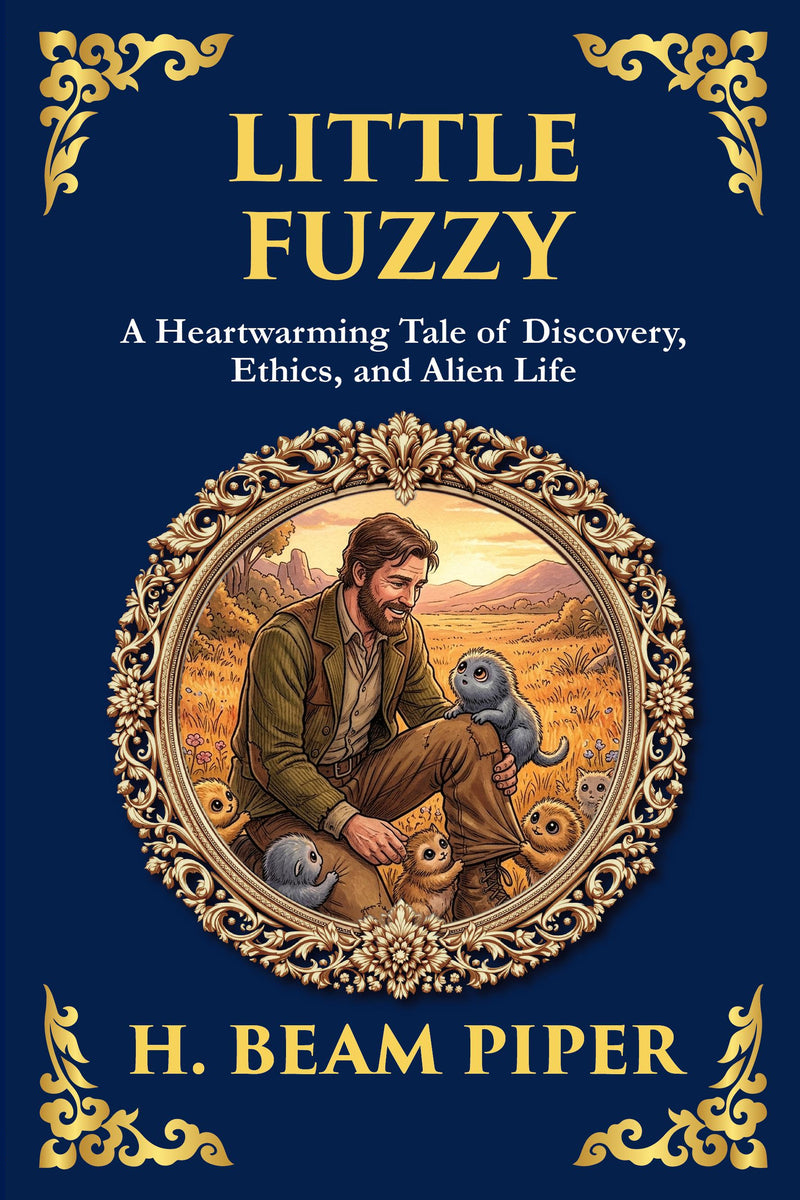
Little Fuzzy
On the newly colonized planet of Zarathustra, prospector Jack Holloway stumbles upon a creature unlike any seen before—a small, adorable, and surprisingly intelligent being.
or free app
10,000+ hrs library
30-day guarantee
The complete Little Fuzzy appears in modern English through Library of Alexandria Press, available online with audiobook narration included for members.
Have you ever wondered why the smallest voice can spark the biggest revolution? In Little Fuzzy, H. Beam Piper offers readers a captivating science fiction tale that explores the boundaries between human and alien, nature and nurture, rights and responsibilities. Originally published in 1962, this novel remains one of the most beloved works in speculative fiction, inviting us to ask: What makes a being truly sentient?
Set on the resource-rich planet of Zarathustra, the story follows Jack Holloway—a rugged loner and mineral prospector—whose routine life is turned upside down when he discovers a charming, furry little creature with wide eyes and curious behavior. As more of these “Fuzzies” appear, Holloway is struck by their empathy, playfulness, and uncanny intelligence. But the powerful Chartered Zarathustra Company sees the Fuzzies as a threat to their profits.
If the Fuzzies are declared sapient, the corporation will lose control of the planet—and their exploitation of its resources. What begins as an interspecies friendship escalates into a legal and moral battle that questions the very definition of personhood. With wit, compassion, and sharp critique of colonialism and corporate ethics, Piper crafts a story that is as socially relevant today as it was at its release.
What you’ll discover in this modern edition
- A Thought-Provoking First Contact Story Follow the discovery of the Fuzzies and the ethical chaos that ensues.
| Formats | eBook (EPUB + PDF) · Audiobook · Paperback · Hardcover · Large Print |
| Language | English |
| Trim size (print) | 6 × 9 in |
| Binding | Paperback — perfect-bound · Hardcover — casewrap |
| Large Print edition | Same text in a larger, easy-read type — a larger font, not a larger trim |
| Print pricing | Every physical book at our true cost — at-cost, no profit (members) |
| Library | 873 restored titles, always growing |
| Length | 61,900 words · ~4 hr 8 min reading |
| Reading level | Grade 6 · an easy, flowing read (this modern-English edition) |
| Edition | Modern English translation · 2026 |
Member reviews for this edition are collected as readers finish it — be the first. Across the library: 12,000+ books shipped, every plan covered by a 365-day print guarantee.
About this edition
A faithful, unabridged modern-English edition by The Library of Alexandria — carefully rendered for today's reader and verified paragraph-by-paragraph against the public-domain source. Available as eBook, audiobook, paperback, hardcover, and large print.
- Complete & unabridgedVerified paragraph by paragraph against the source — never a scan, never abridged.
- Modern English, faithfulReadable today, with the author’s meaning kept intact. Readable — not simplified.
- Every format, one membershipRead in your browser or the free app, or listen to the full audiobook.
Included free with your membership
Cancel anytime, one click · 30-day money-back guarantee
Edition last updated July 2026
What’s inside
Little Fuzzy — complete and unabridged: all 17 sections included with membership, plus the full audiobook.
Begin reading Little Fuzzy
In clear modern English — the complete text is included with membership.
Introduction
There are some books that arrive in the world quietly and then refuse to leave it. They linger in the imagination of readers, passed from one generation to the next, recommended by friends in lowered, almost conspiratorial tones, as if to say: you have to read this one; it will change how you see things. H. Beam Piper’s Little Fuzzy, first published in 1962, is precisely such a book. It is short, deceptively simple, and gentle in its surface texture, yet it contains within it some of the most enduring and important questions a human being can ask. What does it mean to be a person? Who decides? And what do we owe to a creature whose mind we cannot quite measure, but whose heart we cannot help but recognize?
This edition — a modern translation adapted for the contemporary reader — brings Piper’s classic into clearer focus for those encountering it for the first time, while preserving the warmth, the wit, and the deep moral seriousness that have made it a touchstone of thoughtful science fiction for more than sixty years. The aim of this introduction is not to summarize the story, nor to spoil the discoveries that await you, but to prepare the ground so that you may walk into Piper’s world with open eyes and an open heart. Because make no mistake: this is a book that rewards the reader who comes to it ready to feel something.
To understand why Little Fuzzy feels the way it does — that rare combination of cozy and profound — it helps to know something about the man who wrote it. Henry Beam Piper was born in 1904 in Altoona, Pennsylvania, a railroad town, and for much of his life he worked in and around the railroads himself, employed as a laborer and later as a night watchman for the Pennsylvania Railroad. He was, in the truest sense, a self-made intellectual. He never attended university. Instead, he educated himself voraciously, devouring history, anthropology, firearms, languages, and the sciences with the appetite of a man who knew that knowledge was the one thing no one could take from him. He filled notebooks, collected facts, and trained himself to think systematically about how civilizations rise and fall, how cultures collide, and how human nature stays stubbornly consistent across millennia.
This autodidact’s discipline shows up everywhere in his fiction. Piper was a writer who believed that a story should be built on a foundation of solid reasoning — that if you were going to imagine a future, you ought to imagine it consistently, with attention to economics, law, politics, and human motivation. He is perhaps best remembered today for two interlocking achievements: his “Terro-Human Future History,” a sweeping, internally consistent timeline of human expansion across the galaxy spanning thousands of years, and his standalone masterpiece of alternate history and parallel worlds, the Paratime stories, including the beloved Lord Kalvan of Otherwhen. He wrote with the precision of an engineer and the moral imagination of a philosopher.
Yet for all his rigor, Piper was never cold. There is a deep humanism that runs through his work — a genuine affection for ordinary people doing their best in difficult circumstances, a suspicion of bureaucracy and bloodless corporate power, and an abiding faith that decency, courage, and common sense can prevail against arrogance. Little Fuzzy is in many ways the purest distillation of these values. It is set within his Terro-Human Future History, on a frontier planet far from the seat of human power, but you need not have read a single other Piper story to fall completely under its spell. The book stands entirely on its own, a complete and self-sufficient delight.
Piper’s life ended in tragedy. In 1964, beset by financial worries and apparently believing — wrongly, as it turned out — that his writing career had stalled and that no one wanted his work any longer, he took his own life. It is one of the cruel ironies of literary history that his reputation only grew after his death, that his books found ever-larger audiences, and that Little Fuzzy in particular became a beloved classic, spawning sequels, a posthumously discovered manuscript, authorized continuations by other writers, and a devoted readership that endures to this day. Had he known how cherished his work would become, the story might have ended differently. We cannot undo that loss, but we can do the next best thing: we can keep reading him, keep loving the worlds he made, and keep introducing new readers to the gentle wonder of his finest book. That, in a sense, is part of what this edition is for.
It is worth pausing on this point, because it colors the experience of reading Little Fuzzy in a poignant way. Here is a story fundamentally concerned with whether a being’s worth and dignity will be recognized by those with the power to grant or deny it. Here is a story about creatures who are easy to overlook, easy to dismiss, easy to treat as mere resources rather than as ends in themselves. And here is its author, a man of enormous talent who died believing himself overlooked and undervalued. The resonance is hard to miss, and it lends the book’s central plea — look closer, think harder, and recognize the person in front of you — an extra layer of quiet heartbreak. Piper, perhaps better than anyone, understood the cost of being unseen.
The Heart of the Matter: Personhood, Ethics, and the Question of "Us"
Without revealing the turns of the plot, it is fair to say that Little Fuzzy is built around one of the oldest and most urgent questions in all of moral philosophy: how do we decide who counts? Throughout human history, this question has been answered badly, and often violently. We have drawn the circle of “people who matter” narrowly and then defended its borders with cruelty. We have used differences of language, appearance, intelligence, and custom as excuses to deny others their full standing as moral beings. We have, again and again, found reasons to say they are not really like us, so the rules do not really apply to them. And those reasons have almost always served the interests of the people who got to draw the circle.
Piper takes this ancient question and gives it a fresh, disarming, and unforgettable form. He sets it on a distant world, among unfamiliar creatures, with high economic and legal stakes — but the questions he raises are entirely our own. What is the test of personhood? Is it the ability to use tools? To speak? To reason? To create? To feel love and grief? To pass knowledge from one generation to the next? Is it some single bright line, or is it a constellation of qualities that resist easy measurement? And — most troublingly — what happens when the answer to that question is worth a fortune to the people charged with deciding it?
This last point is where Piper’s particular genius reveals itself. He understood, with the clear eyes of a man who had spent his life watching how power actually works, that questions of ethics are never decided in a vacuum. There are always interests at play. There are always people who would prefer one answer over another because of what that answer will cost them or earn them. The brilliance of Little Fuzzy lies in the way it dramatizes the collision between conscience and self-interest, between what is true and what is convenient, between the people who want to look closely at the evidence and the people who would very much prefer not to look at all. It is, in this sense, a profoundly relevant book for our own moment — an age in which we are once again being forced to ask hard questions about the boundaries of mind, the rights of nonhuman creatures, the responsibilities that come with power, and the dangers of letting profit dictate what we are willing to recognize as real.
And yet — and this is crucial — Piper never lectures. He never raises his voice or wags his finger. He embeds these enormous questions in a story so warm, so charming, and so genuinely entertaining that you may not even notice how deep you have waded until you are well past your depth. The ideas arrive not as abstractions but as feelings: as wonder, as delight, as worry, as the fierce protectiveness one feels toward something small and trusting and vulnerable. This is the highest form of moral storytelling. It does not tell you what to think; it makes you feel the truth in your bones and then trusts you to think it through for yourself.
The book also offers a remarkably sophisticated treatment of how knowledge itself is established and contested. Piper takes seriously the idea that figuring out the truth is hard work — that it requires observation, patience, skepticism, careful argument, and a willingness to be surprised. He gives us characters who approach a genuine mystery with the methods of real inquiry, who form hypotheses and test them, who change their minds in the face of evidence. In an era where it is easy to be cynical about expertise and reason, there is something deeply refreshing about a story that depicts the honest pursuit of truth as an adventure worth having — and as a moral act in its own right. To insist on getting the answer right, when getting it wrong would be so much easier and so much more profitable, is itself a form of courage. The book honors that courage.
There is, too, a generosity of spirit in how Piper portrays his human characters. This is not a story of cardboard villains and shining heroes, though it certainly has its share of the noble and the contemptible. Many of the people who populate these pages are simply human — capable of both selfishness and decency, of blindness and sudden moral clarity, of doing the wrong thing out of fear and the right thing out of love. Piper believed that most people are reachable, that good faith can be appealed to, and that the truth, given a fair hearing, has a power of its own. That fundamental optimism, that faith in our capacity to grow and to recognize what is right when it is placed clearly before us, is one of the great gifts this book offers its readers. You finish it not in despair at human nature but with a renewed and tender hope for it.
On This Modern Translation and How to Read It
A word, now, about the edition you hold in your hands, and about the experience that awaits you. Little Fuzzy was written in the early 1960s, by a man born at the very beginning of the twentieth century, and like any work of its era it carries the marks of its time — in its idioms, its rhythms, certain assumptions about technology and society, and the texture of its prose. This modern translation, adapted for the contemporary reader, has been prepared with great care and even greater respect. The intention has never been to “improve” Piper or to second-guess his artistic choices, but rather to clear away the small barriers that can stand between a modern reader and a story written more than half a century ago — to let the warmth and wit and wisdom of the original shine through without the friction of dated phrasing or unfamiliar references getting in the way.
What this means in practice is that the soul of the book is entirely intact. The characters you will meet are Piper’s characters. The story you will follow is Piper’s story, told in his order, building to his conclusions. The moral vision is wholly his. What has been gently refreshed is the surface — the better to deliver you, undistracted and fully present, to the emotional and intellectual heart of the work. Think of it as the difference between viewing a beloved old painting through grimy glass and viewing it through glass that has been carefully cleaned. The painting is the same. You simply see it more clearly. For readers who have loved Little Fuzzy in its original form, this edition offers the pleasure of revisiting an old friend; for those coming to it fresh, it offers the smoothest possible path into a world worth knowing.
How, then, should you approach the reading? My first piece of advice is to surrender to the book’s gentleness. We live in an age of frantic stakes and relentless escalation, of stories that try to overwhelm us with spectacle. Little Fuzzy works differently. Its pleasures are quieter and, I would argue, deeper. There is a particular kind of joy in this book — a joy rooted in discovery, in curiosity, in the simple wonder of encountering something new and trying to understand it. Allow yourself to feel that wonder. Let the book set its own pace. Some of its most powerful moments are also its smallest: a gesture, a glance, an unexpected display of cleverness or affection. Read slowly enough to catch them.
Cancel anytime, one click · 30-day money-back guarantee
Founding annual rate available now — your price locks for life when you join.
Not ready? Get this free chapter by email — read it anytime.
✓ Sent — check your inbox for Little Fuzzy.
Questions about Little Fuzzy
What is Little Fuzzy about?
On the newly colonized planet of Zarathustra, prospector Jack Holloway stumbles upon a creature unlike any seen before—a small, adorable, and surprisingly intelligent being. But what begins as a chance encounter becomes a question that could shake a galaxy: Is the "Little Fuzzy" just a clever animal, or something far more profound? Little Fuzzy is a classic of science fiction that asks big questions through the smallest of heroes.
Who wrote Little Fuzzy?
Little Fuzzy was written by H. Beam Piper. This edition presents the complete work in clear modern English, faithfully rendered from the public-domain original by Library of Alexandria Press.
Is Little Fuzzy free to read?
The opening chapter is free to read on this page. Members read and listen to the complete work — and the entire library — free, and can order any physical book at our true print cost.
How long is Little Fuzzy?
17 chapters (~61,900 words) — about 4 hr 8 min of reading in this modern-English edition.
Is this an abridged version of Little Fuzzy?
No. This is the complete, unabridged Little Fuzzy, carefully rendered into clear modern English and verified paragraph-by-paragraph against the public-domain source — nothing is cut or summarised.
What formats does Little Fuzzy come in?
Little Fuzzy is available as eBook, paperback, hardcover and large print. eBook and audiobook are included with membership; printed editions ship at our true print cost.
Shipping & returns
Billing & membership
More from the library


Explore Science Fiction
- The Island of Doctor Moreau · H. G. Wells
- A Midsummer Night’s Dream · William Shakespeare
- The Invisible Man: A Grotesque Romance · H. G. Wells
- The War of the Worlds · H. G. Wells
- The Strange Case of Dr. Jekyll and Mr. Hyde · Robert Louis Stevenson
- Limanora: the island of progress · Godfrey Sweven
- The Book of Dragons · E. Nesbit
- She · H. Rider Haggard
- Dorothy and the Wizard in Oz · L. Frank Baum
- The Princess and the Goblin · George MacDonald
- Gawayne and the Green Knight: A Fairy Tale · Charlton M. Lewis
- Lucian’s True History · Lucian of Samosata
- The Willows · Algernon Blackwood
- The Call of Cthulhu · H. P. Lovecraft
- The Life-Eater · Harold Ward
- The Marvelous Land of Oz · L. Frank Baum
- Mars is My Destination · Frank Belknap Long
- The Black Kiss
- The Beasts in the Void · Paul W. Fairman
- John Jones’s Dollar · Harry Stephen Keeler
- Subversive · Mack Reynolds
- The Mississippi Saucer · Frank Belknap Long
- Man of Distinction · Michael Shaara
- Spawn of the Comet · H. Thompson Rich
- The Golden Judge · Nathaniel Gordon
- Final Weapon · Everett B. Cole
- The Big Fix · George O. Smith
- Last Enemy · H. Beam Piper
- Time and Time Again · H. Beam Piper
- Sabotage in Space · Carey Rockwell
Little Fuzzy
Little Fuzzy
A Heartwarming Story of Discovery, Ethics, and Alien Life
H. Beam Piper
Contents
- Introduction
- Chapter 1
- Chapter 2
- Chapter 3
- Chapter 4
- Chapter 5
- Chapter 6
- Chapter 7
- Chapter 8
- Chapter 9
- Chapter 10
- Chapter 11
- Chapter 12
- Chapter 13
- Chapter 14
- Chapter 15
- Chapter 16
Introduction
There are some books that arrive in the world quietly and then refuse to leave it. They linger in the imagination of readers, passed from one generation to the next, recommended by friends in lowered, almost conspiratorial tones, as if to say: you have to read this one; it will change how you see things. H. Beam Piper’s Little Fuzzy, first published in 1962, is precisely such a book. It is short, deceptively simple, and gentle in its surface texture, yet it contains within it some of the most enduring and important questions a human being can ask. What does it mean to be a person? Who decides? And what do we owe to a creature whose mind we cannot quite measure, but whose heart we cannot help but recognize?
This edition — a modern translation adapted for the contemporary reader — brings Piper’s classic into clearer focus for those encountering it for the first time, while preserving the warmth, the wit, and the deep moral seriousness that have made it a touchstone of thoughtful science fiction for more than sixty years. The aim of this introduction is not to summarize the story, nor to spoil the discoveries that await you, but to prepare the ground so that you may walk into Piper’s world with open eyes and an open heart. Because make no mistake: this is a book that rewards the reader who comes to it ready to feel something.
To understand why Little Fuzzy feels the way it does — that rare combination of cozy and profound — it helps to know something about the man who wrote it. Henry Beam Piper was born in 1904 in Altoona, Pennsylvania, a railroad town, and for much of his life he worked in and around the railroads himself, employed as a laborer and later as a night watchman for the Pennsylvania Railroad. He was, in the truest sense, a self-made intellectual. He never attended university. Instead, he educated himself voraciously, devouring history, anthropology, firearms, languages, and the sciences with the appetite of a man who knew that knowledge was the one thing no one could take from him. He filled notebooks, collected facts, and trained himself to think systematically about how civilizations rise and fall, how cultures collide, and how human nature stays stubbornly consistent across millennia.
This autodidact’s discipline shows up everywhere in his fiction. Piper was a writer who believed that a story should be built on a foundation of solid reasoning — that if you were going to imagine a future, you ought to imagine it consistently, with attention to economics, law, politics, and human motivation. He is perhaps best remembered today for two interlocking achievements: his “Terro-Human Future History,” a sweeping, internally consistent timeline of human expansion across the galaxy spanning thousands of years, and his standalone masterpiece of alternate history and parallel worlds, the Paratime stories, including the beloved Lord Kalvan of Otherwhen. He wrote with the precision of an engineer and the moral imagination of a philosopher.
Yet for all his rigor, Piper was never cold. There is a deep humanism that runs through his work — a genuine affection for ordinary people doing their best in difficult circumstances, a suspicion of bureaucracy and bloodless corporate power, and an abiding faith that decency, courage, and common sense can prevail against arrogance. Little Fuzzy is in many ways the purest distillation of these values. It is set within his Terro-Human Future History, on a frontier planet far from the seat of human power, but you need not have read a single other Piper story to fall completely under its spell. The book stands entirely on its own, a complete and self-sufficient delight.
Piper’s life ended in tragedy. In 1964, beset by financial worries and apparently believing — wrongly, as it turned out — that his writing career had stalled and that no one wanted his work any longer, he took his own life. It is one of the cruel ironies of literary history that his reputation only grew after his death, that his books found ever-larger audiences, and that Little Fuzzy in particular became a beloved classic, spawning sequels, a posthumously discovered manuscript, authorized continuations by other writers, and a devoted readership that endures to this day. Had he known how cherished his work would become, the story might have ended differently. We cannot undo that loss, but we can do the next best thing: we can keep reading him, keep loving the worlds he made, and keep introducing new readers to the gentle wonder of his finest book. That, in a sense, is part of what this edition is for.
It is worth pausing on this point, because it colors the experience of reading Little Fuzzy in a poignant way. Here is a story fundamentally concerned with whether a being’s worth and dignity will be recognized by those with the power to grant or deny it. Here is a story about creatures who are easy to overlook, easy to dismiss, easy to treat as mere resources rather than as ends in themselves. And here is its author, a man of enormous talent who died believing himself overlooked and undervalued. The resonance is hard to miss, and it lends the book’s central plea — look closer, think harder, and recognize the person in front of you — an extra layer of quiet heartbreak. Piper, perhaps better than anyone, understood the cost of being unseen.
The Heart of the Matter: Personhood, Ethics, and the Question of "Us"
Without revealing the turns of the plot, it is fair to say that Little Fuzzy is built around one of the oldest and most urgent questions in all of moral philosophy: how do we decide who counts? Throughout human history, this question has been answered badly, and often violently. We have drawn the circle of “people who matter” narrowly and then defended its borders with cruelty. We have used differences of language, appearance, intelligence, and custom as excuses to deny others their full standing as moral beings. We have, again and again, found reasons to say they are not really like us, so the rules do not really apply to them. And those reasons have almost always served the interests of the people who got to draw the circle.
Piper takes this ancient question and gives it a fresh, disarming, and unforgettable form. He sets it on a distant world, among unfamiliar creatures, with high economic and legal stakes — but the questions he raises are entirely our own. What is the test of personhood? Is it the ability to use tools? To speak? To reason? To create? To feel love and grief? To pass knowledge from one generation to the next? Is it some single bright line, or is it a constellation of qualities that resist easy measurement? And — most troublingly — what happens when the answer to that question is worth a fortune to the people charged with deciding it?
This last point is where Piper’s particular genius reveals itself. He understood, with the clear eyes of a man who had spent his life watching how power actually works, that questions of ethics are never decided in a vacuum. There are always interests at play. There are always people who would prefer one answer over another because of what that answer will cost them or earn them. The brilliance of Little Fuzzy lies in the way it dramatizes the collision between conscience and self-interest, between what is true and what is convenient, between the people who want to look closely at the evidence and the people who would very much prefer not to look at all. It is, in this sense, a profoundly relevant book for our own moment — an age in which we are once again being forced to ask hard questions about the boundaries of mind, the rights of nonhuman creatures, the responsibilities that come with power, and the dangers of letting profit dictate what we are willing to recognize as real.
And yet — and this is crucial — Piper never lectures. He never raises his voice or wags his finger. He embeds these enormous questions in a story so warm, so charming, and so genuinely entertaining that you may not even notice how deep you have waded until you are well past your depth. The ideas arrive not as abstractions but as feelings: as wonder, as delight, as worry, as the fierce protectiveness one feels toward something small and trusting and vulnerable. This is the highest form of moral storytelling. It does not tell you what to think; it makes you feel the truth in your bones and then trusts you to think it through for yourself.
The book also offers a remarkably sophisticated treatment of how knowledge itself is established and contested. Piper takes seriously the idea that figuring out the truth is hard work — that it requires observation, patience, skepticism, careful argument, and a willingness to be surprised. He gives us characters who approach a genuine mystery with the methods of real inquiry, who form hypotheses and test them, who change their minds in the face of evidence. In an era where it is easy to be cynical about expertise and reason, there is something deeply refreshing about a story that depicts the honest pursuit of truth as an adventure worth having — and as a moral act in its own right. To insist on getting the answer right, when getting it wrong would be so much easier and so much more profitable, is itself a form of courage. The book honors that courage.
There is, too, a generosity of spirit in how Piper portrays his human characters. This is not a story of cardboard villains and shining heroes, though it certainly has its share of the noble and the contemptible. Many of the people who populate these pages are simply human — capable of both selfishness and decency, of blindness and sudden moral clarity, of doing the wrong thing out of fear and the right thing out of love. Piper believed that most people are reachable, that good faith can be appealed to, and that the truth, given a fair hearing, has a power of its own. That fundamental optimism, that faith in our capacity to grow and to recognize what is right when it is placed clearly before us, is one of the great gifts this book offers its readers. You finish it not in despair at human nature but with a renewed and tender hope for it.
On This Modern Translation and How to Read It
A word, now, about the edition you hold in your hands, and about the experience that awaits you. Little Fuzzy was written in the early 1960s, by a man born at the very beginning of the twentieth century, and like any work of its era it carries the marks of its time — in its idioms, its rhythms, certain assumptions about technology and society, and the texture of its prose. This modern translation, adapted for the contemporary reader, has been prepared with great care and even greater respect. The intention has never been to “improve” Piper or to second-guess his artistic choices, but rather to clear away the small barriers that can stand between a modern reader and a story written more than half a century ago — to let the warmth and wit and wisdom of the original shine through without the friction of dated phrasing or unfamiliar references getting in the way.
What this means in practice is that the soul of the book is entirely intact. The characters you will meet are Piper’s characters. The story you will follow is Piper’s story, told in his order, building to his conclusions. The moral vision is wholly his. What has been gently refreshed is the surface — the better to deliver you, undistracted and fully present, to the emotional and intellectual heart of the work. Think of it as the difference between viewing a beloved old painting through grimy glass and viewing it through glass that has been carefully cleaned. The painting is the same. You simply see it more clearly. For readers who have loved Little Fuzzy in its original form, this edition offers the pleasure of revisiting an old friend; for those coming to it fresh, it offers the smoothest possible path into a world worth knowing.
How, then, should you approach the reading? My first piece of advice is to surrender to the book’s gentleness. We live in an age of frantic stakes and relentless escalation, of stories that try to overwhelm us with spectacle. Little Fuzzy works differently. Its pleasures are quieter and, I would argue, deeper. There is a particular kind of joy in this book — a joy rooted in discovery, in curiosity, in the simple wonder of encountering something new and trying to understand it. Allow yourself to feel that wonder. Let the book set its own pace. Some of its most powerful moments are also its smallest: a gesture, a glance, an unexpected display of cleverness or affection. Read slowly enough to catch them.
Jack Holloway squinted as the orange sun glared into his eyes. He pushed his hat forward with one hand, then reached for the controls to adjust the pulse rate of the anti-gravity generators, lifting the manipulator arm another hundred feet. He sat for a moment, puffing on a short pipe that had stained the corners of his white mustache yellow, and looked down at a red rag tied to a bush against the canyon wall five hundred yards away. He was smiling with anticipation.
“This will be a great one,” he said aloud, as men often do when they have been their own only company for a long time. “I can’t wait to see this one blow.”
He always felt that way. He remembered at least a thousand explosions he had triggered over the years on more planets than he could currently name—including a few thermonuclear blasts—but every one was different and always worth watching, even a small one like this. He flipped a switch, pressed the discharge button with his thumb, and sent out a radio signal. The red rag disappeared in a surge of smoke and dust that rose from the canyon, turning copper in the sunlight. The massive manipulator, weightless thanks to anti-gravity, rocked gently; falling debris pelted the trees and splashed into the small stream.
He waited for the machine to steady itself, then glided it down to the spot where the cataclysmite charge had ripped a hole in the cliff. It was a good shot: it brought down plenty of sandstone, cracked the flint vein, and hadn’t scattered the debris too far. Many large slabs were now loose. Using the forward claw-arms, he pulled and tugged, then used the underside grapples to pick up a chunk and drop it on the flat ground between the cliff and the stream. He dropped another chunk on top of it, breaking both, and continued until he had gathered everything he could process for the rest of the day. Then he landed, grabbed his toolbox and the long-handled anti-gravity lifter, and climbed down to the ground. There, he opened the box, put on gloves and a face shield, and took out a microray scanner and a vibro-hammer.
End of the free sample
Keep reading, free
Members read and listen to the complete book — and the entire library. Cancel anytime, one click · 30-day money-back guarantee.