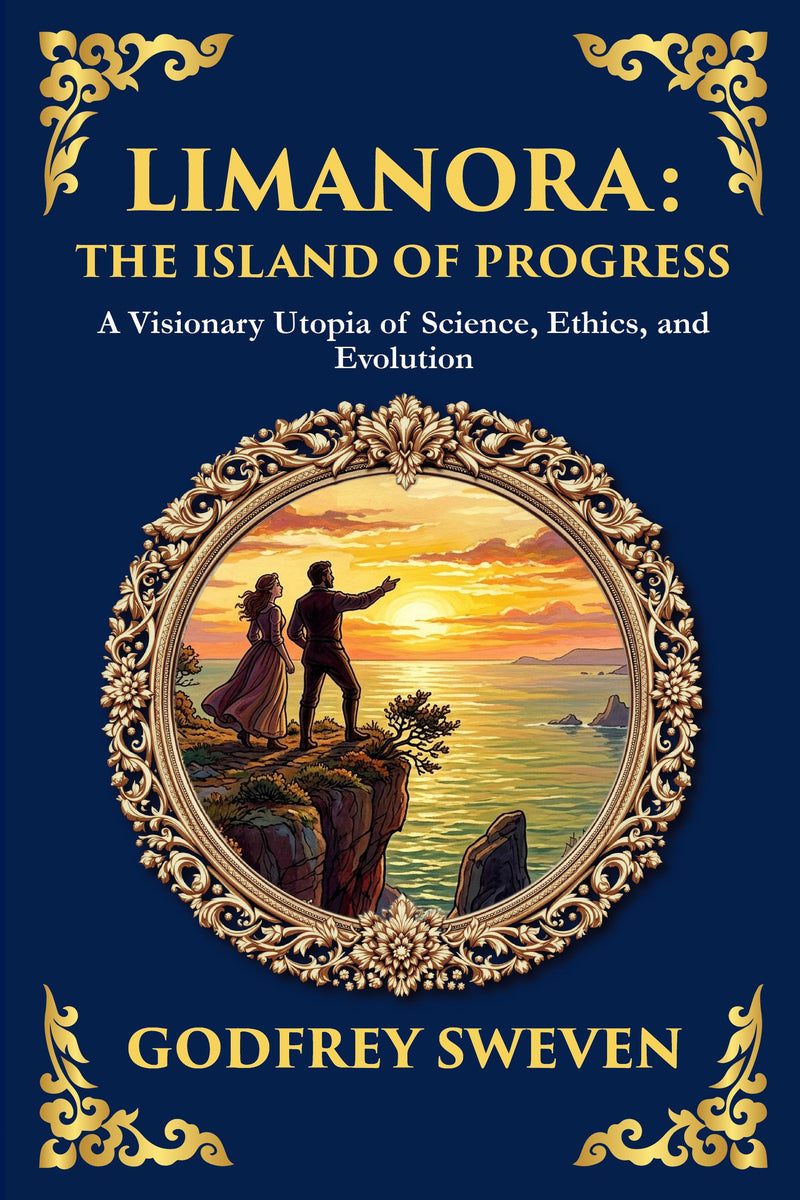
Limanora: the island of progress — Large Print
First published in 1903, Limanora: The Island of Progress is a bold philosophical novel that imagines a hidden island where humanity has evolved beyond war, vice, and ignorance.
or free app
10,000+ hrs library
30-day guarantee
The complete Limanora: The Island of Progress appears in modern English through Library of Alexandria Press, available online with audiobook narration included for members.
Have you ever wondered why humanity struggles to evolve beyond its flaws—even when it knows better? Limanora: The Island of Progress by Godfrey Sweven is a forgotten classic that envisions a future untouched by the chaos and corruption of modern society. Hidden in the vast South Pacific lies the island of Limanora—an isolated utopia ruled not by force, but by intellect, ethics, and disciplined evolution.
Sweven’s narrative, told through the journal of an unexpected castaway, introduces us to a civilization that has systematically eliminated crime, prejudice, greed, and ignorance. Through scientific advancement and cultural purification, the Limanorans have elevated themselves into near-perfection—yet not without sacrifice. This profound and prescient novel serves as a philosophical exploration of idealism, discipline, human potential, and the dangerous allure of comfort.
Sweven critiques both Western decadence and spiritual inertia, proposing instead a world of harmony forged through rigorous self-betterment.
What you’ll discover in this modern edition
- A Hidden Civilization Perfected by Science and Ethics – Enter Limanora, where society is built on conscious evolution and collective intelligence
- A Journey of Self-Discovery Through an Outsider’s Eyes – Follow the narrator as he confronts his own limitations and the flaws of his homeland
- A Critique of Modern Society’s Decay – Explore themes of greed, ignorance, colonialism, and complacency in contrast to rational order
- Philosophy Meets Fiction in an Early Sci-Fi Masterwork – A spiritual and cerebral precursor to Huxley, Wells, and Orwell
- A Challenge to the Reader’s Worldview – What price are we willing to pay for progress—and who defines it? For fans of utopian fiction, speculative philosophy, and transformative literature, Limanora is a compelling and timely rediscovery.
| Formats | eBook (EPUB + PDF) · Audiobook · Paperback · Hardcover · Large Print |
| Language | English |
| Trim size (print) | 6 × 9 in |
| Binding | Paperback — perfect-bound · Hardcover — casewrap |
| Large Print edition | Same text in a larger, easy-read type — a larger font, not a larger trim |
| Print pricing | Every physical book at our true cost — at-cost, no profit (members) |
| Library | 873 restored titles, always growing |
| Length | 193,251 words · ~12 hr 53 min reading |
| Reading level | Grade 14 · a demanding, literary read (this modern-English edition) |
| Edition | Modern English translation · 2026 |
Member reviews for this edition are collected as readers finish it — be the first. Across the library: 12,000+ books shipped, every plan covered by a 365-day print guarantee.
About this edition
A faithful, unabridged modern-English edition by The Library of Alexandria — carefully rendered for today's reader and verified paragraph-by-paragraph against the public-domain source. Available as eBook, audiobook, paperback, hardcover, and large print.
- Complete & unabridgedVerified paragraph by paragraph against the source — never a scan, never abridged.
- Modern English, faithfulReadable today, with the author’s meaning kept intact. Readable — not simplified.
- Every format, one membershipRead in your browser or the free app, or listen to the full audiobook.
Included free with your membership
Cancel anytime, one click · 30-day money-back guarantee
Edition last updated July 2026
What’s inside
Limanora: the island of progress — Large Print — complete and unabridged: all 60 sections included with membership, plus the full audiobook.
Begin reading Limanora: the island of progress — Large Print
In clear modern English — the complete text is included with membership.
Introduction
There is a particular kind of book that arrives in the world slightly ahead of its time, finds a modest audience, and then slips quietly beneath the surface of literary history — not because it failed, but because the world was not yet ready to know what to do with it. The volume you are holding is precisely such a book. Published in New York in June of 1903 by G. P. Putnam’s Sons under the imprint of the Knickerbocker Press, it appeared as the second installment in a two-part sequence, following its companion volume Riallaro: The Archipelago of Exiles, and it was attributed on its title page to one “Godfrey Sweven.” That name is a pseudonym — a carefully chosen one, as we shall see — and the question of who actually wrote these books has never been resolved with complete certainty. What is certain is that the work itself is extraordinary: a sustained, visionary, philosophically ambitious piece of speculative fiction that deserves to stand alongside the great utopian and scientific romances of its era, and that has been unjustly neglected for over a century.
The pseudonym “Godfrey Sweven” is itself a small act of literary art. “Sweven” is an archaic English word meaning a dream or vision, particularly one experienced during sleep — a word that had largely vanished from common usage by the nineteenth century but that would have been recognizable to any reader with a taste for older literature. The choice signals immediately that the author is learned, deliberate, and interested in the relationship between dreaming and knowing. It also establishes a kind of protective distance between the writer and the work, which is appropriate, because the ideas contained in these pages are radical enough that their author might reasonably have wished to advance them from behind a veil. The scholarly consensus, held with varying degrees of confidence, points toward a New Zealand academic of the late Victorian and Edwardian period, but the attribution has never been definitively proven, and this edition makes no claim beyond what the evidence supports. What matters for our purposes is not the biography of the author but the biography of the book itself — where it came from, what it is doing, and why it rewards the attention of a reader in the present century far more richly than it could have rewarded a reader in 1903.
To understand what you are about to read, it helps to situate it within the broader tradition of utopian fiction, while also understanding why it ultimately transcends that tradition in ways that make the label feel inadequate. The nineteenth century produced an enormous quantity of imaginary societies — from Samuel Butler’s Erewhon to Edward Bellamy’s Looking Backward to William Morris’s News from Nowhere — and by 1903 the genre was well established, its conventions familiar, its pleasures and limitations well understood. The typical utopian novel of the period works by contrast: a traveler from the imperfect present arrives in a perfected future or a hidden perfect place, is shown around by a patient guide, and the reader is invited to measure the distance between what is and what could be. The didactic machinery is usually fairly visible. The fiction is often thin, a transparent vehicle for social argument.
What Sweven does is something considerably more ambitious and considerably stranger. The world he constructs is not simply a better version of our own, with improved politics and more equitable economics. It is a civilization that has been evolving, in deliberate and systematic isolation, for so long that it has become genuinely alien — alien in its technology, alien in its social organization, alien in its sensory life, and most profoundly alien in its understanding of what a human being is and what a human being might become. The narrator who arrives on this island is not a tourist being shown improvements. He is an explorer encountering a form of life so advanced that he can barely comprehend it, and the book’s great achievement is that it makes the reader feel this incomprehension as a genuine intellectual and emotional experience rather than a rhetorical device.
The glossary appended to the original edition — reproduced in this volume — is one of the first things a new reader encounters, and it deserves a moment’s attention before we go further. It lists dozens of invented Limanoran words, each corresponding to a technology, institution, or concept that does not exist in the world the narrator comes from. There is the airolan, a sensometer for finding the personal equation of a man. There is the ammerlin, a historoscope. There is the filammu, a will-telegraph. There is the mornalan, a time-telescope. There is the ooaran, a psychometer. There is the duomovamolan, an instrument that interprets the music of the cosmos. Reading through this list before beginning the narrative proper is a quietly vertiginous experience, because the words are precise and systematic — they have the feel of a real language, with recognizable roots and consistent morphology — and yet they describe things that in 1903 did not exist and that in many cases still do not exist today. The glossary is not decoration. It is a map of a mind, and of a civilization, that has organized its relationship to reality along entirely different lines than our own.
The single most useful piece of advice this editor can offer is this: resist the temptation to read this book as a novel in the conventional sense, and resist equally the temptation to read it as a treatise. It is neither, and approaching it as either will produce frustration. What it is, more precisely, is a work of sustained philosophical imagination rendered in the form of a first-person narrative — and the narrative voice is one of the book’s great pleasures, because the narrator is genuinely bewildered, genuinely moved, and genuinely changed by what he encounters. He is not a cipher or a mouthpiece. He is a man from our world — limited, habituated, carrying the weight of assumptions he does not know he has — and watching him encounter Limanoran civilization is watching a mind being slowly and sometimes painfully expanded.
The book is organized, as its subtitle suggests, around the idea of progress — but progress understood in a far more comprehensive and radical sense than the word usually carries. The Limanorans have not simply progressed technologically, though their technology is staggering. They have progressed biologically, psychologically, aesthetically, morally, and spiritually, and they understand all of these dimensions of progress as interconnected, as aspects of a single project that they have been pursuing with extraordinary discipline and patience across many generations. The book’s structure reflects this comprehensiveness: it moves from what it calls the outer or material civilization — the physical environment, the architecture, the technology, the organization of daily life — toward increasingly interior and subtle dimensions of Limanoran achievement, culminating in areas of human development that our own civilization has barely begun to conceptualize.
This means that the book rewards a particular kind of reading attention — one that is willing to slow down, to sit with descriptions that may initially seem excessive or digressive, and to allow the cumulative effect of detail to do its work. Sweven is not a writer who trusts the quick sketch. He builds his world through accretion, through the patient layering of sensory and intellectual detail, and readers who give themselves over to this rhythm will find that the world becomes genuinely immersive in a way that faster-paced fiction rarely achieves. The opening pages, in which the narrator wakes in a room of iridescent, crystalline architecture and gradually becomes aware of a new sense being awakened in him — what the Limanorans call the firla, an electric sense that supplements and in some ways surpasses the ordinary five — are among the most beautiful pieces of descriptive prose in the literature of the period, and they establish a tone of wondering, almost reverent attention that the book sustains across its considerable length.
It is also worth knowing, before you begin, that this is the second volume of a sequence. The first volume, Riallaro, follows the narrator through an archipelago of satirical islands — each one a kind of exaggerated caricature of some human failing or social pathology — before he finally arrives at the shores of Limanora. You do not need to have read Riallaro to follow and enjoy this volume; Sweven provides sufficient context within the narrative itself, and the two books are quite different in tone and method, the first being more conventionally satirical and the second being more purely visionary. But readers who find themselves captivated by this volume and wish to understand more fully where the narrator has come from, and what he has seen and survived before his arrival, will find Riallaro a rewarding companion.
It is one of the more striking facts about this book that so many of its imaginative inventions have turned out to be genuinely prophetic — not in the crude sense of having predicted specific technologies, but in the deeper sense of having identified the directions in which human civilization would need to develop if it were to survive and flourish. The Limanorans have solved problems that in 1903 were barely recognized as problems and that in our own time have become urgent to the point of crisis.
Consider their relationship to the environment. The Limanorans do not exploit their island; they have developed, over centuries, a form of civilization that is in dynamic equilibrium with its natural setting, that draws on natural processes rather than overriding them, and that has made the health of the ecosystem a central concern of social organization. This is not presented as a sacrifice or a limitation but as an achievement — as evidence of a more sophisticated understanding of what human beings are and what they need. The alfarene, or oxygen shrub, the floronal, or tree of life, the entire botanical dimension of Limanoran civilization — these are not background details but expressions of a philosophy that refuses to separate human flourishing from the flourishing of the living world.
Consider their approach to medicine and the body. The Limanorans have moved far beyond the treatment of disease toward the systematic cultivation of health — not merely physical health but the health of the whole person, understood as a unity of body, mind, and what we might call spirit, though the Limanorans would use more precise and less metaphysically loaded language. Their oomalefa, or halls of nutrition and medication, are not hospitals in our sense; they are places where the relationship between the individual and the conditions of life is continuously monitored and adjusted. Their sidralan, or biometer, and their ooaran, or psychometer, are instruments for measuring dimensions of human wellbeing that our own medicine has only recently begun to take seriously.
Consider their understanding of education and human development. The Limanorans do not educate their children in the sense of filling them with information. They cultivate capacities — perceptual, emotional, intellectual, moral — with the same care and sophistication that a master gardener brings to the cultivation of rare plants. They understand that the development of a human being is a biological process as much as a cultural one, and they have organized their society around supporting that process at every stage. The result, as the narrator discovers, is a population of individuals who are not merely more knowledgeable than the people he has known but more alive — more fully present to their own experience, more capable of genuine relationship, more able to act from their deepest values rather than from habit or fear.
And consider, perhaps most remarkably, their approach to the future itself. The Limanorans have institutions — the loomiamo and the fraloomiamo, the families of pioneers who imagine and represent the links between the present and the distant future — whose entire function is to think carefully and systematically about what is coming and to prepare for it. They do not simply react to change; they anticipate it, shape it, and take responsibility for it across timescales that dwarf anything our own civilization has managed to sustain. In an era when the consequences of short-term thinking have become visible on a global scale, this aspect of Limanoran civilization feels less like fantasy and more like a description of what survival will require.
Cancel anytime, one click · 30-day money-back guarantee
Founding annual rate available now — your price locks for life when you join.
Not ready? Get this free chapter by email — read it anytime.
✓ Sent — check your inbox for Limanora: the island of progress — Large Print.
Questions about Limanora: the island of progress — Large Print
What is Limanora: The Island of Progress about?
First published in 1903, Limanora: The Island of Progress is a bold philosophical novel that imagines a hidden island where humanity has evolved beyond war, vice, and ignorance. Governed by ethics, science, and rational beauty, the Limanorans have perfected civilization through generations of conscious evolution—social, moral, and biological. Through the eyes of a stranded traveler, readers are transported to a society unlike any other: one where passion is refined into intellect, technology is guided by morality,
Who wrote Limanora: The Island of Progress?
Limanora: The Island of Progress was written by Godfrey Sweven. This edition presents the complete work in clear modern English, faithfully rendered from the public-domain original by Library of Alexandria Press.
Is Limanora: The Island of Progress free to read?
The opening chapter is free to read on this page. Members read and listen to the complete work — and the entire library — free, and can order any physical book at our true print cost.
How long is Limanora: The Island of Progress?
60 chapters (~193,251 words) — about 12 hr 53 min of reading in this modern-English edition.
Is this an abridged version of Limanora: The Island of Progress?
No. This is the complete, unabridged Limanora: The Island of Progress, carefully rendered into clear modern English and verified paragraph-by-paragraph against the public-domain source — nothing is cut or summarised.
What formats does Limanora: The Island of Progress come in?
Limanora: The Island of Progress is available as eBook, paperback and hardcover. eBook and audiobook are included with membership; printed editions ship at our true print cost.
Shipping & returns
Billing & membership
More from the library


Explore Science Fiction
- The Island of Doctor Moreau · H. G. Wells
- A Midsummer Night’s Dream · William Shakespeare
- The Invisible Man: A Grotesque Romance · H. G. Wells
- The War of the Worlds · H. G. Wells
- The Strange Case of Dr. Jekyll and Mr. Hyde · Robert Louis Stevenson
- Limanora: the island of progress · Godfrey Sweven
- The Book of Dragons · E. Nesbit
- She · H. Rider Haggard
- Dorothy and the Wizard in Oz · L. Frank Baum
- The Princess and the Goblin · George MacDonald
- Gawayne and the Green Knight: A Fairy Tale · Charlton M. Lewis
- Lucian’s True History · Lucian of Samosata
- The Willows · Algernon Blackwood
- The Call of Cthulhu · H. P. Lovecraft
- The Life-Eater · Harold Ward
- The Marvelous Land of Oz · L. Frank Baum
- Mars is My Destination · Frank Belknap Long
- The Black Kiss
- The Beasts in the Void · Paul W. Fairman
- John Jones’s Dollar · Harry Stephen Keeler
- Subversive · Mack Reynolds
- The Mississippi Saucer · Frank Belknap Long
- Man of Distinction · Michael Shaara
- Spawn of the Comet · H. Thompson Rich
- The Golden Judge · Nathaniel Gordon
- Final Weapon · Everett B. Cole
- The Big Fix · George O. Smith
- Last Enemy · H. Beam Piper
- Time and Time Again · H. Beam Piper
- Sabotage in Space · Carey Rockwell
Limanora: the island of progress — Large Print
Limanora: the island of progress — Large Print
A Modern Translation
Godfrey Sweven
Contents
- Introduction
- Chapter 1
- Chapter 2
- Chapter 3
- Chapter 4
- Chapter 5
- Chapter 6
- Chapter 7
- Chapter 8
- Chapter 9
- Chapter 10
- Chapter 11
- Chapter 12
- Chapter 13
- Chapter 14
- Chapter 15
- Chapter 16
- Chapter 17
- Chapter 18
- Chapter 19
- Chapter 20
- Chapter 21
- Chapter 22
- Chapter 23
- Chapter 24
- Chapter 25
- Chapter 26
- Chapter 27
- Chapter 28
- Chapter 29
- Chapter 30
- Chapter 31
- Chapter 32
- Chapter 33
- Chapter 34
- Chapter 35
- Chapter 36
- Chapter 37
- Chapter 38
- Chapter 39
- … and 20 more chapters
Introduction
There is a particular kind of book that arrives in the world slightly ahead of its time, finds a modest audience, and then slips quietly beneath the surface of literary history — not because it failed, but because the world was not yet ready to know what to do with it. The volume you are holding is precisely such a book. Published in New York in June of 1903 by G. P. Putnam’s Sons under the imprint of the Knickerbocker Press, it appeared as the second installment in a two-part sequence, following its companion volume Riallaro: The Archipelago of Exiles, and it was attributed on its title page to one “Godfrey Sweven.” That name is a pseudonym — a carefully chosen one, as we shall see — and the question of who actually wrote these books has never been resolved with complete certainty. What is certain is that the work itself is extraordinary: a sustained, visionary, philosophically ambitious piece of speculative fiction that deserves to stand alongside the great utopian and scientific romances of its era, and that has been unjustly neglected for over a century.
The pseudonym “Godfrey Sweven” is itself a small act of literary art. “Sweven” is an archaic English word meaning a dream or vision, particularly one experienced during sleep — a word that had largely vanished from common usage by the nineteenth century but that would have been recognizable to any reader with a taste for older literature. The choice signals immediately that the author is learned, deliberate, and interested in the relationship between dreaming and knowing. It also establishes a kind of protective distance between the writer and the work, which is appropriate, because the ideas contained in these pages are radical enough that their author might reasonably have wished to advance them from behind a veil. The scholarly consensus, held with varying degrees of confidence, points toward a New Zealand academic of the late Victorian and Edwardian period, but the attribution has never been definitively proven, and this edition makes no claim beyond what the evidence supports. What matters for our purposes is not the biography of the author but the biography of the book itself — where it came from, what it is doing, and why it rewards the attention of a reader in the present century far more richly than it could have rewarded a reader in 1903.
To understand what you are about to read, it helps to situate it within the broader tradition of utopian fiction, while also understanding why it ultimately transcends that tradition in ways that make the label feel inadequate. The nineteenth century produced an enormous quantity of imaginary societies — from Samuel Butler’s Erewhon to Edward Bellamy’s Looking Backward to William Morris’s News from Nowhere — and by 1903 the genre was well established, its conventions familiar, its pleasures and limitations well understood. The typical utopian novel of the period works by contrast: a traveler from the imperfect present arrives in a perfected future or a hidden perfect place, is shown around by a patient guide, and the reader is invited to measure the distance between what is and what could be. The didactic machinery is usually fairly visible. The fiction is often thin, a transparent vehicle for social argument.
What Sweven does is something considerably more ambitious and considerably stranger. The world he constructs is not simply a better version of our own, with improved politics and more equitable economics. It is a civilization that has been evolving, in deliberate and systematic isolation, for so long that it has become genuinely alien — alien in its technology, alien in its social organization, alien in its sensory life, and most profoundly alien in its understanding of what a human being is and what a human being might become. The narrator who arrives on this island is not a tourist being shown improvements. He is an explorer encountering a form of life so advanced that he can barely comprehend it, and the book’s great achievement is that it makes the reader feel this incomprehension as a genuine intellectual and emotional experience rather than a rhetorical device.
The glossary appended to the original edition — reproduced in this volume — is one of the first things a new reader encounters, and it deserves a moment’s attention before we go further. It lists dozens of invented Limanoran words, each corresponding to a technology, institution, or concept that does not exist in the world the narrator comes from. There is the airolan, a sensometer for finding the personal equation of a man. There is the ammerlin, a historoscope. There is the filammu, a will-telegraph. There is the mornalan, a time-telescope. There is the ooaran, a psychometer. There is the duomovamolan, an instrument that interprets the music of the cosmos. Reading through this list before beginning the narrative proper is a quietly vertiginous experience, because the words are precise and systematic — they have the feel of a real language, with recognizable roots and consistent morphology — and yet they describe things that in 1903 did not exist and that in many cases still do not exist today. The glossary is not decoration. It is a map of a mind, and of a civilization, that has organized its relationship to reality along entirely different lines than our own.
The single most useful piece of advice this editor can offer is this: resist the temptation to read this book as a novel in the conventional sense, and resist equally the temptation to read it as a treatise. It is neither, and approaching it as either will produce frustration. What it is, more precisely, is a work of sustained philosophical imagination rendered in the form of a first-person narrative — and the narrative voice is one of the book’s great pleasures, because the narrator is genuinely bewildered, genuinely moved, and genuinely changed by what he encounters. He is not a cipher or a mouthpiece. He is a man from our world — limited, habituated, carrying the weight of assumptions he does not know he has — and watching him encounter Limanoran civilization is watching a mind being slowly and sometimes painfully expanded.
The book is organized, as its subtitle suggests, around the idea of progress — but progress understood in a far more comprehensive and radical sense than the word usually carries. The Limanorans have not simply progressed technologically, though their technology is staggering. They have progressed biologically, psychologically, aesthetically, morally, and spiritually, and they understand all of these dimensions of progress as interconnected, as aspects of a single project that they have been pursuing with extraordinary discipline and patience across many generations. The book’s structure reflects this comprehensiveness: it moves from what it calls the outer or material civilization — the physical environment, the architecture, the technology, the organization of daily life — toward increasingly interior and subtle dimensions of Limanoran achievement, culminating in areas of human development that our own civilization has barely begun to conceptualize.
This means that the book rewards a particular kind of reading attention — one that is willing to slow down, to sit with descriptions that may initially seem excessive or digressive, and to allow the cumulative effect of detail to do its work. Sweven is not a writer who trusts the quick sketch. He builds his world through accretion, through the patient layering of sensory and intellectual detail, and readers who give themselves over to this rhythm will find that the world becomes genuinely immersive in a way that faster-paced fiction rarely achieves. The opening pages, in which the narrator wakes in a room of iridescent, crystalline architecture and gradually becomes aware of a new sense being awakened in him — what the Limanorans call the firla, an electric sense that supplements and in some ways surpasses the ordinary five — are among the most beautiful pieces of descriptive prose in the literature of the period, and they establish a tone of wondering, almost reverent attention that the book sustains across its considerable length.
It is also worth knowing, before you begin, that this is the second volume of a sequence. The first volume, Riallaro, follows the narrator through an archipelago of satirical islands — each one a kind of exaggerated caricature of some human failing or social pathology — before he finally arrives at the shores of Limanora. You do not need to have read Riallaro to follow and enjoy this volume; Sweven provides sufficient context within the narrative itself, and the two books are quite different in tone and method, the first being more conventionally satirical and the second being more purely visionary. But readers who find themselves captivated by this volume and wish to understand more fully where the narrator has come from, and what he has seen and survived before his arrival, will find Riallaro a rewarding companion.
It is one of the more striking facts about this book that so many of its imaginative inventions have turned out to be genuinely prophetic — not in the crude sense of having predicted specific technologies, but in the deeper sense of having identified the directions in which human civilization would need to develop if it were to survive and flourish. The Limanorans have solved problems that in 1903 were barely recognized as problems and that in our own time have become urgent to the point of crisis.
Consider their relationship to the environment. The Limanorans do not exploit their island; they have developed, over centuries, a form of civilization that is in dynamic equilibrium with its natural setting, that draws on natural processes rather than overriding them, and that has made the health of the ecosystem a central concern of social organization. This is not presented as a sacrifice or a limitation but as an achievement — as evidence of a more sophisticated understanding of what human beings are and what they need. The alfarene, or oxygen shrub, the floronal, or tree of life, the entire botanical dimension of Limanoran civilization — these are not background details but expressions of a philosophy that refuses to separate human flourishing from the flourishing of the living world.
Consider their approach to medicine and the body. The Limanorans have moved far beyond the treatment of disease toward the systematic cultivation of health — not merely physical health but the health of the whole person, understood as a unity of body, mind, and what we might call spirit, though the Limanorans would use more precise and less metaphysically loaded language. Their oomalefa, or halls of nutrition and medication, are not hospitals in our sense; they are places where the relationship between the individual and the conditions of life is continuously monitored and adjusted. Their sidralan, or biometer, and their ooaran, or psychometer, are instruments for measuring dimensions of human wellbeing that our own medicine has only recently begun to take seriously.
Consider their understanding of education and human development. The Limanorans do not educate their children in the sense of filling them with information. They cultivate capacities — perceptual, emotional, intellectual, moral — with the same care and sophistication that a master gardener brings to the cultivation of rare plants. They understand that the development of a human being is a biological process as much as a cultural one, and they have organized their society around supporting that process at every stage. The result, as the narrator discovers, is a population of individuals who are not merely more knowledgeable than the people he has known but more alive — more fully present to their own experience, more capable of genuine relationship, more able to act from their deepest values rather than from habit or fear.
And consider, perhaps most remarkably, their approach to the future itself. The Limanorans have institutions — the loomiamo and the fraloomiamo, the families of pioneers who imagine and represent the links between the present and the distant future — whose entire function is to think carefully and systematically about what is coming and to prepare for it. They do not simply react to change; they anticipate it, shape it, and take responsibility for it across timescales that dwarf anything our own civilization has managed to sustain. In an era when the consequences of short-term thinking have become visible on a global scale, this aspect of Limanoran civilization feels less like fantasy and more like a description of what survival will require.
I opened my eyes in a world where I recognized nothing. Everything around me was breathtakingly beautiful. The walls and vaulted ceiling of the room where I lay shimmered like mosaic jewelry. The floors were more muted, yet they glowed with a colored radiance similar to a dew-covered meadow under the slanted light of a mid-morning sun. The light broke across the countless angles and corners of the ceiling in a magnificent display of prismatic colors that shifted every minute. Despite all this marvelous iridescence, there was enough shade in the vault and walls to block the oppressive heat of the sun. I had dreamed of fairy palaces like this, but those dreams had always been incomplete or had turned into something hideous or terrifying. This architecture was as different from anything I had seen on Earth as a dream is, yet it possessed a grace that no dream had ever captured.
I did not know what material the room was made of. It looked like ice, yet it was unaffected by the sun’s heat. It could be molded into the most delicate lace-work, yet it could also be as massive as the marble walls of Eastern palaces built for both luxury and defense. Some parts were as transparent as glass, while others were frosted with wonderful images. How were those countless domes, arches, and tree-like columns produced so easily? How were those airy galleries suspended? How were those fragrant fountains balanced so precisely that a baby’s finger seemed capable of knocking them over? Even the gently moving curtains had the same crystalline quality as the walls—sometimes frosted like a winter morning, sometimes goldenly dim, or colored like a rainbow.
End of the free sample
Keep reading, free
Members read and listen to the complete book — and the entire library. Cancel anytime, one click · 30-day money-back guarantee.