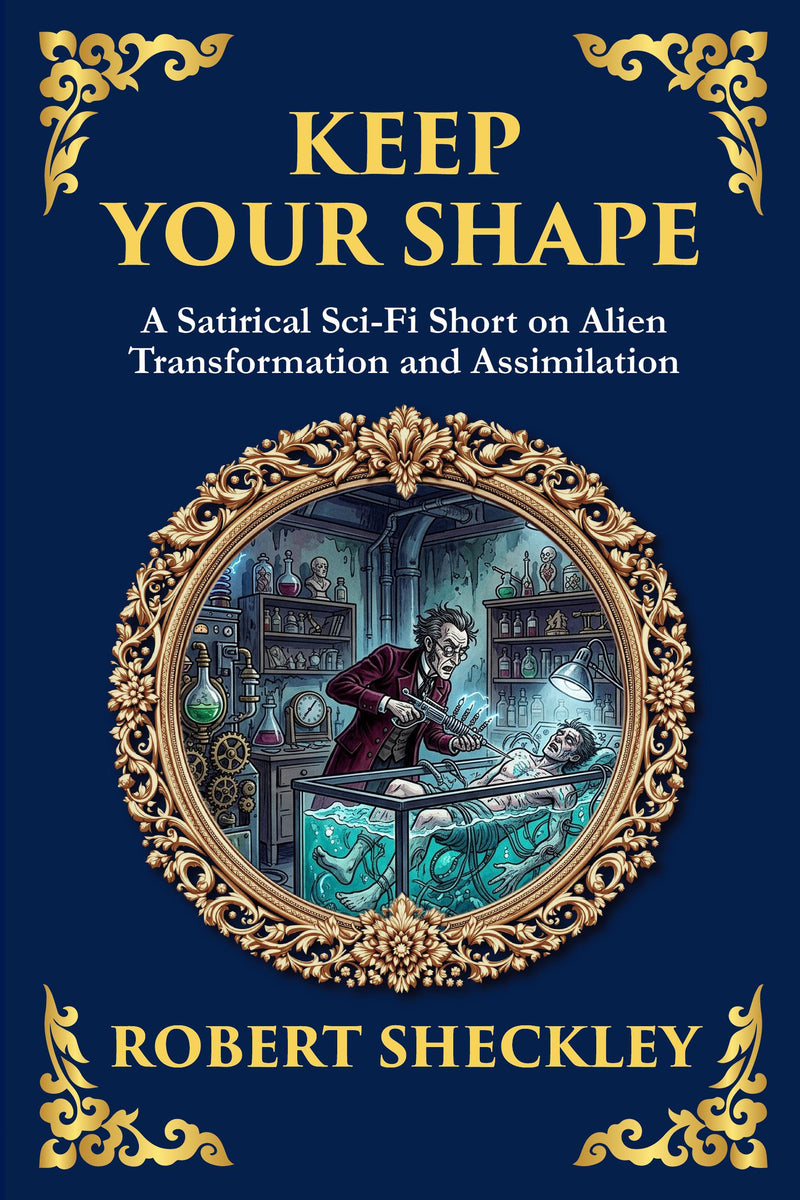
Keep Your Shape
In this biting satirical tale, alien beings capable of limitless transformation are sent to Earth with a mission: blend in, conquer, and control.
or free app
10,000+ hrs library
30-day guarantee
The complete Keep Your Shape appears in modern English through Library of Alexandria Press, available online with audiobook narration included for members.
Have you ever wondered why trying to fit in can sometimes mean losing yourself completely? Robert Sheckley, master of satirical science fiction, delivers a sharp, witty exploration of identity, conformity, and human absurdity in Keep Your Shape. Through the eyes of alien shapeshifters sent to infiltrate Earth, Sheckley exposes both the comedy and tragedy of transformation.
What begins as a straightforward mission soon turns into a crisis of identity. If you can take any form, does your true self even exist? And what happens when you begin to prefer the life you’re supposed to be imitating over the one you were meant to serve?
With his trademark mix of irony, wit, and philosophical bite, Sheckley turns science fiction into a mirror for humanity’s most timeless struggles.
What you’ll discover in this modern edition
- The Alien Art of Disguise – Explore the concept of shapeshifting as both a survival skill and an existential dilemma.
- The Absurdity of Assimilation – See how adapting too well to human life raises unsettling questions about loyalty and selfhood.
- A Playful Critique of Humanity – Sheckley holds up a mirror to society, highlighting our contradictions, vanities, and fears.
- The Comedy of Transformation – Dark humor and sharp satire infuse this tale of cosmic infiltration gone sideways.
- A Philosophical Sci-Fi Short – A brief yet profound story that lingers long after the last page.
| Formats | eBook (EPUB + PDF) · Audiobook · Paperback · Hardcover · Large Print |
| Language | English |
| Trim size (print) | 6 × 9 in |
| Binding | Paperback — perfect-bound · Hardcover — casewrap |
| Large Print edition | Same text in a larger, easy-read type — a larger font, not a larger trim |
| Print pricing | Every physical book at our true cost — at-cost, no profit (members) |
| Library | 873 restored titles, always growing |
| Length | 9,288 words · ~37 min reading |
| Reading level | Grade 5 · an easy, flowing read (this modern-English edition) |
| Edition | Modern English translation · 2026 |
Member reviews for this edition are collected as readers finish it — be the first. Across the library: 12,000+ books shipped, every plan covered by a 365-day print guarantee.
About this edition
A faithful, unabridged modern-English edition by The Library of Alexandria — carefully rendered for today's reader and verified paragraph-by-paragraph against the public-domain source. Available as eBook, audiobook, paperback, hardcover, and large print.
- Complete & unabridgedVerified paragraph by paragraph against the source — never a scan, never abridged.
- Modern English, faithfulReadable today, with the author’s meaning kept intact. Readable — not simplified.
- Every format, one membershipRead in your browser or the free app, or listen to the full audiobook.
Included free with your membership
Cancel anytime, one click · 30-day money-back guarantee
Edition last updated July 2026
What’s inside
Keep Your Shape — complete and unabridged, included in full with membership, plus the full audiobook.
Begin reading Keep Your Shape
In clear modern English — the complete text is included with membership.
Introduction
There are writers who entertain, writers who provoke, and writers who quietly slip a blade between the ribs of your assumptions while you are too busy laughing to notice. Robert Sheckley belonged firmly to that third, rarest category. To read him is to be charmed and disarmed in the same breath, to find yourself nodding along to an absurd premise only to discover, several pages later, that the absurdity was pointing directly at you the entire time. The short work you are about to read is a perfect specimen of his particular genius: brief, deceptively light, and quietly devastating. It is the kind of story that takes ten minutes to read and a lifetime to fully unpack.
Sheckley wrote during what is often called the Golden Age of science fiction, a period when the genre was busy imagining rocket ships, robot armies, and galactic empires. He participated in all of that enthusiastically, but he was never content to simply marvel at the hardware. While many of his contemporaries asked what if we could build a machine that does this?, Sheckley asked the far more dangerous question: what kind of creature would we have to be to want such a machine, and what would it cost us to keep it? His tales are populated with gadgets and aliens and faraway worlds, but their true subject is always the human animal — its appetites, its rationalizations, its terror of being left alone, and its almost limitless capacity to talk itself into terrible choices for entirely reasonable-sounding motives.
This particular story belongs to a lineage of mid-century speculative fiction that used the alien encounter not as an excuse for spectacle but as a mirror. The premise — beings who must hold a particular form, who are bound by rules about what they may and may not become — sounds at first like the setup for a straightforward adventure. And indeed, on its surface, it offers the pleasures of one: tension, peril, the slow tightening of stakes, the dawning of dread. But beneath that surface runs a current of inquiry so sharp that it cuts through decades. What does it mean to keep your shape? What does it cost to lose it? And is the loss always a tragedy, or might it sometimes be something the loser welcomes, even celebrates? These are not idle questions. They sit at the heart of every debate about identity, conformity, freedom, and belonging that human societies have ever conducted — and they have only grown more urgent in the years since Sheckley first set them down.
Robert Sheckley was born in 1928 in New York City and grew up in New Jersey, in the kind of ordinary American childhood that would later furnish his fiction with its instantly recognizable everyman voices. He served in the Army in Korea, attended New York University, and emerged into the early 1950s precisely when the science fiction magazines — Galaxy, Astounding, The Magazine of Fantasy and Science Fiction — were hungry for fresh, clever, fast-moving short fiction. Sheckley fed that hunger with extraordinary productivity and an even more extraordinary consistency of wit. Within a few years he had become one of the most distinctive voices in the field, a writer whose name on a contents page promised something nobody else was quite delivering.
What set him apart was tone. The dominant mode of pulp-era science fiction was earnest, sometimes ponderously so. Sheckley arrived with a grin and a raised eyebrow. He wrote satire that never curdled into mere cynicism, comedy that never sacrificed its underlying seriousness, and absurdity that always obeyed an inner logic so rigorous you could not quite dismiss it. His stories tend to begin in a recognizable, almost cozy reality and then proceed, one perfectly reasonable step at a time, into the genuinely surreal — and the horror, when it comes, arrives not as a monster bursting through a wall but as the slow realization that you walked into the trap of your own free will, agreeing with every step along the way.
It is worth understanding that Sheckley was, in a sense, the conscience of his genre’s lighter side. Where other authors imagined utopias and dystopias on a grand scale, he preferred the intimate disaster, the personal compromise, the moment when a single individual — or a small group — must decide who they are and what they will tolerate. His work anticipated, decades early, the questions that would later preoccupy entire bookshelves of philosophy and cultural criticism. He saw that the great threat to the self was not always violence or oppression. Sometimes it was comfort. Sometimes it was the seductive ease of giving up.
His influence radiated far beyond the magazines. Douglas Adams, the creator of The Hitchhiker’s Guide to the Galaxy, owed an obvious debt to Sheckley’s blend of cosmic scale and deadpan domestic comedy. The absurdist machinery of so much later science fiction — the bureaucracies in space, the talking devices with opinions, the aliens who behave like petty officials or anxious neighbors — traces a clear line back to his desk. Several of his stories were adapted for film and television, including the basis for the cult favorite The Tenth Victim. Yet for all this reach, Sheckley remains, even now, slightly underread relative to his importance, perhaps because his preferred form was the short story rather than the doorstop novel, and perhaps because his humor caused some readers to underestimate the depth of what he was actually saying. That underestimation is precisely the mistake this introduction hopes to help you avoid.
To approach Sheckley correctly, you should resist the temptation to read him only for the joke. The jokes are excellent, and you should enjoy them fully. But every laugh he earns is a setup. He is loosening your grip, lowering your guard, getting you to relax into the rhythm of his prose — and then he strikes. The story before you operates exactly this way. It will amuse you. It will move quickly. And somewhere in its closing movement, it will hand you a question you did not expect to be asked, a question that will likely stay with you long after the last line.
The text in this volume has been prepared as a modern translation, adapted for the contemporary reader. This requires a word of explanation, because the phrase can mean different things, and you deserve to know what it means here. Sheckley wrote in clear, vigorous mid-twentieth-century American English, and the goal of this edition is not to rewrite him or to flatten the particular flavor of his voice. Rather, it is to gently smooth those points where the passage of decades has introduced friction — references that have faded from common knowledge, turns of phrase that now read as quaint in ways that distract rather than charm, rhythms of sentence and paragraph that have shifted between his era and ours. The intention throughout has been to preserve everything essential — the wit, the pacing, the sting — while ensuring that nothing incidental stands between you and the experience he intended. Think of it as cleaning a window rather than repainting the view. The story remains his. The clarity is for you.
The title of this work is also its central instruction, its warning, and its quiet tragedy all at once: Keep Your Shape. Hold onto it. Three small words that sound, at first, almost trivial — the kind of thing you might say to a soufflé or a hairstyle. But sit with them, and they begin to expand. To keep your shape is to remain what you are. It is to resist the forces, internal and external, that would have you become something else. And the question that animates this entire story, the question Sheckley turns over and over with the patient cruelty of a master, is whether keeping your shape is an act of strength or an act of stubbornness — whether it is loyalty or merely fear, whether it is salvation or a kind of slow self-imposed imprisonment.
Without revealing the particulars of what unfolds — and you should come to those particulars fresh, because surprise is one of the story’s chief pleasures — it is fair to say that this is a tale about a mission, a set of rules, and the agonizing collision between duty and desire. It concerns beings who carry within them tremendous capacities, and who are forbidden, by training and discipline and dire necessity, from indulging those capacities. They must stay as they are. They must not change. The penalty for change is catastrophe — or so they have been taught. And the entire drama of the story arises from the simple, terrible fact that staying the same is hard, and that the world around them offers a thousand sweet invitations to let go.
This is, of course, a story that can be read on multiple levels simultaneously, and part of Sheckley’s brilliance is that all the levels are true at once. On one level it is a wry adventure of agents in hostile territory, doing a difficult job under pressure. On another level it is a meditation on military and ideological discipline — on what happens to soldiers, believers, or true followers of any creed when they are immersed in a culture that contradicts everything they have been told. On yet another level, and this is where the story truly opens up, it is a profound parable about assimilation: about what happens when a minority encounters a majority, when an outsider encounters the overwhelming gravitational pull of a different way of living, and must decide whether to resist that pull or surrender to it.
Sheckley wrote this in an America that was, beneath its prosperous surface, intensely anxious about exactly these questions. It was the era of the great melting pot myth and its discontents, of immigrants and their children negotiating how much of the old self to keep and how much of the new world to absorb. It was the era of the organization man, of the suburban conformity that observers like William Whyte and David Riesman were beginning to dissect, of the gnawing fear that the price of belonging to the comfortable middle-class mainstream was the surrender of any genuine individuality. And it was the era of the Cold War, of loyalty oaths and ideological purity tests, of the terror that someone among us might secretly be something else, or that we ourselves might be seduced into becoming something else. Keep Your Shape speaks to all of this. It takes the abstract, even paranoid, anxieties of its moment and renders them in a form so concrete and so strange that they become impossible to look away from.
What makes the story endure, though — what lifts it above being a mere period piece — is that Sheckley refuses to settle the question for you. He does not deliver a tidy moral. He does not tell you that keeping your shape is noble and changing is weak, nor does he tell you the reverse. Instead he stages the conflict with such even-handed honesty that the reader is forced to do the moral work themselves. Is the discipline of the shape-keepers admirable, a model of integrity in a corrupting world? Or is it a kind of fanaticism, a refusal to embrace something genuinely better out of mere fear and inherited prejudice? Is transformation a betrayal or a liberation? The story will not answer. It hands the question to you, smiling, and watches what you do with it.
This is why it rewards rereading so generously. On a first pass, carried along by the propulsive narrative and the dread that builds toward the climax, you may find yourself rooting instinctively for one outcome. On a second pass, knowing where the story is going, you may find your sympathies subtly rearranged. The characters you judged harshly the first time may suddenly seem more human; the choices you applauded may begin to look more ambiguous. Sheckley built the story to do this. He understood that the most important questions are precisely the ones that cannot be answered once and filed away, and he designed a narrative engine that keeps those questions alive every time you encounter it.
There is also, threaded through the whole thing, a streak of genuine pathos that the comedy and satire almost conceal. Beneath the clever premise and the brisk plotting, this is a story about loneliness — about the longing to fit in, the ache of being different in a place where everyone else seems comfortable, and the impossible bargain between the security of the group and the freedom of the self. Anyone who has ever felt like an outsider, anyone who has ever wondered whether the price of acceptance was worth what they had to give up to pay it, will recognize something deeply familiar in these pages, however far the surface details may seem from ordinary life. That recognition is the source of the story’s quiet power. The aliens, the rules, the strange capacities — these are the costume. The thing underneath is utterly, achingly human.
Cancel anytime, one click · 30-day money-back guarantee
Founding annual rate available now — your price locks for life when you join.
Not ready? Get this free chapter by email — read it anytime.
✓ Sent — check your inbox for Keep Your Shape.
Questions about Keep Your Shape
What is Keep Your Shape about?
In this biting satirical tale, alien beings capable of limitless transformation are sent to Earth with a mission: blend in, conquer, and control. But when disguise becomes identity, and the lure of human life begins to take hold, the line between duty and desire blurs. Keep Your Shape explores the absurdity of assimilation, the dangers of losing oneself, and the strange comedy of becoming what you pretend to be.
Who wrote Keep Your Shape?
Keep Your Shape was written by Robert Sheckley. This edition presents the complete work in clear modern English, faithfully rendered from the public-domain original by Library of Alexandria Press.
Is Keep Your Shape free to read?
The opening chapter is free to read on this page. Members read and listen to the complete work — and the entire library — free, and can order any physical book at our true print cost.
How long is Keep Your Shape?
2 chapters (~9,288 words) — about 37 min of reading in this modern-English edition.
Is this an abridged version of Keep Your Shape?
No. This is the complete, unabridged Keep Your Shape, carefully rendered into clear modern English and verified paragraph-by-paragraph against the public-domain source — nothing is cut or summarised.
What formats does Keep Your Shape come in?
Keep Your Shape is available as eBook, paperback, hardcover and large print. eBook and audiobook are included with membership; printed editions ship at our true print cost.
Shipping & returns
Billing & membership
More from the library


Explore Science Fiction
- The Island of Doctor Moreau · H. G. Wells
- A Midsummer Night’s Dream · William Shakespeare
- The Invisible Man: A Grotesque Romance · H. G. Wells
- The War of the Worlds · H. G. Wells
- The Strange Case of Dr. Jekyll and Mr. Hyde · Robert Louis Stevenson
- Limanora: the island of progress · Godfrey Sweven
- The Book of Dragons · E. Nesbit
- She · H. Rider Haggard
- Dorothy and the Wizard in Oz · L. Frank Baum
- The Princess and the Goblin · George MacDonald
- Gawayne and the Green Knight: A Fairy Tale · Charlton M. Lewis
- Lucian’s True History · Lucian of Samosata
- The Willows · Algernon Blackwood
- The Call of Cthulhu · H. P. Lovecraft
- The Life-Eater · Harold Ward
- The Marvelous Land of Oz · L. Frank Baum
- Mars is My Destination · Frank Belknap Long
- The Black Kiss
- The Beasts in the Void · Paul W. Fairman
- John Jones’s Dollar · Harry Stephen Keeler
- Subversive · Mack Reynolds
- The Mississippi Saucer · Frank Belknap Long
- Man of Distinction · Michael Shaara
- Spawn of the Comet · H. Thompson Rich
- The Golden Judge · Nathaniel Gordon
- Final Weapon · Everett B. Cole
- The Big Fix · George O. Smith
- Last Enemy · H. Beam Piper
- Time and Time Again · H. Beam Piper
- Sabotage in Space · Carey Rockwell
Keep Your Shape
Keep Your Shape
A Satirical Sci-Fi Short on Alien Transformation and Assimilation
Robert Sheckley
Contents
- Introduction
- Keep Your Shape
Introduction
There are writers who entertain, writers who provoke, and writers who quietly slip a blade between the ribs of your assumptions while you are too busy laughing to notice. Robert Sheckley belonged firmly to that third, rarest category. To read him is to be charmed and disarmed in the same breath, to find yourself nodding along to an absurd premise only to discover, several pages later, that the absurdity was pointing directly at you the entire time. The short work you are about to read is a perfect specimen of his particular genius: brief, deceptively light, and quietly devastating. It is the kind of story that takes ten minutes to read and a lifetime to fully unpack.
Sheckley wrote during what is often called the Golden Age of science fiction, a period when the genre was busy imagining rocket ships, robot armies, and galactic empires. He participated in all of that enthusiastically, but he was never content to simply marvel at the hardware. While many of his contemporaries asked what if we could build a machine that does this?, Sheckley asked the far more dangerous question: what kind of creature would we have to be to want such a machine, and what would it cost us to keep it? His tales are populated with gadgets and aliens and faraway worlds, but their true subject is always the human animal — its appetites, its rationalizations, its terror of being left alone, and its almost limitless capacity to talk itself into terrible choices for entirely reasonable-sounding motives.
This particular story belongs to a lineage of mid-century speculative fiction that used the alien encounter not as an excuse for spectacle but as a mirror. The premise — beings who must hold a particular form, who are bound by rules about what they may and may not become — sounds at first like the setup for a straightforward adventure. And indeed, on its surface, it offers the pleasures of one: tension, peril, the slow tightening of stakes, the dawning of dread. But beneath that surface runs a current of inquiry so sharp that it cuts through decades. What does it mean to keep your shape? What does it cost to lose it? And is the loss always a tragedy, or might it sometimes be something the loser welcomes, even celebrates? These are not idle questions. They sit at the heart of every debate about identity, conformity, freedom, and belonging that human societies have ever conducted — and they have only grown more urgent in the years since Sheckley first set them down.
Robert Sheckley was born in 1928 in New York City and grew up in New Jersey, in the kind of ordinary American childhood that would later furnish his fiction with its instantly recognizable everyman voices. He served in the Army in Korea, attended New York University, and emerged into the early 1950s precisely when the science fiction magazines — Galaxy, Astounding, The Magazine of Fantasy and Science Fiction — were hungry for fresh, clever, fast-moving short fiction. Sheckley fed that hunger with extraordinary productivity and an even more extraordinary consistency of wit. Within a few years he had become one of the most distinctive voices in the field, a writer whose name on a contents page promised something nobody else was quite delivering.
What set him apart was tone. The dominant mode of pulp-era science fiction was earnest, sometimes ponderously so. Sheckley arrived with a grin and a raised eyebrow. He wrote satire that never curdled into mere cynicism, comedy that never sacrificed its underlying seriousness, and absurdity that always obeyed an inner logic so rigorous you could not quite dismiss it. His stories tend to begin in a recognizable, almost cozy reality and then proceed, one perfectly reasonable step at a time, into the genuinely surreal — and the horror, when it comes, arrives not as a monster bursting through a wall but as the slow realization that you walked into the trap of your own free will, agreeing with every step along the way.
It is worth understanding that Sheckley was, in a sense, the conscience of his genre’s lighter side. Where other authors imagined utopias and dystopias on a grand scale, he preferred the intimate disaster, the personal compromise, the moment when a single individual — or a small group — must decide who they are and what they will tolerate. His work anticipated, decades early, the questions that would later preoccupy entire bookshelves of philosophy and cultural criticism. He saw that the great threat to the self was not always violence or oppression. Sometimes it was comfort. Sometimes it was the seductive ease of giving up.
His influence radiated far beyond the magazines. Douglas Adams, the creator of The Hitchhiker’s Guide to the Galaxy, owed an obvious debt to Sheckley’s blend of cosmic scale and deadpan domestic comedy. The absurdist machinery of so much later science fiction — the bureaucracies in space, the talking devices with opinions, the aliens who behave like petty officials or anxious neighbors — traces a clear line back to his desk. Several of his stories were adapted for film and television, including the basis for the cult favorite The Tenth Victim. Yet for all this reach, Sheckley remains, even now, slightly underread relative to his importance, perhaps because his preferred form was the short story rather than the doorstop novel, and perhaps because his humor caused some readers to underestimate the depth of what he was actually saying. That underestimation is precisely the mistake this introduction hopes to help you avoid.
To approach Sheckley correctly, you should resist the temptation to read him only for the joke. The jokes are excellent, and you should enjoy them fully. But every laugh he earns is a setup. He is loosening your grip, lowering your guard, getting you to relax into the rhythm of his prose — and then he strikes. The story before you operates exactly this way. It will amuse you. It will move quickly. And somewhere in its closing movement, it will hand you a question you did not expect to be asked, a question that will likely stay with you long after the last line.
The text in this volume has been prepared as a modern translation, adapted for the contemporary reader. This requires a word of explanation, because the phrase can mean different things, and you deserve to know what it means here. Sheckley wrote in clear, vigorous mid-twentieth-century American English, and the goal of this edition is not to rewrite him or to flatten the particular flavor of his voice. Rather, it is to gently smooth those points where the passage of decades has introduced friction — references that have faded from common knowledge, turns of phrase that now read as quaint in ways that distract rather than charm, rhythms of sentence and paragraph that have shifted between his era and ours. The intention throughout has been to preserve everything essential — the wit, the pacing, the sting — while ensuring that nothing incidental stands between you and the experience he intended. Think of it as cleaning a window rather than repainting the view. The story remains his. The clarity is for you.
The title of this work is also its central instruction, its warning, and its quiet tragedy all at once: Keep Your Shape. Hold onto it. Three small words that sound, at first, almost trivial — the kind of thing you might say to a soufflé or a hairstyle. But sit with them, and they begin to expand. To keep your shape is to remain what you are. It is to resist the forces, internal and external, that would have you become something else. And the question that animates this entire story, the question Sheckley turns over and over with the patient cruelty of a master, is whether keeping your shape is an act of strength or an act of stubbornness — whether it is loyalty or merely fear, whether it is salvation or a kind of slow self-imposed imprisonment.
Without revealing the particulars of what unfolds — and you should come to those particulars fresh, because surprise is one of the story’s chief pleasures — it is fair to say that this is a tale about a mission, a set of rules, and the agonizing collision between duty and desire. It concerns beings who carry within them tremendous capacities, and who are forbidden, by training and discipline and dire necessity, from indulging those capacities. They must stay as they are. They must not change. The penalty for change is catastrophe — or so they have been taught. And the entire drama of the story arises from the simple, terrible fact that staying the same is hard, and that the world around them offers a thousand sweet invitations to let go.
This is, of course, a story that can be read on multiple levels simultaneously, and part of Sheckley’s brilliance is that all the levels are true at once. On one level it is a wry adventure of agents in hostile territory, doing a difficult job under pressure. On another level it is a meditation on military and ideological discipline — on what happens to soldiers, believers, or true followers of any creed when they are immersed in a culture that contradicts everything they have been told. On yet another level, and this is where the story truly opens up, it is a profound parable about assimilation: about what happens when a minority encounters a majority, when an outsider encounters the overwhelming gravitational pull of a different way of living, and must decide whether to resist that pull or surrender to it.
Sheckley wrote this in an America that was, beneath its prosperous surface, intensely anxious about exactly these questions. It was the era of the great melting pot myth and its discontents, of immigrants and their children negotiating how much of the old self to keep and how much of the new world to absorb. It was the era of the organization man, of the suburban conformity that observers like William Whyte and David Riesman were beginning to dissect, of the gnawing fear that the price of belonging to the comfortable middle-class mainstream was the surrender of any genuine individuality. And it was the era of the Cold War, of loyalty oaths and ideological purity tests, of the terror that someone among us might secretly be something else, or that we ourselves might be seduced into becoming something else. Keep Your Shape speaks to all of this. It takes the abstract, even paranoid, anxieties of its moment and renders them in a form so concrete and so strange that they become impossible to look away from.
What makes the story endure, though — what lifts it above being a mere period piece — is that Sheckley refuses to settle the question for you. He does not deliver a tidy moral. He does not tell you that keeping your shape is noble and changing is weak, nor does he tell you the reverse. Instead he stages the conflict with such even-handed honesty that the reader is forced to do the moral work themselves. Is the discipline of the shape-keepers admirable, a model of integrity in a corrupting world? Or is it a kind of fanaticism, a refusal to embrace something genuinely better out of mere fear and inherited prejudice? Is transformation a betrayal or a liberation? The story will not answer. It hands the question to you, smiling, and watches what you do with it.
This is why it rewards rereading so generously. On a first pass, carried along by the propulsive narrative and the dread that builds toward the climax, you may find yourself rooting instinctively for one outcome. On a second pass, knowing where the story is going, you may find your sympathies subtly rearranged. The characters you judged harshly the first time may suddenly seem more human; the choices you applauded may begin to look more ambiguous. Sheckley built the story to do this. He understood that the most important questions are precisely the ones that cannot be answered once and filed away, and he designed a narrative engine that keeps those questions alive every time you encounter it.
There is also, threaded through the whole thing, a streak of genuine pathos that the comedy and satire almost conceal. Beneath the clever premise and the brisk plotting, this is a story about loneliness — about the longing to fit in, the ache of being different in a place where everyone else seems comfortable, and the impossible bargain between the security of the group and the freedom of the self. Anyone who has ever felt like an outsider, anyone who has ever wondered whether the price of acceptance was worth what they had to give up to pay it, will recognize something deeply familiar in these pages, however far the surface details may seem from ordinary life. That recognition is the source of the story’s quiet power. The aliens, the rules, the strange capacities — these are the costume. The thing underneath is utterly, achingly human.
Only a race as incredibly flexible as the Grom could have just one rule of war:
Pid the Pilot slowed the ship to a near crawl and looked anxiously at the green planet below.
Even without using his instruments, it was obvious. As the third planet from its sun, it was the only one in the system that could support life. It floated peacefully beneath a thin veil of clouds.
It looked completely harmless. Yet, twenty previous Grom expeditions had gone there to prepare the planet for invasion—and every single one had vanished without a trace or a word.
Pid hesitated for only a second before beginning his final descent. There was no point in hovering around and worrying. He and his two crew members were as ready as they would ever be. Their compact Displacers were tucked into body pouches, powered down but ready for use.
Pid wanted to say something to his crew, but he wasn’t sure how to phrase it.
The crew waited. Ilg the Radioman had just sent the final message back to the home planet. Ger the Detector was monitoring sixteen dials at once and reported, “No sign of alien activity.” His body surface was shifting lazily.
Noticing the shifting, Pid knew exactly what to say. Ever since they left Grom, the crew’s shape-discipline had been disgustingly sloppy. The Invasion Chief had warned him about this, and Pid knew he had to step in. It was his responsibility, especially since lower castes like Radiomen and Detectors were famous for their tendency toward Shapelessness.
“A lot is riding on this mission,” he began slowly. “We are a long way from home.”
Ger the Detector nodded. Ilg the Radioman drifted out of his required shape and molded himself comfortably against a wall.
End of the free sample
Keep reading, free
Members read and listen to the complete book — and the entire library. Cancel anytime, one click · 30-day money-back guarantee.