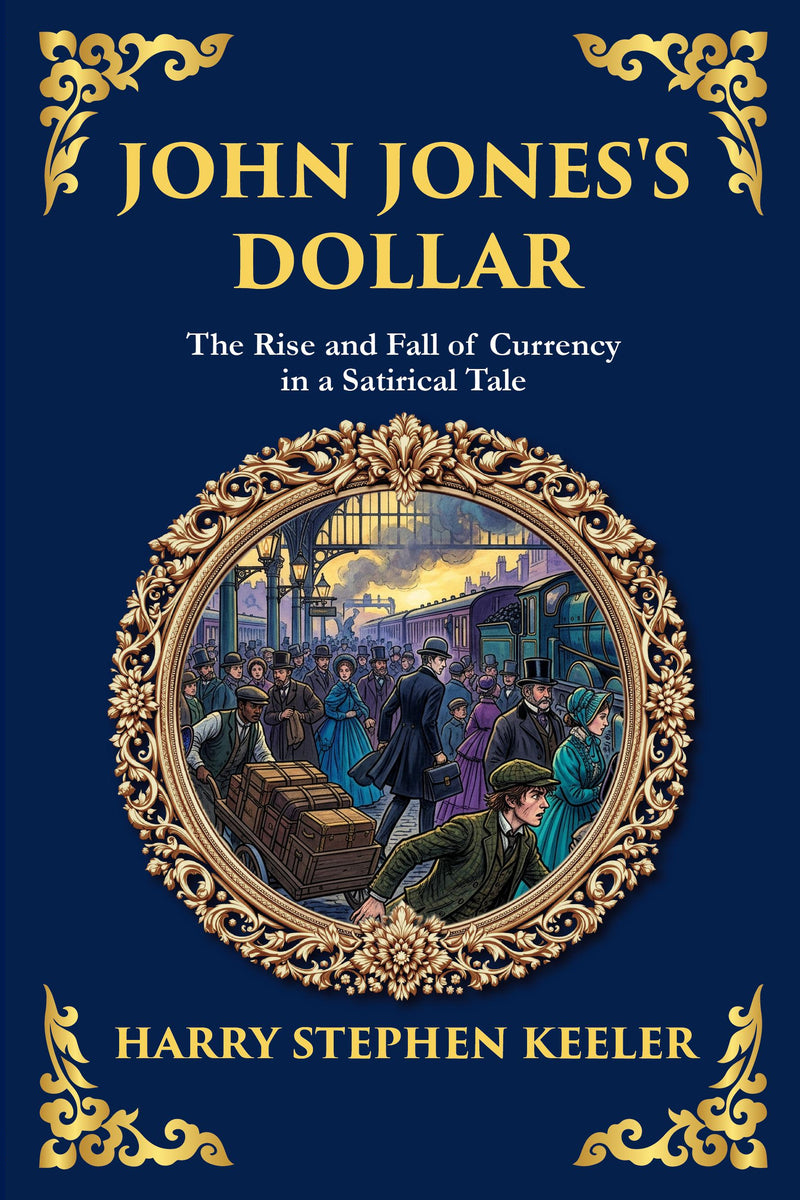
John Jones’s Dollar — Large Print
In a future that takes capitalism to absurd extremes, a single dollar bill becomes the most powerful object on Earth. But when wealth becomes infinite, value vanishes—and society teeters on the brink of madness.
or free app
10,000+ hrs library
30-day guarantee
The complete John Jones's Dollar appears in modern English through Library of Alexandria Press, available online with audiobook narration included for members.
Have you ever wondered why money loses its meaning when it becomes limitless? In John Jones's Dollar, Harry Stephen Keeler delivers a sharp, satirical masterpiece that skewers blind faith in economic systems and questions the very foundation of value. Set in a fantastical future, the story follows the bizarre trajectory of a humble coin transformed into a trillion-dollar empire—and the global unraveling that follows.
When the titular John Jones leaves behind a single dollar bill and the interest compounds over centuries, his descendants awaken to discover a fortune so vast that it reshapes civilization itself. But what starts as triumph soon turns tragic as the world learns the true cost of limitless wealth. Through outrageous logic and comic brilliance, Keeler creates a cautionary tale that echoes modern concerns around inflation, speculation, financial inequality, and the obsession with numbers over people.
What you’ll discover in this modern edition
- A Dystopian Economics Parable Watch as an entire planet collapses under the weight of abstract wealth and imagined prosperity.
| Formats | eBook (EPUB + PDF) · Audiobook · Paperback · Hardcover · Large Print |
| Language | English |
| Trim size (print) | 6 × 9 in |
| Binding | Paperback — perfect-bound · Hardcover — casewrap |
| Large Print edition | Same text in a larger, easy-read type — a larger font, not a larger trim |
| Print pricing | Every physical book at our true cost — at-cost, no profit (members) |
| Library | 873 restored titles, always growing |
| Length | 7,166 words · ~29 min reading |
| Reading level | Grade 12 · a confident, adult read (this modern-English edition) |
| Edition | Modern English translation · 2026 |
Member reviews for this edition are collected as readers finish it — be the first. Across the library: 12,000+ books shipped, every plan covered by a 365-day print guarantee.
About this edition
A faithful, unabridged modern-English edition by The Library of Alexandria — carefully rendered for today's reader and verified paragraph-by-paragraph against the public-domain source. Available as eBook, audiobook, paperback, hardcover, and large print.
- Complete & unabridgedVerified paragraph by paragraph against the source — never a scan, never abridged.
- Modern English, faithfulReadable today, with the author’s meaning kept intact. Readable — not simplified.
- Every format, one membershipRead in your browser or the free app, or listen to the full audiobook.
Included free with your membership
Cancel anytime, one click · 30-day money-back guarantee
Edition last updated July 2026
What’s inside
John Jones’s Dollar — Large Print — complete and unabridged, included in full with membership, plus the full audiobook.
Begin reading John Jones’s Dollar — Large Print
In clear modern English — the complete text is included with membership.
Introduction
There are stories that entertain, stories that instruct, and a rare few that do something stranger and more lasting: they reach across time and tap the reader on the shoulder, asking questions about the world that turn out to be even more urgent in the present than they were when first asked. “John Jones’s Dollar” belongs to that uncommon third category. Written by a young man at the dawn of the twentieth century, it is a small marvel of speculative imagination, a piece of fiction that disguises a series of large and provocative ideas inside the tidy frame of a classroom lesson set in the far future. It is, in its quietest moments, a story about a single coin. In its boldest, it is a meditation on time, money, civilization, and the limits of human foresight.
This modern translation has been prepared with the contemporary reader in mind. The aim has been to preserve the wit, the precision, and the peculiar charm of the original while gently smoothing the places where a century of linguistic drift might otherwise trip the modern eye. The result, we hope, is a version that reads as freshly as it must have read to its first audience — quick, clever, and just a little dizzying in the way it stretches the imagination toward horizons most of us never dare to contemplate. Before you begin, it is worth pausing to consider who wrote this curious tale, what kind of mind produced it, and why a story so brief has managed to outlast so many longer and more ambitious works of its era.
Harry Stephen Keeler is one of the most singular figures in the history of American popular fiction, a writer whose reputation has swung wildly across the decades from modest commercial success to near-total obscurity, and then to a strange, devoted cult revival among readers who delight in the sheer audacity of his methods. To understand “John Jones’s Dollar,” it helps to understand the unusual sensibility of the man who conceived it, because even in this early and comparatively restrained work, the seeds of his lifelong obsessions are already visible.
Keeler was born in Chicago in 1890, and the city would remain central to both his life and his imagination. His childhood was marked by hardship and instability; his father died when he was young, and his mother ran a series of boardinghouses to keep the family afloat. These lodging houses, filled with a rotating cast of transients, eccentrics, and strangers, may well have planted in the boy an early fascination with the way human lives intersect by chance — the way a person glimpsed in passing might, through some improbable chain of coincidence, turn out to be bound to one’s own fate. That theme of hidden connection, of vast and intricate webs linking apparently unrelated people and events, would become the defining feature of his later novels, which he constructed with an almost mathematical relish for coincidence.
Keeler trained as an electrical engineer, and this is no incidental detail. There is an engineer’s mind at work in his fiction, a delight in systems, in cause and effect, in the way small initial conditions can produce enormous downstream consequences. He approached the construction of a story the way another man might approach the design of a bridge or a circuit, plotting out the load-bearing elements, calculating how one event would transmit force to the next. He even developed and wrote about his own peculiar theory of fiction construction, which he called the “webwork” novel — a method in which dozens of seemingly disconnected threads are woven together until, at the climax, they are revealed to have been part of a single grand design all along. To his admirers, this produced fiction of intoxicating ingenuity. To his detractors, it produced something closer to delirium. To both, it produced something unmistakably, unrepeatably his own.
He spent a period of his youth confined in a mental institution, committed by his mother for reasons that remain murky and have been the subject of much speculation. Whatever the truth of that episode, it lends a certain poignancy to a body of work so preoccupied with the question of how individuals are caught up in forces — institutional, financial, familial, historical — far larger than themselves. The man who writes about a single dollar swelling across the centuries into an unimaginable fortune, transforming the entire economic foundation of the world, was a man who knew something firsthand about being swept along by systems beyond one’s control.
By the 1920s and 1930s, Keeler had become a genuinely popular author, his sprawling mystery novels appearing on both sides of the Atlantic and selling in respectable numbers. He was prolific to the point of astonishment, producing book after book stuffed with improbable plots, outlandish characters, invented dialects, and digressions that wandered freely into pseudo-science, invented documents, and stories within stories within stories. His prose could be baroque, his structures labyrinthine, his coincidences shameless. And yet there was always, beneath the apparent chaos, a controlling intelligence — a writer who knew exactly what he was doing, even when what he was doing defied every convention of the well-made story.
Eventually the tide of literary fashion turned against him. His American publishers dropped him; his work became harder to find; for a long stretch of the mid-twentieth century he was remembered, if at all, as a kind of cautionary tale, the man who took plotting to such extremes that he had supposedly broken it. But Keeler has had the last laugh. In recent decades, a new generation of readers and critics has rediscovered him, and what once looked like incompetence or excess now looks like a strange and visionary kind of genius. There is even a society devoted to his memory. His novels, with their gleeful disregard for plausibility and their boundless inventiveness, have come to be appreciated as the work of a true original — an outsider artist of the printed page, untroubled by the rules that constrained his more respectable contemporaries.
“John Jones’s Dollar” stands somewhat apart from the towering, tangled mystery novels for which Keeler is best known. It is short, it is focused, and its central conceit is so clean and elegant that it can be grasped in a sentence. But it is recognizably the work of the same mind. The fascination with time, with cause and effect, with the long arc of consequences, with the way a tiny seed can grow into something monstrous — all of these are present here in concentrated form. If the great webwork novels are sprawling cathedrals of coincidence, this is a perfect little chapel: smaller, simpler, but built by the same hands and animated by the same restless spirit.
It is worth noting that this story first appeared in the early years of the twentieth century, in the pages of the popular magazines that were then the great proving ground for imaginative fiction. This was the era when the genre we now call science fiction was beginning to take shape, before it even had a settled name, when writers were just beginning to discover that the tools of fiction could be turned not only on the present and the past but on the deep future. Keeler’s tale is part of that pioneering moment. It belongs to a tradition of speculative storytelling that includes the early scientific romances and the bold thought-experiments of writers who dared to imagine humanity thousands of years hence. And it does something that very few of its contemporaries attempted: it builds its entire vision of the future not on machines or monsters or interplanetary voyages, but on the quiet, relentless, almost invisible power of a single financial idea.
What gives “John Jones’s Dollar” its peculiar staying power is the brilliance of its central premise, which is at once perfectly logical and utterly astonishing. The story takes a concept that anyone who has ever opened a savings account has encountered — and pushes it to a conclusion so extreme that it transforms a piece of dry financial arithmetic into something approaching the sublime. Without spoiling the particulars of how the tale unfolds, it can safely be said that the engine of the whole narrative is an idea every reader already half-knows but has perhaps never followed all the way to its logical horizon.
That idea is the slow, patient, exponential growth of value over time. We are taught, vaguely, that money left alone tends to accumulate, that small amounts grow into larger ones, that patience is rewarded. But human beings are notoriously poor at intuiting how this growth actually behaves over very long spans of time. Our minds think in straight lines; nature, and mathematics, frequently do not. We imagine that a quantity growing steadily will increase by roughly equal steps. The truth is far stranger and far more dramatic, and Keeler seizes on this gap between intuition and reality to spectacular effect. He takes the modest and asks what becomes of it across not years or decades but a span so vast that civilizations themselves rise and fall within it.
The framing device of the story is itself a small stroke of genius. Rather than narrate events directly, Keeler presents the tale as a lesson — a piece of instruction delivered far in the future, looking back on a chain of events that began in what was, for the original readers, very nearly the present day. This structure accomplishes several things at once. It allows the reader to experience the enormous sweep of time from a vantage point at its far end, gazing back across the centuries the way we might gaze back at ancient history. It lends the whole proceeding an air of dry, almost academic authority, which makes the increasingly extraordinary developments all the more delicious. And it quietly raises the very questions that give the story its philosophical weight: How will the future remember us? What of our present arrangements will survive, and what will be swept away? What looks permanent to us that will seem quaint, or absurd, or unthinkable to those who come after?
This is, at heart, a story about consequences — about the way a decision made by one person at one moment can ripple outward across time, gathering force and significance far beyond anything its originator could have imagined. There is a deep human pathos in this idea. We all make choices whose full consequences we will never live to see. We plant trees in whose shade we will never sit; we set in motion processes that will outlast us. Keeler dramatizes this universal truth by isolating a single, almost comically modest act and tracing its consequences forward across an expanse of time that dwarfs all of recorded history. The effect is to make the reader feel, in a visceral way, both the smallness of the individual and the strange grandeur of the systems we collectively create and set running.
It is also, crucially, a satire — and this is where the subtitle of the present edition earns its keep. Keeler is not merely playing an intellectual game with compound figures. He is using that game to cast a sardonic and clear-eyed light on the institutions of money, ownership, and economic value. He invites the reader to ask uncomfortable questions. What is wealth, really? Where does it come from, and who deserves it? Can a quantity of money grow so large that it ceases to make any sense at all, that it strains against the very limits of the physical and social world that gave it meaning? What happens when an abstraction we have all agreed to treat as real collides with the hard facts of geography, resources, and human need? These are not idle questions. They sit at the foundation of every economic system human beings have ever devised, and Keeler, with the mischievous logic of a man who trained as an engineer and thought like a satirist, follows them to a destination that is by turns hilarious, alarming, and strangely beautiful.
The satire works because Keeler never strains for it. He simply sets up his premise, applies relentless logic, and lets the absurdity emerge naturally from the collision between a system we treat as eternal and a span of time long enough to test it to destruction. There is a coolness to his method, a refusal to editorialize, that makes the underlying critique all the more cutting. He does not lecture the reader about the nature of money or the follies of finance. He simply shows what happens, step by logical step, and trusts the reader to draw the appropriate conclusions — and to feel the appropriate vertigo. This is satire of a high and durable kind, the kind that does not depend on the particular targets of its own moment but speaks to something permanent in the way human societies organize themselves around the strange fiction of value.
Cancel anytime, one click · 30-day money-back guarantee
Founding annual rate available now — your price locks for life when you join.
Not ready? Get this free chapter by email — read it anytime.
✓ Sent — check your inbox for John Jones’s Dollar — Large Print.
Questions about John Jones’s Dollar — Large Print
What is John Jones's Dollar about?
In a future that takes capitalism to absurd extremes, a single dollar bill becomes the most powerful object on Earth. But when wealth becomes infinite, value vanishes—and society teeters on the brink of madness. John Jones's Dollar is a brilliant and biting satire that unravels the very fabric of economic logic, exposing the folly of unchecked financial systems and blind ambition.
Who wrote John Jones's Dollar?
John Jones's Dollar was written by Harry Stephen Keeler. This edition presents the complete work in clear modern English, faithfully rendered from the public-domain original by Library of Alexandria Press.
Is John Jones's Dollar free to read?
The opening chapter is free to read on this page. Members read and listen to the complete work — and the entire library — free, and can order any physical book at our true print cost.
How long is John Jones's Dollar?
2 chapters (~7,166 words) — about 29 min of reading in this modern-English edition.
Is this an abridged version of John Jones's Dollar?
No. This is the complete, unabridged John Jones's Dollar, carefully rendered into clear modern English and verified paragraph-by-paragraph against the public-domain source — nothing is cut or summarised.
What formats does John Jones's Dollar come in?
John Jones's Dollar is available as eBook, paperback, hardcover and large print. eBook and audiobook are included with membership; printed editions ship at our true print cost.
Shipping & returns
Billing & membership
More from the library


Explore Free eBooks
- Kant's Prolegomena to Any Future Metaphysics · Immanuel Kant
- The Advancement of Learning · Francis Bacon
- The Dawn of Day · Friedrich Nietzsche
- Meditations · Marcus Aurelius
- The Confessions of St. Augustine · Saint Augustine of Hippo
- Resurrection · Leo Tolstoy
- Dialogues Concerning Natural Religion · David Hume
- As You Like It · William Shakespeare
- Jack and Jill · Louisa May Alcott
- Dream Psychology: Psychoanalysis for Beginners · Sigmund Freud
- The Raven · Edgar Allan Poe
- Considerations on Representative Government · John Stuart Mill
- The Will to Power: An Attempted Transvaluation of All Values. Book III and IV · Friedrich Nietzsche
- Tarzan of the Apes · Edgar Rice Burroughs
- Fundamental Principles of the Metaphysic of Morals · Immanuel Kant
- The Confessions of Jean Jacques Rousseau — Complete · Jean-Jacques Rousseau
- The Merchant of Venice · William Shakespeare
- Democracy in America — Volume 2 · Alexis de Tocqueville
- Ecce Homo · Friedrich Wilhelm Nietzsche
- Second Treatise of Government · John Locke
- The Wonderful Wizard of Oz · L. Frank Baum
- The Prince · Niccolò Machiavelli
- Anne of Green Gables · L. M. Montgomery
- De Profundis · Oscar Wilde
- Thus Spake Zarathustra: A Book for All and None · Friedrich Nietzsche
- Anna Karenina · Leo Tolstoy
- Great Expectations · Charles Dickens
- The Island of Doctor Moreau · H. G. Wells
- A Midsummer Night's Dream · William Shakespeare
- The Strange Case of Dr. Jekyll and Mr. Hyde · Robert Louis Stevenson
John Jones’s Dollar — Large Print
John Jones’s Dollar — Large Print
A Satirical Story About the Rise and Fall of Money
Harry Stephen Keeler
Contents
- Introduction
- John Jones’s Dollar
Introduction
There are stories that entertain, stories that instruct, and a rare few that do something stranger and more lasting: they reach across time and tap the reader on the shoulder, asking questions about the world that turn out to be even more urgent in the present than they were when first asked. “John Jones’s Dollar” belongs to that uncommon third category. Written by a young man at the dawn of the twentieth century, it is a small marvel of speculative imagination, a piece of fiction that disguises a series of large and provocative ideas inside the tidy frame of a classroom lesson set in the far future. It is, in its quietest moments, a story about a single coin. In its boldest, it is a meditation on time, money, civilization, and the limits of human foresight.
This modern translation has been prepared with the contemporary reader in mind. The aim has been to preserve the wit, the precision, and the peculiar charm of the original while gently smoothing the places where a century of linguistic drift might otherwise trip the modern eye. The result, we hope, is a version that reads as freshly as it must have read to its first audience — quick, clever, and just a little dizzying in the way it stretches the imagination toward horizons most of us never dare to contemplate. Before you begin, it is worth pausing to consider who wrote this curious tale, what kind of mind produced it, and why a story so brief has managed to outlast so many longer and more ambitious works of its era.
Harry Stephen Keeler is one of the most singular figures in the history of American popular fiction, a writer whose reputation has swung wildly across the decades from modest commercial success to near-total obscurity, and then to a strange, devoted cult revival among readers who delight in the sheer audacity of his methods. To understand “John Jones’s Dollar,” it helps to understand the unusual sensibility of the man who conceived it, because even in this early and comparatively restrained work, the seeds of his lifelong obsessions are already visible.
Keeler was born in Chicago in 1890, and the city would remain central to both his life and his imagination. His childhood was marked by hardship and instability; his father died when he was young, and his mother ran a series of boardinghouses to keep the family afloat. These lodging houses, filled with a rotating cast of transients, eccentrics, and strangers, may well have planted in the boy an early fascination with the way human lives intersect by chance — the way a person glimpsed in passing might, through some improbable chain of coincidence, turn out to be bound to one’s own fate. That theme of hidden connection, of vast and intricate webs linking apparently unrelated people and events, would become the defining feature of his later novels, which he constructed with an almost mathematical relish for coincidence.
Keeler trained as an electrical engineer, and this is no incidental detail. There is an engineer’s mind at work in his fiction, a delight in systems, in cause and effect, in the way small initial conditions can produce enormous downstream consequences. He approached the construction of a story the way another man might approach the design of a bridge or a circuit, plotting out the load-bearing elements, calculating how one event would transmit force to the next. He even developed and wrote about his own peculiar theory of fiction construction, which he called the “webwork” novel — a method in which dozens of seemingly disconnected threads are woven together until, at the climax, they are revealed to have been part of a single grand design all along. To his admirers, this produced fiction of intoxicating ingenuity. To his detractors, it produced something closer to delirium. To both, it produced something unmistakably, unrepeatably his own.
He spent a period of his youth confined in a mental institution, committed by his mother for reasons that remain murky and have been the subject of much speculation. Whatever the truth of that episode, it lends a certain poignancy to a body of work so preoccupied with the question of how individuals are caught up in forces — institutional, financial, familial, historical — far larger than themselves. The man who writes about a single dollar swelling across the centuries into an unimaginable fortune, transforming the entire economic foundation of the world, was a man who knew something firsthand about being swept along by systems beyond one’s control.
By the 1920s and 1930s, Keeler had become a genuinely popular author, his sprawling mystery novels appearing on both sides of the Atlantic and selling in respectable numbers. He was prolific to the point of astonishment, producing book after book stuffed with improbable plots, outlandish characters, invented dialects, and digressions that wandered freely into pseudo-science, invented documents, and stories within stories within stories. His prose could be baroque, his structures labyrinthine, his coincidences shameless. And yet there was always, beneath the apparent chaos, a controlling intelligence — a writer who knew exactly what he was doing, even when what he was doing defied every convention of the well-made story.
Eventually the tide of literary fashion turned against him. His American publishers dropped him; his work became harder to find; for a long stretch of the mid-twentieth century he was remembered, if at all, as a kind of cautionary tale, the man who took plotting to such extremes that he had supposedly broken it. But Keeler has had the last laugh. In recent decades, a new generation of readers and critics has rediscovered him, and what once looked like incompetence or excess now looks like a strange and visionary kind of genius. There is even a society devoted to his memory. His novels, with their gleeful disregard for plausibility and their boundless inventiveness, have come to be appreciated as the work of a true original — an outsider artist of the printed page, untroubled by the rules that constrained his more respectable contemporaries.
“John Jones’s Dollar” stands somewhat apart from the towering, tangled mystery novels for which Keeler is best known. It is short, it is focused, and its central conceit is so clean and elegant that it can be grasped in a sentence. But it is recognizably the work of the same mind. The fascination with time, with cause and effect, with the long arc of consequences, with the way a tiny seed can grow into something monstrous — all of these are present here in concentrated form. If the great webwork novels are sprawling cathedrals of coincidence, this is a perfect little chapel: smaller, simpler, but built by the same hands and animated by the same restless spirit.
It is worth noting that this story first appeared in the early years of the twentieth century, in the pages of the popular magazines that were then the great proving ground for imaginative fiction. This was the era when the genre we now call science fiction was beginning to take shape, before it even had a settled name, when writers were just beginning to discover that the tools of fiction could be turned not only on the present and the past but on the deep future. Keeler’s tale is part of that pioneering moment. It belongs to a tradition of speculative storytelling that includes the early scientific romances and the bold thought-experiments of writers who dared to imagine humanity thousands of years hence. And it does something that very few of its contemporaries attempted: it builds its entire vision of the future not on machines or monsters or interplanetary voyages, but on the quiet, relentless, almost invisible power of a single financial idea.
What gives “John Jones’s Dollar” its peculiar staying power is the brilliance of its central premise, which is at once perfectly logical and utterly astonishing. The story takes a concept that anyone who has ever opened a savings account has encountered — and pushes it to a conclusion so extreme that it transforms a piece of dry financial arithmetic into something approaching the sublime. Without spoiling the particulars of how the tale unfolds, it can safely be said that the engine of the whole narrative is an idea every reader already half-knows but has perhaps never followed all the way to its logical horizon.
That idea is the slow, patient, exponential growth of value over time. We are taught, vaguely, that money left alone tends to accumulate, that small amounts grow into larger ones, that patience is rewarded. But human beings are notoriously poor at intuiting how this growth actually behaves over very long spans of time. Our minds think in straight lines; nature, and mathematics, frequently do not. We imagine that a quantity growing steadily will increase by roughly equal steps. The truth is far stranger and far more dramatic, and Keeler seizes on this gap between intuition and reality to spectacular effect. He takes the modest and asks what becomes of it across not years or decades but a span so vast that civilizations themselves rise and fall within it.
The framing device of the story is itself a small stroke of genius. Rather than narrate events directly, Keeler presents the tale as a lesson — a piece of instruction delivered far in the future, looking back on a chain of events that began in what was, for the original readers, very nearly the present day. This structure accomplishes several things at once. It allows the reader to experience the enormous sweep of time from a vantage point at its far end, gazing back across the centuries the way we might gaze back at ancient history. It lends the whole proceeding an air of dry, almost academic authority, which makes the increasingly extraordinary developments all the more delicious. And it quietly raises the very questions that give the story its philosophical weight: How will the future remember us? What of our present arrangements will survive, and what will be swept away? What looks permanent to us that will seem quaint, or absurd, or unthinkable to those who come after?
This is, at heart, a story about consequences — about the way a decision made by one person at one moment can ripple outward across time, gathering force and significance far beyond anything its originator could have imagined. There is a deep human pathos in this idea. We all make choices whose full consequences we will never live to see. We plant trees in whose shade we will never sit; we set in motion processes that will outlast us. Keeler dramatizes this universal truth by isolating a single, almost comically modest act and tracing its consequences forward across an expanse of time that dwarfs all of recorded history. The effect is to make the reader feel, in a visceral way, both the smallness of the individual and the strange grandeur of the systems we collectively create and set running.
It is also, crucially, a satire — and this is where the subtitle of the present edition earns its keep. Keeler is not merely playing an intellectual game with compound figures. He is using that game to cast a sardonic and clear-eyed light on the institutions of money, ownership, and economic value. He invites the reader to ask uncomfortable questions. What is wealth, really? Where does it come from, and who deserves it? Can a quantity of money grow so large that it ceases to make any sense at all, that it strains against the very limits of the physical and social world that gave it meaning? What happens when an abstraction we have all agreed to treat as real collides with the hard facts of geography, resources, and human need? These are not idle questions. They sit at the foundation of every economic system human beings have ever devised, and Keeler, with the mischievous logic of a man who trained as an engineer and thought like a satirist, follows them to a destination that is by turns hilarious, alarming, and strangely beautiful.
The satire works because Keeler never strains for it. He simply sets up his premise, applies relentless logic, and lets the absurdity emerge naturally from the collision between a system we treat as eternal and a span of time long enough to test it to destruction. There is a coolness to his method, a refusal to editorialize, that makes the underlying critique all the more cutting. He does not lecture the reader about the nature of money or the follies of finance. He simply shows what happens, step by logical step, and trusts the reader to draw the appropriate conclusions — and to feel the appropriate vertigo. This is satire of a high and durable kind, the kind that does not depend on the particular targets of its own moment but speaks to something permanent in the way human societies organize themselves around the strange fiction of value.
Imagine a board with 64 squares. Place one grain of wheat on the first square, two on the second, and four on the third. If you keep doubling the amount like this, you will discover that there isn’t enough wheat in the entire world to fill the sixty-fourth square. Compound interest works in much the same way.
On the 201st day of the year 3221 A.D., the history professor at the University of Terra sat down in front of the Visaphone to give his daily lecture to a class whose students lived in different parts of the world.
The device he sat before looked like a giant window frame, as it featured three or four hundred squares of frosted glass. In the center, where there were no glass squares, was a dark rectangular area and a shelf holding a piece of chalk. Above this area was a large brass cylinder, which the professor would soon use to project his voice.
To make sure it was time to alert his history students to go to their local Visaphones, the professor took a small device from his vest pocket and held it to his ear. When he flipped a tiny switch on the device, a metallic voice that sounded like it was coming from deep space repeated mechanically: “Fifteen o’clock and one minute—fifteen o’clock and one minute—fifteen o’clock and one min—“ The professor quickly put the device back in his pocket and pressed a button on the side of the Visaphone.
As if responding to the call, the frosted squares began to fill one by one with the faces and shoulders of a specific kind of young man: they had large, bulging foreheads, were bald and toothless, and wore enormous horn-rimmed glasses. However, one square remained empty. When the professor noticed this, he looked irritated.
End of the free sample
Keep reading, free
Members read and listen to the complete book — and the entire library. Cancel anytime, one click · 30-day money-back guarantee.