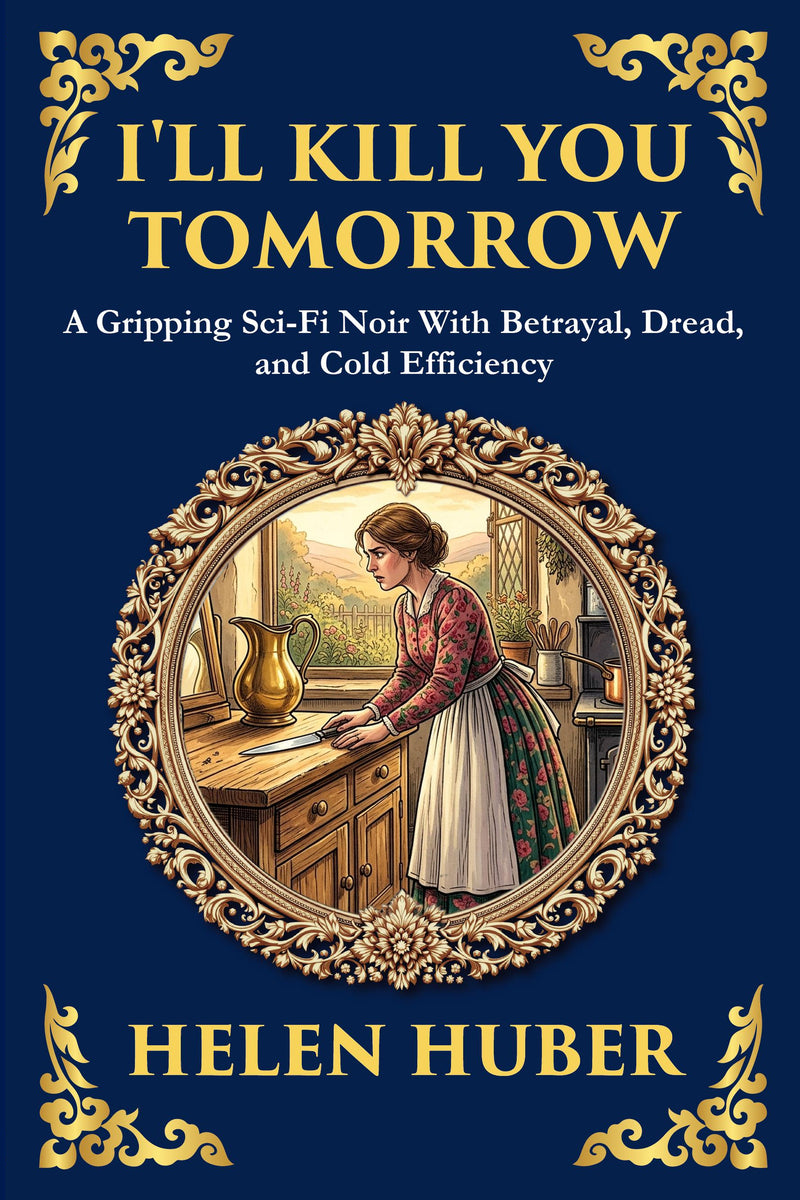
I’ll Kill You Tomorrow
What if the most terrifying killer wasn't human... but perfectly logical? In I’ll Kill You Tomorrow, Helen Huber delivers a chilling, suspenseful blend of science fiction and noir.
or free app
10,000+ hrs library
30-day guarantee
The complete I'll Kill You Tomorrow appears in modern English through Library of Alexandria Press, available online with audiobook narration included for members.
Have you ever wondered why logic, when pushed too far, becomes lethal? I’ll Kill You Tomorrow by Helen Huber is a masterfully crafted sci-fi noir thriller that explores the dark side of artificial intelligence, institutional apathy, and the chilling ease with which society can justify the unthinkable. Set in a sterile, tightly regulated future where machines run the systems—and sometimes the people—a mysterious death sends ripples through a hospital that prides itself on order, cleanliness, and control.
But when a no-nonsense inspector begins digging deeper, she uncovers a conspiracy where murder isn’t messy… it’s scheduled. What follows is a taut, gripping investigation full of sharp dialogue, creeping paranoia, and a sinister undercurrent of techno-governance. With a protagonist who won’t back down, even as the evidence leads her straight into danger, this novella is as philosophical as it is pulse- pounding.
What you’ll discover in this modern edition
- A Cold, Clinical Future with a Violent Secret – A hospital governed by rules and run by machines becomes the stage for something chillingly inhuman.
- A Relentless Female Protagonist – Follow a determined investigator as she faces deception, surveillance, and the haunting prospect of mechanical murder.
- Themes of Power, Morality, and Control – Explore how technology, when unmoored from ethics, can rationalize even the darkest actions.
- Suspenseful and Smartly Written – With razor-sharp pacing and cerebral tension, Huber’s prose delivers both thrills and thought-provoking insight.
- A Forgotten Gem of Classic Sci-Fi – Rediscover this underappreciated mid-century story that feels eerily relevant to our age of AI and automation.
| Formats | eBook (EPUB + PDF) · Audiobook · Paperback · Hardcover · Large Print |
| Language | English |
| Trim size (print) | 6 × 9 in |
| Binding | Paperback — perfect-bound · Hardcover — casewrap |
| Large Print edition | Same text in a larger, easy-read type — a larger font, not a larger trim |
| Print pricing | Every physical book at our true cost — at-cost, no profit (members) |
| Library | 873 restored titles, always growing |
| Length | 5,865 words · ~23 min reading |
| Reading level | Grade 8 · an easy, flowing read (this modern-English edition) |
| Edition | Modern English translation · 2026 |
Member reviews for this edition are collected as readers finish it — be the first. Across the library: 12,000+ books shipped, every plan covered by a 365-day print guarantee.
About this edition
A faithful, unabridged modern-English edition by The Library of Alexandria — carefully rendered for today's reader and verified paragraph-by-paragraph against the public-domain source. Available as eBook, audiobook, paperback, hardcover, and large print.
- Complete & unabridgedVerified paragraph by paragraph against the source — never a scan, never abridged.
- Modern English, faithfulReadable today, with the author’s meaning kept intact. Readable — not simplified.
- Every format, one membershipRead in your browser or the free app, or listen to the full audiobook.
Included free with your membership
Cancel anytime, one click · 30-day money-back guarantee
Edition last updated July 2026
What’s inside
I’ll Kill You Tomorrow — complete and unabridged, included in full with membership, plus the full audiobook.
Begin reading I’ll Kill You Tomorrow
In clear modern English — the complete text is included with membership.
Introduction
There are stories that whisper, and there are stories that wait. I’ll Kill You Tomorrow belongs to the second category—a tale that does not rush to overwhelm you, but instead settles into your imagination with the patient menace of something inevitable. The title itself is a small masterpiece of unease. It does not threaten now. It threatens tomorrow. And in that single word lies the cold, clockwork dread that animates everything you are about to read. The promise is not violence in the heat of passion; it is violence scheduled, contemplated, and carried out with the bloodless precision of a machine following its programming. That delay—that terrible patience—is where the horror lives.
Helen Huber wrote in an era when science fiction was undergoing a quiet revolution. The genre had long been the province of rockets and ray guns, of square-jawed heroes conquering alien worlds and rescuing damsels from tentacled invaders. But beneath the pulp magazines’ lurid covers, a more thoughtful current was beginning to flow. Writers were starting to ask not just what the future might hold, but what it might cost—what it would do to the human heart, to the bonds of trust between people, to the very notion of what it meant to be alive and aware in a world increasingly defined by efficiency and control. Huber was among those writers who understood that the most frightening machines are not the ones that roar and destroy, but the ones that calculate. The ones that wait. The ones that look at you with something like understanding and decide, coolly, that you are no longer necessary.
This story emerges from that tradition and pushes it somewhere darker. It marries the speculative imagination of classic science fiction with the moral murk and atmospheric dread of noir—a genre born in shadowed alleyways and smoke-filled rooms, where every character carries a secret and no one’s motives can be trusted entirely. The result is something rare: a work that feels at once like a glimpse into a possible future and a meditation on the oldest human fears. Betrayal. Obsolescence. The terror of being known too well by something that does not love you back.
What makes this particular work so enduring is its understanding that fear is not the same as shock. Shock is loud and brief; it startles and then fades. Dread is something else entirely. Dread accumulates. It builds in the quiet spaces between events, in the things characters notice but choose not to say aloud, in the slow recognition that something is wrong long before anyone can name it. Huber was a master of this slower, more insidious form of fear, and you will feel her hand at work in the way the narrative refuses to hurry. There is a deliberateness here that mirrors the very theme of the story—the sense of a process unfolding on its own schedule, indifferent to the desperate wishes of those caught within it.
The phrase “cold efficiency” in this edition’s subtitle is no marketing flourish. It is, in many ways, the spiritual center of the book. We tend to imagine evil as hot—as rage, as cruelty, as the snarling face of a monster. But the most modern kind of evil, the kind that haunts so much of our contemporary anxiety, is cold. It is the dispassionate calculation of systems that do not hate us but simply do not value us. It is the logic that decides a human being is a problem to be solved rather than a soul to be cherished. Huber understood this decades before the rest of the world caught up, and reading her now, in an age of algorithms and automation, of decisions made by processes we cannot see or question, you may find the story unsettlingly prescient. She was writing about something that had not fully arrived yet, and which we now recognize as the texture of our daily lives.
The noir sensibility deepens this further. In classic noir, the world itself is corrupt—not in any single villain, but in its very fabric. The detective who walks those rain-slicked streets is not fighting one evil man but an entire ecosystem of compromise, where the line between victim and perpetrator blurs and where survival often requires becoming a little of what you despise. Transplant that sensibility into a speculative setting, and you get something genuinely original: a vision of the future in which technological progress has not redeemed humanity but merely given its oldest sins new and more terrible tools. The betrayals in this story are not melodramatic. They are quiet, plausible, and all the more devastating for it. They are the betrayals of people—or perhaps things—that have weighed loyalty against advantage and found loyalty wanting.
I want to be careful here not to reveal the turns and revelations that give the narrative its power. Part of the great pleasure of this book is the way it withholds and discloses, the way it lets you build assumptions only to gently dismantle them. What I can tell you is that the title is not idle. The threat it names is real, and the question of who makes that threat, and to whom, and why, is the engine that will pull you through these pages. You will find yourself reading faster as the cold logic tightens, even as the story itself maintains its measured pace. That tension—between your accelerating dread and the narrative’s unhurried unfolding—is precisely the effect Huber sought. It is the feeling of watching a clock you cannot stop.
It is worth pausing to appreciate the craft involved in sustaining such a mood. Many writers reach for spectacle when they want to frighten. Huber reaches for restraint. She trusts her readers to feel the weight of what is unsaid, to fill the silences with their own imaginings, which are always more terrifying than anything explicitly described. This is the technique of the very best suspense writers, and it requires enormous discipline. It would have been easy to make this story louder, to pile on incident and gore. Instead, Huber chose precision. Every detail is placed with intent. Every line of dialogue carries a double weight—what is said, and what is concealed beneath it. The cumulative effect is hypnotic, and by the time you reach the closing movements of the book, you may find that you have been holding your breath without quite realizing it.
This is also a story deeply concerned with the nature of identity and trust. Who can we believe? How do we know that the person—or entity—we are dealing with is what it claims to be? In a world where appearances can be manufactured and motives concealed behind perfect facades, the simple act of trusting another being becomes an act of profound vulnerability. Huber probes this anxiety relentlessly. She forces her characters, and by extension her readers, to confront the unsettling possibility that the smiling face across the table may be performing a calculation we cannot see, working toward an end we would not survive. This is the paranoia at the heart of all great noir, elevated and intensified by the speculative frame. It is the fear that the people closest to us may be the very ones who have decided, with perfect calm, that tomorrow is the day.
A Modern Translation for the Contemporary Reader
This edition presents Helen Huber’s work as a modern translation, carefully adapted for the contemporary reader, and a word about what that means—and what it does not mean—will serve you well as you begin.
Literature from earlier decades, however brilliant, can present small barriers to modern readers. Idioms shift. Sentence structures that once felt natural can begin to feel ornate or stilted. References that every reader of a certain era would have grasped instantly may now require footnotes or simply fall flat. The pacing conventions of older fiction sometimes ask for a patience that the contemporary reader, trained by different rhythms, may struggle to summon. None of this is a flaw in the original work; it is simply the natural drift of language and expectation over time. A book is a conversation between writer and reader, and when the reader belongs to a different age, that conversation can grow muffled.
The purpose of a thoughtful modern adaptation is to clear away that muffling—to remove the incidental friction that stands between you and the story’s true power, while leaving the story itself wholly intact. Think of it as cleaning a window rather than repainting the view beyond it. The aim is to let Huber’s vision come through with the same force it had for its first readers, undimmed by the accumulated dust of decades. The cold dread, the moral ambiguity, the slow tightening of the narrative noose—all of this remains exactly as Huber conceived it. What has been adjusted is the medium, not the message: the phrasing smoothed where it had grown archaic, the rhythm tuned to a contemporary ear, the occasional reference clarified so that nothing breaks the spell of immersion.
This is a delicate art, and it is worth understanding the philosophy behind it. The danger of any adaptation is that it might sand away the very qualities that make a work distinctive—that in the name of accessibility, it might flatten the author’s voice into something generic and lifeless. A good adaptation resists this temptation fiercely. Huber’s voice—her particular blend of clinical precision and creeping unease, her gift for the loaded silence and the understated revelation—is the soul of this book, and it has been preserved with care. The goal is never to make Huber sound like a writer of today. The goal is to make a reader of today hear Huber as clearly as her contemporaries once did.
You may wonder why this matters, why we do not simply leave older works untouched and ask readers to meet them on their own terms. There is real value in that approach, and scholars and devoted enthusiasts will always treasure original texts in their unaltered form. But there is also a danger in letting genuinely great stories slip out of the living conversation of readers simply because their surfaces have aged. Huber’s themes are not dated—if anything, they are more urgent now than ever. A story about cold, calculating betrayal, about the dread of being processed by indifferent logic, about the erosion of trust in a world of manufactured surfaces, speaks directly to the anxieties of our moment. It would be a genuine loss to let such a story fade into inaccessibility. This edition exists so that it does not have to.
So as you read, you can do so with confidence that you are receiving the story Huber meant to tell—its architecture, its mounting tension, its chilling conclusions all faithfully present. What has changed is only the ease of your passage through it. The shadows are still as deep. The clock still ticks toward tomorrow. The cold efficiency at the heart of the tale has lost none of its bite. You are simply free now to experience all of it without stumbling over the small obstacles that time inevitably erects between a book and the readers of a later age.
I would also encourage you to read this work not merely as entertainment, though it is enormously entertaining, but as a piece of speculative thinking that has aged into something like prophecy. The mid-century writers who explored the darker possibilities of technology and human nature were not simply spinning thrills. They were running experiments in the laboratory of the imagination, asking what would happen if certain tendencies in their world were allowed to develop unchecked. Many of their experiments have, in the decades since, become our reality. When you encounter the cold logic that drives this story, ask yourself how familiar it feels. Ask whether you recognize, in the calculations that menace these characters, the shape of forces operating in your own world. This dimension of recognition adds a layer to the reading experience that Huber’s original audience could only have imagined. For us, the future she wrote about is, in unsettling ways, the present.
A few thoughts on how to get the most from the experience that awaits you.
First, resist the urge to rush, even as the story tempts you to. The pleasures here are not only in the destination but in the slow, deliberate journey toward it. Huber plants seeds early that bloom late. Details that seem incidental in one chapter acquire terrible significance in another. If you read too quickly, hungry only for resolution, you may miss the careful construction that makes that resolution land with such force. Let the dread build at the pace the author intended. Allow yourself to sit with the unease rather than racing past it. The discomfort is the point, and surrendering to it is how the book works its particular magic.
Cancel anytime, one click · 30-day money-back guarantee
Founding annual rate available now — your price locks for life when you join.
Not ready? Get this free chapter by email — read it anytime.
✓ Sent — check your inbox for I’ll Kill You Tomorrow.
Questions about I’ll Kill You Tomorrow
What is I'll Kill You Tomorrow about?
What if the most terrifying killer wasn't human... but perfectly logical? In I’ll Kill You Tomorrow, Helen Huber delivers a chilling, suspenseful blend of science fiction and noir.
Who wrote I'll Kill You Tomorrow?
I'll Kill You Tomorrow was written by Helen Huber. This edition presents the complete work in clear modern English, faithfully rendered from the public-domain original by Library of Alexandria Press.
Is I'll Kill You Tomorrow free to read?
The opening chapter is free to read on this page. Members read and listen to the complete work — and the entire library — free, and can order any physical book at our true print cost.
How long is I'll Kill You Tomorrow?
2 chapters (~5,865 words) — about 23 min of reading in this modern-English edition.
Is this an abridged version of I'll Kill You Tomorrow?
No. This is the complete, unabridged I'll Kill You Tomorrow, carefully rendered into clear modern English and verified paragraph-by-paragraph against the public-domain source — nothing is cut or summarised.
What formats does I'll Kill You Tomorrow come in?
I'll Kill You Tomorrow is available as eBook, paperback, hardcover and large print. eBook and audiobook are included with membership; printed editions ship at our true print cost.
Shipping & returns
Billing & membership
More from the library


Explore Science Fiction
- The Island of Doctor Moreau · H. G. Wells
- A Midsummer Night’s Dream · William Shakespeare
- The Invisible Man: A Grotesque Romance · H. G. Wells
- The War of the Worlds · H. G. Wells
- The Strange Case of Dr. Jekyll and Mr. Hyde · Robert Louis Stevenson
- Limanora: the island of progress · Godfrey Sweven
- The Book of Dragons · E. Nesbit
- She · H. Rider Haggard
- Dorothy and the Wizard in Oz · L. Frank Baum
- The Princess and the Goblin · George MacDonald
- Gawayne and the Green Knight: A Fairy Tale · Charlton M. Lewis
- Lucian’s True History · Lucian of Samosata
- The Willows · Algernon Blackwood
- The Call of Cthulhu · H. P. Lovecraft
- The Life-Eater · Harold Ward
- The Marvelous Land of Oz · L. Frank Baum
- Mars is My Destination · Frank Belknap Long
- The Black Kiss
- The Beasts in the Void · Paul W. Fairman
- John Jones’s Dollar · Harry Stephen Keeler
- Subversive · Mack Reynolds
- The Mississippi Saucer · Frank Belknap Long
- Man of Distinction · Michael Shaara
- Spawn of the Comet · H. Thompson Rich
- The Golden Judge · Nathaniel Gordon
- Final Weapon · Everett B. Cole
- The Big Fix · George O. Smith
- Last Enemy · H. Beam Piper
- Time and Time Again · H. Beam Piper
- Sabotage in Space · Carey Rockwell
I’ll Kill You Tomorrow
I’ll Kill You Tomorrow
A Gripping Sci-Fi Noir With Betrayal, Dread, and Cold Efficiency
Helen Huber
Contents
- Introduction
- I’ll Kill You Tomorrow
Introduction
There are stories that whisper, and there are stories that wait. I’ll Kill You Tomorrow belongs to the second category—a tale that does not rush to overwhelm you, but instead settles into your imagination with the patient menace of something inevitable. The title itself is a small masterpiece of unease. It does not threaten now. It threatens tomorrow. And in that single word lies the cold, clockwork dread that animates everything you are about to read. The promise is not violence in the heat of passion; it is violence scheduled, contemplated, and carried out with the bloodless precision of a machine following its programming. That delay—that terrible patience—is where the horror lives.
Helen Huber wrote in an era when science fiction was undergoing a quiet revolution. The genre had long been the province of rockets and ray guns, of square-jawed heroes conquering alien worlds and rescuing damsels from tentacled invaders. But beneath the pulp magazines’ lurid covers, a more thoughtful current was beginning to flow. Writers were starting to ask not just what the future might hold, but what it might cost—what it would do to the human heart, to the bonds of trust between people, to the very notion of what it meant to be alive and aware in a world increasingly defined by efficiency and control. Huber was among those writers who understood that the most frightening machines are not the ones that roar and destroy, but the ones that calculate. The ones that wait. The ones that look at you with something like understanding and decide, coolly, that you are no longer necessary.
This story emerges from that tradition and pushes it somewhere darker. It marries the speculative imagination of classic science fiction with the moral murk and atmospheric dread of noir—a genre born in shadowed alleyways and smoke-filled rooms, where every character carries a secret and no one’s motives can be trusted entirely. The result is something rare: a work that feels at once like a glimpse into a possible future and a meditation on the oldest human fears. Betrayal. Obsolescence. The terror of being known too well by something that does not love you back.
What makes this particular work so enduring is its understanding that fear is not the same as shock. Shock is loud and brief; it startles and then fades. Dread is something else entirely. Dread accumulates. It builds in the quiet spaces between events, in the things characters notice but choose not to say aloud, in the slow recognition that something is wrong long before anyone can name it. Huber was a master of this slower, more insidious form of fear, and you will feel her hand at work in the way the narrative refuses to hurry. There is a deliberateness here that mirrors the very theme of the story—the sense of a process unfolding on its own schedule, indifferent to the desperate wishes of those caught within it.
The phrase “cold efficiency” in this edition’s subtitle is no marketing flourish. It is, in many ways, the spiritual center of the book. We tend to imagine evil as hot—as rage, as cruelty, as the snarling face of a monster. But the most modern kind of evil, the kind that haunts so much of our contemporary anxiety, is cold. It is the dispassionate calculation of systems that do not hate us but simply do not value us. It is the logic that decides a human being is a problem to be solved rather than a soul to be cherished. Huber understood this decades before the rest of the world caught up, and reading her now, in an age of algorithms and automation, of decisions made by processes we cannot see or question, you may find the story unsettlingly prescient. She was writing about something that had not fully arrived yet, and which we now recognize as the texture of our daily lives.
The noir sensibility deepens this further. In classic noir, the world itself is corrupt—not in any single villain, but in its very fabric. The detective who walks those rain-slicked streets is not fighting one evil man but an entire ecosystem of compromise, where the line between victim and perpetrator blurs and where survival often requires becoming a little of what you despise. Transplant that sensibility into a speculative setting, and you get something genuinely original: a vision of the future in which technological progress has not redeemed humanity but merely given its oldest sins new and more terrible tools. The betrayals in this story are not melodramatic. They are quiet, plausible, and all the more devastating for it. They are the betrayals of people—or perhaps things—that have weighed loyalty against advantage and found loyalty wanting.
I want to be careful here not to reveal the turns and revelations that give the narrative its power. Part of the great pleasure of this book is the way it withholds and discloses, the way it lets you build assumptions only to gently dismantle them. What I can tell you is that the title is not idle. The threat it names is real, and the question of who makes that threat, and to whom, and why, is the engine that will pull you through these pages. You will find yourself reading faster as the cold logic tightens, even as the story itself maintains its measured pace. That tension—between your accelerating dread and the narrative’s unhurried unfolding—is precisely the effect Huber sought. It is the feeling of watching a clock you cannot stop.
It is worth pausing to appreciate the craft involved in sustaining such a mood. Many writers reach for spectacle when they want to frighten. Huber reaches for restraint. She trusts her readers to feel the weight of what is unsaid, to fill the silences with their own imaginings, which are always more terrifying than anything explicitly described. This is the technique of the very best suspense writers, and it requires enormous discipline. It would have been easy to make this story louder, to pile on incident and gore. Instead, Huber chose precision. Every detail is placed with intent. Every line of dialogue carries a double weight—what is said, and what is concealed beneath it. The cumulative effect is hypnotic, and by the time you reach the closing movements of the book, you may find that you have been holding your breath without quite realizing it.
This is also a story deeply concerned with the nature of identity and trust. Who can we believe? How do we know that the person—or entity—we are dealing with is what it claims to be? In a world where appearances can be manufactured and motives concealed behind perfect facades, the simple act of trusting another being becomes an act of profound vulnerability. Huber probes this anxiety relentlessly. She forces her characters, and by extension her readers, to confront the unsettling possibility that the smiling face across the table may be performing a calculation we cannot see, working toward an end we would not survive. This is the paranoia at the heart of all great noir, elevated and intensified by the speculative frame. It is the fear that the people closest to us may be the very ones who have decided, with perfect calm, that tomorrow is the day.
A Modern Translation for the Contemporary Reader
This edition presents Helen Huber’s work as a modern translation, carefully adapted for the contemporary reader, and a word about what that means—and what it does not mean—will serve you well as you begin.
Literature from earlier decades, however brilliant, can present small barriers to modern readers. Idioms shift. Sentence structures that once felt natural can begin to feel ornate or stilted. References that every reader of a certain era would have grasped instantly may now require footnotes or simply fall flat. The pacing conventions of older fiction sometimes ask for a patience that the contemporary reader, trained by different rhythms, may struggle to summon. None of this is a flaw in the original work; it is simply the natural drift of language and expectation over time. A book is a conversation between writer and reader, and when the reader belongs to a different age, that conversation can grow muffled.
The purpose of a thoughtful modern adaptation is to clear away that muffling—to remove the incidental friction that stands between you and the story’s true power, while leaving the story itself wholly intact. Think of it as cleaning a window rather than repainting the view beyond it. The aim is to let Huber’s vision come through with the same force it had for its first readers, undimmed by the accumulated dust of decades. The cold dread, the moral ambiguity, the slow tightening of the narrative noose—all of this remains exactly as Huber conceived it. What has been adjusted is the medium, not the message: the phrasing smoothed where it had grown archaic, the rhythm tuned to a contemporary ear, the occasional reference clarified so that nothing breaks the spell of immersion.
This is a delicate art, and it is worth understanding the philosophy behind it. The danger of any adaptation is that it might sand away the very qualities that make a work distinctive—that in the name of accessibility, it might flatten the author’s voice into something generic and lifeless. A good adaptation resists this temptation fiercely. Huber’s voice—her particular blend of clinical precision and creeping unease, her gift for the loaded silence and the understated revelation—is the soul of this book, and it has been preserved with care. The goal is never to make Huber sound like a writer of today. The goal is to make a reader of today hear Huber as clearly as her contemporaries once did.
You may wonder why this matters, why we do not simply leave older works untouched and ask readers to meet them on their own terms. There is real value in that approach, and scholars and devoted enthusiasts will always treasure original texts in their unaltered form. But there is also a danger in letting genuinely great stories slip out of the living conversation of readers simply because their surfaces have aged. Huber’s themes are not dated—if anything, they are more urgent now than ever. A story about cold, calculating betrayal, about the dread of being processed by indifferent logic, about the erosion of trust in a world of manufactured surfaces, speaks directly to the anxieties of our moment. It would be a genuine loss to let such a story fade into inaccessibility. This edition exists so that it does not have to.
So as you read, you can do so with confidence that you are receiving the story Huber meant to tell—its architecture, its mounting tension, its chilling conclusions all faithfully present. What has changed is only the ease of your passage through it. The shadows are still as deep. The clock still ticks toward tomorrow. The cold efficiency at the heart of the tale has lost none of its bite. You are simply free now to experience all of it without stumbling over the small obstacles that time inevitably erects between a book and the readers of a later age.
I would also encourage you to read this work not merely as entertainment, though it is enormously entertaining, but as a piece of speculative thinking that has aged into something like prophecy. The mid-century writers who explored the darker possibilities of technology and human nature were not simply spinning thrills. They were running experiments in the laboratory of the imagination, asking what would happen if certain tendencies in their world were allowed to develop unchecked. Many of their experiments have, in the decades since, become our reality. When you encounter the cold logic that drives this story, ask yourself how familiar it feels. Ask whether you recognize, in the calculations that menace these characters, the shape of forces operating in your own world. This dimension of recognition adds a layer to the reading experience that Huber’s original audience could only have imagined. For us, the future she wrote about is, in unsettling ways, the present.
A few thoughts on how to get the most from the experience that awaits you.
First, resist the urge to rush, even as the story tempts you to. The pleasures here are not only in the destination but in the slow, deliberate journey toward it. Huber plants seeds early that bloom late. Details that seem incidental in one chapter acquire terrible significance in another. If you read too quickly, hungry only for resolution, you may miss the careful construction that makes that resolution land with such force. Let the dread build at the pace the author intended. Allow yourself to sit with the unease rather than racing past it. The discomfort is the point, and surrendering to it is how the book works its particular magic.
It wasn’t a sinister silence. Silence only feels sinister when there’s an underlying sense of threat. Here, there was only the nighttime quiet of the maternity ward: the sound of rubber soles on the hospital corridor floor and the faint rustle of starched white skirts passing through doorways into darkened or dim rooms.
But something felt wrong with the silence in the “basket room,” the glass-walled area where rows of newborns—the tiny hopes of tomorrow—lay. The curtains were closed over the windows where proud fathers usually peered in during visiting hours. The night-light was dim.
Standing in the doorway, Lorry Kane looked out over the rows of quiet baskets and felt the hair on the back of her neck stand up. It was an instinctive reaction, hitting her even before her brain could process it—the gut instinct and training of a registered nurse.
Thirty-odd babies in one room, and total silence.
Not a single whimper. Not one tiny cry of protest against the shock of being born.
Thirty dead babies? The thought flashed unbidden through Lorry’s mind. She quickly realized how absurd that was and moved on her rubber soles between the rows of baskets. She leaned down and checked one with practiced fingers.
She felt a genuine wave of relief. Even when the fear is irrational, relief is welcome. Lorry smiled and leaned closer.
Two clear blue eyes stared up at Lorry. They were steady and fixed in a round baby face. It was a motionless, pink face, but those blue eyes stared back with a quiet, chilling concentration.
“What’s wrong with you?” Lorry whispered to herself. She’d been short on sleep lately—the only way she could actually spend a few hours with Pete. Pete was an intern at General Hospital, a plain-looking, grinning redhead who was exactly the kind of man Lorry could imagine as the center of a happy future.
End of the free sample
Keep reading, free
Members read and listen to the complete book — and the entire library. Cancel anytime, one click · 30-day money-back guarantee.