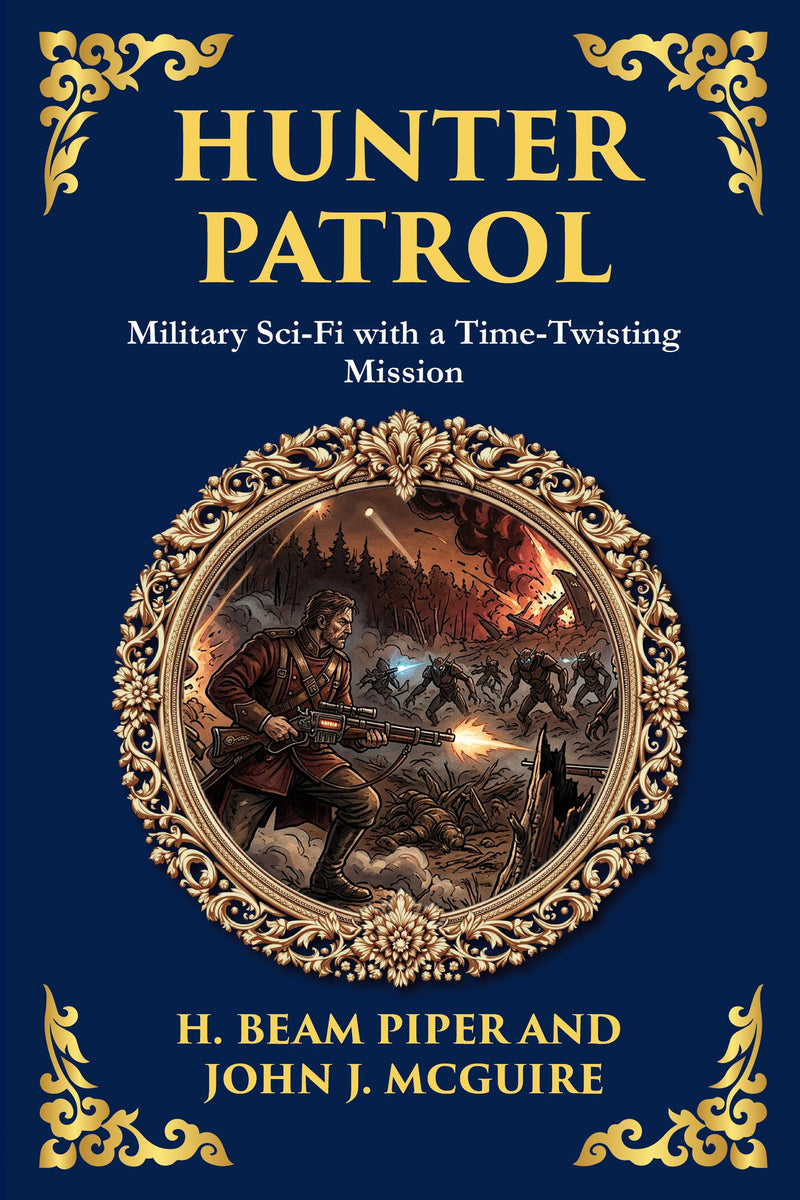
Hunter Patrol
H. Beam Piper In Hunter Patrol, two masters of classic science fiction, H. Beam Piper and John J. McGuire, send readers on a pulse-pounding adventure where the laws of time, space, and war no longer apply.
or free app
10,000+ hrs library
30-day guarantee
The complete Hunter Patrol appears in modern English through Library of Alexandria Press, available online with audiobook narration included for members.
Have you ever wondered why the future depends on soldiers trapped in the past? Hunter Patrol blends military science fiction with time travel in a gripping novella where history is both battleground and weapon. In the midst of a seemingly harmless war game, a futuristic Earth Defense team is hurled backward into a critical point in human history.
But this is no accident. Someone—or something—is manipulating the flow of time. Written by genre pioneers H. Beam Piper and John J. McGuire, this high-concept story combines sharp dialogue, tactical realism, and philosophical dilemmas into a compact yet impactful narrative.
With themes of temporal warfare, causality, and destiny, Hunter Patrol challenges readers to consider what would happen if those with advanced firepower were unleashed on the unprepared past—and how even the smallest actions can alter the future.
What you’ll discover in this modern edition
- A Futuristic Combat Unit Thrust Into History – Experience the clash of advanced technology with ancient battlegrounds.
| Formats | eBook (EPUB + PDF) · Audiobook · Paperback · Hardcover · Large Print |
| Language | English |
| Trim size (print) | 6 × 9 in |
| Binding | Paperback — perfect-bound · Hardcover — casewrap |
| Large Print edition | Same text in a larger, easy-read type — a larger font, not a larger trim |
| Print pricing | Every physical book at our true cost — at-cost, no profit (members) |
| Library | 873 restored titles, always growing |
| Length | 14,708 words · ~59 min reading |
| Reading level | Grade 3 · an easy, flowing read (this modern-English edition) |
| Edition | Modern English translation · 2026 |
Member reviews for this edition are collected as readers finish it — be the first. Across the library: 12,000+ books shipped, every plan covered by a 365-day print guarantee.
About this edition
A faithful, unabridged modern-English edition by The Library of Alexandria — carefully rendered for today's reader and verified paragraph-by-paragraph against the public-domain source. Available as eBook, audiobook, paperback, hardcover, and large print.
- Complete & unabridgedVerified paragraph by paragraph against the source — never a scan, never abridged.
- Modern English, faithfulReadable today, with the author’s meaning kept intact. Readable — not simplified.
- Every format, one membershipRead in your browser or the free app, or listen to the full audiobook.
Included free with your membership
Cancel anytime, one click · 30-day money-back guarantee
Edition last updated July 2026
What’s inside
Hunter Patrol — complete and unabridged, included in full with membership, plus the full audiobook.
Begin reading Hunter Patrol
In clear modern English — the complete text is included with membership.
Introduction
There are stories that arrive quietly, almost modestly, and only reveal their ambitions once you are fully under their spell. Hunter Patrol is one of those stories. On its surface, it presents itself as a brisk piece of mid-century adventure fiction, the kind of thing a reader might once have picked up from a spinning rack at a drugstore, drawn in by the promise of soldiers, danger, and the unknown. But beneath that accessible, propulsive exterior lies a tale that quietly probes some of the most enduring questions of human existence: What does it mean to be loyal? Can a single act change the course of history? And who, ultimately, decides what counts as victory and what counts as failure when the stakes are nothing less than the future of an entire civilization?
This collaboration between H. Beam Piper and John J. McGuire is a compact, tightly wound piece of speculative fiction that rewards both the casual reader looking for excitement and the more reflective reader who enjoys turning ideas over in their mind long after the final page. It belongs to a tradition of science fiction that took the genre’s most exciting toolkit — the manipulation of time, the clash of armies, the leap across improbable distances — and used it not merely for spectacle but for genuine inquiry. The result is a work that moves with the speed of a thriller while carrying the weight of a philosophical meditation, and it is precisely this combination that has kept it alive in the affections of readers across the decades.
This edition has been prepared as a modern translation and adaptation for the contemporary reader. That phrase deserves a moment of explanation, because it speaks to the care that has gone into making this book as inviting as possible. The original text was written in a particular era, with its own idioms, its own assumptions, and its own rhythms of speech and narrative pacing. Some of those qualities are timeless and have been preserved with affection. Others — the occasional dated turn of phrase, the references that have grown obscure with the passage of years, the sentence structures that once read as crisp but now feel stiff — have been gently smoothed so that nothing stands between you and the pure pleasure of the story. The aim throughout has been fidelity to the spirit of the original while ensuring that a reader picking this up today experiences the same immediacy, the same urgency, and the same sense of wonder that its first audience felt. Think of it as a faithful restoration rather than a reinvention: the architecture remains exactly as the authors built it, but the windows have been cleaned and the rooms freshly lit.
To understand why Hunter Patrol feels the way it does — confident, intelligent, unafraid to ask hard questions of its characters and its readers — it helps to know something about the men who wrote it, and about the remarkable creative ferment of the period in which they worked.
H. Beam Piper occupies a singular and somewhat poignant place in the history of American science fiction. Largely self-taught, he came to writing not through the academy or the literary establishment but through a deep and abiding love of history, of machinery, of how things actually worked in the real world. He had an autodidact’s hunger for knowledge and a craftsman’s respect for getting the details right, and both qualities saturate his fiction. Piper was the kind of writer who believed that even the most fantastical premise had to obey its own internal logic, that the most exotic future or the most improbable alternate world still had to feel as solid and lived-in as the ground beneath your feet. He cared about the mechanics of governance, the realities of warfare, the way ordinary people actually behaved under extraordinary pressure. This grounding is part of what gives his work its enduring credibility; you believe in his worlds because he so clearly believed in them himself.
Piper is perhaps best remembered today for two major bodies of work. The first is his “Terro-Human Future History,” a sprawling and carefully constructed timeline of humanity’s expansion across the galaxy, which gave rise to some of his most celebrated novels. The second is his fascination with the idea of parallel time lines — the notion that history might have branched at countless points, producing an infinity of alternate worlds, each one a road taken where ours took a different turn. This concept, which he developed across a number of works, was not for him merely a clever gimmick. It was a way of thinking about contingency, about the fragility of the world we know, about how the smallest decisions might ripple outward into entirely different futures. Readers familiar with this strand of his thought will recognize its fingerprints all over Hunter Patrol, where questions of time, consequence, and the malleability of history sit at the very heart of the drama.
There is also, it must be said, a certain melancholy that hovers around Piper’s legacy. His life ended in tragedy, and for a period after his death his work fell into a kind of undeserved neglect. But the quality of the writing refused to stay buried. Over the years, devoted readers, editors, and fellow writers kept his books in circulation, championed their reissue, and ensured that new generations could discover the pleasures of his clear, muscular prose and his fertile, restless imagination. Today he is rightly regarded as one of the genre’s underappreciated masters — a writer whose influence far exceeds his fame, and whose stories continue to feel startlingly relevant.
John J. McGuire, Piper’s collaborator on this work, is a less familiar name to most readers, but his partnership with Piper produced several memorable stories. Collaboration in fiction is a delicate art; it requires two minds to find a shared voice, to harmonize their instincts, to subordinate ego to the demands of the story. The fact that the Piper-McGuire collaborations read so seamlessly is a testament to how well their sensibilities meshed. McGuire brought his own perspective to bear, and the resulting works carry a distinctive energy — perhaps a slightly different rhythm, a slightly different angle of approach — that distinguishes them from Piper’s solo efforts while remaining unmistakably part of the same imaginative universe of concerns.
Both men were writing during what is often called the Golden Age of science fiction and the years immediately following it — a period of extraordinary creativity when the genre was rapidly maturing, shedding some of its pulpier excesses and beginning to grapple seriously with big ideas. This was an era shaped by the enormous anxieties and hopes of the mid-twentieth century: the recent memory of global war, the dawning age of nuclear weapons, the deepening tensions between great powers, and the dizzying acceleration of technology. Science fiction became a natural vehicle for processing all of this — a literature in which writers could stage the great debates of their time on the safely distant ground of the future, the alien, or the alternate. When you read Hunter Patrol, you are reading a book that breathes the air of that moment. Its concerns with war and peace, with the responsibilities that power imposes, with the question of whether human beings can ever truly escape the cycles of violence that have defined their history — all of these are deeply of their time, and yet, unsettlingly, they remain entirely of ours.
It would be a disservice to you as a reader to lay out the specifics of the plot, because so much of the pleasure of this particular story lies in the way it unfolds, in the discoveries it has in store, and in the gradual revelation of just how large its ambitions really are. What can be said, without spoiling anything, is that the title itself offers a clue to the territory you are about to enter. Hunter Patrol signals military fiction — soldiers, missions, the hard-edged world of those who operate at the sharp end of conflict — and indeed the story is steeped in that atmosphere. But the subtitle hints at something more: a “time-twisting mission,” a phrase that promises the kind of conceptual richness that elevates the best science fiction above mere adventure.
What you will find, then, is a story that begins in the recognizable world of combat and danger, with all the immediacy and tension that implies, and then opens outward into something far stranger and more thought-provoking. The military framework is not incidental; it is essential. Piper and McGuire understood the world of soldiers — the discipline, the camaraderie, the brutal arithmetic of survival, the way that violence both forges and corrodes the human spirit. They use this understanding to anchor the more speculative elements of the story in emotional and psychological reality. When the fantastic enters the narrative, it does not feel like an escape from the harsh realities of war but rather an intensification of them, a way of asking even larger questions about conflict, power, and the possibility of peace.
One of the great strengths of this work is its pacing. These are writers who understood that a story must move, that the reader’s attention is a gift that must be continually earned. There is very little here that is wasted; scenes do their work and then propel you forward to the next. And yet this efficiency never comes at the cost of substance. Within the lean, forward-driving narrative, the authors find room for genuine ideas, for moments of moral complexity, for the kind of unexpected turn that makes you set the book down for a moment and reconsider everything you thought you understood. This is fiction that respects your intelligence even as it works hard to entertain you.
You will also notice, as you read, the particular pleasure of Piper’s gift for character. His protagonists tend to be competent, intelligent, resourceful people — but they are never bland or invulnerable. They struggle, they doubt, they make mistakes, and they must reckon with the consequences of their choices. There is something deeply satisfying about following a capable character through a difficult situation, watching them think their way through problems, watching them apply skill and courage and ingenuity to circumstances that would defeat lesser people. But Piper never lets competence become a substitute for humanity. His characters bleed, they fear, they wrestle with questions of right and wrong, and it is this combination of capability and vulnerability that makes them so engaging to spend time with.
The thematic heart of the book — and here, again, care is needed not to reveal too much — concerns the great questions that have always preoccupied the most serious science fiction. What is the relationship between an individual and the vast historical forces that shape their world? Can one person, placed at the right moment in the right circumstances, alter the destiny of millions? And if such power were to fall into a person’s hands, what would they be obligated to do with it? These are not abstract puzzles for the authors; they are dramatized through the concrete experiences of characters who must make wrenching decisions under conditions of profound uncertainty. The result is a book that works simultaneously on multiple levels — as a thrilling adventure, as a meditation on history and contingency, and as a moral inquiry into the nature of duty and sacrifice.
There is, too, a quality of optimism running through the work that feels both characteristic of its era and quietly bracing to encounter today. For all their awareness of human folly and the persistence of conflict, Piper and McGuire were not nihilists. They believed in the possibility of intelligence, of decency, of finding a better path. They believed that human beings, for all their flaws, were capable of rising to meet enormous challenges. This is not a naive optimism — the story is too clear-eyed about violence and its costs for that — but a hard-won one, the kind that acknowledges the darkness and chooses hope anyway. In a literary landscape that has often tilted toward despair, there is something genuinely refreshing about a story that takes the human capacity for greatness seriously.
Cancel anytime, one click · 30-day money-back guarantee
Founding annual rate available now — your price locks for life when you join.
Not ready? Get this free chapter by email — read it anytime.
✓ Sent — check your inbox for Hunter Patrol.
Questions about Hunter Patrol
What is Hunter Patrol about?
H. Beam Piper In Hunter Patrol, two masters of classic science fiction, H. Beam Piper and John J. McGuire, send readers on a pulse-pounding adventure where the laws of time, space, and war no longer apply. When an elite military unit is deployed on a routine simulation, they unknowingly cross into the past. But history has changed, and now the hunters are being hunted.
Is Hunter Patrol free to read?
The opening chapter is free to read on this page. Members read and listen to the complete work — and the entire library — free, and can order any physical book at our true print cost.
How long is Hunter Patrol?
2 chapters (~14,708 words) — about 59 min of reading in this modern-English edition.
Is this an abridged version of Hunter Patrol?
No. This is the complete, unabridged Hunter Patrol, carefully rendered into clear modern English and verified paragraph-by-paragraph against the public-domain source — nothing is cut or summarised.
What formats does Hunter Patrol come in?
Hunter Patrol is available as eBook, paperback, hardcover and large print. eBook and audiobook are included with membership; printed editions ship at our true print cost.
Shipping & returns
Billing & membership
More from the library


Explore Science Fiction
- The Island of Doctor Moreau · H. G. Wells
- A Midsummer Night’s Dream · William Shakespeare
- The Invisible Man: A Grotesque Romance · H. G. Wells
- The War of the Worlds · H. G. Wells
- The Strange Case of Dr. Jekyll and Mr. Hyde · Robert Louis Stevenson
- Limanora: the island of progress · Godfrey Sweven
- The Book of Dragons · E. Nesbit
- She · H. Rider Haggard
- Dorothy and the Wizard in Oz · L. Frank Baum
- The Princess and the Goblin · George MacDonald
- Gawayne and the Green Knight: A Fairy Tale · Charlton M. Lewis
- Lucian’s True History · Lucian of Samosata
- The Willows · Algernon Blackwood
- The Call of Cthulhu · H. P. Lovecraft
- The Life-Eater · Harold Ward
- The Marvelous Land of Oz · L. Frank Baum
- Mars is My Destination · Frank Belknap Long
- The Black Kiss
- The Beasts in the Void · Paul W. Fairman
- John Jones’s Dollar · Harry Stephen Keeler
- Subversive · Mack Reynolds
- The Mississippi Saucer · Frank Belknap Long
- Man of Distinction · Michael Shaara
- Spawn of the Comet · H. Thompson Rich
- The Golden Judge · Nathaniel Gordon
- Final Weapon · Everett B. Cole
- The Big Fix · George O. Smith
- Last Enemy · H. Beam Piper
- Time and Time Again · H. Beam Piper
- Sabotage in Space · Carey Rockwell
Hunter Patrol
Hunter Patrol
Military Sci-Fi with a Time-Twisting Mission
Anonymous
Contents
- Introduction
- Hunter Patrol
Introduction
There are stories that arrive quietly, almost modestly, and only reveal their ambitions once you are fully under their spell. Hunter Patrol is one of those stories. On its surface, it presents itself as a brisk piece of mid-century adventure fiction, the kind of thing a reader might once have picked up from a spinning rack at a drugstore, drawn in by the promise of soldiers, danger, and the unknown. But beneath that accessible, propulsive exterior lies a tale that quietly probes some of the most enduring questions of human existence: What does it mean to be loyal? Can a single act change the course of history? And who, ultimately, decides what counts as victory and what counts as failure when the stakes are nothing less than the future of an entire civilization?
This collaboration between H. Beam Piper and John J. McGuire is a compact, tightly wound piece of speculative fiction that rewards both the casual reader looking for excitement and the more reflective reader who enjoys turning ideas over in their mind long after the final page. It belongs to a tradition of science fiction that took the genre’s most exciting toolkit — the manipulation of time, the clash of armies, the leap across improbable distances — and used it not merely for spectacle but for genuine inquiry. The result is a work that moves with the speed of a thriller while carrying the weight of a philosophical meditation, and it is precisely this combination that has kept it alive in the affections of readers across the decades.
This edition has been prepared as a modern translation and adaptation for the contemporary reader. That phrase deserves a moment of explanation, because it speaks to the care that has gone into making this book as inviting as possible. The original text was written in a particular era, with its own idioms, its own assumptions, and its own rhythms of speech and narrative pacing. Some of those qualities are timeless and have been preserved with affection. Others — the occasional dated turn of phrase, the references that have grown obscure with the passage of years, the sentence structures that once read as crisp but now feel stiff — have been gently smoothed so that nothing stands between you and the pure pleasure of the story. The aim throughout has been fidelity to the spirit of the original while ensuring that a reader picking this up today experiences the same immediacy, the same urgency, and the same sense of wonder that its first audience felt. Think of it as a faithful restoration rather than a reinvention: the architecture remains exactly as the authors built it, but the windows have been cleaned and the rooms freshly lit.
To understand why Hunter Patrol feels the way it does — confident, intelligent, unafraid to ask hard questions of its characters and its readers — it helps to know something about the men who wrote it, and about the remarkable creative ferment of the period in which they worked.
H. Beam Piper occupies a singular and somewhat poignant place in the history of American science fiction. Largely self-taught, he came to writing not through the academy or the literary establishment but through a deep and abiding love of history, of machinery, of how things actually worked in the real world. He had an autodidact’s hunger for knowledge and a craftsman’s respect for getting the details right, and both qualities saturate his fiction. Piper was the kind of writer who believed that even the most fantastical premise had to obey its own internal logic, that the most exotic future or the most improbable alternate world still had to feel as solid and lived-in as the ground beneath your feet. He cared about the mechanics of governance, the realities of warfare, the way ordinary people actually behaved under extraordinary pressure. This grounding is part of what gives his work its enduring credibility; you believe in his worlds because he so clearly believed in them himself.
Piper is perhaps best remembered today for two major bodies of work. The first is his “Terro-Human Future History,” a sprawling and carefully constructed timeline of humanity’s expansion across the galaxy, which gave rise to some of his most celebrated novels. The second is his fascination with the idea of parallel time lines — the notion that history might have branched at countless points, producing an infinity of alternate worlds, each one a road taken where ours took a different turn. This concept, which he developed across a number of works, was not for him merely a clever gimmick. It was a way of thinking about contingency, about the fragility of the world we know, about how the smallest decisions might ripple outward into entirely different futures. Readers familiar with this strand of his thought will recognize its fingerprints all over Hunter Patrol, where questions of time, consequence, and the malleability of history sit at the very heart of the drama.
There is also, it must be said, a certain melancholy that hovers around Piper’s legacy. His life ended in tragedy, and for a period after his death his work fell into a kind of undeserved neglect. But the quality of the writing refused to stay buried. Over the years, devoted readers, editors, and fellow writers kept his books in circulation, championed their reissue, and ensured that new generations could discover the pleasures of his clear, muscular prose and his fertile, restless imagination. Today he is rightly regarded as one of the genre’s underappreciated masters — a writer whose influence far exceeds his fame, and whose stories continue to feel startlingly relevant.
John J. McGuire, Piper’s collaborator on this work, is a less familiar name to most readers, but his partnership with Piper produced several memorable stories. Collaboration in fiction is a delicate art; it requires two minds to find a shared voice, to harmonize their instincts, to subordinate ego to the demands of the story. The fact that the Piper-McGuire collaborations read so seamlessly is a testament to how well their sensibilities meshed. McGuire brought his own perspective to bear, and the resulting works carry a distinctive energy — perhaps a slightly different rhythm, a slightly different angle of approach — that distinguishes them from Piper’s solo efforts while remaining unmistakably part of the same imaginative universe of concerns.
Both men were writing during what is often called the Golden Age of science fiction and the years immediately following it — a period of extraordinary creativity when the genre was rapidly maturing, shedding some of its pulpier excesses and beginning to grapple seriously with big ideas. This was an era shaped by the enormous anxieties and hopes of the mid-twentieth century: the recent memory of global war, the dawning age of nuclear weapons, the deepening tensions between great powers, and the dizzying acceleration of technology. Science fiction became a natural vehicle for processing all of this — a literature in which writers could stage the great debates of their time on the safely distant ground of the future, the alien, or the alternate. When you read Hunter Patrol, you are reading a book that breathes the air of that moment. Its concerns with war and peace, with the responsibilities that power imposes, with the question of whether human beings can ever truly escape the cycles of violence that have defined their history — all of these are deeply of their time, and yet, unsettlingly, they remain entirely of ours.
It would be a disservice to you as a reader to lay out the specifics of the plot, because so much of the pleasure of this particular story lies in the way it unfolds, in the discoveries it has in store, and in the gradual revelation of just how large its ambitions really are. What can be said, without spoiling anything, is that the title itself offers a clue to the territory you are about to enter. Hunter Patrol signals military fiction — soldiers, missions, the hard-edged world of those who operate at the sharp end of conflict — and indeed the story is steeped in that atmosphere. But the subtitle hints at something more: a “time-twisting mission,” a phrase that promises the kind of conceptual richness that elevates the best science fiction above mere adventure.
What you will find, then, is a story that begins in the recognizable world of combat and danger, with all the immediacy and tension that implies, and then opens outward into something far stranger and more thought-provoking. The military framework is not incidental; it is essential. Piper and McGuire understood the world of soldiers — the discipline, the camaraderie, the brutal arithmetic of survival, the way that violence both forges and corrodes the human spirit. They use this understanding to anchor the more speculative elements of the story in emotional and psychological reality. When the fantastic enters the narrative, it does not feel like an escape from the harsh realities of war but rather an intensification of them, a way of asking even larger questions about conflict, power, and the possibility of peace.
One of the great strengths of this work is its pacing. These are writers who understood that a story must move, that the reader’s attention is a gift that must be continually earned. There is very little here that is wasted; scenes do their work and then propel you forward to the next. And yet this efficiency never comes at the cost of substance. Within the lean, forward-driving narrative, the authors find room for genuine ideas, for moments of moral complexity, for the kind of unexpected turn that makes you set the book down for a moment and reconsider everything you thought you understood. This is fiction that respects your intelligence even as it works hard to entertain you.
You will also notice, as you read, the particular pleasure of Piper’s gift for character. His protagonists tend to be competent, intelligent, resourceful people — but they are never bland or invulnerable. They struggle, they doubt, they make mistakes, and they must reckon with the consequences of their choices. There is something deeply satisfying about following a capable character through a difficult situation, watching them think their way through problems, watching them apply skill and courage and ingenuity to circumstances that would defeat lesser people. But Piper never lets competence become a substitute for humanity. His characters bleed, they fear, they wrestle with questions of right and wrong, and it is this combination of capability and vulnerability that makes them so engaging to spend time with.
The thematic heart of the book — and here, again, care is needed not to reveal too much — concerns the great questions that have always preoccupied the most serious science fiction. What is the relationship between an individual and the vast historical forces that shape their world? Can one person, placed at the right moment in the right circumstances, alter the destiny of millions? And if such power were to fall into a person’s hands, what would they be obligated to do with it? These are not abstract puzzles for the authors; they are dramatized through the concrete experiences of characters who must make wrenching decisions under conditions of profound uncertainty. The result is a book that works simultaneously on multiple levels — as a thrilling adventure, as a meditation on history and contingency, and as a moral inquiry into the nature of duty and sacrifice.
There is, too, a quality of optimism running through the work that feels both characteristic of its era and quietly bracing to encounter today. For all their awareness of human folly and the persistence of conflict, Piper and McGuire were not nihilists. They believed in the possibility of intelligence, of decency, of finding a better path. They believed that human beings, for all their flaws, were capable of rising to meet enormous challenges. This is not a naive optimism — the story is too clear-eyed about violence and its costs for that — but a hard-won one, the kind that acknowledges the darkness and chooses hope anyway. In a literary landscape that has often tilted toward despair, there is something genuinely refreshing about a story that takes the human capacity for greatness seriously.
Many people have dreamed of world peace, but no one has ever managed to achieve it. If one person actually had that power, could humanity afford the cost?
Benson stopped for a moment at the top of the ridge, checking his watch and then looking back over his shoulder. It was 0539; in eleven minutes, an artillery barrage would hit the exact spot where he was standing. Behind him, on the long northeast slope, he could see columns of black smoke rising from the former Pan-Soviet supply depot. There was a lot of gunfire coming from that direction. He wondered if the Communists had trapped a few of his men after the patrol finished its mission and split up, or if a couple of Communist units were accidentally shooting at each other. Either way, the result was the same: reserve units would be in chaos, and some soldiers would be pulled away from the front lines. His small group of UN regulars and Turkish partisans had done a great job of making it look like a large paratrooper attack. At least his part was finished; now it was time for the classic infantry move: “get the hell out of here.” This was his final patrol before heading home. He didn’t want anything to go wrong.
There was a small ravine to his left. The stream that had carved it into the steep southern slope would be dry this time of year. He could move faster there and find cover from any stray shots once the barrage began. He hurried toward it and followed it down into the valley. This path would lead him toward the front—the thinly guarded section of the Communist lines and the UN lines beyond, where fresh troops were waiting in their foxholes to launch the attack.
End of the free sample
Keep reading, free
Members read and listen to the complete book — and the entire library. Cancel anytime, one click · 30-day money-back guarantee.