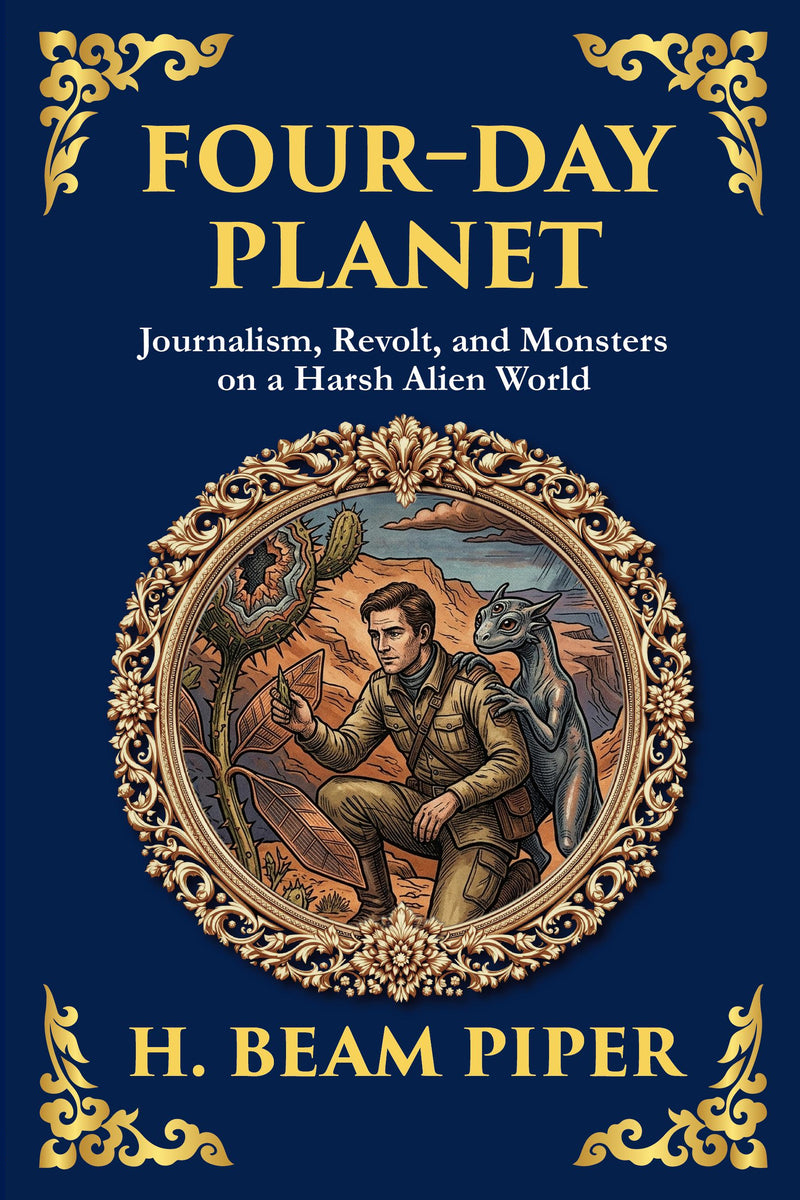
Four-Day Planet
Welcome to Fenris, a planet where days last 96 Earth hours and the world is scorched by fire, frozen by night, and plagued by giant sea-monsters.
or free app
10,000+ hrs library
30-day guarantee
The complete Four-Day Planet appears in modern English through Library of Alexandria Press, available online with audiobook narration included for members.
Have you ever wondered why the truth can be the most dangerous weapon of all— especially on another world? Four-Day Planet by H. Beam Piper is a fast-paced, sharply written sci-fi adventure set on the brutal frontier world of Fenris—a planet of extremes. With a day-night cycle that spans four Earth days, Fenris is home to a struggling colony of humans who rely entirely on hunting sea- monsters called “old crocks” to survive.
But something deeper stirs beneath the waves... and within the colony’s political system. Teenage reporter Walt Boyd wants more than monster stories. He wants to expose the corruption that’s strangling his world—and when an off-world observer arrives, his chance comes.
But what begins as a bold news assignment becomes a deadly investigation as Walt uncovers a conspiracy of smugglers, lies, and revolution. Armed with nothing but a camera, a microphone, and his determination, Walt must navigate treacherous waters—literal and political—to get the truth out. This modern edition revives Piper’s sharp, prophetic tale of media, power, and resistance with gripping clarity and relevance.
What you’ll discover in this modern edition
- A Teenage Hero with Guts and a Pen – Join young journalist Walt Boyd as he risks it all to tell the truth.
| Formats | eBook (EPUB + PDF) · Audiobook · Paperback · Hardcover · Large Print |
| Language | English |
| Trim size (print) | 6 × 9 in |
| Binding | Paperback — perfect-bound · Hardcover — casewrap |
| Large Print edition | Same text in a larger, easy-read type — a larger font, not a larger trim |
| Print pricing | Every physical book at our true cost — at-cost, no profit (members) |
| Library | 873 restored titles, always growing |
| Length | 59,129 words · ~3 hr 57 min reading |
| Reading level | Grade 3 · an easy, flowing read (this modern-English edition) |
| Edition | Modern English translation · 2026 |
Member reviews for this edition are collected as readers finish it — be the first. Across the library: 12,000+ books shipped, every plan covered by a 365-day print guarantee.
About this edition
A faithful, unabridged modern-English edition by The Library of Alexandria — carefully rendered for today's reader and verified paragraph-by-paragraph against the public-domain source. Available as eBook, audiobook, paperback, hardcover, and large print.
- Complete & unabridgedVerified paragraph by paragraph against the source — never a scan, never abridged.
- Modern English, faithfulReadable today, with the author’s meaning kept intact. Readable — not simplified.
- Every format, one membershipRead in your browser or the free app, or listen to the full audiobook.
Included free with your membership
Cancel anytime, one click · 30-day money-back guarantee
Edition last updated July 2026
What’s inside
Four-Day Planet — complete and unabridged: all 15 sections included with membership, plus the full audiobook.
Begin reading Four-Day Planet
In clear modern English — the complete text is included with membership.
Introduction
There are certain books that arrive at the perfect moment in a reader’s life—stories that combine the thrill of adventure with the quiet education of how the world actually works. Four-Day Planet is one of those rare books. First published in 1961, during the golden flowering of American science fiction, H. Beam Piper’s novel stands today not merely as a relic of mid-century pulp storytelling, but as a remarkably durable and intelligent work that still has a great deal to say to readers in our own century. It is a coming-of-age tale, a frontier adventure, a political drama, and a love letter to the craft of honest journalism, all wrapped into a single propulsive narrative set on one of the most vividly imagined worlds in the genre.
What you hold in your hands is a modern translation—an adaptation prepared with the contemporary reader in mind. Piper wrote in a clear, muscular prose style that has aged better than most of his contemporaries, but language inevitably drifts over the decades. Idioms fall out of use, technological assumptions shift, and certain turns of phrase that once felt crisp now read as quaint or obscure. This edition has been carefully reworked to smooth those rough edges while preserving the author’s voice, his wit, and the essential character of his storytelling. The goal has been to let the novel breathe freely for a new generation, to ensure that nothing stands between you and the pleasures of the tale—the salt-stinging cold of an alien sea, the tension of a crowded meeting hall, the heart-pounding excitement of a hunt for creatures larger than houses. This is not a watered-down version. It is, rather, an invitation: come into this world as Piper imagined it, and find it as fresh and immediate as the day it was written.
To understand what makes Four-Day Planet special, it helps to know something about the man who wrote it. Henry Beam Piper was, in many ways, an unlikely figure to become one of the most beloved cult authors in science fiction history. Born in Altoona, Pennsylvania, in 1904, he never attended college. He worked for years as a laborer and night watchman for the Pennsylvania Railroad, educating himself voraciously in libraries during whatever hours he could spare. He was a passionate amateur historian, a serious student of firearms and military history, and a man whose conversation, by all accounts, ranged across an extraordinary breadth of subjects. This self-made intellect is everywhere visible in his fiction. Piper was not a writer who decorated his stories with a thin veneer of research; he was a man who genuinely thought hard about how societies form, how economies function, how political power shifts and consolidates, and how ordinary people behave under pressure.
Piper’s career as a fiction writer was relatively short—he began publishing in the late 1940s and died, tragically, in 1964—but in that compressed span he produced a body of work that has outlasted the output of far more prolific authors. He is best remembered today for two great creations. The first is his “Terro-Human Future History,” an elaborate and internally consistent timeline of human expansion across the galaxy over thousands of years, of which Four-Day Planet is a part. The second is Little Fuzzy, a gentle and morally serious novel about the discovery of a small, intelligent alien species and the legal and ethical questions their existence provokes—a book that has charmed readers for generations and inspired numerous continuations by other hands.
What unites Piper’s best work is a deep humanism combined with a hard-headed practicality. He had no patience for utopian fantasies in which human nature is magically improved, nor for grim dystopias in which everything is hopeless. His characters live in worlds that are recognizably governed by the same forces that govern our own: greed and generosity, courage and cowardice, the slow grinding wheels of bureaucracy and the sudden eruptions of crowd emotion. His heroes are not chosen ones with mystical destinies. They are competent, observant, decent people who pay attention to the world around them and act with integrity when it counts. This is precisely the kind of hero you will meet in Four-Day Planet, and it is one of the reasons the novel feels so trustworthy and so satisfying.
It is worth pausing to note the strange afterlife of Piper’s reputation. For a period after his death, much of his work fell out of print, and he risked becoming one of those authors known only to dedicated collectors and aging fans. Yet the durability of his ideas and the appeal of his characters refused to let him be forgotten. Decades after his death, his books were reprinted, anthologized, and discovered by entirely new readers, in part because so much of his work eventually entered the public domain and became freely available. This curious twist of fate—an author rescued from obscurity by the very passage of time that had nearly buried him—feels appropriate for a man who spent his life believing in the long view, in the patterns of history that repeat and resolve across centuries. Reading him now, we participate in that rediscovery, and there is genuine pleasure in encountering a voice that so many almost lost.
The juvenile or “young adult” label that has sometimes been attached to Four-Day Planet deserves a word of clarification. In the 1950s and early 1960s, science fiction for younger readers was a thriving and respected category, championed above all by Robert A. Heinlein, whose famous series of “juveniles” set the standard. These were not condescending books. They treated their young protagonists—and their young readers—as intelligent beings capable of understanding complex situations, making hard choices, and learning real lessons about how the adult world operates. Piper worked squarely in this tradition. Four-Day Planet features a teenage narrator, but it never talks down to its audience, and it offers just as much to an adult reader as to a younger one. The political maneuvering, the economic detail, the moral complexity of the situations the characters face—none of it is softened or simplified. If anything, the choice of a young narrator sharpens the book’s appeal, because we experience this harsh and fascinating world through eyes that are still learning to see it clearly, and we learn alongside him.
The World of Fenris and the Spirit of the Frontier
The setting of Four-Day Planet is one of its greatest achievements, and it deserves to be appreciated for the feat of imagination it represents. The planet on which the story unfolds is a place of almost unbearable extremity—a world whose rotation and orbit conspire to produce conditions that would seem to make human habitation nearly impossible. The very title of the novel refers to the strange temporal rhythm of this world, where the cycle of day and night stretches across a span that warps every aspect of life. Long periods of blistering heat give way to long periods of killing cold, and the human population must organize its entire existence around surviving these brutal swings. Piper thought through the consequences of this with the care of a true world-builder. He understood that a planet’s physical nature shapes not only its weather but its economy, its architecture, its politics, and the very temperament of the people who choose to live there.
And what kind of people would choose to live in such a place? This is where Piper’s genius for human society comes into play. The settlers of this hostile world are pioneers in the oldest and truest sense—tough, independent, often cynical, bound together by the shared knowledge that survival depends on competence and mutual reliance. The economy of the planet rests almost entirely on a single dangerous industry, the hunting of enormous sea creatures whose bodies yield a substance of immense value. This is a frontier economy, raw and volatile, where fortunes are made and lost on the strength of a season’s catch, where the workers who risk their lives doing the actual hunting must constantly defend their interests against those who would profit from their labor without sharing the danger.
Readers who know their history will recognize in this setup a clear and deliberate echo of the great whaling industry of the eighteenth and nineteenth centuries. Piper was a careful student of the past, and he understood that the best way to imagine an alien future is often to study the human past closely. The hunters of his frozen world, the markets for their catch, the economic pressures and the corrupt schemes that arise around a commodity trade—all of this is grounded in real historical patterns. There is something of Melville in these pages, something of the great age of sail and the men who pursued leviathans across dangerous waters. But Piper transposes it all to an alien planet with such conviction that it feels entirely original. The result is a setting that is simultaneously exotic and deeply familiar, strange enough to thrill the imagination yet grounded enough to feel utterly real.
This frontier quality gives the novel a particular flavor that distinguishes it from much of the science fiction being written in its era. Where many writers of the period were preoccupied with sleek future cities, gleaming technology, and the marvels of progress, Piper was drawn to the rough edges of expansion—the places where civilization was still being built, where law was thin and institutions were young, where individuals still mattered enormously because there was no vast machinery to absorb their choices. There is a frontier spirit here that has deep roots in the American imagination, the same spirit that animates the best Westerns. The remote settlement, the hard-bitten community, the threat of corruption from powerful interests, the lone voice of honesty trying to make itself heard—these are archetypes that resonate across genres and centuries.
It is also worth appreciating the role that journalism plays in the novel, because this is one of its most distinctive and enduring features. Our protagonist is connected to the world of news-gathering, and through him Piper offers a thoughtful and affectionate portrait of what it means to report the truth in a place where powerful people would very much prefer that certain truths remain hidden. In an age when questions about media, information, and the public good are more urgent than ever, this dimension of the book has only grown in relevance. Piper takes seriously the idea that a free press is one of the load-bearing pillars of a functioning society, and that the courage to print what is true—even when it is dangerous, even when it is unpopular—is a genuine form of heroism. The newspaper at the heart of the story is not a glamorous institution. It is a small, scrappy operation, run by people who believe in their work, and its struggles feel as authentic as anything in the book. Young readers encountering these ideas for the first time, and older readers revisiting them, will find here a quiet but powerful argument for the value of honest information and the responsibilities of those who provide it.
The monsters of the title—the great creatures of the deep that the hunters pursue—deserve their own mention, because they are among the most memorable elements of the story. Piper does not treat them as mere obstacles or video-game targets. They are imagined with real biological plausibility, fearsome and magnificent, and the sequences in which they are hunted crackle with genuine danger and excitement. There is a primal thrill in these scenes that taps into something very old in the human spirit: the encounter between fragile, clever humanity and the overwhelming power of the natural world. Yet Piper is also alert to the moral and ecological dimensions of this relationship, to the questions of sustainability and respect that any hunting culture must eventually confront. He does not lecture, but the thoughtful reader will find much to consider beneath the surface of the adventure.
Cancel anytime, one click · 30-day money-back guarantee
Founding annual rate available now — your price locks for life when you join.
Not ready? Get this free chapter by email — read it anytime.
✓ Sent — check your inbox for Four-Day Planet.
Questions about Four-Day Planet
What is Four-Day Planet about?
Welcome to Fenris, a planet where days last 96 Earth hours and the world is scorched by fire, frozen by night, and plagued by giant sea-monsters. In the middle of it all is a teenage journalist, trying to make a name for himself. But when a report turns into a revolution, his story becomes a fight for truth, justice, and survival.
Who wrote Four-Day Planet?
Four-Day Planet was written by H. Beam Piper. This edition presents the complete work in clear modern English, faithfully rendered from the public-domain original by Library of Alexandria Press.
Is Four-Day Planet free to read?
The opening chapter is free to read on this page. Members read and listen to the complete work — and the entire library — free, and can order any physical book at our true print cost.
How long is Four-Day Planet?
15 chapters (~59,129 words) — about 3 hr 57 min of reading in this modern-English edition.
Is this an abridged version of Four-Day Planet?
No. This is the complete, unabridged Four-Day Planet, carefully rendered into clear modern English and verified paragraph-by-paragraph against the public-domain source — nothing is cut or summarised.
What formats does Four-Day Planet come in?
Four-Day Planet is available as eBook, paperback, hardcover and large print. eBook and audiobook are included with membership; printed editions ship at our true print cost.
Shipping & returns
Billing & membership
More from the library


Explore Science Fiction
- The Island of Doctor Moreau · H. G. Wells
- A Midsummer Night’s Dream · William Shakespeare
- The Invisible Man: A Grotesque Romance · H. G. Wells
- The War of the Worlds · H. G. Wells
- The Strange Case of Dr. Jekyll and Mr. Hyde · Robert Louis Stevenson
- Limanora: the island of progress · Godfrey Sweven
- The Book of Dragons · E. Nesbit
- She · H. Rider Haggard
- Dorothy and the Wizard in Oz · L. Frank Baum
- The Princess and the Goblin · George MacDonald
- Gawayne and the Green Knight: A Fairy Tale · Charlton M. Lewis
- Lucian’s True History · Lucian of Samosata
- The Willows · Algernon Blackwood
- The Call of Cthulhu · H. P. Lovecraft
- The Life-Eater · Harold Ward
- The Marvelous Land of Oz · L. Frank Baum
- Mars is My Destination · Frank Belknap Long
- The Black Kiss
- The Beasts in the Void · Paul W. Fairman
- John Jones’s Dollar · Harry Stephen Keeler
- Subversive · Mack Reynolds
- The Mississippi Saucer · Frank Belknap Long
- Man of Distinction · Michael Shaara
- Spawn of the Comet · H. Thompson Rich
- The Golden Judge · Nathaniel Gordon
- Final Weapon · Everett B. Cole
- The Big Fix · George O. Smith
- Last Enemy · H. Beam Piper
- Time and Time Again · H. Beam Piper
- Sabotage in Space · Carey Rockwell
Four-Day Planet
Four-Day Planet
Journalism, Rebellion, and Monsters on a Brutal Alien World
H. Beam Piper
Contents
- Introduction
- Chapter 1
- Chapter 2
- Chapter 3
- Chapter 4
- Chapter 5
- Chapter 6
- Chapter 7
- Chapter 8
- Chapter 9
- Chapter 10
- Chapter 11
- Chapter 12
- Chapter 13
- Chapter 14
Introduction
There are certain books that arrive at the perfect moment in a reader’s life—stories that combine the thrill of adventure with the quiet education of how the world actually works. Four-Day Planet is one of those rare books. First published in 1961, during the golden flowering of American science fiction, H. Beam Piper’s novel stands today not merely as a relic of mid-century pulp storytelling, but as a remarkably durable and intelligent work that still has a great deal to say to readers in our own century. It is a coming-of-age tale, a frontier adventure, a political drama, and a love letter to the craft of honest journalism, all wrapped into a single propulsive narrative set on one of the most vividly imagined worlds in the genre.
What you hold in your hands is a modern translation—an adaptation prepared with the contemporary reader in mind. Piper wrote in a clear, muscular prose style that has aged better than most of his contemporaries, but language inevitably drifts over the decades. Idioms fall out of use, technological assumptions shift, and certain turns of phrase that once felt crisp now read as quaint or obscure. This edition has been carefully reworked to smooth those rough edges while preserving the author’s voice, his wit, and the essential character of his storytelling. The goal has been to let the novel breathe freely for a new generation, to ensure that nothing stands between you and the pleasures of the tale—the salt-stinging cold of an alien sea, the tension of a crowded meeting hall, the heart-pounding excitement of a hunt for creatures larger than houses. This is not a watered-down version. It is, rather, an invitation: come into this world as Piper imagined it, and find it as fresh and immediate as the day it was written.
To understand what makes Four-Day Planet special, it helps to know something about the man who wrote it. Henry Beam Piper was, in many ways, an unlikely figure to become one of the most beloved cult authors in science fiction history. Born in Altoona, Pennsylvania, in 1904, he never attended college. He worked for years as a laborer and night watchman for the Pennsylvania Railroad, educating himself voraciously in libraries during whatever hours he could spare. He was a passionate amateur historian, a serious student of firearms and military history, and a man whose conversation, by all accounts, ranged across an extraordinary breadth of subjects. This self-made intellect is everywhere visible in his fiction. Piper was not a writer who decorated his stories with a thin veneer of research; he was a man who genuinely thought hard about how societies form, how economies function, how political power shifts and consolidates, and how ordinary people behave under pressure.
Piper’s career as a fiction writer was relatively short—he began publishing in the late 1940s and died, tragically, in 1964—but in that compressed span he produced a body of work that has outlasted the output of far more prolific authors. He is best remembered today for two great creations. The first is his “Terro-Human Future History,” an elaborate and internally consistent timeline of human expansion across the galaxy over thousands of years, of which Four-Day Planet is a part. The second is Little Fuzzy, a gentle and morally serious novel about the discovery of a small, intelligent alien species and the legal and ethical questions their existence provokes—a book that has charmed readers for generations and inspired numerous continuations by other hands.
What unites Piper’s best work is a deep humanism combined with a hard-headed practicality. He had no patience for utopian fantasies in which human nature is magically improved, nor for grim dystopias in which everything is hopeless. His characters live in worlds that are recognizably governed by the same forces that govern our own: greed and generosity, courage and cowardice, the slow grinding wheels of bureaucracy and the sudden eruptions of crowd emotion. His heroes are not chosen ones with mystical destinies. They are competent, observant, decent people who pay attention to the world around them and act with integrity when it counts. This is precisely the kind of hero you will meet in Four-Day Planet, and it is one of the reasons the novel feels so trustworthy and so satisfying.
It is worth pausing to note the strange afterlife of Piper’s reputation. For a period after his death, much of his work fell out of print, and he risked becoming one of those authors known only to dedicated collectors and aging fans. Yet the durability of his ideas and the appeal of his characters refused to let him be forgotten. Decades after his death, his books were reprinted, anthologized, and discovered by entirely new readers, in part because so much of his work eventually entered the public domain and became freely available. This curious twist of fate—an author rescued from obscurity by the very passage of time that had nearly buried him—feels appropriate for a man who spent his life believing in the long view, in the patterns of history that repeat and resolve across centuries. Reading him now, we participate in that rediscovery, and there is genuine pleasure in encountering a voice that so many almost lost.
The juvenile or “young adult” label that has sometimes been attached to Four-Day Planet deserves a word of clarification. In the 1950s and early 1960s, science fiction for younger readers was a thriving and respected category, championed above all by Robert A. Heinlein, whose famous series of “juveniles” set the standard. These were not condescending books. They treated their young protagonists—and their young readers—as intelligent beings capable of understanding complex situations, making hard choices, and learning real lessons about how the adult world operates. Piper worked squarely in this tradition. Four-Day Planet features a teenage narrator, but it never talks down to its audience, and it offers just as much to an adult reader as to a younger one. The political maneuvering, the economic detail, the moral complexity of the situations the characters face—none of it is softened or simplified. If anything, the choice of a young narrator sharpens the book’s appeal, because we experience this harsh and fascinating world through eyes that are still learning to see it clearly, and we learn alongside him.
The World of Fenris and the Spirit of the Frontier
The setting of Four-Day Planet is one of its greatest achievements, and it deserves to be appreciated for the feat of imagination it represents. The planet on which the story unfolds is a place of almost unbearable extremity—a world whose rotation and orbit conspire to produce conditions that would seem to make human habitation nearly impossible. The very title of the novel refers to the strange temporal rhythm of this world, where the cycle of day and night stretches across a span that warps every aspect of life. Long periods of blistering heat give way to long periods of killing cold, and the human population must organize its entire existence around surviving these brutal swings. Piper thought through the consequences of this with the care of a true world-builder. He understood that a planet’s physical nature shapes not only its weather but its economy, its architecture, its politics, and the very temperament of the people who choose to live there.
And what kind of people would choose to live in such a place? This is where Piper’s genius for human society comes into play. The settlers of this hostile world are pioneers in the oldest and truest sense—tough, independent, often cynical, bound together by the shared knowledge that survival depends on competence and mutual reliance. The economy of the planet rests almost entirely on a single dangerous industry, the hunting of enormous sea creatures whose bodies yield a substance of immense value. This is a frontier economy, raw and volatile, where fortunes are made and lost on the strength of a season’s catch, where the workers who risk their lives doing the actual hunting must constantly defend their interests against those who would profit from their labor without sharing the danger.
Readers who know their history will recognize in this setup a clear and deliberate echo of the great whaling industry of the eighteenth and nineteenth centuries. Piper was a careful student of the past, and he understood that the best way to imagine an alien future is often to study the human past closely. The hunters of his frozen world, the markets for their catch, the economic pressures and the corrupt schemes that arise around a commodity trade—all of this is grounded in real historical patterns. There is something of Melville in these pages, something of the great age of sail and the men who pursued leviathans across dangerous waters. But Piper transposes it all to an alien planet with such conviction that it feels entirely original. The result is a setting that is simultaneously exotic and deeply familiar, strange enough to thrill the imagination yet grounded enough to feel utterly real.
This frontier quality gives the novel a particular flavor that distinguishes it from much of the science fiction being written in its era. Where many writers of the period were preoccupied with sleek future cities, gleaming technology, and the marvels of progress, Piper was drawn to the rough edges of expansion—the places where civilization was still being built, where law was thin and institutions were young, where individuals still mattered enormously because there was no vast machinery to absorb their choices. There is a frontier spirit here that has deep roots in the American imagination, the same spirit that animates the best Westerns. The remote settlement, the hard-bitten community, the threat of corruption from powerful interests, the lone voice of honesty trying to make itself heard—these are archetypes that resonate across genres and centuries.
It is also worth appreciating the role that journalism plays in the novel, because this is one of its most distinctive and enduring features. Our protagonist is connected to the world of news-gathering, and through him Piper offers a thoughtful and affectionate portrait of what it means to report the truth in a place where powerful people would very much prefer that certain truths remain hidden. In an age when questions about media, information, and the public good are more urgent than ever, this dimension of the book has only grown in relevance. Piper takes seriously the idea that a free press is one of the load-bearing pillars of a functioning society, and that the courage to print what is true—even when it is dangerous, even when it is unpopular—is a genuine form of heroism. The newspaper at the heart of the story is not a glamorous institution. It is a small, scrappy operation, run by people who believe in their work, and its struggles feel as authentic as anything in the book. Young readers encountering these ideas for the first time, and older readers revisiting them, will find here a quiet but powerful argument for the value of honest information and the responsibilities of those who provide it.
The monsters of the title—the great creatures of the deep that the hunters pursue—deserve their own mention, because they are among the most memorable elements of the story. Piper does not treat them as mere obstacles or video-game targets. They are imagined with real biological plausibility, fearsome and magnificent, and the sequences in which they are hunted crackle with genuine danger and excitement. There is a primal thrill in these scenes that taps into something very old in the human spirit: the encounter between fragile, clever humanity and the overwhelming power of the natural world. Yet Piper is also alert to the moral and ecological dimensions of this relationship, to the questions of sustainability and respect that any hunting culture must eventually confront. He does not lecture, but the thoughtful reader will find much to consider beneath the surface of the adventure.
I walked through the entrance, pulling my gear behind me in an anti-gravity bin floating above my head. As I always did, I wondered what it would actually take—besides a full-scale revolution—to make the city of Port Sandor as clean, organized, and well-lit as the spaceport district. I realized that my father’s opinion pieces and my own biting news reports weren’t going to change anything. We had been trying for far too long.
Two girls in bikinis ahead of me kept walking, still chatting away about a fight one of them had with her boyfriend. I followed behind a group of about six monster hunters wearing long pants, ankle boots, and short jackets, with large knives strapped to their belts. They were likely from the same crew, since they weren’t arguing over whose ship was the fastest, who had the toughest captain, or who earned the most money. Instead, they were discussing the price of tallow-wax; they seemed to have heard a rumor that the price was about to drop by another ten centisols per pound. I listened in without any shame, though it was the same rumor I had heard myself a short while before.
“Hi, Walt,” someone called from behind me. “Looking for some news worth printing?”
I turned around. It was a man around thirty-five with curly brown hair and a big smile. This was Adolf Lautier, the entertainment promoter. He and my father each owned a part of the Port Sandor telecast station, splitting the airtime between Dad’s news reports and Lautier’s music and drama films.
“All news is worth printing, and if it’s news, the Times prints it,” I replied. “Do you think you’ll get some good thrillers this time?”
End of the free sample
Keep reading, free
Members read and listen to the complete book — and the entire library. Cancel anytime, one click · 30-day money-back guarantee.