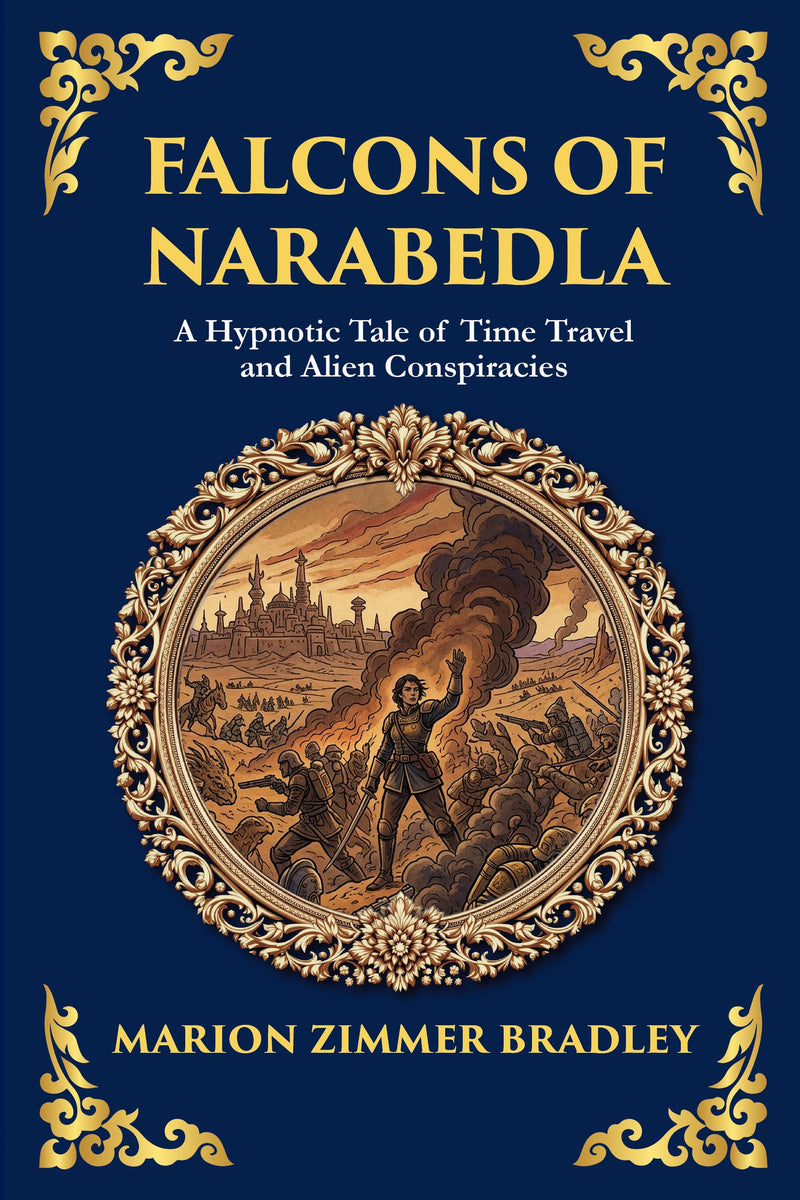
Falcons of Narabedla
A forgotten singer wakes to find himself far from home—transported to a world of two suns, exotic beauty, and dangerous secrets.
or free app
10,000+ hrs library
30-day guarantee
The complete Falcons of Narabedla appears in modern English through Library of Alexandria Press, available online with audiobook narration included for members.
Have you ever wondered why some destinies are written in the stars—while others are trapped in time? Falcons of Narabedla is a mesmerizing journey into a world where ancient powers manipulate fate, reality is fluid, and nothing—not even yourself—can be trusted. From the mind of Marion Zimmer Bradley, master of speculative fiction, comes a time-bending adventure of transformation and cosmic intrigue.
When opera singer Mike Kenscott collapses on stage, he awakes not in a hospital—but in the surreal world of Narabedla, a planet orbiting twin suns. Here, strange creatures and hypnotic alien masters rule an empire out of time, and Kenscott’s mind and body are no longer his own. What follows is a gripping battle of identity and agency, as he is pulled into a conspiracy that spans galaxies.
Is he Mike Kenscott… or someone far more important? A reincarnated hero, perhaps—a falcon-eyed warrior destined to rise against impossible odds? In this unforgettable classic, Bradley masterfully blends science fiction with fantasy, myth with memory, and action with philosophical depth.
What you’ll discover in this modern edition
- A hypnotic tale of time travel, memory manipulation, and interplanetary rebellion
- A richly imagined alien world—Narabedla—filled with intrigue, beauty, and betrayal
| Formats | eBook (EPUB + PDF) · Audiobook · Paperback · Hardcover · Large Print |
| Language | English |
| Trim size (print) | 6 × 9 in |
| Binding | Paperback — perfect-bound · Hardcover — casewrap |
| Large Print edition | Same text in a larger, easy-read type — a larger font, not a larger trim |
| Print pricing | Every physical book at our true cost — at-cost, no profit (members) |
| Library | 873 restored titles, always growing |
| Length | 30,232 words · ~2 hr 1 min reading |
| Reading level | Grade 7 · an easy, flowing read (this modern-English edition) |
| Edition | Modern English translation · 2026 |
Member reviews for this edition are collected as readers finish it — be the first. Across the library: 12,000+ books shipped, every plan covered by a 365-day print guarantee.
About this edition
A faithful, unabridged modern-English edition by The Library of Alexandria — carefully rendered for today's reader and verified paragraph-by-paragraph against the public-domain source. Available as eBook, audiobook, paperback, hardcover, and large print.
- Complete & unabridgedVerified paragraph by paragraph against the source — never a scan, never abridged.
- Modern English, faithfulReadable today, with the author’s meaning kept intact. Readable — not simplified.
- Every format, one membershipRead in your browser or the free app, or listen to the full audiobook.
Included free with your membership
Cancel anytime, one click · 30-day money-back guarantee
Edition last updated July 2026
What’s inside
Falcons of Narabedla — complete and unabridged: all 12 sections included with membership, plus the full audiobook.
Begin reading Falcons of Narabedla
In clear modern English — the complete text is included with membership.
Introduction
There are certain stories that arrive at the very threshold of a writer’s career, before the full weight of their later mastery has settled into place, that nonetheless burn with an unmistakable vitality. Falcons of Narabedla is precisely such a story. Written early in the career of Marion Zimmer Bradley, it offers readers a fascinating window into the imaginative engine that would, in the decades to come, power some of the most beloved and influential works of speculative fiction ever produced. To encounter this tale is to witness the raw, electric beginnings of a literary sensibility that would eventually reshape the contours of science fiction and fantasy alike.
What you hold in your hands is a modern translation and adaptation, carefully prepared for the contemporary reader. The language has been gently updated, the rhythms of the prose smoothed for present-day eyes and ears, and the occasional archaism of mid-century pulp writing eased into a more accessible register. Yet the essential spirit of the original remains entirely intact: the breathless pacing, the vivid strangeness, the sense of a world unfolding just beyond the edge of the familiar. This introduction is intended to prepare you for that journey, to set the stage and sharpen your anticipation, without ever revealing the surprises that await. Rest assured, no secrets of the plot will be spoiled here. Instead, the pages that follow aim to deepen your appreciation of the context, the craft, and the enduring appeal of this remarkable early work.
Marion Zimmer Bradley occupies a singular place in the history of imaginative literature. To readers who came of age in the latter half of the twentieth century, her name is synonymous with grand, immersive world-building and a profound interest in the inner lives of her characters. She is perhaps best remembered for two monumental achievements. The first is her sprawling Darkover saga, a sequence of novels and stories set on a distant world where the descendants of stranded Earth colonists develop psychic powers and a complex feudal society, all of it shadowed by the eventual return of the larger galactic civilization. The second is The Mists of Avalon, her landmark retelling of the Arthurian legend from the perspectives of its women, a book that became a genuine cultural phenomenon and demonstrated, perhaps more powerfully than any work before it, that the old myths could be made entirely new by shifting the angle of vision.
But every towering body of work has its foundations, and Falcons of Narabedla belongs to those formative years when Bradley was still discovering the full extent of what she could do. Composed during the era of the science fiction magazines, when stories were measured by their capacity to grip a reader from the first sentence and never let go, this tale carries the unmistakable energy of pulp adventure. The magazine markets of that period demanded momentum above all else. A writer could not afford to dawdle; the reader had paid for thrills, for wonder, for the sensation of being swept up and carried off to somewhere extraordinary. Bradley delivered all of this with an enthusiasm that practically leaps off the page, and yet, even at this early stage, one can detect the deeper preoccupations that would come to define her later masterpieces.
It is worth pausing to appreciate what it meant to be a woman writing science fiction in that era. The field was, in those days, overwhelmingly dominated by male authors and male editors, and the audience was assumed, often quite explicitly, to be young men hungry for tales of rockets and rayguns. Bradley entered this landscape with a confidence and a distinctive voice that would, over time, help to transform it. She brought to the genre a sensitivity to emotion, to relationship, to the texture of feeling, that was too often absent from the harder-edged adventure stories of the day. Even here, in a work that wears its pulp heritage proudly on its sleeve, there is an attentiveness to the interior experience of the protagonist that distinguishes it from the merely mechanical thrillers of its time. The story is not only about what happens; it is about what it feels like to have these things happen to you, about the disorientation and wonder and dawning understanding of a person thrust into circumstances beyond all ordinary experience.
This blending of high adventure with genuine emotional depth is, in many ways, the signature that Bradley would carry throughout her career. She understood, perhaps more intuitively than many of her contemporaries, that the most enduring fantasies are those that engage the heart as fully as the imagination. A strange world, no matter how dazzling, becomes truly memorable only when we care about the person moving through it. And so, as you read, you may find yourself noticing how the spectacle of the tale is always anchored to a recognizable human center, how the marvels are filtered through the consciousness of a character whose responses we can share and understand. This is the secret of immersive fiction, and Bradley was already practicing it with considerable skill.
The title itself signals the flavor of what awaits. Falcons of Narabedla conjures images at once exotic and evocative: the predatory grace of the falcon, a creature of swift flight and keen vision, paired with the mysterious, almost incantatory sound of a place-name that exists nowhere on any earthly map. The combination promises a setting both alien and somehow archetypal, a world where ancient resonances mingle with the wholly unfamiliar. This is characteristic of the kind of imaginative territory Bradley loved to explore, territory in which the boundaries between science fiction and fantasy grow deliciously blurred, where advanced powers might be indistinguishable from magic and where the rationalist explanations of one age give way to the wonder and dread of something far older.
The subtitle of this edition describes the book as a mesmerizing story of time travel and alien plots, and these elements alone hint at the breadth of Bradley’s ambitions even in this early work. Time travel has always been among the most philosophically rich premises in all of speculative fiction. It raises questions of fate and free will, of identity and continuity, of what it means to be displaced not merely in space but in the very flow of existence. A person torn loose from their own moment in history confronts a particularly profound form of isolation, a severance from everything that once defined them. Bradley takes this premise and runs with it, using the device not merely for its plot mechanics but for the emotional resonance it makes possible. There is something deeply affecting about a protagonist who must navigate not only a strange environment but the unmooring of their entire sense of self and place.
The notion of alien plots, meanwhile, points toward the intrigue and conspiracy that drive the narrative forward. This is not a tale of simple exploration or passive discovery. There are forces at work, agendas in motion, designs that the protagonist must gradually come to understand and reckon with. The pleasure of such a story lies partly in the slow unveiling of these hidden purposes, in the way understanding accumulates piece by piece until the full shape of the situation comes into view. Bradley structures her tale to maximize this pleasure, doling out information with a careful hand, allowing mysteries to deepen before they resolve, and keeping the reader pleasantly off balance even as the momentum carries them irresistibly forward.
The Enduring Magic of Worlds Beyond Our Own
What is it that draws us, generation after generation, to stories of other worlds and other times? The question is worth considering as you prepare to enter the realm of this novel, because Falcons of Narabedla taps into some of the deepest and most ancient impulses of human storytelling. Long before there was science fiction as we know it, there were tales of voyages to distant lands, of heroes who passed through enchanted thresholds into realms where the ordinary rules no longer applied. The traveler who crosses into the unknown and returns transformed is one of the oldest patterns in all of literature, found in myths and legends from every corner of the world. Bradley’s tale stands in this venerable tradition, dressing the ancient pattern in the costume of speculative adventure but preserving its essential power to enchant.
There is a particular delight in the early science fiction and fantasy of the magazine era that modern readers sometimes underestimate. These were stories written with an unembarrassed love of wonder, a willingness to embrace the marvelous without apology or excessive justification. The writers of that period understood that the reader had come for the sensation of awe, for the thrill of the impossible made vivid and immediate. They did not bog their tales down in excessive explanation or self-conscious irony. Instead, they trusted the reader’s imagination, presenting their wonders boldly and inviting the audience to dive in headfirst. Falcons of Narabedla carries this quality in abundance. It is a story that wants, above all, to amaze and delight you, to carry you off on a current of incident and revelation, and it pursues this goal with an infectious energy.
At the same time, this modern adaptation has been crafted with the present-day reader firmly in mind. The conventions of mid-century pulp fiction, for all their charm, can sometimes present obstacles to contemporary enjoyment. Sentence structures that felt natural to readers of an earlier generation may now seem stiff or convoluted. Vocabulary that was once current may have faded into obscurity. Cultural assumptions embedded in the original prose may strike modern eyes as jarring or simply puzzling. The work of adaptation has been to ease these difficulties, to render the prose clean and inviting, to ensure that nothing stands between you and the pure pleasure of the story. The aim throughout has been faithfulness in spirit rather than slavish reproduction of every original phrase, preserving the heart of Bradley’s vision while presenting it in a form that flows smoothly for today’s audience.
This is a delicate balance, and it deserves a word of explanation. A translation or adaptation of this kind is not an attempt to improve upon the author or to substitute the adapter’s judgment for hers. Rather, it is an act of stewardship, a way of carrying a valuable work across the gap of time so that it can continue to find readers. Languages and literary conventions evolve, and a story written for one generation can grow gradually less accessible to the next, not because its merits have diminished but simply because the medium through which it speaks has changed. By gently updating the language, this edition seeks to remove that barrier and let the story’s intrinsic qualities shine through as freshly as they did when it first appeared. The wonder, the adventure, the emotional truth at the core of the tale, all of these remain exactly as Bradley conceived them.
One of the most rewarding aspects of reading early work by a major author is the opportunity it provides to trace the development of their characteristic themes and concerns. Readers familiar with Bradley’s later novels will find much to recognize here, even in embryonic form. Her fascination with worlds where extraordinary mental and psychic powers play a central role, so fully developed in the Darkover books, can be glimpsed in the texture of this earlier tale. Her interest in the experience of the outsider, the individual who must find their footing in a society whose rules and values are wholly foreign to them, runs throughout her body of work and finds vivid expression here. Her gift for evoking the atmosphere of a place, for making an imagined setting feel solid and inhabited and real, is already very much in evidence. Reading Falcons of Narabedla with these continuities in mind adds a layer of richness to the experience, allowing one to appreciate not only the story on its own terms but also its place within the larger arc of a remarkable creative life.
Cancel anytime, one click · 30-day money-back guarantee
Founding annual rate available now — your price locks for life when you join.
Not ready? Get this free chapter by email — read it anytime.
✓ Sent — check your inbox for Falcons of Narabedla.
Questions about Falcons of Narabedla
What is Falcons of Narabedla about?
A forgotten singer wakes to find himself far from home—transported to a world of two suns, exotic beauty, and dangerous secrets. Caught between warring factions, powerful alien minds, and the haunting pull of an ancient past, he must decide: is he just a pawn in a galactic game— or the key to its salvation? In Falcons of Narabedla, legendary author Marion Zimmer Bradley delivers a hauntingly original fusion of science fiction and fantasy.
Who wrote Falcons of Narabedla?
Falcons of Narabedla was written by Marion Zimmer Bradley. This edition presents the complete work in clear modern English, faithfully rendered from the public-domain original by Library of Alexandria Press.
Is Falcons of Narabedla free to read?
The opening chapter is free to read on this page. Members read and listen to the complete work — and the entire library — free, and can order any physical book at our true print cost.
How long is Falcons of Narabedla?
12 chapters (~30,232 words) — about 2 hr 1 min of reading in this modern-English edition.
Is this an abridged version of Falcons of Narabedla?
No. This is the complete, unabridged Falcons of Narabedla, carefully rendered into clear modern English and verified paragraph-by-paragraph against the public-domain source — nothing is cut or summarised.
What formats does Falcons of Narabedla come in?
Falcons of Narabedla is available as eBook, paperback, hardcover and large print. eBook and audiobook are included with membership; printed editions ship at our true print cost.
Shipping & returns
Billing & membership
More from the library


Explore Science Fiction
- The Island of Doctor Moreau · H. G. Wells
- A Midsummer Night’s Dream · William Shakespeare
- The Invisible Man: A Grotesque Romance · H. G. Wells
- The War of the Worlds · H. G. Wells
- The Strange Case of Dr. Jekyll and Mr. Hyde · Robert Louis Stevenson
- Limanora: the island of progress · Godfrey Sweven
- The Book of Dragons · E. Nesbit
- She · H. Rider Haggard
- Dorothy and the Wizard in Oz · L. Frank Baum
- The Princess and the Goblin · George MacDonald
- Gawayne and the Green Knight: A Fairy Tale · Charlton M. Lewis
- Lucian’s True History · Lucian of Samosata
- The Willows · Algernon Blackwood
- The Call of Cthulhu · H. P. Lovecraft
- The Life-Eater · Harold Ward
- The Marvelous Land of Oz · L. Frank Baum
- Mars is My Destination · Frank Belknap Long
- The Black Kiss
- The Beasts in the Void · Paul W. Fairman
- John Jones’s Dollar · Harry Stephen Keeler
- Subversive · Mack Reynolds
- The Mississippi Saucer · Frank Belknap Long
- Man of Distinction · Michael Shaara
- Spawn of the Comet · H. Thompson Rich
- The Golden Judge · Nathaniel Gordon
- Final Weapon · Everett B. Cole
- The Big Fix · George O. Smith
- Last Enemy · H. Beam Piper
- Time and Time Again · H. Beam Piper
- Sabotage in Space · Carey Rockwell
Falcons of Narabedla
Falcons of Narabedla
A Mesmerizing Story of Time Travel and Alien Plots
Marion Zimmer Bradley
Contents
- Introduction
- Chapter 1
- Chapter 2
- Chapter 3
- Chapter 4
- Chapter 5
- Chapter 6
- Chapter 7
- Chapter 8
- Chapter 9
- Chapter 10
- Chapter 11
Introduction
There are certain stories that arrive at the very threshold of a writer’s career, before the full weight of their later mastery has settled into place, that nonetheless burn with an unmistakable vitality. Falcons of Narabedla is precisely such a story. Written early in the career of Marion Zimmer Bradley, it offers readers a fascinating window into the imaginative engine that would, in the decades to come, power some of the most beloved and influential works of speculative fiction ever produced. To encounter this tale is to witness the raw, electric beginnings of a literary sensibility that would eventually reshape the contours of science fiction and fantasy alike.
What you hold in your hands is a modern translation and adaptation, carefully prepared for the contemporary reader. The language has been gently updated, the rhythms of the prose smoothed for present-day eyes and ears, and the occasional archaism of mid-century pulp writing eased into a more accessible register. Yet the essential spirit of the original remains entirely intact: the breathless pacing, the vivid strangeness, the sense of a world unfolding just beyond the edge of the familiar. This introduction is intended to prepare you for that journey, to set the stage and sharpen your anticipation, without ever revealing the surprises that await. Rest assured, no secrets of the plot will be spoiled here. Instead, the pages that follow aim to deepen your appreciation of the context, the craft, and the enduring appeal of this remarkable early work.
Marion Zimmer Bradley occupies a singular place in the history of imaginative literature. To readers who came of age in the latter half of the twentieth century, her name is synonymous with grand, immersive world-building and a profound interest in the inner lives of her characters. She is perhaps best remembered for two monumental achievements. The first is her sprawling Darkover saga, a sequence of novels and stories set on a distant world where the descendants of stranded Earth colonists develop psychic powers and a complex feudal society, all of it shadowed by the eventual return of the larger galactic civilization. The second is The Mists of Avalon, her landmark retelling of the Arthurian legend from the perspectives of its women, a book that became a genuine cultural phenomenon and demonstrated, perhaps more powerfully than any work before it, that the old myths could be made entirely new by shifting the angle of vision.
But every towering body of work has its foundations, and Falcons of Narabedla belongs to those formative years when Bradley was still discovering the full extent of what she could do. Composed during the era of the science fiction magazines, when stories were measured by their capacity to grip a reader from the first sentence and never let go, this tale carries the unmistakable energy of pulp adventure. The magazine markets of that period demanded momentum above all else. A writer could not afford to dawdle; the reader had paid for thrills, for wonder, for the sensation of being swept up and carried off to somewhere extraordinary. Bradley delivered all of this with an enthusiasm that practically leaps off the page, and yet, even at this early stage, one can detect the deeper preoccupations that would come to define her later masterpieces.
It is worth pausing to appreciate what it meant to be a woman writing science fiction in that era. The field was, in those days, overwhelmingly dominated by male authors and male editors, and the audience was assumed, often quite explicitly, to be young men hungry for tales of rockets and rayguns. Bradley entered this landscape with a confidence and a distinctive voice that would, over time, help to transform it. She brought to the genre a sensitivity to emotion, to relationship, to the texture of feeling, that was too often absent from the harder-edged adventure stories of the day. Even here, in a work that wears its pulp heritage proudly on its sleeve, there is an attentiveness to the interior experience of the protagonist that distinguishes it from the merely mechanical thrillers of its time. The story is not only about what happens; it is about what it feels like to have these things happen to you, about the disorientation and wonder and dawning understanding of a person thrust into circumstances beyond all ordinary experience.
This blending of high adventure with genuine emotional depth is, in many ways, the signature that Bradley would carry throughout her career. She understood, perhaps more intuitively than many of her contemporaries, that the most enduring fantasies are those that engage the heart as fully as the imagination. A strange world, no matter how dazzling, becomes truly memorable only when we care about the person moving through it. And so, as you read, you may find yourself noticing how the spectacle of the tale is always anchored to a recognizable human center, how the marvels are filtered through the consciousness of a character whose responses we can share and understand. This is the secret of immersive fiction, and Bradley was already practicing it with considerable skill.
The title itself signals the flavor of what awaits. Falcons of Narabedla conjures images at once exotic and evocative: the predatory grace of the falcon, a creature of swift flight and keen vision, paired with the mysterious, almost incantatory sound of a place-name that exists nowhere on any earthly map. The combination promises a setting both alien and somehow archetypal, a world where ancient resonances mingle with the wholly unfamiliar. This is characteristic of the kind of imaginative territory Bradley loved to explore, territory in which the boundaries between science fiction and fantasy grow deliciously blurred, where advanced powers might be indistinguishable from magic and where the rationalist explanations of one age give way to the wonder and dread of something far older.
The subtitle of this edition describes the book as a mesmerizing story of time travel and alien plots, and these elements alone hint at the breadth of Bradley’s ambitions even in this early work. Time travel has always been among the most philosophically rich premises in all of speculative fiction. It raises questions of fate and free will, of identity and continuity, of what it means to be displaced not merely in space but in the very flow of existence. A person torn loose from their own moment in history confronts a particularly profound form of isolation, a severance from everything that once defined them. Bradley takes this premise and runs with it, using the device not merely for its plot mechanics but for the emotional resonance it makes possible. There is something deeply affecting about a protagonist who must navigate not only a strange environment but the unmooring of their entire sense of self and place.
The notion of alien plots, meanwhile, points toward the intrigue and conspiracy that drive the narrative forward. This is not a tale of simple exploration or passive discovery. There are forces at work, agendas in motion, designs that the protagonist must gradually come to understand and reckon with. The pleasure of such a story lies partly in the slow unveiling of these hidden purposes, in the way understanding accumulates piece by piece until the full shape of the situation comes into view. Bradley structures her tale to maximize this pleasure, doling out information with a careful hand, allowing mysteries to deepen before they resolve, and keeping the reader pleasantly off balance even as the momentum carries them irresistibly forward.
The Enduring Magic of Worlds Beyond Our Own
What is it that draws us, generation after generation, to stories of other worlds and other times? The question is worth considering as you prepare to enter the realm of this novel, because Falcons of Narabedla taps into some of the deepest and most ancient impulses of human storytelling. Long before there was science fiction as we know it, there were tales of voyages to distant lands, of heroes who passed through enchanted thresholds into realms where the ordinary rules no longer applied. The traveler who crosses into the unknown and returns transformed is one of the oldest patterns in all of literature, found in myths and legends from every corner of the world. Bradley’s tale stands in this venerable tradition, dressing the ancient pattern in the costume of speculative adventure but preserving its essential power to enchant.
There is a particular delight in the early science fiction and fantasy of the magazine era that modern readers sometimes underestimate. These were stories written with an unembarrassed love of wonder, a willingness to embrace the marvelous without apology or excessive justification. The writers of that period understood that the reader had come for the sensation of awe, for the thrill of the impossible made vivid and immediate. They did not bog their tales down in excessive explanation or self-conscious irony. Instead, they trusted the reader’s imagination, presenting their wonders boldly and inviting the audience to dive in headfirst. Falcons of Narabedla carries this quality in abundance. It is a story that wants, above all, to amaze and delight you, to carry you off on a current of incident and revelation, and it pursues this goal with an infectious energy.
At the same time, this modern adaptation has been crafted with the present-day reader firmly in mind. The conventions of mid-century pulp fiction, for all their charm, can sometimes present obstacles to contemporary enjoyment. Sentence structures that felt natural to readers of an earlier generation may now seem stiff or convoluted. Vocabulary that was once current may have faded into obscurity. Cultural assumptions embedded in the original prose may strike modern eyes as jarring or simply puzzling. The work of adaptation has been to ease these difficulties, to render the prose clean and inviting, to ensure that nothing stands between you and the pure pleasure of the story. The aim throughout has been faithfulness in spirit rather than slavish reproduction of every original phrase, preserving the heart of Bradley’s vision while presenting it in a form that flows smoothly for today’s audience.
This is a delicate balance, and it deserves a word of explanation. A translation or adaptation of this kind is not an attempt to improve upon the author or to substitute the adapter’s judgment for hers. Rather, it is an act of stewardship, a way of carrying a valuable work across the gap of time so that it can continue to find readers. Languages and literary conventions evolve, and a story written for one generation can grow gradually less accessible to the next, not because its merits have diminished but simply because the medium through which it speaks has changed. By gently updating the language, this edition seeks to remove that barrier and let the story’s intrinsic qualities shine through as freshly as they did when it first appeared. The wonder, the adventure, the emotional truth at the core of the tale, all of these remain exactly as Bradley conceived them.
One of the most rewarding aspects of reading early work by a major author is the opportunity it provides to trace the development of their characteristic themes and concerns. Readers familiar with Bradley’s later novels will find much to recognize here, even in embryonic form. Her fascination with worlds where extraordinary mental and psychic powers play a central role, so fully developed in the Darkover books, can be glimpsed in the texture of this earlier tale. Her interest in the experience of the outsider, the individual who must find their footing in a society whose rules and values are wholly foreign to them, runs throughout her body of work and finds vivid expression here. Her gift for evoking the atmosphere of a place, for making an imagined setting feel solid and inhabited and real, is already very much in evidence. Reading Falcons of Narabedla with these continuities in mind adds a layer of richness to the experience, allowing one to appreciate not only the story on its own terms but also its place within the larger arc of a remarkable creative life.
I heard a large bird scream from the cliffs above us.
I turned to Andy, who was standing knee-deep in the icy stream next to me. “There’s your eagle. It probably smells the cougar I shot yesterday.” I began to pull in my fishing line, knowing exactly what my brother would do next. “Grab the camera, and we’ll try to get a photo.”
We crouched together in the brush and watched as the large bird of prey circled down in a slow spiral toward the dead cougar. Andy was shaking with excitement, holding the camera against his chest and staring through the viewfinder. “Wow,” he whispered, almost like a prayer, “a six-foot wingspan—maybe even more—”
The bird screamed again, sounding cautious, with its head tilted into the wind. We were downwind, so the scent of the dead animal hid our own smell from the bird. The eagle didn’t smell or see us; it dove down and landed on the cougar’s head. Andy’s camera clicked twice. The eagle jabbed its beak in—
A bolt of white-hot intensity flared in my mind. The bird—the bird—I leaped from my hiding spot and sprinted across the ten-foot clearing toward the attacking eagle, my hand automatically grabbing the hunting knife from my belt. Andy’s shout of shocked anger sounded distant to me as the eagle took off with angry, flapping wings—then, in a rage, it dove at me, its wings beating around my head. I felt the sharp beak strike, and I thrust the knife blindly upward, ripping and slashing. I heard the bird scream in pain and felt its wide wings flapping. A red haze spun around me—
Then the screaming eagle was gone, and Andy’s angry grip was on my shoulder, shaking me hard. His voice, filled with fury and fear, was almost unrecognizable. “Mike! Mike, you idiot, are you okay? You’ve gone crazy!”
End of the free sample
Keep reading, free
Members read and listen to the complete book — and the entire library. Cancel anytime, one click · 30-day money-back guarantee.