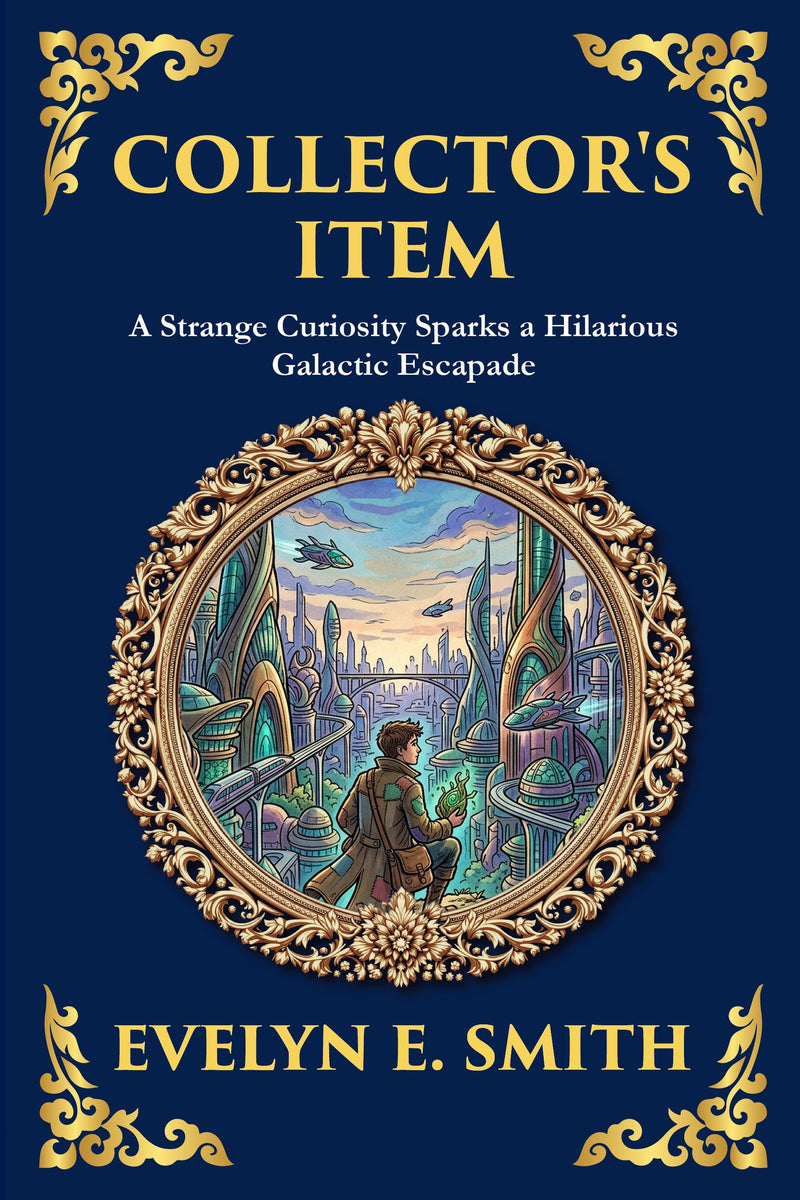
Collector’s Item
When two alien collectors stumble upon Earth, they discover something unexpected—humans. To them, we are nothing more than peculiar curiosities, strange artifacts to be studied, catalogued, or even displayed.
or free app
10,000+ hrs library
30-day guarantee
The complete Collector's Item appears in modern English through Library of Alexandria Press, available online with audiobook narration included for members.
Have you ever wondered why the strangest things become priceless in the eyes of others? In Collector’s Item, Evelyn E. Smith delivers a delightful and satirical science fiction tale that takes a sideways look at humanity, logic, and the oddities of value itself. Blending wit, humor, and interstellar absurdity, Smith creates a story where aliens see humanity not as rulers of Earth —but as odd little specimens worth collecting.
At once playful and thought-provoking, this short masterpiece is a testament to Smith’s unique voice in science fiction, combining comedy with a razor-sharp exploration of culture, perspective, and the vanity of human self-importance.
What you’ll discover in this modern edition
- A Comic Interstellar Encounter – Follow aliens who see Earth and humanity through bizarre, hilarious misunderstandings.
- A Satire of Value and Vanity – A witty exploration of how perspective shapes worth and meaning.
- A Classic Work of Humor and Science Fiction – Evelyn E. Smith’s sharp writing blends levity with timeless commentary.
- A Story That Will Leave You Laughing and Thinking – A reminder that sometimes the strangest truths are best told through comedy.
| Formats | eBook (EPUB + PDF) · Audiobook · Paperback · Hardcover · Large Print |
| Language | English |
| Trim size (print) | 6 × 9 in |
| Binding | Paperback — perfect-bound · Hardcover — casewrap |
| Large Print edition | Same text in a larger, easy-read type — a larger font, not a larger trim |
| Print pricing | Every physical book at our true cost — at-cost, no profit (members) |
| Library | 873 restored titles, always growing |
| Length | 16,477 words · ~1 hr 6 min reading |
| Reading level | Grade 3 · an easy, flowing read (this modern-English edition) |
| Edition | Modern English translation · 2026 |
Member reviews for this edition are collected as readers finish it — be the first. Across the library: 12,000+ books shipped, every plan covered by a 365-day print guarantee.
About this edition
A faithful, unabridged modern-English edition by The Library of Alexandria — carefully rendered for today's reader and verified paragraph-by-paragraph against the public-domain source. Available as eBook, audiobook, paperback, hardcover, and large print.
- Complete & unabridgedVerified paragraph by paragraph against the source — never a scan, never abridged.
- Modern English, faithfulReadable today, with the author’s meaning kept intact. Readable — not simplified.
- Every format, one membershipRead in your browser or the free app, or listen to the full audiobook.
Included free with your membership
Cancel anytime, one click · 30-day money-back guarantee
Edition last updated July 2026
What’s inside
Collector’s Item — complete and unabridged, included in full with membership, plus the full audiobook.
Begin reading Collector’s Item
In clear modern English — the complete text is included with membership.
Introduction
There is a particular kind of pleasure that comes from rediscovering a writer who once delighted readers in the golden age of science fiction magazines, only to slip quietly from the shelves of memory while the genre roared on without her. Evelyn E. Smith is precisely such a writer—a sly, witty, and unmistakably original voice whose stories crackled with the kind of intelligence and humor that too often went unappreciated in an era obsessed with rockets, robots, and ray guns. To open one of her tales is to step into a world where the absurdities of the cosmos are met not with grim seriousness but with a raised eyebrow and a quiet chuckle, where the strangeness of the universe becomes an occasion for comedy rather than catastrophe. This book, presented here in a fresh modern translation adapted for the contemporary reader, offers exactly that experience: a galactic escapade sparked by something as deceptively simple as a peculiar object, an item whose value and meaning unravel in directions no one could possibly predict.
What you hold in your hands is more than a single story; it is an invitation to remember a way of writing science fiction that prized wit over spectacle, character over hardware, and the gentle skewering of human folly over the manufactured drama of intergalactic war. Smith belonged to a generation of writers who understood that the most interesting territory in speculative fiction was not the distant planet or the alien biology, but the strange and contradictory creature who insists on dragging its habits, vanities, and obsessions across the stars. Her work asks us to laugh at ourselves, and in doing so, it asks us to see ourselves more clearly. That is no small accomplishment, and it is one of the reasons her stories repay attention even now, decades after they first appeared.
The Voice and the World of Evelyn E. Smith
Evelyn E. Smith came to prominence during the 1950s, a decade that has come to be regarded as one of the most fertile periods in the history of science fiction. The magazines of the era—the digest-sized publications that crowded newsstands and arrived in mailboxes with thrilling regularity—were hungry for short fiction, and they provided a platform for an extraordinary diversity of voices. It was a time when a clever idea, executed with style, could find an audience of hundreds of thousands of readers, and when a writer with a distinctive sensibility could carve out a place in the imaginations of devoted fans. Smith was one of those writers, and her contributions stood out precisely because they refused to take themselves too seriously.
Where many of her contemporaries leaned toward the portentous and the apocalyptic—toward stories of doom, conquest, and the cold indifference of the universe—Smith brought a lighter touch, a comic sensibility that was rare and rarer still in being genuinely funny rather than merely whimsical. Her humor was not the broad slapstick of pratfalls and exploding gadgets, though there is plenty of inventive nonsense to enjoy. It was a humor of observation, of irony, of the delicious gap between what people believe themselves to be and what they actually are. She had an ear for the way human beings rationalize their desires, and an eye for the social comedy that emerges when ordinary expectations collide with extraordinary circumstances. Reading her, one is reminded of the satirists who came before the rise of the genre—the writers who understood that the fantastic is most powerful when it holds up a mirror to the familiar.
It is worth pausing to appreciate just how difficult it is to write comic science fiction well. The genre depends, after all, on a certain suspension of disbelief, an agreement between writer and reader that the impossible will be treated as possible. Comedy threatens that agreement; the moment a writer winks too broadly at the reader, the fictional dream collapses, and the wonder evaporates. Smith managed the rare feat of writing fiction that is both genuinely speculative and genuinely funny—stories in which the laughter never undercuts the imaginative seriousness, and the imagination never weighs down the comedy. She achieves this balance through a kind of deadpan commitment: her characters take their absurd situations entirely seriously, and it is precisely their seriousness that produces the comedy. The universe she describes operates according to its own internal logic, and that logic, however bizarre, is followed with rigorous consistency. The result is a fictional world that feels both ridiculous and real, a world we can believe in even as we laugh at it.
Beyond her comic gifts, Smith was a writer of considerable craft. Her prose is economical and precise, never wasting a word, building each scene with the efficiency that the magazine market demanded but also with an elegance that transcends mere efficiency. She had a gift for the telling detail, the small observation that suddenly illuminates a character or a culture. And she had, perhaps most importantly, a deep and abiding interest in the question of value—in what people prize, why they prize it, and how the things we treasure reveal who we truly are. This preoccupation runs through much of her work, and it gives even her lightest stories a substratum of genuine thought. Beneath the laughter, there is always a question being asked, and the question is rarely a comfortable one.
This particular tale exemplifies all of these qualities. It begins, as the title suggests, with a curiosity—an object that draws attention, that provokes desire, that sets events in motion. From this small seed grows an adventure that ranges across the galaxy, an escapade that is at once a comedy of manners, a satire of consumer culture and connoisseurship, and a thoughtful meditation on the strange relationship between human beings and the things they collect. Smith uses the conventions of the space adventure—the journeys, the encounters with the unfamiliar, the complications that pile up with delightful inevitability—as a vehicle for exploring ideas that are far more enduring than the conventions themselves. The pleasures of the surface, the chase and the comedy and the surprise, are real and substantial. But beneath them lies something more, and the attentive reader will find much to ponder long after the final page.
A Note on This Modern Translation and the Art of Adaptation
This edition presents Smith’s work as a modern translation adapted for the contemporary reader, and a word about what that means—and what it does not mean—will help you approach the book with the right expectations. The fiction of the mid-twentieth century, for all its enduring delights, was written for an audience that no longer exists. The conventions of language, the assumptions about technology, the rhythms of reading, and even the cultural references that once flowed naturally between writer and reader have shifted over the intervening decades. A story that felt fresh and immediate to a reader in the 1950s may, to a reader today, contain small frictions—turns of phrase that have grown unfamiliar, idioms that have faded, references that have lost their resonance. The work of adaptation is the work of smoothing those frictions without sacrificing the essential character of the original.
The goal of a modern translation of this kind is not to rewrite the author or to impose a contemporary sensibility upon a work that belongs to another time. It is, rather, to remove the incidental obstacles that stand between the reader and the experience the author intended to create. Where a sentence has grown cumbersome through the simple passage of time, it has been gently clarified. Where a reference would now puzzle rather than illuminate, it has been handled with care so that its meaning remains accessible. The aim throughout has been fidelity to the spirit of the work—to its humor, its intelligence, its particular way of seeing—rather than slavish reproduction of every period detail. The reader who comes to this edition should feel that they are reading a living story, one that speaks to them directly, rather than a museum piece to be admired from behind glass.
This approach reflects a particular philosophy about the relationship between classic literature and contemporary readers. There is a school of thought that holds that older works should be presented exactly as they were written, with all their archaisms intact, as a kind of historical document. There is merit to this view, and for the scholar or the dedicated enthusiast, unaltered original texts will always have their place. But there is another school of thought, the one to which this edition belongs, which holds that the primary purpose of a story is to be read and enjoyed—that a story locked away in the amber of its original language risks losing the very audience that gives it life. By offering a careful, respectful adaptation, this edition seeks to extend the life of the work, to introduce it to readers who might otherwise pass it by, and to ensure that Smith’s wit and imagination continue to find an audience in an age very different from the one in which she wrote.
It should be said, too, that comedy is especially vulnerable to the erosion of time. A joke depends on timing, on shared understanding, on the precise calibration of expectation and surprise. When the language in which a joke is told grows unfamiliar, the joke can fall flat through no fault of its own—the humor is there, but the modern reader trips over the unfamiliar phrasing and misses the punchline. One of the great virtues of a thoughtful modern adaptation is that it restores the comic timing, allowing the reader to laugh where the author intended laughter, to feel the delight that the original audience felt. In adapting a comic writer like Smith, this is no small consideration. The humor is the heart of the work, and preserving that humor across the gulf of decades is the adaptation’s most important task.
None of this is to suggest that the original work has been altered beyond recognition or that its essential nature has been compromised. The story you will read is fundamentally Smith’s story, told in Smith’s way, animated by Smith’s sensibility. The adaptation is a light touch, a polishing rather than a remaking. Think of it as the careful cleaning of an old painting—the removal of the grime and varnish that have accumulated over the years, revealing the bright colors and crisp lines that the artist originally intended. The painting is unchanged; it is merely seen more clearly. So it is with this edition. Smith’s voice rings through it as clearly as ever, perhaps more clearly than it has rung in many years.
For readers who have never encountered Smith before, this edition offers an ideal introduction—an accessible entry point into the work of a writer who deserves to be far better known than she is. For readers who remember her from the magazines of long ago, or who have sought out her work in the years since, this edition offers the pleasure of rediscovery, the chance to revisit a beloved voice in a form that feels fresh and immediate. In either case, the experience promises to be a rewarding one, and the modern adaptation is offered in the hope that it will multiply the pleasures of the original rather than diminish them.
What, then, can you expect as you turn from this introduction to the story itself? You can expect, first and foremost, to be entertained. This is a book that wears its learning lightly and its purpose lightly, a book that wants above all to give pleasure. The pacing is brisk, the developments are surprising, and the comic energy never flags. There is a momentum to the narrative that carries the reader along almost effortlessly, from one delightful complication to the next, with the satisfying sense that the story is always one step ahead, always ready with a fresh twist or an unexpected revelation. This is storytelling in the classic mode—storytelling that respects the reader’s intelligence while never forgetting that its first duty is to delight.
Cancel anytime, one click · 30-day money-back guarantee
Founding annual rate available now — your price locks for life when you join.
Not ready? Get this free chapter by email — read it anytime.
✓ Sent — check your inbox for Collector’s Item.
Questions about Collector’s Item
What is Collector's Item about?
When two alien collectors stumble upon Earth, they discover something unexpected—humans. To them, we are nothing more than peculiar curiosities, strange artifacts to be studied, catalogued, or even displayed. What follows is a witty, satirical romp across space and logic, where misunderstandings lead to hilarity and a sharp commentary on what it truly means to be “valuable.” Step into Evelyn E. Smith’s brilliantly comic imagination, where the absurd becomes profound and laughter is the key to survival.
Who wrote Collector's Item?
Collector's Item was written by Evelyn E. Smith. This edition presents the complete work in clear modern English, faithfully rendered from the public-domain original by Library of Alexandria Press.
Is Collector's Item free to read?
The opening chapter is free to read on this page. Members read and listen to the complete work — and the entire library — free, and can order any physical book at our true print cost.
How long is Collector's Item?
2 chapters (~16,477 words) — about 1 hr 6 min of reading in this modern-English edition.
Is this an abridged version of Collector's Item?
No. This is the complete, unabridged Collector's Item, carefully rendered into clear modern English and verified paragraph-by-paragraph against the public-domain source — nothing is cut or summarised.
What formats does Collector's Item come in?
Collector's Item is available as eBook, paperback, hardcover and large print. eBook and audiobook are included with membership; printed editions ship at our true print cost.
Shipping & returns
Billing & membership
More from the library


Explore Science Fiction
- The Island of Doctor Moreau · H. G. Wells
- A Midsummer Night’s Dream · William Shakespeare
- The Invisible Man: A Grotesque Romance · H. G. Wells
- The War of the Worlds · H. G. Wells
- The Strange Case of Dr. Jekyll and Mr. Hyde · Robert Louis Stevenson
- Limanora: the island of progress · Godfrey Sweven
- The Book of Dragons · E. Nesbit
- She · H. Rider Haggard
- Dorothy and the Wizard in Oz · L. Frank Baum
- The Princess and the Goblin · George MacDonald
- Gawayne and the Green Knight: A Fairy Tale · Charlton M. Lewis
- Lucian’s True History · Lucian of Samosata
- The Willows · Algernon Blackwood
- The Call of Cthulhu · H. P. Lovecraft
- The Life-Eater · Harold Ward
- The Marvelous Land of Oz · L. Frank Baum
- Mars is My Destination · Frank Belknap Long
- The Black Kiss
- The Beasts in the Void · Paul W. Fairman
- John Jones’s Dollar · Harry Stephen Keeler
- Subversive · Mack Reynolds
- The Mississippi Saucer · Frank Belknap Long
- Man of Distinction · Michael Shaara
- Spawn of the Comet · H. Thompson Rich
- The Golden Judge · Nathaniel Gordon
- Final Weapon · Everett B. Cole
- The Big Fix · George O. Smith
- Last Enemy · H. Beam Piper
- Time and Time Again · H. Beam Piper
- Sabotage in Space · Carey Rockwell
Collector’s Item
Collector’s Item
A Strange Curiosity Sparks a Hilarious Galactic Escapade
Evelyn E. Smith
Contents
- Introduction
- Collector’s Item
Introduction
There is a particular kind of pleasure that comes from rediscovering a writer who once delighted readers in the golden age of science fiction magazines, only to slip quietly from the shelves of memory while the genre roared on without her. Evelyn E. Smith is precisely such a writer—a sly, witty, and unmistakably original voice whose stories crackled with the kind of intelligence and humor that too often went unappreciated in an era obsessed with rockets, robots, and ray guns. To open one of her tales is to step into a world where the absurdities of the cosmos are met not with grim seriousness but with a raised eyebrow and a quiet chuckle, where the strangeness of the universe becomes an occasion for comedy rather than catastrophe. This book, presented here in a fresh modern translation adapted for the contemporary reader, offers exactly that experience: a galactic escapade sparked by something as deceptively simple as a peculiar object, an item whose value and meaning unravel in directions no one could possibly predict.
What you hold in your hands is more than a single story; it is an invitation to remember a way of writing science fiction that prized wit over spectacle, character over hardware, and the gentle skewering of human folly over the manufactured drama of intergalactic war. Smith belonged to a generation of writers who understood that the most interesting territory in speculative fiction was not the distant planet or the alien biology, but the strange and contradictory creature who insists on dragging its habits, vanities, and obsessions across the stars. Her work asks us to laugh at ourselves, and in doing so, it asks us to see ourselves more clearly. That is no small accomplishment, and it is one of the reasons her stories repay attention even now, decades after they first appeared.
The Voice and the World of Evelyn E. Smith
Evelyn E. Smith came to prominence during the 1950s, a decade that has come to be regarded as one of the most fertile periods in the history of science fiction. The magazines of the era—the digest-sized publications that crowded newsstands and arrived in mailboxes with thrilling regularity—were hungry for short fiction, and they provided a platform for an extraordinary diversity of voices. It was a time when a clever idea, executed with style, could find an audience of hundreds of thousands of readers, and when a writer with a distinctive sensibility could carve out a place in the imaginations of devoted fans. Smith was one of those writers, and her contributions stood out precisely because they refused to take themselves too seriously.
Where many of her contemporaries leaned toward the portentous and the apocalyptic—toward stories of doom, conquest, and the cold indifference of the universe—Smith brought a lighter touch, a comic sensibility that was rare and rarer still in being genuinely funny rather than merely whimsical. Her humor was not the broad slapstick of pratfalls and exploding gadgets, though there is plenty of inventive nonsense to enjoy. It was a humor of observation, of irony, of the delicious gap between what people believe themselves to be and what they actually are. She had an ear for the way human beings rationalize their desires, and an eye for the social comedy that emerges when ordinary expectations collide with extraordinary circumstances. Reading her, one is reminded of the satirists who came before the rise of the genre—the writers who understood that the fantastic is most powerful when it holds up a mirror to the familiar.
It is worth pausing to appreciate just how difficult it is to write comic science fiction well. The genre depends, after all, on a certain suspension of disbelief, an agreement between writer and reader that the impossible will be treated as possible. Comedy threatens that agreement; the moment a writer winks too broadly at the reader, the fictional dream collapses, and the wonder evaporates. Smith managed the rare feat of writing fiction that is both genuinely speculative and genuinely funny—stories in which the laughter never undercuts the imaginative seriousness, and the imagination never weighs down the comedy. She achieves this balance through a kind of deadpan commitment: her characters take their absurd situations entirely seriously, and it is precisely their seriousness that produces the comedy. The universe she describes operates according to its own internal logic, and that logic, however bizarre, is followed with rigorous consistency. The result is a fictional world that feels both ridiculous and real, a world we can believe in even as we laugh at it.
Beyond her comic gifts, Smith was a writer of considerable craft. Her prose is economical and precise, never wasting a word, building each scene with the efficiency that the magazine market demanded but also with an elegance that transcends mere efficiency. She had a gift for the telling detail, the small observation that suddenly illuminates a character or a culture. And she had, perhaps most importantly, a deep and abiding interest in the question of value—in what people prize, why they prize it, and how the things we treasure reveal who we truly are. This preoccupation runs through much of her work, and it gives even her lightest stories a substratum of genuine thought. Beneath the laughter, there is always a question being asked, and the question is rarely a comfortable one.
This particular tale exemplifies all of these qualities. It begins, as the title suggests, with a curiosity—an object that draws attention, that provokes desire, that sets events in motion. From this small seed grows an adventure that ranges across the galaxy, an escapade that is at once a comedy of manners, a satire of consumer culture and connoisseurship, and a thoughtful meditation on the strange relationship between human beings and the things they collect. Smith uses the conventions of the space adventure—the journeys, the encounters with the unfamiliar, the complications that pile up with delightful inevitability—as a vehicle for exploring ideas that are far more enduring than the conventions themselves. The pleasures of the surface, the chase and the comedy and the surprise, are real and substantial. But beneath them lies something more, and the attentive reader will find much to ponder long after the final page.
A Note on This Modern Translation and the Art of Adaptation
This edition presents Smith’s work as a modern translation adapted for the contemporary reader, and a word about what that means—and what it does not mean—will help you approach the book with the right expectations. The fiction of the mid-twentieth century, for all its enduring delights, was written for an audience that no longer exists. The conventions of language, the assumptions about technology, the rhythms of reading, and even the cultural references that once flowed naturally between writer and reader have shifted over the intervening decades. A story that felt fresh and immediate to a reader in the 1950s may, to a reader today, contain small frictions—turns of phrase that have grown unfamiliar, idioms that have faded, references that have lost their resonance. The work of adaptation is the work of smoothing those frictions without sacrificing the essential character of the original.
The goal of a modern translation of this kind is not to rewrite the author or to impose a contemporary sensibility upon a work that belongs to another time. It is, rather, to remove the incidental obstacles that stand between the reader and the experience the author intended to create. Where a sentence has grown cumbersome through the simple passage of time, it has been gently clarified. Where a reference would now puzzle rather than illuminate, it has been handled with care so that its meaning remains accessible. The aim throughout has been fidelity to the spirit of the work—to its humor, its intelligence, its particular way of seeing—rather than slavish reproduction of every period detail. The reader who comes to this edition should feel that they are reading a living story, one that speaks to them directly, rather than a museum piece to be admired from behind glass.
This approach reflects a particular philosophy about the relationship between classic literature and contemporary readers. There is a school of thought that holds that older works should be presented exactly as they were written, with all their archaisms intact, as a kind of historical document. There is merit to this view, and for the scholar or the dedicated enthusiast, unaltered original texts will always have their place. But there is another school of thought, the one to which this edition belongs, which holds that the primary purpose of a story is to be read and enjoyed—that a story locked away in the amber of its original language risks losing the very audience that gives it life. By offering a careful, respectful adaptation, this edition seeks to extend the life of the work, to introduce it to readers who might otherwise pass it by, and to ensure that Smith’s wit and imagination continue to find an audience in an age very different from the one in which she wrote.
It should be said, too, that comedy is especially vulnerable to the erosion of time. A joke depends on timing, on shared understanding, on the precise calibration of expectation and surprise. When the language in which a joke is told grows unfamiliar, the joke can fall flat through no fault of its own—the humor is there, but the modern reader trips over the unfamiliar phrasing and misses the punchline. One of the great virtues of a thoughtful modern adaptation is that it restores the comic timing, allowing the reader to laugh where the author intended laughter, to feel the delight that the original audience felt. In adapting a comic writer like Smith, this is no small consideration. The humor is the heart of the work, and preserving that humor across the gulf of decades is the adaptation’s most important task.
None of this is to suggest that the original work has been altered beyond recognition or that its essential nature has been compromised. The story you will read is fundamentally Smith’s story, told in Smith’s way, animated by Smith’s sensibility. The adaptation is a light touch, a polishing rather than a remaking. Think of it as the careful cleaning of an old painting—the removal of the grime and varnish that have accumulated over the years, revealing the bright colors and crisp lines that the artist originally intended. The painting is unchanged; it is merely seen more clearly. So it is with this edition. Smith’s voice rings through it as clearly as ever, perhaps more clearly than it has rung in many years.
For readers who have never encountered Smith before, this edition offers an ideal introduction—an accessible entry point into the work of a writer who deserves to be far better known than she is. For readers who remember her from the magazines of long ago, or who have sought out her work in the years since, this edition offers the pleasure of rediscovery, the chance to revisit a beloved voice in a form that feels fresh and immediate. In either case, the experience promises to be a rewarding one, and the modern adaptation is offered in the hope that it will multiply the pleasures of the original rather than diminish them.
What, then, can you expect as you turn from this introduction to the story itself? You can expect, first and foremost, to be entertained. This is a book that wears its learning lightly and its purpose lightly, a book that wants above all to give pleasure. The pacing is brisk, the developments are surprising, and the comic energy never flags. There is a momentum to the narrative that carries the reader along almost effortlessly, from one delightful complication to the next, with the satisfying sense that the story is always one step ahead, always ready with a fresh twist or an unexpected revelation. This is storytelling in the classic mode—storytelling that respects the reader’s intelligence while never forgetting that its first duty is to delight.
“What I really want to know,” Professor Bernardi said, watching thoughtfully as the lizard-man carried the screaming Miss Anspacher away in his scaly arms, “is whether he plans to eat her or romance her. Because if it’s the latter, I’m not sure we should interfere. It might be her only chance.”
“Carl!” his wife cried, offended. “That is a horrible thing to say! You have to rescue her right now!”
“Oh, I guess so,” he said, giving his wife a smug little grin he knew would annoy her. “It’s not that she’s unattractive, dear—in case you hadn’t noticed—though she’s definitely past her prime—”
“Will you stop making those creepy noises and just go save her or not?”
“If you don’t stop lecturing and go, I will!” his wife threatened.
“Fine, fine,” he said with a sigh. “Come on, Mortland.”
The two scientists trudged through the steamy, smelly jungle of Venus. They soon caught up to the lizard-man, who had been slowed down by his captive.
“You blast him,” the professor told Mortland. “And try not to hit Miss Anspacher, if you can manage it.”
“Uh—I’ve never actually fired one of these things,” Mortland said. “I can’t stand the noise. But here goes.” He cautiously aimed his weapon at the lizard-like creature. “Hands up!” he ordered. He explained to Professor Bernardi, “It’s only fair to give the guy a sporting chance.”
To their surprise, the lizard-man immediately dropped Miss Anspacher into the lavender-colored mud and put his hands up. Miss Anspacher let out an indignant yelp.
“He seems intelligent, despite the kidnapping,” Mortland noted. “But how does he understand English? As far as I know, we’re the only expedition that’s ever reached Venus.” He and the professor looked at each other in confusion. “Maybe there was a secret mission before us and they left a base or something, which would explain why—”
End of the free sample
Keep reading, free
Members read and listen to the complete book — and the entire library. Cancel anytime, one click · 30-day money-back guarantee.