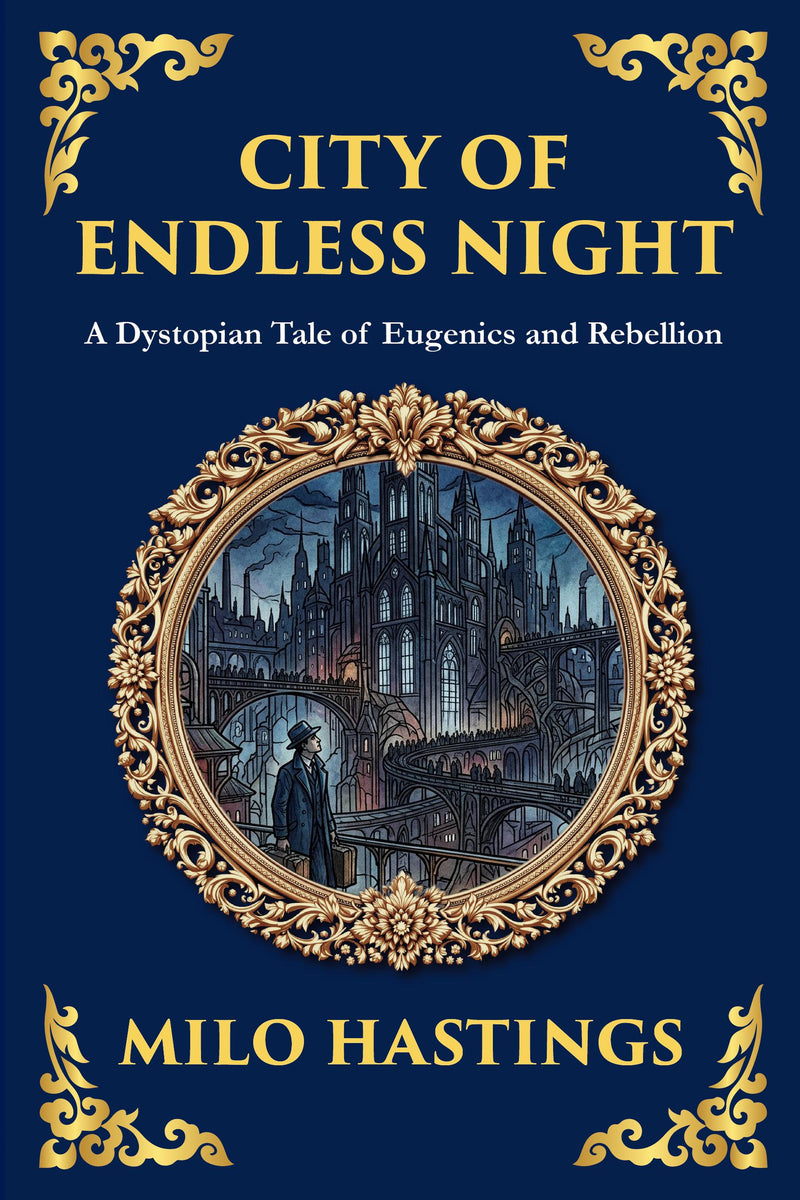
City of Endless Night
City of Endless Night In a future shaped by totalitarian science and militarized control, the remnants of Germany survive underground in a vast city governed by eugenics, propaganda, and obedience.
or free app
10,000+ hrs library
30-day guarantee
The complete City of Endless Night appears in modern English through Library of Alexandria Press, available online with audiobook narration included for members.
Have you ever wondered why freedom becomes the greatest threat in a world built on control? City of Endless Night is one of the earliest and most prophetic dystopian novels ever written— an underground classic that envisioned the machinery of fascism, state eugenics, and social engineering before they became global horrors. Set in a militarized Berlin buried beneath the Earth, Hastings’ novel follows an American spy who infiltrates the subterranean city-state where individuality is crushed, children are bred for function, and rebellion is eradicated at its root.
Here, science is not a beacon of progress—but a weapon wielded by the elite to manipulate, divide, and conquer. Hastings builds a world where surveillance is absolute, freedom is forbidden, and the only hope lies in the fragile flicker of human defiance. Boldly philosophical and politically explosive, City of Endless Night is both a product of its time and a chilling mirror to our own.
What you’ll discover in this modern edition
- A Visionary Dystopia – Explore a futuristic Berlin ruled by totalitarian science, class-based eugenics, and unrelenting surveillance.
| Formats | eBook (EPUB + PDF) · Audiobook · Paperback · Hardcover · Large Print |
| Language | English |
| Trim size (print) | 6 × 9 in |
| Binding | Paperback — perfect-bound · Hardcover — casewrap |
| Large Print edition | Same text in a larger, easy-read type — a larger font, not a larger trim |
| Print pricing | Every physical book at our true cost — at-cost, no profit (members) |
| Library | 873 restored titles, always growing |
| Length | 81,399 words · ~5 hr 26 min reading |
| Reading level | Grade 3 · an easy, flowing read (this modern-English edition) |
| Edition | Modern English translation · 2026 |
Member reviews for this edition are collected as readers finish it — be the first. Across the library: 12,000+ books shipped, every plan covered by a 365-day print guarantee.
About this edition
A faithful, unabridged modern-English edition by The Library of Alexandria — carefully rendered for today's reader and verified paragraph-by-paragraph against the public-domain source. Available as eBook, audiobook, paperback, hardcover, and large print.
- Complete & unabridgedVerified paragraph by paragraph against the source — never a scan, never abridged.
- Modern English, faithfulReadable today, with the author’s meaning kept intact. Readable — not simplified.
- Every format, one membershipRead in your browser or the free app, or listen to the full audiobook.
Included free with your membership
Cancel anytime, one click · 30-day money-back guarantee
Edition last updated July 2026
What’s inside
City of Endless Night — complete and unabridged: all 15 sections included with membership, plus the full audiobook.
Begin reading City of Endless Night
In clear modern English — the complete text is included with membership.
Introduction
When City of Endless Night first appeared in 1920, the world was still reeling from the most devastating conflict it had ever known. The Great War had shattered the optimism of the nineteenth century, leaving behind a Europe scarred by trenches, gas attacks, and the staggering machinery of industrialized death. Out of this rubble, writers began to imagine futures both terrible and instructive—worlds shaped by the technologies and ideologies that had so recently turned the planet into a charnel house. Milo Hastings, an American agricultural scientist, journalist, and inventor with a restless and inquisitive mind, gave us one of the most prophetic and unsettling of these visions. His novel imagines a world in which a single nation, sealed away from humanity, has perfected the arts of war, propaganda, and human breeding to a degree that would make any tyrant envious. It is a book that speaks to its own moment with extraordinary clarity, yet it reaches across more than a century to address concerns that feel startlingly urgent to us now.
This modern translation has been carefully adapted for the contemporary reader. The aim has been to preserve the texture and atmosphere of Hastings’s original prose—its sense of foreboding, its intellectual ambition, its sly humor—while smoothing the archaisms and stylistic conventions that can sometimes make century-old fiction feel distant or laborious. The result is a reading experience that honors the author’s intentions while inviting you into the story as if it were written for your own time. What follows in these introductory pages is meant to enrich that experience: to provide context, to sharpen your appreciation of the novel’s themes, and to prepare you for the journey ahead without spoiling the discoveries that await. The pleasures of this book lie in its gradual unfolding, in the slow revelation of a society so alien and yet so eerily plausible, and so the discussion here will stay clear of the plot’s twists and turns.
To understand the achievement of this novel, it helps to know something of the curious and gifted man who wrote it. Milo Hastings was born in Kansas in 1884 and spent his early life immersed in the practical sciences. He trained in agriculture and nutrition, and he possessed the kind of mind that could not resist tinkering, improving, and reimagining the world around him. He designed an early incubator for chickens, wrote extensively on diet and health, and became a popular columnist dispensing advice on food and living. He was, in short, a man of facts and systems, fascinated by how living things could be measured, managed, and optimized. This background is not incidental to the novel he produced—it is central to it. The book is suffused with the sensibility of a scientist, someone who understands intimately how breeding, nutrition, and engineering can be applied to populations of animals, and who follows that logic with chilling rigor to its application upon human beings.
This was no accident of imagination. The early twentieth century was the heyday of the eugenics movement, a pseudoscientific enterprise that commanded enormous respectability among intellectuals, politicians, and reformers across the Western world. The idea that human populations could and should be improved through controlled reproduction—that society could weed out the “unfit” and cultivate the “desirable”—was taught in universities, endorsed in legislatures, and celebrated at international congresses. In the United States, eugenic thinking led to forced sterilization laws; in the decades that followed, in Germany, it would furnish part of the intellectual scaffolding for crimes of almost unimaginable scale. Hastings, writing in 1920, perceived with remarkable foresight where such thinking might lead if pursued without conscience and married to the absolute power of a militarized state. His novel is, among many other things, one of the earliest and most pointed literary warnings against the eugenic dream. It dramatizes a civilization that has accepted the breeding of humans as a settled matter of policy, sorting its citizens into rigid castes engineered for specific functions, and it asks us to recoil at what such a society costs in dignity, freedom, and the irreducible value of the individual.
What makes Hastings’s vision so prescient is not merely his anticipation of eugenic horror but the broader portrait he paints of total state control. The society he imagines anticipates, in striking detail, the apparatus of the totalitarian regimes that would rise in the decades after the book’s publication. Here is a government that controls information absolutely, that rewrites history to serve its purposes, that manufactures the beliefs and emotions of its citizens through relentless propaganda, that maintains its power through surveillance and the careful management of every aspect of human life. Readers familiar with the great dystopian novels of the mid-twentieth century—the works of George Orwell, Aldous Huxley, and others—will recognize a remarkable kinship. Indeed, City of Endless Night predates Huxley’s Brave New World by more than a decade and Orwell’s Nineteen Eighty-Four by nearly thirty years. It deserves to be understood as a foundational text in the dystopian tradition, a book that mapped the dark territory those later masterpieces would explore. That it has been less celebrated than those successors says more about the accidents of literary fortune than about the quality of Hastings’s accomplishment.
The novel’s imaginative power also rests on its vivid and unforgettable central conceit: an entire civilization that lives underground, sealed away from the surface world, illuminated by artificial light, sustained by synthetic food and ingenious engineering. This is the “endless night” of the title—a world where the sun never rises because the people have buried themselves beneath the earth, both literally and morally. The image is haunting and richly symbolic. A society that has chosen perpetual darkness, that has cut itself off from the natural world and from the rest of humanity, that mistakes its technological mastery for enlightenment while dwelling in a kind of spiritual blindness—this is a metaphor that resonates far beyond the particular story Hastings tells. The subterranean city is at once a triumph of human ingenuity and a monument to human folly, a place where the most advanced science serves the most retrograde tyranny. As you read, you will find that the darkness is never merely a setting; it is a condition of the soul, a comment on what happens when a people surrenders its freedom and its connection to the wider world in exchange for security, order, and the seductive promises of a controlling state.
Hastings was writing in the immediate aftermath of a war in which Germany had been cast, in the Allied imagination, as the great threat to civilization. The novel projects forward into a future where this conflict has never truly ended but has instead hardened into a permanent siege, a frozen confrontation between an isolated militarist power and the rest of the world. Modern readers should approach this dimension of the book with a degree of historical awareness. The novel reflects the anxieties and the rhetoric of its era, including attitudes toward the nation it depicts as antagonist that are very much products of the wartime moment in which Hastings wrote. Yet it would be a mistake to read the book as mere wartime propaganda. Hastings’s true subject is not any particular nation but the universal human temptation toward tyranny, the way any society—including his own—might be seduced by visions of perfect order and racial purity. The warning he issues is meant for all of us, and the regime he depicts functions as a cautionary mirror rather than a simple portrait of an enemy. The careful reader will notice how often the novel turns its critical eye toward ideas that were, at the time, perfectly respectable in the author’s own country. This self-implicating quality is one of the things that elevates the book above the level of period polemic and grants it lasting moral seriousness.
The Pleasures and Provocations of the Story
Beyond its prophetic themes and its place in literary history, City of Endless Night is, first and foremost, a gripping and entertaining story. Hastings understood that ideas alone do not make a novel; they must be embodied in action, in suspense, in the predicament of a compelling protagonist whose fate we come to care about. The book unfolds as an adventure, an act of espionage, a journey of discovery into a forbidden world. There is intrigue and danger at every turn, a constant tension between concealment and exposure, between the desire to understand this strange civilization and the necessity of surviving within it. The narrative carries forward with genuine momentum, and the reader is drawn ever deeper into the labyrinthine society Hastings has constructed, learning its rules, its hierarchies, its hidden cruelties, and its unexpected vulnerabilities alongside the protagonist.
One of the great satisfactions of the novel is the sheer thoroughness of its world-building. Hastings does not content himself with sketching a few exotic details and leaving the rest to vague suggestion. He thinks through the implications of his imagined society with the methodical care of the scientist he was. How does such a city feed itself? How does it organize labor and reproduction? How does it manage information, maintain its defenses, sustain its ideology across generations? How does a population live and love and die in a world of artificial light and total control? The novel answers these questions with an inventiveness and consistency that lend the whole edifice a remarkable solidity. Reading it, one has the sense of genuinely visiting another place—a place that feels coherent, lived-in, and disturbingly logical. This is the hallmark of the finest speculative fiction: not merely the conjuring of strange marvels, but the rigorous working-out of their consequences. Hastings belongs in the company of those rare writers who can make the impossible feel inevitable.
The novel also rewards attention to its quieter dimensions. Amid the espionage and the social criticism, there is a thread of genuine human feeling—the longing for connection, the stirrings of conscience, the question of whether love and loyalty can survive in a world engineered to suppress them. Hastings is interested in how individuals respond to systems that seek to define and confine them, in the small acts of resistance and the larger awakenings of moral awareness that can occur even in the most oppressive circumstances. The “rebellion” promised in the subtitle is not merely a matter of plots and uprisings, though there is drama enough on that front. It is also a rebellion of the spirit, an assertion of human individuality against the machinery of conformity. This is the moral heart of the book, and it is what gives the adventure its weight and resonance. We read not only to discover what happens, but to consider what it means to remain human in a dehumanizing world—a question as pressing in our own age of algorithms, surveillance, and engineered consensus as it was a century ago.
It is worth dwelling for a moment on how remarkably the novel’s concerns map onto the anxieties of the present day. Hastings could not have foreseen the specific technologies that now shape our lives—the digital networks, the genetic editing tools, the artificial intelligences—but the questions he raises hover over all of them. What happens when a society gains the power to redesign human beings according to a plan? Who decides which traits are desirable, and to what ends? How does a controlling power maintain itself through the management of information and belief, through the shaping of what people are permitted to know and feel? What is lost when efficiency and order are pursued at the expense of liberty and dignity? These are not abstract academic puzzles; they are live issues debated in newspapers and legislatures and laboratories today. The novel’s continued relevance is, frankly, a little uncanny. Reading it, one repeatedly encounters passages that seem to anticipate developments and dilemmas of the twenty-first century with an accuracy that no mere guesswork could produce. Hastings’s gift was to understand the deep logic of certain ideas and to follow that logic without flinching to its endpoint. The future he imagined is not ours, but it rhymes with ours in ways that should give us pause.
Cancel anytime, one click · 30-day money-back guarantee
Founding annual rate available now — your price locks for life when you join.
Not ready? Get this free chapter by email — read it anytime.
✓ Sent — check your inbox for City of Endless Night.
Questions about City of Endless Night
What is City of Endless Night about?
City of Endless Night In a future shaped by totalitarian science and militarized control, the remnants of Germany survive underground in a vast city governed by eugenics, propaganda, and obedience. City of Endless Night is a chilling vision of a world stripped of individuality and conscience—where identity is dictated at birth and freedom is the most dangerous idea of all. Written in the aftermath of World War I, Milo Hastings’ dystopian masterpiece predicted the terrifying rise of authoritarian ideologies before t
Who wrote City of Endless Night?
City of Endless Night was written by Milo Hastings. This edition presents the complete work in clear modern English, faithfully rendered from the public-domain original by Library of Alexandria Press.
Is City of Endless Night free to read?
The opening chapter is free to read on this page. Members read and listen to the complete work — and the entire library — free, and can order any physical book at our true print cost.
How long is City of Endless Night?
15 chapters (~81,399 words) — about 5 hr 26 min of reading in this modern-English edition.
Is this an abridged version of City of Endless Night?
No. This is the complete, unabridged City of Endless Night, carefully rendered into clear modern English and verified paragraph-by-paragraph against the public-domain source — nothing is cut or summarised.
What formats does City of Endless Night come in?
City of Endless Night is available as eBook, paperback, hardcover and large print. eBook and audiobook are included with membership; printed editions ship at our true print cost.
Shipping & returns
Billing & membership
More from the library


Explore Science Fiction
- The Island of Doctor Moreau · H. G. Wells
- A Midsummer Night’s Dream · William Shakespeare
- The Invisible Man: A Grotesque Romance · H. G. Wells
- The War of the Worlds · H. G. Wells
- The Strange Case of Dr. Jekyll and Mr. Hyde · Robert Louis Stevenson
- Limanora: the island of progress · Godfrey Sweven
- The Book of Dragons · E. Nesbit
- She · H. Rider Haggard
- Dorothy and the Wizard in Oz · L. Frank Baum
- The Princess and the Goblin · George MacDonald
- Gawayne and the Green Knight: A Fairy Tale · Charlton M. Lewis
- Lucian’s True History · Lucian of Samosata
- The Willows · Algernon Blackwood
- The Call of Cthulhu · H. P. Lovecraft
- The Life-Eater · Harold Ward
- The Marvelous Land of Oz · L. Frank Baum
- Mars is My Destination · Frank Belknap Long
- The Black Kiss
- The Beasts in the Void · Paul W. Fairman
- John Jones’s Dollar · Harry Stephen Keeler
- Subversive · Mack Reynolds
- The Mississippi Saucer · Frank Belknap Long
- Man of Distinction · Michael Shaara
- Spawn of the Comet · H. Thompson Rich
- The Golden Judge · Nathaniel Gordon
- Final Weapon · Everett B. Cole
- The Big Fix · George O. Smith
- Last Enemy · H. Beam Piper
- Time and Time Again · H. Beam Piper
- Sabotage in Space · Carey Rockwell
City of Endless Night
City of Endless Night
A Dystopian Tale of Eugenics and Rebellion
Milo Hastings
Contents
- Introduction
- Chapter 1
- Chapter 2
- Chapter 3
- Chapter 4
- Chapter 5
- Chapter 6
- Chapter 7
- Chapter 8
- Chapter 9
- Chapter 10
- Chapter 11
- Chapter 12
- Chapter 13
- Chapter 14
Introduction
When City of Endless Night first appeared in 1920, the world was still reeling from the most devastating conflict it had ever known. The Great War had shattered the optimism of the nineteenth century, leaving behind a Europe scarred by trenches, gas attacks, and the staggering machinery of industrialized death. Out of this rubble, writers began to imagine futures both terrible and instructive—worlds shaped by the technologies and ideologies that had so recently turned the planet into a charnel house. Milo Hastings, an American agricultural scientist, journalist, and inventor with a restless and inquisitive mind, gave us one of the most prophetic and unsettling of these visions. His novel imagines a world in which a single nation, sealed away from humanity, has perfected the arts of war, propaganda, and human breeding to a degree that would make any tyrant envious. It is a book that speaks to its own moment with extraordinary clarity, yet it reaches across more than a century to address concerns that feel startlingly urgent to us now.
This modern translation has been carefully adapted for the contemporary reader. The aim has been to preserve the texture and atmosphere of Hastings’s original prose—its sense of foreboding, its intellectual ambition, its sly humor—while smoothing the archaisms and stylistic conventions that can sometimes make century-old fiction feel distant or laborious. The result is a reading experience that honors the author’s intentions while inviting you into the story as if it were written for your own time. What follows in these introductory pages is meant to enrich that experience: to provide context, to sharpen your appreciation of the novel’s themes, and to prepare you for the journey ahead without spoiling the discoveries that await. The pleasures of this book lie in its gradual unfolding, in the slow revelation of a society so alien and yet so eerily plausible, and so the discussion here will stay clear of the plot’s twists and turns.
To understand the achievement of this novel, it helps to know something of the curious and gifted man who wrote it. Milo Hastings was born in Kansas in 1884 and spent his early life immersed in the practical sciences. He trained in agriculture and nutrition, and he possessed the kind of mind that could not resist tinkering, improving, and reimagining the world around him. He designed an early incubator for chickens, wrote extensively on diet and health, and became a popular columnist dispensing advice on food and living. He was, in short, a man of facts and systems, fascinated by how living things could be measured, managed, and optimized. This background is not incidental to the novel he produced—it is central to it. The book is suffused with the sensibility of a scientist, someone who understands intimately how breeding, nutrition, and engineering can be applied to populations of animals, and who follows that logic with chilling rigor to its application upon human beings.
This was no accident of imagination. The early twentieth century was the heyday of the eugenics movement, a pseudoscientific enterprise that commanded enormous respectability among intellectuals, politicians, and reformers across the Western world. The idea that human populations could and should be improved through controlled reproduction—that society could weed out the “unfit” and cultivate the “desirable”—was taught in universities, endorsed in legislatures, and celebrated at international congresses. In the United States, eugenic thinking led to forced sterilization laws; in the decades that followed, in Germany, it would furnish part of the intellectual scaffolding for crimes of almost unimaginable scale. Hastings, writing in 1920, perceived with remarkable foresight where such thinking might lead if pursued without conscience and married to the absolute power of a militarized state. His novel is, among many other things, one of the earliest and most pointed literary warnings against the eugenic dream. It dramatizes a civilization that has accepted the breeding of humans as a settled matter of policy, sorting its citizens into rigid castes engineered for specific functions, and it asks us to recoil at what such a society costs in dignity, freedom, and the irreducible value of the individual.
What makes Hastings’s vision so prescient is not merely his anticipation of eugenic horror but the broader portrait he paints of total state control. The society he imagines anticipates, in striking detail, the apparatus of the totalitarian regimes that would rise in the decades after the book’s publication. Here is a government that controls information absolutely, that rewrites history to serve its purposes, that manufactures the beliefs and emotions of its citizens through relentless propaganda, that maintains its power through surveillance and the careful management of every aspect of human life. Readers familiar with the great dystopian novels of the mid-twentieth century—the works of George Orwell, Aldous Huxley, and others—will recognize a remarkable kinship. Indeed, City of Endless Night predates Huxley’s Brave New World by more than a decade and Orwell’s Nineteen Eighty-Four by nearly thirty years. It deserves to be understood as a foundational text in the dystopian tradition, a book that mapped the dark territory those later masterpieces would explore. That it has been less celebrated than those successors says more about the accidents of literary fortune than about the quality of Hastings’s accomplishment.
The novel’s imaginative power also rests on its vivid and unforgettable central conceit: an entire civilization that lives underground, sealed away from the surface world, illuminated by artificial light, sustained by synthetic food and ingenious engineering. This is the “endless night” of the title—a world where the sun never rises because the people have buried themselves beneath the earth, both literally and morally. The image is haunting and richly symbolic. A society that has chosen perpetual darkness, that has cut itself off from the natural world and from the rest of humanity, that mistakes its technological mastery for enlightenment while dwelling in a kind of spiritual blindness—this is a metaphor that resonates far beyond the particular story Hastings tells. The subterranean city is at once a triumph of human ingenuity and a monument to human folly, a place where the most advanced science serves the most retrograde tyranny. As you read, you will find that the darkness is never merely a setting; it is a condition of the soul, a comment on what happens when a people surrenders its freedom and its connection to the wider world in exchange for security, order, and the seductive promises of a controlling state.
Hastings was writing in the immediate aftermath of a war in which Germany had been cast, in the Allied imagination, as the great threat to civilization. The novel projects forward into a future where this conflict has never truly ended but has instead hardened into a permanent siege, a frozen confrontation between an isolated militarist power and the rest of the world. Modern readers should approach this dimension of the book with a degree of historical awareness. The novel reflects the anxieties and the rhetoric of its era, including attitudes toward the nation it depicts as antagonist that are very much products of the wartime moment in which Hastings wrote. Yet it would be a mistake to read the book as mere wartime propaganda. Hastings’s true subject is not any particular nation but the universal human temptation toward tyranny, the way any society—including his own—might be seduced by visions of perfect order and racial purity. The warning he issues is meant for all of us, and the regime he depicts functions as a cautionary mirror rather than a simple portrait of an enemy. The careful reader will notice how often the novel turns its critical eye toward ideas that were, at the time, perfectly respectable in the author’s own country. This self-implicating quality is one of the things that elevates the book above the level of period polemic and grants it lasting moral seriousness.
The Pleasures and Provocations of the Story
Beyond its prophetic themes and its place in literary history, City of Endless Night is, first and foremost, a gripping and entertaining story. Hastings understood that ideas alone do not make a novel; they must be embodied in action, in suspense, in the predicament of a compelling protagonist whose fate we come to care about. The book unfolds as an adventure, an act of espionage, a journey of discovery into a forbidden world. There is intrigue and danger at every turn, a constant tension between concealment and exposure, between the desire to understand this strange civilization and the necessity of surviving within it. The narrative carries forward with genuine momentum, and the reader is drawn ever deeper into the labyrinthine society Hastings has constructed, learning its rules, its hierarchies, its hidden cruelties, and its unexpected vulnerabilities alongside the protagonist.
One of the great satisfactions of the novel is the sheer thoroughness of its world-building. Hastings does not content himself with sketching a few exotic details and leaving the rest to vague suggestion. He thinks through the implications of his imagined society with the methodical care of the scientist he was. How does such a city feed itself? How does it organize labor and reproduction? How does it manage information, maintain its defenses, sustain its ideology across generations? How does a population live and love and die in a world of artificial light and total control? The novel answers these questions with an inventiveness and consistency that lend the whole edifice a remarkable solidity. Reading it, one has the sense of genuinely visiting another place—a place that feels coherent, lived-in, and disturbingly logical. This is the hallmark of the finest speculative fiction: not merely the conjuring of strange marvels, but the rigorous working-out of their consequences. Hastings belongs in the company of those rare writers who can make the impossible feel inevitable.
The novel also rewards attention to its quieter dimensions. Amid the espionage and the social criticism, there is a thread of genuine human feeling—the longing for connection, the stirrings of conscience, the question of whether love and loyalty can survive in a world engineered to suppress them. Hastings is interested in how individuals respond to systems that seek to define and confine them, in the small acts of resistance and the larger awakenings of moral awareness that can occur even in the most oppressive circumstances. The “rebellion” promised in the subtitle is not merely a matter of plots and uprisings, though there is drama enough on that front. It is also a rebellion of the spirit, an assertion of human individuality against the machinery of conformity. This is the moral heart of the book, and it is what gives the adventure its weight and resonance. We read not only to discover what happens, but to consider what it means to remain human in a dehumanizing world—a question as pressing in our own age of algorithms, surveillance, and engineered consensus as it was a century ago.
It is worth dwelling for a moment on how remarkably the novel’s concerns map onto the anxieties of the present day. Hastings could not have foreseen the specific technologies that now shape our lives—the digital networks, the genetic editing tools, the artificial intelligences—but the questions he raises hover over all of them. What happens when a society gains the power to redesign human beings according to a plan? Who decides which traits are desirable, and to what ends? How does a controlling power maintain itself through the management of information and belief, through the shaping of what people are permitted to know and feel? What is lost when efficiency and order are pursued at the expense of liberty and dignity? These are not abstract academic puzzles; they are live issues debated in newspapers and legislatures and laboratories today. The novel’s continued relevance is, frankly, a little uncanny. Reading it, one repeatedly encounters passages that seem to anticipate developments and dilemmas of the twenty-first century with an accuracy that no mere guesswork could produce. Hastings’s gift was to understand the deep logic of certain ideas and to follow that logic without flinching to its endpoint. The future he imagined is not ours, but it rhymes with ours in ways that should give us pause.
When I was seven years old, my uncle enrolled me in a private school where one of the so-called “redeemed” submarine sailors taught German. Looking back now with everything I know, I better understand that man’s passive humility and his carefully maintained ignorance. In his classes, he used a description of German life taken from a captured submarine as a textbook. He based his entire understanding of a civilization on this book, despite knowing practically nothing about it in reality. I remember asking Herr Meineke if he had actually seen the strange things he taught us about. He always answered, “The book is official; human observation is flawed.”
“He can speak it,” said my playmates, who attended public schools where teaching the language of the outcast nation was banned. They always cast me as “the Germans” and locked me in the old garage. They would rain sun-dried clay bombs down on the roof and then rush in to “break down the walls of Berlin” by forcing open the door. I would mutter strange, guttural oaths as they led me out to be “exterminated.”
On rainy days, I would sometimes bring my favorite friends into my uncle’s library, where five large maps hung in order on the paneled wall.
The first map was labeled “The Age of Nations—1914.” It showed Germany as a black spot, similar in size to many of the surrounding countries we studied in history class.
The second map, “Germany’s Maximum Expansion of the First World War—1918,” showed the black area tripled in size. It crowded into the pale gold of France and stretched a hungry arm across the Hellespont toward Baghdad. From the Balkans to the Baltic, it erased everything except for the flaming red of Bolshevist Russia, which spread across Eastern Europe like a pool of fresh blood.
End of the free sample
Keep reading, free
Members read and listen to the complete book — and the entire library. Cancel anytime, one click · 30-day money-back guarantee.