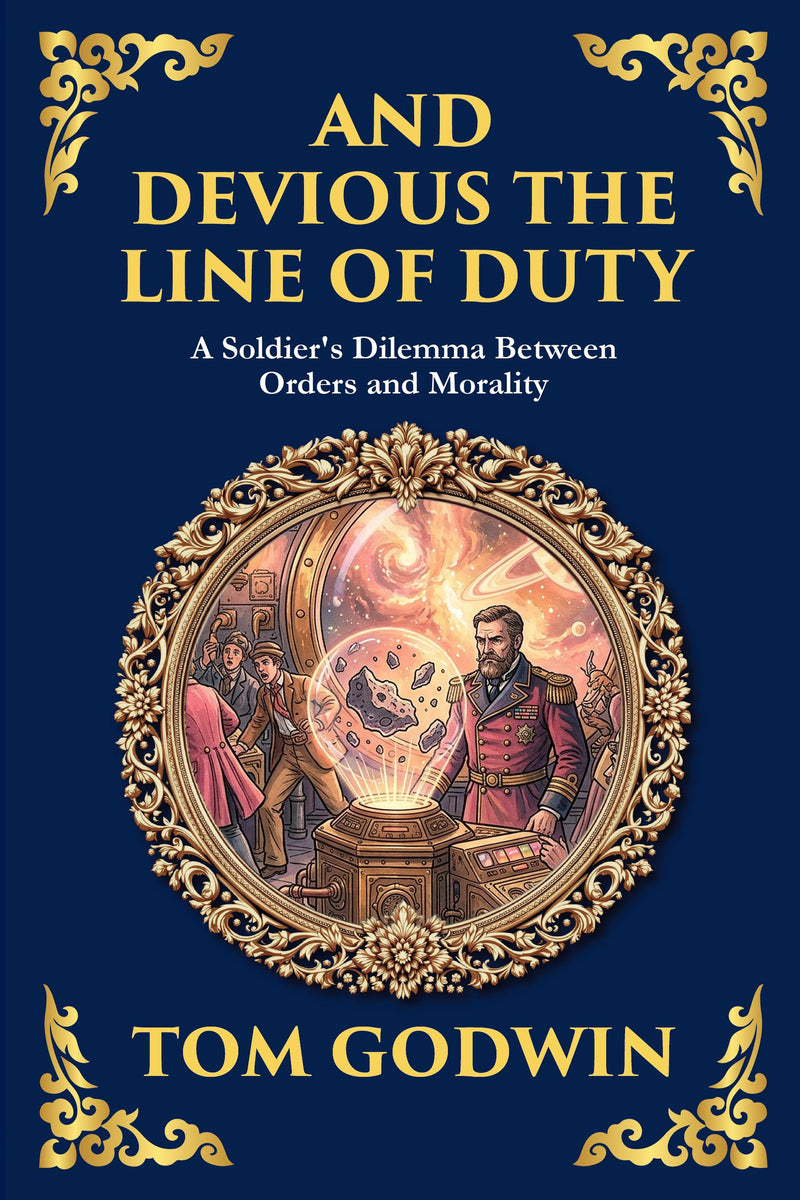
—And Devious the Line of Duty
What happens when doing your duty means abandoning your conscience? In —And Devious the Line of Duty, Tom Godwin masterfully examines the human cost of war—not in blood, but in moral compromise.
or free app
10,000+ hrs library
30-day guarantee
The complete —And Devious the Line of Duty appears in modern English through Library of Alexandria Press, available online with audiobook narration included for members.
Have you ever wondered why the hardest battles are fought not on the battlefield—but within the soul of the soldier? In —And Devious the Line of Duty, acclaimed science fiction author Tom Godwin delivers a harrowing tale of moral reckoning amidst the rigid machinery of war. Set in a future where loyalty is demanded at all costs and questions are a liability, this short masterpiece unravels the story of a soldier forced to confront the line between duty and decency.
When Corporal Brant is ordered to enforce a directive that could cost innocent lives, the lines between right and wrong blur into ash. Trained to follow, conditioned to obey, and praised for effectiveness, he now faces a decision that will define his humanity forever. Torn between the soldier’s oath and the whispers of his conscience, Brant must decide: obey and live with the consequences, or rebel and face them head-on.
What you’ll discover in this modern edition
- in this powerful novella of war and inner conflict:
- A Soldier Caught in an Ethical Crossfire – Witness the emotional turmoil of duty clashing with morality.
| Formats | eBook (EPUB + PDF) · Audiobook · Paperback · Hardcover · Large Print |
| Language | English |
| Trim size (print) | 6 × 9 in |
| Binding | Paperback — perfect-bound · Hardcover — casewrap |
| Large Print edition | Same text in a larger, easy-read type — a larger font, not a larger trim |
| Print pricing | Every physical book at our true cost — at-cost, no profit (members) |
| Library | 873 restored titles, always growing |
| Length | 16,472 words · ~1 hr 6 min reading |
| Reading level | Grade 3 · an easy, flowing read (this modern-English edition) |
| Edition | Modern English translation · 2026 |
Member reviews for this edition are collected as readers finish it — be the first. Across the library: 12,000+ books shipped, every plan covered by a 365-day print guarantee.
About this edition
A faithful, unabridged modern-English edition by The Library of Alexandria — carefully rendered for today's reader and verified paragraph-by-paragraph against the public-domain source. Available as eBook, audiobook, paperback, hardcover, and large print.
- Complete & unabridgedVerified paragraph by paragraph against the source — never a scan, never abridged.
- Modern English, faithfulReadable today, with the author’s meaning kept intact. Readable — not simplified.
- Every format, one membershipRead in your browser or the free app, or listen to the full audiobook.
Included free with your membership
Cancel anytime, one click · 30-day money-back guarantee
Edition last updated July 2026
What’s inside
—And Devious the Line of Duty — complete and unabridged, included in full with membership, plus the full audiobook.
Begin reading —And Devious the Line of Duty
In clear modern English — the complete text is included with membership.
Introduction
There is a particular kind of science fiction that does not concern itself primarily with the gleam of starships or the marvels of distant worlds, but instead turns its gaze inward—toward the human conscience, toward the quiet and terrible decisions that men and women must make when the universe offers them no easy path. —And Devious the Line of Duty belongs squarely to this tradition. It is a work that uses the vast canvas of interstellar conflict not to dazzle, but to interrogate. Beneath its surface of military protocol and tactical maneuvering lies a far older and more intimate question: what does a person owe to the orders they are given, and what do they owe to the still, insistent voice of their own moral certainty?
Tom Godwin, the author of this haunting tale, was a writer who understood that the genre of speculative fiction could be a scalpel as easily as it could be a spectacle. He is perhaps best remembered for one of the most discussed and debated short stories in the history of the field, a story whose central premise forced readers to confront the cold mathematics of survival against the warm pull of human empathy. That same preoccupation—the collision between unyielding circumstance and the human heart—runs through the present work like a current beneath still water. Godwin was not a writer who flinched. He had a talent, rare even among the best of his contemporaries, for placing his characters in situations where there were no clean answers, only consequences, and for refusing to let either the reader or the protagonist off the hook.
This edition presents the work in a modern translation, carefully adapted for the contemporary reader. That phrase deserves a moment of explanation, because it speaks directly to the experience you are about to have. The science fiction of the mid-twentieth century, for all its brilliance, was written in an idiom shaped by its own era—an era of particular rhythms, particular assumptions, and particular literary conventions. Some of those conventions have aged gracefully; others have become small obstacles between the modern reader and the power of the underlying story. The work of adaptation undertaken here has been to preserve everything that makes Godwin’s vision compelling—its moral seriousness, its tension, its sharply drawn characters—while smoothing the path for readers encountering it fresh. The intent is not to modernize the soul of the book, but to ensure that soul reaches you undimmed. What you hold is the same story Godwin told, made newly accessible without being made shallow.
The subtitle of this volume names its central preoccupation with admirable directness: A Soldier’s Struggle Between Orders and Morality. This is, at its heart, a book about obedience and the limits of obedience. It is about the moment—the moment that has confronted soldiers throughout the whole of human history, and which the genre of science fiction allows us to examine at a useful distance—when a person in uniform must decide whether the chain of command represents the highest authority to which they answer.
There is a profound and ancient tension embedded in the figure of the soldier. On the one hand, military discipline depends absolutely upon obedience. An army in which every order is debated, in which every command is filtered through the individual conscience of every individual who receives it, is not an army at all; it is a debating society that will be destroyed by the first disciplined force it encounters. The soldier surrenders a portion of their personal judgment when they take up arms in service of a cause larger than themselves. This is not a flaw in the system—it is the system. It is what makes coordinated action possible, what allows thousands of individuals to move as one, what permits the defense of the things worth defending. The soldier who will not follow orders is, in a very real sense, no soldier at all.
And yet. And yet there is the other hand, the hand that history has shown us again and again, often at terrible cost. There are orders that should not be obeyed. There are commands that, if followed, transform the soldier from a servant of a cause into an instrument of atrocity. The defense that one was merely following orders has been weighed in the gravest courts humanity has ever convened and found wanting. The conscience does not surrender entirely when the uniform is donned. Something remains, some irreducible kernel of personal responsibility that no chain of command can fully absorb. The question is not whether that kernel exists, but where its boundaries lie—and that is precisely the question that no rulebook can answer in advance, that must be answered, when the moment comes, by a single human being standing alone with their own judgment and the weight of the consequences.
This is the territory Godwin maps in —And Devious the Line of Duty. The title itself is a small masterpiece of suggestion. Duty, we are told, is not a straight road but a devious one—winding, treacherous, full of turns that conceal what lies beyond them. The word carries a deliberate ambiguity. To call a line “devious” is to suggest both that it is difficult to follow and that it may lead the follower astray. Duty, in Godwin’s vision, is not a comforting absolute but a path that demands constant vigilance, that requires the one who walks it to keep asking, at every bend, whether they are still going the right way. The straight and obvious course is not necessarily the dutiful one. Sometimes the truest fulfillment of duty requires the kind of deviation that looks, to the casual observer or the rigid superior, like disobedience.
What makes this examination so effective in the hands of a science fiction writer is the genre’s unique capacity to strip away the familiar and force us to see moral questions afresh. When we read about historical or contemporary conflicts, our judgments are clouded by partisanship, by what we already believe, by the heavy freight of accumulated context. But when the conflict unfolds among the stars, between forces and circumstances of the author’s own invention, we approach the moral question with cleaner eyes. We are not asked to take sides in a quarrel we already have opinions about. We are asked, instead, to think about the underlying principle—the relationship between the individual conscience and the institutional command—in something closer to its pure form. The setting is a lens, and the lens brings the moral question into sharper focus precisely because it removes the distractions of the familiar.
Godwin understood this power and wielded it deliberately. The trappings of his future—the technology, the structures of authority, the nature of the conflicts in which his characters are embroiled—are not ends in themselves but instruments for isolating the human question. He is not interested in dazzling us with invention for its own sake. He is interested in placing a human being in a crucible and watching what emerges. The science fiction elements heat the crucible; the human drama is what is being forged within it.
To understand what makes this book worth your time, it helps to understand something about the kind of writer Tom Godwin was, and the particular corner of science fiction he made his own. Godwin emerged as a voice during what is often called the Golden Age of the genre—a period when the field was maturing rapidly, moving beyond its pulp origins toward something more ambitious, more literary, more willing to engage with serious ideas. He wrote for the magazines that defined the era, the publications where the most influential editors of the time shaped the direction of the entire field. And within that world, Godwin developed a reputation as a writer who was willing to follow a premise to its logical and often unsettling conclusion, no matter how uncomfortable that conclusion might be.
This is the quality that distinguishes the truly memorable practitioners of the genre from the merely competent. It is easy to set up a difficult situation; it is much harder to resist the temptation to resolve it with a convenient deus ex machina, a last-minute reprieve, a softening of the consequences so that the reader can close the book feeling comfortable. Godwin’s great strength was his refusal to comfort. When he constructed a dilemma, he respected both his characters and his readers enough to let the dilemma have its full weight. He did not pretend that the universe owes us happy endings or clean moral resolutions. He understood that some choices cost something no matter which way they are made, and that the measure of a person is not whether they can avoid the cost but how they bear it.
This refusal to flinch is what gives Godwin’s work its enduring power. There is an honesty to it that many readers find bracing, even decades after it was written. We live in an age that is often hungry for the reassurance that everything will work out, that the good will be rewarded and the wicked punished, that the moral arc of the universe bends reliably toward justice. Godwin offers no such reassurance. What he offers instead is something rarer and, in its way, more valuable: a clear-eyed examination of what it means to act rightly in a universe that does not guarantee that right action will be rewarded. His characters do not do the difficult thing because they expect to be praised for it. They do it—when they do it—because they have concluded that it is the thing that must be done, and they accept the consequences as part of the doing.
In —And Devious the Line of Duty, this characteristic Godwin honesty is brought to bear on the specific terrain of military duty. The protagonist’s struggle is not a struggle that can be resolved by discovering some hidden fact that makes everything clear, by learning that the order was illegitimate all along or that the superior officer was secretly a villain. The genuine difficulty of the moral situation is that it remains difficult even after all the facts are known. The orders may be legitimate. The cause may be just. The superiors may be acting in good faith. And still the conscience may rebel, may insist that something is wrong, may demand a deviation from the prescribed course. It is in this gap—between the legitimacy of the command and the protest of the conscience—that the real drama lives, and Godwin explores that gap with the patience and rigor it deserves.
There is also, woven throughout, a deep sympathy for the soldier as a human being. It would have been easy to write a story that treated military obedience with contempt, that portrayed the soldier as a mere automaton and the institution as an unambiguous evil. Godwin does not take this easy path. He understands the genuine virtues of military discipline, the real reasons it exists, the courage and selflessness it can foster. His soldiers are not fools or monsters. They are people who have committed themselves to something larger than themselves, who have accepted constraints upon their individual judgment for reasons they believe to be sound. This is what makes the central conflict so wrenching. The struggle between orders and morality is not a struggle between an obvious good and an obvious evil. It is a struggle between two things that both have real claims upon the soul—loyalty and conscience, duty and decency, the demands of the institution and the demands of the self. When both sides of a conflict have legitimate claims, the resolution cannot be easy, and Godwin does not pretend otherwise.
The relevance of these questions has not diminished with the passage of time; if anything, it has grown. We live in a world increasingly shaped by large institutions—military, governmental, corporate—that demand the cooperation of individuals and that exert enormous pressure toward conformity and obedience. The question of when and how the individual conscience should assert itself against institutional authority is not a relic of some bygone era. It is a question that every thoughtful person must confront, in forms large and small, throughout their life. Most of us will never be soldiers ordered to do something we believe to be wrong. But all of us will, at some point, find ourselves part of some larger system whose demands conflict with our private sense of what is right. Godwin’s exploration of the soldier’s dilemma is, in this sense, an exploration of a universal human predicament, given particular sharpness and clarity by the specific circumstances of the military life.
Cancel anytime, one click · 30-day money-back guarantee
Founding annual rate available now — your price locks for life when you join.
Not ready? Get this free chapter by email — read it anytime.
✓ Sent — check your inbox for —And Devious the Line of Duty.
Questions about —And Devious the Line of Duty
What is —And Devious the Line of Duty about?
What happens when doing your duty means abandoning your conscience? In —And Devious the Line of Duty, Tom Godwin masterfully examines the human cost of war—not in blood, but in moral compromise. A soldier finds himself caught in the crossfire between strict obedience and personal ethics, between military necessity and the unbearable weight of truth.
Who wrote —And Devious the Line of Duty?
—And Devious the Line of Duty was written by Tom Godwin. This edition presents the complete work in clear modern English, faithfully rendered from the public-domain original by Library of Alexandria Press.
Is —And Devious the Line of Duty free to read?
The opening chapter is free to read on this page. Members read and listen to the complete work — and the entire library — free, and can order any physical book at our true print cost.
How long is —And Devious the Line of Duty?
2 chapters (~16,472 words) — about 1 hr 6 min of reading in this modern-English edition.
Is this an abridged version of —And Devious the Line of Duty?
No. This is the complete, unabridged —And Devious the Line of Duty, carefully rendered into clear modern English and verified paragraph-by-paragraph against the public-domain source — nothing is cut or summarised.
What formats does —And Devious the Line of Duty come in?
—And Devious the Line of Duty is available as eBook, paperback, hardcover and large print. eBook and audiobook are included with membership; printed editions ship at our true print cost.
Shipping & returns
Billing & membership
More from the library


Explore Science Fiction
- The Island of Doctor Moreau · H. G. Wells
- A Midsummer Night’s Dream · William Shakespeare
- The Invisible Man: A Grotesque Romance · H. G. Wells
- The War of the Worlds · H. G. Wells
- The Strange Case of Dr. Jekyll and Mr. Hyde · Robert Louis Stevenson
- Limanora: the island of progress · Godfrey Sweven
- The Book of Dragons · E. Nesbit
- She · H. Rider Haggard
- Dorothy and the Wizard in Oz · L. Frank Baum
- The Princess and the Goblin · George MacDonald
- Gawayne and the Green Knight: A Fairy Tale · Charlton M. Lewis
- Lucian’s True History · Lucian of Samosata
- The Willows · Algernon Blackwood
- The Call of Cthulhu · H. P. Lovecraft
- The Life-Eater · Harold Ward
- The Marvelous Land of Oz · L. Frank Baum
- Mars is My Destination · Frank Belknap Long
- The Black Kiss
- The Beasts in the Void · Paul W. Fairman
- John Jones’s Dollar · Harry Stephen Keeler
- Subversive · Mack Reynolds
- The Mississippi Saucer · Frank Belknap Long
- Man of Distinction · Michael Shaara
- Spawn of the Comet · H. Thompson Rich
- The Golden Judge · Nathaniel Gordon
- Final Weapon · Everett B. Cole
- The Big Fix · George O. Smith
- Last Enemy · H. Beam Piper
- Time and Time Again · H. Beam Piper
- Sabotage in Space · Carey Rockwell
—And Devious the Line of Duty
—And Devious the Line of Duty
A Soldier's Struggle Between Orders and Morality
Tom Godwin
Contents
- Introduction
- —And Devious the Line of Duty
Introduction
There is a particular kind of science fiction that does not concern itself primarily with the gleam of starships or the marvels of distant worlds, but instead turns its gaze inward—toward the human conscience, toward the quiet and terrible decisions that men and women must make when the universe offers them no easy path. —And Devious the Line of Duty belongs squarely to this tradition. It is a work that uses the vast canvas of interstellar conflict not to dazzle, but to interrogate. Beneath its surface of military protocol and tactical maneuvering lies a far older and more intimate question: what does a person owe to the orders they are given, and what do they owe to the still, insistent voice of their own moral certainty?
Tom Godwin, the author of this haunting tale, was a writer who understood that the genre of speculative fiction could be a scalpel as easily as it could be a spectacle. He is perhaps best remembered for one of the most discussed and debated short stories in the history of the field, a story whose central premise forced readers to confront the cold mathematics of survival against the warm pull of human empathy. That same preoccupation—the collision between unyielding circumstance and the human heart—runs through the present work like a current beneath still water. Godwin was not a writer who flinched. He had a talent, rare even among the best of his contemporaries, for placing his characters in situations where there were no clean answers, only consequences, and for refusing to let either the reader or the protagonist off the hook.
This edition presents the work in a modern translation, carefully adapted for the contemporary reader. That phrase deserves a moment of explanation, because it speaks directly to the experience you are about to have. The science fiction of the mid-twentieth century, for all its brilliance, was written in an idiom shaped by its own era—an era of particular rhythms, particular assumptions, and particular literary conventions. Some of those conventions have aged gracefully; others have become small obstacles between the modern reader and the power of the underlying story. The work of adaptation undertaken here has been to preserve everything that makes Godwin’s vision compelling—its moral seriousness, its tension, its sharply drawn characters—while smoothing the path for readers encountering it fresh. The intent is not to modernize the soul of the book, but to ensure that soul reaches you undimmed. What you hold is the same story Godwin told, made newly accessible without being made shallow.
The subtitle of this volume names its central preoccupation with admirable directness: A Soldier’s Struggle Between Orders and Morality. This is, at its heart, a book about obedience and the limits of obedience. It is about the moment—the moment that has confronted soldiers throughout the whole of human history, and which the genre of science fiction allows us to examine at a useful distance—when a person in uniform must decide whether the chain of command represents the highest authority to which they answer.
There is a profound and ancient tension embedded in the figure of the soldier. On the one hand, military discipline depends absolutely upon obedience. An army in which every order is debated, in which every command is filtered through the individual conscience of every individual who receives it, is not an army at all; it is a debating society that will be destroyed by the first disciplined force it encounters. The soldier surrenders a portion of their personal judgment when they take up arms in service of a cause larger than themselves. This is not a flaw in the system—it is the system. It is what makes coordinated action possible, what allows thousands of individuals to move as one, what permits the defense of the things worth defending. The soldier who will not follow orders is, in a very real sense, no soldier at all.
And yet. And yet there is the other hand, the hand that history has shown us again and again, often at terrible cost. There are orders that should not be obeyed. There are commands that, if followed, transform the soldier from a servant of a cause into an instrument of atrocity. The defense that one was merely following orders has been weighed in the gravest courts humanity has ever convened and found wanting. The conscience does not surrender entirely when the uniform is donned. Something remains, some irreducible kernel of personal responsibility that no chain of command can fully absorb. The question is not whether that kernel exists, but where its boundaries lie—and that is precisely the question that no rulebook can answer in advance, that must be answered, when the moment comes, by a single human being standing alone with their own judgment and the weight of the consequences.
This is the territory Godwin maps in —And Devious the Line of Duty. The title itself is a small masterpiece of suggestion. Duty, we are told, is not a straight road but a devious one—winding, treacherous, full of turns that conceal what lies beyond them. The word carries a deliberate ambiguity. To call a line “devious” is to suggest both that it is difficult to follow and that it may lead the follower astray. Duty, in Godwin’s vision, is not a comforting absolute but a path that demands constant vigilance, that requires the one who walks it to keep asking, at every bend, whether they are still going the right way. The straight and obvious course is not necessarily the dutiful one. Sometimes the truest fulfillment of duty requires the kind of deviation that looks, to the casual observer or the rigid superior, like disobedience.
What makes this examination so effective in the hands of a science fiction writer is the genre’s unique capacity to strip away the familiar and force us to see moral questions afresh. When we read about historical or contemporary conflicts, our judgments are clouded by partisanship, by what we already believe, by the heavy freight of accumulated context. But when the conflict unfolds among the stars, between forces and circumstances of the author’s own invention, we approach the moral question with cleaner eyes. We are not asked to take sides in a quarrel we already have opinions about. We are asked, instead, to think about the underlying principle—the relationship between the individual conscience and the institutional command—in something closer to its pure form. The setting is a lens, and the lens brings the moral question into sharper focus precisely because it removes the distractions of the familiar.
Godwin understood this power and wielded it deliberately. The trappings of his future—the technology, the structures of authority, the nature of the conflicts in which his characters are embroiled—are not ends in themselves but instruments for isolating the human question. He is not interested in dazzling us with invention for its own sake. He is interested in placing a human being in a crucible and watching what emerges. The science fiction elements heat the crucible; the human drama is what is being forged within it.
To understand what makes this book worth your time, it helps to understand something about the kind of writer Tom Godwin was, and the particular corner of science fiction he made his own. Godwin emerged as a voice during what is often called the Golden Age of the genre—a period when the field was maturing rapidly, moving beyond its pulp origins toward something more ambitious, more literary, more willing to engage with serious ideas. He wrote for the magazines that defined the era, the publications where the most influential editors of the time shaped the direction of the entire field. And within that world, Godwin developed a reputation as a writer who was willing to follow a premise to its logical and often unsettling conclusion, no matter how uncomfortable that conclusion might be.
This is the quality that distinguishes the truly memorable practitioners of the genre from the merely competent. It is easy to set up a difficult situation; it is much harder to resist the temptation to resolve it with a convenient deus ex machina, a last-minute reprieve, a softening of the consequences so that the reader can close the book feeling comfortable. Godwin’s great strength was his refusal to comfort. When he constructed a dilemma, he respected both his characters and his readers enough to let the dilemma have its full weight. He did not pretend that the universe owes us happy endings or clean moral resolutions. He understood that some choices cost something no matter which way they are made, and that the measure of a person is not whether they can avoid the cost but how they bear it.
This refusal to flinch is what gives Godwin’s work its enduring power. There is an honesty to it that many readers find bracing, even decades after it was written. We live in an age that is often hungry for the reassurance that everything will work out, that the good will be rewarded and the wicked punished, that the moral arc of the universe bends reliably toward justice. Godwin offers no such reassurance. What he offers instead is something rarer and, in its way, more valuable: a clear-eyed examination of what it means to act rightly in a universe that does not guarantee that right action will be rewarded. His characters do not do the difficult thing because they expect to be praised for it. They do it—when they do it—because they have concluded that it is the thing that must be done, and they accept the consequences as part of the doing.
In —And Devious the Line of Duty, this characteristic Godwin honesty is brought to bear on the specific terrain of military duty. The protagonist’s struggle is not a struggle that can be resolved by discovering some hidden fact that makes everything clear, by learning that the order was illegitimate all along or that the superior officer was secretly a villain. The genuine difficulty of the moral situation is that it remains difficult even after all the facts are known. The orders may be legitimate. The cause may be just. The superiors may be acting in good faith. And still the conscience may rebel, may insist that something is wrong, may demand a deviation from the prescribed course. It is in this gap—between the legitimacy of the command and the protest of the conscience—that the real drama lives, and Godwin explores that gap with the patience and rigor it deserves.
There is also, woven throughout, a deep sympathy for the soldier as a human being. It would have been easy to write a story that treated military obedience with contempt, that portrayed the soldier as a mere automaton and the institution as an unambiguous evil. Godwin does not take this easy path. He understands the genuine virtues of military discipline, the real reasons it exists, the courage and selflessness it can foster. His soldiers are not fools or monsters. They are people who have committed themselves to something larger than themselves, who have accepted constraints upon their individual judgment for reasons they believe to be sound. This is what makes the central conflict so wrenching. The struggle between orders and morality is not a struggle between an obvious good and an obvious evil. It is a struggle between two things that both have real claims upon the soul—loyalty and conscience, duty and decency, the demands of the institution and the demands of the self. When both sides of a conflict have legitimate claims, the resolution cannot be easy, and Godwin does not pretend otherwise.
The relevance of these questions has not diminished with the passage of time; if anything, it has grown. We live in a world increasingly shaped by large institutions—military, governmental, corporate—that demand the cooperation of individuals and that exert enormous pressure toward conformity and obedience. The question of when and how the individual conscience should assert itself against institutional authority is not a relic of some bygone era. It is a question that every thoughtful person must confront, in forms large and small, throughout their life. Most of us will never be soldiers ordered to do something we believe to be wrong. But all of us will, at some point, find ourselves part of some larger system whose demands conflict with our private sense of what is right. Godwin’s exploration of the soldier’s dilemma is, in this sense, an exploration of a universal human predicament, given particular sharpness and clarity by the specific circumstances of the military life.
Sometimes the most dedicated and loyal thing an old man can do is mess up, drink some beer, and let a young man get himself into trouble....
“We’re almost there, son.” George Rockford, a Special Agent for Strategic Services and the man who would be Lieutenant Dale Hunter’s boss, opened his fifth can of beer. “By the time this helicopter lands, the political scheming will already be in full swing. Soon after, there will be an attempted murder. I’ll handle the politics; you’ll handle the crime.”
Rockford smiled as he spoke, looking like a kind, affectionate father. However, his eyes, though surrounded by laugh lines, were as blank and unreadable as gray slate. They were the eyes of a professional gambler or a master con artist.
“Of course you don’t,” Rockford agreed. “Earth is a hundred light-years behind us. Here on Vesta, to ensure Earth even has a future, you’re going to do things your Space Patrol instructors back home never even dreamed of. You’re in for a surprise, my boy.”
Hunter stayed silent, but he felt a growing resentment toward Rockford’s condescending tone. Only a few weeks earlier, President Diskar himself had declared: For over a century, the brave men of the Space Patrol have been our steadfast guardians; they have fought and died in the millions so that Earth and the other worlds of the Terran Republic could remain free—
“I assume you’re aware,” Rockford said, “that we have only four days to stop the Verdam oligarchy from achieving its long-term goal of growing powerful enough to swallow the Terran Republic.”
The key was Jardeen, the planet orbiting the same star as Vesta. Jardeen was massive and powerful, possessing a space navy that outperformed any other single world. A large group of neutral planets would likely follow Jardeen’s lead. If Jardeen allied with the Verdam People’s Worlds, the Terran Republic would be finished quickly. However, if Jardeen could be convinced to join the Terran Republic, the reaching tentacles of the Verdam empire would begin to shrink—
End of the free sample
Keep reading, free
Members read and listen to the complete book — and the entire library. Cancel anytime, one click · 30-day money-back guarantee.