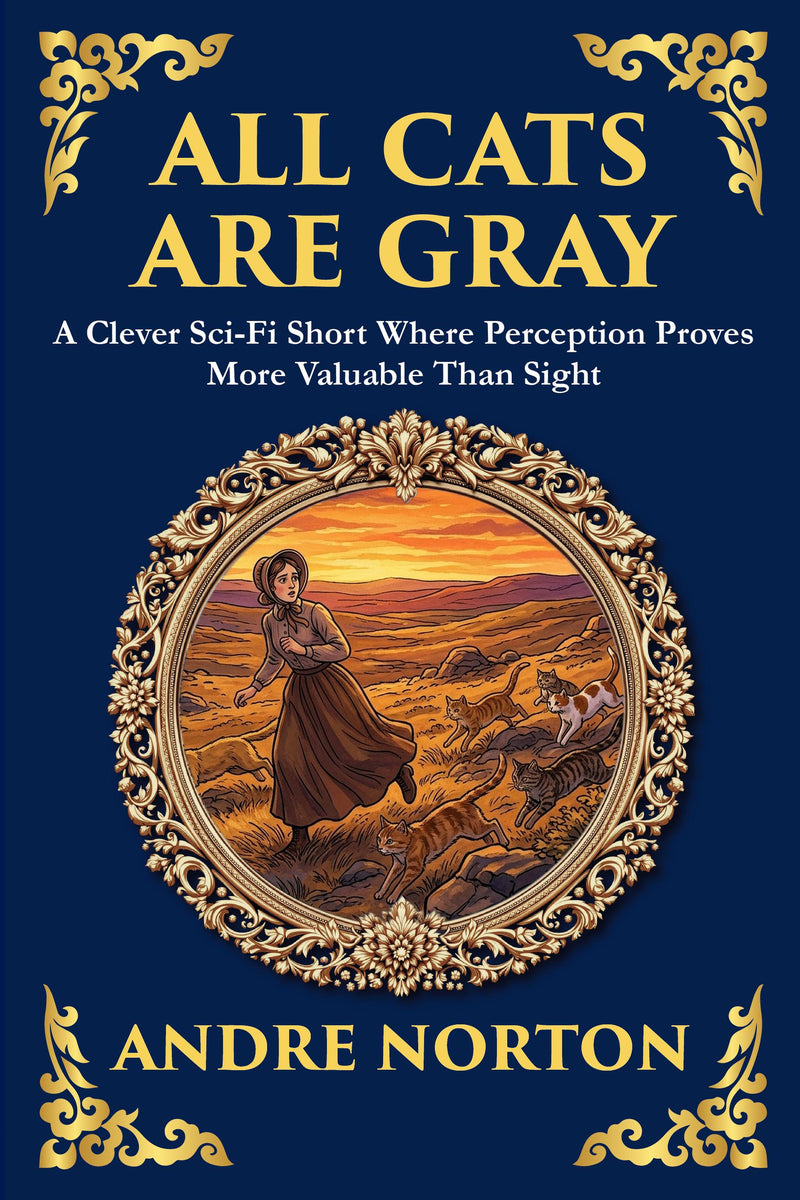
All Cats Are Gray
In the vacuum of deep space, where treasure-hunters chase legends and myths warp into madness, the most valuable asset isn’t strength or fame—it’s clarity.
or free app
10,000+ hrs library
30-day guarantee
The complete All Cats Are Gray appears in modern English through Library of Alexandria Press, available online with audiobook narration included for members.
Have you ever wondered why those who see least often understand the most? In All Cats Are Gray, science fiction legend Andre Norton delivers a smart, swift, and subversive tale set among the stars. First published in 1953, this iconic short story continues to challenge assumptions with its deceptively simple premise: what if a colorless world held the key to ultimate clarity?
Meet Steena—a quiet, unassuming woman passed over and underestimated in every spaceport bar and crew manifest. By her side is a sleek gray cat named Bat. Together, they embark on a ghost-ship mission where brash explorers have failed.
What sets them apart isn’t firepower or bravado, but something far rarer in the vacuum of space: the ability to perceive beyond illusion. As Steena navigates the abandoned corridors of the long-lost Empress of Mars, she uncovers truths invisible to the proud and power-hungry. With wit, calm, and eerie intuition, she demonstrates that heroism doesn’t always look the part—and that sometimes, the invisible forces in life are the most real of all.
What you’ll discover in this modern edition
- A Heroine Unlike Any Other – Steena isn’t flashy, loud, or famous—she’s quietly extraordinary.
- A Smart, Subtle Space Tale – Combines suspense, mystery, and sci-fi in a tightly written masterpiece.
- Themes of Perception vs. Appearance – A story that explores how we see, judge, and understand the world—and each other.
- A Pioneering Female Voice in Sci-Fi – From one of the first women to break into and reshape the science fiction genre. Perfect for readers of Ursula K.
| Formats | eBook (EPUB + PDF) · Audiobook · Paperback · Hardcover · Large Print |
| Language | English |
| Trim size (print) | 6 × 9 in |
| Binding | Paperback — perfect-bound · Hardcover — casewrap |
| Large Print edition | Same text in a larger, easy-read type — a larger font, not a larger trim |
| Print pricing | Every physical book at our true cost — at-cost, no profit (members) |
| Library | 873 restored titles, always growing |
| Length | 6,057 words · ~24 min reading |
| Reading level | Grade 10 · a comfortable read (this modern-English edition) |
| Edition | Modern English translation · 2026 |
Member reviews for this edition are collected as readers finish it — be the first. Across the library: 12,000+ books shipped, every plan covered by a 365-day print guarantee.
About this edition
A faithful, unabridged modern-English edition by The Library of Alexandria — carefully rendered for today's reader and verified paragraph-by-paragraph against the public-domain source. Available as eBook, audiobook, paperback, hardcover, and large print.
- Complete & unabridgedVerified paragraph by paragraph against the source — never a scan, never abridged.
- Modern English, faithfulReadable today, with the author’s meaning kept intact. Readable — not simplified.
- Every format, one membershipRead in your browser or the free app, or listen to the full audiobook.
Included free with your membership
Cancel anytime, one click · 30-day money-back guarantee
Edition last updated July 2026
What’s inside
All Cats Are Gray — complete and unabridged, included in full with membership, plus the full audiobook.
Begin reading All Cats Are Gray
In clear modern English — the complete text is included with membership.
Introduction
There are stories that announce themselves with thunder, and there are stories that slip quietly into your hands, deceptively small, only to expand in your mind long after the final sentence has passed. The brief tale you are about to read belongs firmly to the second category. It is a compact piece of speculative fiction, the kind that fits in the palm of an afternoon, yet it carries within it a question so elegant and so quietly subversive that readers have returned to it for decades, turning it over like a stone that keeps revealing new facets in the light. What looks at first like a simple adventure—a treasure, a danger, a person who must face it—becomes, by its conclusion, a meditation on the very nature of how we know what we think we know.
Written by Andre Norton, one of the towering figures of twentieth-century science fiction and fantasy, this short work distills many of the qualities that made her a beloved and enduring author into a remarkably tight package. Where some of her novels stretch across galaxies and generations, here she works in miniature, and the discipline of the short form sharpens her gifts to a fine point. Every word earns its place. Every detail is a clue or a feeling or a piece of the puzzle, and nothing is wasted. The result is a story that can be read in a single sitting but contemplated for a lifetime, the kind of narrative that teachers assign and readers remember, the kind that demonstrates, with quiet confidence, exactly how much a master can accomplish in a small space.
This edition presents the work in a modern translation, adapted for the contemporary reader. That phrase deserves a moment of explanation, because it speaks to the spirit in which this volume has been prepared. The original tale emerged from a particular era of magazine science fiction, when certain turns of phrase, certain rhythms of dialogue, and certain assumptions about the reader were simply the air that stories breathed. Time has a way of building small walls between a text and the people who come to it later—not walls of meaning, exactly, but walls of texture, of cadence, of unfamiliar idiom. The aim of this adaptation is to lower those walls gently, to let the brilliance of the underlying idea shine through to readers who did not grow up with the conventions of mid-century pulp fiction, without sanding away the personality and atmosphere that make the story distinctly itself. You are meant to feel at home here, to move through the prose without stumbling, and to arrive at the story’s central revelation with all the force its author intended.
To understand why this small story carries such weight, it helps to understand the woman who wrote it. Andre Norton was born Alice Mary Norton in 1912, and over a writing career that spanned more than half a century, she became one of the most prolific and influential authors the genre has ever known. She wrote more than a hundred books and countless shorter pieces, and she did so during decades when the worlds of science fiction and fantasy were widely assumed to belong to men. Early in her career she adopted the gender-neutral pen name by which she is universally known, a practical decision in a marketplace that did not always welcome women, and one that quietly underscores a truth running through much of her best work: that the surface of a thing is not the same as its substance, and that what we expect to find often blinds us to what is actually there.
Norton’s reputation rests in large part on her gift for adventure and her deep humanity. She wrote for young readers and adults alike, and she had an unusual ability to speak to both at once, crafting stories that thrilled on the level of pure event while carrying emotional and ethical undercurrents that rewarded deeper attention. She was fascinated by outsiders—by characters who did not fit the mold, who possessed unusual talents or carried unusual burdens, who saw the world differently from those around them. Her protagonists are frequently the overlooked, the doubted, the ones whose particular way of perceiving turns out to be precisely the gift the situation requires. In this respect, the story before you is pure Norton, a perfect crystallization of her abiding interests. It centers on a character whose difference is not a weakness to be overcome but an advantage to be understood, and it builds its entire structure around the idea that the conventional way of seeing is not the only way, nor even always the best one.
She received some of the highest honors her field can bestow. She was named a Grand Master by the Science Fiction and Fantasy Writers of America, recognized as a living legend whose body of work had shaped the imaginations of countless readers and writers. She was inducted into the Science Fiction Hall of Fame. Generations of authors who came after her have cited her as a formative influence, a writer who showed them that adventure stories could carry heart, that speculative fiction could explore ideas with genuine seriousness while never forgetting its first duty to entertain. To read her is to encounter a craftsperson who never condescended to her audience, who trusted readers to follow her into strange places and to feel the human stakes within the fantastic situations she devised.
This particular story comes from a moment in her career when she was actively publishing in the science fiction magazines that served as the genre’s proving ground. These publications were where ideas were tested, where new voices found their footing, and where the short story flourished as a primary mode of expression. The short form demanded economy and impact; a writer had perhaps a few thousand words to establish a world, introduce a character, pose a problem, and deliver a satisfying resolution. The discipline was brutal, and it produced some of the most enduring work in the genre’s history. Many of the classics that science fiction readers still treasure are short stories born in exactly this environment, polished gems that achieve more in their brevity than many novels manage across the pages ahead. The tale you hold belongs to this tradition, and it is a fine example of why the era is remembered so fondly.
What makes Norton’s contribution here especially notable is the way she takes a premise that could have been a simple thriller and turns it into something quietly philosophical. The bones of the story are familiar enough—there is a place that holds something valuable, there is a reason to go there, and there is a danger that must be confronted. These are the building blocks of countless adventures. But Norton is not interested merely in whether the danger will be faced and overcome. She is interested in how, and in why the usual approaches have failed, and in what it means that the solution depends not on strength or speed or weaponry but on a different way of perceiving the world entirely. The title itself, which you have already read on the cover, is a clue and an invitation, an old saying repurposed into a statement of theme. Hold it in your mind as you read. It will mean one thing to you at the beginning and something richer by the end.
At the heart of this story lies a question that has occupied philosophers, scientists, and storytellers for as long as humans have wondered about their own minds: How much of what we perceive is actually there, and how much is supplied by our expectations, our habits, our assumptions about how the world is supposed to work? We move through our days trusting our senses, and chief among them, for most of us, is sight. We believe what we see. We organize our understanding of reality around the constant flood of visual information our eyes provide. And yet sight, for all its power, is also a kind of trap. It can be fooled. It can be overwhelmed. It can fixate on the obvious and miss the essential. There are things that hide precisely because they exploit the way vision works, things that cannot be seen until you stop relying on seeing.
This is the territory Norton explores, and the subtitle of this edition names it directly: perception proves more valuable than sight. The distinction between those two words—perception and sight—is the entire engine of the story. Sight is mechanical, a matter of light and lenses and the receiving surface of the eye. Perception is something larger and stranger: it is the whole apparatus of attention, intuition, and understanding by which a mind makes sense of the world. The two usually travel together so closely that we forget they are different. But Norton constructs a situation in which they come apart, in which the ordinary act of looking actively prevents a person from grasping the truth, and in which a different mode of awareness—quieter, more patient, less dependent on the eyes—becomes the key that unlocks everything.
There is something deeply satisfying about a story that takes a problem everyone has failed to solve and reveals that the failure lay not in insufficient effort but in a flawed approach. We are conditioned to admire force and persistence, to believe that obstacles yield to those who push hardest against them. Norton gently overturns this assumption. The breakthrough here does not come from pushing harder. It comes from thinking differently, from recognizing that the tool everyone has been using is the wrong tool, and that the solution has been available all along to anyone willing to set aside the obvious. This is a profoundly democratic and hopeful idea. It suggests that advantage does not always belong to the strong or the well-equipped, but sometimes to the perceptive, the thoughtful, the one who pauses to ask whether the problem has been correctly understood in the first place.
It is worth saying a word here about the kind of protagonist Norton chooses to carry this theme, though without revealing too much. She has a particular sympathy for characters who succeed not despite their differences but because of them, and that sympathy gives the story its emotional warmth. There is a quiet dignity in watching someone whose particular way of moving through the world—their habits of attention, the qualities others might overlook or even pity—turn out to be exactly what the moment demands. The story does not preach this lesson. It simply enacts it, letting the events speak for themselves, and that restraint is part of its considerable charm. Norton respects her readers enough to let them draw their own conclusions, and the conclusions, once drawn, tend to stay.
The science fiction setting is essential to all of this, and not merely decorative. By placing her tale in a speculative environment, Norton frees herself from the constraints of the ordinary and creates a space in which the gap between sight and perception can be dramatized in a way that real life rarely permits. The unfamiliar setting lets her build a situation with no easy real-world parallel, a genuine puzzle whose solution can be both surprising and, in retrospect, inevitable. This is one of the great gifts of science fiction as a form: it can take an abstract idea—a philosophical proposition about the limits of human knowing—and give it flesh, turning it into a concrete situation with real stakes and real suspense. The reader does not simply contemplate the idea; the reader experiences it, feels the tension of the problem and the relief of its resolution, and emerges with the philosophical point lodged not just in the mind but in the memory of a story well told.
There is also a wonderful atmosphere to the piece, a mood that lingers. Norton was a master of evoking place and feeling with a few well-chosen strokes, and even in this short space she creates an environment that feels real and slightly eerie, a setting charged with mystery and a low hum of menace. The danger is felt before it is understood, which is exactly as it should be, and the gradual unveiling of what is actually happening is paced with the assurance of a writer who knows precisely how much to reveal and precisely when. You will find yourself leaning forward as the pieces come together, and the moment of clarity, when it arrives, delivers that particular pleasure unique to the best short fiction—the click of a well-made mechanism, the sense that everything you have read was leading exactly here.
Cancel anytime, one click · 30-day money-back guarantee
Founding annual rate available now — your price locks for life when you join.
Not ready? Get this free chapter by email — read it anytime.
✓ Sent — check your inbox for All Cats Are Gray.
Questions about All Cats Are Gray
What is All Cats Are Gray about?
In the vacuum of deep space, where treasure-hunters chase legends and myths warp into madness, the most valuable asset isn’t strength or fame—it’s clarity. All Cats Are Gray is a brilliantly subversive tale of science fiction, where a nondescript woman and her cat prove that true power lies in perception, not appearances. With subtle humor and razor-sharp insight, Andre Norton flips the space-adventure genre on its head.
Who wrote All Cats Are Gray?
All Cats Are Gray was written by Andre Norton. This edition presents the complete work in clear modern English, faithfully rendered from the public-domain original by Library of Alexandria Press.
Is All Cats Are Gray free to read?
The opening chapter is free to read on this page. Members read and listen to the complete work — and the entire library — free, and can order any physical book at our true print cost.
How long is All Cats Are Gray?
2 chapters (~6,057 words) — about 24 min of reading in this modern-English edition.
Is this an abridged version of All Cats Are Gray?
No. This is the complete, unabridged All Cats Are Gray, carefully rendered into clear modern English and verified paragraph-by-paragraph against the public-domain source — nothing is cut or summarised.
What formats does All Cats Are Gray come in?
All Cats Are Gray is available as eBook, paperback, hardcover and large print. eBook and audiobook are included with membership; printed editions ship at our true print cost.
Shipping & returns
Billing & membership
More from the library


Explore Science Fiction
- The Island of Doctor Moreau · H. G. Wells
- A Midsummer Night’s Dream · William Shakespeare
- The Invisible Man: A Grotesque Romance · H. G. Wells
- The War of the Worlds · H. G. Wells
- The Strange Case of Dr. Jekyll and Mr. Hyde · Robert Louis Stevenson
- Limanora: the island of progress · Godfrey Sweven
- The Book of Dragons · E. Nesbit
- She · H. Rider Haggard
- Dorothy and the Wizard in Oz · L. Frank Baum
- The Princess and the Goblin · George MacDonald
- Gawayne and the Green Knight: A Fairy Tale · Charlton M. Lewis
- Lucian’s True History · Lucian of Samosata
- The Willows · Algernon Blackwood
- The Call of Cthulhu · H. P. Lovecraft
- The Life-Eater · Harold Ward
- The Marvelous Land of Oz · L. Frank Baum
- Mars is My Destination · Frank Belknap Long
- The Black Kiss
- The Beasts in the Void · Paul W. Fairman
- John Jones’s Dollar · Harry Stephen Keeler
- Subversive · Mack Reynolds
- The Mississippi Saucer · Frank Belknap Long
- Man of Distinction · Michael Shaara
- Spawn of the Comet · H. Thompson Rich
- The Golden Judge · Nathaniel Gordon
- Final Weapon · Everett B. Cole
- The Big Fix · George O. Smith
- Last Enemy · H. Beam Piper
- Time and Time Again · H. Beam Piper
- Sabotage in Space · Carey Rockwell
All Cats Are Gray
All Cats Are Gray
A Clever Sci-Fi Short Where Perception Proves More Valuable Than Sight
Andre Norton
Contents
- Introduction
- All Cats Are Gray
Introduction
There are stories that announce themselves with thunder, and there are stories that slip quietly into your hands, deceptively small, only to expand in your mind long after the final sentence has passed. The brief tale you are about to read belongs firmly to the second category. It is a compact piece of speculative fiction, the kind that fits in the palm of an afternoon, yet it carries within it a question so elegant and so quietly subversive that readers have returned to it for decades, turning it over like a stone that keeps revealing new facets in the light. What looks at first like a simple adventure—a treasure, a danger, a person who must face it—becomes, by its conclusion, a meditation on the very nature of how we know what we think we know.
Written by Andre Norton, one of the towering figures of twentieth-century science fiction and fantasy, this short work distills many of the qualities that made her a beloved and enduring author into a remarkably tight package. Where some of her novels stretch across galaxies and generations, here she works in miniature, and the discipline of the short form sharpens her gifts to a fine point. Every word earns its place. Every detail is a clue or a feeling or a piece of the puzzle, and nothing is wasted. The result is a story that can be read in a single sitting but contemplated for a lifetime, the kind of narrative that teachers assign and readers remember, the kind that demonstrates, with quiet confidence, exactly how much a master can accomplish in a small space.
This edition presents the work in a modern translation, adapted for the contemporary reader. That phrase deserves a moment of explanation, because it speaks to the spirit in which this volume has been prepared. The original tale emerged from a particular era of magazine science fiction, when certain turns of phrase, certain rhythms of dialogue, and certain assumptions about the reader were simply the air that stories breathed. Time has a way of building small walls between a text and the people who come to it later—not walls of meaning, exactly, but walls of texture, of cadence, of unfamiliar idiom. The aim of this adaptation is to lower those walls gently, to let the brilliance of the underlying idea shine through to readers who did not grow up with the conventions of mid-century pulp fiction, without sanding away the personality and atmosphere that make the story distinctly itself. You are meant to feel at home here, to move through the prose without stumbling, and to arrive at the story’s central revelation with all the force its author intended.
To understand why this small story carries such weight, it helps to understand the woman who wrote it. Andre Norton was born Alice Mary Norton in 1912, and over a writing career that spanned more than half a century, she became one of the most prolific and influential authors the genre has ever known. She wrote more than a hundred books and countless shorter pieces, and she did so during decades when the worlds of science fiction and fantasy were widely assumed to belong to men. Early in her career she adopted the gender-neutral pen name by which she is universally known, a practical decision in a marketplace that did not always welcome women, and one that quietly underscores a truth running through much of her best work: that the surface of a thing is not the same as its substance, and that what we expect to find often blinds us to what is actually there.
Norton’s reputation rests in large part on her gift for adventure and her deep humanity. She wrote for young readers and adults alike, and she had an unusual ability to speak to both at once, crafting stories that thrilled on the level of pure event while carrying emotional and ethical undercurrents that rewarded deeper attention. She was fascinated by outsiders—by characters who did not fit the mold, who possessed unusual talents or carried unusual burdens, who saw the world differently from those around them. Her protagonists are frequently the overlooked, the doubted, the ones whose particular way of perceiving turns out to be precisely the gift the situation requires. In this respect, the story before you is pure Norton, a perfect crystallization of her abiding interests. It centers on a character whose difference is not a weakness to be overcome but an advantage to be understood, and it builds its entire structure around the idea that the conventional way of seeing is not the only way, nor even always the best one.
She received some of the highest honors her field can bestow. She was named a Grand Master by the Science Fiction and Fantasy Writers of America, recognized as a living legend whose body of work had shaped the imaginations of countless readers and writers. She was inducted into the Science Fiction Hall of Fame. Generations of authors who came after her have cited her as a formative influence, a writer who showed them that adventure stories could carry heart, that speculative fiction could explore ideas with genuine seriousness while never forgetting its first duty to entertain. To read her is to encounter a craftsperson who never condescended to her audience, who trusted readers to follow her into strange places and to feel the human stakes within the fantastic situations she devised.
This particular story comes from a moment in her career when she was actively publishing in the science fiction magazines that served as the genre’s proving ground. These publications were where ideas were tested, where new voices found their footing, and where the short story flourished as a primary mode of expression. The short form demanded economy and impact; a writer had perhaps a few thousand words to establish a world, introduce a character, pose a problem, and deliver a satisfying resolution. The discipline was brutal, and it produced some of the most enduring work in the genre’s history. Many of the classics that science fiction readers still treasure are short stories born in exactly this environment, polished gems that achieve more in their brevity than many novels manage across the pages ahead. The tale you hold belongs to this tradition, and it is a fine example of why the era is remembered so fondly.
What makes Norton’s contribution here especially notable is the way she takes a premise that could have been a simple thriller and turns it into something quietly philosophical. The bones of the story are familiar enough—there is a place that holds something valuable, there is a reason to go there, and there is a danger that must be confronted. These are the building blocks of countless adventures. But Norton is not interested merely in whether the danger will be faced and overcome. She is interested in how, and in why the usual approaches have failed, and in what it means that the solution depends not on strength or speed or weaponry but on a different way of perceiving the world entirely. The title itself, which you have already read on the cover, is a clue and an invitation, an old saying repurposed into a statement of theme. Hold it in your mind as you read. It will mean one thing to you at the beginning and something richer by the end.
At the heart of this story lies a question that has occupied philosophers, scientists, and storytellers for as long as humans have wondered about their own minds: How much of what we perceive is actually there, and how much is supplied by our expectations, our habits, our assumptions about how the world is supposed to work? We move through our days trusting our senses, and chief among them, for most of us, is sight. We believe what we see. We organize our understanding of reality around the constant flood of visual information our eyes provide. And yet sight, for all its power, is also a kind of trap. It can be fooled. It can be overwhelmed. It can fixate on the obvious and miss the essential. There are things that hide precisely because they exploit the way vision works, things that cannot be seen until you stop relying on seeing.
This is the territory Norton explores, and the subtitle of this edition names it directly: perception proves more valuable than sight. The distinction between those two words—perception and sight—is the entire engine of the story. Sight is mechanical, a matter of light and lenses and the receiving surface of the eye. Perception is something larger and stranger: it is the whole apparatus of attention, intuition, and understanding by which a mind makes sense of the world. The two usually travel together so closely that we forget they are different. But Norton constructs a situation in which they come apart, in which the ordinary act of looking actively prevents a person from grasping the truth, and in which a different mode of awareness—quieter, more patient, less dependent on the eyes—becomes the key that unlocks everything.
There is something deeply satisfying about a story that takes a problem everyone has failed to solve and reveals that the failure lay not in insufficient effort but in a flawed approach. We are conditioned to admire force and persistence, to believe that obstacles yield to those who push hardest against them. Norton gently overturns this assumption. The breakthrough here does not come from pushing harder. It comes from thinking differently, from recognizing that the tool everyone has been using is the wrong tool, and that the solution has been available all along to anyone willing to set aside the obvious. This is a profoundly democratic and hopeful idea. It suggests that advantage does not always belong to the strong or the well-equipped, but sometimes to the perceptive, the thoughtful, the one who pauses to ask whether the problem has been correctly understood in the first place.
It is worth saying a word here about the kind of protagonist Norton chooses to carry this theme, though without revealing too much. She has a particular sympathy for characters who succeed not despite their differences but because of them, and that sympathy gives the story its emotional warmth. There is a quiet dignity in watching someone whose particular way of moving through the world—their habits of attention, the qualities others might overlook or even pity—turn out to be exactly what the moment demands. The story does not preach this lesson. It simply enacts it, letting the events speak for themselves, and that restraint is part of its considerable charm. Norton respects her readers enough to let them draw their own conclusions, and the conclusions, once drawn, tend to stay.
The science fiction setting is essential to all of this, and not merely decorative. By placing her tale in a speculative environment, Norton frees herself from the constraints of the ordinary and creates a space in which the gap between sight and perception can be dramatized in a way that real life rarely permits. The unfamiliar setting lets her build a situation with no easy real-world parallel, a genuine puzzle whose solution can be both surprising and, in retrospect, inevitable. This is one of the great gifts of science fiction as a form: it can take an abstract idea—a philosophical proposition about the limits of human knowing—and give it flesh, turning it into a concrete situation with real stakes and real suspense. The reader does not simply contemplate the idea; the reader experiences it, feels the tension of the problem and the relief of its resolution, and emerges with the philosophical point lodged not just in the mind but in the memory of a story well told.
There is also a wonderful atmosphere to the piece, a mood that lingers. Norton was a master of evoking place and feeling with a few well-chosen strokes, and even in this short space she creates an environment that feels real and slightly eerie, a setting charged with mystery and a low hum of menace. The danger is felt before it is understood, which is exactly as it should be, and the gradual unveiling of what is actually happening is paced with the assurance of a writer who knows precisely how much to reveal and precisely when. You will find yourself leaning forward as the pieces come together, and the moment of clarity, when it arrives, delivers that particular pleasure unique to the best short fiction—the click of a well-made mechanism, the sense that everything you have read was leading exactly here.
Steena of the spaceways—that sounds like a cheesy title for one of those Stellar-Vedo features. I should know; I’ve written enough of them myself. But this Steena wasn’t some glamour girl. She was as colorless as a Lunar plant—even the hair pinned tight to her scalp had a grayish tint, and I only ever saw her wearing a shapeless, baggy gray spacesuit.
Steena stayed strictly in the background, which is where she spent most of her free time—in the smelly, smoky corners of the spaceport dives where freelance spacers hung out. If you really looked for her, you could find her just sitting there, listening to the chatter—listening and remembering. She rarely spoke. But when she did, the spacers had learned to pay attention. The lucky few who ever heard her speak would never forget her.
She drifted from port to port. As an expert operator of the large computers, she could find work wherever she decided to stay for a while. She eventually became like the complex machines she maintained—smooth, gray, and lacking much of a personality.
But Steena was the one who told Bub Nelson about the Jovan moon-rites, and her warning saved Bub’s life six months later. Steena was also the one who identified the piece of stone Keene Clark was passing around a table one night, correctly calling it raw Slitite. That sparked a rush that created ten overnight fortunes for men who had been down to their last few credits. And finally, she solved the mystery of the Empress of Mars.
All the men who had benefited from her strange knowledge and photographic memory tried at one time or another to pay her back. But she wouldn’t let them buy her so much as a glass of water, let alone accept the credits they tried to give her. Bub Nelson was the only one who managed to get around her refusal. He was the one who brought her Bat.
End of the free sample
Keep reading, free
Members read and listen to the complete book — and the entire library. Cancel anytime, one click · 30-day money-back guarantee.