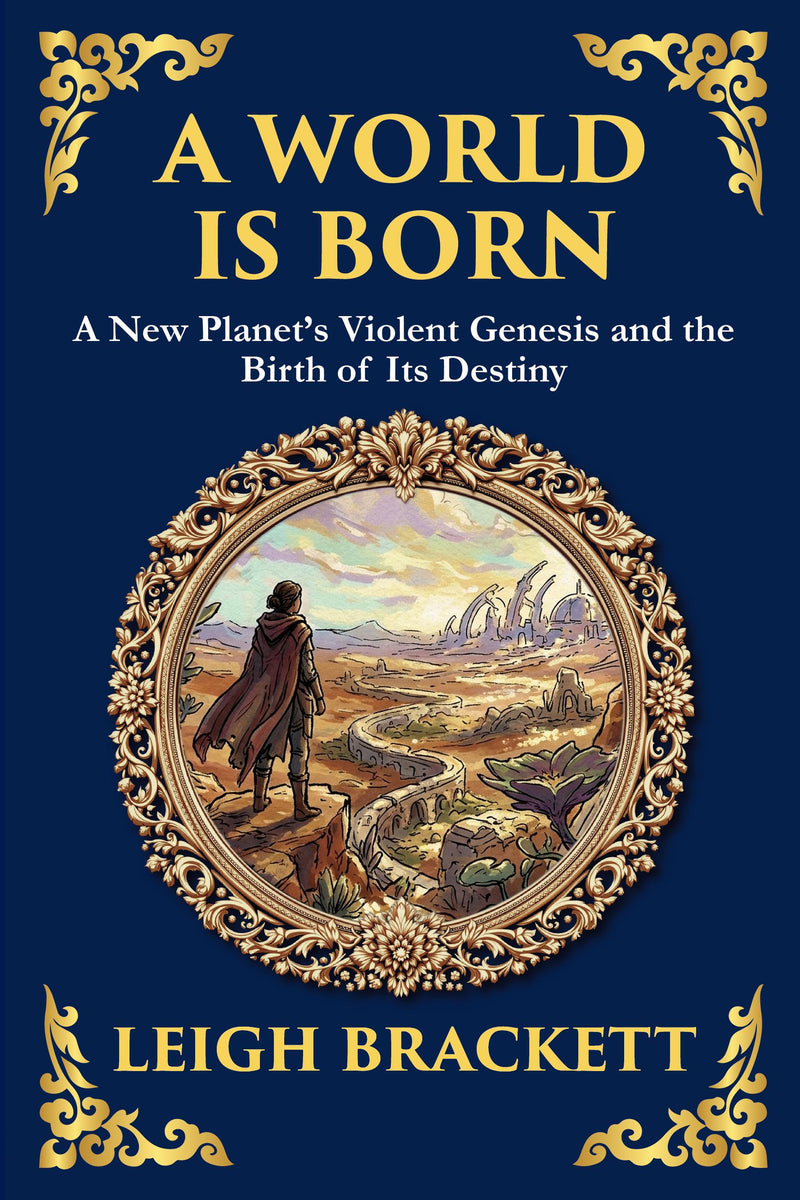
A World is Born
From the Queen of Space Opera comes a tale of cosmic birth, violent upheaval, and the struggle for survival. In A World is Born, an unforgiving planet emerges from fire and chaos, its destiny shaped by both the fury of nature and the ambitions of humankind.
or free app
10,000+ hrs library
30-day guarantee
The complete A World is Born appears in modern English through Library of Alexandria Press, available online with audiobook narration included for members.
Have you ever wondered why creation often begins in fire and conflict? Leigh Brackett, hailed as one of the great voices of Golden Age science fiction, weaves a breathtaking vision of planetary birth and human ambition in A World is Born. In this sweeping space adventure, Brackett blends raw cosmic spectacle with the intimate drama of those who dare to tame a newly formed world.
A planet is forged in violence—its crust still trembling, its skies thick with ash and firestorms. Yet even in its infancy, it becomes a battleground for colonists, adventurers, and conquerors who see opportunity in chaos. Amid the clash of wills, the planet itself becomes a character— untamed, unpredictable, and unwilling to be subdued without sacrifice.
What you’ll discover in this modern edition
- A Planet’s Fiery Genesis – Witness the violent birth of a world forged in chaos and fire.
- Human Ambition Against Nature – Experience the clash between survival, conquest, and the raw forces of an untamed planet.
- Leigh Brackett’s Signature Vision – Bold, lyrical prose from the “Queen of Space Opera,” whose works shaped generations of science fiction.
- Conflict, Destiny, and Survival – Discover how human will collides with planetary destiny in a struggle that echoes across the cosmos.
- A Timeless Exploration of Power and Creation – A story that asks who has the right to shape a new world, and what the cost of that power may be.
| Formats | eBook (EPUB + PDF) · Audiobook · Paperback · Hardcover · Large Print |
| Language | English |
| Trim size (print) | 6 × 9 in |
| Binding | Paperback — perfect-bound · Hardcover — casewrap |
| Large Print edition | Same text in a larger, easy-read type — a larger font, not a larger trim |
| Print pricing | Every physical book at our true cost — at-cost, no profit (members) |
| Library | 873 restored titles, always growing |
| Length | 11,470 words · ~46 min reading |
| Reading level | Grade 3 · an easy, flowing read (this modern-English edition) |
| Edition | Modern English translation · 2026 |
Member reviews for this edition are collected as readers finish it — be the first. Across the library: 12,000+ books shipped, every plan covered by a 365-day print guarantee.
About this edition
A faithful, unabridged modern-English edition by The Library of Alexandria — carefully rendered for today's reader and verified paragraph-by-paragraph against the public-domain source. Available as eBook, audiobook, paperback, hardcover, and large print.
- Complete & unabridgedVerified paragraph by paragraph against the source — never a scan, never abridged.
- Modern English, faithfulReadable today, with the author’s meaning kept intact. Readable — not simplified.
- Every format, one membershipRead in your browser or the free app, or listen to the full audiobook.
Included free with your membership
Cancel anytime, one click · 30-day money-back guarantee
Edition last updated July 2026
What’s inside
A World is Born — complete and unabridged, included in full with membership, plus the full audiobook.
Begin reading A World is Born
In clear modern English — the complete text is included with membership.
Introduction
There is a particular kind of pleasure that comes from reading science fiction written before the genre had fully decided what it wanted to be. In those early decades, when the pulps roared off the presses in lurid colors and rough paper, writers were inventing the future with one hand while inventing the very tools of storytelling with the other. They were not bound by the rigid conventions that would later calcify around space opera, hard science fiction, and planetary romance. They wrote with a freedom and a hunger that can still leap off the page and seize a modern reader by the collar. The work you are about to read belongs to that wild, formative era, and it carries within it the unmistakable energy of a young author finding her voice—an author who would go on to become one of the most influential figures the field has ever known.
Leigh Brackett is a name that deserves to be spoken with reverence by anyone who loves imaginative fiction. To readers who know their history, she is the Queen of Space Opera, the woman who painted Mars and Venus in colors so vivid and romantic that her versions of those worlds became templates for generations of writers who followed. To moviegoers, she is the screenwriter who helped adapt Raymond Chandler’s The Big Sleep for Howard Hawks, who wrote tough, sun-baked Westerns like Rio Bravo and El Dorado, and who, in the final months of her life, delivered an early draft of the screenplay for The Empire Strikes Back—a film many consider the finest in the entire Star Wars saga. Few writers have ever bridged the worlds of pulp fiction, literary craft, and blockbuster cinema with such apparent ease. Fewer still managed to do it while being one of the relatively few women working in a field that was, at the time, overwhelmingly populated by men.
This early work, presented here in a fresh modern translation adapted for the contemporary reader, offers a window into the beginnings of that remarkable career. It is a story about creation in the most literal sense—about the violent, churning processes by which a new world might come into being, and about the destinies that such a birth might set in motion. Reading it now, with the benefit of nearly a century of hindsight, we can see both the conventions of its time and the early sparks of the genius that would define Brackett’s mature work. We can feel the pulse of an imagination straining against the limits of what was known, reaching toward something grander, stranger, and more beautiful than the everyday world could offer.
To approach this book properly, it helps to understand a little about the moment in which it was written and the woman who wrote it. Brackett came of age as a writer during the golden glow of the pulp magazines, those cheap, gaudy periodicals that filled the newsstands of mid-century America with tales of adventure, mystery, romance, and the fantastic. The pulps were not respectable. They were not the kind of thing one displayed proudly on the parlor shelf. But they were alive in a way that more respectable literature often was not, and they gave a generation of young writers a place to learn their craft, to experiment, to fail and try again, and occasionally to produce work of startling power. Brackett learned in this school, and she learned well. She absorbed its lessons about pacing, about momentum, about the way a story must keep moving lest the reader lose interest. But she brought to it something the pulps often lacked: a genuine lyricism, a sensitivity to atmosphere and mood, and a deep, almost melancholy romanticism that suffused even her most action-packed tales.
Born in Los Angeles in 1915, Leigh Douglass Brackett grew up under California skies, and there is something in her work that seems to carry the heat and light of that landscape—the dry winds, the sense of vast spaces, the feeling of standing at the edge of a continent and looking out toward unknown horizons. She lost her father young, and she devoured the adventure fiction of Edgar Rice Burroughs, whose tales of John Carter on Barsoom—a dying, romantic, war-torn Mars—would leave a permanent mark on her imagination. Burroughs gave her the dream of other worlds, and she would spend much of her career making that dream her own, reshaping it through the lens of her own distinctive sensibility.
What set Brackett apart, even early on, was her refusal to treat the alien worlds of her fiction as mere backdrops for action. For her, a planet was not simply a stage upon which heroes fought and villains schemed. It was a character in its own right, a living presence with its own history, its own moods, its own tragic grandeur. She understood that the most powerful science fiction is not about gadgets or technology but about the encounter between human beings and the vast, indifferent universe—about what happens to the soul when it confronts the truly alien, the truly ancient, the truly other. Her best work has the quality of myth, of legend, of stories told around fires in the deep night when the stars seem close enough to touch.
This sensibility is what makes her early fiction worth reading even now, decades after the scientific assumptions of her era have been overturned. We know today that Mars is a frozen desert and that Venus is a hellish furnace beneath sulfuric clouds. We know that the solar system Brackett wrote about—populated by ancient Martian races and steaming Venusian swamps—never existed and never could have. And yet, paradoxically, this makes her work more valuable rather than less. It frees us to read her not as a failed prophet of the actual future but as a poet of the possible, a dreamer who used the materials of science to build cathedrals of wonder. Her solar system is a place of the imagination, as real and as unreal as Tolkien’s Middle-earth or Howard’s Hyborian Age. It is a place we visit not to learn facts but to feel something—awe, longing, terror, the ache of beauty glimpsed and lost.
The title of this volume points us toward one of the great themes that would run through all of Brackett’s work: the theme of creation and destruction intertwined, the recognition that nothing new comes into being without violence, that genesis and catastrophe are two faces of the same coin. The birth of a world is not a gentle thing. It is fire and pressure and unimaginable force, the collision of vast energies, the slow accretion of matter under the relentless pull of gravity, the gradual cooling of molten rock into something that might, in time, support life. To write about such a thing is to write about the largest possible canvas, to grapple with forces that dwarf human comprehension. And yet Brackett, even in her early work, understood that the truly grand only becomes meaningful when it is connected to the intimate—when the birth of a world is also, somehow, the birth of a destiny, the beginning of a story that individual beings will live out, suffer through, and perhaps redeem.
I will not say more about the specifics of what unfolds in these pages, because part of the joy of reading Brackett is discovering her worlds for yourself, watching them unfold scene by scene with no foreknowledge of where they are heading. What I can tell you is that you are in the hands of a writer who knew how to keep you turning pages, who understood the rhythms of suspense and revelation, and who never forgot that the purpose of a story is, first and foremost, to make you feel. There is a directness to her storytelling, a confidence and a momentum, that even in her earliest published work distinguishes her from the run-of-the-mill scribblers who filled the pulps with forgettable filler. You can sense, reading her, that here is someone who is going somewhere, who is going to matter, whose name will be remembered long after the magazines that first carried her words have crumbled into dust.
It is worth pausing here to reflect on what it meant for a woman to be doing this work in the 1930s and 1940s. Science fiction was, to put it mildly, not a welcoming field for women. The readership was assumed to be young and male, the writers were overwhelmingly men, and the prevailing attitudes about what women could and should do were narrow and confining. Brackett navigated this world with formidable skill. Early in her career, some readers assumed that “Leigh Brackett” was a man, and the ambiguity of the name no doubt served her well in an industry rife with prejudice. But she did not hide who she was, and she did not write timid, retiring fiction. Her stories crackle with energy and adventure; her heroes are bold and her villains are dangerous; her action sequences are as muscular and kinetic as anything written by her male contemporaries. At the same time, she brought a depth of feeling and a richness of characterization that elevated her work above mere adventure. She proved, decisively and permanently, that a woman could not only compete in this arena but could excel in it, could indeed become one of its acknowledged masters.
Her influence radiated outward in ways that are still being felt. Ray Bradbury, who would become one of the most beloved writers of the twentieth century, was a friend and protégé; she mentored him in his early years, and when she left an unfinished story to go work in Hollywood, Bradbury completed it—the result being a collaboration that helped launch his own stellar career. The connections ripple onward from there, through the science fiction community of mid-century America and out into the wider culture. When you trace the lineage of modern space opera—of the grand, romantic, planet-spanning adventures that fill our movie screens and bookshelves today—you find Brackett standing near the headwaters, one of the essential sources from which the whole tradition flows.
Reading Brackett in the Twenty-First Century
How should a contemporary reader approach a book like this one? Let me offer a few thoughts that may enhance your experience and help you get the most out of what awaits you.
First, surrender to the romance of it. Brackett wrote in a mode that is unapologetically romantic—not in the narrow sense of love stories, though those appear, but in the older and grander sense of romance as a literary tradition: the tradition of heightened emotion, of larger-than-life heroes and adventures, of worlds painted in bold strokes and vivid colors. This is not the spare, clinical, technologically obsessed science fiction that would later dominate certain corners of the field. It is closer in spirit to myth and legend, to the sagas and epics that human beings have told one another since the beginning of language. If you come to it expecting cold scientific rigor, you will be disappointed. But if you come to it open to wonder, willing to be swept along by the sheer imaginative power of the storytelling, you will find riches that more “realistic” fiction can never offer.
Second, attend to the prose. Brackett was a stylist, and even in her early work there are passages of real beauty—descriptions that linger in the mind, images that resonate, sentences that achieve a kind of incantatory power. She had an ear for language and a painter’s eye for the visual. She understood how to use words to create atmosphere, to make you feel the heat of an alien sun or the chill of a dead sea bottom or the weight of unimaginable antiquity pressing down upon the present. This modern translation and adaptation has been prepared with care to bring her language to contemporary readers in its full power, smoothing away the occasional archaisms and infelicities that can trip up the modern eye while preserving the essential music and momentum of her style. The goal has been to let her voice come through clearly, undimmed by the passage of time, so that you can experience the story as vividly as its first readers did when it appeared fresh on the newsstands.
Third, place the work in its proper context. This is early Brackett, and it should be read as such—not as the polished masterwork of her maturity but as the vigorous, ambitious early effort of a writer who was still discovering the full range of her powers. There is something deeply satisfying about reading an artist’s early work when you know what they will go on to achieve. You can see the seeds of greatness already present, the themes and obsessions that will recur and deepen throughout the career, the characteristic gestures and preoccupations that will become her signature. You can watch her testing her instruments, finding out what she can do, reaching for effects that she will later achieve with greater control and assurance. This is not a diminishment of the work but an enrichment of it. To read early Brackett is to witness the birth of a major talent, and there is a particular pleasure in that witnessing that the mature work, for all its mastery, cannot quite provide.
Cancel anytime, one click · 30-day money-back guarantee
Founding annual rate available now — your price locks for life when you join.
Not ready? Get this free chapter by email — read it anytime.
✓ Sent — check your inbox for A World is Born.
Questions about A World is Born
What is A World is Born about?
From the Queen of Space Opera comes a tale of cosmic birth, violent upheaval, and the struggle for survival. In A World is Born, an unforgiving planet emerges from fire and chaos, its destiny shaped by both the fury of nature and the ambitions of humankind. Out of the ashes rises a story of resilience, exploration, and the eternal question: who truly owns the right to shape a world?
Who wrote A World is Born?
A World is Born was written by Leigh Brackett. This edition presents the complete work in clear modern English, faithfully rendered from the public-domain original by Library of Alexandria Press.
Is A World is Born free to read?
The opening chapter is free to read on this page. Members read and listen to the complete work — and the entire library — free, and can order any physical book at our true print cost.
How long is A World is Born?
2 chapters (~11,470 words) — about 46 min of reading in this modern-English edition.
Is this an abridged version of A World is Born?
No. This is the complete, unabridged A World is Born, carefully rendered into clear modern English and verified paragraph-by-paragraph against the public-domain source — nothing is cut or summarised.
What formats does A World is Born come in?
A World is Born is available as eBook, paperback, hardcover and large print. eBook and audiobook are included with membership; printed editions ship at our true print cost.
Shipping & returns
Billing & membership
More from the library


Explore Science Fiction
- The Island of Doctor Moreau · H. G. Wells
- A Midsummer Night’s Dream · William Shakespeare
- The Invisible Man: A Grotesque Romance · H. G. Wells
- The War of the Worlds · H. G. Wells
- The Strange Case of Dr. Jekyll and Mr. Hyde · Robert Louis Stevenson
- Limanora: the island of progress · Godfrey Sweven
- The Book of Dragons · E. Nesbit
- She · H. Rider Haggard
- Dorothy and the Wizard in Oz · L. Frank Baum
- The Princess and the Goblin · George MacDonald
- Gawayne and the Green Knight: A Fairy Tale · Charlton M. Lewis
- Lucian’s True History · Lucian of Samosata
- The Willows · Algernon Blackwood
- The Call of Cthulhu · H. P. Lovecraft
- The Life-Eater · Harold Ward
- The Marvelous Land of Oz · L. Frank Baum
- Mars is My Destination · Frank Belknap Long
- The Black Kiss
- The Beasts in the Void · Paul W. Fairman
- John Jones’s Dollar · Harry Stephen Keeler
- Subversive · Mack Reynolds
- The Mississippi Saucer · Frank Belknap Long
- Man of Distinction · Michael Shaara
- Spawn of the Comet · H. Thompson Rich
- The Golden Judge · Nathaniel Gordon
- Final Weapon · Everett B. Cole
- The Big Fix · George O. Smith
- Last Enemy · H. Beam Piper
- Time and Time Again · H. Beam Piper
- Sabotage in Space · Carey Rockwell
A World is Born
A World is Born
A New Planet’s Violent Genesis and the Birth of Its Destiny
Leigh Brackett
Contents
- Introduction
- A World is Born
Introduction
There is a particular kind of pleasure that comes from reading science fiction written before the genre had fully decided what it wanted to be. In those early decades, when the pulps roared off the presses in lurid colors and rough paper, writers were inventing the future with one hand while inventing the very tools of storytelling with the other. They were not bound by the rigid conventions that would later calcify around space opera, hard science fiction, and planetary romance. They wrote with a freedom and a hunger that can still leap off the page and seize a modern reader by the collar. The work you are about to read belongs to that wild, formative era, and it carries within it the unmistakable energy of a young author finding her voice—an author who would go on to become one of the most influential figures the field has ever known.
Leigh Brackett is a name that deserves to be spoken with reverence by anyone who loves imaginative fiction. To readers who know their history, she is the Queen of Space Opera, the woman who painted Mars and Venus in colors so vivid and romantic that her versions of those worlds became templates for generations of writers who followed. To moviegoers, she is the screenwriter who helped adapt Raymond Chandler’s The Big Sleep for Howard Hawks, who wrote tough, sun-baked Westerns like Rio Bravo and El Dorado, and who, in the final months of her life, delivered an early draft of the screenplay for The Empire Strikes Back—a film many consider the finest in the entire Star Wars saga. Few writers have ever bridged the worlds of pulp fiction, literary craft, and blockbuster cinema with such apparent ease. Fewer still managed to do it while being one of the relatively few women working in a field that was, at the time, overwhelmingly populated by men.
This early work, presented here in a fresh modern translation adapted for the contemporary reader, offers a window into the beginnings of that remarkable career. It is a story about creation in the most literal sense—about the violent, churning processes by which a new world might come into being, and about the destinies that such a birth might set in motion. Reading it now, with the benefit of nearly a century of hindsight, we can see both the conventions of its time and the early sparks of the genius that would define Brackett’s mature work. We can feel the pulse of an imagination straining against the limits of what was known, reaching toward something grander, stranger, and more beautiful than the everyday world could offer.
To approach this book properly, it helps to understand a little about the moment in which it was written and the woman who wrote it. Brackett came of age as a writer during the golden glow of the pulp magazines, those cheap, gaudy periodicals that filled the newsstands of mid-century America with tales of adventure, mystery, romance, and the fantastic. The pulps were not respectable. They were not the kind of thing one displayed proudly on the parlor shelf. But they were alive in a way that more respectable literature often was not, and they gave a generation of young writers a place to learn their craft, to experiment, to fail and try again, and occasionally to produce work of startling power. Brackett learned in this school, and she learned well. She absorbed its lessons about pacing, about momentum, about the way a story must keep moving lest the reader lose interest. But she brought to it something the pulps often lacked: a genuine lyricism, a sensitivity to atmosphere and mood, and a deep, almost melancholy romanticism that suffused even her most action-packed tales.
Born in Los Angeles in 1915, Leigh Douglass Brackett grew up under California skies, and there is something in her work that seems to carry the heat and light of that landscape—the dry winds, the sense of vast spaces, the feeling of standing at the edge of a continent and looking out toward unknown horizons. She lost her father young, and she devoured the adventure fiction of Edgar Rice Burroughs, whose tales of John Carter on Barsoom—a dying, romantic, war-torn Mars—would leave a permanent mark on her imagination. Burroughs gave her the dream of other worlds, and she would spend much of her career making that dream her own, reshaping it through the lens of her own distinctive sensibility.
What set Brackett apart, even early on, was her refusal to treat the alien worlds of her fiction as mere backdrops for action. For her, a planet was not simply a stage upon which heroes fought and villains schemed. It was a character in its own right, a living presence with its own history, its own moods, its own tragic grandeur. She understood that the most powerful science fiction is not about gadgets or technology but about the encounter between human beings and the vast, indifferent universe—about what happens to the soul when it confronts the truly alien, the truly ancient, the truly other. Her best work has the quality of myth, of legend, of stories told around fires in the deep night when the stars seem close enough to touch.
This sensibility is what makes her early fiction worth reading even now, decades after the scientific assumptions of her era have been overturned. We know today that Mars is a frozen desert and that Venus is a hellish furnace beneath sulfuric clouds. We know that the solar system Brackett wrote about—populated by ancient Martian races and steaming Venusian swamps—never existed and never could have. And yet, paradoxically, this makes her work more valuable rather than less. It frees us to read her not as a failed prophet of the actual future but as a poet of the possible, a dreamer who used the materials of science to build cathedrals of wonder. Her solar system is a place of the imagination, as real and as unreal as Tolkien’s Middle-earth or Howard’s Hyborian Age. It is a place we visit not to learn facts but to feel something—awe, longing, terror, the ache of beauty glimpsed and lost.
The title of this volume points us toward one of the great themes that would run through all of Brackett’s work: the theme of creation and destruction intertwined, the recognition that nothing new comes into being without violence, that genesis and catastrophe are two faces of the same coin. The birth of a world is not a gentle thing. It is fire and pressure and unimaginable force, the collision of vast energies, the slow accretion of matter under the relentless pull of gravity, the gradual cooling of molten rock into something that might, in time, support life. To write about such a thing is to write about the largest possible canvas, to grapple with forces that dwarf human comprehension. And yet Brackett, even in her early work, understood that the truly grand only becomes meaningful when it is connected to the intimate—when the birth of a world is also, somehow, the birth of a destiny, the beginning of a story that individual beings will live out, suffer through, and perhaps redeem.
I will not say more about the specifics of what unfolds in these pages, because part of the joy of reading Brackett is discovering her worlds for yourself, watching them unfold scene by scene with no foreknowledge of where they are heading. What I can tell you is that you are in the hands of a writer who knew how to keep you turning pages, who understood the rhythms of suspense and revelation, and who never forgot that the purpose of a story is, first and foremost, to make you feel. There is a directness to her storytelling, a confidence and a momentum, that even in her earliest published work distinguishes her from the run-of-the-mill scribblers who filled the pulps with forgettable filler. You can sense, reading her, that here is someone who is going somewhere, who is going to matter, whose name will be remembered long after the magazines that first carried her words have crumbled into dust.
It is worth pausing here to reflect on what it meant for a woman to be doing this work in the 1930s and 1940s. Science fiction was, to put it mildly, not a welcoming field for women. The readership was assumed to be young and male, the writers were overwhelmingly men, and the prevailing attitudes about what women could and should do were narrow and confining. Brackett navigated this world with formidable skill. Early in her career, some readers assumed that “Leigh Brackett” was a man, and the ambiguity of the name no doubt served her well in an industry rife with prejudice. But she did not hide who she was, and she did not write timid, retiring fiction. Her stories crackle with energy and adventure; her heroes are bold and her villains are dangerous; her action sequences are as muscular and kinetic as anything written by her male contemporaries. At the same time, she brought a depth of feeling and a richness of characterization that elevated her work above mere adventure. She proved, decisively and permanently, that a woman could not only compete in this arena but could excel in it, could indeed become one of its acknowledged masters.
Her influence radiated outward in ways that are still being felt. Ray Bradbury, who would become one of the most beloved writers of the twentieth century, was a friend and protégé; she mentored him in his early years, and when she left an unfinished story to go work in Hollywood, Bradbury completed it—the result being a collaboration that helped launch his own stellar career. The connections ripple onward from there, through the science fiction community of mid-century America and out into the wider culture. When you trace the lineage of modern space opera—of the grand, romantic, planet-spanning adventures that fill our movie screens and bookshelves today—you find Brackett standing near the headwaters, one of the essential sources from which the whole tradition flows.
Reading Brackett in the Twenty-First Century
How should a contemporary reader approach a book like this one? Let me offer a few thoughts that may enhance your experience and help you get the most out of what awaits you.
First, surrender to the romance of it. Brackett wrote in a mode that is unapologetically romantic—not in the narrow sense of love stories, though those appear, but in the older and grander sense of romance as a literary tradition: the tradition of heightened emotion, of larger-than-life heroes and adventures, of worlds painted in bold strokes and vivid colors. This is not the spare, clinical, technologically obsessed science fiction that would later dominate certain corners of the field. It is closer in spirit to myth and legend, to the sagas and epics that human beings have told one another since the beginning of language. If you come to it expecting cold scientific rigor, you will be disappointed. But if you come to it open to wonder, willing to be swept along by the sheer imaginative power of the storytelling, you will find riches that more “realistic” fiction can never offer.
Second, attend to the prose. Brackett was a stylist, and even in her early work there are passages of real beauty—descriptions that linger in the mind, images that resonate, sentences that achieve a kind of incantatory power. She had an ear for language and a painter’s eye for the visual. She understood how to use words to create atmosphere, to make you feel the heat of an alien sun or the chill of a dead sea bottom or the weight of unimaginable antiquity pressing down upon the present. This modern translation and adaptation has been prepared with care to bring her language to contemporary readers in its full power, smoothing away the occasional archaisms and infelicities that can trip up the modern eye while preserving the essential music and momentum of her style. The goal has been to let her voice come through clearly, undimmed by the passage of time, so that you can experience the story as vividly as its first readers did when it appeared fresh on the newsstands.
Third, place the work in its proper context. This is early Brackett, and it should be read as such—not as the polished masterwork of her maturity but as the vigorous, ambitious early effort of a writer who was still discovering the full range of her powers. There is something deeply satisfying about reading an artist’s early work when you know what they will go on to achieve. You can see the seeds of greatness already present, the themes and obsessions that will recur and deepen throughout the career, the characteristic gestures and preoccupations that will become her signature. You can watch her testing her instruments, finding out what she can do, reaching for effects that she will later achieve with greater control and assurance. This is not a diminishment of the work but an enrichment of it. To read early Brackett is to witness the birth of a major talent, and there is a particular pleasure in that witnessing that the mature work, for all its mastery, cannot quite provide.
Mel Gray slammed his hoe down with sudden, animal ferocity and stood up straight. Tom Ward, working next to him, glanced at Gray’s sharp, Native American-style profile—a youthful face hardened by war and the horrors of the Eros prison blocks.
A flicker of satisfaction crossed Ward’s dark eyes. He grinned and spoke mockingly.
“Hell of a place to spend the rest of your life, isn’t it?”
Mel Gray stared down the valley with narrowed blue eyes. The massive sun of Mercury scorched his bare skin, and sweat carved channels through the dust on his body. His throat burned with thirst. The bleak landscape felt more mocking to him than Ward’s smug face.
“The rest of my life,” he repeated softly. “The rest of my life!”
Wade spat into the damp, black soil. “You should be grateful—helping the less fortunate, building a sanctuary for the abandoned...”
“Shut up!” Gray felt a surge of rage, hotter than the boiling springs that flowed from the Sunside to water the valleys. He hated Mercury. He hated John Moulton and his daughter Jill, the people who had dreamed up this plan to build a new world for the broke and desperate veterans of the Second Interplanetary War.
“I’ve had enough of ‘unselfish service’,” he whispered. “From now on, I’m looking out for myself.”
Escape. That was all he wanted. He wanted to get away from these suffocating valleys and the howling wind in the barren cliffs that towered higher than Everest into the vacuum of space. He wanted to escape the eyes of the twenty guards and the forced company of the ninety-nine other convict-veterans.
Wade poked at the soil between the sturdy hybrid tubers. “It’s not possible, kid. Not even for ‘Duke’ Gray, the ‘light-fingered genius who kept the Interstellar Police guessing for five years’.” He laughed. “I read your press coverage.”
End of the free sample
Keep reading, free
Members read and listen to the complete book — and the entire library. Cancel anytime, one click · 30-day money-back guarantee.