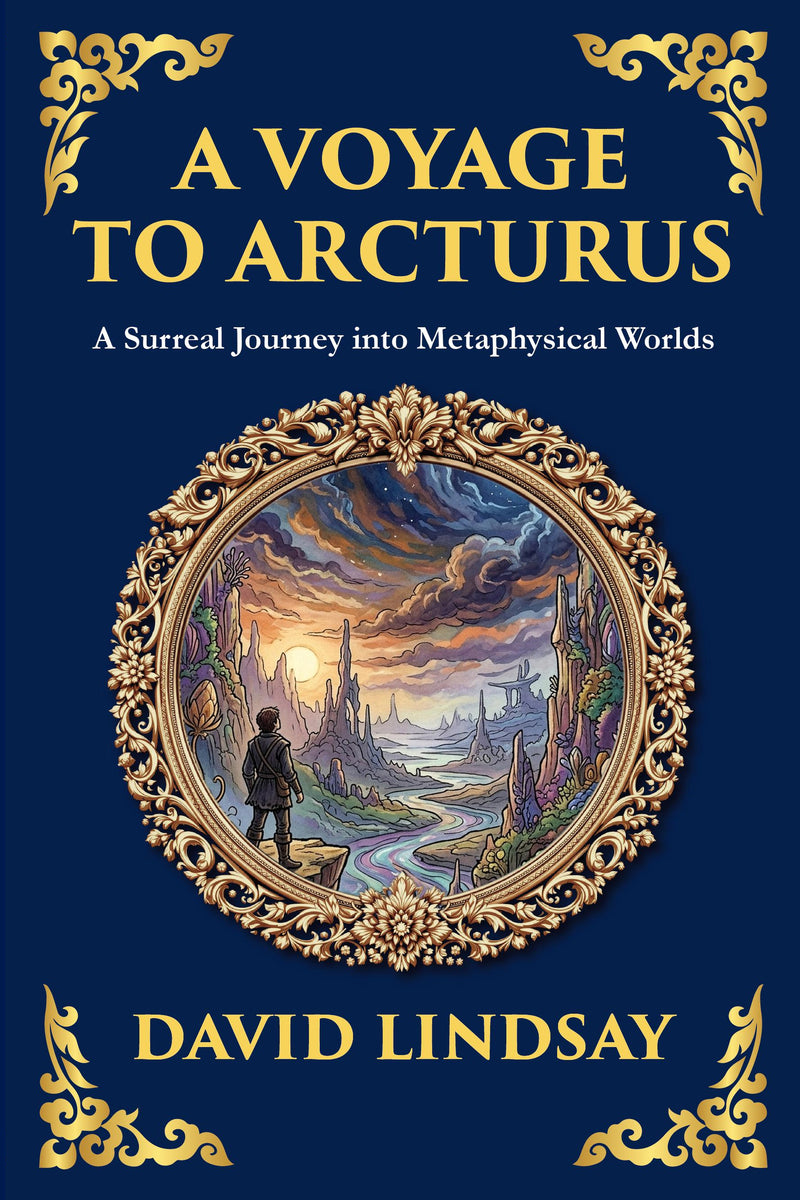
A Voyage to Arcturus
What if the journey to truth required the death of illusion? In A Voyage to Arcturus, Scottish visionary David Lindsay crafts a philosophical science fiction masterpiece unlike any other.
or free app
10,000+ hrs library
30-day guarantee
The complete A Voyage to Arcturus appears in modern English through Library of Alexandria Press, available online with audiobook narration included for members.
Have you ever wondered why we cling to illusions—even when they keep us from knowing who we really are? David Lindsay’s A Voyage to Arcturus is not just a science fiction novel—it’s an otherworldly revelation. First published in 1920 and beloved by literary icons like C.S. Lewis and J.R.R. Tolkien, this genre-defying work blends philosophical mysticism with cosmic exploration in a journey that transcends time, space, and the self.
The story follows Maskull, a restless seeker drawn to the mysterious planet Tormance, where the laws of nature are unlike anything on Earth—and where every encounter tests his identity, morality, and spirit. In this surreal and ever-shifting world, physical transformations mirror internal awakenings, and each landscape challenges Maskull’s understanding of good, evil, desire, and reality itself. As Maskull moves through the bizarre terrains of Tormance—meeting hypnotic prophets, seductive tyrants, and godlike beings—he finds that this alien planet reflects the innermost struggles of humanity.
With its bold vision and poetic depth, A Voyage to Arcturus remains one of the most profound explorations of the human condition ever written in speculative fiction.
What you’ll discover in this modern edition
- A Genre-Bending Masterpiece – A seamless blend of philosophical inquiry, fantasy, and science fiction that defies categorization.
| Formats | eBook (EPUB + PDF) · Audiobook · Paperback · Hardcover · Large Print |
| Language | English |
| Trim size (print) | 6 × 9 in |
| Binding | Paperback — perfect-bound · Hardcover — casewrap |
| Large Print edition | Same text in a larger, easy-read type — a larger font, not a larger trim |
| Print pricing | Every physical book at our true cost — at-cost, no profit (members) |
| Library | 873 restored titles, always growing |
| Length | 89,558 words · ~5 hr 58 min reading |
| Reading level | Grade 3 · an easy, flowing read (this modern-English edition) |
| Edition | Modern English translation · 2026 |
Member reviews for this edition are collected as readers finish it — be the first. Across the library: 12,000+ books shipped, every plan covered by a 365-day print guarantee.
About this edition
A faithful, unabridged modern-English edition by The Library of Alexandria — carefully rendered for today's reader and verified paragraph-by-paragraph against the public-domain source. Available as eBook, audiobook, paperback, hardcover, and large print.
- Complete & unabridgedVerified paragraph by paragraph against the source — never a scan, never abridged.
- Modern English, faithfulReadable today, with the author’s meaning kept intact. Readable — not simplified.
- Every format, one membershipRead in your browser or the free app, or listen to the full audiobook.
Included free with your membership
Cancel anytime, one click · 30-day money-back guarantee
Edition last updated July 2026
What’s inside
A Voyage to Arcturus — complete and unabridged: all 22 sections included with membership, plus the full audiobook.
Begin reading A Voyage to Arcturus
In clear modern English — the complete text is included with membership.
Introduction
There are books that entertain, books that instruct, and books that quietly rearrange the furniture of your inner life while you are not looking. A Voyage to Arcturus belongs decisively to the third category. First published in 1920 to almost total public indifference, it has since become one of the strangest and most fiercely admired works in the English language—a book that has been called a masterpiece, a failure, a revelation, and a nightmare, sometimes by the very same readers. To open it is to step off a cliff into a void that turns out to be furnished with worlds, colors that have no earthly names, organs of perception you did not know a body could possess, and questions so vast and uncomfortable that you may find yourself setting the book down simply to breathe.
This is not a comfortable read, and it was never meant to be. David Lindsay did not write to please. He wrote to wound, to provoke, to strip away the soft furnishings of conventional belief and expose something raw beneath. And yet, paradoxically, the experience of reading him is exhilarating—not despite the difficulty but because of it. There is a sense, rare in literature, of being in the presence of a writer who genuinely did not care whether you liked what he had to say, who was pursuing a private vision with a fanatic’s intensity, and who burned through the ordinary machinery of plot and character in order to reach something he believed lay underneath all of them. The result is a book that does not so much tell a story as conduct an interrogation—of the reader, of reality, of the very nature of pleasure, suffering, and meaning.
Before you begin, it is worth understanding a little of what you are walking into, and how best to walk into it. This introduction is meant to be a doorway, not a map. I will not spoil the journey for you, because the entire power of this novel depends on its capacity to disorient, to overturn your expectations chapter by chapter, to make you complicit in its discoveries. What I can do is prepare you—to set your expectations correctly, to hand you a few interpretive tools, and to assure you that the strangeness you are about to encounter is deliberate, controlled, and meaningful. If at any point you feel lost, that is not a sign that you have failed as a reader. It is, very often, exactly the response Lindsay intended.
To appreciate what A Voyage to Arcturus attempts, it helps to imagine the moment of its birth. The year is 1920. Europe is staggering out of the wreckage of the First World War, a catastrophe that had shattered the comfortable Victorian and Edwardian faith in progress, reason, and the benevolent order of things. Millions of young men had been fed into the machinery of industrial slaughter; the old certainties about God, civilization, and human nature lay in ruins. Out of this disillusionment came a generation of writers and thinkers determined to look more honestly—and more harshly—at the foundations of existence.
David Lindsay was forty-four when his first novel appeared. He had spent two decades working as an insurance clerk at Lloyd’s of London, a respectable and entirely unremarkable career that gave no outward hint of the volcanic inner world he was nurturing. He had served briefly in the war. He was, by all accounts, a private and somewhat brooding man, deeply read in philosophy and drawn especially to the bleak and bracing pessimism of Arthur Schopenhauer, the German philosopher who held that the world we perceive is a veil of illusion concealing a blind, striving Will beneath—a Will that drives all living things into endless desire, suffering, and dissatisfaction. From Schopenhauer, and from the broader currents of German Idealism and mysticism that were percolating through European intellectual life, Lindsay drew the central conviction that animates this entire book: that the world we take for real is a deception, a glittering trap, and that the true business of the spirit is to see through it.
This is a profoundly unfashionable idea, and it was unfashionable even in 1920. The reading public of the time wanted adventure stories, romances, the well-made novels of social observation. They were not clamoring for a metaphysical fable disguised as interplanetary fiction, in which the journey to another star functions as a journey into the deepest and darkest questions of philosophy. Small wonder, then, that the book sold barely a few hundred copies in Lindsay’s lifetime and that he died in 1945 in relative obscurity, his vision largely unrecognized.
And yet the book did not die with him. Word of it passed quietly from reader to reader, like a rumor of something extraordinary hidden in plain sight. The British writer and critic Colin Wilson championed it. The fantasy and science fiction communities discovered in it a strange ancestor—a work that anticipated, decades early, the philosophical and psychedelic ambitions that would later flower in the genre. C. S. Lewis confessed that A Voyage to Arcturus had been a crucial influence on his own Space Trilogy, even though he disagreed violently with its conclusions; he admired its power even as he recoiled from its philosophy. Harold Bloom, the formidable American literary critic, was so obsessed with the novel that he wrote his only work of fiction, The Flight to Lucifer, as a direct homage to it, later calling Lindsay’s book a sublime and visionary achievement.
This is the curious afterlife of a book that failed in its own moment: it became a touchstone for those who sense that ordinary fiction does not reach far enough. It is a book that creates its own readers—people who, having encountered it, are never entirely the same again, and who carry it with them like a secret. You are about to join that lineage. Whether you finish exhilarated or disturbed, persuaded or appalled, you will not finish indifferent.
It is worth dwelling for a moment on what this edition offers. A Voyage to Arcturus was written in a prose style that even its admirers concede can be stiff, archaic, and occasionally clumsy. Lindsay was a visionary, not a stylist, and the original text sometimes labors under the weight of Edwardian conventions and awkward constructions that can throw up barriers between the modern reader and the astonishing visions the book contains. This modern adaptation has been prepared with a single goal: to clear away those barriers so that the visionary content can reach you directly. The strangeness that remains—and a great deal of strangeness remains—is the intended strangeness, the strangeness that belongs to Lindsay’s imagination rather than to the accidents of his period and his prose. What you will encounter here is the dream, not the dust on the window through which the dream was first glimpsed.
How to Read a Book That Refuses to Behave
If you come to A Voyage to Arcturus expecting the satisfactions of conventional fiction, you will be bewildered—and you may give up too soon. So let me offer some guidance about what kind of book this is and how to read it on its own terms.
First: this is not, in any ordinary sense, a science fiction novel, even though it involves a voyage to a distant star and a journey across the surface of another world. The trappings of science fiction are present, but they are not the point. Lindsay was not interested in technology, in plausible extrapolation, in the mechanics of space travel or alien biology. The journey to Arcturus is a vehicle—a way of getting the protagonist (and the reader) out of the familiar world and into a landscape where the rules can be entirely rewritten. The distant planet is less a place than a state of being, a canvas on which Lindsay can paint his philosophical and spiritual concerns in their purest and most vivid form. Think of it less as Mars or Venus and more as a dreamscape, a moral allegory, a theater of the soul.
This connects to the second crucial point: the book operates by the logic of dream and allegory, not the logic of realism. As the protagonist moves across the alien landscape, he encounters a succession of beings, regions, and experiences, each of which embodies a particular philosophy of life, a particular way of relating to desire, love, power, pleasure, and pain. Each encounter is a kind of test, a temptation, a worldview presented for examination and—almost invariably—found wanting. The structure is episodic, almost like a pilgrimage or a series of moral parables strung together. Do not expect a tightly plotted narrative with foreshadowing and payoff in the conventional sense. Expect instead a sequence of confrontations, each one peeling away another layer of illusion, each one bringing the protagonist (and you) closer to whatever terrible truth lies at the center of things.
Third: pay attention to the colors. Lindsay does something extraordinary and unprecedented with sensation in this book. On the alien world, the protagonist perceives colors that do not exist on Earth—new primary colors with invented names—and he develops new bodily organs, new senses, new ways of feeling and perceiving. These are not mere decorative inventions. They are central to the book’s meaning. Lindsay is dramatizing the idea that our ordinary human perception is desperately limited, that there are whole dimensions of reality to which we are blind, and that genuine spiritual progress might require not just new ideas but entirely new faculties of perception. When you read about these strange new senses, resist the urge to dismiss them as fantasy decoration. They are clues. They are arguments made in the language of sensation rather than logic. The body in this book is constantly changing, growing and losing organs, because Lindsay believed that what we are—our very physical and perceptual constitution—is bound up with what we are able to know.
Fourth: be prepared for the book’s relentless severity toward pleasure and beauty. This is perhaps the most difficult thing for a modern reader to accept. We are accustomed to thinking of pleasure as good, of love as redemptive, of beauty as a path toward the divine. Lindsay turns all of this on its head. In his vision, the most seductive and beautiful experiences are precisely the most dangerous—because they are the most effective traps, the most cunning disguises worn by the illusion that keeps us bound to a false reality. The book treats joy, warmth, sweetness, and pleasure with deep suspicion, and it associates the true spiritual path with austerity, harshness, and a kind of merciless honesty that finds satisfaction in nothing. This will strike many readers as bleak, even cruel. But it is essential to understanding what Lindsay was trying to do. He believed that the universe contains a fundamental moral structure, and that this structure is at war with the pleasure-seeking, comfort-loving impulses of ordinary life. To read him well, you must be willing to entertain, at least provisionally, the possibility that everything you instinctively value might be a deception.
Fifth, and finally: do not look too hard for a single, settled answer. The book is a quest for ultimate truth, and it does arrive somewhere—but where it arrives is so strange, so wrenching, and so resistant to easy summary that critics have argued about its meaning for a century. Lindsay was not constructing a tidy philosophical system that can be extracted and put into a paragraph. He was dramatizing a struggle, an agonized search, a confrontation with mysteries that may not have clean solutions. The deepest pleasure of this book lies not in reaching its conclusion but in undergoing its journey—in being subjected, as the protagonist is, to a relentless series of revelations and disillusionments, until the very ground of reality seems to shift beneath your feet.
A practical word of encouragement: the opening chapters, set in our own familiar world, may feel deceptively conventional—a gathering of people, an unsettling presence, hints of the uncanny breaking into the everyday. Do not be lulled by this, and do not be impatient with it. Lindsay is establishing his baseline of reality precisely so that he can demolish it. Once the voyage begins, the book accelerates into a sustained visionary intensity that rarely lets up. Some readers find the early sections the hardest to get through; once you are on the alien world, the strange momentum of the thing tends to carry you forward. Give it time. Let it work on you.
Cancel anytime, one click · 30-day money-back guarantee
Founding annual rate available now — your price locks for life when you join.
Not ready? Get this free chapter by email — read it anytime.
✓ Sent — check your inbox for A Voyage to Arcturus.
Questions about A Voyage to Arcturus
What is A Voyage to Arcturus about?
What if the journey to truth required the death of illusion? In A Voyage to Arcturus, Scottish visionary David Lindsay crafts a philosophical science fiction masterpiece unlike any other. Blending fantastical landscapes, metaphysical battles, and spiritual transformation, this cult classic follows a traveler who leaves Earth behind to explore Tormance—a planet orbiting the distant star Arcturus—only to find that each step forward strips away another illusion of reality.
Who wrote A Voyage to Arcturus?
A Voyage to Arcturus was written by David Lindsay. This edition presents the complete work in clear modern English, faithfully rendered from the public-domain original by Library of Alexandria Press.
Is A Voyage to Arcturus free to read?
The opening chapter is free to read on this page. Members read and listen to the complete work — and the entire library — free, and can order any physical book at our true print cost.
How long is A Voyage to Arcturus?
22 chapters (~89,558 words) — about 5 hr 58 min of reading in this modern-English edition.
Is this an abridged version of A Voyage to Arcturus?
No. This is the complete, unabridged A Voyage to Arcturus, carefully rendered into clear modern English and verified paragraph-by-paragraph against the public-domain source — nothing is cut or summarised.
What formats does A Voyage to Arcturus come in?
A Voyage to Arcturus is available as eBook, paperback, hardcover and large print. eBook and audiobook are included with membership; printed editions ship at our true print cost.
Shipping & returns
Billing & membership
More from the library


Explore Science Fiction
- The Island of Doctor Moreau · H. G. Wells
- A Midsummer Night’s Dream · William Shakespeare
- The Invisible Man: A Grotesque Romance · H. G. Wells
- The War of the Worlds · H. G. Wells
- The Strange Case of Dr. Jekyll and Mr. Hyde · Robert Louis Stevenson
- Limanora: the island of progress · Godfrey Sweven
- The Book of Dragons · E. Nesbit
- She · H. Rider Haggard
- Dorothy and the Wizard in Oz · L. Frank Baum
- The Princess and the Goblin · George MacDonald
- Gawayne and the Green Knight: A Fairy Tale · Charlton M. Lewis
- Lucian’s True History · Lucian of Samosata
- The Willows · Algernon Blackwood
- The Call of Cthulhu · H. P. Lovecraft
- The Life-Eater · Harold Ward
- The Marvelous Land of Oz · L. Frank Baum
- Mars is My Destination · Frank Belknap Long
- The Black Kiss
- The Beasts in the Void · Paul W. Fairman
- John Jones’s Dollar · Harry Stephen Keeler
- Subversive · Mack Reynolds
- The Mississippi Saucer · Frank Belknap Long
- Man of Distinction · Michael Shaara
- Spawn of the Comet · H. Thompson Rich
- The Golden Judge · Nathaniel Gordon
- Final Weapon · Everett B. Cole
- The Big Fix · George O. Smith
- Last Enemy · H. Beam Piper
- Time and Time Again · H. Beam Piper
- Sabotage in Space · Carey Rockwell
A Voyage to Arcturus
A Voyage to Arcturus
A Surreal Journey into Metaphysical Worlds
David Lindsay
Contents
- Introduction
- Chapter 1
- Chapter 2
- Chapter 3
- Chapter 4
- Chapter 5
- Chapter 6
- Chapter 7
- Chapter 8
- Chapter 9
- Chapter 10
- Chapter 11
- Chapter 12
- Chapter 13
- Chapter 14
- Chapter 15
- Chapter 16
- Chapter 17
- Chapter 18
- Chapter 19
- Chapter 20
- Chapter 21
Introduction
There are books that entertain, books that instruct, and books that quietly rearrange the furniture of your inner life while you are not looking. A Voyage to Arcturus belongs decisively to the third category. First published in 1920 to almost total public indifference, it has since become one of the strangest and most fiercely admired works in the English language—a book that has been called a masterpiece, a failure, a revelation, and a nightmare, sometimes by the very same readers. To open it is to step off a cliff into a void that turns out to be furnished with worlds, colors that have no earthly names, organs of perception you did not know a body could possess, and questions so vast and uncomfortable that you may find yourself setting the book down simply to breathe.
This is not a comfortable read, and it was never meant to be. David Lindsay did not write to please. He wrote to wound, to provoke, to strip away the soft furnishings of conventional belief and expose something raw beneath. And yet, paradoxically, the experience of reading him is exhilarating—not despite the difficulty but because of it. There is a sense, rare in literature, of being in the presence of a writer who genuinely did not care whether you liked what he had to say, who was pursuing a private vision with a fanatic’s intensity, and who burned through the ordinary machinery of plot and character in order to reach something he believed lay underneath all of them. The result is a book that does not so much tell a story as conduct an interrogation—of the reader, of reality, of the very nature of pleasure, suffering, and meaning.
Before you begin, it is worth understanding a little of what you are walking into, and how best to walk into it. This introduction is meant to be a doorway, not a map. I will not spoil the journey for you, because the entire power of this novel depends on its capacity to disorient, to overturn your expectations chapter by chapter, to make you complicit in its discoveries. What I can do is prepare you—to set your expectations correctly, to hand you a few interpretive tools, and to assure you that the strangeness you are about to encounter is deliberate, controlled, and meaningful. If at any point you feel lost, that is not a sign that you have failed as a reader. It is, very often, exactly the response Lindsay intended.
To appreciate what A Voyage to Arcturus attempts, it helps to imagine the moment of its birth. The year is 1920. Europe is staggering out of the wreckage of the First World War, a catastrophe that had shattered the comfortable Victorian and Edwardian faith in progress, reason, and the benevolent order of things. Millions of young men had been fed into the machinery of industrial slaughter; the old certainties about God, civilization, and human nature lay in ruins. Out of this disillusionment came a generation of writers and thinkers determined to look more honestly—and more harshly—at the foundations of existence.
David Lindsay was forty-four when his first novel appeared. He had spent two decades working as an insurance clerk at Lloyd’s of London, a respectable and entirely unremarkable career that gave no outward hint of the volcanic inner world he was nurturing. He had served briefly in the war. He was, by all accounts, a private and somewhat brooding man, deeply read in philosophy and drawn especially to the bleak and bracing pessimism of Arthur Schopenhauer, the German philosopher who held that the world we perceive is a veil of illusion concealing a blind, striving Will beneath—a Will that drives all living things into endless desire, suffering, and dissatisfaction. From Schopenhauer, and from the broader currents of German Idealism and mysticism that were percolating through European intellectual life, Lindsay drew the central conviction that animates this entire book: that the world we take for real is a deception, a glittering trap, and that the true business of the spirit is to see through it.
This is a profoundly unfashionable idea, and it was unfashionable even in 1920. The reading public of the time wanted adventure stories, romances, the well-made novels of social observation. They were not clamoring for a metaphysical fable disguised as interplanetary fiction, in which the journey to another star functions as a journey into the deepest and darkest questions of philosophy. Small wonder, then, that the book sold barely a few hundred copies in Lindsay’s lifetime and that he died in 1945 in relative obscurity, his vision largely unrecognized.
And yet the book did not die with him. Word of it passed quietly from reader to reader, like a rumor of something extraordinary hidden in plain sight. The British writer and critic Colin Wilson championed it. The fantasy and science fiction communities discovered in it a strange ancestor—a work that anticipated, decades early, the philosophical and psychedelic ambitions that would later flower in the genre. C. S. Lewis confessed that A Voyage to Arcturus had been a crucial influence on his own Space Trilogy, even though he disagreed violently with its conclusions; he admired its power even as he recoiled from its philosophy. Harold Bloom, the formidable American literary critic, was so obsessed with the novel that he wrote his only work of fiction, The Flight to Lucifer, as a direct homage to it, later calling Lindsay’s book a sublime and visionary achievement.
This is the curious afterlife of a book that failed in its own moment: it became a touchstone for those who sense that ordinary fiction does not reach far enough. It is a book that creates its own readers—people who, having encountered it, are never entirely the same again, and who carry it with them like a secret. You are about to join that lineage. Whether you finish exhilarated or disturbed, persuaded or appalled, you will not finish indifferent.
It is worth dwelling for a moment on what this edition offers. A Voyage to Arcturus was written in a prose style that even its admirers concede can be stiff, archaic, and occasionally clumsy. Lindsay was a visionary, not a stylist, and the original text sometimes labors under the weight of Edwardian conventions and awkward constructions that can throw up barriers between the modern reader and the astonishing visions the book contains. This modern adaptation has been prepared with a single goal: to clear away those barriers so that the visionary content can reach you directly. The strangeness that remains—and a great deal of strangeness remains—is the intended strangeness, the strangeness that belongs to Lindsay’s imagination rather than to the accidents of his period and his prose. What you will encounter here is the dream, not the dust on the window through which the dream was first glimpsed.
How to Read a Book That Refuses to Behave
If you come to A Voyage to Arcturus expecting the satisfactions of conventional fiction, you will be bewildered—and you may give up too soon. So let me offer some guidance about what kind of book this is and how to read it on its own terms.
First: this is not, in any ordinary sense, a science fiction novel, even though it involves a voyage to a distant star and a journey across the surface of another world. The trappings of science fiction are present, but they are not the point. Lindsay was not interested in technology, in plausible extrapolation, in the mechanics of space travel or alien biology. The journey to Arcturus is a vehicle—a way of getting the protagonist (and the reader) out of the familiar world and into a landscape where the rules can be entirely rewritten. The distant planet is less a place than a state of being, a canvas on which Lindsay can paint his philosophical and spiritual concerns in their purest and most vivid form. Think of it less as Mars or Venus and more as a dreamscape, a moral allegory, a theater of the soul.
This connects to the second crucial point: the book operates by the logic of dream and allegory, not the logic of realism. As the protagonist moves across the alien landscape, he encounters a succession of beings, regions, and experiences, each of which embodies a particular philosophy of life, a particular way of relating to desire, love, power, pleasure, and pain. Each encounter is a kind of test, a temptation, a worldview presented for examination and—almost invariably—found wanting. The structure is episodic, almost like a pilgrimage or a series of moral parables strung together. Do not expect a tightly plotted narrative with foreshadowing and payoff in the conventional sense. Expect instead a sequence of confrontations, each one peeling away another layer of illusion, each one bringing the protagonist (and you) closer to whatever terrible truth lies at the center of things.
Third: pay attention to the colors. Lindsay does something extraordinary and unprecedented with sensation in this book. On the alien world, the protagonist perceives colors that do not exist on Earth—new primary colors with invented names—and he develops new bodily organs, new senses, new ways of feeling and perceiving. These are not mere decorative inventions. They are central to the book’s meaning. Lindsay is dramatizing the idea that our ordinary human perception is desperately limited, that there are whole dimensions of reality to which we are blind, and that genuine spiritual progress might require not just new ideas but entirely new faculties of perception. When you read about these strange new senses, resist the urge to dismiss them as fantasy decoration. They are clues. They are arguments made in the language of sensation rather than logic. The body in this book is constantly changing, growing and losing organs, because Lindsay believed that what we are—our very physical and perceptual constitution—is bound up with what we are able to know.
Fourth: be prepared for the book’s relentless severity toward pleasure and beauty. This is perhaps the most difficult thing for a modern reader to accept. We are accustomed to thinking of pleasure as good, of love as redemptive, of beauty as a path toward the divine. Lindsay turns all of this on its head. In his vision, the most seductive and beautiful experiences are precisely the most dangerous—because they are the most effective traps, the most cunning disguises worn by the illusion that keeps us bound to a false reality. The book treats joy, warmth, sweetness, and pleasure with deep suspicion, and it associates the true spiritual path with austerity, harshness, and a kind of merciless honesty that finds satisfaction in nothing. This will strike many readers as bleak, even cruel. But it is essential to understanding what Lindsay was trying to do. He believed that the universe contains a fundamental moral structure, and that this structure is at war with the pleasure-seeking, comfort-loving impulses of ordinary life. To read him well, you must be willing to entertain, at least provisionally, the possibility that everything you instinctively value might be a deception.
Fifth, and finally: do not look too hard for a single, settled answer. The book is a quest for ultimate truth, and it does arrive somewhere—but where it arrives is so strange, so wrenching, and so resistant to easy summary that critics have argued about its meaning for a century. Lindsay was not constructing a tidy philosophical system that can be extracted and put into a paragraph. He was dramatizing a struggle, an agonized search, a confrontation with mysteries that may not have clean solutions. The deepest pleasure of this book lies not in reaching its conclusion but in undergoing its journey—in being subjected, as the protagonist is, to a relentless series of revelations and disillusionments, until the very ground of reality seems to shift beneath your feet.
A practical word of encouragement: the opening chapters, set in our own familiar world, may feel deceptively conventional—a gathering of people, an unsettling presence, hints of the uncanny breaking into the everyday. Do not be lulled by this, and do not be impatient with it. Lindsay is establishing his baseline of reality precisely so that he can demolish it. Once the voyage begins, the book accelerates into a sustained visionary intensity that rarely lets up. Some readers find the early sections the hardest to get through; once you are on the alien world, the strange momentum of the thing tends to carry you forward. Give it time. Let it work on you.
At eight o’clock on a March evening, Backhouse, a medium and rising star in the psychic world, was shown into the study at Prolands, the Hampstead home of Montague Faull. The only light in the room came from a roaring fire. The host looked at him with lazy curiosity, stood up, and they exchanged the usual polite greetings. After pointing out a comfortable chair by the fire for his guest, the South American merchant sank back into his own. He switched on the electric light. Faull had sharp, prominent features and skin that looked almost metallic; he seemed generally bored and indifferent. This didn’t seem to faze the medium, who was used to analyzing people from a unique perspective. To the merchant, however, Backhouse was a curiosity. As Faull studied him calmly through half-closed eyes and a cloud of cigar smoke, he wondered how this short, stocky man with the pointed beard managed to look so fresh and sane, given the morbid nature of his work.
“Do you smoke?” Faull drawled, trying to start a conversation. “No? Then would you like a drink?”
“Is everything ready? Will the materialization happen?”
“That’s good; I wouldn’t want my guests to be disappointed. I have your check ready in my pocket.”
The conversation continued to stall. Faull sprawled in his chair, looking completely indifferent.
“Would you like to hear about the arrangements I’ve made?”
“I’m not aware that any are necessary, other than chairs for your guests.”
“I mean the decorations for the séance room, the music, and things like that.”
Backhouse stared at him. “But this isn’t a theater performance.”
“That’s true. Perhaps I should explain... there will be women present, and women, as you know, appreciate the aesthetics.”
End of the free sample
Keep reading, free
Members read and listen to the complete book — and the entire library. Cancel anytime, one click · 30-day money-back guarantee.