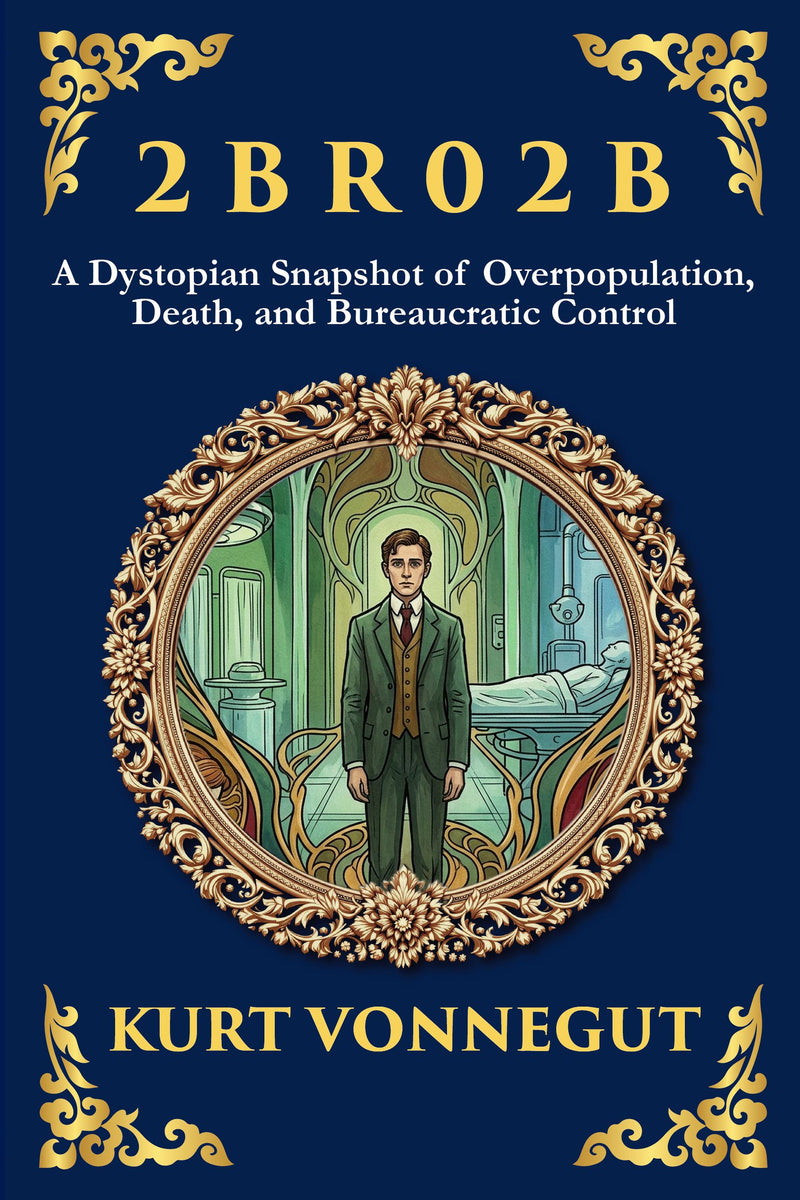
2 B R 0 2 B
In a future where death is the price of life, the world has achieved perfect equilibrium—but at what moral cost? In 2 B R 0 2 B, Kurt Vonnegut delivers a razor-sharp and chilling satire of society’s obsession with control, efficiency, and balance.
or free app
10,000+ hrs library
30-day guarantee
The complete 2 B R 0 2 B appears in modern English through Library of Alexandria Press, available online with audiobook narration included for members.
Have you ever wondered why utopias often require the death of our humanity? Welcome to the year when all problems have been “solved”—except the most vital one: the soul. In 2 B R 0 2 B, Kurt Vonnegut imagines a sterile future where every birth must be offset by a voluntary death.
There is no war, no hunger, no crime. Yet human freedom has been replaced by numbers, paperwork, and a surreal acceptance of state-administered euthanasia. The story centers on Edward Wehling Jr., a man waiting in a hospital for his wife to give birth to triplets.
There’s just one catch—he only has one volunteer lined up to die. Caught between love, despair, and the chilling logic of bureaucracy, he must decide what he's willing to sacrifice for a future that no longer values life as a miracle, but as a quota. Vonnegut’s piercing satire exposes the dehumanizing effect of rigid systems and questions what happens when our ethics become as automated as our institutions.
What you’ll discover in this modern edition
- A Satirical Dystopia Like No Other – A glimpse into a world where government control reaches into the womb and the grave.
- A Chilling Vision of Population Control – Explore a society where life and death are managed by a bureaucratic death toll hotline.
- The Absurdity of Utopian Logic – Vonnegut brilliantly twists perfection into something grotesque and tragically comic.
- A Philosophical Examination of Sacrifice and Sanity – When choice becomes ritual, is there still meaning in it?
- A Compact Story with Immense Depth – A thought-provoking read that punches far above its word count. Originally published in 1962, 2 B R 0 2 B remains one of Kurt Vonnegut’s most prophetic and unsettling visions of the future.
| Formats | eBook (EPUB + PDF) · Audiobook · Paperback · Hardcover · Large Print |
| Language | English |
| Trim size (print) | 6 × 9 in |
| Binding | Paperback — perfect-bound · Hardcover — casewrap |
| Large Print edition | Same text in a larger, easy-read type — a larger font, not a larger trim |
| Print pricing | Every physical book at our true cost — at-cost, no profit (members) |
| Library | 873 restored titles, always growing |
| Length | 5,904 words · ~24 min reading |
| Reading level | Grade 9 · a comfortable read (this modern-English edition) |
| Edition | Modern English translation · 2026 |
Member reviews for this edition are collected as readers finish it — be the first. Across the library: 12,000+ books shipped, every plan covered by a 365-day print guarantee.
About this edition
A faithful, unabridged modern-English edition by The Library of Alexandria — carefully rendered for today's reader and verified paragraph-by-paragraph against the public-domain source. Available as eBook, audiobook, paperback, hardcover, and large print.
- Complete & unabridgedVerified paragraph by paragraph against the source — never a scan, never abridged.
- Modern English, faithfulReadable today, with the author’s meaning kept intact. Readable — not simplified.
- Every format, one membershipRead in your browser or the free app, or listen to the full audiobook.
Included free with your membership
Cancel anytime, one click · 30-day money-back guarantee
Edition last updated July 2026
What’s inside
2 B R 0 2 B — complete and unabridged, included in full with membership, plus the full audiobook.
Begin reading 2 B R 0 2 B
In clear modern English — the complete text is included with membership.
Introduction
There are stories that announce themselves with thunder, and there are stories that slip in quietly, smiling, offering you a chair and a cup of coffee before they cut you to the bone. The work you are about to read belongs firmly to the second category. It is short—deceptively, almost mischievously so—and yet within its brief span it carries the weight of one of the largest questions a human being can ask: what does it cost to live, and who decides the price? Few writers have ever been able to fold such enormous concerns into so compact a form, and fewer still have done it with the sly, deadpan wit that makes the reading feel less like a lecture and more like a conversation with a very clever friend who happens to be telling you the truth while pretending to make a joke.
This particular tale comes to us from a writer whose voice is among the most distinctive in all of twentieth-century literature. He wrote about machines and humans, about war and peace, about death and the absurd dignity of trying to be decent in an indifferent universe—and he did all of it with a clarity so plain it can fool you into thinking it is simple. It is not simple. Beneath the casual surface lies a mind that had seen the worst of what people can do to one another and had decided, against all evidence, that the only sane response was to keep laughing, keep questioning, and keep insisting that kindness matters even when nothing else seems to. That insistence runs through everything he produced, and it pulses quietly at the heart of this small, sharp story.
A Brief Word on the Strange and Wonderful Title
Let us begin with the curious arrangement of characters that sits atop this work, because it is the first puzzle the reader encounters and the first invitation into the book’s particular sense of humor. The title is not a typo, not a glitch, and not an attempt to be obscure for the sake of obscurity. It is, in fact, a phone number, rendered in the old style where letters and numbers shared the same buttons on a telephone dial. Read it aloud the way it was meant to be read, and the digits and letters resolve into one of the most famous lines in the English language—a question of being or not being, of existence weighed against the alternative.
The cleverness of this device is worth pausing over, because it tells you almost everything about the author’s method before you have read a single page of the story proper. Here is a man who takes the grandest, most solemn question in all of Western literature—the meditation on suicide and mortality that has echoed through four centuries of theater, philosophy, and casual quotation—and reduces it to something you might find printed on a phone bill. He drains the grandeur out of it, replaces the velvet and candlelight of the stage with the fluorescent hum of an institution, and in doing so makes the question somehow more urgent rather than less. Strip away the poetry, the author seems to suggest, and you are left with the raw transaction: to be, or not to be, dial accordingly.
This is the kind of move that defines the work as a whole. The author has a genius for taking the loftiest human concerns and setting them down in the most mundane, bureaucratic, paperwork-stained surroundings imaginable. He understood, perhaps better than any writer of his era, that the truly terrifying things in modern life rarely arrive draped in melodrama. They arrive in waiting rooms. They arrive with friendly receptionists and pleasant background music and a polite functionary explaining the procedures. The horror, when it comes, comes administratively. And so the title itself is a small overture, preparing you for a story in which the most profound matters of life and death are handled with the same casual efficiency as renewing a driver’s license.
Once you grasp the joke embedded in those few characters, you will find yourself in the proper frame of mind to receive everything that follows. You will be ready to laugh and wince in the same breath, to recognize the comedy and the tragedy as two faces of a single coin, and to appreciate the way this author can make you feel the chill of an entire civilization’s choices in the space of a single overheard remark.
The World This Story Imagines, and the Mind Behind It
Without revealing the turns and surprises that give the narrative its punch—for those deserve to be discovered fresh, in the order the author intended—it is fair and useful to describe the territory in which this story unfolds. We are placed in a future, though not a future of gleaming spires and impossible technologies for their own sake. The author was never much interested in gadgets as spectacle. What fascinated him was the human consequence of any given arrangement, the way a single decision made at the level of society could ripple down into the smallest gestures of ordinary people going about their day.
The premise that organizes this future is a question that haunted thinkers throughout the twentieth century and continues, in altered forms, to haunt us now: what happens when a species solves the problems that once kept it in check? Disease, aging, scarcity—imagine these conquered, or nearly so. Imagine a world in which the great enemies of human longevity have been defeated, in which the natural limits on a human lifespan have been pushed back so far that they have, for practical purposes, dissolved. It sounds like paradise. It sounds like the fulfillment of every prayer ever offered against the cruelty of mortality. And then comes the obvious, awful complication: if no one leaves, and people keep arriving, where does everyone go?
This is the engine of the story’s world, and the author handles it with characteristic economy. He does not deliver pages of exposition or scientific justification. He simply sketches the situation in a few strokes and trusts the reader to feel the implications crowding in. A society that has cured death must, by some cold arithmetic, find another way to make room. And the solution this particular society has arrived at is the dark center around which everything else orbits—a solution rendered all the more disturbing by how reasonable, how orderly, how procedurally tidy it has been made to seem.
To understand why the author was drawn to this kind of scenario, it helps to know a little about the experiences that shaped him. He came of age in a century that had witnessed industrialized slaughter on a scale that previous generations could scarcely have imagined. He had personally survived one of the most devastating events of a world war, sheltered underground while a city burned above him, emerging to confront the wreckage and the unanswerable question of how human beings could do such things to one another. That experience never left him. It seeped into all his work, lending even his lightest comedies a substrata of grief, an awareness that the universe is enormous and indifferent and that human suffering, however vast, often goes unremarked.
What he took from that horror was not despair, exactly, but a kind of clear-eyed tenderness. He refused to pretend the world was kind, but he also refused to surrender the conviction that human beings ought to be kind to one another, that this was the one redemptive thing available to us in a cosmos that offered no guarantees. This tension—between bleakness and compassion, between the recognition of cruelty and the insistence on gentleness—is the moral oxygen of everything he wrote, and you will feel it breathing through this story as surely as through his longer and more famous works.
The future imagined here is, in this sense, a thought experiment with a moral edge. It asks: when we engineer our way out of one form of suffering, what new forms do we invent? When we hand over the most intimate decisions of life and death to systems, institutions, and the soothing logic of public policy, what happens to the individual human soul caught in the machinery? These are not abstract questions for the author. They are the questions of his entire life, distilled here into a parable so concentrated that it can be read in a single sitting and yet pondered for years afterward.
It is worth dwelling, too, on the particular flavor of the author’s prose, because the experience of reading him is unlike the experience of reading almost anyone else. His sentences are short. His vocabulary is plain. He distrusted ornament and grandiosity, having seen too clearly how easily fine language could be marshaled to dress up monstrous deeds. Instead, he wrote in a voice that feels almost childlike in its directness—and that directness is itself a weapon. When you state the most appalling things in the simplest possible words, you remove the cushion that elaborate language provides. You force the reader to confront the bare fact without the comfort of decoration. This is a technique he deployed throughout his career, and in a story this short, the effect is intensified to an almost surgical precision. Every word counts. Nothing is wasted. The plainness of the telling is exactly what makes the underlying horror land with such force.
And yet—and this is the crucial thing—he is funny. Genuinely, reliably, surprisingly funny, even when, perhaps especially when, the subject matter is at its grimmest. He had a gift for the absurd detail, the deflating aside, the gentle mockery of institutions and the people who run them. He understood that laughter and dread are close cousins, that the same situations which make us want to weep can, viewed from a slightly different angle, make us want to laugh. He never let one cancel out the other. He held them in balance, and that balance is one of the great pleasures of his work. As you read, you will likely find yourself smiling at a turn of phrase even as the implications of what you are reading settle coldly into your stomach. That dissonance is intentional. It is, in fact, the whole point.
The bureaucratic texture of this story deserves special mention, because it is here that the author’s vision feels most prophetic. He was writing in an age that was beginning to grapple with the rise of vast, impersonal systems—governments, corporations, institutions that processed human beings as data points rather than as individuals. He saw how such systems could commit terrible acts while everyone involved felt blameless, because each individual was merely following a procedure, filling out a form, doing their assigned job. No single person needed to feel responsible, because responsibility had been distributed so thinly across the machine that it evaporated entirely. This is one of the most quietly chilling insights in all of his fiction, and it animates this story from beginning to end. The future he depicts is frightening not because it is run by villains, but because it is run by ordinary, pleasant people who have simply accepted the logic of their situation and learned to administer it cheerfully.
How to Read This Book, and Why It Still Matters
This edition has been prepared as a modern translation, adapted for the contemporary reader, and a word about what that means may be helpful as you begin. The author wrote in a particular moment, with the idioms, references, and rhythms of his time. The aim of this presentation is to keep faith entirely with his meaning, his wit, and his moral seriousness while smoothing away any small obstacles that the passage of decades may have placed between his words and your understanding. Nothing essential has been altered. The story’s shape, its surprises, its sting—all remain intact. What has been adjusted is only the occasional phrasing or reference that might have caused a momentary stumble, so that the experience flows as cleanly for you as it did for the readers who first encountered it. The goal throughout has been to let the author’s voice come through with maximum clarity, so that what you hear is, as nearly as possible, exactly what he intended you to hear.
As for how to approach the reading itself: I would gently encourage you to resist the temptation to rush, despite the brevity of the piece. Because it is so short, there is a danger of treating it as a trifle, a quick diversion to be consumed and forgotten. That would be a mistake. The best way to honor a work like this is to read it slowly, to let each scene register fully before moving to the next, and to pay attention to the small details that the author plants along the way. He was an economical writer, which means that almost nothing is incidental. A passing description, a snatch of dialogue, an object mentioned in passing—these things tend to matter. They are placed deliberately, and they reward the attentive reader who notices how they fit together.
Cancel anytime, one click · 30-day money-back guarantee
Founding annual rate available now — your price locks for life when you join.
Not ready? Get this free chapter by email — read it anytime.
✓ Sent — check your inbox for 2 B R 0 2 B.
Questions about 2 B R 0 2 B
What is 2 B R 0 2 B about?
In a future where death is the price of life, the world has achieved perfect equilibrium—but at what moral cost? In 2 B R 0 2 B, Kurt Vonnegut delivers a razor-sharp and chilling satire of society’s obsession with control, efficiency, and balance. When population growth is outlawed, and a phone call to the Federal Bureau of Termination is required for new life to begin, what does it mean to be human?
Who wrote 2 B R 0 2 B?
2 B R 0 2 B was written by Kurt Vonnegut. This edition presents the complete work in clear modern English, faithfully rendered from the public-domain original by Library of Alexandria Press.
Is 2 B R 0 2 B free to read?
The opening chapter is free to read on this page. Members read and listen to the complete work — and the entire library — free, and can order any physical book at our true print cost.
How long is 2 B R 0 2 B?
2 chapters (~5,904 words) — about 24 min of reading in this modern-English edition.
Is this an abridged version of 2 B R 0 2 B?
No. This is the complete, unabridged 2 B R 0 2 B, carefully rendered into clear modern English and verified paragraph-by-paragraph against the public-domain source — nothing is cut or summarised.
What formats does 2 B R 0 2 B come in?
2 B R 0 2 B is available as eBook, paperback, hardcover and large print. eBook and audiobook are included with membership; printed editions ship at our true print cost.
Shipping & returns
Billing & membership
More from the library


Explore Science Fiction
- The Island of Doctor Moreau · H. G. Wells
- A Midsummer Night’s Dream · William Shakespeare
- The Invisible Man: A Grotesque Romance · H. G. Wells
- The War of the Worlds · H. G. Wells
- The Strange Case of Dr. Jekyll and Mr. Hyde · Robert Louis Stevenson
- Limanora: the island of progress · Godfrey Sweven
- The Book of Dragons · E. Nesbit
- She · H. Rider Haggard
- Dorothy and the Wizard in Oz · L. Frank Baum
- The Princess and the Goblin · George MacDonald
- Gawayne and the Green Knight: A Fairy Tale · Charlton M. Lewis
- Lucian’s True History · Lucian of Samosata
- The Willows · Algernon Blackwood
- The Call of Cthulhu · H. P. Lovecraft
- The Life-Eater · Harold Ward
- The Marvelous Land of Oz · L. Frank Baum
- Mars is My Destination · Frank Belknap Long
- The Black Kiss
- The Beasts in the Void · Paul W. Fairman
- John Jones’s Dollar · Harry Stephen Keeler
- Subversive · Mack Reynolds
- The Mississippi Saucer · Frank Belknap Long
- Man of Distinction · Michael Shaara
- Spawn of the Comet · H. Thompson Rich
- The Golden Judge · Nathaniel Gordon
- Final Weapon · Everett B. Cole
- The Big Fix · George O. Smith
- Last Enemy · H. Beam Piper
- Time and Time Again · H. Beam Piper
- Sabotage in Space · Carey Rockwell
2 B R 0 2 B
2 B R 0 2 B
A Dystopian Snapshot of Overpopulation, Death, and Bureaucratic Control
Kurt Vonnegut
Contents
- Introduction
- 2 B R 0 2 B
Introduction
There are stories that announce themselves with thunder, and there are stories that slip in quietly, smiling, offering you a chair and a cup of coffee before they cut you to the bone. The work you are about to read belongs firmly to the second category. It is short—deceptively, almost mischievously so—and yet within its brief span it carries the weight of one of the largest questions a human being can ask: what does it cost to live, and who decides the price? Few writers have ever been able to fold such enormous concerns into so compact a form, and fewer still have done it with the sly, deadpan wit that makes the reading feel less like a lecture and more like a conversation with a very clever friend who happens to be telling you the truth while pretending to make a joke.
This particular tale comes to us from a writer whose voice is among the most distinctive in all of twentieth-century literature. He wrote about machines and humans, about war and peace, about death and the absurd dignity of trying to be decent in an indifferent universe—and he did all of it with a clarity so plain it can fool you into thinking it is simple. It is not simple. Beneath the casual surface lies a mind that had seen the worst of what people can do to one another and had decided, against all evidence, that the only sane response was to keep laughing, keep questioning, and keep insisting that kindness matters even when nothing else seems to. That insistence runs through everything he produced, and it pulses quietly at the heart of this small, sharp story.
A Brief Word on the Strange and Wonderful Title
Let us begin with the curious arrangement of characters that sits atop this work, because it is the first puzzle the reader encounters and the first invitation into the book’s particular sense of humor. The title is not a typo, not a glitch, and not an attempt to be obscure for the sake of obscurity. It is, in fact, a phone number, rendered in the old style where letters and numbers shared the same buttons on a telephone dial. Read it aloud the way it was meant to be read, and the digits and letters resolve into one of the most famous lines in the English language—a question of being or not being, of existence weighed against the alternative.
The cleverness of this device is worth pausing over, because it tells you almost everything about the author’s method before you have read a single page of the story proper. Here is a man who takes the grandest, most solemn question in all of Western literature—the meditation on suicide and mortality that has echoed through four centuries of theater, philosophy, and casual quotation—and reduces it to something you might find printed on a phone bill. He drains the grandeur out of it, replaces the velvet and candlelight of the stage with the fluorescent hum of an institution, and in doing so makes the question somehow more urgent rather than less. Strip away the poetry, the author seems to suggest, and you are left with the raw transaction: to be, or not to be, dial accordingly.
This is the kind of move that defines the work as a whole. The author has a genius for taking the loftiest human concerns and setting them down in the most mundane, bureaucratic, paperwork-stained surroundings imaginable. He understood, perhaps better than any writer of his era, that the truly terrifying things in modern life rarely arrive draped in melodrama. They arrive in waiting rooms. They arrive with friendly receptionists and pleasant background music and a polite functionary explaining the procedures. The horror, when it comes, comes administratively. And so the title itself is a small overture, preparing you for a story in which the most profound matters of life and death are handled with the same casual efficiency as renewing a driver’s license.
Once you grasp the joke embedded in those few characters, you will find yourself in the proper frame of mind to receive everything that follows. You will be ready to laugh and wince in the same breath, to recognize the comedy and the tragedy as two faces of a single coin, and to appreciate the way this author can make you feel the chill of an entire civilization’s choices in the space of a single overheard remark.
The World This Story Imagines, and the Mind Behind It
Without revealing the turns and surprises that give the narrative its punch—for those deserve to be discovered fresh, in the order the author intended—it is fair and useful to describe the territory in which this story unfolds. We are placed in a future, though not a future of gleaming spires and impossible technologies for their own sake. The author was never much interested in gadgets as spectacle. What fascinated him was the human consequence of any given arrangement, the way a single decision made at the level of society could ripple down into the smallest gestures of ordinary people going about their day.
The premise that organizes this future is a question that haunted thinkers throughout the twentieth century and continues, in altered forms, to haunt us now: what happens when a species solves the problems that once kept it in check? Disease, aging, scarcity—imagine these conquered, or nearly so. Imagine a world in which the great enemies of human longevity have been defeated, in which the natural limits on a human lifespan have been pushed back so far that they have, for practical purposes, dissolved. It sounds like paradise. It sounds like the fulfillment of every prayer ever offered against the cruelty of mortality. And then comes the obvious, awful complication: if no one leaves, and people keep arriving, where does everyone go?
This is the engine of the story’s world, and the author handles it with characteristic economy. He does not deliver pages of exposition or scientific justification. He simply sketches the situation in a few strokes and trusts the reader to feel the implications crowding in. A society that has cured death must, by some cold arithmetic, find another way to make room. And the solution this particular society has arrived at is the dark center around which everything else orbits—a solution rendered all the more disturbing by how reasonable, how orderly, how procedurally tidy it has been made to seem.
To understand why the author was drawn to this kind of scenario, it helps to know a little about the experiences that shaped him. He came of age in a century that had witnessed industrialized slaughter on a scale that previous generations could scarcely have imagined. He had personally survived one of the most devastating events of a world war, sheltered underground while a city burned above him, emerging to confront the wreckage and the unanswerable question of how human beings could do such things to one another. That experience never left him. It seeped into all his work, lending even his lightest comedies a substrata of grief, an awareness that the universe is enormous and indifferent and that human suffering, however vast, often goes unremarked.
What he took from that horror was not despair, exactly, but a kind of clear-eyed tenderness. He refused to pretend the world was kind, but he also refused to surrender the conviction that human beings ought to be kind to one another, that this was the one redemptive thing available to us in a cosmos that offered no guarantees. This tension—between bleakness and compassion, between the recognition of cruelty and the insistence on gentleness—is the moral oxygen of everything he wrote, and you will feel it breathing through this story as surely as through his longer and more famous works.
The future imagined here is, in this sense, a thought experiment with a moral edge. It asks: when we engineer our way out of one form of suffering, what new forms do we invent? When we hand over the most intimate decisions of life and death to systems, institutions, and the soothing logic of public policy, what happens to the individual human soul caught in the machinery? These are not abstract questions for the author. They are the questions of his entire life, distilled here into a parable so concentrated that it can be read in a single sitting and yet pondered for years afterward.
It is worth dwelling, too, on the particular flavor of the author’s prose, because the experience of reading him is unlike the experience of reading almost anyone else. His sentences are short. His vocabulary is plain. He distrusted ornament and grandiosity, having seen too clearly how easily fine language could be marshaled to dress up monstrous deeds. Instead, he wrote in a voice that feels almost childlike in its directness—and that directness is itself a weapon. When you state the most appalling things in the simplest possible words, you remove the cushion that elaborate language provides. You force the reader to confront the bare fact without the comfort of decoration. This is a technique he deployed throughout his career, and in a story this short, the effect is intensified to an almost surgical precision. Every word counts. Nothing is wasted. The plainness of the telling is exactly what makes the underlying horror land with such force.
And yet—and this is the crucial thing—he is funny. Genuinely, reliably, surprisingly funny, even when, perhaps especially when, the subject matter is at its grimmest. He had a gift for the absurd detail, the deflating aside, the gentle mockery of institutions and the people who run them. He understood that laughter and dread are close cousins, that the same situations which make us want to weep can, viewed from a slightly different angle, make us want to laugh. He never let one cancel out the other. He held them in balance, and that balance is one of the great pleasures of his work. As you read, you will likely find yourself smiling at a turn of phrase even as the implications of what you are reading settle coldly into your stomach. That dissonance is intentional. It is, in fact, the whole point.
The bureaucratic texture of this story deserves special mention, because it is here that the author’s vision feels most prophetic. He was writing in an age that was beginning to grapple with the rise of vast, impersonal systems—governments, corporations, institutions that processed human beings as data points rather than as individuals. He saw how such systems could commit terrible acts while everyone involved felt blameless, because each individual was merely following a procedure, filling out a form, doing their assigned job. No single person needed to feel responsible, because responsibility had been distributed so thinly across the machine that it evaporated entirely. This is one of the most quietly chilling insights in all of his fiction, and it animates this story from beginning to end. The future he depicts is frightening not because it is run by villains, but because it is run by ordinary, pleasant people who have simply accepted the logic of their situation and learned to administer it cheerfully.
How to Read This Book, and Why It Still Matters
This edition has been prepared as a modern translation, adapted for the contemporary reader, and a word about what that means may be helpful as you begin. The author wrote in a particular moment, with the idioms, references, and rhythms of his time. The aim of this presentation is to keep faith entirely with his meaning, his wit, and his moral seriousness while smoothing away any small obstacles that the passage of decades may have placed between his words and your understanding. Nothing essential has been altered. The story’s shape, its surprises, its sting—all remain intact. What has been adjusted is only the occasional phrasing or reference that might have caused a momentary stumble, so that the experience flows as cleanly for you as it did for the readers who first encountered it. The goal throughout has been to let the author’s voice come through with maximum clarity, so that what you hear is, as nearly as possible, exactly what he intended you to hear.
As for how to approach the reading itself: I would gently encourage you to resist the temptation to rush, despite the brevity of the piece. Because it is so short, there is a danger of treating it as a trifle, a quick diversion to be consumed and forgotten. That would be a mistake. The best way to honor a work like this is to read it slowly, to let each scene register fully before moving to the next, and to pay attention to the small details that the author plants along the way. He was an economical writer, which means that almost nothing is incidental. A passing description, a snatch of dialogue, an object mentioned in passing—these things tend to matter. They are placed deliberately, and they reward the attentive reader who notices how they fit together.
Got a problem? Just pick up the phone. It solved them all—and all the same way!
There were no prisons, no slums, no mental hospitals, no disabled people, no poverty, and no wars.
Every disease had been cured. Old age had been cured, too.
Unless there was an accident, death was something only volunteers chose.
The U.S. population was kept steady at forty million people.
One bright morning at the Chicago maternity hospital, a man named Edward K. Wehling, Jr. waited for his wife to give birth. He was the only man there. Not many babies were born these days.
Wehling was fifty-six, which made him a youngster in a society where the average age was one hundred and twenty-nine.
X-rays showed that his wife was having triplets. They would be his first children.
Young Wehling sat hunched in his chair with his head in his hand. He looked so worn out, still, and colorless that he almost blended into the background. He fit right in, because the waiting room also felt messy and depressing. Chairs and ashtrays had been pushed away from the walls, and the floor was covered in splattered dropcloths.
The room was being redecorated. It was being turned into a memorial for a man who had volunteered to die.
A cynical old man, about two hundred years old, sat on a stepladder painting a mural he hated. Back when people still looked their age, he would have looked about thirty-five. He had aged that much before the cure for aging was discovered.
The mural showed a very tidy garden. Doctors and nurses in white clothes were tilling the soil, planting seedlings, spraying for bugs, and spreading fertilizer.
People in purple uniforms were pulling weeds, cutting down old and sickly plants, raking leaves, and carrying trash to the incinerators.
End of the free sample
Keep reading, free
Members read and listen to the complete book — and the entire library. Cancel anytime, one click · 30-day money-back guarantee.