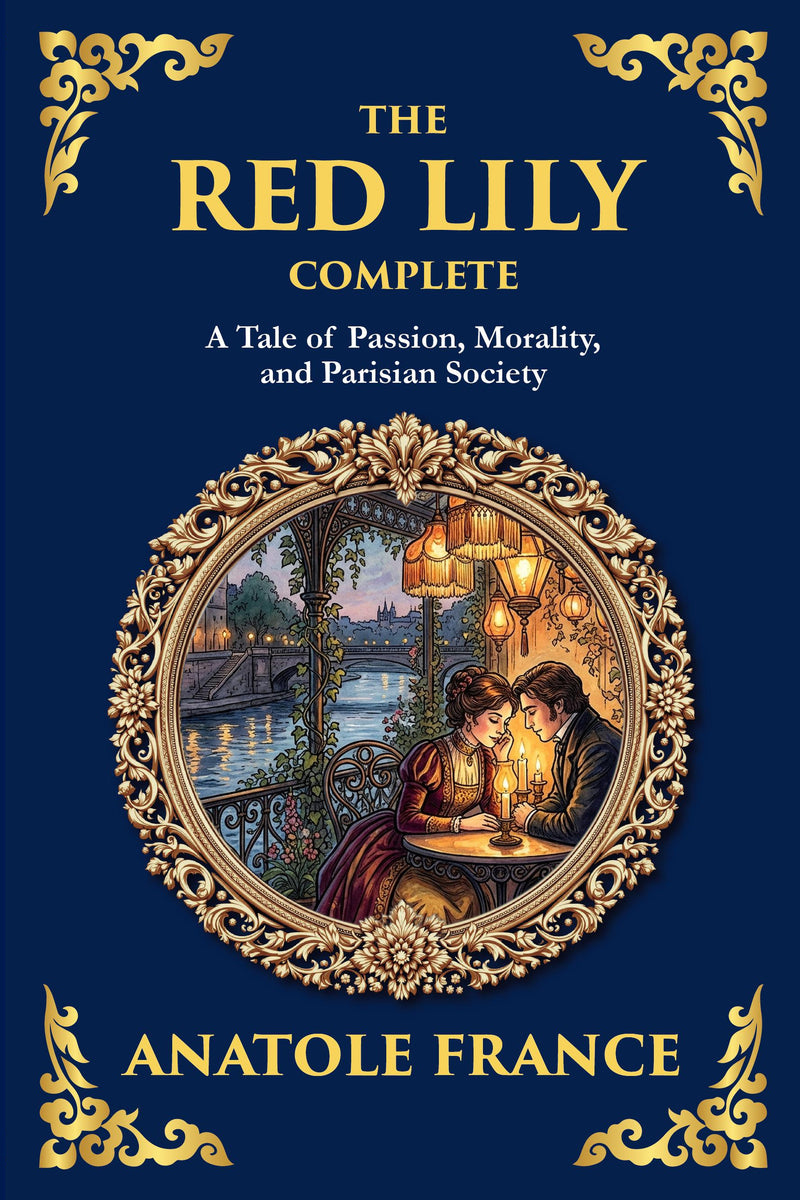
The Red Lily — Complete — Large Print
In the glittering salons and smoky cafés of Paris, love and art collide in an elegant tragedy of the heart. The Red Lily follows the emotional journey of Madame Thérèse Martin-Bellème, a woman caught between societal expectation and personal desire.
or free app
10,000+ hrs library
30-day guarantee
The complete The Red Lily — Complete appears in modern English through Library of Alexandria Press, available online with audiobook narration included for members.
Have you ever wondered why love can be the most beautiful and dangerous rebellion? Set in the refined yet restrictive society of turn-of-the-century France, The Red Lily is Anatole France’s most poignant and emotionally nuanced novel. With psychological precision and poetic restraint, this story chronicles the awakening of a woman who dares to follow her heart in a world that demands she remain silent.
Thérèse Martin-Bellème is a young and cultured woman trapped in a loveless marriage. When she finds herself torn between two lovers—one a passionate artist, the other an intellectual idealist—Thérèse embarks on a journey of emotional awakening and personal transformation. But in seeking love and meaning beyond her gilded cage, she must confront the cost of defying the conventions that bind her.
This complete edition restores all the lyrical beauty and moral depth of France’s original prose, now in a fluid modern translation accessible to today’s readers.
What you’ll discover in this modern edition
- A Complex Portrait of Female Emotion and Morality Thérèse’s emotional and ethical dilemmas remain strikingly relevant in today’s world.
- An Exploration of Love, Autonomy, and Inner Turmoil Witness the conflict between duty, passion, and personal freedom in a patriarchal society.
- An Elegant Depiction of Parisian Culture Explore the art, salons, and literary life of Belle Époque Paris through France’s sharp, elegant prose.
- A Nobel Laureate’s Masterwork Anatole France weaves wit, irony, and compassion into a moving novel that critiques society without cynicism.
- Themes That Still Resonate From feminism to fidelity, self-discovery to sacrifice, this story remains timeless in its questions and humanity.
| Formats | eBook (EPUB + PDF) · Audiobook · Paperback · Hardcover · Large Print |
| Language | English |
| Trim size (print) | 6 × 9 in |
| Binding | Paperback — perfect-bound · Hardcover — casewrap |
| Large Print edition | Same text in a larger, easy-read type — a larger font, not a larger trim |
| Print pricing | Every physical book at our true cost — at-cost, no profit (members) |
| Library | 873 restored titles, always growing |
| Length | 77,313 words · ~5 hr 9 min reading |
| Reading level | Grade 8 · an easy, flowing read (this modern-English edition) |
| Edition | Modern English translation · 2026 |
Member reviews for this edition are collected as readers finish it — be the first. Across the library: 12,000+ books shipped, every plan covered by a 365-day print guarantee.
About this edition
A faithful, unabridged modern-English edition by The Library of Alexandria — carefully rendered for today's reader and verified paragraph-by-paragraph against the public-domain source. Available as eBook, audiobook, paperback, hardcover, and large print.
- Complete & unabridgedVerified paragraph by paragraph against the source — never a scan, never abridged.
- Modern English, faithfulReadable today, with the author’s meaning kept intact. Readable — not simplified.
- Every format, one membershipRead in your browser or the free app, or listen to the full audiobook.
Included free with your membership
Cancel anytime, one click · 30-day money-back guarantee
Edition last updated July 2026
What’s inside
The Red Lily — Complete — Large Print — complete and unabridged: all 38 sections included with membership, plus the full audiobook.
Begin reading The Red Lily — Complete — Large Print
In clear modern English — the complete text is included with membership.
Introduction
There are novels that announce themselves with thunder, and there are novels that arrive like the slow opening of a window onto a Florentine garden at dusk—the light golden, the air heavy with the scent of stone and roses, the conversation drifting somewhere just beyond the hedge. The Red Lily belongs unmistakably to the second kind. Anatole France, writing at the height of his powers in 1894, produced here a work of extraordinary refinement, a meditation on love and its discontents dressed in the silks and shadows of fin-de-siècle aristocratic society. To open these pages is to step into a world where every gesture carries meaning, where a glance exchanged across a salon can alter the course of a life, and where the most dangerous passions are spoken in the most polished of voices.
This modern translation, adapted thoughtfully for the contemporary reader, has been prepared with a single guiding ambition: to let the brilliance of France’s prose reach you unimpeded by the dust of more than a century. The original French is a marvel of elegance, irony, and psychological precision, and the danger of any translation is that these qualities calcify into something stiff and museum-like. The aim here has been to preserve the music and the wit—the famous lightness of touch that won France the Nobel Prize in 1921—while smoothing the archaisms and the more obscure period references that might otherwise stand between you and the story’s emotional core. What remains is a novel that feels astonishingly alive, its insights into the human heart as sharp and as troubling as they were when France first set them down.
To understand why The Red Lily matters, it helps to know something of the man who wrote it. Anatole France—born Jacques Anatole François Thibault in 1844—was, by the time he composed this novel, one of the most celebrated literary figures in France. He was a man of the libraries before he was a man of the salons; his father kept a bookshop on the Quai Malaquais in Paris that specialized in works on the French Revolution, and the boy grew up surrounded by old volumes, old ideas, and the lingering perfume of history. This immersion in the written word shaped everything he would later become. He was a scholar’s writer and a sensualist’s writer at once, equally capable of dissecting a philosophical argument and of describing the exact quality of light on a woman’s bare shoulder.
What distinguishes France from many of his contemporaries is the particular flavor of his intelligence—a skeptical, ironic, faintly melancholy worldliness that never quite tips into cynicism. He had looked long at human folly and decided, in the end, to be amused by it rather than enraged. This temperament infuses The Red Lily from its opening pages. The characters who populate its drawing rooms are clever, cultivated, often kind, and almost always self-deceiving. France observes them with the affectionate detachment of a man who knows that he, too, is one of them. When his people deliver their polished epigrams about art and love and the meaning of existence, we are meant to admire the wit even as we sense the loneliness underneath it. This double vision—the simultaneous celebration and gentle puncturing of a refined civilization—is the signature of his art, and it is nowhere more beautifully sustained than here.
It is worth pausing on the moment in which the book was written. The 1890s in France were a strange and luminous decade, a time of decadence and disquiet, of immense artistic ambition and a creeping sense that the gilded order of bourgeois society rested on uncertain foundations. The aesthetic movement was in full flower; beauty was being elevated almost to a religion. And yet beneath the surface, the old certainties of religion and morality were dissolving, leaving educated men and women to grapple with questions of how to live, what to value, and whether love—that most overworked of human ideals—could bear the weight that romantics had heaped upon it. France was acutely sensitive to these tensions, and The Red Lily is in many ways the most personal of his explorations of them. It draws, scholars have long agreed, on the emotional currents of his own life during this period, on the intensities and disappointments of a great attachment. There is a warmth and a wound in this book that distinguishes it from the more purely intellectual satires that made his early reputation. Here, France writes not merely as an observer of passion but as one who has felt its scorch.
The novel emerged from a world saturated in art and conversation. France’s circle included some of the most brilliant minds of the age, and the dialogue in The Red Lily reflects this milieu with uncanny fidelity. The talk in these pages is not idle chatter; it is the medium through which his characters perform themselves, defend themselves, and occasionally betray themselves. Reading it, one understands that for these people conversation is a kind of art form, almost a competitive sport, and that the man or woman who can turn a phrase most beautifully wields a particular sort of power. France was himself a famous conversationalist, and he lavishes upon his characters the gift of his own eloquence. The result is a book in which the talk is as compelling as the action—indeed, in which the talk frequently is the action, the verbal duels and seductions carrying more dramatic weight than anything more overt.
It would be a mistake, however, to imagine The Red Lily as a merely decorative work, a parade of beautiful sentences and witty exchanges. Beneath its polished surface runs a current of genuine philosophical seriousness. France was preoccupied throughout his career with the limits of human freedom, with the ways in which our supposed choices are conditioned by forces beyond our control—by temperament, by circumstance, by the deep irrational tides of desire. The subtitle of this edition rightly identifies its great themes as passion, morality, and Parisian society, and what makes the novel so rich is the way these three concerns are not treated separately but woven into a single, inseparable fabric. The passions of the characters are shaped by the moral codes they have inherited and the society they inhabit; and that society, in turn, both nourishes and constrains the passions it pretends to civilize. France does not lecture. He dramatizes. He sets his characters in motion and lets us watch, with a clarity that can be almost painful, as they discover the gap between what they believe themselves to be and what they actually are.
One of the novel’s most striking qualities is its treatment of sculpture and the visual arts. France was deeply interested in the artist’s relationship to beauty, and in the way the making of art mirrors the making—and unmaking—of love. The Italian settings that figure so prominently in the book are not mere backdrop; Florence in particular becomes a kind of living presence, a city where the accumulated beauty of centuries presses in upon the characters and heightens their every emotion. France knew Italy well and loved it, and his descriptions of its art and architecture, its light and its atmosphere, are among the most sensuously beautiful passages he ever wrote. For the contemporary reader, these passages offer a double pleasure: they are gorgeous in themselves, and they function as a sustained meditation on the relationship between art and life, between the eternal beauty of the masterpiece and the fleeting, fragile beauty of human happiness.
What can a novel about wealthy, idle aristocrats and their amorous entanglements, written in the language and customs of more than a century ago, offer to a reader living in our own restless age? The answer, surprisingly, is a great deal—and perhaps more than the novel could offer to readers closer to its own time. Distance has a way of clarifying. The particular social rituals of 1890s Paris may have faded, but the human realities they once clothed remain entirely recognizable. The jealousy that gnaws at a lover who suspects, the intoxication of a new attachment, the slow corrosion of trust, the impossibility of fully knowing another person, the terrible discovery that love does not erase the loneliness it promised to cure—these are not period furniture. They are the permanent furniture of the human heart, and France arranges them with the precision of a master.
The central drama of the novel concerns a woman of intelligence, beauty, and complicated circumstances who finds herself caught between competing claims upon her affections and her conscience. To say more would be to spoil the unfolding of a story that depends for much of its power on the gradual revelation of character. But it is fair to observe that France gives us in his heroine one of the most psychologically convincing portraits of a woman in love—and in conflict—that the literature of his era produced. She is no saint and no villain; she is a fully realized human being, capable of generosity and selfishness, of great tenderness and startling coldness, of self-knowledge and self-deception in equal measure. France refuses to judge her, and in refusing, he invites us to understand her. This is one of the deepest pleasures the novel affords: the experience of being drawn so fully into another consciousness that we come to share its hopes and fears as our own, even as we see, from our slightly elevated vantage, the mistakes she is poised to make.
The men in her orbit are drawn with equal care, and here France’s irony does some of its finest work. The novel is, among other things, a study of masculine desire in its various guises—the desire that idealizes, the desire that possesses, the desire that worships and the desire that consumes. France understood, with a clarity that can feel startlingly modern, the difference between loving a person and loving the image one has constructed of that person. He understood the way jealousy can masquerade as love, the way the wish to possess can disguise itself as devotion, and the way even the most refined and self-aware individuals can be reduced by passion to something primal and frightening. The novel does not flinch from these darker currents, but it explores them with a tact and a subtlety that make them all the more disturbing. There are no melodramatic villains here, no cardboard heroes. There are only people—intelligent, cultivated, fallible people—doing their best and failing, as people do.
For the contemporary reader, one of the great rewards of this novel lies in its frankness about the difficulty of love between equals. France’s heroine is no passive object of male attention; she is a woman with her own desires, her own will, her own intellect, and the novel takes seriously the question of what it means for such a woman to love and be loved in a world that does not always know what to do with her independence. In this respect, The Red Lily speaks to concerns that have only grown more urgent in the years since it was written. The negotiation of power within intimacy, the tension between autonomy and attachment, the question of whether two people can ever truly meet as equals when the deck of social convention is so heavily stacked—these are questions our own age continues to wrestle with, and France illuminates them with a wisdom that has lost none of its force.
A word should be said about the experience of reading France’s prose, even in translation. He was a stylist of the very first rank, a writer for whom the shape of a sentence mattered as much as its sense. His prose has a quality of suspended grace, a way of holding a thought delicately before the reader and turning it slowly so that all its facets catch the light. There is wit in it, and melancholy, and a kind of civilized sadness that is unique to him. This translation has labored to preserve that quality—to render France’s irony without coarsening it, to keep his sentences supple and his cadences intact, while removing the genuine obstacles that the passage of time has placed in the path of the modern English reader. Obscure references have been gently clarified or contextualized; constructions that would now feel stilted have been eased into a more natural flow; and the overall aim throughout has been to give you the experience that France’s original readers had—the experience of being in the presence of a supremely intelligent and sensitive mind, observing the human comedy with amusement and compassion.
Cancel anytime, one click · 30-day money-back guarantee
Founding annual rate available now — your price locks for life when you join.
Not ready? Get this free chapter by email — read it anytime.
✓ Sent — check your inbox for The Red Lily — Complete — Large Print.
Questions about The Red Lily — Complete — Large Print
What is The Red Lily — Complete about?
In the glittering salons and smoky cafés of Paris, love and art collide in an elegant tragedy of the heart. The Red Lily follows the emotional journey of Madame Thérèse Martin-Bellème, a woman caught between societal expectation and personal desire. Amid the charms and contradictions of Parisian life, she becomes entangled in affairs of the heart that stir her soul but challenge her conscience.
Who wrote The Red Lily — Complete?
The Red Lily — Complete was written by Anatole France. This edition presents the complete work in clear modern English, faithfully rendered from the public-domain original by Library of Alexandria Press.
Is The Red Lily — Complete free to read?
The opening chapter is free to read on this page. Members read and listen to the complete work — and the entire library — free, and can order any physical book at our true print cost.
How long is The Red Lily — Complete?
38 chapters (~77,313 words) — about 5 hr 9 min of reading in this modern-English edition.
Is this an abridged version of The Red Lily — Complete?
No. This is the complete, unabridged The Red Lily — Complete, carefully rendered into clear modern English and verified paragraph-by-paragraph against the public-domain source — nothing is cut or summarised.
What formats does The Red Lily — Complete come in?
The Red Lily — Complete is available as eBook, paperback, hardcover and large print. eBook and audiobook are included with membership; printed editions ship at our true print cost.
Shipping & returns
Billing & membership
More from the library


Explore Romance
- As You Like It · William Shakespeare
- Anna Karenina · Leo Tolstoy
- A Midsummer Night’s Dream · William Shakespeare
- Romeo and Juliet · William Shakespeare
- Sonnets from the Portuguese · Elizabeth Barrett Browning
- Miss Primrose · Agnes Giberne
- The Gay Adventure: A Romance · Richard Bird
- The Belle of Bowling Green · Amelia E. Barr
- The Monk: A Romance · M. G. Lewis
- She · H. Rider Haggard
- The Mill on the Floss · George Eliot
- The Glad Lady · Amy Ella Blanchard
- The Red Lily — Complete · Anatole France
- The Blue Goose · Frank Lewis Nason
- The History of Sir Richard Calmady: A Romance · Lucas Malet
- The Quest of the Silver Fleece: A Novel · W. E. B. Du Bois
- The Love Letters of Mary Wollstonecraft to Gilbert Imlay · Mary Wollstonecraft
- Daddy-Long-Legs · Jean Webster
- The Age of Innocence · Edith Wharton
- The Portrait of a Lady — Volume 1 · Henry James
- Wuthering Heights · Emily Brontë
- The Lady of the Lake · Walter Scott
- Lady Chatterley’s Lover · D. H. Lawrence
- Jane Eyre: An Autobiography · Charlotte Brontë
- A Connecticut Yankee in King Arthur’s Court · Mark Twain
- Northanger Abbey · Jane Austen
- Mansfield Park · Jane Austen
- Anthem · Ayn Rand
- This Side of Paradise · F. Scott Fitzgerald
- Persuasion · Jane Austen
The Red Lily — Complete — Large Print
The Red Lily — Complete — Large Print
A Story of Passion, Morality, and Parisian Society
Anatole France
Contents
- Introduction
- Book 1
- Chapter 1
- Chapter 2
- Chapter 3
- Chapter 4
- Chapter 5
- Chapter 6
- Chapter 7
- Chapter 8
- Chapter 9
- Book 2
- Chapter 10
- Chapter 11
- Chapter 12
- Chapter 13
- Chapter 14
- Chapter 15
- Chapter 16
- Chapter 17
- Chapter 18
- Chapter 19
- Chapter 20
- Chapter 21
- Chapter 22
- Book 3
- Chapter 23
- Chapter 24
- Chapter 25
- Chapter 26
- Chapter 27
- Chapter 28
- Chapter 29
- Chapter 30
- Chapter 31
- Chapter 32
- Chapter 33
- Chapter 34
Introduction
There are novels that announce themselves with thunder, and there are novels that arrive like the slow opening of a window onto a Florentine garden at dusk—the light golden, the air heavy with the scent of stone and roses, the conversation drifting somewhere just beyond the hedge. The Red Lily belongs unmistakably to the second kind. Anatole France, writing at the height of his powers in 1894, produced here a work of extraordinary refinement, a meditation on love and its discontents dressed in the silks and shadows of fin-de-siècle aristocratic society. To open these pages is to step into a world where every gesture carries meaning, where a glance exchanged across a salon can alter the course of a life, and where the most dangerous passions are spoken in the most polished of voices.
This modern translation, adapted thoughtfully for the contemporary reader, has been prepared with a single guiding ambition: to let the brilliance of France’s prose reach you unimpeded by the dust of more than a century. The original French is a marvel of elegance, irony, and psychological precision, and the danger of any translation is that these qualities calcify into something stiff and museum-like. The aim here has been to preserve the music and the wit—the famous lightness of touch that won France the Nobel Prize in 1921—while smoothing the archaisms and the more obscure period references that might otherwise stand between you and the story’s emotional core. What remains is a novel that feels astonishingly alive, its insights into the human heart as sharp and as troubling as they were when France first set them down.
To understand why The Red Lily matters, it helps to know something of the man who wrote it. Anatole France—born Jacques Anatole François Thibault in 1844—was, by the time he composed this novel, one of the most celebrated literary figures in France. He was a man of the libraries before he was a man of the salons; his father kept a bookshop on the Quai Malaquais in Paris that specialized in works on the French Revolution, and the boy grew up surrounded by old volumes, old ideas, and the lingering perfume of history. This immersion in the written word shaped everything he would later become. He was a scholar’s writer and a sensualist’s writer at once, equally capable of dissecting a philosophical argument and of describing the exact quality of light on a woman’s bare shoulder.
What distinguishes France from many of his contemporaries is the particular flavor of his intelligence—a skeptical, ironic, faintly melancholy worldliness that never quite tips into cynicism. He had looked long at human folly and decided, in the end, to be amused by it rather than enraged. This temperament infuses The Red Lily from its opening pages. The characters who populate its drawing rooms are clever, cultivated, often kind, and almost always self-deceiving. France observes them with the affectionate detachment of a man who knows that he, too, is one of them. When his people deliver their polished epigrams about art and love and the meaning of existence, we are meant to admire the wit even as we sense the loneliness underneath it. This double vision—the simultaneous celebration and gentle puncturing of a refined civilization—is the signature of his art, and it is nowhere more beautifully sustained than here.
It is worth pausing on the moment in which the book was written. The 1890s in France were a strange and luminous decade, a time of decadence and disquiet, of immense artistic ambition and a creeping sense that the gilded order of bourgeois society rested on uncertain foundations. The aesthetic movement was in full flower; beauty was being elevated almost to a religion. And yet beneath the surface, the old certainties of religion and morality were dissolving, leaving educated men and women to grapple with questions of how to live, what to value, and whether love—that most overworked of human ideals—could bear the weight that romantics had heaped upon it. France was acutely sensitive to these tensions, and The Red Lily is in many ways the most personal of his explorations of them. It draws, scholars have long agreed, on the emotional currents of his own life during this period, on the intensities and disappointments of a great attachment. There is a warmth and a wound in this book that distinguishes it from the more purely intellectual satires that made his early reputation. Here, France writes not merely as an observer of passion but as one who has felt its scorch.
The novel emerged from a world saturated in art and conversation. France’s circle included some of the most brilliant minds of the age, and the dialogue in The Red Lily reflects this milieu with uncanny fidelity. The talk in these pages is not idle chatter; it is the medium through which his characters perform themselves, defend themselves, and occasionally betray themselves. Reading it, one understands that for these people conversation is a kind of art form, almost a competitive sport, and that the man or woman who can turn a phrase most beautifully wields a particular sort of power. France was himself a famous conversationalist, and he lavishes upon his characters the gift of his own eloquence. The result is a book in which the talk is as compelling as the action—indeed, in which the talk frequently is the action, the verbal duels and seductions carrying more dramatic weight than anything more overt.
It would be a mistake, however, to imagine The Red Lily as a merely decorative work, a parade of beautiful sentences and witty exchanges. Beneath its polished surface runs a current of genuine philosophical seriousness. France was preoccupied throughout his career with the limits of human freedom, with the ways in which our supposed choices are conditioned by forces beyond our control—by temperament, by circumstance, by the deep irrational tides of desire. The subtitle of this edition rightly identifies its great themes as passion, morality, and Parisian society, and what makes the novel so rich is the way these three concerns are not treated separately but woven into a single, inseparable fabric. The passions of the characters are shaped by the moral codes they have inherited and the society they inhabit; and that society, in turn, both nourishes and constrains the passions it pretends to civilize. France does not lecture. He dramatizes. He sets his characters in motion and lets us watch, with a clarity that can be almost painful, as they discover the gap between what they believe themselves to be and what they actually are.
One of the novel’s most striking qualities is its treatment of sculpture and the visual arts. France was deeply interested in the artist’s relationship to beauty, and in the way the making of art mirrors the making—and unmaking—of love. The Italian settings that figure so prominently in the book are not mere backdrop; Florence in particular becomes a kind of living presence, a city where the accumulated beauty of centuries presses in upon the characters and heightens their every emotion. France knew Italy well and loved it, and his descriptions of its art and architecture, its light and its atmosphere, are among the most sensuously beautiful passages he ever wrote. For the contemporary reader, these passages offer a double pleasure: they are gorgeous in themselves, and they function as a sustained meditation on the relationship between art and life, between the eternal beauty of the masterpiece and the fleeting, fragile beauty of human happiness.
What can a novel about wealthy, idle aristocrats and their amorous entanglements, written in the language and customs of more than a century ago, offer to a reader living in our own restless age? The answer, surprisingly, is a great deal—and perhaps more than the novel could offer to readers closer to its own time. Distance has a way of clarifying. The particular social rituals of 1890s Paris may have faded, but the human realities they once clothed remain entirely recognizable. The jealousy that gnaws at a lover who suspects, the intoxication of a new attachment, the slow corrosion of trust, the impossibility of fully knowing another person, the terrible discovery that love does not erase the loneliness it promised to cure—these are not period furniture. They are the permanent furniture of the human heart, and France arranges them with the precision of a master.
The central drama of the novel concerns a woman of intelligence, beauty, and complicated circumstances who finds herself caught between competing claims upon her affections and her conscience. To say more would be to spoil the unfolding of a story that depends for much of its power on the gradual revelation of character. But it is fair to observe that France gives us in his heroine one of the most psychologically convincing portraits of a woman in love—and in conflict—that the literature of his era produced. She is no saint and no villain; she is a fully realized human being, capable of generosity and selfishness, of great tenderness and startling coldness, of self-knowledge and self-deception in equal measure. France refuses to judge her, and in refusing, he invites us to understand her. This is one of the deepest pleasures the novel affords: the experience of being drawn so fully into another consciousness that we come to share its hopes and fears as our own, even as we see, from our slightly elevated vantage, the mistakes she is poised to make.
The men in her orbit are drawn with equal care, and here France’s irony does some of its finest work. The novel is, among other things, a study of masculine desire in its various guises—the desire that idealizes, the desire that possesses, the desire that worships and the desire that consumes. France understood, with a clarity that can feel startlingly modern, the difference between loving a person and loving the image one has constructed of that person. He understood the way jealousy can masquerade as love, the way the wish to possess can disguise itself as devotion, and the way even the most refined and self-aware individuals can be reduced by passion to something primal and frightening. The novel does not flinch from these darker currents, but it explores them with a tact and a subtlety that make them all the more disturbing. There are no melodramatic villains here, no cardboard heroes. There are only people—intelligent, cultivated, fallible people—doing their best and failing, as people do.
For the contemporary reader, one of the great rewards of this novel lies in its frankness about the difficulty of love between equals. France’s heroine is no passive object of male attention; she is a woman with her own desires, her own will, her own intellect, and the novel takes seriously the question of what it means for such a woman to love and be loved in a world that does not always know what to do with her independence. In this respect, The Red Lily speaks to concerns that have only grown more urgent in the years since it was written. The negotiation of power within intimacy, the tension between autonomy and attachment, the question of whether two people can ever truly meet as equals when the deck of social convention is so heavily stacked—these are questions our own age continues to wrestle with, and France illuminates them with a wisdom that has lost none of its force.
A word should be said about the experience of reading France’s prose, even in translation. He was a stylist of the very first rank, a writer for whom the shape of a sentence mattered as much as its sense. His prose has a quality of suspended grace, a way of holding a thought delicately before the reader and turning it slowly so that all its facets catch the light. There is wit in it, and melancholy, and a kind of civilized sadness that is unique to him. This translation has labored to preserve that quality—to render France’s irony without coarsening it, to keep his sentences supple and his cadences intact, while removing the genuine obstacles that the passage of time has placed in the path of the modern English reader. Obscure references have been gently clarified or contextualized; constructions that would now feel stilted have been eased into a more natural flow; and the overall aim throughout has been to give you the experience that France’s original readers had—the experience of being in the presence of a supremely intelligent and sensitive mind, observing the human comedy with amusement and compassion.
She glanced at the armchairs by the fireplace, the tea table gleaming in the shadows, and the tall, pale flower stems rising from Chinese vases. She reached into the flowering branches of the guelder roses, making their silvery clusters tremble. Then, she studied herself in a mirror with focused attention. Standing sideways and turning her neck over her shoulder, she followed the curves of her slender figure, dressed in a tight black satin gown and a light, pearl-studded tunic that shimmered with dark light. She stepped closer, curious to see how she looked that day. The mirror reflected her gaze calmly, as if the pleasant woman she was observing—a woman she found quite likable—lived a life free from both intense joy and deep sorrow.
On the walls of the vast, empty, and silent drawing room, the figures in the tapestries looked like vague shadows, appearing pale amidst their ancient games and fading elegance. Like those figures, the terra-cotta statuettes on thin columns, the old Saxony figurines, and the Sèvres paintings all spoke of bygone glories. On a pedestal decorated with fine bronzes, a marble bust of a royal princess dressed as Diana seemed ready to leap out of her swirling robes, while on the ceiling, a figure of Night, powdered like a marquise and surrounded by cupids, scattered flowers. Everything was still, and the only sounds were the crackling logs in the fire and the soft rattle of Therese’s pearls.
She stepped away from the mirror, lifted the edge of a curtain, and looked out the window. Beyond the dark trees along the wharf, the Seine river shimmered with yellow reflections. A sense of boredom with the sky and water showed in her delicate gray eyes. A boat called the ‘Hirondelle’ passed by, emerging from under an arch of the Alma Bridge and carrying modest passengers toward Grenelle and Billancourt. She watched it disappear, then let the curtain drop. Sitting down beneath some flowers, she picked up a book from the table. The title, ‘Yseult la Blonde’ by Vivian Bell, was printed in gold on the straw-colored linen cover. It was a collection of French poems written by an Englishwoman and published in London. She read with little interest while waiting for guests, thinking less about the poetry and more about the author, Miss Bell. Miss Bell was perhaps her dearest friend, though they rarely saw each other. On the few occasions they did meet, the poet would kiss her, call her “darling,” and chatter away. Plain yet charming, almost silly yet completely refined, she lived in Fiesole like a philosopher, even as England celebrated her as its most beloved poet. Much like Vernon Lee and Mary Robinson, she had fallen in love with the art and lifestyle of Tuscany. Before even finishing her Tristan—the first part of which had inspired dreamy watercolors by Burne-Jones—she began writing Provencal verses and French poems based on Italian ideas. She had sent ‘Yseult la Blonde’ to “Darling” along with a letter inviting her to spend a month together in Fiesole. She had written: “Come; you will see the most beautiful things in the world, and you will make them even more beautiful.”
End of the free sample
Keep reading, free
Members read and listen to the complete book — and the entire library. Cancel anytime, one click · 30-day money-back guarantee.