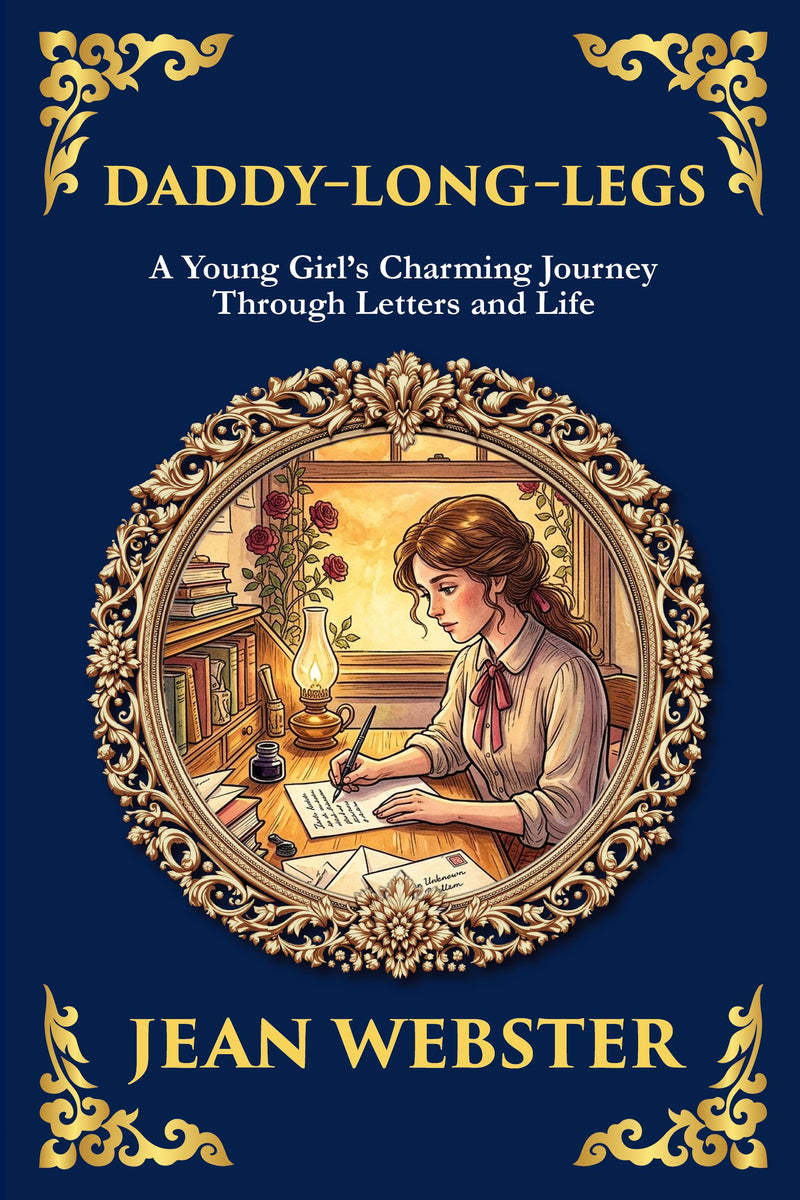
Daddy-Long-Legs
What if your entire life changed because of a mysterious benefactor you’ve never met? In this heartwarming epistolary novel, orphan Jerusha “Judy” Abbott is sent to college by an anonymous patron whom she affectionately nicknames "Daddy-Long-Legs"—and in return, she must write him regular letters.
or free app
10,000+ hrs library
30-day guarantee
The complete Daddy-Long-Legs appears in modern English through Library of Alexandria Press, available online with audiobook narration included for members.
Have you ever wondered why some of the most transformative relationships are the ones that begin in silence? Daddy-Long-Legs by Jean Webster is a timeless coming-of-age story told entirely through letters—a narrative of discovery, resilience, and self-expression that continues to enchant readers across generations. Judy Abbott, a bright and imaginative girl raised in a dreary orphanage, is unexpectedly offered the chance to attend college by an anonymous benefactor.
The only condition: she must write to him regularly, sharing her progress and experiences. Judy’s letters—full of humor, insight, and irrepressible joy—reveal her evolving intellect, ideals, and spirit as she navigates school life, friendships, and self-discovery. While she does not receive replies, Judy’s correspondence gradually builds a one-sided but deeply revealing relationship.
What unfolds is not just an education, but a personal awakening— a journey from girlhood to womanhood, shaped by curiosity, courage, and the desire to belong.
What you’ll discover in this modern edition
- A Touching Epistolary Format – Experience Judy’s life unfold entirely through her candid, witty, and poignant letters.
- A Celebration of Female Independence and Education – Follow Judy as she grows into a self-assured young woman, pursuing her dreams on her own terms.
- Themes of Gratitude, Growth, and Belonging – Discover the emotional richness of a young girl finding her place in the world.
- A Hidden Romance – Savor the subtle, surprising emergence of love behind the curtain of anonymity.
- A Perfect Modern Edition – Presented with contemporary formatting and clean design for today’s reader, while preserving the charm and tone of Webster’s original.
| Formats | eBook (EPUB + PDF) · Audiobook · Paperback · Hardcover · Large Print |
| Language | English |
| Trim size (print) | 6 × 9 in |
| Binding | Paperback — perfect-bound · Hardcover — casewrap |
| Large Print edition | Same text in a larger, easy-read type — a larger font, not a larger trim |
| Print pricing | Every physical book at our true cost — at-cost, no profit (members) |
| Library | 873 restored titles, always growing |
| Length | 38,578 words · ~2 hr 34 min reading |
| Reading level | Grade 3 · an easy, flowing read (this modern-English edition) |
| Edition | Modern English translation · 2026 |
Member reviews for this edition are collected as readers finish it — be the first. Across the library: 12,000+ books shipped, every plan covered by a 365-day print guarantee.
About this edition
A faithful, unabridged modern-English edition by The Library of Alexandria — carefully rendered for today's reader and verified paragraph-by-paragraph against the public-domain source. Available as eBook, audiobook, paperback, hardcover, and large print.
- Complete & unabridgedVerified paragraph by paragraph against the source — never a scan, never abridged.
- Modern English, faithfulReadable today, with the author’s meaning kept intact. Readable — not simplified.
- Every format, one membershipRead in your browser or the free app, or listen to the full audiobook.
Included free with your membership
Cancel anytime, one click · 30-day money-back guarantee
Edition last updated July 2026
What’s inside
Daddy-Long-Legs — complete and unabridged: all 3 sections included with membership, plus the full audiobook.
Begin reading Daddy-Long-Legs
In clear modern English — the complete text is included with membership.
Introduction
There are certain books that arrive in a reader’s life like a letter from an old friend—warm, unguarded, and impossible to set aside once begun. Daddy-Long-Legs is precisely such a book. First published in 1912, it has charmed generations of readers across more than a century, and it continues to feel astonishingly fresh, funny, and alive. To open its pages is to be invited into a private correspondence, to lean close and read words that were never meant for the wider world, and to discover, almost by accident, that you have fallen completely in love with the person writing them.
This modern translation, adapted for the contemporary reader, has been prepared with a single purpose in mind: to remove the small barriers of time and idiom that can sometimes stand between a present-day reader and a beloved classic, while preserving entirely the wit, the heart, and the irrepressible voice that made the original such an enduring treasure. What you hold is not a diluted version, nor a simplified retelling, but a faithful rendering that lets the spirit of Jean Webster’s masterpiece shine through with all its original sparkle. The jokes still land. The tears still rise. The mischief is all intact. The intention is that you should feel, as you read, exactly what readers felt in 1912—the delight of meeting an extraordinary narrator, and the slow, sweet pleasure of watching a young life unfold.
Before you begin, it is worth pausing to consider what makes this slim volume so remarkable, and why it has refused to fade from the affections of readers when so many books of its era have quietly slipped from memory. For Daddy-Long-Legs is, in many ways, a small miracle of form and feeling—a book that does something quite daring with how a story is told, that smuggles serious ideas inside a package of pure charm, and that captures something timeless about youth, ambition, and the dizzying experience of discovering who you are.
The most immediately distinctive feature of this book is its form. Daddy-Long-Legs is what is known as an epistolary novel—a story told almost entirely through letters. This is an old and honorable tradition in literature, stretching back to the eighteenth century and earlier, when novelists discovered that there was a peculiar intimacy in pretending that a book was simply a bundle of private correspondence that the reader had been permitted to peek at. But few writers have ever handled the form with the lightness, the humor, and the sheer emotional directness that Jean Webster brings to it here.
When a story is told through letters, something interesting happens to the relationship between reader and narrator. There is no omniscient voice standing between you and the character, no authorial narrator explaining and interpreting and arranging events for your convenience. Instead, you have only the words the character chooses to write—and, just as importantly, the words she chooses not to write. You become, in effect, the recipient of these letters. You are the one being confided in, teased, charmed, and occasionally exasperated. The effect is wonderfully immediate. You are not watching a character from a distance; you are listening to her speak directly to you, as though she had pulled up a chair beside you and begun to talk.
What is especially clever about this particular epistolary novel is that we hear from only one side of the correspondence. The letters flow in a single direction, written by a young woman to a benefactor she has never met and knows almost nothing about. This means that the silences in the book—the unanswered questions, the replies that never come, the things the recipient might be thinking but never says—become part of the storytelling itself. We are left, like the writer of the letters, to imagine and to wonder. It is a brilliant technique, because it draws us deep into the narrator’s own emotional experience. Her uncertainty becomes our uncertainty. Her longing to be understood becomes something we feel acutely, precisely because we, too, are reading these words and trying to make sense of the silence on the other end.
This one-sided correspondence also gives the book its extraordinary sense of voice. Because we are reading only what one person writes, and because she writes constantly, expansively, and without inhibition, we come to know her with a depth and immediacy that few characters in literature ever achieve. We learn how she thinks, how she jokes, how she sulks and rejoices and rationalizes and dreams. We watch her handwriting—metaphorically speaking—change over the course of the book, as her thoughts grow more sophisticated, her vocabulary richer, her opinions bolder. The letters are not merely a way of conveying plot. They are themselves the most important thing the book has to offer, because the gradual evolution of this voice is, in a sense, the very heart of the story.
Webster also fills these letters with small drawings and doodles—stick figures, sketches, little visual jokes scribbled in the margins of the correspondence. These touches make the letters feel utterly real, the spontaneous outpourings of a lively mind that cannot quite contain itself within the bounds of mere words. They add a quality of playfulness and intimacy that is rare in any novel. You feel, reading them, that you are holding the actual pages this young woman wrote, smudges and all, and that sense of authenticity is a large part of the book’s irresistible appeal.
It is worth saying, too, that the epistolary form perfectly suits the book’s central concerns. This is a story about education, self-discovery, and the slow process of becoming a fully realized person—and what better way to dramatize that growth than through the writing itself? As our narrator becomes more educated, more confident, more herself, we can literally watch it happen in the changing texture of her prose. The letters are a record of a mind awakening. Few literary devices could be more fitting for a story about a young woman learning to think, to question, and to claim her own place in the world.
To understand why Daddy-Long-Legs feels so vivid and so true, it helps to know a little about the woman who wrote it. Jean Webster—born Alice Jane Chandler Webster in 1876—came from a remarkable lineage. She was the grand-niece of the great American humorist Mark Twain, and something of his gift for warm, observant comedy clearly ran in the family. She grew up in an atmosphere of books, ideas, and literary ambition, and from an early age she possessed both a sharp eye for human absurdity and a deep well of compassion for the people she observed.
Webster attended Vassar College, one of the pioneering institutions of higher education for women in America, and her years there left a permanent mark on her imagination and on her writing. The world of Daddy-Long-Legs—its lecture halls and dormitories, its friendships and rivalries, its earnest debates and midnight feasts, its sense of young women discovering their own intellectual powers—is drawn directly from the life Webster knew firsthand. She understood, from the inside, what it meant to be a young woman at the dawn of the twentieth century, when the doors of education and independence were just beginning to open, and when the very idea of a woman pursuing knowledge and a vocation for her own sake was thrillingly new.
This was a transformative period in history, and Webster was very much a woman of her moment. The early years of the twentieth century saw enormous changes in the role of women in society. The movement for women’s right to vote was gathering force. Old assumptions about what women could and should do with their lives were being challenged on every front. New opportunities in education and in work were opening up, even as old prejudices clung on stubbornly. Webster was deeply engaged with these questions. She was a committed social reformer, passionately interested in the welfare of children, in prison reform, in the conditions of orphanages and asylums, and in the broader project of creating a more just and humane society. She did not merely write about these things; she cared about them with real intensity, and that caring informs everything she wrote.
What makes Webster’s social conscience so effective in her fiction is that she never preaches. She had the rare gift of being able to fold serious concerns into a story so naturally that you absorb them almost without noticing, carried along by laughter and affection. Daddy-Long-Legs contains, beneath its sunny surface, a quietly pointed examination of charity, of class, of the way society treats those who begin life without advantages, and of the conditions under which children grow up when they have no family to protect them. But these themes never weigh the book down. They are woven into the texture of a story that remains, first and foremost, delightful. Webster trusted her readers to feel the deeper currents without having them spelled out, and she trusted her heroine’s vivacity to carry the heavier material lightly.
Webster’s own life was, in many ways, as full of feeling and incident as one of her novels, and although it would not be right to dwell on it here, it is enough to say that she lived her convictions, championed the causes she believed in, and brought to her writing the same warmth and idealism that animate her most famous character. She wrote several books, but Daddy-Long-Legs remains her crowning achievement—the work in which everything she cared about and everything she could do as a writer came together in perfect balance. It was an immediate and enormous success when it was published, beloved by readers across the world, and it has gone on to be adapted many times for the stage and screen, a testament to the universal appeal of its central story.
The voice that emerges from these pages, then, is not a fabrication but something earned—the product of a writer who knew her subject from the inside, who had laughed in those dormitories and pored over those textbooks, who understood both the comedy and the seriousness of a young woman’s coming of age. When you read this book, you are encountering the distilled wisdom and humor of a remarkable woman, offered to you with a generosity that has not dimmed in over a century.
It would be a disservice to you, the reader, to reveal too much of what happens in this book. Part of its considerable pleasure lies in the way it unfolds—the small surprises, the gradual revelations, the slow accumulation of detail that makes the ending feel both unexpected and inevitable. So rather than describing events, let me instead try to prepare you for the experience of reading, and to point toward the qualities that have made so many readers cherish this book and return to it again and again across their lives.
First and foremost, prepare to laugh. Daddy-Long-Legs is genuinely, frequently funny. Its humor comes not from contrived situations or clever plotting but from the personality of its narrator—from her irreverent observations, her self-deprecating jokes, her tendency to get carried away by enthusiasm and then mock herself for it, her keen eye for the ridiculous in the people and institutions around her. She is the kind of person who can make a wry comment about almost anything, who finds the world endlessly amusing even when it is being difficult, and whose high spirits are simply contagious. The comedy here is the warm, affectionate kind that springs from a deep love of life. You will find yourself smiling on nearly every page, and laughing aloud more often than you might expect from a book of this vintage.
But this is not merely a comic novel. Beneath the laughter runs a current of real emotion—of loneliness, of longing, of the deep human hunger to be known and loved for who one truly is. Our narrator is, when we meet her, a young person without family, without history, without any of the connections that most of us take for granted. She has had to make herself, largely alone, and the book is in part the story of how she learns to reach out to others, to trust, to form bonds, and to claim the right to her own happiness. There are moments in these pages of genuine tenderness and even quiet sorrow, and they land with such force precisely because they are surrounded by so much joy. Webster knew that comedy and pathos are not opposites but partners, and she balances them with a sure hand throughout.
Cancel anytime, one click · 30-day money-back guarantee
Founding annual rate available now — your price locks for life when you join.
Not ready? Get this free chapter by email — read it anytime.
✓ Sent — check your inbox for Daddy-Long-Legs.
Questions about Daddy-Long-Legs
What is Daddy-Long-Legs about?
What if your entire life changed because of a mysterious benefactor you’ve never met? In this heartwarming epistolary novel, orphan Jerusha “Judy” Abbott is sent to college by an anonymous patron whom she affectionately nicknames "Daddy-Long-Legs"—and in return, she must write him regular letters. Through wit, warmth, and an unbreakable spirit, Judy blossoms into an independent young woman with a voice all her own.
Who wrote Daddy-Long-Legs?
Daddy-Long-Legs was written by Jean Webster. This edition presents the complete work in clear modern English, faithfully rendered from the public-domain original by Library of Alexandria Press.
Is Daddy-Long-Legs free to read?
The opening chapter is free to read on this page. Members read and listen to the complete work — and the entire library — free, and can order any physical book at our true print cost.
How long is Daddy-Long-Legs?
3 chapters (~38,578 words) — about 2 hr 34 min of reading in this modern-English edition.
Is this an abridged version of Daddy-Long-Legs?
No. This is the complete, unabridged Daddy-Long-Legs, carefully rendered into clear modern English and verified paragraph-by-paragraph against the public-domain source — nothing is cut or summarised.
What formats does Daddy-Long-Legs come in?
Daddy-Long-Legs is available as eBook, paperback, hardcover and large print. eBook and audiobook are included with membership; printed editions ship at our true print cost.
Shipping & returns
Billing & membership
More from the library


Explore Biography & Letters
- Meditations · Marcus Aurelius
- The Confessions of St. Augustine · Saint Augustine
- The Confessions of Jean-Jacques Rousseau — Complete · Jean-Jacques Rousseau
- Ecce Homo · Friedrich Wilhelm Nietzsche
- De Profundis · Oscar Wilde
- Memoirs of Joseph Grimaldi · Joseph Grimaldi
- English Eccentrics and Eccentricities · John Timbs
- You Can’t Win · Jack Black
- Wild Animals I Have Known · Ernest Thompson Seton
- The Diary of Samuel Pepys — Complete 1665 N.S. · Samuel Pepys
- Random Reminiscences of Men and Events · John D. Rockefeller
- The Story of My Life · Helen Keller
- Elizabeth, Empress of Austria and Queen of Hungary · Carl Küchler
- Society as I Have Found It · Ward McAllister
- Autobiography of a Yogi · Paramahansa Yogananda
- Christopher Columbus and How He Received and Imparted the Spirit of Discovery
- A Portrait of the Artist as a Young Man · James Joyce
- Memoirs of the Author of a Vindication of the Rights of Woman · William Godwin
- Mary: A Fiction · Mary Wollstonecraft
- The Romance of Biography (Vol. 1 of 2) · Mrs. Jameson
- The Love Letters of Mary Wollstonecraft to Gilbert Imlay · Mary Wollstonecraft
- Selected Works of Voltairine de Cleyre · Voltairine de Cleyre
- Eighty Years and More; Reminiscences 1815–1897 · Elizabeth Cady Stanton
- Anarchism and Other Essays · Emma Goldman
- Agnes Grey · Anne Brontë
- Reminiscences of a Stock Operator · Edwin Lefèvre
- Martin Eden · Jack London
- Matthew Calbraith Perry: A Typical American Naval Officer · William Elliot Griffis
- Walden, and On the Duty of Civil Disobedience · Henry David Thoreau
- Little Women · Louisa May Alcott
Daddy-Long-Legs
Daddy-Long-Legs
A Young Girl’s Charming Journey Through Letters and Life
Jean Webster
Contents
- Introduction
- Blue Wednesday
- The Letters
Introduction
There are certain books that arrive in a reader’s life like a letter from an old friend—warm, unguarded, and impossible to set aside once begun. Daddy-Long-Legs is precisely such a book. First published in 1912, it has charmed generations of readers across more than a century, and it continues to feel astonishingly fresh, funny, and alive. To open its pages is to be invited into a private correspondence, to lean close and read words that were never meant for the wider world, and to discover, almost by accident, that you have fallen completely in love with the person writing them.
This modern translation, adapted for the contemporary reader, has been prepared with a single purpose in mind: to remove the small barriers of time and idiom that can sometimes stand between a present-day reader and a beloved classic, while preserving entirely the wit, the heart, and the irrepressible voice that made the original such an enduring treasure. What you hold is not a diluted version, nor a simplified retelling, but a faithful rendering that lets the spirit of Jean Webster’s masterpiece shine through with all its original sparkle. The jokes still land. The tears still rise. The mischief is all intact. The intention is that you should feel, as you read, exactly what readers felt in 1912—the delight of meeting an extraordinary narrator, and the slow, sweet pleasure of watching a young life unfold.
Before you begin, it is worth pausing to consider what makes this slim volume so remarkable, and why it has refused to fade from the affections of readers when so many books of its era have quietly slipped from memory. For Daddy-Long-Legs is, in many ways, a small miracle of form and feeling—a book that does something quite daring with how a story is told, that smuggles serious ideas inside a package of pure charm, and that captures something timeless about youth, ambition, and the dizzying experience of discovering who you are.
The most immediately distinctive feature of this book is its form. Daddy-Long-Legs is what is known as an epistolary novel—a story told almost entirely through letters. This is an old and honorable tradition in literature, stretching back to the eighteenth century and earlier, when novelists discovered that there was a peculiar intimacy in pretending that a book was simply a bundle of private correspondence that the reader had been permitted to peek at. But few writers have ever handled the form with the lightness, the humor, and the sheer emotional directness that Jean Webster brings to it here.
When a story is told through letters, something interesting happens to the relationship between reader and narrator. There is no omniscient voice standing between you and the character, no authorial narrator explaining and interpreting and arranging events for your convenience. Instead, you have only the words the character chooses to write—and, just as importantly, the words she chooses not to write. You become, in effect, the recipient of these letters. You are the one being confided in, teased, charmed, and occasionally exasperated. The effect is wonderfully immediate. You are not watching a character from a distance; you are listening to her speak directly to you, as though she had pulled up a chair beside you and begun to talk.
What is especially clever about this particular epistolary novel is that we hear from only one side of the correspondence. The letters flow in a single direction, written by a young woman to a benefactor she has never met and knows almost nothing about. This means that the silences in the book—the unanswered questions, the replies that never come, the things the recipient might be thinking but never says—become part of the storytelling itself. We are left, like the writer of the letters, to imagine and to wonder. It is a brilliant technique, because it draws us deep into the narrator’s own emotional experience. Her uncertainty becomes our uncertainty. Her longing to be understood becomes something we feel acutely, precisely because we, too, are reading these words and trying to make sense of the silence on the other end.
This one-sided correspondence also gives the book its extraordinary sense of voice. Because we are reading only what one person writes, and because she writes constantly, expansively, and without inhibition, we come to know her with a depth and immediacy that few characters in literature ever achieve. We learn how she thinks, how she jokes, how she sulks and rejoices and rationalizes and dreams. We watch her handwriting—metaphorically speaking—change over the course of the book, as her thoughts grow more sophisticated, her vocabulary richer, her opinions bolder. The letters are not merely a way of conveying plot. They are themselves the most important thing the book has to offer, because the gradual evolution of this voice is, in a sense, the very heart of the story.
Webster also fills these letters with small drawings and doodles—stick figures, sketches, little visual jokes scribbled in the margins of the correspondence. These touches make the letters feel utterly real, the spontaneous outpourings of a lively mind that cannot quite contain itself within the bounds of mere words. They add a quality of playfulness and intimacy that is rare in any novel. You feel, reading them, that you are holding the actual pages this young woman wrote, smudges and all, and that sense of authenticity is a large part of the book’s irresistible appeal.
It is worth saying, too, that the epistolary form perfectly suits the book’s central concerns. This is a story about education, self-discovery, and the slow process of becoming a fully realized person—and what better way to dramatize that growth than through the writing itself? As our narrator becomes more educated, more confident, more herself, we can literally watch it happen in the changing texture of her prose. The letters are a record of a mind awakening. Few literary devices could be more fitting for a story about a young woman learning to think, to question, and to claim her own place in the world.
To understand why Daddy-Long-Legs feels so vivid and so true, it helps to know a little about the woman who wrote it. Jean Webster—born Alice Jane Chandler Webster in 1876—came from a remarkable lineage. She was the grand-niece of the great American humorist Mark Twain, and something of his gift for warm, observant comedy clearly ran in the family. She grew up in an atmosphere of books, ideas, and literary ambition, and from an early age she possessed both a sharp eye for human absurdity and a deep well of compassion for the people she observed.
Webster attended Vassar College, one of the pioneering institutions of higher education for women in America, and her years there left a permanent mark on her imagination and on her writing. The world of Daddy-Long-Legs—its lecture halls and dormitories, its friendships and rivalries, its earnest debates and midnight feasts, its sense of young women discovering their own intellectual powers—is drawn directly from the life Webster knew firsthand. She understood, from the inside, what it meant to be a young woman at the dawn of the twentieth century, when the doors of education and independence were just beginning to open, and when the very idea of a woman pursuing knowledge and a vocation for her own sake was thrillingly new.
This was a transformative period in history, and Webster was very much a woman of her moment. The early years of the twentieth century saw enormous changes in the role of women in society. The movement for women’s right to vote was gathering force. Old assumptions about what women could and should do with their lives were being challenged on every front. New opportunities in education and in work were opening up, even as old prejudices clung on stubbornly. Webster was deeply engaged with these questions. She was a committed social reformer, passionately interested in the welfare of children, in prison reform, in the conditions of orphanages and asylums, and in the broader project of creating a more just and humane society. She did not merely write about these things; she cared about them with real intensity, and that caring informs everything she wrote.
What makes Webster’s social conscience so effective in her fiction is that she never preaches. She had the rare gift of being able to fold serious concerns into a story so naturally that you absorb them almost without noticing, carried along by laughter and affection. Daddy-Long-Legs contains, beneath its sunny surface, a quietly pointed examination of charity, of class, of the way society treats those who begin life without advantages, and of the conditions under which children grow up when they have no family to protect them. But these themes never weigh the book down. They are woven into the texture of a story that remains, first and foremost, delightful. Webster trusted her readers to feel the deeper currents without having them spelled out, and she trusted her heroine’s vivacity to carry the heavier material lightly.
Webster’s own life was, in many ways, as full of feeling and incident as one of her novels, and although it would not be right to dwell on it here, it is enough to say that she lived her convictions, championed the causes she believed in, and brought to her writing the same warmth and idealism that animate her most famous character. She wrote several books, but Daddy-Long-Legs remains her crowning achievement—the work in which everything she cared about and everything she could do as a writer came together in perfect balance. It was an immediate and enormous success when it was published, beloved by readers across the world, and it has gone on to be adapted many times for the stage and screen, a testament to the universal appeal of its central story.
The voice that emerges from these pages, then, is not a fabrication but something earned—the product of a writer who knew her subject from the inside, who had laughed in those dormitories and pored over those textbooks, who understood both the comedy and the seriousness of a young woman’s coming of age. When you read this book, you are encountering the distilled wisdom and humor of a remarkable woman, offered to you with a generosity that has not dimmed in over a century.
It would be a disservice to you, the reader, to reveal too much of what happens in this book. Part of its considerable pleasure lies in the way it unfolds—the small surprises, the gradual revelations, the slow accumulation of detail that makes the ending feel both unexpected and inevitable. So rather than describing events, let me instead try to prepare you for the experience of reading, and to point toward the qualities that have made so many readers cherish this book and return to it again and again across their lives.
First and foremost, prepare to laugh. Daddy-Long-Legs is genuinely, frequently funny. Its humor comes not from contrived situations or clever plotting but from the personality of its narrator—from her irreverent observations, her self-deprecating jokes, her tendency to get carried away by enthusiasm and then mock herself for it, her keen eye for the ridiculous in the people and institutions around her. She is the kind of person who can make a wry comment about almost anything, who finds the world endlessly amusing even when it is being difficult, and whose high spirits are simply contagious. The comedy here is the warm, affectionate kind that springs from a deep love of life. You will find yourself smiling on nearly every page, and laughing aloud more often than you might expect from a book of this vintage.
But this is not merely a comic novel. Beneath the laughter runs a current of real emotion—of loneliness, of longing, of the deep human hunger to be known and loved for who one truly is. Our narrator is, when we meet her, a young person without family, without history, without any of the connections that most of us take for granted. She has had to make herself, largely alone, and the book is in part the story of how she learns to reach out to others, to trust, to form bonds, and to claim the right to her own happiness. There are moments in these pages of genuine tenderness and even quiet sorrow, and they land with such force precisely because they are surrounded by so much joy. Webster knew that comedy and pathos are not opposites but partners, and she balances them with a sure hand throughout.
The first Wednesday of every month was a completely awful day—a day to be dreaded, endured with courage, and forgotten as quickly as possible. Every floor had to be spotless, every chair dust-free, and every bed perfectly smooth. Ninety-seven squirming little orphans had to be scrubbed, combed, and buttoned into freshly starched gingham dresses. All ninety-seven were reminded of their manners and told to say, “Yes, sir,” or “No, sir,” whenever a Trustee spoke.
It was a stressful time, and poor Jerusha Abbott, as the oldest orphan, had to handle the worst of it. But this particular first Wednesday, like the ones before it, finally came to an end. Jerusha escaped the pantry where she had been making sandwiches for the asylum’s guests and headed upstairs to finish her usual chores. She was specifically in charge of room F, where eleven toddlers, ages four to seven, slept in eleven little cots lined up in a row. Jerusha gathered the children, straightened their messy dresses, wiped their noses, and led them in an orderly, willing line toward the dining room to keep them busy for a blessed half hour with bread, milk, and prune pudding.
Then she sank onto the window seat and leaned her throbbing temples against the cool glass. She had been on her feet since five that morning, doing whatever everyone asked, while being scolded and rushed by a nervous matron. Behind the scenes, Mrs. Lippett didn’t always maintain the calm, pompous dignity she showed to the Trustees and lady visitors. Jerusha looked out across a wide stretch of frozen lawn, beyond the tall iron fence that marked the asylum’s boundaries, over rolling hills dotted with country estates, toward the village spires rising from among the bare trees.
End of the free sample
Keep reading, free
Members read and listen to the complete book — and the entire library. Cancel anytime, one click · 30-day money-back guarantee.