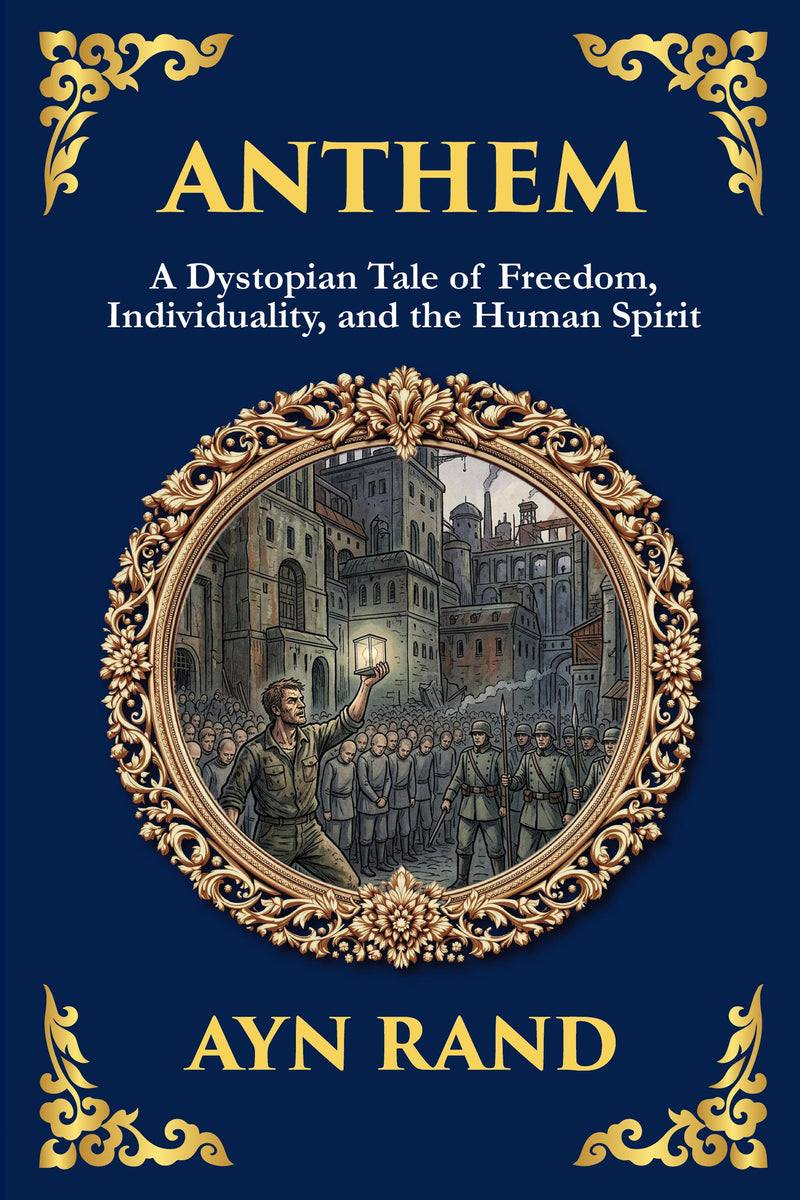
Anthem
In a world where the word “I” no longer exists, one man dares to rediscover the forbidden truth of his own identity. Anthem is Ayn Rand’s haunting and prophetic novella about a future where individuality has been stamped out by collectivism, and society lives under the tyranny of absolute equality.
or free app
10,000+ hrs library
30-day guarantee
The complete Anthem appears in modern English through Library of Alexandria Press, available online with audiobook narration included for members.
Have you ever wondered why individuality threatens oppressive societies? Anthem is Ayn Rand’s chilling dystopian vision of a society where independence is a sin and conformity is law. In this future world, the word “I” has been erased from human language.
All men are bound by the sacred pronoun “We.” Creativity is forbidden, love is a crime, and knowledge is tightly controlled by the collective. Enter Equality 7-2521—a curious and brilliant young man who dares to think for himself. As he secretly conducts experiments and discovers long-lost truths, he begins to question everything his world has taught him.
Escaping into the forbidden Uncharted Forest with the one he loves, he begins a journey not only of physical freedom, but of mental and spiritual awakening. Written with lyrical intensity and philosophical depth, Anthem is a declaration of self-worth in the face of dehumanizing collectivism. Though short in length, its impact is vast, offering a searing critique of totalitarianism and an unforgettable defense of the individual.
What you’ll discover in this modern edition
- A Visionary Dystopia – A chilling society where free thought is forbidden and identity erased.
- A Hero’s Awakening – Follow Equality 7-2521 as he dares to reclaim his voice, his name, and his soul.
- A Poetic Exploration of Philosophy – Rand’s early expression of her ideals that would evolve into Objectivism.
- A Celebration of Individualism – A powerful reminder that self-discovery is the first act of rebellion.
- A Short Novel with Immense Impact – One of the most influential dystopian texts of the 20th century. For readers of Orwell, Huxley, or anyone who values freedom and thought, Anthem remains a vital and inspiring call to reclaim the self.
| Formats | eBook (EPUB + PDF) · Audiobook · Paperback · Hardcover · Large Print |
| Language | English |
| Trim size (print) | 6 × 9 in |
| Binding | Paperback — perfect-bound · Hardcover — casewrap |
| Large Print edition | Same text in a larger, easy-read type — a larger font, not a larger trim |
| Print pricing | Every physical book at our true cost — at-cost, no profit (members) |
| Library | 873 restored titles, always growing |
| Length | 20,881 words · ~1 hr 24 min reading |
| Reading level | Grade 7 · an easy, flowing read (this modern-English edition) |
| Edition | Modern English translation · 2026 |
Member reviews for this edition are collected as readers finish it — be the first. Across the library: 12,000+ books shipped, every plan covered by a 365-day print guarantee.
About this edition
A faithful, unabridged modern-English edition by The Library of Alexandria — carefully rendered for today's reader and verified paragraph-by-paragraph against the public-domain source. Available as eBook, audiobook, paperback, hardcover, and large print.
- Complete & unabridgedVerified paragraph by paragraph against the source — never a scan, never abridged.
- Modern English, faithfulReadable today, with the author’s meaning kept intact. Readable — not simplified.
- Every format, one membershipRead in your browser or the free app, or listen to the full audiobook.
Included free with your membership
Cancel anytime, one click · 30-day money-back guarantee
Edition last updated July 2026
What’s inside
Anthem — complete and unabridged: all 13 sections included with membership, plus the full audiobook.
Begin reading Anthem
In clear modern English — the complete text is included with membership.
Introduction
There are books we read, and there are books that read us. Anthem belongs to the second category. It is a slim volume—you could finish it in a single afternoon—yet it has lodged itself in the imaginations of generations of readers with the persistence of a song you cannot stop humming. First published in England in 1938, after being rejected by American publishers who could not quite grasp what they were holding, this short and fierce work has since sold millions of copies and become a fixture in classrooms, debate societies, and the private libraries of people who think deeply about what it means to be free. To open it now, in this modern translation adapted for the contemporary reader, is to step into one of the most concentrated and emotionally charged stories ever written about the value of a single human soul.
What makes this little book so enduring is not its length or even its plot, which is deliberately spare. It is the intensity of its conviction. Ayn Rand wrote with the urgency of someone who had personally watched a great experiment in collective living devour the individuals it claimed to serve. She had grown up in Russia during the revolution that promised paradise and delivered terror, and she carried out of that experience a lifelong determination to defend the one thing she believed totalitarian systems always sought to extinguish: the irreducible, sacred fact of the self. Anthem is the purest distillation of that determination. It is a parable, a prose poem, a warning, and—perhaps most surprisingly to those who expect only cold philosophy from its author—a love story. It is also, beneath all of these, a celebration of the moment when a human being first dares to say the word “I.”
To prepare yourself for the experience ahead, it helps to understand the remarkable formal experiment at the heart of this story, because it is unlike almost anything else you will read. Rand imagined a future in which humanity has decided, deliberately and completely, that the individual must be erased. Not merely controlled, not merely organized into committees and collectives, but erased at the deepest possible level—the level of language itself. In the world she creates, the word “I” has been forbidden and forgotten. It does not exist. No person may refer to himself in the singular. Every man and woman speaks of themselves only as “we,” because the people of this world have been taught that to think of oneself as a separate being is the gravest of all sins.
Consider what this means for the act of reading. The narrator of this tale tells his own story, describes his own thoughts, confesses his own fears and longings—and yet he must do so without the most natural word in any human tongue. When he is afraid, “we are afraid.” When he loves, “we love.” When he stands alone in the darkness with a forbidden secret burning in his chest, he must still call himself “we.” The effect is strange, claustrophobic, and quietly devastating. You feel, almost from the first page, that something essential is missing, that a voice is straining against an invisible cage, that a single person is trying to speak through a grammar designed to deny that single persons exist.
This is no mere literary trick. It is the entire argument of the book made flesh in its sentences. Rand understood something that great writers and great tyrants have always understood in their different ways: that the words we are permitted to use shape the thoughts we are able to think. Take away the word for the self, and you may be able to take away the very idea of the self. The genius of this story is that it lets you feel the suffocation directly. You do not merely learn that the narrator lives in a world that denies individuality; you experience that denial in every “we” that should be an “I,” and you find yourself longing, on his behalf, for a liberation you cannot yet imagine. When that liberation comes—and the moment when it comes is one of the most thrilling in modern literature—it lands with the force of a revelation precisely because Rand has made you wait for it, made you ache for it, made you understand in your own body why a single word can be worth more than an empire.
This modern translation has been prepared with the goal of letting that experience reach you as cleanly as possible. The original prose carries a deliberately archaic, almost biblical cadence, an echo of the King James solemnity that suited Rand’s intention of writing something that felt like scripture turned upside down. That solemnity is part of the book’s beauty, but it can sometimes place a veil between a contemporary reader and the raw feeling underneath. The aim here has been to preserve the dignity and the rhythm of Rand’s voice—the chant-like quality that gives the book its title—while smoothing the passages where older constructions might cause a reader to stumble or stand at a distance. Think of it as cleaning a window: the view beyond, the burning landscape of Rand’s imagination, remains exactly as she painted it. You will still feel the strangeness of a world without “I.” You will still hear the rising music of a soul learning to sing alone. But the glass between you and that world has been made clear.
Our narrator introduces himself by a name that is not really a name at all. In his society, people are not given names; they are assigned designations, combinations of a word and a number, stamped upon them like a label on a product on a shelf. He is one among thousands who share the same word in their designation, distinguished only by the number that follows it. This detail tells you everything about the world he inhabits. Here, no one is meant to be special, no one is meant to stand out, and the worst thing a person can be is preferred—to be loved more than another, to be more gifted than another, to want anything for oneself that others do not equally possess. From birth, the people of this world are taught a single overriding lesson: that they exist only for their brothers, that they have no purpose but to serve the collective, and that the words carved above the great hall of their city are the highest truth a human being can know—words declaring that there is no man, only the great and indivisible “we.”
Into this gray and regimented existence, Rand places a man who is, despite everything his world has done to prevent it, different. He is taller than his brothers. He learns too quickly. He asks questions that no one is supposed to ask. He feels curiosity stirring in him like a fever, a hunger to understand the workings of the world that the wise old men of his city call evil. He has been taught that his quickness of mind is a curse, that his height is a kind of insolence, that his restless wondering is the mark of a sinner. And for much of his early life he believes this. He tries to be smaller than he is, slower than he is, more obedient than his nature allows. But there is something in him that will not be flattened, a flame that will not be smothered, and it is the story of that flame—how it survives, how it grows, how it finally breaks free and burns—that you are about to follow.
It is worth pausing over the life of the woman who wrote this remarkable book, because few authors have been so thoroughly shaped by their own experience, and few books grow so directly out of a life. Ayn Rand was born in St. Petersburg, Russia, in 1905, into a comfortable middle-class family. Her father was a pharmacist who had worked his way up to ownership of his own business, and the young girl who would become one of the twentieth century’s most controversial writers grew up surrounded by the small securities of a successful family in a great imperial city. Then, when she was twelve years old, the Bolshevik Revolution swept everything away.
She watched as armed men entered her father’s shop and declared that it now belonged to “the people.” She watched her family’s savings vanish, their security crumble, their freedom contract month by month under a regime that spoke endlessly of the collective good while delivering hunger, fear, and silence. She saw friends and neighbors disappear. She learned, at an age when most children are learning arithmetic, that a government claiming to act in the name of all could crush each and every one with perfect ease. These were not abstract lessons for her, not theories debated in a classroom. They were the texture of her adolescence, and they burned into her a hatred of collectivism so total that it would animate everything she ever wrote.
When she finally managed to leave the Soviet Union in 1926, ostensibly to visit relatives in America, she had no intention of returning. She arrived in the United States knowing only a little English and possessing little money, but carrying with her an almost worshipful vision of America as the land where the individual was free—free to think, to work, to rise, to become whatever his abilities and his effort could make of him. She made her way to Hollywood, worked in the film industry, married, struggled, and slowly taught herself to write fiction in a language that was not her own. Her mastery of English would become one of the quiet astonishments of her career; she wrote some of the most rhetorically powerful prose in American letters in a tongue she had begun learning as an adult.
Anthem was written during a break from her labor on a much longer novel, almost as a kind of relief—a short, intense expression of an idea that had been pressing on her for years. The idea was simple and terrifying: What is the logical endpoint of a society that places the collective above the individual in all things? If you really meant it, if you really built a world on the principle that no person should ever place himself above his brothers, where would that world end? Her answer was the world of this book—a stagnant, fearful, technologically backward society where men have forgotten the achievements of the past and live in a permanent twilight, governed by councils that fear progress because progress requires individual minds working freely, and individual minds working freely are the one thing such a society cannot permit.
Notice how this differs from the dystopias you may already know. The famous nightmares of twentieth-century fiction often imagine the future as a place of overwhelming technological power turned against humanity—surveillance everywhere, machines of terrifying sophistication, propaganda piped into every home. Rand imagined something almost more chilling: a future that has gone backward. Her dystopia is not a world of too much technology but of too little, a world where the candle is considered a recent and dangerous innovation, where the great discoveries of earlier ages have been lost because the men who might have made new ones were forbidden to think for themselves. She understood that genius is individual, that every invention, every work of art, every leap forward in human understanding began in a single mind that dared to see what others had not seen. Forbid that daring, she argued, and you do not merely slow human progress—you reverse it, dragging civilization back toward the cave. The decay of her imagined world is not an accident or a catastrophe. It is the inevitable harvest of a philosophy that treats the individual as nothing.
This is why the book reads less like a prophecy of a specific political future and more like a fable about a permanent human truth. Rand was not predicting that the world would literally come to resemble her gray city of councils and torches. She was dramatizing a principle, isolating it, taking it to its absolute extreme so that you could see it clearly. In this sense Anthem belongs to a very old tradition—the tradition of the philosophical tale, the story written to make an idea visible and unforgettable. And like the best of those tales, it accomplishes its purpose not by lecturing but by making you feel. You do not need to agree with every element of Rand’s later, more elaborate philosophy to be moved by this book. You need only to be a person who has ever wanted something for yourself, who has ever felt the particular loneliness of being different, who has ever sensed that there is a part of you that belongs to no one else and that you would die rather than surrender. To anyone who has felt these things—which is to say, to everyone—this story speaks directly.
Cancel anytime, one click · 30-day money-back guarantee
Founding annual rate available now — your price locks for life when you join.
Not ready? Get this free chapter by email — read it anytime.
✓ Sent — check your inbox for Anthem.
Questions about Anthem
What is Anthem about?
In a world where the word “I” no longer exists, one man dares to rediscover the forbidden truth of his own identity. Anthem is Ayn Rand’s haunting and prophetic novella about a future where individuality has been stamped out by collectivism, and society lives under the tyranny of absolute equality. But within the shadows of obedience, a spark of defiance begins to burn.
Who wrote Anthem?
Anthem was written by Ayn Rand. This edition presents the complete work in clear modern English, faithfully rendered from the public-domain original by Library of Alexandria Press.
Is Anthem free to read?
The opening chapter is free to read on this page. Members read and listen to the complete work — and the entire library — free, and can order any physical book at our true print cost.
How long is Anthem?
13 chapters (~20,881 words) — about 1 hr 24 min of reading in this modern-English edition.
Is this an abridged version of Anthem?
No. This is the complete, unabridged Anthem, carefully rendered into clear modern English and verified paragraph-by-paragraph against the public-domain source — nothing is cut or summarised.
What formats does Anthem come in?
Anthem is available as eBook, paperback, hardcover and large print. eBook and audiobook are included with membership; printed editions ship at our true print cost.
Shipping & returns
Billing & membership
More from the library


Explore Romance
- As You Like It · William Shakespeare
- Anna Karenina · Leo Tolstoy
- A Midsummer Night’s Dream · William Shakespeare
- Romeo and Juliet · William Shakespeare
- Sonnets from the Portuguese · Elizabeth Barrett Browning
- Miss Primrose · Agnes Giberne
- The Gay Adventure: A Romance · Richard Bird
- The Belle of Bowling Green · Amelia E. Barr
- The Monk: A Romance · M. G. Lewis
- She · H. Rider Haggard
- The Mill on the Floss · George Eliot
- The Glad Lady · Amy Ella Blanchard
- The Red Lily — Complete · Anatole France
- The Blue Goose · Frank Lewis Nason
- The History of Sir Richard Calmady: A Romance · Lucas Malet
- The Quest of the Silver Fleece: A Novel · W. E. B. Du Bois
- The Love Letters of Mary Wollstonecraft to Gilbert Imlay · Mary Wollstonecraft
- Daddy-Long-Legs · Jean Webster
- The Age of Innocence · Edith Wharton
- The Portrait of a Lady — Volume 1 · Henry James
- Wuthering Heights · Emily Brontë
- The Lady of the Lake · Walter Scott
- Lady Chatterley’s Lover · D. H. Lawrence
- Jane Eyre: An Autobiography · Charlotte Brontë
- A Connecticut Yankee in King Arthur’s Court · Mark Twain
- Northanger Abbey · Jane Austen
- Mansfield Park · Jane Austen
- This Side of Paradise · F. Scott Fitzgerald
- Persuasion · Jane Austen
- The Blue Castle: A Novel · L. M. Montgomery
Anthem
Anthem
A Dystopian Tale of Freedom, Individuality, and the Human Spirit
Ayn Rand
Contents
- Introduction
- Part 1
- Part 2
- Part 3
- Part 4
- Part 5
- Part 6
- Part 7
- Part 8
- Part 9
- Part 10
- Part 11
- Part 12
Introduction
There are books we read, and there are books that read us. Anthem belongs to the second category. It is a slim volume—you could finish it in a single afternoon—yet it has lodged itself in the imaginations of generations of readers with the persistence of a song you cannot stop humming. First published in England in 1938, after being rejected by American publishers who could not quite grasp what they were holding, this short and fierce work has since sold millions of copies and become a fixture in classrooms, debate societies, and the private libraries of people who think deeply about what it means to be free. To open it now, in this modern translation adapted for the contemporary reader, is to step into one of the most concentrated and emotionally charged stories ever written about the value of a single human soul.
What makes this little book so enduring is not its length or even its plot, which is deliberately spare. It is the intensity of its conviction. Ayn Rand wrote with the urgency of someone who had personally watched a great experiment in collective living devour the individuals it claimed to serve. She had grown up in Russia during the revolution that promised paradise and delivered terror, and she carried out of that experience a lifelong determination to defend the one thing she believed totalitarian systems always sought to extinguish: the irreducible, sacred fact of the self. Anthem is the purest distillation of that determination. It is a parable, a prose poem, a warning, and—perhaps most surprisingly to those who expect only cold philosophy from its author—a love story. It is also, beneath all of these, a celebration of the moment when a human being first dares to say the word “I.”
To prepare yourself for the experience ahead, it helps to understand the remarkable formal experiment at the heart of this story, because it is unlike almost anything else you will read. Rand imagined a future in which humanity has decided, deliberately and completely, that the individual must be erased. Not merely controlled, not merely organized into committees and collectives, but erased at the deepest possible level—the level of language itself. In the world she creates, the word “I” has been forbidden and forgotten. It does not exist. No person may refer to himself in the singular. Every man and woman speaks of themselves only as “we,” because the people of this world have been taught that to think of oneself as a separate being is the gravest of all sins.
Consider what this means for the act of reading. The narrator of this tale tells his own story, describes his own thoughts, confesses his own fears and longings—and yet he must do so without the most natural word in any human tongue. When he is afraid, “we are afraid.” When he loves, “we love.” When he stands alone in the darkness with a forbidden secret burning in his chest, he must still call himself “we.” The effect is strange, claustrophobic, and quietly devastating. You feel, almost from the first page, that something essential is missing, that a voice is straining against an invisible cage, that a single person is trying to speak through a grammar designed to deny that single persons exist.
This is no mere literary trick. It is the entire argument of the book made flesh in its sentences. Rand understood something that great writers and great tyrants have always understood in their different ways: that the words we are permitted to use shape the thoughts we are able to think. Take away the word for the self, and you may be able to take away the very idea of the self. The genius of this story is that it lets you feel the suffocation directly. You do not merely learn that the narrator lives in a world that denies individuality; you experience that denial in every “we” that should be an “I,” and you find yourself longing, on his behalf, for a liberation you cannot yet imagine. When that liberation comes—and the moment when it comes is one of the most thrilling in modern literature—it lands with the force of a revelation precisely because Rand has made you wait for it, made you ache for it, made you understand in your own body why a single word can be worth more than an empire.
This modern translation has been prepared with the goal of letting that experience reach you as cleanly as possible. The original prose carries a deliberately archaic, almost biblical cadence, an echo of the King James solemnity that suited Rand’s intention of writing something that felt like scripture turned upside down. That solemnity is part of the book’s beauty, but it can sometimes place a veil between a contemporary reader and the raw feeling underneath. The aim here has been to preserve the dignity and the rhythm of Rand’s voice—the chant-like quality that gives the book its title—while smoothing the passages where older constructions might cause a reader to stumble or stand at a distance. Think of it as cleaning a window: the view beyond, the burning landscape of Rand’s imagination, remains exactly as she painted it. You will still feel the strangeness of a world without “I.” You will still hear the rising music of a soul learning to sing alone. But the glass between you and that world has been made clear.
Our narrator introduces himself by a name that is not really a name at all. In his society, people are not given names; they are assigned designations, combinations of a word and a number, stamped upon them like a label on a product on a shelf. He is one among thousands who share the same word in their designation, distinguished only by the number that follows it. This detail tells you everything about the world he inhabits. Here, no one is meant to be special, no one is meant to stand out, and the worst thing a person can be is preferred—to be loved more than another, to be more gifted than another, to want anything for oneself that others do not equally possess. From birth, the people of this world are taught a single overriding lesson: that they exist only for their brothers, that they have no purpose but to serve the collective, and that the words carved above the great hall of their city are the highest truth a human being can know—words declaring that there is no man, only the great and indivisible “we.”
Into this gray and regimented existence, Rand places a man who is, despite everything his world has done to prevent it, different. He is taller than his brothers. He learns too quickly. He asks questions that no one is supposed to ask. He feels curiosity stirring in him like a fever, a hunger to understand the workings of the world that the wise old men of his city call evil. He has been taught that his quickness of mind is a curse, that his height is a kind of insolence, that his restless wondering is the mark of a sinner. And for much of his early life he believes this. He tries to be smaller than he is, slower than he is, more obedient than his nature allows. But there is something in him that will not be flattened, a flame that will not be smothered, and it is the story of that flame—how it survives, how it grows, how it finally breaks free and burns—that you are about to follow.
It is worth pausing over the life of the woman who wrote this remarkable book, because few authors have been so thoroughly shaped by their own experience, and few books grow so directly out of a life. Ayn Rand was born in St. Petersburg, Russia, in 1905, into a comfortable middle-class family. Her father was a pharmacist who had worked his way up to ownership of his own business, and the young girl who would become one of the twentieth century’s most controversial writers grew up surrounded by the small securities of a successful family in a great imperial city. Then, when she was twelve years old, the Bolshevik Revolution swept everything away.
She watched as armed men entered her father’s shop and declared that it now belonged to “the people.” She watched her family’s savings vanish, their security crumble, their freedom contract month by month under a regime that spoke endlessly of the collective good while delivering hunger, fear, and silence. She saw friends and neighbors disappear. She learned, at an age when most children are learning arithmetic, that a government claiming to act in the name of all could crush each and every one with perfect ease. These were not abstract lessons for her, not theories debated in a classroom. They were the texture of her adolescence, and they burned into her a hatred of collectivism so total that it would animate everything she ever wrote.
When she finally managed to leave the Soviet Union in 1926, ostensibly to visit relatives in America, she had no intention of returning. She arrived in the United States knowing only a little English and possessing little money, but carrying with her an almost worshipful vision of America as the land where the individual was free—free to think, to work, to rise, to become whatever his abilities and his effort could make of him. She made her way to Hollywood, worked in the film industry, married, struggled, and slowly taught herself to write fiction in a language that was not her own. Her mastery of English would become one of the quiet astonishments of her career; she wrote some of the most rhetorically powerful prose in American letters in a tongue she had begun learning as an adult.
Anthem was written during a break from her labor on a much longer novel, almost as a kind of relief—a short, intense expression of an idea that had been pressing on her for years. The idea was simple and terrifying: What is the logical endpoint of a society that places the collective above the individual in all things? If you really meant it, if you really built a world on the principle that no person should ever place himself above his brothers, where would that world end? Her answer was the world of this book—a stagnant, fearful, technologically backward society where men have forgotten the achievements of the past and live in a permanent twilight, governed by councils that fear progress because progress requires individual minds working freely, and individual minds working freely are the one thing such a society cannot permit.
Notice how this differs from the dystopias you may already know. The famous nightmares of twentieth-century fiction often imagine the future as a place of overwhelming technological power turned against humanity—surveillance everywhere, machines of terrifying sophistication, propaganda piped into every home. Rand imagined something almost more chilling: a future that has gone backward. Her dystopia is not a world of too much technology but of too little, a world where the candle is considered a recent and dangerous innovation, where the great discoveries of earlier ages have been lost because the men who might have made new ones were forbidden to think for themselves. She understood that genius is individual, that every invention, every work of art, every leap forward in human understanding began in a single mind that dared to see what others had not seen. Forbid that daring, she argued, and you do not merely slow human progress—you reverse it, dragging civilization back toward the cave. The decay of her imagined world is not an accident or a catastrophe. It is the inevitable harvest of a philosophy that treats the individual as nothing.
This is why the book reads less like a prophecy of a specific political future and more like a fable about a permanent human truth. Rand was not predicting that the world would literally come to resemble her gray city of councils and torches. She was dramatizing a principle, isolating it, taking it to its absolute extreme so that you could see it clearly. In this sense Anthem belongs to a very old tradition—the tradition of the philosophical tale, the story written to make an idea visible and unforgettable. And like the best of those tales, it accomplishes its purpose not by lecturing but by making you feel. You do not need to agree with every element of Rand’s later, more elaborate philosophy to be moved by this book. You need only to be a person who has ever wanted something for yourself, who has ever felt the particular loneliness of being different, who has ever sensed that there is a part of you that belongs to no one else and that you would die rather than surrender. To anyone who has felt these things—which is to say, to everyone—this story speaks directly.
Writing this is a sin. It is a sin to think thoughts that no one else thinks and to write them down on paper that no one else is allowed to see. It is low and evil. It is as if we were speaking to ourselves, with no one else listening. And we know very well that there is no crime worse than acting or thinking alone. We have broken the law. The law states that no one may write unless the Council of Vocations orders them to. May we be forgiven!
But this isn’t our only sin. We have committed a far greater crime, one for which there is no name. We don’t know what punishment awaits us if we are caught, because no such crime has occurred in living memory, and there are no laws to cover it.
It is dark here. The candle flame stands still in the air. Nothing moves in this tunnel except our hand on the paper. We are alone here underground. “Alone” is a terrifying word. The law says that no person may ever be alone, at any time, because this is the ultimate transgression and the root of all evil. But we have broken many laws. Now, there is nothing here but our own body. It feels strange to see only two legs stretched out on the ground, and the shadow of our single head on the wall in front of us.
The walls are cracked, and water runs down them in thin, silent threads, black and glistening like blood. We stole the candle from the pantry of the Home of the Street Sweepers. If we are caught, we will be sentenced to ten years in the Palace of Corrective Detention. But that doesn’t matter. All that matters is that the light is precious; we shouldn’t waste it on writing when we need it for the work that is our crime. Nothing matters except the work—our secret, our evil, our precious work. Still, we must write, because—may the Council have mercy on us!—for once, we want to speak to no one but ourselves.
End of the free sample
Keep reading, free
Members read and listen to the complete book — and the entire library. Cancel anytime, one click · 30-day money-back guarantee.