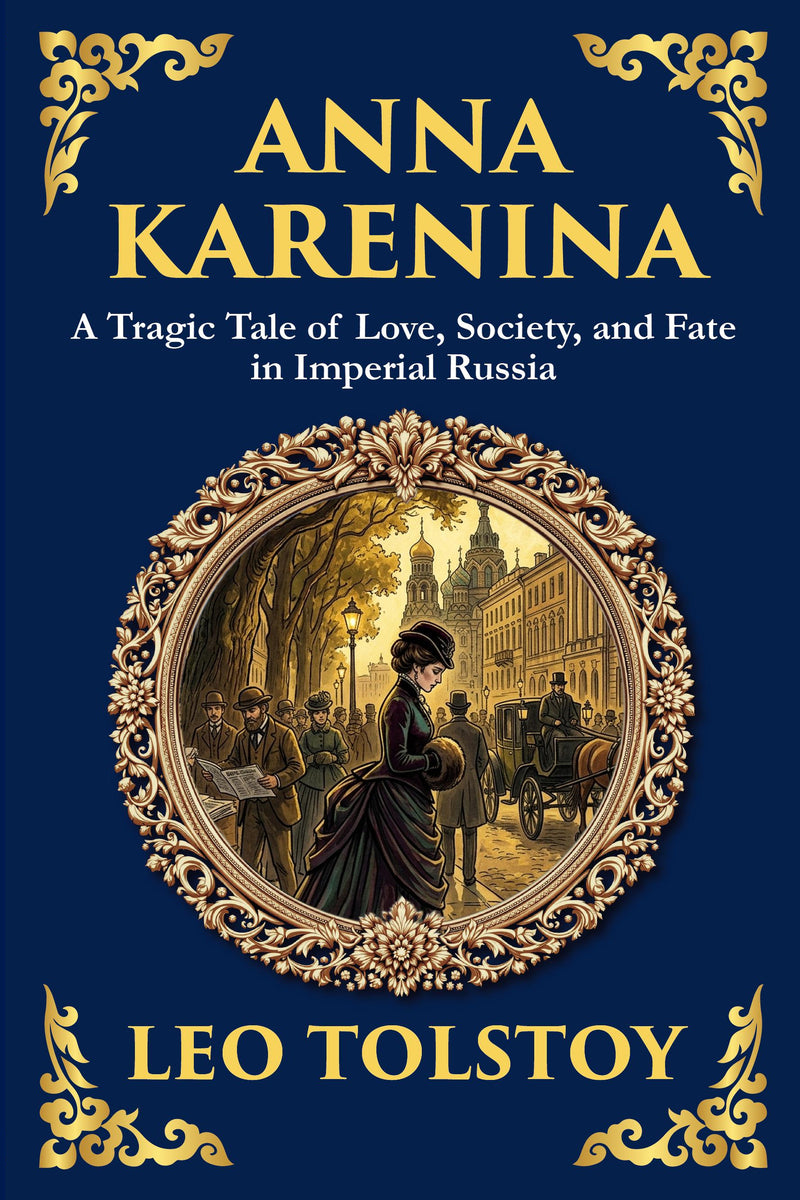
Anna Karenina
Step into the glittering world of Imperial Russia, where passion and duty collide in one of the greatest novels ever written.
or free app
10,000+ hrs library
30-day guarantee
The complete Anna Karenina appears in modern English through Library of Alexandria Press, available online with audiobook narration included for members.
Have you ever wondered why passion can lead to both bliss and ruin? In Anna Karenina, Leo Tolstoy delivers one of the most celebrated novels in world literature—a sweeping epic of love, betrayal, and the search for meaning in a rapidly changing society. Set amidst the opulence and intrigue of Imperial Russia, this novel tells the intertwined stories of characters whose lives are shaped by powerful forces of desire, duty, and destiny.
At its heart is Anna Karenina, a captivating woman trapped in a loveless marriage. When she meets the dashing Count Vronsky, their passionate affair ignites scandal and forces Anna to confront the limits of her freedom and the crushing weight of societal judgment. Alongside Anna’s tale, Tolstoy weaves the life of Konstantin Levin, a landowner grappling with questions of faith, purpose, and the meaning of happiness.
This modern translation captures Tolstoy’s lyrical prose and philosophical depth, making this timeless novel accessible for today’s readers. Whether you are drawn to its romantic drama or its profound moral questions, Anna Karenina offers a reading experience that is as emotionally powerful as it is intellectually stirring.
What you’ll discover in this modern edition
- A Tragic Love Story – Follow Anna’s journey as she risks everything for love, only to face devastating consequences.
- The Glitter and Shadows of Imperial Russia – Experience the contrasts of aristocratic salons and rural farmlands in a society on the brink of change.
- Philosophical Depth – Explore Tolstoy’s reflections on morality, free will, and the search for lasting happiness.
- Interwoven Lives and Themes – Discover how Anna’s tragedy parallels Levin’s spiritual awakening and quest for purpose.
- A Modern, Accessible Translation – Enjoy Tolstoy’s classic work with clear, engaging language tailored for today’s readers. Anna Karenina is more than a novel—it is a profound meditation on love, family, and the human condition.
| Formats | eBook (EPUB + PDF) · Audiobook · Paperback · Hardcover · Large Print |
| Language | English |
| Trim size (print) | 6 × 9 in |
| Binding | Paperback — perfect-bound · Hardcover — casewrap |
| Large Print edition | Same text in a larger, easy-read type — a larger font, not a larger trim |
| Print pricing | Every physical book at our true cost — at-cost, no profit (members) |
| Library | 873 restored titles, always growing |
| Length | 322,911 words · ~21 hr 32 min reading |
| Reading level | Grade 8 · an easy, flowing read (this modern-English edition) |
| Edition | Modern English translation · 2026 |
Member reviews for this edition are collected as readers finish it — be the first. Across the library: 12,000+ books shipped, every plan covered by a 365-day print guarantee.
About this edition
A faithful, unabridged modern-English edition by The Library of Alexandria — carefully rendered for today's reader and verified paragraph-by-paragraph against the public-domain source. Available as eBook, audiobook, paperback, hardcover, and large print.
- Complete & unabridgedVerified paragraph by paragraph against the source — never a scan, never abridged.
- Modern English, faithfulReadable today, with the author’s meaning kept intact. Readable — not simplified.
- Every format, one membershipRead in your browser or the free app, or listen to the full audiobook.
Included free with your membership
Cancel anytime, one click · 30-day money-back guarantee
Edition last updated July 2026
What’s inside
Anna Karenina — complete and unabridged: all 44 sections included with membership, plus the full audiobook.
Begin reading Anna Karenina
In clear modern English — the complete text is included with membership.
Introduction
Few opening lines in all of literature have been quoted, debated, and treasured as often as the one that begins this novel: “Happy families are all alike; every unhappy family is unhappy in its own way.” In a single sentence, Leo Tolstoy announces the vast ambition of the book you are about to read. He is not interested in painting a tidy portrait of contentment; he is interested in the messy, contradictory, painfully human ways that people pursue happiness and stumble into sorrow. He wants to examine love in all its forms—passionate and tender, doomed and enduring, selfish and self-sacrificing—and to set those private dramas against the immense backdrop of a society in flux. The result is a work that has been called, by no less an authority than William Faulkner, simply “the best novel ever written.” Whether or not you finish these pages agreeing with that verdict, you will understand why the claim has been made so often and so confidently.
This edition has been prepared with you, the contemporary reader, firmly in mind. Tolstoy wrote in the 1870s, in a Russia governed by a Tsar, populated by a landed aristocracy and a vast peasantry, and shaped by social codes and religious assumptions that can feel remote to us today. The modern adaptation you hold aims to clear away the unnecessary obstacles—the archaic phrasings, the conventions of nineteenth-century prose that have aged less gracefully than the story itself—while preserving the soul of the work: its emotional precision, its moral seriousness, its breathtaking psychological insight. You will not need a scholarly apparatus or a Russian dictionary to lose yourself in these pages. What you will need is patience for a story that unfolds at its own deliberate pace, and a willingness to live for a while inside the minds of people who feel astonishingly real. By the end, you may find that they have become as familiar to you as members of your own family.
It is worth saying at the outset that this is a long book, and an unhurried one. Tolstoy did not write for readers in a hurry. He wrote for readers who wanted to inhabit a world completely, to follow characters across years of their lives, to watch them change in increments so gradual that we scarcely notice until we look back and realize how far they have traveled. If you approach this novel expecting the brisk momentum of a thriller, you may at first feel restless. But if you allow yourself to settle into its rhythms, you will discover one of the great pleasures of reading: the sense of total immersion, of having lived another life entirely. The investment of your time will be repaid many times over.
To enter this novel is to step into Imperial Russia at a moment of profound transformation. The 1860s and 1870s were a period of upheaval and uncertainty. In 1861, only a little more than a decade before Tolstoy began writing, Tsar Alexander II had emancipated the serfs—tens of millions of peasants who had been bound to the land and to their masters. This was an event of seismic consequence, comparable in scale to the abolition of slavery in the United States, and its aftershocks ripple all through the book. The aristocratic landowners whose lives we follow are wrestling with what it means to manage their estates in this new order, how to relate to the peasants who once belonged to them, and what their own role should be in a society whose foundations have shifted beneath their feet.
This is not merely historical background; it is woven into the very fabric of the story. One of the novel’s central figures spends a great deal of his energy thinking about agriculture, land reform, and the relationship between the educated elite and the people who actually work the soil. These passages, which some readers find challenging, were deeply personal to Tolstoy. He himself was a wealthy landowner who agonized over precisely these questions, who experimented with new methods of farming and schooling on his own estate, and who would eventually renounce much of his privilege in pursuit of a simpler, more authentic life. When you read about the joys and frustrations of working the land, of mowing a field alongside the peasants, of trying to bridge the chasm between classes, you are reading something Tolstoy lived and felt to the depths of his being.
At the same time, the novel takes us into the glittering, suffocating world of high society—the salons and ballrooms and theaters of Moscow and St. Petersburg, where reputation is currency and a single misstep can ruin a life. This was a world bound by rigid rules, especially for women. A man might conduct affairs with relative impunity; a woman who strayed from the path of propriety faced social annihilation. The drawing rooms that seem so elegant are also arenas of judgment, where smiles conceal cruelty and the whispered opinion of the right people can determine whether one is welcomed or cast out. Understanding the weight of these social codes is essential to feeling the full force of the choices the characters make. What might seem, to a modern reader, like an ordinary human decision could in this world be an act of extraordinary courage or catastrophic recklessness.
The texture of daily life in this Russia is rendered with a fullness that few novelists before or since have matched. We attend dinners and balls, horse races and weddings, sickbeds and childbirths. We follow characters to the opera and the country, to the gambling table and the church. Tolstoy had an almost supernatural gift for the telling detail—the way a person fiddles with their gloves when nervous, the particular quality of light at a certain hour, the half-conscious gestures that betray what words conceal. Reading these scenes, you do not feel that you are being told about this world; you feel that you are present within it, that you could reach out and touch the cool marble of a staircase or smell the perfume in a crowded room. This is one of the secrets of the book’s enduring power. It does not describe life from the outside; it recreates the experience of being alive.
Religion, too, runs as a deep current beneath the surface. The Orthodox faith shaped every aspect of Russian life, from the rituals that marked birth and marriage and death to the moral assumptions that governed how people judged one another and themselves. Several characters grapple seriously with questions of faith—not in an abstract, theological way, but as a lived crisis: How should one live? What gives life meaning? Is there a God, and if so, what does He ask of us? These were the very questions that would come to dominate Tolstoy’s own existence, and in the latter part of the novel especially, you can feel the author working through them with an urgency that transcends mere storytelling. The spiritual searching of the book is not a digression from its drama; it is, in many ways, the destination toward which the whole vast structure has been moving.
To read this novel is to encounter one of the most extraordinary minds in the history of literature. Count Lev Nikolayevich Tolstoy was born in 1828 into one of Russia’s oldest and most distinguished noble families. Orphaned young, he was raised by relatives and educated by tutors before attending university, which he left without a degree, restless and dissatisfied. As a young man he led a life of considerable dissipation—gambling, drinking, womanizing—and he recorded his moral struggles in diaries with a ruthless honesty that would become the hallmark of his fiction. He served in the army during the Crimean War, witnessing the horrors of the siege of Sevastopol, an experience that gave him an unsparing understanding of courage, fear, and death that would inform all his later writing.
By the time he began this novel in the early 1870s, Tolstoy was already famous as the author of War and Peace, that colossal epic of Russia during the Napoleonic invasion. He was a married man, the master of a great estate at Yasnaya Polyana, and a father many times over. He was also a man perpetually at war with himself, torn between the pleasures and privileges of his class and a growing conviction that such a life was hollow, even sinful. This inner conflict—between the demands of the flesh and the longings of the spirit, between worldly success and moral truth—is the engine that drives so much of his fiction, and it beats powerfully at the heart of this book.
What sets Tolstoy apart from nearly every other writer is the uncanny accuracy with which he renders human consciousness. He seems to have understood, intuitively and completely, how people actually think and feel—not how they say they think and feel, not how literary convention dictates they should, but the real, contradictory, often unflattering truth of inner experience. He shows us characters lying to themselves, rationalizing their worst impulses, surprising themselves with sudden tenderness or unexpected cruelty. He captures the way a single emotion can contain its opposite, the way love can curdle into resentment, the way a moment of joy can be shadowed by an inexplicable dread. Reading him, you will repeatedly experience the shock of recognition—the sense that he has put into words something you have felt but never quite been able to articulate, something you may have hidden even from yourself.
This psychological realism extends to every character, however minor. Tolstoy does not divide his people into heroes and villains. Even the characters who behave badly are shown from within, with their reasons and their pains made comprehensible. Even the characters we admire are shown to have their flaws, their pettiness, their blind spots. This refusal to simplify is one of the great moral achievements of the novel. It teaches us, gently and without preaching, to extend our sympathy more widely, to recognize that every human being is the protagonist of their own story, struggling with their own burdens that we cannot fully see. By the time you finish, you may find that your capacity for understanding others has been quietly enlarged.
It is worth noting that Tolstoy’s own marriage informed the novel profoundly. He and his wife, Sofya, had a relationship of extraordinary intensity, full of passion and conflict, devotion and friction. Before their wedding, in a gesture that shocked her, he gave her his bachelor diaries to read, wanting her to know the full truth of his past—a scene that finds an echo within these pages. The portrait of courtship and marriage in this book, with all its ecstasies and disillusionments, its quarrels and reconciliations, has the unmistakable ring of lived experience. Tolstoy knew from the inside what it meant to love another person across the long years of a shared life, and he poured that knowledge into his fiction with a candor that can still take a reader’s breath away.
After completing this novel, Tolstoy underwent a spiritual crisis so severe that he contemplated suicide, and he emerged from it a transformed man. He renounced his earlier fiction, embraced a radical form of Christianity centered on nonviolence and simple living, and gave away much of his wealth—a path that brought him into conflict with the Church, the state, and his own family. He became a kind of secular prophet, his moral teachings influencing figures as significant as Mahatma Gandhi. But for all his later renunciations, the novels he wrote in his prime remain his greatest gift to the world. In this book, you can see him standing at the threshold of that transformation—still a supreme artist, but already a man consumed by the largest questions a human being can ask. That tension, between the storyteller and the seeker, gives the book a depth and urgency that few works of fiction possess.
Let me offer a few thoughts to enhance your experience, without revealing anything that would spoil the unfolding of the story. First, be patient with the structure. This is a novel of parallel lives. Tolstoy follows several characters and several relationships at once, cutting back and forth between them, and the connections between these storylines are not always immediately obvious. At first you may wonder why we have left one set of characters to spend time with another. Trust the architecture. Tolstoy is building a vast counterpoint, a series of mirrors and contrasts in which each story illuminates the others. The relationships are meant to be compared—their differences and resemblances are the very substance of what Tolstoy wants to show us about love and life. By the end, you will see how every thread belongs to a single, magnificent design.
Cancel anytime, one click · 30-day money-back guarantee
Founding annual rate available now — your price locks for life when you join.
Not ready? Get this free chapter by email — read it anytime.
✓ Sent — check your inbox for Anna Karenina.
Questions about Anna Karenina
What is Anna Karenina about?
Step into the glittering world of Imperial Russia, where passion and duty collide in one of the greatest novels ever written. Anna Karenina, a woman of rare beauty and charm, risks everything for a love that defies social conventions. Her story unfolds against a backdrop of aristocratic privilege, rural struggles, and sweeping societal change.
Who wrote Anna Karenina?
Anna Karenina was written by Leo Tolstoy. This edition presents the complete work in clear modern English, faithfully rendered from the public-domain original by Library of Alexandria Press.
Is Anna Karenina free to read?
The opening chapter is free to read on this page. Members read and listen to the complete work — and the entire library — free, and can order any physical book at our true print cost.
How long is Anna Karenina?
44 chapters (~322,911 words) — about 21 hr 32 min of reading in this modern-English edition.
Is this an abridged version of Anna Karenina?
No. This is the complete, unabridged Anna Karenina, carefully rendered into clear modern English and verified paragraph-by-paragraph against the public-domain source — nothing is cut or summarised.
What formats does Anna Karenina come in?
Anna Karenina is available as eBook. eBook and audiobook are included with membership; printed editions ship at our true print cost.
Shipping & returns
Billing & membership
More from the library


Explore Romance
- As You Like It · William Shakespeare
- A Midsummer Night’s Dream · William Shakespeare
- Romeo and Juliet · William Shakespeare
- The Peony Pavilion — Large Print · Tang Xianzu
- The Lost Estate — Large Print · Alain-Fournier
- The Peony Pavilion · Tang Xianzu
- The Nail — Large Print · Pedro Antonio de Alarcón
- Jacques — Large Print · George Sand
- The Nail · Pedro Antonio de Alarcón
- The Lost Estate · Alain-Fournier
- Jacques · George Sand
- The Gay Cockade · Temple Bailey
- The Eternal Savage — Large Print · Edgar Rice Burroughs
- Salthaven — Large Print · W. W. Jacobs
- Salthaven · W. W. Jacobs
- Evangeline · Henry Wadsworth Longfellow
- Robert Orange · John Oliver Hobbes
- The Fairy of the Sands · Paul Féval
- Summer — Large Print · Edith Wharton
- Evangeline — Large Print · Henry Wadsworth Longfellow
- The Eternal Savage · Edgar Rice Burroughs
- Women in Love — Large Print · D. H. Lawrence
- Villette — Large Print · Charlotte Brontë
- Aurora Leigh — Large Print · Elizabeth Barrett Browning
- Cyrano de Bergerac · Edmond Rostand
- Tales of Love — Large Print · Emilia Pardo Bazán
- Saved from Herself — Large Print · Adelaide Stirling
- Tristram of Blent — Large Print · Anthony Hope
- The Palace of Eternal Life · Hong Sheng
- Night and Day — Large Print · Virginia Woolf
Anna Karenina
Anna Karenina
A Tragic Tale of Love, Society, and Fate in Imperial Russia
Leo Tolstoy
Contents
- Introduction
- Part 1
- Chapter 1
- Chapter 2
- Chapter 3
- Chapter 4
- Chapter 5
- Chapter 6
- Chapter 7
- Chapter 8
- Chapter 9
- Chapter 10
- Chapter 11
- Chapter 12
- Chapter 13
- Chapter 14
- Chapter 15
- Chapter 16
- Chapter 17
- Chapter 18
- Chapter 19
- Chapter 20
- Chapter 21
- Chapter 22
- Chapter 23
- Chapter 24
- Chapter 25
- Chapter 26
- Chapter 27
- Chapter 28
- Chapter 29
- Chapter 30
- Chapter 31
- Chapter 32
- Chapter 33
- Chapter 34
- Part 2
- Chapter 35
- Part 3
- Part 4
- … and 4 more chapters
Introduction
Few opening lines in all of literature have been quoted, debated, and treasured as often as the one that begins this novel: “Happy families are all alike; every unhappy family is unhappy in its own way.” In a single sentence, Leo Tolstoy announces the vast ambition of the book you are about to read. He is not interested in painting a tidy portrait of contentment; he is interested in the messy, contradictory, painfully human ways that people pursue happiness and stumble into sorrow. He wants to examine love in all its forms—passionate and tender, doomed and enduring, selfish and self-sacrificing—and to set those private dramas against the immense backdrop of a society in flux. The result is a work that has been called, by no less an authority than William Faulkner, simply “the best novel ever written.” Whether or not you finish these pages agreeing with that verdict, you will understand why the claim has been made so often and so confidently.
This edition has been prepared with you, the contemporary reader, firmly in mind. Tolstoy wrote in the 1870s, in a Russia governed by a Tsar, populated by a landed aristocracy and a vast peasantry, and shaped by social codes and religious assumptions that can feel remote to us today. The modern adaptation you hold aims to clear away the unnecessary obstacles—the archaic phrasings, the conventions of nineteenth-century prose that have aged less gracefully than the story itself—while preserving the soul of the work: its emotional precision, its moral seriousness, its breathtaking psychological insight. You will not need a scholarly apparatus or a Russian dictionary to lose yourself in these pages. What you will need is patience for a story that unfolds at its own deliberate pace, and a willingness to live for a while inside the minds of people who feel astonishingly real. By the end, you may find that they have become as familiar to you as members of your own family.
It is worth saying at the outset that this is a long book, and an unhurried one. Tolstoy did not write for readers in a hurry. He wrote for readers who wanted to inhabit a world completely, to follow characters across years of their lives, to watch them change in increments so gradual that we scarcely notice until we look back and realize how far they have traveled. If you approach this novel expecting the brisk momentum of a thriller, you may at first feel restless. But if you allow yourself to settle into its rhythms, you will discover one of the great pleasures of reading: the sense of total immersion, of having lived another life entirely. The investment of your time will be repaid many times over.
To enter this novel is to step into Imperial Russia at a moment of profound transformation. The 1860s and 1870s were a period of upheaval and uncertainty. In 1861, only a little more than a decade before Tolstoy began writing, Tsar Alexander II had emancipated the serfs—tens of millions of peasants who had been bound to the land and to their masters. This was an event of seismic consequence, comparable in scale to the abolition of slavery in the United States, and its aftershocks ripple all through the book. The aristocratic landowners whose lives we follow are wrestling with what it means to manage their estates in this new order, how to relate to the peasants who once belonged to them, and what their own role should be in a society whose foundations have shifted beneath their feet.
This is not merely historical background; it is woven into the very fabric of the story. One of the novel’s central figures spends a great deal of his energy thinking about agriculture, land reform, and the relationship between the educated elite and the people who actually work the soil. These passages, which some readers find challenging, were deeply personal to Tolstoy. He himself was a wealthy landowner who agonized over precisely these questions, who experimented with new methods of farming and schooling on his own estate, and who would eventually renounce much of his privilege in pursuit of a simpler, more authentic life. When you read about the joys and frustrations of working the land, of mowing a field alongside the peasants, of trying to bridge the chasm between classes, you are reading something Tolstoy lived and felt to the depths of his being.
At the same time, the novel takes us into the glittering, suffocating world of high society—the salons and ballrooms and theaters of Moscow and St. Petersburg, where reputation is currency and a single misstep can ruin a life. This was a world bound by rigid rules, especially for women. A man might conduct affairs with relative impunity; a woman who strayed from the path of propriety faced social annihilation. The drawing rooms that seem so elegant are also arenas of judgment, where smiles conceal cruelty and the whispered opinion of the right people can determine whether one is welcomed or cast out. Understanding the weight of these social codes is essential to feeling the full force of the choices the characters make. What might seem, to a modern reader, like an ordinary human decision could in this world be an act of extraordinary courage or catastrophic recklessness.
The texture of daily life in this Russia is rendered with a fullness that few novelists before or since have matched. We attend dinners and balls, horse races and weddings, sickbeds and childbirths. We follow characters to the opera and the country, to the gambling table and the church. Tolstoy had an almost supernatural gift for the telling detail—the way a person fiddles with their gloves when nervous, the particular quality of light at a certain hour, the half-conscious gestures that betray what words conceal. Reading these scenes, you do not feel that you are being told about this world; you feel that you are present within it, that you could reach out and touch the cool marble of a staircase or smell the perfume in a crowded room. This is one of the secrets of the book’s enduring power. It does not describe life from the outside; it recreates the experience of being alive.
Religion, too, runs as a deep current beneath the surface. The Orthodox faith shaped every aspect of Russian life, from the rituals that marked birth and marriage and death to the moral assumptions that governed how people judged one another and themselves. Several characters grapple seriously with questions of faith—not in an abstract, theological way, but as a lived crisis: How should one live? What gives life meaning? Is there a God, and if so, what does He ask of us? These were the very questions that would come to dominate Tolstoy’s own existence, and in the latter part of the novel especially, you can feel the author working through them with an urgency that transcends mere storytelling. The spiritual searching of the book is not a digression from its drama; it is, in many ways, the destination toward which the whole vast structure has been moving.
To read this novel is to encounter one of the most extraordinary minds in the history of literature. Count Lev Nikolayevich Tolstoy was born in 1828 into one of Russia’s oldest and most distinguished noble families. Orphaned young, he was raised by relatives and educated by tutors before attending university, which he left without a degree, restless and dissatisfied. As a young man he led a life of considerable dissipation—gambling, drinking, womanizing—and he recorded his moral struggles in diaries with a ruthless honesty that would become the hallmark of his fiction. He served in the army during the Crimean War, witnessing the horrors of the siege of Sevastopol, an experience that gave him an unsparing understanding of courage, fear, and death that would inform all his later writing.
By the time he began this novel in the early 1870s, Tolstoy was already famous as the author of War and Peace, that colossal epic of Russia during the Napoleonic invasion. He was a married man, the master of a great estate at Yasnaya Polyana, and a father many times over. He was also a man perpetually at war with himself, torn between the pleasures and privileges of his class and a growing conviction that such a life was hollow, even sinful. This inner conflict—between the demands of the flesh and the longings of the spirit, between worldly success and moral truth—is the engine that drives so much of his fiction, and it beats powerfully at the heart of this book.
What sets Tolstoy apart from nearly every other writer is the uncanny accuracy with which he renders human consciousness. He seems to have understood, intuitively and completely, how people actually think and feel—not how they say they think and feel, not how literary convention dictates they should, but the real, contradictory, often unflattering truth of inner experience. He shows us characters lying to themselves, rationalizing their worst impulses, surprising themselves with sudden tenderness or unexpected cruelty. He captures the way a single emotion can contain its opposite, the way love can curdle into resentment, the way a moment of joy can be shadowed by an inexplicable dread. Reading him, you will repeatedly experience the shock of recognition—the sense that he has put into words something you have felt but never quite been able to articulate, something you may have hidden even from yourself.
This psychological realism extends to every character, however minor. Tolstoy does not divide his people into heroes and villains. Even the characters who behave badly are shown from within, with their reasons and their pains made comprehensible. Even the characters we admire are shown to have their flaws, their pettiness, their blind spots. This refusal to simplify is one of the great moral achievements of the novel. It teaches us, gently and without preaching, to extend our sympathy more widely, to recognize that every human being is the protagonist of their own story, struggling with their own burdens that we cannot fully see. By the time you finish, you may find that your capacity for understanding others has been quietly enlarged.
It is worth noting that Tolstoy’s own marriage informed the novel profoundly. He and his wife, Sofya, had a relationship of extraordinary intensity, full of passion and conflict, devotion and friction. Before their wedding, in a gesture that shocked her, he gave her his bachelor diaries to read, wanting her to know the full truth of his past—a scene that finds an echo within these pages. The portrait of courtship and marriage in this book, with all its ecstasies and disillusionments, its quarrels and reconciliations, has the unmistakable ring of lived experience. Tolstoy knew from the inside what it meant to love another person across the long years of a shared life, and he poured that knowledge into his fiction with a candor that can still take a reader’s breath away.
After completing this novel, Tolstoy underwent a spiritual crisis so severe that he contemplated suicide, and he emerged from it a transformed man. He renounced his earlier fiction, embraced a radical form of Christianity centered on nonviolence and simple living, and gave away much of his wealth—a path that brought him into conflict with the Church, the state, and his own family. He became a kind of secular prophet, his moral teachings influencing figures as significant as Mahatma Gandhi. But for all his later renunciations, the novels he wrote in his prime remain his greatest gift to the world. In this book, you can see him standing at the threshold of that transformation—still a supreme artist, but already a man consumed by the largest questions a human being can ask. That tension, between the storyteller and the seeker, gives the book a depth and urgency that few works of fiction possess.
Let me offer a few thoughts to enhance your experience, without revealing anything that would spoil the unfolding of the story. First, be patient with the structure. This is a novel of parallel lives. Tolstoy follows several characters and several relationships at once, cutting back and forth between them, and the connections between these storylines are not always immediately obvious. At first you may wonder why we have left one set of characters to spend time with another. Trust the architecture. Tolstoy is building a vast counterpoint, a series of mirrors and contrasts in which each story illuminates the others. The relationships are meant to be compared—their differences and resemblances are the very substance of what Tolstoy wants to show us about love and life. By the end, you will see how every thread belongs to a single, magnificent design.
Happy families are all alike; every unhappy family is unhappy in its own way.
The Oblonsky household was in total chaos. The wife had discovered that her husband was having an affair with a French girl who had worked as their governess, and she told him she could no longer live in the same house. This standoff had lasted for three days, and everyone in the home—not just the couple, but the entire family and staff—was painfully aware of it. Everyone felt that living together no longer made sense; they felt that random strangers meeting at an inn would have more in common with each other than they did with one another. The wife refused to leave her room, and the husband had been gone for three days. The children ran wild through the house, the English governess fought with the housekeeper and wrote to a friend to help her find a new job, the cook had walked out right at dinner time the day before, and both the kitchen maid and the coachman had given their notice.
Three days after the fight, Prince Stepan Arkadyevitch Oblonsky—known as Stiva in high society—woke up at his usual time, eight in the morning. He wasn’t in his wife’s bedroom, but on the leather sofa in his study. He shifted his plump, well-kept body on the springy sofa as if trying to fall back into a deep sleep; he hugged the pillow tightly and buried his face in it. Then, suddenly, he bolted upright and opened his eyes.
“Right, now, how did it go?” he wondered, retracing his dream. “How was it exactly? I remember! Alabin was hosting a dinner in Darmstadt—no, not Darmstadt, but somewhere in America. Yes, that’s it, Darmstadt was in America. Alabin was serving dinner on glass tables, and the tables were singing ‘Il mio tesoro’—actually, not that song, but something even better. And there were these little decanters on the table, and they were actually women,” he recalled.
End of the free sample
Keep reading, free
Members read and listen to the complete book — and the entire library. Cancel anytime, one click · 30-day money-back guarantee.