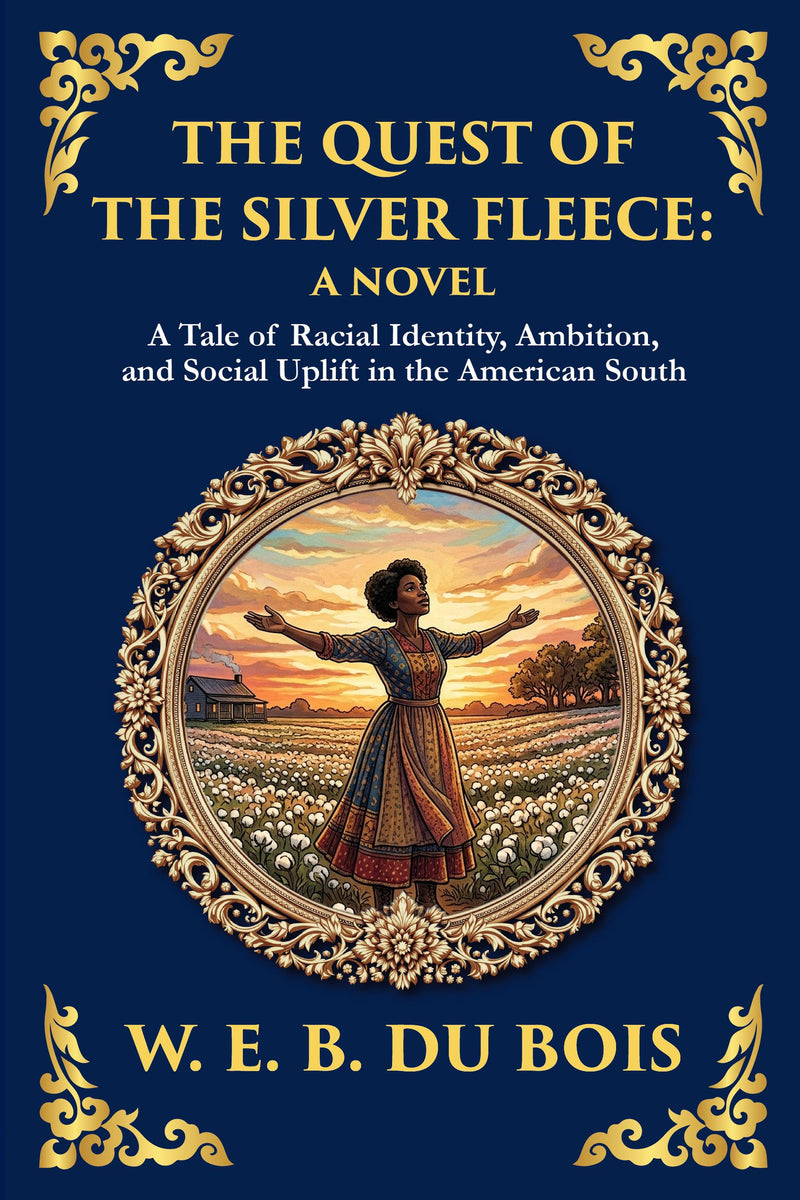
The Quest of the Silver Fleece: A Novel
In the shadows of Reconstruction and the rise of Jim Crow, The Quest of the Silver Fleece unravels the powerful story of love, identity, and resistance.
or free app
10,000+ hrs library
30-day guarantee
The complete The Quest of the Silver Fleece: A Novel appears in modern English through Library of Alexandria Press, available online with audiobook narration included for members.
Have you ever wondered why the pursuit of dignity can demand the highest cost? W. E. B. Du Bois’s The Quest of the Silver Fleece is more than a novel—it is a powerful allegory of liberation, resistance, and love amid the harsh realities of a racially divided America. Set during the post-Reconstruction South, this compelling tale follows the journey of Zora and Bles —two young African Americans whose paths are shaped by ambition, betrayal, and the fierce desire to transform their world.
Zora, raised in the mystical swamps outside Alabama, possesses an innate intelligence and unyielding spirit. Bles, her childhood companion, dreams of justice, education, and societal reform. As the two struggle to navigate a society built on exploitation—where cotton is king and Black labor is currency—they must decide what price they are willing to pay for power, love, and truth.
Through the lens of race, politics, and economics, Du Bois paints a gripping and unflinching portrait of early 20th-century Black life, revealing both its brutal constraints and its radical possibilities.
What you’ll discover in this modern edition
- A Visionary Tale of Race and Resistance Witness Du Bois’s literary genius as he examines the roots of inequality and the fight for justice.
| Formats | eBook (EPUB + PDF) · Audiobook · Paperback · Hardcover · Large Print |
| Language | English |
| Trim size (print) | 6 × 9 in |
| Binding | Paperback — perfect-bound · Hardcover — casewrap |
| Large Print edition | Same text in a larger, easy-read type — a larger font, not a larger trim |
| Print pricing | Every physical book at our true cost — at-cost, no profit (members) |
| Library | 873 restored titles, always growing |
| Length | 112,413 words · ~7 hr 30 min reading |
| Reading level | Grade 7 · an easy, flowing read (this modern-English edition) |
| Edition | Modern English translation · 2026 |
Member reviews for this edition are collected as readers finish it — be the first. Across the library: 12,000+ books shipped, every plan covered by a 365-day print guarantee.
About this edition
A faithful, unabridged modern-English edition by The Library of Alexandria — carefully rendered for today's reader and verified paragraph-by-paragraph against the public-domain source. Available as eBook, audiobook, paperback, hardcover, and large print.
- Complete & unabridgedVerified paragraph by paragraph against the source — never a scan, never abridged.
- Modern English, faithfulReadable today, with the author’s meaning kept intact. Readable — not simplified.
- Every format, one membershipRead in your browser or the free app, or listen to the full audiobook.
Included free with your membership
Cancel anytime, one click · 30-day money-back guarantee
Edition last updated July 2026
What’s inside
The Quest of the Silver Fleece: A Novel — complete and unabridged: all 42 sections included with membership, plus the full audiobook.
Begin reading The Quest of the Silver Fleece: A Novel
In clear modern English — the complete text is included with membership.
Introduction
When The Quest of the Silver Fleece first appeared in 1911, its author was already one of the most formidable intellects in the United States—a scholar, sociologist, editor, and activist whose name had become synonymous with the cause of racial justice in a nation still reckoning with the unfinished business of emancipation. W. E. B. Du Bois had earned a doctorate from Harvard, had studied in Berlin, had produced groundbreaking sociological studies, and had published in 1903 the era-defining collection of essays The Souls of Black Folk. Yet here, in this novel, he reached for something different. He turned to fiction not to abandon argument but to extend it, to clothe the hard data of his sociology in the warmer, more intimate garments of story. This is a book that asks to be read both as a sweeping romance of two young people coming of age in a hostile world and as a searching meditation on the economic and moral forces that shaped the post-Reconstruction South. It is, in the truest sense, a novel of ideas—but it is also a novel of feeling, of longing, of ambition kindled and tested.
The version you hold has been carefully adapted for the contemporary reader. This means that the dense, sometimes ornate prose of the early twentieth century has been rendered into language that flows more naturally to a modern ear, that archaic constructions and obscure references have been gently clarified, and that the reading experience has been smoothed without sacrificing the substance, the music, or the moral seriousness of Du Bois’s original vision. The aim has been to remove the barriers that can stand between a present-day reader and a book more than a century old, while preserving everything that makes the work matter. What remains is the heart of the story: its characters, its drama, its searching questions about who we are and what we owe to one another, and its enduring belief that human dignity is not a privilege to be granted but a birthright to be claimed.
To enter this book is to step into a world organized around a single, glittering, deceptive substance: cotton. In the imagination of the novel, cotton becomes something almost mythic—a kind of golden fleece, dazzling and dangerous, the pursuit of which draws men and nations into a contest that is at once economic, political, and spiritual. The “silver fleece” of the title is no idle ornament; it is the organizing metaphor of the entire work, the thread that binds together the destinies of its characters and the fate of a region. Du Bois had spent years studying the cotton economy of the American South, and he understood as few writers ever have how thoroughly that economy shaped the lives of those who labored within it. Cotton was the engine of Southern wealth, the foundation of vast fortunes, the subject of speculation in distant financial markets. And cotton was grown, picked, and processed largely by Black hands working land they did not own, under conditions that often differed from slavery more in name than in substance.
The novel opens in the swamps and fields of Alabama, in a landscape both beautiful and brutal, where two young people will meet and where their lives will become entangled with the great machinery of the cotton trade. Out of this setting Du Bois fashions a story of education, ambition, and awakening. His protagonists are young, gifted, and poor, born into a system designed to keep them down, and the central drama of the book follows their efforts to rise—to learn, to grow, to make something of themselves, and, crucially, to determine what “making something of themselves” should even mean in a world that has rigged the game against them. Is success measured in money? In power? In the accumulation of the very wealth that the cotton fields produce? Or is there some deeper measure, rooted in love, in community, in the lifting of one’s people rather than the mere elevation of oneself?
These questions are not abstract in the novel; they are dramatized through the choices the characters make, the temptations they face, and the relationships they form and break. Du Bois was deeply skeptical of a purely materialist vision of progress. He had grown wary of the idea, much promoted in his day, that the path to advancement for Black Americans lay simply in industrious labor and the quiet accumulation of property, with political and civil rights deferred to some indefinite future. The novel engages this debate—one of the defining arguments of its era—not through lecture but through plot, allowing the reader to see what such philosophies cost and what they yield in the lives of real human beings. The result is a book that thinks while it feels, that argues while it enchants.
The geography of the novel is itself instructive. It moves between the rural South, with its plantations and swamps and the people who work the land, and the corridors of power far to the north, where the cotton that the South produces becomes the raw material of national and international finance. Du Bois wanted his readers to see the connections between these worlds—to understand that the suffering of a sharecropper in Alabama and the wheeling and dealing of a financier or politician were not separate phenomena but parts of a single interlocking system. In drawing these connections, he was doing something quite radical for a novelist of his time: he was insisting that the personal and the political, the intimate and the economic, the romantic and the systemic, could not be neatly separated. Every choice a character makes ripples outward into the larger structures of society, and those structures in turn press down upon every choice.
What makes this so compelling, even now, is that Du Bois never loses sight of the individual amid the system. His characters are not mere illustrations of social forces; they are vivid, contradictory, sometimes maddening, often deeply sympathetic human beings. There is the young woman of the swamp, half wild and wholly remarkable, possessed of an instinctive nobility and an uncanny gift; there is the earnest young man whose hunger for learning and for a place in the world drives him toward both triumph and danger; there are teachers and schemers, idealists and cynics, the powerful and the powerless. The reader comes to care about them, to worry over their fates, to feel the sting of their disappointments and the warmth of their hopes. This emotional investment is precisely what allows the novel’s larger arguments to land with such force. We do not simply understand the cost of injustice; we feel it in the lives of people we have come to love.
It is worth pausing to appreciate how unusual this novel was, and remains. In 1911, the dominant image of Black life in American popular fiction was a grotesque caricature—the contented servant, the comic buffoon, the menacing brute, all the demeaning types churned out by a culture eager to justify segregation and disenfranchisement. Against this tide, Du Bois offered something almost revolutionary: Black characters of full interiority, intelligence, ambition, and moral complexity. He gave his readers Black women who were not servants but scholars and dreamers, Black men who were not threats but thinkers and builders, communities that were not pathologies but living, struggling, aspiring societies with their own institutions, traditions, and inner lives. To read the novel today is to recognize how much of what we now take for granted in serious fiction about race and identity has roots in this early, brave effort to insist upon the full humanity of people whom the wider culture was determined to diminish.
To understand the ambition of this novel, it helps to understand something of the man who wrote it. William Edward Burghardt Du Bois was born in 1868 in Great Barrington, Massachusetts, just three years after the end of the Civil War. He came of age in a Northern town where he experienced a relatively integrated childhood, only to confront the full weight of American racism as he grew older and ventured into the wider world. He attended Fisk University in Nashville, where he encountered the realities of the Jim Crow South for the first time, then went on to Harvard, becoming the first African American to earn a doctorate from that institution. He studied in Germany, immersing himself in the latest currents of European social science, and returned to the United States determined to apply rigorous scholarship to the problems of race.
His early career was that of a pioneering sociologist. His study The Philadelphia Negro remains a landmark of empirical social research, and his work at Atlanta University produced a series of detailed investigations into the conditions of Black life. But Du Bois was never content to be merely a gatherer of data. He possessed a poetic sensibility, a gift for language, and a burning sense of mission. In The Souls of Black Folk, he fused scholarship with lyricism, sociology with autobiography, producing a book whose famous declaration—that “the problem of the twentieth century is the problem of the color line”—proved prophetic. There he also articulated his enduring concept of “double consciousness,” the peculiar sensation of always seeing oneself through the eyes of a society that holds one in contempt, of feeling one’s identity split between being American and being Black in a nation that refused to fully embrace the combination.
By the time he came to write fiction, Du Bois had also become a political leader. He helped found the Niagara Movement and then, in 1909, the National Association for the Advancement of Colored People—the NAACP—and he became the editor of its influential magazine, The Crisis. He was, in these years, locked in a profound and consequential disagreement with Booker T. Washington, the most prominent Black leader of the age, whose program of accommodation and gradualism—of focusing on vocational training and economic self-help while temporarily setting aside demands for political and civil rights—Du Bois regarded as dangerously insufficient. Du Bois insisted instead on full citizenship, on the right to vote, on access to higher education and the liberal arts, on the cultivation of what he called the “Talented Tenth,” the educated leadership class who would guide and uplift the broader community.
All of these convictions and concerns flow into the novel. It is, among other things, a book deeply engaged with the question of education—what kind of education Black Americans should receive, to what ends, and at what cost. It dramatizes the tension between industrial training and intellectual cultivation, between the practical and the ideal, that lay at the heart of the Washington–Du Bois debate. It explores the seductions and corruptions of power and money, the compromises that ambition can demand, the way that systems of oppression can co-opt and deform even those who set out to resist them. And it returns again and again to the theme of identity—of what it means to know oneself, to claim one’s worth, to refuse the diminished image that society tries to impose.
Yet for all its intellectual seriousness, the novel never forgets that it is a story. Du Bois had a genuine flair for narrative, for scene-setting, for the building of suspense and the orchestration of emotion. There is romance here, and rivalry, and betrayal, and the slow agonizing growth of two souls toward maturity and understanding. There is a swamp that takes on almost mystical significance, a place of danger and mystery and transformation. There is the drama of a great cotton crop, the gamble of planting and harvest, the speculative frenzy of distant markets, all rendered with a vividness that makes the abstract forces of economics feel as immediate and threatening as a gathering storm. The novel moves between registers—the lyrical and the analytical, the intimate and the panoramic, the tender and the fierce—with a confidence that marks the work of a writer fully in command of his material.
Cancel anytime, one click · 30-day money-back guarantee
Founding annual rate available now — your price locks for life when you join.
Not ready? Get this free chapter by email — read it anytime.
✓ Sent — check your inbox for The Quest of the Silver Fleece: A Novel.
Questions about The Quest of the Silver Fleece: A Novel
What is The Quest of the Silver Fleece: A Novel about?
In the shadows of Reconstruction and the rise of Jim Crow, The Quest of the Silver Fleece unravels the powerful story of love, identity, and resistance. Through the intertwined destinies of Zora, a brilliant and resilient Black girl raised in the swamps, and Bles, a young man determined to rise through education and purpose, Du Bois explores the tension between personal ambition and collective struggle. Set against the backdrop of the American South and the corrupt cotton economy, this prophetic novel weaves themes
Who wrote The Quest of the Silver Fleece: A Novel?
The Quest of the Silver Fleece: A Novel was written by W. E. B. Du Bois. This edition presents the complete work in clear modern English, faithfully rendered from the public-domain original by Library of Alexandria Press.
Is The Quest of the Silver Fleece: A Novel free to read?
The opening chapter is free to read on this page. Members read and listen to the complete work — and the entire library — free, and can order any physical book at our true print cost.
How long is The Quest of the Silver Fleece: A Novel?
42 chapters (~112,413 words) — about 7 hr 30 min of reading in this modern-English edition.
Is this an abridged version of The Quest of the Silver Fleece: A Novel?
No. This is the complete, unabridged The Quest of the Silver Fleece: A Novel, carefully rendered into clear modern English and verified paragraph-by-paragraph against the public-domain source — nothing is cut or summarised.
What formats does The Quest of the Silver Fleece: A Novel come in?
The Quest of the Silver Fleece: A Novel is available as eBook, paperback, hardcover and large print. eBook and audiobook are included with membership; printed editions ship at our true print cost.
Shipping & returns
Billing & membership
More from the library


Explore Romance
- As You Like It · William Shakespeare
- Anna Karenina · Leo Tolstoy
- Romeo and Juliet · William Shakespeare
- The Virginian: A Horseman of the Plains — Large Print · Owen Wister
- The Virginian: A Horseman of the Plains · Owen Wister
- Ethan Frome · Edith Wharton
- Ethan Frome — Large Print · Edith Wharton
- North and South · Elizabeth Gaskell
- North and South — Large Print · Elizabeth Gaskell
- Anne of the Island · L. M. Montgomery
- Sonnets from the Portuguese — Large Print · Elizabeth Barrett Browning
- Anne of the Island — Large Print · L. M. Montgomery
- Tess of the d'Urbervilles: A Pure Woman — Large Print · Thomas Hardy
- Jane Eyre: An Autobiography — Large Print · Charlotte Brontë
- The Belle of Bowling Green — Large Print · Amelia E. Barr
- Tess of the d'Urbervilles: A Pure Woman · Thomas Hardy
- Persuasion — Large Print · Jane Austen
- As You Like It — Large Print · William Shakespeare
- Shirley — Large Print · Charlotte Brontë
- Northanger Abbey — Large Print · Jane Austen
- Shirley · Charlotte Brontë
- The Night Land — Large Print · William Hope Hodgson
- Mansfield Park — Large Print · Jane Austen
- The Night Land · William Hope Hodgson
- Lady Chatterley's Lover — Large Print · D. H. Lawrence
- Daddy-Long-Legs — Large Print · Jean Webster
- The Lady of the Lake — Large Print · Walter Scott
- The Blue Castle: a novel — Large Print · L. M. Montgomery
- The Age of Innocence — Large Print · Edith Wharton
- Romeo and Juliet — Large Print · William Shakespeare
The Quest of the Silver Fleece: A Novel
The Quest of the Silver Fleece: A Novel
A story about racial identity, ambition, and social progress in the American South
W. E. B. Du Bois
Contents
- Introduction
- Chapter 1
- Chapter 2
- Chapter 3
- Chapter 4
- Chapter 5
- Chapter 6
- Chapter 7
- Chapter 8
- Chapter 9
- Chapter 10
- Chapter 11
- Chapter 12
- Chapter 13
- Chapter 14
- Chapter 15
- Chapter 16
- Chapter 17
- Chapter 18
- Chapter 19
- Chapter 20
- Chapter 21
- Chapter 22
- Chapter 23
- Chapter 24
- Chapter 25
- Chapter 26
- Chapter 27
- Chapter 28
- Chapter 29
- Chapter 30
- Chapter 31
- Chapter 32
- Chapter 33
- Chapter 34
- Chapter 35
- Chapter 36
- Chapter 37
- Chapter 38
- Chapter 39
- … and 2 more chapters
Introduction
When The Quest of the Silver Fleece first appeared in 1911, its author was already one of the most formidable intellects in the United States—a scholar, sociologist, editor, and activist whose name had become synonymous with the cause of racial justice in a nation still reckoning with the unfinished business of emancipation. W. E. B. Du Bois had earned a doctorate from Harvard, had studied in Berlin, had produced groundbreaking sociological studies, and had published in 1903 the era-defining collection of essays The Souls of Black Folk. Yet here, in this novel, he reached for something different. He turned to fiction not to abandon argument but to extend it, to clothe the hard data of his sociology in the warmer, more intimate garments of story. This is a book that asks to be read both as a sweeping romance of two young people coming of age in a hostile world and as a searching meditation on the economic and moral forces that shaped the post-Reconstruction South. It is, in the truest sense, a novel of ideas—but it is also a novel of feeling, of longing, of ambition kindled and tested.
The version you hold has been carefully adapted for the contemporary reader. This means that the dense, sometimes ornate prose of the early twentieth century has been rendered into language that flows more naturally to a modern ear, that archaic constructions and obscure references have been gently clarified, and that the reading experience has been smoothed without sacrificing the substance, the music, or the moral seriousness of Du Bois’s original vision. The aim has been to remove the barriers that can stand between a present-day reader and a book more than a century old, while preserving everything that makes the work matter. What remains is the heart of the story: its characters, its drama, its searching questions about who we are and what we owe to one another, and its enduring belief that human dignity is not a privilege to be granted but a birthright to be claimed.
To enter this book is to step into a world organized around a single, glittering, deceptive substance: cotton. In the imagination of the novel, cotton becomes something almost mythic—a kind of golden fleece, dazzling and dangerous, the pursuit of which draws men and nations into a contest that is at once economic, political, and spiritual. The “silver fleece” of the title is no idle ornament; it is the organizing metaphor of the entire work, the thread that binds together the destinies of its characters and the fate of a region. Du Bois had spent years studying the cotton economy of the American South, and he understood as few writers ever have how thoroughly that economy shaped the lives of those who labored within it. Cotton was the engine of Southern wealth, the foundation of vast fortunes, the subject of speculation in distant financial markets. And cotton was grown, picked, and processed largely by Black hands working land they did not own, under conditions that often differed from slavery more in name than in substance.
The novel opens in the swamps and fields of Alabama, in a landscape both beautiful and brutal, where two young people will meet and where their lives will become entangled with the great machinery of the cotton trade. Out of this setting Du Bois fashions a story of education, ambition, and awakening. His protagonists are young, gifted, and poor, born into a system designed to keep them down, and the central drama of the book follows their efforts to rise—to learn, to grow, to make something of themselves, and, crucially, to determine what “making something of themselves” should even mean in a world that has rigged the game against them. Is success measured in money? In power? In the accumulation of the very wealth that the cotton fields produce? Or is there some deeper measure, rooted in love, in community, in the lifting of one’s people rather than the mere elevation of oneself?
These questions are not abstract in the novel; they are dramatized through the choices the characters make, the temptations they face, and the relationships they form and break. Du Bois was deeply skeptical of a purely materialist vision of progress. He had grown wary of the idea, much promoted in his day, that the path to advancement for Black Americans lay simply in industrious labor and the quiet accumulation of property, with political and civil rights deferred to some indefinite future. The novel engages this debate—one of the defining arguments of its era—not through lecture but through plot, allowing the reader to see what such philosophies cost and what they yield in the lives of real human beings. The result is a book that thinks while it feels, that argues while it enchants.
The geography of the novel is itself instructive. It moves between the rural South, with its plantations and swamps and the people who work the land, and the corridors of power far to the north, where the cotton that the South produces becomes the raw material of national and international finance. Du Bois wanted his readers to see the connections between these worlds—to understand that the suffering of a sharecropper in Alabama and the wheeling and dealing of a financier or politician were not separate phenomena but parts of a single interlocking system. In drawing these connections, he was doing something quite radical for a novelist of his time: he was insisting that the personal and the political, the intimate and the economic, the romantic and the systemic, could not be neatly separated. Every choice a character makes ripples outward into the larger structures of society, and those structures in turn press down upon every choice.
What makes this so compelling, even now, is that Du Bois never loses sight of the individual amid the system. His characters are not mere illustrations of social forces; they are vivid, contradictory, sometimes maddening, often deeply sympathetic human beings. There is the young woman of the swamp, half wild and wholly remarkable, possessed of an instinctive nobility and an uncanny gift; there is the earnest young man whose hunger for learning and for a place in the world drives him toward both triumph and danger; there are teachers and schemers, idealists and cynics, the powerful and the powerless. The reader comes to care about them, to worry over their fates, to feel the sting of their disappointments and the warmth of their hopes. This emotional investment is precisely what allows the novel’s larger arguments to land with such force. We do not simply understand the cost of injustice; we feel it in the lives of people we have come to love.
It is worth pausing to appreciate how unusual this novel was, and remains. In 1911, the dominant image of Black life in American popular fiction was a grotesque caricature—the contented servant, the comic buffoon, the menacing brute, all the demeaning types churned out by a culture eager to justify segregation and disenfranchisement. Against this tide, Du Bois offered something almost revolutionary: Black characters of full interiority, intelligence, ambition, and moral complexity. He gave his readers Black women who were not servants but scholars and dreamers, Black men who were not threats but thinkers and builders, communities that were not pathologies but living, struggling, aspiring societies with their own institutions, traditions, and inner lives. To read the novel today is to recognize how much of what we now take for granted in serious fiction about race and identity has roots in this early, brave effort to insist upon the full humanity of people whom the wider culture was determined to diminish.
To understand the ambition of this novel, it helps to understand something of the man who wrote it. William Edward Burghardt Du Bois was born in 1868 in Great Barrington, Massachusetts, just three years after the end of the Civil War. He came of age in a Northern town where he experienced a relatively integrated childhood, only to confront the full weight of American racism as he grew older and ventured into the wider world. He attended Fisk University in Nashville, where he encountered the realities of the Jim Crow South for the first time, then went on to Harvard, becoming the first African American to earn a doctorate from that institution. He studied in Germany, immersing himself in the latest currents of European social science, and returned to the United States determined to apply rigorous scholarship to the problems of race.
His early career was that of a pioneering sociologist. His study The Philadelphia Negro remains a landmark of empirical social research, and his work at Atlanta University produced a series of detailed investigations into the conditions of Black life. But Du Bois was never content to be merely a gatherer of data. He possessed a poetic sensibility, a gift for language, and a burning sense of mission. In The Souls of Black Folk, he fused scholarship with lyricism, sociology with autobiography, producing a book whose famous declaration—that “the problem of the twentieth century is the problem of the color line”—proved prophetic. There he also articulated his enduring concept of “double consciousness,” the peculiar sensation of always seeing oneself through the eyes of a society that holds one in contempt, of feeling one’s identity split between being American and being Black in a nation that refused to fully embrace the combination.
By the time he came to write fiction, Du Bois had also become a political leader. He helped found the Niagara Movement and then, in 1909, the National Association for the Advancement of Colored People—the NAACP—and he became the editor of its influential magazine, The Crisis. He was, in these years, locked in a profound and consequential disagreement with Booker T. Washington, the most prominent Black leader of the age, whose program of accommodation and gradualism—of focusing on vocational training and economic self-help while temporarily setting aside demands for political and civil rights—Du Bois regarded as dangerously insufficient. Du Bois insisted instead on full citizenship, on the right to vote, on access to higher education and the liberal arts, on the cultivation of what he called the “Talented Tenth,” the educated leadership class who would guide and uplift the broader community.
All of these convictions and concerns flow into the novel. It is, among other things, a book deeply engaged with the question of education—what kind of education Black Americans should receive, to what ends, and at what cost. It dramatizes the tension between industrial training and intellectual cultivation, between the practical and the ideal, that lay at the heart of the Washington–Du Bois debate. It explores the seductions and corruptions of power and money, the compromises that ambition can demand, the way that systems of oppression can co-opt and deform even those who set out to resist them. And it returns again and again to the theme of identity—of what it means to know oneself, to claim one’s worth, to refuse the diminished image that society tries to impose.
Yet for all its intellectual seriousness, the novel never forgets that it is a story. Du Bois had a genuine flair for narrative, for scene-setting, for the building of suspense and the orchestration of emotion. There is romance here, and rivalry, and betrayal, and the slow agonizing growth of two souls toward maturity and understanding. There is a swamp that takes on almost mystical significance, a place of danger and mystery and transformation. There is the drama of a great cotton crop, the gamble of planting and harvest, the speculative frenzy of distant markets, all rendered with a vividness that makes the abstract forces of economics feel as immediate and threatening as a gathering storm. The novel moves between registers—the lyrical and the analytical, the intimate and the panoramic, the tender and the fierce—with a confidence that marks the work of a writer fully in command of his material.
Night arrived. The red waters of the swamp became dark and menacing. The tall pine trees lost their sharp outlines, appearing as wide, blurry smudges across the landscape, and a large, shadowy bird flew up, circled, and vanished with a murmur into the black-green sky.
The boy tiredly dropped his heavy bag and stood still, listening as the sound of crickets broke through the shadows and made the silence feel real. A single tear ran down his brown cheek. He whispered to himself that his father and old mother were eating dinner now, far away beyond the night. They were distant; they would never be as close as they once were, because he had finally stepped out into the world. And then there was the cat and Old Billy—the world felt like such a lonely place, so wide, tall, and empty! It felt so bare, so bitterly bare! He had never imagined the world was lonely before; he had set out toward welcoming hands and temptations, drawn by the eager hum of human voices that sounded like a great, swelling piece of music.
But now he was alone; the empty night was closing in around him in a strange land, and he was afraid. The bundle containing his few worldly treasures felt heavier and heavier on his shoulder; his small stash of money was tightly wrapped in his sock, and the school was hidden somewhere far off in the shadows. He wondered how far away it was; he looked and listened, startled by the sound of his own heartbeat, fearing the long, dark fingers of the night more and more.
Then, suddenly, music emerged from the darkness. It was human music, but it had a wild and strange quality that startled the boy as it floated and danced across the dull red waters of the swamp. He hesitated, but then, driven by a strange force, he left the main road and slipped into the swampy forest. Though he felt small and frightened, he followed the song hungrily, half-forgetting his fear. A harsher, shriller note joined in, sounding like many rougher voices; but above them flew that first sweet music, free and birdlike, and the boy crept closer.
End of the free sample
Keep reading, free
Members read and listen to the complete book — and the entire library. Cancel anytime, one click · 30-day money-back guarantee.