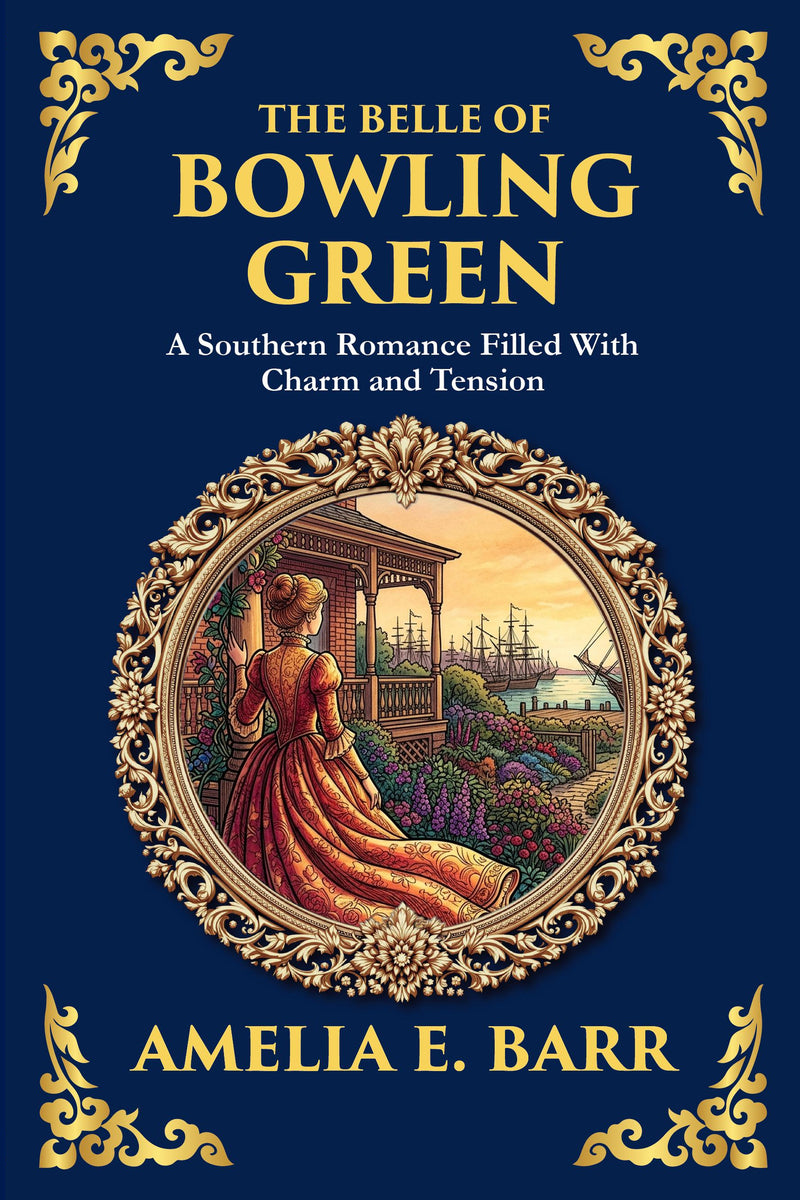
The Belle of Bowling Green
In the gracious, sun-warmed South of yesteryear, where magnolia blossoms bloom and reputations are worth more than gold, The Belle of Bowling Green unfolds with grace, wit, and romantic intrigue.
or free app
10,000+ hrs library
30-day guarantee
The complete The Belle of Bowling Green appears in modern English through Library of Alexandria Press, available online with audiobook narration included for members.
Have you ever wondered why the strongest hearts bloom in the most delicate places? Step into the golden light of the American South in Amelia E. Barr’s beloved novel The Belle of Bowling Green, a story where romance is both a promise and a peril. This classic Southern tale follows Betty Gordon—a young woman admired for her beauty, poise, and grace—as she comes of age in a world bound by custom, whispered secrets, and unyielding codes of honor.
With prose as refined as the setting it depicts, Barr offers a tale of passion, betrayal, and self- discovery. At the heart of Betty’s journey lies a choice: follow the path society expects—or forge one of her own. Along the way, she must confront the shadows behind the smiles, the risks of true love, and the complexities of a community caught between progress and the past.
This beautifully formatted modern edition restores Barr’s storytelling for a new generation of readers. For fans of Southern romance, strong female leads, or genteel historical dramas, this novel is a hidden gem.
What you’ll discover in this modern edition
- A Heroine of Strength and Sensibility – Betty Gordon isn’t just the belle of the town— she’s a woman awakening to her power, her values, and her right to choose.
- Atmospheric Southern Setting – Lush gardens, stately porches, and polite drawing rooms hide family secrets and simmering drama.
- Timeless Romance and Conflict – Love letters, secret suitors, and tangled hearts bring emotional richness to every page.
- Insight Into Tradition and Transition – Witness the cultural shifts of a South straddling the past and an uncertain future.
- A Story of Feminine Identity – Through Betty, the novel explores womanhood, societal roles, and the quiet rebellion of choosing one's own destiny.
| Formats | eBook (EPUB + PDF) · Audiobook · Paperback · Hardcover · Large Print |
| Language | English |
| Trim size (print) | 6 × 9 in |
| Binding | Paperback — perfect-bound · Hardcover — casewrap |
| Large Print edition | Same text in a larger, easy-read type — a larger font, not a larger trim |
| Print pricing | Every physical book at our true cost — at-cost, no profit (members) |
| Library | 873 restored titles, always growing |
| Length | 84,807 words · ~5 hr 39 min reading |
| Reading level | Grade 3 · an easy, flowing read (this modern-English edition) |
| Edition | Modern English translation · 2026 |
Member reviews for this edition are collected as readers finish it — be the first. Across the library: 12,000+ books shipped, every plan covered by a 365-day print guarantee.
About this edition
A faithful, unabridged modern-English edition by The Library of Alexandria — carefully rendered for today's reader and verified paragraph-by-paragraph against the public-domain source. Available as eBook, audiobook, paperback, hardcover, and large print.
- Complete & unabridgedVerified paragraph by paragraph against the source — never a scan, never abridged.
- Modern English, faithfulReadable today, with the author’s meaning kept intact. Readable — not simplified.
- Every format, one membershipRead in your browser or the free app, or listen to the full audiobook.
Included free with your membership
Cancel anytime, one click · 30-day money-back guarantee
Edition last updated July 2026
What’s inside
The Belle of Bowling Green — complete and unabridged: all 13 sections included with membership, plus the full audiobook.
Begin reading The Belle of Bowling Green
In clear modern English — the complete text is included with membership.
Introduction
There are certain books that arrive in our hands like a letter from a distant relation we never knew we had—familiar in their warmth, surprising in their candor, and unmistakably shaped by a world that has slipped just out of reach. The Belle of Bowling Green, first published in 1926 and here presented in a modern translation adapted for the contemporary reader, is precisely that kind of book. It carries the unmistakable fragrance of an older America, of porches and parlors, of letters written by candlelight and feelings confessed only after long deliberation. Yet beneath its period charm beats a heart that any reader today will recognize at once: the eternal, restless, hopeful longing to love and to be loved, to belong somewhere, and to discover who we truly are when our circumstances change beneath our feet.
Amelia E. Barr, the author of this gracious and engaging romance, was by 1926 one of the most beloved and prolific storytellers in the English-speaking world. To open one of her novels is to be taken into the confidence of a woman who had lived enormously, suffered greatly, and emerged not embittered but tenderly wise. She understood the human heart in all its contradictions, and she knew how to render the small dramas of domestic life—the misunderstanding at the dinner table, the unspoken word that changes everything, the glance exchanged across a crowded room—with a delicacy and a knowing humor that have kept her readers turning pages for well over a century. This introduction is intended to prepare you for that experience: to set the table, as it were, so that you may sit down to the feast that follows with the fullest possible appetite and the keenest possible appreciation.
A Storyteller Forged by Loss and Resilience
To truly savor this novel, it helps to understand a little about the remarkable woman who wrote it, for few authors poured more of their own hard-won understanding into their fiction than Amelia Edith Huddleston Barr. Born in Ulverston, in the north of England, in 1831, she came into the world during the reign of William IV, before the railway had transformed the landscape and before the great wave of Victorian optimism had fully crested. Her father was a Methodist minister, and from him she inherited both a deep moral seriousness and a gift for narrative that could hold a congregation—or a reader—in rapt attention. Hers was an education unusual for a girl of her era, rich in literature and language, and it nurtured in her the lifelong conviction that storytelling was not merely an amusement but a kind of ministry, a way of helping ordinary people make sense of their joys and sorrows.
What gives Barr’s work its particular emotional authenticity, however, is not her happy beginnings but the staggering tragedies that followed. As a young woman she married Robert Barr, and together they emigrated to the United States in search of a better life. They settled eventually in Texas, in the years surrounding the Civil War, and there Amelia experienced the kind of grief that would have broken a lesser spirit. She lost children to disease. She lost her husband and her sons to the yellow fever epidemic that swept through Galveston in 1867. In the span of a single terrible season, she found herself a widow with surviving daughters to support and almost no resources to do it. She had been raised in comfort and had married for love, and now she stood, in middle age, in a foreign land, with the responsibility for her family resting entirely on her own shoulders.
It is one of the great inspiring stories of American letters that Amelia Barr did not surrender to despair. She moved to New York, took up her pen, and began to write—first journalism and essays, then short fiction, and at last the novels that would make her famous. She did not publish her first novel until she was nearly fifty years old, an age at which many people consider their most ambitious days behind them. Yet she went on to write more than seventy books, becoming one of the highest-paid and most widely read authors of her generation. By the time The Belle of Bowling Green appeared in 1926, she was in her nineties, a living link to a vanished age, still composing stories with the same warmth, energy, and emotional intelligence that had won her millions of devoted readers.
This biography matters because it suffuses everything she wrote. When Barr writes of a young woman facing an uncertain future, of a family adjusting to changed fortunes, of the courage required to begin again, she writes not as a distant observer but as someone who knew these things in her very bones. Her romances are never frivolous, even when they are light and charming. They are built on a bedrock of genuine experience—of the knowledge that love is precious precisely because life is fragile, that happiness must be chosen and worked for rather than passively received, and that a strong character is the only fortune that no misfortune can take away. As you read this novel, you will feel that solidity beneath the sparkle. You will sense that the author understands exactly what is at stake for her characters, because she once stood where they stand and learned, the hard way, how to find her footing.
It is also worth noting that Barr was, in her quiet way, an advocate for the dignity and capability of women. Having supported herself and her daughters through her own labor in an age when few women could imagine doing so, she filled her books with heroines who possess intelligence, spirit, and moral backbone. Her belles are never merely decorative; they think, they feel, they make choices, and they live with the consequences. This is part of what makes her fiction so satisfying to a modern audience. The romance is real, but so is the personhood of the woman at the center of it. She is not a prize to be won but a soul to be understood, and the best of Barr’s male characters understand that distinction perfectly.
The World of Bowling Green and the Art of the Southern Romance
The title of this novel announces its setting with confident specificity, and part of the pleasure that awaits you lies in being transported to a world that, for most contemporary readers, exists only in imagination and memory. The American South of Barr’s fiction is a place of profound contrasts—of grace and hardship, of beauty and complication, of warm hospitality and rigid social codes. It is a region defined by its sense of place and its reverence for tradition, where family history matters intensely, where reputation can be more valuable than money, and where the rhythms of daily life unfold against a backdrop of rolling country, gracious homes, and the slow, golden turning of the seasons.
Into this richly textured environment Barr places her heroine, the “belle” of the title—a designation that carries far more weight in the Southern vocabulary than the simple word “beauty” might suggest. To be a belle was to occupy a particular and exacting social position. It meant being admired, certainly, but it also meant being watched, judged, and held to standards that could feel both flattering and confining. The belle was expected to be charming without being forward, accomplished without being ambitious, desirable without being aware of her own desire. She moved through a world of careful courtship rituals, of chaperoned visits and meaningful dances, of conversations conducted in a language of hints and proprieties that the modern reader will find both quaint and surprisingly relatable. For beneath the formal surface, the same urgent questions pulsed then as now: Whom shall I love? Who truly loves me? How do I reconcile what my heart wants with what the world expects of me?
This is the deep current that runs through every great Southern romance, and Barr navigates it with a sure hand. She understood that the constraints of a tightly ordered society do not diminish romantic drama but intensify it. When every gesture is loaded with meaning, when a single misstep can alter a young woman’s prospects forever, when feelings must be expressed through indirection and restraint, then the smallest moments become charged with electricity. A held glance, a withheld letter, a word spoken or left unspoken—these are the materials from which Barr builds her tension, and they are far more powerful than any melodramatic excess could ever be. The reader leans forward, attentive to every nuance, because in this world nuance is everything.
The subtitle promises “charm and tension,” and that pairing is no accident. The charm of the novel lies in its surface: the gracious manners, the witty exchanges, the descriptions of beautiful places and elegant gatherings, the gentle humor with which Barr observes the foibles of her characters. But the tension lies beneath, in the genuine uncertainties of the heart and the real obstacles that stand between the characters and their happiness. Barr never lets us forget that her people have something to lose. Their feelings are real, their choices are difficult, and the outcome is never guaranteed. This is what elevates the book above mere period decoration and makes it a story that can still move us, nearly a century after it was written.
It would be a disservice to reveal the particulars of the plot, for much of the joy of reading Barr lies in the gradual unfolding of her narrative, in the way she allows relationships to develop and complications to emerge at their own measured pace. Suffice it to say that you will find here a cast of characters drawn with affection and insight—the spirited heroine at the center, the suitors who circle her, the family members whose expectations shape her path, and the broader community whose opinions form a kind of Greek chorus to the central drama. You will encounter rivalries and reconciliations, secrets and revelations, the agony of misunderstanding and the bliss of understanding restored. And you will find, woven throughout, Barr’s abiding faith that good character is eventually rewarded, that true feeling will find its way through the obstacles placed before it, and that the journey toward love is also a journey toward self-knowledge.
One of the particular delights of this novel is its attention to the social fabric of its time and place. Barr was a keen observer of how communities work—how reputation is made and unmade, how families negotiate marriage and money, how the formal occasions of social life provide both opportunity and peril for those seeking happiness. The contemporary reader, accustomed to a world of instant communication and casual relationships, may find something deeply refreshing in this slower, more deliberate way of life. There is a kind of luxury in the time these characters take—time to consider, to court, to grow certain of their own hearts before declaring them. There is also a poignancy in the limits they face, the doors that are closed to them by circumstance or custom. Barr invites us to feel both the romance and the constraint, and in doing so she gives us a fuller, truer picture of human longing than any simpler treatment could provide.
Reading Barr Today: on This Modern Translation and the Pleasures That Await
This edition has been prepared as a modern translation, adapted for the contemporary reader, and a word about what that means will help you approach the book with the right expectations. The literary conventions of 1926—and indeed of the older traditions that shaped Barr’s style—differ in significant ways from those of our own era. Sentence structures were often longer and more elaborate. Vocabulary included words and idioms that have since fallen out of common use. Punctuation, paragraphing, and the general rhythm of prose followed patterns that can feel, to the unaccustomed eye, dense or distant. The purpose of this adaptation is not to alter Barr’s story, her characters, or the essential flavor of her voice, but to clear away the small obstacles of dated usage that might otherwise stand between you and the pleasure of her storytelling.
Cancel anytime, one click · 30-day money-back guarantee
Founding annual rate available now — your price locks for life when you join.
Not ready? Get this free chapter by email — read it anytime.
✓ Sent — check your inbox for The Belle of Bowling Green.
Questions about The Belle of Bowling Green
What is The Belle of Bowling Green about?
In the gracious, sun-warmed South of yesteryear, where magnolia blossoms bloom and reputations are worth more than gold, The Belle of Bowling Green unfolds with grace, wit, and romantic intrigue. At the heart of it all stands Betty Gordon—the radiant belle whose charm captivates every suitor and whose courage will be tested by secrets, pride, and the unspoken truths of the past. As family legacies, hidden rivalries, and old-world expectations swirl around her, Betty must navigate not only matters of the heart, but
Who wrote The Belle of Bowling Green?
The Belle of Bowling Green was written by Amelia E. Barr. This edition presents the complete work in clear modern English, faithfully rendered from the public-domain original by Library of Alexandria Press.
Is The Belle of Bowling Green free to read?
The opening chapter is free to read on this page. Members read and listen to the complete work — and the entire library — free, and can order any physical book at our true print cost.
How long is The Belle of Bowling Green?
13 chapters (~84,807 words) — about 5 hr 39 min of reading in this modern-English edition.
Is this an abridged version of The Belle of Bowling Green?
No. This is the complete, unabridged The Belle of Bowling Green, carefully rendered into clear modern English and verified paragraph-by-paragraph against the public-domain source — nothing is cut or summarised.
What formats does The Belle of Bowling Green come in?
The Belle of Bowling Green is available as eBook, paperback, hardcover and large print. eBook and audiobook are included with membership; printed editions ship at our true print cost.
Shipping & returns
Billing & membership
More from the library


Explore Military & Strategy
- The War of the Worlds · H. G. Wells
- Give Me Liberty or Give Me Death · Patrick Henry
- The Thirty-Nine Steps · John Buchan
- Julius Caesar · William Shakespeare
- Rilla of Ingleside · L. M. Montgomery
- Troilus and Criseyde · Geoffrey Chaucer
- The Adventures of Heine · Edgar Wallace
- The Declaration of Independence of the United States of America · Thomas Jefferson
- Armageddon—2419 A.D. · Philip Francis Nowlan
- The Variable Man · Philip K. Dick
- Arms and the Man · Bernard Shaw
- South Africa and the Transvaal War, Vol. 2 (of 8) · Louis Creswicke
- The Red Badge of Courage: An Episode of the American Civil War · Stephen Crane
- Second Variety · Philip K. Dick
- Lysistrata · Aristophanes
- The Iliad · Homer
- A Matter of Proportion · Anne Walker
- This Side of Paradise · F. Scott Fitzgerald
The Belle of Bowling Green
The Belle of Bowling Green
A Southern Romance Full of Charm and Tension
Amelia E. Barr
Contents
- Introduction
- Prologue
- Chapter 1
- Chapter 2
- Chapter 3
- Chapter 4
- Chapter 5
- Chapter 6
- Chapter 7
- Chapter 8
- Chapter 9
- Chapter 10
- Chapter 11
Introduction
There are certain books that arrive in our hands like a letter from a distant relation we never knew we had—familiar in their warmth, surprising in their candor, and unmistakably shaped by a world that has slipped just out of reach. The Belle of Bowling Green, first published in 1926 and here presented in a modern translation adapted for the contemporary reader, is precisely that kind of book. It carries the unmistakable fragrance of an older America, of porches and parlors, of letters written by candlelight and feelings confessed only after long deliberation. Yet beneath its period charm beats a heart that any reader today will recognize at once: the eternal, restless, hopeful longing to love and to be loved, to belong somewhere, and to discover who we truly are when our circumstances change beneath our feet.
Amelia E. Barr, the author of this gracious and engaging romance, was by 1926 one of the most beloved and prolific storytellers in the English-speaking world. To open one of her novels is to be taken into the confidence of a woman who had lived enormously, suffered greatly, and emerged not embittered but tenderly wise. She understood the human heart in all its contradictions, and she knew how to render the small dramas of domestic life—the misunderstanding at the dinner table, the unspoken word that changes everything, the glance exchanged across a crowded room—with a delicacy and a knowing humor that have kept her readers turning pages for well over a century. This introduction is intended to prepare you for that experience: to set the table, as it were, so that you may sit down to the feast that follows with the fullest possible appetite and the keenest possible appreciation.
A Storyteller Forged by Loss and Resilience
To truly savor this novel, it helps to understand a little about the remarkable woman who wrote it, for few authors poured more of their own hard-won understanding into their fiction than Amelia Edith Huddleston Barr. Born in Ulverston, in the north of England, in 1831, she came into the world during the reign of William IV, before the railway had transformed the landscape and before the great wave of Victorian optimism had fully crested. Her father was a Methodist minister, and from him she inherited both a deep moral seriousness and a gift for narrative that could hold a congregation—or a reader—in rapt attention. Hers was an education unusual for a girl of her era, rich in literature and language, and it nurtured in her the lifelong conviction that storytelling was not merely an amusement but a kind of ministry, a way of helping ordinary people make sense of their joys and sorrows.
What gives Barr’s work its particular emotional authenticity, however, is not her happy beginnings but the staggering tragedies that followed. As a young woman she married Robert Barr, and together they emigrated to the United States in search of a better life. They settled eventually in Texas, in the years surrounding the Civil War, and there Amelia experienced the kind of grief that would have broken a lesser spirit. She lost children to disease. She lost her husband and her sons to the yellow fever epidemic that swept through Galveston in 1867. In the span of a single terrible season, she found herself a widow with surviving daughters to support and almost no resources to do it. She had been raised in comfort and had married for love, and now she stood, in middle age, in a foreign land, with the responsibility for her family resting entirely on her own shoulders.
It is one of the great inspiring stories of American letters that Amelia Barr did not surrender to despair. She moved to New York, took up her pen, and began to write—first journalism and essays, then short fiction, and at last the novels that would make her famous. She did not publish her first novel until she was nearly fifty years old, an age at which many people consider their most ambitious days behind them. Yet she went on to write more than seventy books, becoming one of the highest-paid and most widely read authors of her generation. By the time The Belle of Bowling Green appeared in 1926, she was in her nineties, a living link to a vanished age, still composing stories with the same warmth, energy, and emotional intelligence that had won her millions of devoted readers.
This biography matters because it suffuses everything she wrote. When Barr writes of a young woman facing an uncertain future, of a family adjusting to changed fortunes, of the courage required to begin again, she writes not as a distant observer but as someone who knew these things in her very bones. Her romances are never frivolous, even when they are light and charming. They are built on a bedrock of genuine experience—of the knowledge that love is precious precisely because life is fragile, that happiness must be chosen and worked for rather than passively received, and that a strong character is the only fortune that no misfortune can take away. As you read this novel, you will feel that solidity beneath the sparkle. You will sense that the author understands exactly what is at stake for her characters, because she once stood where they stand and learned, the hard way, how to find her footing.
It is also worth noting that Barr was, in her quiet way, an advocate for the dignity and capability of women. Having supported herself and her daughters through her own labor in an age when few women could imagine doing so, she filled her books with heroines who possess intelligence, spirit, and moral backbone. Her belles are never merely decorative; they think, they feel, they make choices, and they live with the consequences. This is part of what makes her fiction so satisfying to a modern audience. The romance is real, but so is the personhood of the woman at the center of it. She is not a prize to be won but a soul to be understood, and the best of Barr’s male characters understand that distinction perfectly.
The World of Bowling Green and the Art of the Southern Romance
The title of this novel announces its setting with confident specificity, and part of the pleasure that awaits you lies in being transported to a world that, for most contemporary readers, exists only in imagination and memory. The American South of Barr’s fiction is a place of profound contrasts—of grace and hardship, of beauty and complication, of warm hospitality and rigid social codes. It is a region defined by its sense of place and its reverence for tradition, where family history matters intensely, where reputation can be more valuable than money, and where the rhythms of daily life unfold against a backdrop of rolling country, gracious homes, and the slow, golden turning of the seasons.
Into this richly textured environment Barr places her heroine, the “belle” of the title—a designation that carries far more weight in the Southern vocabulary than the simple word “beauty” might suggest. To be a belle was to occupy a particular and exacting social position. It meant being admired, certainly, but it also meant being watched, judged, and held to standards that could feel both flattering and confining. The belle was expected to be charming without being forward, accomplished without being ambitious, desirable without being aware of her own desire. She moved through a world of careful courtship rituals, of chaperoned visits and meaningful dances, of conversations conducted in a language of hints and proprieties that the modern reader will find both quaint and surprisingly relatable. For beneath the formal surface, the same urgent questions pulsed then as now: Whom shall I love? Who truly loves me? How do I reconcile what my heart wants with what the world expects of me?
This is the deep current that runs through every great Southern romance, and Barr navigates it with a sure hand. She understood that the constraints of a tightly ordered society do not diminish romantic drama but intensify it. When every gesture is loaded with meaning, when a single misstep can alter a young woman’s prospects forever, when feelings must be expressed through indirection and restraint, then the smallest moments become charged with electricity. A held glance, a withheld letter, a word spoken or left unspoken—these are the materials from which Barr builds her tension, and they are far more powerful than any melodramatic excess could ever be. The reader leans forward, attentive to every nuance, because in this world nuance is everything.
The subtitle promises “charm and tension,” and that pairing is no accident. The charm of the novel lies in its surface: the gracious manners, the witty exchanges, the descriptions of beautiful places and elegant gatherings, the gentle humor with which Barr observes the foibles of her characters. But the tension lies beneath, in the genuine uncertainties of the heart and the real obstacles that stand between the characters and their happiness. Barr never lets us forget that her people have something to lose. Their feelings are real, their choices are difficult, and the outcome is never guaranteed. This is what elevates the book above mere period decoration and makes it a story that can still move us, nearly a century after it was written.
It would be a disservice to reveal the particulars of the plot, for much of the joy of reading Barr lies in the gradual unfolding of her narrative, in the way she allows relationships to develop and complications to emerge at their own measured pace. Suffice it to say that you will find here a cast of characters drawn with affection and insight—the spirited heroine at the center, the suitors who circle her, the family members whose expectations shape her path, and the broader community whose opinions form a kind of Greek chorus to the central drama. You will encounter rivalries and reconciliations, secrets and revelations, the agony of misunderstanding and the bliss of understanding restored. And you will find, woven throughout, Barr’s abiding faith that good character is eventually rewarded, that true feeling will find its way through the obstacles placed before it, and that the journey toward love is also a journey toward self-knowledge.
One of the particular delights of this novel is its attention to the social fabric of its time and place. Barr was a keen observer of how communities work—how reputation is made and unmade, how families negotiate marriage and money, how the formal occasions of social life provide both opportunity and peril for those seeking happiness. The contemporary reader, accustomed to a world of instant communication and casual relationships, may find something deeply refreshing in this slower, more deliberate way of life. There is a kind of luxury in the time these characters take—time to consider, to court, to grow certain of their own hearts before declaring them. There is also a poignancy in the limits they face, the doors that are closed to them by circumstance or custom. Barr invites us to feel both the romance and the constraint, and in doing so she gives us a fuller, truer picture of human longing than any simpler treatment could provide.
Reading Barr Today: on This Modern Translation and the Pleasures That Await
This edition has been prepared as a modern translation, adapted for the contemporary reader, and a word about what that means will help you approach the book with the right expectations. The literary conventions of 1926—and indeed of the older traditions that shaped Barr’s style—differ in significant ways from those of our own era. Sentence structures were often longer and more elaborate. Vocabulary included words and idioms that have since fallen out of common use. Punctuation, paragraphing, and the general rhythm of prose followed patterns that can feel, to the unaccustomed eye, dense or distant. The purpose of this adaptation is not to alter Barr’s story, her characters, or the essential flavor of her voice, but to clear away the small obstacles of dated usage that might otherwise stand between you and the pleasure of her storytelling.
Every city has a specific place where its most important heroic and civic memories are rooted; in New York City, that place is the historic acre of Bowling Green. Throughout the city’s entire history, it has remained constantly linked to this spot. Its blended history of military camps, royal courts, and everyday home life should mean as much to New Yorkers as the Palladium did to the people of ancient Troy. Just as the Palladium held a spear in one hand and spinning tools in the other, the story of Bowling Green is a mix of war and domesticity. It has felt the boots of soldiers and the light steps of joyful young women. Even though it has been guarded by cannons, for nearly three hundred years it has sat at the city’s open seaside entrance, like a welcoming green doorstep.
During the late seventeen hundreds and early eighteen hundreds, the area around Bowling Green was mostly surrounded by the grand homes of the city’s most respected and wealthy residents. Although these people began moving slowly toward the north before the War of 1812, the neighborhood remained a very high-class district for several more years. It was especially popular with wealthy families of Dutch descent who had lived near the Fort and Bowling Green for many generations and were reluctant to leave a place they knew and loved so much.
Because of this, members of the Bloommaert family had lived along the old Beaver Path and in Bloommaert’s Valley, also known as Broad Street, for nearly one hundred and forty years. When Judge Gerardus Bloommaert built a beautiful home for himself in 1790, he decided that Bowling Green was the perfect location. The house was a tall, spacious red-brick building without any flashy decorations on the outside, but the interior design and furniture represented the absolute peak of comfort and elegance.
End of the free sample
Keep reading, free
Members read and listen to the complete book — and the entire library. Cancel anytime, one click · 30-day money-back guarantee.