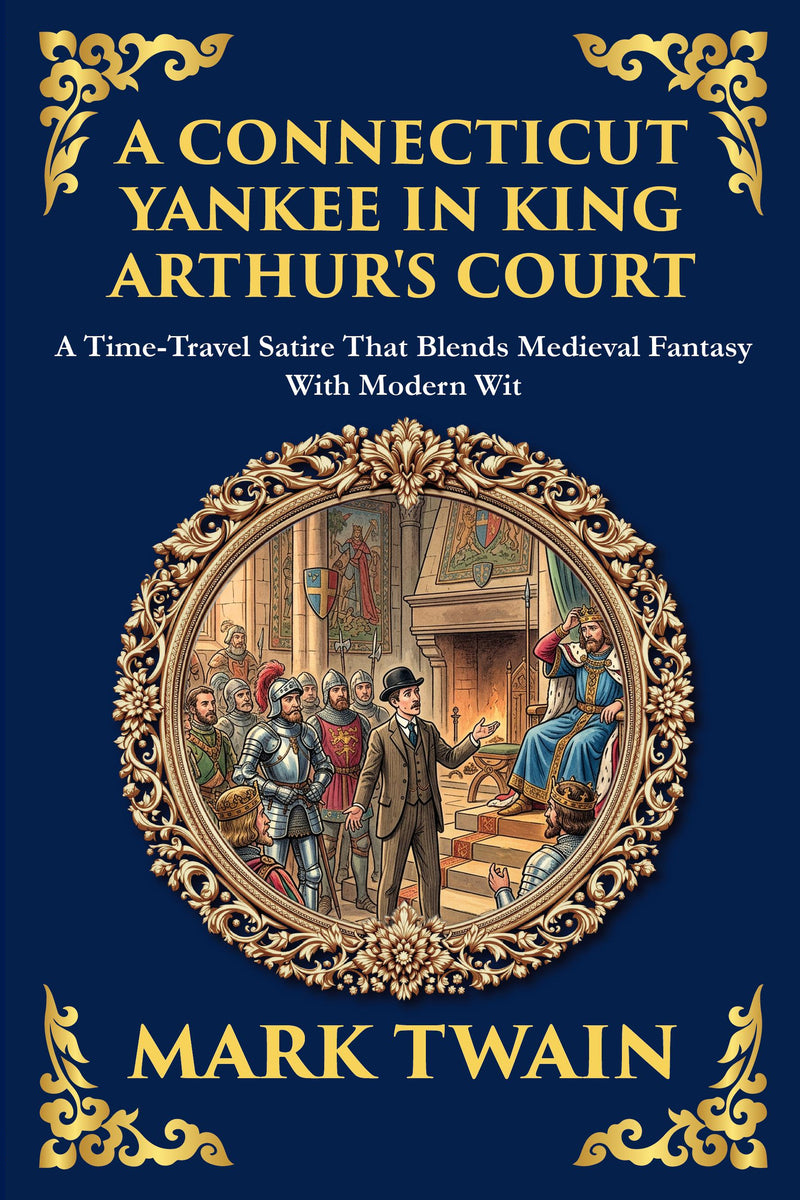
A Connecticut Yankee in King Arthur’s Court
When a 19th-century Yankee engineer is knocked unconscious and wakes up in the age of King Arthur, chaos and comedy collide in spectacular fashion.
or free app
10,000+ hrs library
30-day guarantee
The complete A Connecticut Yankee in King Arthur's appears in modern English through Library of Alexandria Press, available online with audiobook narration included for members.
Have you ever wondered why progress sometimes feels like a punchline? Mark Twain’s A Connecticut Yankee in King Arthur’s Court is one of the earliest and sharpest examples of time-travel fiction—a hilarious, biting, and sometimes dark satire that skewers romantic notions of the past and uncritical celebrations of the present. When Hank Morgan, a clever and practical-minded engineer from Connecticut, is mysteriously transported to 6th-century England, he finds himself in the midst of knights, castles, and superstition.
Declaring himself “The Boss,” Hank uses his 19th-century know-how to introduce modern inventions like gunpowder, factories, newspapers, and even a telegraph system to King Arthur’s court. But what begins as comic superiority soon spirals into a sobering exploration of power, control, and unintended consequences. As Hank attempts to remake Camelot in his own image, Twain subtly unpacks the dangers of unchecked progress, the folly of blind tradition, and the limits of reason in an irrational world.
What you’ll discover in this modern edition
- A Hilarious Clash of Eras – See how one man’s attempt to bring modernity to the Middle Ages turns into a brilliant farce.
- Satire With Sharp Teeth – Twain skewers everything from monarchy and church power to capitalism and militarism.
- A Timeless Warning on Technology and Arrogance – Discover how innovation can enlighten—or destroy—when wielded without humility.
- Wit, Irony, and Wonder – Twain’s humor remains sharp, his insights surprisingly current.
- An Unforgettable Protagonist – Hank Morgan’s journey from confident reformer to tragic visionary is both comedic and thought-provoking.
| Formats | eBook (EPUB + PDF) · Audiobook · Paperback · Hardcover · Large Print |
| Language | English |
| Trim size (print) | 6 × 9 in |
| Binding | Paperback — perfect-bound · Hardcover — casewrap |
| Large Print edition | Same text in a larger, easy-read type — a larger font, not a larger trim |
| Print pricing | Every physical book at our true cost — at-cost, no profit (members) |
| Library | 873 restored titles, always growing |
| Length | 109,628 words · ~7 hr 19 min reading |
| Reading level | Grade 8 · an easy, flowing read (this modern-English edition) |
| Edition | Modern English translation · 2026 |
Member reviews for this edition are collected as readers finish it — be the first. Across the library: 12,000+ books shipped, every plan covered by a 365-day print guarantee.
About this edition
A faithful, unabridged modern-English edition by The Library of Alexandria — carefully rendered for today's reader and verified paragraph-by-paragraph against the public-domain source. Available as eBook, audiobook, paperback, hardcover, and large print.
- Complete & unabridgedVerified paragraph by paragraph against the source — never a scan, never abridged.
- Modern English, faithfulReadable today, with the author’s meaning kept intact. Readable — not simplified.
- Every format, one membershipRead in your browser or the free app, or listen to the full audiobook.
Included free with your membership
Cancel anytime, one click · 30-day money-back guarantee
Edition last updated July 2026
What’s inside
A Connecticut Yankee in King Arthur’s Court — complete and unabridged: all 49 sections included with membership, plus the full audiobook.
Begin reading A Connecticut Yankee in King Arthur’s Court
In clear modern English — the complete text is included with membership.
Introduction
Imagine waking from a blow to the head and finding that the world around you has dissolved into something utterly unrecognizable. The clamor of the nineteenth-century factory floor has vanished. The smoke and steam, the gears and pistons, the steady hum of progress — all gone. In their place: open fields, distant towers, men in armor astride horses, and a sun that seems older somehow, as if it has not yet learned the things you take for granted. You are alive, you are awake, and you are very, very far from home. Not in the sense of miles, but in the sense of years — more than a thousand of them.
This is the predicament at the heart of Mark Twain’s audacious and endlessly inventive novel, first published in 1889, in which a thoroughly modern American — practical, confident, and brimming with the can-do spirit of his industrial age — finds himself transported into the legendary world of King Arthur and his Knights of the Round Table. The premise is deceptively simple, almost like the setup to a tall tale told around a campfire. But what Twain builds upon that foundation is something far more ambitious, far stranger, and far more enduring than a mere fish-out-of-water comedy. It is a book that laughs and rages in equal measure, that delights even as it warns, and that has lost none of its bite in the years since it first appeared.
What you hold in your hands is a modern translation, carefully adapted for the contemporary reader. This is worth pausing over, because it speaks directly to the kind of experience that awaits you. Twain wrote in a particular idiom — peppered with the dialect, slang, and rhetorical flourishes of late-nineteenth-century America, layered over a deliberately archaic, mock-medieval style meant to parody the romantic literature of his day. That collision of registers was part of the original joke. But for a reader coming to the book fresh, more than a century later, those layers can sometimes obscure as much as they reveal. The aim of this adaptation is not to flatten Twain’s voice or sand away his sharp edges, but to clear a path through the thicket of dated reference and unfamiliar phrasing so that the wit, the storytelling, and the moral fire underneath shine through with full force. The goal is to let you laugh where Twain wanted you to laugh, to feel the chill where he wanted you to shiver, and to recognize, with a start, how much of what he was writing about still describes the world you live in now.
Because that is perhaps the most remarkable thing about this novel: it does not feel like a museum piece. For all its knights and castles, its enchanters and damsels, its tournaments and quests, it is a profoundly forward-looking book — a meditation on technology, power, ignorance, and the fragile machinery of human society that reads, in places, as if it were written yesterday. The medieval setting is a kind of stage, a borrowed backdrop against which Twain can examine the questions that obsessed him about his own era and, by extension, ours. What happens when knowledge confronts superstition? What does progress actually cost? Can a society be reformed from the top down, by a single clever person with good intentions and better tools? And what becomes of those good intentions when they meet the stubborn, irrational, deeply human reality of the people they are meant to help?
The protagonist who carries us through these questions is a man named Hank Morgan, though he comes to be known by a grander, more ironic title in the world he stumbles into. He is a superintendent at an arms factory in Hartford, Connecticut — a man who, by his own description, can make or fix nearly anything. Guns, engines, machines, tools: if it has parts that move and a purpose to serve, Hank understands it. He is not a scholar or a dreamer. He is a doer, a builder, a man of his hands and his head, and he possesses an absolute, unshakable faith in the superiority of his own age. To Hank, the world he comes from is the pinnacle of human achievement, and the world he finds himself thrown into is a backward, benighted place crying out for the gifts of modernity. Much of the novel’s drama — and much of its comedy, and ultimately much of its tragedy — flows directly from this conviction and from what happens when Hank decides to act upon it.
It would be easy, and not entirely wrong, to read Hank as a hero. He is funny, resourceful, and frequently sympathetic. He stands against cruelty and stupidity. He believes in fairness, in opportunity, in the dignity of ordinary working people. When he rails against the injustices of the feudal system — the casual brutality of the nobility, the crushing poverty of the peasantry, the way the many are kept ignorant and submissive for the benefit of the few — his anger is righteous, and Twain clearly shares it. But part of the genius of the book is that Twain does not let Hank off the hook so easily. The same confidence that makes Hank admirable also makes him dangerous. The same certainty that he knows best can curdle into something far less attractive. As you read, you will find yourself rooting for him and then, perhaps, growing uneasy about what you are rooting for. That discomfort is intentional. It is one of the things that lifts this novel above simple satire and into the realm of genuine literature.
To understand why this book takes the shape it does, it helps to know something about the man who wrote it, for few authors have ever poured so much of themselves into a work that on its surface seems to be pure entertainment. Mark Twain was the pen name of Samuel Langhorne Clemens, and by the time he sat down to write this novel he was already among the most famous writers in the world. He had given readers the sun-drenched riverbank adventures of Tom Sawyer and the searching, morally serious journey of Huckleberry Finn. He had made his name as a humorist, a lecturer, a teller of tales whose wit could fill a hall and whose newspaper sketches could spread across a continent. But the man who wrote this particular book was changing. The exuberant comic of his early years was darkening into something more complicated — angrier, more skeptical, more haunted by the contradictions of the age he lived in.
Twain came of age in a country that worshipped progress. The nineteenth century was the great age of the machine, of the railroad and the telegraph, of the factory and the patent office. Americans believed, with something close to religious fervor, that technology and industry were carrying humanity inexorably upward toward a brighter, freer, more prosperous future. Twain himself was caught up in this faith. He loved gadgets and inventions. He famously poured a fortune into a typesetting machine that promised to revolutionize printing — an investment that would eventually help drive him into bankruptcy. He was, in many ways, a man very much like Hank Morgan: dazzled by the possibilities of his era, eager to believe that ingenuity could solve almost any problem.
And yet Twain was also a man who had seen too much to swallow that faith whole. He had grown up in a slaveholding society and never stopped wrestling with the moral catastrophe of it. He had traveled widely and observed firsthand the gulf between humanity’s noble ideals and its squalid behavior. He had watched the gilded prosperity of his country mask deep currents of greed, exploitation, and cruelty. He was beginning to suspect, more and more, that human nature was a stubborn and unimproving thing — that you could change a society’s tools without changing its heart, and that the same impulses which built cathedrals could just as easily build instruments of slaughter.
This novel is where many of those tensions come to a head. On one level, Twain is using the medieval setting to mock the romantic nostalgia that was fashionable in his day. He had a particular contempt for the kind of literature — the chivalric romances, the misty-eyed celebrations of knighthood and feudal glory — that he believed encouraged people to admire a brutal and unjust past. He once half-seriously blamed the romantic novels of Sir Walter Scott for fostering the very attitudes that led to the American Civil War, by filling people’s heads with delusions of aristocratic honor and martial glory. So when Twain sends his hard-headed Yankee into the world of King Arthur, part of his purpose is demolition: to strip away the glamour, to show the dirt and disease and cruelty beneath the shining armor, to puncture the fantasy with the sharp pin of reality. The knights in this book are often not gallant heroes but vain, dim, violent men playing at honor. The famous court is shown to be a place of pettiness and superstition. The romance is revealed as a lie.
But Twain is too honest a writer to leave it there, and this is where the book becomes something deeper than satire. Having torn down the medieval fantasy, he turns his gaze on the modern world that Hank represents — and finds it wanting too. For all of Hank’s contempt for the ignorance and brutality of the sixth century, he carries within him the seeds of brutalities all his own. The tools he brings from the nineteenth century are not only the printing press and the telephone and the schoolhouse; they are also the gun, the explosive, the engine of mass destruction. As the story unfolds, Twain forces us to ask whether progress is really progress at all, or whether it merely gives old human cruelties new and more terrible forms. The book that begins as a comedy about a clever man outwitting a backward age ends in a place far stranger and more sobering, a place that has led generations of readers to argue about exactly what Twain meant and where his sympathies finally lie.
This is part of what makes the novel so rewarding to read carefully. It refuses to resolve into a simple message. It contains multitudes, and not always comfortably. There are passages of pure, gleeful comedy — Hank’s running commentary on the absurdities of the world around him is some of the funniest writing Twain ever produced, full of dry asides and exasperated observations that will have you laughing out loud. There are set pieces of dazzling invention, in which Hank uses his modern knowledge to astonish and overawe the people of the past, staging effects that seem like miracles to them and that the reader, in on the trick, can savor with delicious anticipation. There is genuine adventure, with quests and battles and narrow escapes. There is even, woven through it all, a current of real tenderness and unexpected emotion that catches you off guard.
But underneath the entertainment there runs a darker stream, and the longer you read, the more strongly you feel its pull. Twain was, in this book, working out some of the most troubling questions of his life and his century — questions about whether human beings are capable of improvement, about the relationship between knowledge and power, about the terrible ease with which good intentions can become instruments of destruction. He did not pretend to have answers. What he offers instead is the spectacle of a brilliant mind grappling, in full view, with problems too large for any neat solution. That grappling is exhilarating to witness, and it is one of the reasons this novel has outlasted so many of its contemporaries. It does not condescend to its reader. It assumes that you, too, are capable of holding complicated thoughts at once, of laughing and worrying in the same breath.
A few words of guidance may help you get the most out of the journey ahead, for this is a novel with its own particular rhythms and one that rewards a certain kind of attentive reading. First, do not expect a tightly plotted story that marches efficiently from beginning to end. Twain was not, by temperament, a careful architect of plots. He wrote, as he often did, by following his interests and his enthusiasms, and the book reflects that. It is episodic, digressive, sometimes wandering. Hank will embark on one adventure, then pause to deliver an extended observation on some aspect of medieval life, then launch into a scheme that occupies him for chapters before circling back to the larger story. If you approach the book expecting the brisk forward momentum of a modern thriller, you may find yourself impatient. But if you can settle into its leisurely, conversational pace — if you can enjoy the detours as much as the destination — you will discover that the digressions are often where the real treasures lie. Some of Twain’s most pointed observations, his funniest jokes, and his most cutting moral arguments appear in passages that have nothing directly to do with the plot. Read them as you would listen to a brilliant and unpredictable companion who cannot resist following a thought wherever it leads.
Cancel anytime, one click · 30-day money-back guarantee
Founding annual rate available now — your price locks for life when you join.
Not ready? Get this free chapter by email — read it anytime.
✓ Sent — check your inbox for A Connecticut Yankee in King Arthur’s Court.
Questions about A Connecticut Yankee in King Arthur’s Court
What is A Connecticut Yankee in King Arthur's about?
When a 19th-century Yankee engineer is knocked unconscious and wakes up in the age of King Arthur, chaos and comedy collide in spectacular fashion. Armed with modern knowledge—and a sharp tongue—he sets out to "civilize" Camelot with science, democracy, and sarcasm. But meddling with history has its consequences.
Who wrote A Connecticut Yankee in King Arthur's?
A Connecticut Yankee in King Arthur's was written by Mark Twain. This edition presents the complete work in clear modern English, faithfully rendered from the public-domain original by Library of Alexandria Press.
Is A Connecticut Yankee in King Arthur's free to read?
The opening chapter is free to read on this page. Members read and listen to the complete work — and the entire library — free, and can order any physical book at our true print cost.
How long is A Connecticut Yankee in King Arthur's?
49 chapters (~109,628 words) — about 7 hr 19 min of reading in this modern-English edition.
Is this an abridged version of A Connecticut Yankee in King Arthur's?
No. This is the complete, unabridged A Connecticut Yankee in King Arthur's, carefully rendered into clear modern English and verified paragraph-by-paragraph against the public-domain source — nothing is cut or summarised.
What formats does A Connecticut Yankee in King Arthur's come in?
A Connecticut Yankee in King Arthur's is available as eBook, paperback, hardcover and large print. eBook and audiobook are included with membership; printed editions ship at our true print cost.
Shipping & returns
Billing & membership
More from the library


Explore Humour & Satire
- The Imaginary Invalid · Molière
- My Man Jeeves · P. G. Wodehouse
- Barry Lyndon · William Makepeace Thackeray
- The Man with Two Left Feet, and Other Stories · P. G. Wodehouse
- Carry On, Jeeves · P. G. Wodehouse
- The Confidence-Man: His Masquerade · Herman Melville
- Lucian’s True History · Lucian of Samosata
- Penrod · Booth Tarkington
- Status Quo · Mack Reynolds
- Herland · Charlotte Perkins Gilman
- Sartor Resartus: The Life and Opinions of Herr Teufelsdröckh · Thomas Carlyle
- The Satyricon of Petronius Arbiter · Petronius Arbiter
- Three Men in a Boat (To Say Nothing of the Dog) · Jerome K. Jerome
- Northanger Abbey · Jane Austen
- Once Aboard the Lugger—The History of George and his Mary · A. S. M. Hutchinson
- Candide · Voltaire
- Gulliver’s Travels into Several Remote Regions of the World · Jonathan Swift
- Emma · Jane Austen
- A Room with a View · E. M. Forster
- The Eyes Have It · Philip K. Dick
- The Wind in the Willows · Kenneth Grahame
- Right Ho, Jeeves · P. G. Wodehouse
- The Mysterious Stranger and Other Stories · Mark Twain
- A Modest Proposal · Jonathan Swift
A Connecticut Yankee in King Arthur’s Court
A Connecticut Yankee in King Arthur’s Court
A Time-Travel Satire That Blends Medieval Fantasy With Modern Wit
Mark Twain
Contents
- Introduction
- Preface by the Author
- A Word of Explanation
- How Sir Launcelot Killed Two Giants,
- The Stranger's Story
- Chapter 1
- Chapter 2
- Chapter 3
- Chapter 4
- Chapter 5
- Chapter 6
- Chapter 7
- Chapter 8
- Chapter 9
- Chapter 10
- Chapter 11
- Chapter 12
- Chapter 13
- Chapter 14
- Chapter 15
- Chapter 16
- Chapter 17
- Chapter 18
- Chapter 19
- Chapter 20
- Chapter 21
- Chapter 22
- Chapter 23
- Chapter 24
- Chapter 25
- Chapter 26
- Chapter 27
- Chapter 28
- Chapter 29
- Chapter 30
- Chapter 31
- Chapter 32
- Chapter 33
- Chapter 34
- Chapter 35
- … and 9 more chapters
Introduction
Imagine waking from a blow to the head and finding that the world around you has dissolved into something utterly unrecognizable. The clamor of the nineteenth-century factory floor has vanished. The smoke and steam, the gears and pistons, the steady hum of progress — all gone. In their place: open fields, distant towers, men in armor astride horses, and a sun that seems older somehow, as if it has not yet learned the things you take for granted. You are alive, you are awake, and you are very, very far from home. Not in the sense of miles, but in the sense of years — more than a thousand of them.
This is the predicament at the heart of Mark Twain’s audacious and endlessly inventive novel, first published in 1889, in which a thoroughly modern American — practical, confident, and brimming with the can-do spirit of his industrial age — finds himself transported into the legendary world of King Arthur and his Knights of the Round Table. The premise is deceptively simple, almost like the setup to a tall tale told around a campfire. But what Twain builds upon that foundation is something far more ambitious, far stranger, and far more enduring than a mere fish-out-of-water comedy. It is a book that laughs and rages in equal measure, that delights even as it warns, and that has lost none of its bite in the years since it first appeared.
What you hold in your hands is a modern translation, carefully adapted for the contemporary reader. This is worth pausing over, because it speaks directly to the kind of experience that awaits you. Twain wrote in a particular idiom — peppered with the dialect, slang, and rhetorical flourishes of late-nineteenth-century America, layered over a deliberately archaic, mock-medieval style meant to parody the romantic literature of his day. That collision of registers was part of the original joke. But for a reader coming to the book fresh, more than a century later, those layers can sometimes obscure as much as they reveal. The aim of this adaptation is not to flatten Twain’s voice or sand away his sharp edges, but to clear a path through the thicket of dated reference and unfamiliar phrasing so that the wit, the storytelling, and the moral fire underneath shine through with full force. The goal is to let you laugh where Twain wanted you to laugh, to feel the chill where he wanted you to shiver, and to recognize, with a start, how much of what he was writing about still describes the world you live in now.
Because that is perhaps the most remarkable thing about this novel: it does not feel like a museum piece. For all its knights and castles, its enchanters and damsels, its tournaments and quests, it is a profoundly forward-looking book — a meditation on technology, power, ignorance, and the fragile machinery of human society that reads, in places, as if it were written yesterday. The medieval setting is a kind of stage, a borrowed backdrop against which Twain can examine the questions that obsessed him about his own era and, by extension, ours. What happens when knowledge confronts superstition? What does progress actually cost? Can a society be reformed from the top down, by a single clever person with good intentions and better tools? And what becomes of those good intentions when they meet the stubborn, irrational, deeply human reality of the people they are meant to help?
The protagonist who carries us through these questions is a man named Hank Morgan, though he comes to be known by a grander, more ironic title in the world he stumbles into. He is a superintendent at an arms factory in Hartford, Connecticut — a man who, by his own description, can make or fix nearly anything. Guns, engines, machines, tools: if it has parts that move and a purpose to serve, Hank understands it. He is not a scholar or a dreamer. He is a doer, a builder, a man of his hands and his head, and he possesses an absolute, unshakable faith in the superiority of his own age. To Hank, the world he comes from is the pinnacle of human achievement, and the world he finds himself thrown into is a backward, benighted place crying out for the gifts of modernity. Much of the novel’s drama — and much of its comedy, and ultimately much of its tragedy — flows directly from this conviction and from what happens when Hank decides to act upon it.
It would be easy, and not entirely wrong, to read Hank as a hero. He is funny, resourceful, and frequently sympathetic. He stands against cruelty and stupidity. He believes in fairness, in opportunity, in the dignity of ordinary working people. When he rails against the injustices of the feudal system — the casual brutality of the nobility, the crushing poverty of the peasantry, the way the many are kept ignorant and submissive for the benefit of the few — his anger is righteous, and Twain clearly shares it. But part of the genius of the book is that Twain does not let Hank off the hook so easily. The same confidence that makes Hank admirable also makes him dangerous. The same certainty that he knows best can curdle into something far less attractive. As you read, you will find yourself rooting for him and then, perhaps, growing uneasy about what you are rooting for. That discomfort is intentional. It is one of the things that lifts this novel above simple satire and into the realm of genuine literature.
To understand why this book takes the shape it does, it helps to know something about the man who wrote it, for few authors have ever poured so much of themselves into a work that on its surface seems to be pure entertainment. Mark Twain was the pen name of Samuel Langhorne Clemens, and by the time he sat down to write this novel he was already among the most famous writers in the world. He had given readers the sun-drenched riverbank adventures of Tom Sawyer and the searching, morally serious journey of Huckleberry Finn. He had made his name as a humorist, a lecturer, a teller of tales whose wit could fill a hall and whose newspaper sketches could spread across a continent. But the man who wrote this particular book was changing. The exuberant comic of his early years was darkening into something more complicated — angrier, more skeptical, more haunted by the contradictions of the age he lived in.
Twain came of age in a country that worshipped progress. The nineteenth century was the great age of the machine, of the railroad and the telegraph, of the factory and the patent office. Americans believed, with something close to religious fervor, that technology and industry were carrying humanity inexorably upward toward a brighter, freer, more prosperous future. Twain himself was caught up in this faith. He loved gadgets and inventions. He famously poured a fortune into a typesetting machine that promised to revolutionize printing — an investment that would eventually help drive him into bankruptcy. He was, in many ways, a man very much like Hank Morgan: dazzled by the possibilities of his era, eager to believe that ingenuity could solve almost any problem.
And yet Twain was also a man who had seen too much to swallow that faith whole. He had grown up in a slaveholding society and never stopped wrestling with the moral catastrophe of it. He had traveled widely and observed firsthand the gulf between humanity’s noble ideals and its squalid behavior. He had watched the gilded prosperity of his country mask deep currents of greed, exploitation, and cruelty. He was beginning to suspect, more and more, that human nature was a stubborn and unimproving thing — that you could change a society’s tools without changing its heart, and that the same impulses which built cathedrals could just as easily build instruments of slaughter.
This novel is where many of those tensions come to a head. On one level, Twain is using the medieval setting to mock the romantic nostalgia that was fashionable in his day. He had a particular contempt for the kind of literature — the chivalric romances, the misty-eyed celebrations of knighthood and feudal glory — that he believed encouraged people to admire a brutal and unjust past. He once half-seriously blamed the romantic novels of Sir Walter Scott for fostering the very attitudes that led to the American Civil War, by filling people’s heads with delusions of aristocratic honor and martial glory. So when Twain sends his hard-headed Yankee into the world of King Arthur, part of his purpose is demolition: to strip away the glamour, to show the dirt and disease and cruelty beneath the shining armor, to puncture the fantasy with the sharp pin of reality. The knights in this book are often not gallant heroes but vain, dim, violent men playing at honor. The famous court is shown to be a place of pettiness and superstition. The romance is revealed as a lie.
But Twain is too honest a writer to leave it there, and this is where the book becomes something deeper than satire. Having torn down the medieval fantasy, he turns his gaze on the modern world that Hank represents — and finds it wanting too. For all of Hank’s contempt for the ignorance and brutality of the sixth century, he carries within him the seeds of brutalities all his own. The tools he brings from the nineteenth century are not only the printing press and the telephone and the schoolhouse; they are also the gun, the explosive, the engine of mass destruction. As the story unfolds, Twain forces us to ask whether progress is really progress at all, or whether it merely gives old human cruelties new and more terrible forms. The book that begins as a comedy about a clever man outwitting a backward age ends in a place far stranger and more sobering, a place that has led generations of readers to argue about exactly what Twain meant and where his sympathies finally lie.
This is part of what makes the novel so rewarding to read carefully. It refuses to resolve into a simple message. It contains multitudes, and not always comfortably. There are passages of pure, gleeful comedy — Hank’s running commentary on the absurdities of the world around him is some of the funniest writing Twain ever produced, full of dry asides and exasperated observations that will have you laughing out loud. There are set pieces of dazzling invention, in which Hank uses his modern knowledge to astonish and overawe the people of the past, staging effects that seem like miracles to them and that the reader, in on the trick, can savor with delicious anticipation. There is genuine adventure, with quests and battles and narrow escapes. There is even, woven through it all, a current of real tenderness and unexpected emotion that catches you off guard.
But underneath the entertainment there runs a darker stream, and the longer you read, the more strongly you feel its pull. Twain was, in this book, working out some of the most troubling questions of his life and his century — questions about whether human beings are capable of improvement, about the relationship between knowledge and power, about the terrible ease with which good intentions can become instruments of destruction. He did not pretend to have answers. What he offers instead is the spectacle of a brilliant mind grappling, in full view, with problems too large for any neat solution. That grappling is exhilarating to witness, and it is one of the reasons this novel has outlasted so many of its contemporaries. It does not condescend to its reader. It assumes that you, too, are capable of holding complicated thoughts at once, of laughing and worrying in the same breath.
A few words of guidance may help you get the most out of the journey ahead, for this is a novel with its own particular rhythms and one that rewards a certain kind of attentive reading. First, do not expect a tightly plotted story that marches efficiently from beginning to end. Twain was not, by temperament, a careful architect of plots. He wrote, as he often did, by following his interests and his enthusiasms, and the book reflects that. It is episodic, digressive, sometimes wandering. Hank will embark on one adventure, then pause to deliver an extended observation on some aspect of medieval life, then launch into a scheme that occupies him for chapters before circling back to the larger story. If you approach the book expecting the brisk forward momentum of a modern thriller, you may find yourself impatient. But if you can settle into its leisurely, conversational pace — if you can enjoy the detours as much as the destination — you will discover that the digressions are often where the real treasures lie. Some of Twain’s most pointed observations, his funniest jokes, and his most cutting moral arguments appear in passages that have nothing directly to do with the plot. Read them as you would listen to a brilliant and unpredictable companion who cannot resist following a thought wherever it leads.
I met the strange man I’m about to describe at Warwick Castle. Three things drew me to him: his honest simplicity, his amazing knowledge of ancient armor, and how relaxing it was to be around him—mostly because he did all the talking. As modest people often do, we both ended up at the back of the tour group, and he immediately started telling me things that caught my interest. As he spoke in a soft, pleasant, and fluid way, he seemed to drift away from the present world and time, transporting me to some remote era and a forgotten land. He gradually cast a spell over me until I felt as if I were walking through the ghosts, shadows, and dust of a gray antiquity, chatting with a living relic of that time. He spoke of Sir Bedivere, Sir Bors de Ganis, Sir Lancelot of the Lake, Sir Galahad, and all the other great names of the Round Table as if they were his closest friends, enemies, or neighbors. The more he talked, the more he seemed to look ancient—faded, dry, musty, and impossibly old. Then, he turned to me and asked, as casually as if he were talking about the weather:
“You’ve heard of the transmigration of souls; have you heard of the transposition of eras—and bodies?”
I told him I hadn’t. He seemed barely interested in my answer—again, like someone chatting about the weather—and didn’t even seem to notice if I replied. There was a brief moment of silence, which was immediately broken by the droning voice of the paid tour guide:
“Ancient hauberk, dating to the sixth century, from the time of King Arthur and the Round Table; said to have belonged to the knight Sir Sagramor le Desirous; note the round hole through the chain-mail in the left breast; it cannot be explained; it’s thought to have been made by a bullet after firearms were invented—perhaps by Cromwell’s soldiers acting out of malice.”
End of the free sample
Keep reading, free
Members read and listen to the complete book — and the entire library. Cancel anytime, one click · 30-day money-back guarantee.