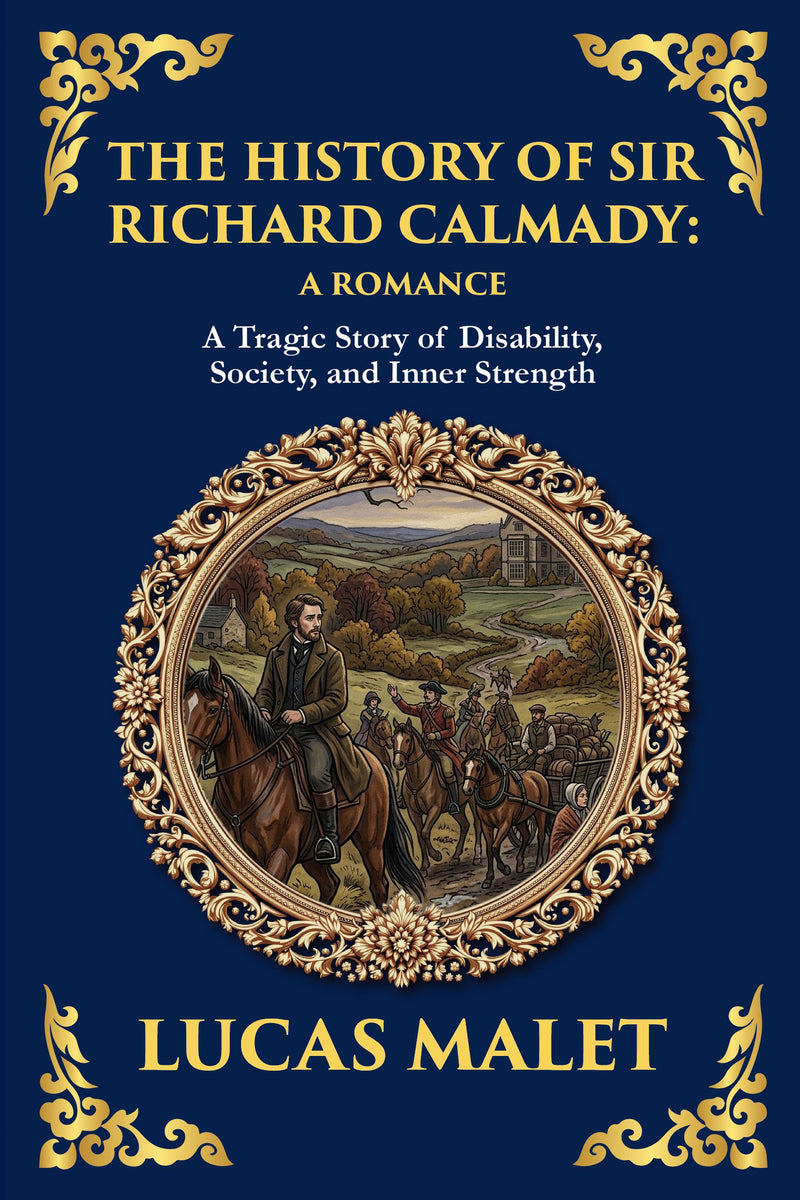
The History of Sir Richard Calmady: A Romance
Born into privilege but cursed by fate, Sir Richard Calmady is a man shaped by contradiction. Struggling with physical deformity in a society obsessed with appearance and lineage, he journeys through heartbreak, temptation, and inner conflict in search of dignity, love, and self- worth.
or free app
10,000+ hrs library
30-day guarantee
The complete The History of Sir Richard Calmady: A Romance appears in modern English through Library of Alexandria Press, available online with audiobook narration included for members.
Have you ever wondered why the greatest battles are fought not in war—but within the soul? In The History of Sir Richard Calmady: A Romance, Lucas Malet crafts a searing narrative of internal conflict and societal tension, blending Victorian realism with modern psychological insight. Sir Richard Calmady is born into wealth, nobility, and a world of promise—yet also into pain.
His legs are severely deformed, and from infancy, he becomes both the heir of a great estate and the object of whispered pity and concealed revulsion. As he grows into manhood, Richard must navigate the hypocrisy of a society that values beauty above character, legacy above truth. Haunted by the tragic death of his mother and the spiritual collapse of those around him, Richard oscillates between defiance and despair.
He experiences romantic longing, spiritual inquiry, and moments of profound revelation. But at the heart of his journey lies a singular question: Can a man broken in body find peace in soul? This modern edition brings renewed attention to a neglected masterpiece—a novel as intellectually bold as it is emotionally stirring.
What you’ll discover in this modern edition
- A Complex Portrait of Disability – A nuanced exploration of physical difference, dignity, and social stigma.
| Formats | eBook (EPUB + PDF) · Audiobook · Paperback · Hardcover · Large Print |
| Language | English |
| Trim size (print) | 6 × 9 in |
| Binding | Paperback — perfect-bound · Hardcover — casewrap |
| Large Print edition | Same text in a larger, easy-read type — a larger font, not a larger trim |
| Print pricing | Every physical book at our true cost — at-cost, no profit (members) |
| Library | 873 restored titles, always growing |
| Length | 251,628 words · ~16 hr 47 min reading |
| Reading level | Grade 6 · an easy, flowing read (this modern-English edition) |
| Edition | Modern English translation · 2026 |
Member reviews for this edition are collected as readers finish it — be the first. Across the library: 12,000+ books shipped, every plan covered by a 365-day print guarantee.
About this edition
A faithful, unabridged modern-English edition by The Library of Alexandria — carefully rendered for today's reader and verified paragraph-by-paragraph against the public-domain source. Available as eBook, audiobook, paperback, hardcover, and large print.
- Complete & unabridgedVerified paragraph by paragraph against the source — never a scan, never abridged.
- Modern English, faithfulReadable today, with the author’s meaning kept intact. Readable — not simplified.
- Every format, one membershipRead in your browser or the free app, or listen to the full audiobook.
Included free with your membership
Cancel anytime, one click · 30-day money-back guarantee
Edition last updated July 2026
What’s inside
The History of Sir Richard Calmady: A Romance — complete and unabridged: all 17 sections included with membership, plus the full audiobook.
Begin reading The History of Sir Richard Calmady: A Romance
In clear modern English — the complete text is included with membership.
Introduction
When The History of Sir Richard Calmady first appeared in 1901, it arrived not with a whisper but with a roar of controversy that rippled across the literary salons of London and New York alike. Readers and critics found themselves confronted by a novel that refused to look away from subjects polite society preferred to leave unspoken: physical difference, the cruelty of social judgment, the demands and disappointments of the body, and the long, painful labor of forging a self worth living with. Some reviewers recoiled, calling the book daring to the point of indecency. Others recognized in it something rare and important—a work of fiction unafraid to test the boundaries of what the novel could do, and willing to grant dignity and depth to a protagonist whom lesser writers might have used merely as an object of pity or horror. More than a century later, the book stands revealed as one of the most ambitious and emotionally searching novels of its era, a work whose central questions about identity, belonging, and resilience feel startlingly contemporary.
This edition presents the novel in a modern translation, carefully adapted for the contemporary reader. The aim throughout has been to preserve the grandeur, the psychological subtlety, and the moral seriousness of the original while easing the path for readers who might otherwise stumble over the dense, ornate prose conventions of the late Victorian and Edwardian periods. The story itself—its events, its characters, its emotional architecture—remains intact and faithful to the author’s vision. What has changed is the accessibility of the language, the smoothing of certain archaic constructions, and the clarification of references that might bewilder a reader encountering them for the first time today. The intention is not to diminish the novel but to open its doors more widely, so that the power that so unsettled and moved its original audience can reach a new generation without the friction of outdated idiom.
The name “Lucas Malet” was a pseudonym, and the story behind it is itself a small drama of literary identity worth knowing before you begin. The author was Mary St. Leger Kingsley, born in 1852 into one of the most distinguished literary families of Victorian England. Her father was Charles Kingsley, the celebrated clergyman and novelist who authored The Water-Babies and Westward Ho!, a man whose moral fervor and reformist energy shaped much of mid-century English Protestant culture. To grow up in such a household was to be steeped in the conviction that literature carried weight, that stories could change hearts and minds, and that the writer bore a kind of responsibility toward truth. Yet it was also, perhaps, to grow up in a long shadow.
Mary chose to write under a name that concealed both her gender and her famous lineage, combining two family surnames to create “Lucas Malet.” The decision was deliberate and revealing. She wanted to be judged on her own terms, free from the expectations that her father’s reputation would inevitably impose. She also wanted, one suspects, the freedom to explore territory her father would never have dared approach. Where Charles Kingsley’s fiction served clear moral and religious ends, his daughter’s work probed the murkier, more ambiguous regions of human experience—desire, suffering, the failures of conventional morality, the inner lives of people whom society marginalized or misunderstood.
Her own life supplied her with rich material for such explorations. She married a clergyman, William Harrison, but the marriage was not a happy one, and she came increasingly to feel constrained by the role expected of a vicar’s wife. Later in life she converted to Roman Catholicism, a decision that placed her at odds with the muscular Anglicanism of her upbringing and signaled a profound personal and spiritual restlessness. She traveled, she struggled financially despite considerable literary success, and she lived through a period of immense cultural transformation as the certainties of the Victorian age gave way to the anxieties and experiments of the new century.
In her own time, Lucas Malet was regarded as one of the foremost novelists in the English language. Contemporary critics ranked her alongside Thomas Hardy and George Meredith; some considered her the most important woman novelist of her generation. That her reputation faded so dramatically in the decades after her death in 1931 says less about the quality of her work than about the shifting fashions of literary history and the particular difficulties faced by women writers whose names were not securely anchored in the canon. The rediscovery of The History of Sir Richard Calmady is part of a broader and overdue effort to recover the achievements of writers like her, whose courage and craft deserve renewed attention.
What distinguishes Malet’s writing, and what you will encounter throughout this novel, is a remarkable combination of intellectual ambition and emotional intensity. She was not content merely to tell a story; she wanted to interrogate the assumptions on which her characters’ lives—and her readers’ lives—were built. She wrote about bodies and souls with equal seriousness, refusing the false comfort of separating them. She understood that the way a society treats those who differ from its norms reveals its deepest values and its most shameful failings. And she possessed an extraordinary gift for atmosphere, for rendering landscapes and houses and weather so vividly that they become almost characters in their own right, mirrors and amplifiers of the human dramas unfolding within them.
A Story of Body, Spirit, and the Weight of the World
At the heart of this novel lies a protagonist whose physical difference shapes every aspect of his existence and every relationship he enters. Without revealing the particulars of his circumstances or the turns his life takes, it is enough to say that Richard Calmady is born into wealth, beauty of feature, and aristocratic privilege, yet he carries from birth a burden that sets him irrevocably apart from those around him. The novel follows the long arc of his life, tracing how this single fact of his being radiates outward to touch his sense of self, his capacity for love, his relationship with his mother, his place in the world of his ancestors, and his struggle to understand what kind of man he can become.
This is, fundamentally, a novel about the relationship between what we cannot change and what we can. Malet was writing in an age that had inherited rigid ideas about destiny, heredity, and the supposed natural order of things—ideas reinforced by class, by religion, by the pseudoscientific theories that flourished at the turn of the century. Against this backdrop, she poses questions that remain urgently alive: To what extent are we defined by the circumstances of our birth? How much of our identity is fixed, and how much can be reshaped through will, suffering, and love? Can a person who has been marked as different by the world find a way to claim a full and meaningful life, or will the weight of others’ perceptions crush every attempt at self-realization?
The subtitle of this edition—A Tragic Story of Disability, Society, and Inner Strength—captures the novel’s three great preoccupations, and it is worth pausing on each. The element of tragedy is real and unflinching; this is not a sentimental tale that arranges easy comforts for its readers. Malet had absorbed the lessons of the great tragic tradition, and she understood that genuine tragedy arises not from external misfortune alone but from the collision between a noble spirit and the limits imposed upon it. There is grandeur in Richard’s struggle precisely because the obstacles he faces are so formidable, and because he refuses, again and again, to surrender his humanity to them.
The theme of disability runs through the book as both a literal and a symbolic thread. In Richard’s particular situation, Malet found a way to dramatize a truth that applies far beyond any single condition: the experience of being seen first as a problem, a deviation, an object of curiosity or revulsion, rather than as a full and complex human being. She treats this experience with a seriousness and a refusal of easy answers that were genuinely radical for her time, and that still have much to teach. She does not flinch from the pain, the bitterness, the temptation to despair. But neither does she reduce her protagonist to his difference. He is proud, intelligent, passionate, capable of both cruelty and tenderness, of self-pity and astonishing courage. He is, in short, fully human, and the novel insists on his humanity at every turn.
The role of society—the third great theme—is rendered with sharp observation and considerable satirical bite. Malet knew the world of English aristocracy and country houses intimately, and she depicts it with a novelist’s precision: its rituals, its hypocrisies, its capacity for both genuine kindness and casual cruelty. Around Richard circulate a vivid cast of characters whose responses to him reveal their own moral natures. Some are blinded by convention; some are capable of seeing past it; some are predatory, some protective, some hopelessly entangled in their own desires and fears. Through these characters, Malet builds a panoramic portrait of a particular world while simultaneously asking how any society defines the boundaries of acceptability, and at what cost to those who fall outside them.
Finally, there is the theme of inner strength—the quality that, more than any other, redeems the novel’s darkness and lifts it toward something like hope. This is not a glib or easy strength. It is hard-won, repeatedly tested, sometimes nearly extinguished. But it is real, and watching it develop over the course of the narrative is one of the deepest pleasures the book offers. Malet was too honest a writer to suggest that resilience erases suffering or that inner strength makes a person invulnerable. What she shows instead is something subtler and more valuable: that the work of becoming oneself, of refusing to be wholly defined by external judgments, of finding meaning in the face of enormous difficulty, is the central work of a human life, and that there is a kind of triumph in undertaking it even when victory is uncertain.
The mother-son relationship that anchors much of the novel deserves particular mention, for it is among the most powerful and psychologically acute portrayals of maternal love in the literature of its period. Malet understood the ways in which love can become both a sustaining force and a kind of imprisonment, how the desire to protect can shade into the desire to control, how a parent’s grief and guilt can shape a child’s entire experience of himself. The bond at the novel’s core is rendered with such emotional truth that readers may find themselves recognizing patterns from their own lives, however different their circumstances. This is one of the marks of great fiction: that the highly particular becomes, through the alchemy of art, universal.
It is also worth preparing yourself for the novel’s frankness about desire and the body. Part of what scandalized contemporary readers was Malet’s willingness to acknowledge that her protagonist, like any person, possessed longings and appetites, and that these could not be neatly suppressed or sublimated simply because society found them inconvenient or distasteful in someone like him. In treating these matters seriously, Malet was decades ahead of her time. She refused the comfortable fiction that people who differ from the norm are somehow exempt from the full range of human feeling. This honesty gives the novel much of its disturbing power and much of its enduring relevance.
Reading the Novel Today: Craft, Context, and Lasting Resonance
To approach this novel in the twenty-first century is to be struck by how much of it speaks directly to our own preoccupations. We live in an age newly attentive to questions of disability, inclusion, and the dignity of those whose bodies and minds do not conform to narrow standards of normalcy. We are increasingly aware of the ways in which language and social attitudes can wound, exclude, and dehumanize. Malet, writing more than a hundred years ago, anticipated many of these concerns with extraordinary sensitivity. Her novel can be read as an early and powerful argument for the full personhood of those whom society marginalizes—an argument made not through polemic but through the patient, immersive work of storytelling, which invites us to inhabit another consciousness and to feel from within what we might otherwise observe only from a comfortable distance.
Cancel anytime, one click · 30-day money-back guarantee
Founding annual rate available now — your price locks for life when you join.
Not ready? Get this free chapter by email — read it anytime.
✓ Sent — check your inbox for The History of Sir Richard Calmady: A Romance.
Questions about The History of Sir Richard Calmady: A Romance
What is The History of Sir Richard Calmady: A Romance about?
Born into privilege but cursed by fate, Sir Richard Calmady is a man shaped by contradiction. Struggling with physical deformity in a society obsessed with appearance and lineage, he journeys through heartbreak, temptation, and inner conflict in search of dignity, love, and self- worth. Lucas Malet’s The History of Sir Richard Calmady is a bold, compassionate novel that confronts the cruelty of social expectations and the power of the human spirit.
Who wrote The History of Sir Richard Calmady: A Romance?
The History of Sir Richard Calmady: A Romance was written by Lucas Malet. This edition presents the complete work in clear modern English, faithfully rendered from the public-domain original by Library of Alexandria Press.
Is The History of Sir Richard Calmady: A Romance free to read?
The opening chapter is free to read on this page. Members read and listen to the complete work — and the entire library — free, and can order any physical book at our true print cost.
How long is The History of Sir Richard Calmady: A Romance?
17 chapters (~251,628 words) — about 16 hr 47 min of reading in this modern-English edition.
Is this an abridged version of The History of Sir Richard Calmady: A Romance?
No. This is the complete, unabridged The History of Sir Richard Calmady: A Romance, carefully rendered into clear modern English and verified paragraph-by-paragraph against the public-domain source — nothing is cut or summarised.
What formats does The History of Sir Richard Calmady: A Romance come in?
The History of Sir Richard Calmady: A Romance is available as eBook, paperback and hardcover. eBook and audiobook are included with membership; printed editions ship at our true print cost.
Shipping & returns
Billing & membership
More from the library


Explore Romance
- As You Like It · William Shakespeare
- Anna Karenina · Leo Tolstoy
- A Midsummer Night’s Dream · William Shakespeare
- Romeo and Juliet · William Shakespeare
- Sonnets from the Portuguese · Elizabeth Barrett Browning
- Miss Primrose · Agnes Giberne
- The Gay Adventure: A Romance · Richard Bird
- The Belle of Bowling Green · Amelia E. Barr
- The Monk: A Romance · M. G. Lewis
- She · H. Rider Haggard
- The Mill on the Floss · George Eliot
- The Glad Lady · Amy Ella Blanchard
- The Red Lily — Complete · Anatole France
- The Blue Goose · Frank Lewis Nason
- The Quest of the Silver Fleece: A Novel · W. E. B. Du Bois
- The Love Letters of Mary Wollstonecraft to Gilbert Imlay · Mary Wollstonecraft
- Daddy-Long-Legs · Jean Webster
- The Age of Innocence · Edith Wharton
- The Portrait of a Lady — Volume 1 · Henry James
- Wuthering Heights · Emily Brontë
- The Lady of the Lake · Walter Scott
- Lady Chatterley’s Lover · D. H. Lawrence
- Jane Eyre: An Autobiography · Charlotte Brontë
- A Connecticut Yankee in King Arthur’s Court · Mark Twain
- Northanger Abbey · Jane Austen
- Mansfield Park · Jane Austen
- Anthem · Ayn Rand
- This Side of Paradise · F. Scott Fitzgerald
- Persuasion · Jane Austen
- The Blue Castle: A Novel · L. M. Montgomery
The History of Sir Richard Calmady: A Romance
The History of Sir Richard Calmady: A Romance
A Tragic Story of Disability, Society, and Inner Strength
Lucas Malet
Contents
- Introduction
- Chapter 1
- Chapter 2
- Chapter 3
- Chapter 4
- Chapter 5
- Chapter 6
- Chapter 7
- Chapter 8
- Chapter 9
- Chapter 10
- Book 2
- Book 3
- Chapter 11
- Book 4
- Book 5
- Book 6
Introduction
When The History of Sir Richard Calmady first appeared in 1901, it arrived not with a whisper but with a roar of controversy that rippled across the literary salons of London and New York alike. Readers and critics found themselves confronted by a novel that refused to look away from subjects polite society preferred to leave unspoken: physical difference, the cruelty of social judgment, the demands and disappointments of the body, and the long, painful labor of forging a self worth living with. Some reviewers recoiled, calling the book daring to the point of indecency. Others recognized in it something rare and important—a work of fiction unafraid to test the boundaries of what the novel could do, and willing to grant dignity and depth to a protagonist whom lesser writers might have used merely as an object of pity or horror. More than a century later, the book stands revealed as one of the most ambitious and emotionally searching novels of its era, a work whose central questions about identity, belonging, and resilience feel startlingly contemporary.
This edition presents the novel in a modern translation, carefully adapted for the contemporary reader. The aim throughout has been to preserve the grandeur, the psychological subtlety, and the moral seriousness of the original while easing the path for readers who might otherwise stumble over the dense, ornate prose conventions of the late Victorian and Edwardian periods. The story itself—its events, its characters, its emotional architecture—remains intact and faithful to the author’s vision. What has changed is the accessibility of the language, the smoothing of certain archaic constructions, and the clarification of references that might bewilder a reader encountering them for the first time today. The intention is not to diminish the novel but to open its doors more widely, so that the power that so unsettled and moved its original audience can reach a new generation without the friction of outdated idiom.
The name “Lucas Malet” was a pseudonym, and the story behind it is itself a small drama of literary identity worth knowing before you begin. The author was Mary St. Leger Kingsley, born in 1852 into one of the most distinguished literary families of Victorian England. Her father was Charles Kingsley, the celebrated clergyman and novelist who authored The Water-Babies and Westward Ho!, a man whose moral fervor and reformist energy shaped much of mid-century English Protestant culture. To grow up in such a household was to be steeped in the conviction that literature carried weight, that stories could change hearts and minds, and that the writer bore a kind of responsibility toward truth. Yet it was also, perhaps, to grow up in a long shadow.
Mary chose to write under a name that concealed both her gender and her famous lineage, combining two family surnames to create “Lucas Malet.” The decision was deliberate and revealing. She wanted to be judged on her own terms, free from the expectations that her father’s reputation would inevitably impose. She also wanted, one suspects, the freedom to explore territory her father would never have dared approach. Where Charles Kingsley’s fiction served clear moral and religious ends, his daughter’s work probed the murkier, more ambiguous regions of human experience—desire, suffering, the failures of conventional morality, the inner lives of people whom society marginalized or misunderstood.
Her own life supplied her with rich material for such explorations. She married a clergyman, William Harrison, but the marriage was not a happy one, and she came increasingly to feel constrained by the role expected of a vicar’s wife. Later in life she converted to Roman Catholicism, a decision that placed her at odds with the muscular Anglicanism of her upbringing and signaled a profound personal and spiritual restlessness. She traveled, she struggled financially despite considerable literary success, and she lived through a period of immense cultural transformation as the certainties of the Victorian age gave way to the anxieties and experiments of the new century.
In her own time, Lucas Malet was regarded as one of the foremost novelists in the English language. Contemporary critics ranked her alongside Thomas Hardy and George Meredith; some considered her the most important woman novelist of her generation. That her reputation faded so dramatically in the decades after her death in 1931 says less about the quality of her work than about the shifting fashions of literary history and the particular difficulties faced by women writers whose names were not securely anchored in the canon. The rediscovery of The History of Sir Richard Calmady is part of a broader and overdue effort to recover the achievements of writers like her, whose courage and craft deserve renewed attention.
What distinguishes Malet’s writing, and what you will encounter throughout this novel, is a remarkable combination of intellectual ambition and emotional intensity. She was not content merely to tell a story; she wanted to interrogate the assumptions on which her characters’ lives—and her readers’ lives—were built. She wrote about bodies and souls with equal seriousness, refusing the false comfort of separating them. She understood that the way a society treats those who differ from its norms reveals its deepest values and its most shameful failings. And she possessed an extraordinary gift for atmosphere, for rendering landscapes and houses and weather so vividly that they become almost characters in their own right, mirrors and amplifiers of the human dramas unfolding within them.
A Story of Body, Spirit, and the Weight of the World
At the heart of this novel lies a protagonist whose physical difference shapes every aspect of his existence and every relationship he enters. Without revealing the particulars of his circumstances or the turns his life takes, it is enough to say that Richard Calmady is born into wealth, beauty of feature, and aristocratic privilege, yet he carries from birth a burden that sets him irrevocably apart from those around him. The novel follows the long arc of his life, tracing how this single fact of his being radiates outward to touch his sense of self, his capacity for love, his relationship with his mother, his place in the world of his ancestors, and his struggle to understand what kind of man he can become.
This is, fundamentally, a novel about the relationship between what we cannot change and what we can. Malet was writing in an age that had inherited rigid ideas about destiny, heredity, and the supposed natural order of things—ideas reinforced by class, by religion, by the pseudoscientific theories that flourished at the turn of the century. Against this backdrop, she poses questions that remain urgently alive: To what extent are we defined by the circumstances of our birth? How much of our identity is fixed, and how much can be reshaped through will, suffering, and love? Can a person who has been marked as different by the world find a way to claim a full and meaningful life, or will the weight of others’ perceptions crush every attempt at self-realization?
The subtitle of this edition—A Tragic Story of Disability, Society, and Inner Strength—captures the novel’s three great preoccupations, and it is worth pausing on each. The element of tragedy is real and unflinching; this is not a sentimental tale that arranges easy comforts for its readers. Malet had absorbed the lessons of the great tragic tradition, and she understood that genuine tragedy arises not from external misfortune alone but from the collision between a noble spirit and the limits imposed upon it. There is grandeur in Richard’s struggle precisely because the obstacles he faces are so formidable, and because he refuses, again and again, to surrender his humanity to them.
The theme of disability runs through the book as both a literal and a symbolic thread. In Richard’s particular situation, Malet found a way to dramatize a truth that applies far beyond any single condition: the experience of being seen first as a problem, a deviation, an object of curiosity or revulsion, rather than as a full and complex human being. She treats this experience with a seriousness and a refusal of easy answers that were genuinely radical for her time, and that still have much to teach. She does not flinch from the pain, the bitterness, the temptation to despair. But neither does she reduce her protagonist to his difference. He is proud, intelligent, passionate, capable of both cruelty and tenderness, of self-pity and astonishing courage. He is, in short, fully human, and the novel insists on his humanity at every turn.
The role of society—the third great theme—is rendered with sharp observation and considerable satirical bite. Malet knew the world of English aristocracy and country houses intimately, and she depicts it with a novelist’s precision: its rituals, its hypocrisies, its capacity for both genuine kindness and casual cruelty. Around Richard circulate a vivid cast of characters whose responses to him reveal their own moral natures. Some are blinded by convention; some are capable of seeing past it; some are predatory, some protective, some hopelessly entangled in their own desires and fears. Through these characters, Malet builds a panoramic portrait of a particular world while simultaneously asking how any society defines the boundaries of acceptability, and at what cost to those who fall outside them.
Finally, there is the theme of inner strength—the quality that, more than any other, redeems the novel’s darkness and lifts it toward something like hope. This is not a glib or easy strength. It is hard-won, repeatedly tested, sometimes nearly extinguished. But it is real, and watching it develop over the course of the narrative is one of the deepest pleasures the book offers. Malet was too honest a writer to suggest that resilience erases suffering or that inner strength makes a person invulnerable. What she shows instead is something subtler and more valuable: that the work of becoming oneself, of refusing to be wholly defined by external judgments, of finding meaning in the face of enormous difficulty, is the central work of a human life, and that there is a kind of triumph in undertaking it even when victory is uncertain.
The mother-son relationship that anchors much of the novel deserves particular mention, for it is among the most powerful and psychologically acute portrayals of maternal love in the literature of its period. Malet understood the ways in which love can become both a sustaining force and a kind of imprisonment, how the desire to protect can shade into the desire to control, how a parent’s grief and guilt can shape a child’s entire experience of himself. The bond at the novel’s core is rendered with such emotional truth that readers may find themselves recognizing patterns from their own lives, however different their circumstances. This is one of the marks of great fiction: that the highly particular becomes, through the alchemy of art, universal.
It is also worth preparing yourself for the novel’s frankness about desire and the body. Part of what scandalized contemporary readers was Malet’s willingness to acknowledge that her protagonist, like any person, possessed longings and appetites, and that these could not be neatly suppressed or sublimated simply because society found them inconvenient or distasteful in someone like him. In treating these matters seriously, Malet was decades ahead of her time. She refused the comfortable fiction that people who differ from the norm are somehow exempt from the full range of human feeling. This honesty gives the novel much of its disturbing power and much of its enduring relevance.
Reading the Novel Today: Craft, Context, and Lasting Resonance
To approach this novel in the twenty-first century is to be struck by how much of it speaks directly to our own preoccupations. We live in an age newly attentive to questions of disability, inclusion, and the dignity of those whose bodies and minds do not conform to narrow standards of normalcy. We are increasingly aware of the ways in which language and social attitudes can wound, exclude, and dehumanize. Malet, writing more than a hundred years ago, anticipated many of these concerns with extraordinary sensitivity. Her novel can be read as an early and powerful argument for the full personhood of those whom society marginalizes—an argument made not through polemic but through the patient, immersive work of storytelling, which invites us to inhabit another consciousness and to feel from within what we might otherwise observe only from a comfortable distance.
During a lucky era of English history, after the horrors and instabilities of the Middle Ages had vanished, but before the strictness of Puritanism had ruined everything joyful and pleasant, a man named Denzil Calmady, esquire, decided to build a grand house of red brick and limestone. He placed it on the southern edge of a vast moorland plateau that stretched north toward Windsor Forest and east toward the Surrey Hills. He didn’t do this out of vanity or to show off his wealth to the local gentry. Instead, he did it because he genuinely loved beauty and craftsmanship, and because he had a curious, philosophical mind. Denzil Calmady was more than just a rich country landlord who raised cattle and brewed beer. He was a courtier and a traveler; and, according to legend, he was a poet who could write elegant verses to praise his mistress’s beauty or cleverly mock her whims. He supported the arts, bringing back ivory and bronze from Italy, paintings and porcelain from the Low Countries, and enamel work from France. He was a scholar who collected rare, leather-bound books on strange arts, obscure theories, legendary histories, and daring voyages—books that still make the Brockhurst library incredibly valuable. He could even be called a man of science, though it was the charming, old-fashioned kind of science. This version of science didn’t argue with miracles or wonders; it allowed angels and demons to interfere with both nature and divine grace. It was a science that sincerely studied the mysteries of the Rosy Cross, mixed odd ingredients to create a potential Elixir of Life, searched for the Philosopher’s Stone, gathered herbs during specific moon phases, and saw comets and meteors as terrifying warnings of disaster or divine anger.
End of the free sample
Keep reading, free
Members read and listen to the complete book — and the entire library. Cancel anytime, one click · 30-day money-back guarantee.