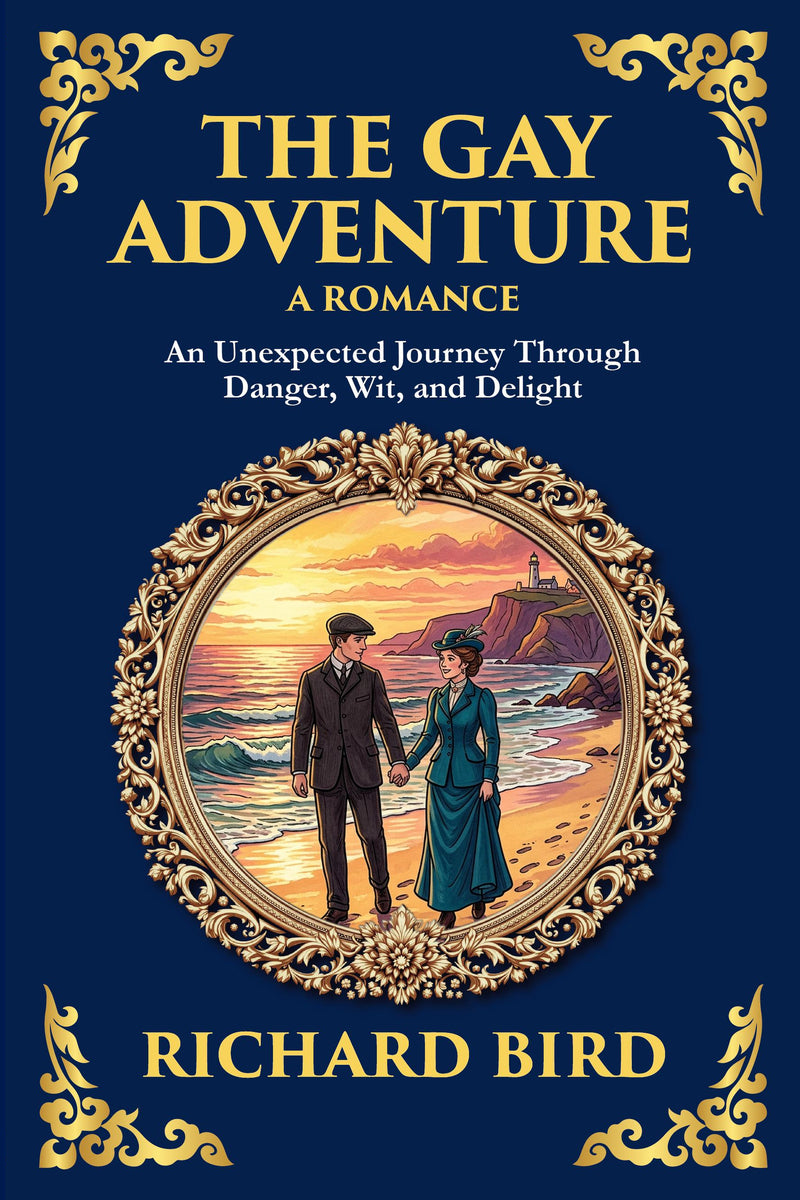
The Gay Adventure: A Romance
Meet James Pendlebury, a modest, respectable schoolmaster whose quiet life takes a wild turn when he stumbles into a world of intrigue, mistaken identity, and absurd adventure.
or free app
10,000+ hrs library
30-day guarantee
The complete The Gay Adventure: A Romance appears in modern English through Library of Alexandria Press, available online with audiobook narration included for members.
Have you ever wondered why the most thrilling adventures often begin with the most ordinary people? In The Gay Adventure: A Romance, Richard Bird crafts a deliciously lighthearted tale that begins with the most unlikely of protagonists—James Pendlebury, a mild-mannered schoolteacher whose dull life is upended by a twist of fate. Expecting a quiet holiday, Pendlebury instead finds himself caught in a whirlwind of espionage, bluffs, and bullet-dodging escapades.
What follows is a whirlwind comic thriller—part caper, part romance, part satire—that delights in upending expectations and delivering pure narrative joy. Set against the backdrop of early 20th-century England, this forgotten gem has been resurrected and newly formatted for modern readers, offering a charming alternative to today’s brooding thrillers. Think derring-do with a dose of self-deprecating British humor and you’re halfway there.
What you’ll discover in this modern edition
- An Unlikely Hero Worth Rooting For – James Pendlebury is ordinary in every way… except for his accidental brilliance in chaos
- A Comic Thriller That Doesn’t Take Itself Too Seriously – Light, witty, and full of misadventures with just enough danger
- Romance and Espionage Collide – A stolen document, a beautiful accomplice, and a man out of his depth—what could go wrong?
- Sharp Dialogue and British Satire – Fans of P. G. Wodehouse or E. F. Benson will feel right at home
| Formats | eBook (EPUB + PDF) · Audiobook · Paperback · Hardcover · Large Print |
| Language | English |
| Trim size (print) | 6 × 9 in |
| Binding | Paperback — perfect-bound · Hardcover — casewrap |
| Large Print edition | Same text in a larger, easy-read type — a larger font, not a larger trim |
| Print pricing | Every physical book at our true cost — at-cost, no profit (members) |
| Library | 873 restored titles, always growing |
| Length | 81,001 words · ~5 hr 24 min reading |
| Reading level | Grade 7 · an easy, flowing read (this modern-English edition) |
| Edition | Modern English translation · 2026 |
Member reviews for this edition are collected as readers finish it — be the first. Across the library: 12,000+ books shipped, every plan covered by a 365-day print guarantee.
About this edition
A faithful, unabridged modern-English edition by The Library of Alexandria — carefully rendered for today's reader and verified paragraph-by-paragraph against the public-domain source. Available as eBook, audiobook, paperback, hardcover, and large print.
- Complete & unabridgedVerified paragraph by paragraph against the source — never a scan, never abridged.
- Modern English, faithfulReadable today, with the author’s meaning kept intact. Readable — not simplified.
- Every format, one membershipRead in your browser or the free app, or listen to the full audiobook.
Included free with your membership
Cancel anytime, one click · 30-day money-back guarantee
Edition last updated July 2026
What’s inside
The Gay Adventure: A Romance — complete and unabridged: all 27 sections included with membership, plus the full audiobook.
Begin reading The Gay Adventure: A Romance
In clear modern English — the complete text is included with membership.
Introduction
There is a particular pleasure in opening a book that does not take itself too seriously, yet rewards the reader who pays attention. The Gay Adventure: A Romance belongs to that delightful and slightly mischievous tradition of storytelling in which the ordinary is suddenly overturned, in which a man wakes one morning with no expectation of incident and finds himself, by nightfall, tangled in a web of intrigue, comedy, and unexpected feeling. It is a book that invites you to set aside the weight of the world for a few hours and accompany its characters down lanes and corridors you could not have predicted. To read it well is to surrender to its spirit — to its lightness of foot, its quick humor, and the warmth that hums beneath its surface like a current beneath a sunlit stream.
The word “gay” in the title carries the meaning it held for the generations who first encountered this story: bright, lighthearted, full of high spirits and the irrepressible joy of living. It is a promise made on the cover and faithfully kept within. This is a tale of adventure in the older and richer sense of that word — not merely the pursuit of danger, but the embrace of the unforeseen, the willingness to step outside the well-worn groove of habit and to see where the road leads. The protagonists of such stories are not professional heroes; they are people much like ourselves, suddenly visited by circumstance and obliged to discover what they are made of. That discovery, undertaken with wit and grace and no small measure of pluck, is the true substance of the romance you are about to enjoy.
This edition has been prepared as a modern translation and adaptation for the contemporary reader. That phrase deserves a word of explanation, because it shapes the experience that awaits you. The original text, a product of an earlier era, carried with it the idioms, the rhythms, and occasionally the obscurities of its time. Some of its references would have been instantly transparent to its first audience and yet would bring a modern reader to a puzzled halt. Some of its sentence constructions, charming as they are, wound their way through clause after clause in a manner that the modern eye, accustomed to a brisker pace, can find taxing. The aim of this adaptation has been to preserve everything that gives the book its enduring charm — its humor, its momentum, its tenderness, its sly observations of human nature — while gently smoothing the path so that nothing stands needlessly between you and the story. Think of it as the careful cleaning of an old and lovely painting: the image is unchanged, but the colors shine again as the artist intended.
The first thing to understand about this book is that it was written to be enjoyed. That may sound obvious, but it is worth saying plainly, because so much of what we are taught about literature encourages us to approach it solemnly, as though every page were an examination. There is a place for that kind of reading, and there are books that demand it. This is not one of them — or rather, it is a book that yields its deeper pleasures only to the reader who first allows it to be fun. It was conceived in the same generous spirit as the comic romances and adventure tales that delighted readers in railway carriages and on rainy afternoons, the kind of story passed from hand to hand with the recommendation, “You really must read this — it’s enormous fun.”
The romance of the title is twofold, and the play between its two meanings is one of the quiet pleasures of the whole. There is romance in the sense of adventure: a quest, a mystery, a series of escalating predicaments through which our characters must scheme, charm, and occasionally blunder their way. And there is romance in the more familiar sense: the gradual, often comical, sometimes exasperating business of two people discovering that they matter to one another more than either had quite expected. The author handles both with a light hand, never letting the sentiment grow cloying nor the adventure grow grim. The two strands are braided together so that the danger heightens the affection and the affection lends weight to the danger. You will find yourself caring about the outcome on both counts, and that double investment is what carries you so swiftly from chapter to chapter.
It is the nature of this kind of story that things are rarely what they first appear. Mistaken identities, overheard conversations, secrets imperfectly kept, plans that go gloriously awry — these are the machinery of the plot, and the author operates that machinery with evident relish. Part of the joy is in being slightly ahead of one character and slightly behind another, in knowing more than one person on the page and less than someone else, so that you are constantly leaning forward to see how the next misunderstanding will resolve itself. The pleasure here is not unlike that of watching a well-built farce on the stage, where doors open and close at exactly the wrong moments and the audience is kept in a state of happy suspense. To enjoy it fully, give yourself permission not to anticipate every turn. Let the story surprise you. It is far more rewarding to be carried along by the current than to stand on the bank trying to map the river.
I will say nothing here of the particulars — of who meets whom, of what is discovered behind which door, of where the journey leads and how it ends. To reveal such things would be a discourtesy of the worst kind, robbing you of the very surprises the author labored to arrange. It is enough to know that the adventure begins, as the best adventures do, with an ordinary person on an ordinary day, and that one small departure from routine sets in motion a chain of events that neither the character nor the reader could have foreseen. From there the tale gathers speed, and the wisest course is simply to hold on and enjoy the ride.
What I can tell you is something of the texture of the experience. This is a book of bright dialogue and quick exchanges, of characters who think on their feet and speak with a sparkle that has not dimmed with the passing decades. The humor is woven into the very fabric of the prose rather than applied to it like decoration; it lives in the turns of phrase, in the wry asides, in the gap between what people say and what they mean. There is a great deal of charm in the way the author observes his creations, regarding them with an affection that never tips into mockery even when they behave foolishly — and they do behave foolishly, as people in love and in peril tend to do. You will laugh, I think, more than you expect to. And you may find, somewhere in the middle of laughing, that you have grown unexpectedly fond of these people and rather anxious about their fortunes.
The pacing rewards a reader who can settle in for a good long sitting, though it is equally hospitable to the reader who picks it up and sets it down across many evenings. The chapters are shaped with a craftsman’s understanding of momentum: each tends to end with a small hook, a question left dangling, a new complication introduced just as the previous one seemed about to resolve. This is the storyteller’s oldest and most reliable trick, and there is no shame in being caught by it. When you tell yourself “just one more chapter” and find the clock has advanced an hour, you will know the author has done his work and that you have entered fully into the spirit of the thing.
A book written in an earlier era arrives at our door like a traveler from a distant country. It speaks our language, more or less, but it carries the customs and assumptions of its homeland, and part of the joy of welcoming it is learning to see the world a little through its eyes. To get the most from this story, it helps to bring a certain generosity to the encounter — a willingness to meet the book on its own terms rather than insisting that it conform entirely to ours.
The world depicted here moves at a different rhythm than our own. There are no devices buzzing in pockets, no instant messages flashing across continents. When a character needs to send word, that word must travel — by letter, by messenger, by the trusting of a confidence to another mouth. When two people are separated, they are genuinely separated, with all the suspense and longing that distance once imposed. This is not a limitation of the story but one of its great resources. So much of the tension and the comedy depends precisely on the slowness and uncertainty of communication, on the things that go unsaid because there was no easy way to say them, on the plans that founder because a message arrived too late or not at all. Modern life has largely banished these particular sources of drama, which is one reason stories from earlier times retain a peculiar charm. They remind us of a world in which a knock at the door might be anyone, in which a journey was an undertaking, in which to lose track of a person was genuinely to lose them. Lean into that slower world. It is part of the pleasure on offer.
The manners and conventions of the period are likewise woven through the book. People observe forms of address and codes of conduct that may seem elaborate or even quaint to a modern sensibility. There are expectations about how men and women may speak to one another, about what is proper and what is daring, about the gulf between public behavior and private feeling. These conventions are not mere window-dressing; they are the very obstacles the characters must navigate, and much of the romance derives its delicious tension from the difficulty of saying directly what one feels when so many rules stand in the way. A glance held a moment too long, a hand offered or withheld, a word spoken or swallowed — in a world of strict convention, these small things carry enormous weight. The modern reader, accustomed to greater frankness, may need to recalibrate slightly to feel the full charge of such moments, but the effort is richly repaid. There is an intensity to restrained emotion that our more candid age sometimes lacks, and this book is full of it.
This adaptation has taken care to ensure that the period flavor remains intact even as the prose has been clarified for contemporary reading. The goal has never been to drag the story into the present, to pretend it was written yesterday, or to strip away the qualities that mark it as a product of its time. Quite the opposite: those qualities are precious, and they have been preserved with affection. What has been adjusted is largely a matter of accessibility — the untangling of an occasional knotty sentence, the gentle modernizing of a word whose meaning has drifted so far that it would only confuse, the smoothing of passages where the original style might have caused a modern reader to stumble and lose the thread. The voice of the author remains; the wit remains; the warmth remains. You are reading the same story that delighted readers in its own day, simply with a few of the obstacles of time and idiom cleared from the road.
It is worth remembering, too, that books of this kind were written for an audience that read differently than we do. The reader of an earlier generation often had more patience for description, for the slow establishment of a scene, for the leisurely introduction of a character before the action began in earnest. Our own age tends to favor a faster start and a brisker pace throughout. This adaptation has sought a sensible middle ground, honoring the author’s original design while ensuring the story never drags. But you, too, can meet the book halfway by allowing yourself to slow down. There is no prize for finishing quickly. The descriptions that establish a place, the small scenes that let us come to know a character before the plot demands action of them — these are not delays but investments, and they pay their dividends later when we find ourselves caring deeply about people and places we have come to know.
A word, finally, about the inevitable distance between the values of the past and those of the present. Any book that honestly reflects its own era will contain attitudes, assumptions, and turns of phrase that a thoughtful modern reader will notice and may find dated. This is true of nearly all literature written before our own moment, and it would be a strange and impoverishing thing to demand that the past agree with us in every particular. The wiser and more rewarding approach is to read such books as windows into how people once thought and felt and spoke — not to endorse every attitude they contain, but to understand them, and in understanding them, to understand something of how far we have traveled and in what directions. This particular story is, above all, a lighthearted and good-natured one, written to delight rather than to provoke, and its spirit is generous and humane. Read it in the same generous spirit, and you will find far more to enjoy than to forgive.
Cancel anytime, one click · 30-day money-back guarantee
Founding annual rate available now — your price locks for life when you join.
Not ready? Get this free chapter by email — read it anytime.
✓ Sent — check your inbox for The Gay Adventure: A Romance.
Questions about The Gay Adventure: A Romance
What is The Gay Adventure: A Romance about?
Meet James Pendlebury, a modest, respectable schoolmaster whose quiet life takes a wild turn when he stumbles into a world of intrigue, mistaken identity, and absurd adventure. Thrust into the role of an accidental hero, he’s forced to navigate a tangled plot involving secret agents, stolen documents, and a dash of romance—all while maintaining his gentlemanly composure. First published in the golden age of British adventure fiction, The Gay Adventure is a witty, fast- paced romp that channels the comic elegance of
Who wrote The Gay Adventure: A Romance?
The Gay Adventure: A Romance was written by Richard Bird. This edition presents the complete work in clear modern English, faithfully rendered from the public-domain original by Library of Alexandria Press.
Is The Gay Adventure: A Romance free to read?
The opening chapter is free to read on this page. Members read and listen to the complete work — and the entire library — free, and can order any physical book at our true print cost.
How long is The Gay Adventure: A Romance?
27 chapters (~81,001 words) — about 5 hr 24 min of reading in this modern-English edition.
Is this an abridged version of The Gay Adventure: A Romance?
No. This is the complete, unabridged The Gay Adventure: A Romance, carefully rendered into clear modern English and verified paragraph-by-paragraph against the public-domain source — nothing is cut or summarised.
What formats does The Gay Adventure: A Romance come in?
The Gay Adventure: A Romance is available as eBook, paperback, hardcover and large print. eBook and audiobook are included with membership; printed editions ship at our true print cost.
Shipping & returns
Billing & membership
More from the library


Explore Romance
- As You Like It · William Shakespeare
- Anna Karenina · Leo Tolstoy
- A Midsummer Night’s Dream · William Shakespeare
- Romeo and Juliet · William Shakespeare
- Sonnets from the Portuguese · Elizabeth Barrett Browning
- Miss Primrose · Agnes Giberne
- The Belle of Bowling Green · Amelia E. Barr
- The Monk: A Romance · M. G. Lewis
- She · H. Rider Haggard
- The Mill on the Floss · George Eliot
- The Glad Lady · Amy Ella Blanchard
- The Red Lily — Complete · Anatole France
- The Blue Goose · Frank Lewis Nason
- The History of Sir Richard Calmady: A Romance · Lucas Malet
- The Quest of the Silver Fleece: A Novel · W. E. B. Du Bois
- The Love Letters of Mary Wollstonecraft to Gilbert Imlay · Mary Wollstonecraft
- Daddy-Long-Legs · Jean Webster
- The Age of Innocence · Edith Wharton
- The Portrait of a Lady — Volume 1 · Henry James
- Wuthering Heights · Emily Brontë
- The Lady of the Lake · Walter Scott
- Lady Chatterley’s Lover · D. H. Lawrence
- Jane Eyre: An Autobiography · Charlotte Brontë
- A Connecticut Yankee in King Arthur’s Court · Mark Twain
- Northanger Abbey · Jane Austen
- Mansfield Park · Jane Austen
- Anthem · Ayn Rand
- This Side of Paradise · F. Scott Fitzgerald
- Persuasion · Jane Austen
- The Blue Castle: A Novel · L. M. Montgomery
The Gay Adventure: A Romance
The Gay Adventure: A Romance
An Unexpected Journey of Danger, Wit, and Pleasure
Richard Bird
Contents
- Introduction
- Chapter 1
- Chapter 2
- Chapter 3
- Chapter 4
- Chapter 5
- Chapter 6
- Chapter 7
- Chapter 8
- Chapter 9
- Chapter 10
- Chapter 11
- Chapter 12
- Chapter 13
- Chapter 14
- Chapter 15
- Chapter 16
- Chapter 17
- Chapter 18
- Chapter 19
- Chapter 20
- Chapter 21
- Chapter 22
- Chapter 23
- Chapter 24
- Chapter 25
- Chapter 26
Introduction
There is a particular pleasure in opening a book that does not take itself too seriously, yet rewards the reader who pays attention. The Gay Adventure: A Romance belongs to that delightful and slightly mischievous tradition of storytelling in which the ordinary is suddenly overturned, in which a man wakes one morning with no expectation of incident and finds himself, by nightfall, tangled in a web of intrigue, comedy, and unexpected feeling. It is a book that invites you to set aside the weight of the world for a few hours and accompany its characters down lanes and corridors you could not have predicted. To read it well is to surrender to its spirit — to its lightness of foot, its quick humor, and the warmth that hums beneath its surface like a current beneath a sunlit stream.
The word “gay” in the title carries the meaning it held for the generations who first encountered this story: bright, lighthearted, full of high spirits and the irrepressible joy of living. It is a promise made on the cover and faithfully kept within. This is a tale of adventure in the older and richer sense of that word — not merely the pursuit of danger, but the embrace of the unforeseen, the willingness to step outside the well-worn groove of habit and to see where the road leads. The protagonists of such stories are not professional heroes; they are people much like ourselves, suddenly visited by circumstance and obliged to discover what they are made of. That discovery, undertaken with wit and grace and no small measure of pluck, is the true substance of the romance you are about to enjoy.
This edition has been prepared as a modern translation and adaptation for the contemporary reader. That phrase deserves a word of explanation, because it shapes the experience that awaits you. The original text, a product of an earlier era, carried with it the idioms, the rhythms, and occasionally the obscurities of its time. Some of its references would have been instantly transparent to its first audience and yet would bring a modern reader to a puzzled halt. Some of its sentence constructions, charming as they are, wound their way through clause after clause in a manner that the modern eye, accustomed to a brisker pace, can find taxing. The aim of this adaptation has been to preserve everything that gives the book its enduring charm — its humor, its momentum, its tenderness, its sly observations of human nature — while gently smoothing the path so that nothing stands needlessly between you and the story. Think of it as the careful cleaning of an old and lovely painting: the image is unchanged, but the colors shine again as the artist intended.
The first thing to understand about this book is that it was written to be enjoyed. That may sound obvious, but it is worth saying plainly, because so much of what we are taught about literature encourages us to approach it solemnly, as though every page were an examination. There is a place for that kind of reading, and there are books that demand it. This is not one of them — or rather, it is a book that yields its deeper pleasures only to the reader who first allows it to be fun. It was conceived in the same generous spirit as the comic romances and adventure tales that delighted readers in railway carriages and on rainy afternoons, the kind of story passed from hand to hand with the recommendation, “You really must read this — it’s enormous fun.”
The romance of the title is twofold, and the play between its two meanings is one of the quiet pleasures of the whole. There is romance in the sense of adventure: a quest, a mystery, a series of escalating predicaments through which our characters must scheme, charm, and occasionally blunder their way. And there is romance in the more familiar sense: the gradual, often comical, sometimes exasperating business of two people discovering that they matter to one another more than either had quite expected. The author handles both with a light hand, never letting the sentiment grow cloying nor the adventure grow grim. The two strands are braided together so that the danger heightens the affection and the affection lends weight to the danger. You will find yourself caring about the outcome on both counts, and that double investment is what carries you so swiftly from chapter to chapter.
It is the nature of this kind of story that things are rarely what they first appear. Mistaken identities, overheard conversations, secrets imperfectly kept, plans that go gloriously awry — these are the machinery of the plot, and the author operates that machinery with evident relish. Part of the joy is in being slightly ahead of one character and slightly behind another, in knowing more than one person on the page and less than someone else, so that you are constantly leaning forward to see how the next misunderstanding will resolve itself. The pleasure here is not unlike that of watching a well-built farce on the stage, where doors open and close at exactly the wrong moments and the audience is kept in a state of happy suspense. To enjoy it fully, give yourself permission not to anticipate every turn. Let the story surprise you. It is far more rewarding to be carried along by the current than to stand on the bank trying to map the river.
I will say nothing here of the particulars — of who meets whom, of what is discovered behind which door, of where the journey leads and how it ends. To reveal such things would be a discourtesy of the worst kind, robbing you of the very surprises the author labored to arrange. It is enough to know that the adventure begins, as the best adventures do, with an ordinary person on an ordinary day, and that one small departure from routine sets in motion a chain of events that neither the character nor the reader could have foreseen. From there the tale gathers speed, and the wisest course is simply to hold on and enjoy the ride.
What I can tell you is something of the texture of the experience. This is a book of bright dialogue and quick exchanges, of characters who think on their feet and speak with a sparkle that has not dimmed with the passing decades. The humor is woven into the very fabric of the prose rather than applied to it like decoration; it lives in the turns of phrase, in the wry asides, in the gap between what people say and what they mean. There is a great deal of charm in the way the author observes his creations, regarding them with an affection that never tips into mockery even when they behave foolishly — and they do behave foolishly, as people in love and in peril tend to do. You will laugh, I think, more than you expect to. And you may find, somewhere in the middle of laughing, that you have grown unexpectedly fond of these people and rather anxious about their fortunes.
The pacing rewards a reader who can settle in for a good long sitting, though it is equally hospitable to the reader who picks it up and sets it down across many evenings. The chapters are shaped with a craftsman’s understanding of momentum: each tends to end with a small hook, a question left dangling, a new complication introduced just as the previous one seemed about to resolve. This is the storyteller’s oldest and most reliable trick, and there is no shame in being caught by it. When you tell yourself “just one more chapter” and find the clock has advanced an hour, you will know the author has done his work and that you have entered fully into the spirit of the thing.
A book written in an earlier era arrives at our door like a traveler from a distant country. It speaks our language, more or less, but it carries the customs and assumptions of its homeland, and part of the joy of welcoming it is learning to see the world a little through its eyes. To get the most from this story, it helps to bring a certain generosity to the encounter — a willingness to meet the book on its own terms rather than insisting that it conform entirely to ours.
The world depicted here moves at a different rhythm than our own. There are no devices buzzing in pockets, no instant messages flashing across continents. When a character needs to send word, that word must travel — by letter, by messenger, by the trusting of a confidence to another mouth. When two people are separated, they are genuinely separated, with all the suspense and longing that distance once imposed. This is not a limitation of the story but one of its great resources. So much of the tension and the comedy depends precisely on the slowness and uncertainty of communication, on the things that go unsaid because there was no easy way to say them, on the plans that founder because a message arrived too late or not at all. Modern life has largely banished these particular sources of drama, which is one reason stories from earlier times retain a peculiar charm. They remind us of a world in which a knock at the door might be anyone, in which a journey was an undertaking, in which to lose track of a person was genuinely to lose them. Lean into that slower world. It is part of the pleasure on offer.
The manners and conventions of the period are likewise woven through the book. People observe forms of address and codes of conduct that may seem elaborate or even quaint to a modern sensibility. There are expectations about how men and women may speak to one another, about what is proper and what is daring, about the gulf between public behavior and private feeling. These conventions are not mere window-dressing; they are the very obstacles the characters must navigate, and much of the romance derives its delicious tension from the difficulty of saying directly what one feels when so many rules stand in the way. A glance held a moment too long, a hand offered or withheld, a word spoken or swallowed — in a world of strict convention, these small things carry enormous weight. The modern reader, accustomed to greater frankness, may need to recalibrate slightly to feel the full charge of such moments, but the effort is richly repaid. There is an intensity to restrained emotion that our more candid age sometimes lacks, and this book is full of it.
This adaptation has taken care to ensure that the period flavor remains intact even as the prose has been clarified for contemporary reading. The goal has never been to drag the story into the present, to pretend it was written yesterday, or to strip away the qualities that mark it as a product of its time. Quite the opposite: those qualities are precious, and they have been preserved with affection. What has been adjusted is largely a matter of accessibility — the untangling of an occasional knotty sentence, the gentle modernizing of a word whose meaning has drifted so far that it would only confuse, the smoothing of passages where the original style might have caused a modern reader to stumble and lose the thread. The voice of the author remains; the wit remains; the warmth remains. You are reading the same story that delighted readers in its own day, simply with a few of the obstacles of time and idiom cleared from the road.
It is worth remembering, too, that books of this kind were written for an audience that read differently than we do. The reader of an earlier generation often had more patience for description, for the slow establishment of a scene, for the leisurely introduction of a character before the action began in earnest. Our own age tends to favor a faster start and a brisker pace throughout. This adaptation has sought a sensible middle ground, honoring the author’s original design while ensuring the story never drags. But you, too, can meet the book halfway by allowing yourself to slow down. There is no prize for finishing quickly. The descriptions that establish a place, the small scenes that let us come to know a character before the plot demands action of them — these are not delays but investments, and they pay their dividends later when we find ourselves caring deeply about people and places we have come to know.
A word, finally, about the inevitable distance between the values of the past and those of the present. Any book that honestly reflects its own era will contain attitudes, assumptions, and turns of phrase that a thoughtful modern reader will notice and may find dated. This is true of nearly all literature written before our own moment, and it would be a strange and impoverishing thing to demand that the past agree with us in every particular. The wiser and more rewarding approach is to read such books as windows into how people once thought and felt and spoke — not to endorse every attitude they contain, but to understand them, and in understanding them, to understand something of how far we have traveled and in what directions. This particular story is, above all, a lighthearted and good-natured one, written to delight rather than to provoke, and its spirit is generous and humane. Read it in the same generous spirit, and you will find far more to enjoy than to forgive.
Lionel Mortimer was a young man with very few goals and no money of his own. He was friendly, quite handsome, and had a charming way about him—the kind of person you would expect to achieve great things. His natural cheerfulness and social skills were more than enough to make a great first impression, but anyone who got to know him better was eventually disappointed. You would still enjoy his positive attitude toward life, but his lack of a clear purpose and his obvious inability to make money from his talents would leave you feeling skeptical. He was a lovely guy, certainly, but completely impractical... the sort of man everyone likes except for mothers looking for a son-in-law.
He lived in a two-room apartment on a quiet street near the Strand. When we first meet him, he has just finished a meal typical of the struggling lower middle class: high tea. For those who appreciate fine food, it should be noted that this meal consisted of herrings, a loaf of bread, some unappetizing butter, and strawberry jam. Lionel lit his pipe and sat by the window, trying to enjoy a June evening as best as one can in a London back alley. He had barely taken three puffs of his pipe when a knock at the door announced the arrival of his landlady.
Mrs. Barker, a woman with a powerful presence dressed in faded black, entered the room. She didn’t say a word, not even a casual comment about the lovely weather or how the days would soon start getting shorter. With a gloomy but efficient manner, she began clearing away the leftovers of the meal, occasionally letting out a harsh cough or a sharp sniff. Lionel seemed completely unaware of her; he remained sitting with his back to the door, staring intently at the street. This was strange, as the street was nothing more than a quiet lane with very little traffic and nothing interesting to see. The building across from him wasn’t much better, being nothing more than the blank wall of a warehouse. There wasn’t a single window to break the boredom, something that usually frustrates artists or thrill-seekers. Even so, Lionel continued smoking his pipe, gazing silently ahead as if he were looking at a masterpiece by Whistler.
End of the free sample
Keep reading, free
Members read and listen to the complete book — and the entire library. Cancel anytime, one click · 30-day money-back guarantee.