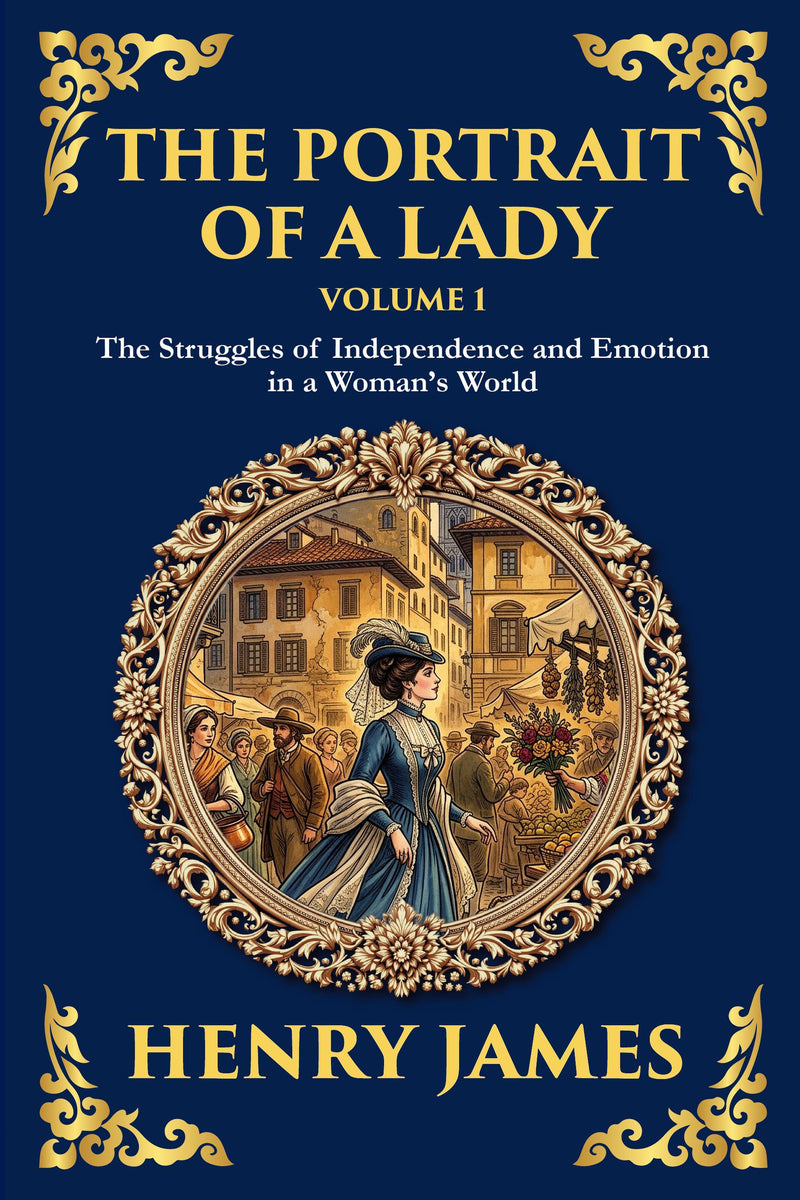
The Portrait of a Lady — Volume 1
Isabel Archer is young, intelligent, and free-spirited—an American in Europe with the world at her feet. In The Portrait of a Lady — Volume 1, Henry James paints the first strokes of one of literature’s most enduring heroines as she steps into the complexities of wealth, courtship, and independence.
or free app
10,000+ hrs library
30-day guarantee
The complete The Portrait of a Lady — Volume 1 appears in modern English through Library of Alexandria Press, available online with audiobook narration included for members.
Have you ever wondered why the freedom to choose can sometimes feel like the heaviest burden of all? In The Portrait of a Lady — Volume 1: The Struggles of Independence and Emotion in a Woman’s World, Henry James invites us into a world of social refinement, moral tension, and the quiet battles of a brilliant woman determined to live life on her own terms. Isabel Archer, a spirited and inquisitive young American, arrives in Europe with a thirst for experience and a refusal to be molded by society’s expectations.
Surrounded by admirers, wealth, and opportunity, she quickly becomes the subject of fascination and speculation. Yet beneath the polite conversations and sunlit drawing rooms lie darker currents—decisions that will test Isabel’s sense of self, her values, and her vision of what it means to be truly free. Volume 1 introduces the cast of unforgettable characters—from the ailing but wise Ralph Touchett, to the charming yet cryptic Lord Warburton—each shaping Isabel’s path in subtle and profound ways.
What you’ll discover in this modern edition
- The Origins of a Literary Heroine – Follow Isabel Archer as she begins her transformative journey from innocence to insight.
- A Deep Dive into Psychological Realism – Experience Henry James’s masterful portrayal of inner conflict, perception, and social nuance.
- A Feminist Milestone in 19th-Century Fiction – Explore the emotional and societal struggles of a woman navigating choice and consequence.
- Elegant Prose and Layered Storytelling – Discover why James is considered a cornerstone of literary modernism.
- An Evocative Portrait of Europe Through American Eyes – From the grand estates of England to the charm of Florence, experience the contrast between old-world traditions and new-world ideals.
| Formats | eBook (EPUB + PDF) · Audiobook · Paperback · Hardcover · Large Print |
| Language | English |
| Trim size (print) | 6 × 9 in |
| Binding | Paperback — perfect-bound · Hardcover — casewrap |
| Large Print edition | Same text in a larger, easy-read type — a larger font, not a larger trim |
| Print pricing | Every physical book at our true cost — at-cost, no profit (members) |
| Library | 873 restored titles, always growing |
| Length | 109,273 words · ~7 hr 17 min reading |
| Reading level | Grade 6 · an easy, flowing read (this modern-English edition) |
| Edition | Modern English translation · 2026 |
Member reviews for this edition are collected as readers finish it — be the first. Across the library: 12,000+ books shipped, every plan covered by a 365-day print guarantee.
About this edition
A faithful, unabridged modern-English edition by The Library of Alexandria — carefully rendered for today's reader and verified paragraph-by-paragraph against the public-domain source. Available as eBook, audiobook, paperback, hardcover, and large print.
- Complete & unabridgedVerified paragraph by paragraph against the source — never a scan, never abridged.
- Modern English, faithfulReadable today, with the author’s meaning kept intact. Readable — not simplified.
- Every format, one membershipRead in your browser or the free app, or listen to the full audiobook.
Included free with your membership
Cancel anytime, one click · 30-day money-back guarantee
Edition last updated July 2026
What’s inside
The Portrait of a Lady — Volume 1 — complete and unabridged: all 29 sections included with membership, plus the full audiobook.
Begin reading The Portrait of a Lady — Volume 1
In clear modern English — the complete text is included with membership.
Introduction
The title of this work is worth pausing over, because it tells us a great deal about what kind of book we are about to read. James called it a portrait, and the choice of word is deliberate. A portrait is not a record of events; it is the rendering of a person. When we stand before a great painted portrait in a gallery, we do not ask what the subject did on a particular afternoon. We ask who she is—what she thinks, what she feels, what she conceals, what she reveals without meaning to. We study the expression in the eyes, the set of the mouth, the way the light falls across a face that seems to be on the verge of telling us something it can never quite say. James wanted his readers to approach his heroine in exactly this spirit. The plot, such as it is, exists in service of the character, not the other way around.
This represents a quiet revolution in the art of the novel. For much of literary history, fiction had been driven primarily by external incident—by what happened. Marriages and inheritances, journeys and shipwrecks, crimes and their punishments, fortunes won and lost: these were the materials of storytelling, and the inner life of a character was often sketched in only as much as was needed to make the events comprehensible. James reversed this priority. For him, the most dramatic thing in the world was not an event but a moment of perception—the instant in which a person sees something clearly for the first time, or fails to see it, or begins to suspect a truth that will eventually change everything. The great scenes in this novel are frequently scenes in which, on the surface, very little appears to be happening. Two people sit and talk. A woman stands alone in a room at night and thinks. And yet these quiet passages contain more genuine drama than a hundred sword fights, because what is at stake in them is nothing less than the shape of a human soul.
To read James well, then, is to slow down and to pay attention. This is a book that rewards the patient reader extravagantly, and the modern adaptation you are about to enjoy has been crafted precisely to make that patience easier to sustain. James’s original sentences are famous—or, to some readers, infamous—for their length, their density, and their many qualifications and refinements. He was a writer who could not bear to state a thing simply when it might be stated with greater precision, and his prose often circles its subject, approaching it from one angle and then another, building meaning the way a painter builds up layers of color. This is glorious when one has the time and the temperament for it, but it can also be a barrier. The present edition seeks to keep the precision while easing the difficulty, so that the music of James’s thought comes through without the reader having to disentangle every clause. You will still find here the subtle distinctions, the careful weighing of motive against motive, the sense that every human exchange is full of unspoken meaning. But you will find these things rendered in a way that invites you in rather than holding you at a distance.
What you should expect, in other words, is not a fast-moving entertainment but a deeply absorbing immersion in another person’s inner world. The pleasure of this book is the pleasure of intimacy—of coming to know a fictional person so thoroughly that she begins to feel as real and as complex as anyone you have ever met. By the time you reach the end of this first volume, you will understand the heroine not in the way you understand a character in a typical novel, but in the way you understand a close friend whose virtues and flaws you have observed over a long acquaintance. You will see her brilliance and her blindness, her generosity and her pride, her longing for life and her vulnerability to those who would use that longing against her. And because James is so honest in his portraiture, you may also find that she holds up a mirror to something in yourself.
The central drama of the story turns on a question that remains as urgent today as it was when the novel first appeared: what does it mean for a person—and particularly for a woman—to be free? The heroine is given, in the course of the narrative, a degree of freedom that few young women of her time could even imagine. She is unmarried, intelligent, and, through a turn of fortune, suddenly possessed of the means to do more or less as she pleases. The world lies open before her. She may go where she likes, choose whom she likes, become whatever she decides to become. This is exactly what she has always wanted. And yet the novel asks, with great delicacy and great unsparingness, whether such freedom is really the simple blessing it appears to be. Freedom requires choices, and choices have consequences, and a person who is free to choose is also free to choose wrongly. The heroine’s independence is genuine, but it does not protect her from the deepest dangers of human life—the danger of misjudging others, the danger of misunderstanding herself, the danger of mistaking a cage for a garden.
It is important to say, for the reader’s sake, that the novel treats this question without cynicism and without sentimentality. James was too clear-eyed to suggest that freedom is worthless, and too wise to pretend that it is without cost. He honors his heroine’s desire for self-determination; he understands it; he makes us feel its rightness and its beauty. At the same time, he refuses to flatter her or to shield her. He allows her to be wrong, sometimes painfully so, and he allows us to see her being wrong even when she cannot see it herself. This is one of the most remarkable features of the book: the gap that often opens between what the heroine believes about her situation and what the reader gradually comes to understand. Watching that gap widen and narrow, feeling the tension between her perception and the truth, is among the great pleasures—and great anxieties—of the reading experience.
Although this is fundamentally a study of one woman’s character, that character does not exist in a vacuum. James surrounds his heroine with a gallery of figures so vividly drawn that any one of them might have served as the protagonist of a lesser novel. There is the kindly, ailing older man whose affection for her shapes the course of her life in ways she does not at first perceive. There is his son, an invalid of wit and wisdom and limitless tenderness, whose love for her must remain forever unspoken in certain ways and whose role as observer often mirrors our own. There is the formidable older woman who first brings the heroine out into the wider world, a person of fierce energy and unsentimental judgment. There are suitors—more than one, each representing a different vision of what the heroine’s life might become, each offering her a different kind of devotion and demanding a different kind of surrender. And there are others, encountered along the way, whose true natures are not always what they seem, whose charm may conceal calculation, and whose entrance into the story alters its temperature in ways the reader will feel before fully understanding.
Each of these characters functions, in part, as a kind of test. The heroine must measure herself against them, must decide what she thinks of them and what she will allow them to mean to her. In choosing how to respond to each one—whom to trust, whom to refuse, whom to love—she defines herself. James understood that we reveal who we are not in isolation but in relation, and so he builds his portrait of his heroine out of her encounters with these other souls. We learn what she values by watching what she accepts and what she rejects. We learn the limits of her understanding by watching her misread someone whose true character is plain to us. The supporting cast, in other words, is never merely decorative. Every conversation, every visit, every small social maneuver is part of the larger design.
The settings, too, deserve a word. The story moves across several of the great landscapes of nineteenth-century life: the green, settled comfort of the English countryside; the busy streets and drawing rooms of London; the ancient, layered beauty of Italy. James knew these places intimately, for he was himself a wanderer between cultures—an American by birth who spent the greater part of his life in Europe and who made the encounter between the New World and the Old one of the central themes of his fiction. His heroine carries with her a distinctly American freshness: a frankness, an optimism, a faith in the individual will that strikes the older, more guarded European world as both charming and faintly alarming. The drama of the book is in part the drama of this encounter—of a young, hopeful spirit meeting a civilization that is older, subtler, more beautiful, and more dangerous than anything she has known. The Old World offers her treasures: art, history, refinement, a depth of experience her own country cannot match. It also offers her traps, baited with exactly those treasures. Part of the suspense of the narrative lies in wondering whether she will be enriched by Europe or consumed by it.
This theme of the American abroad runs through much of James’s work, but it finds in this novel one of its fullest and most resonant expressions. For the modern reader, it offers a fascinating window into a particular historical moment—a time when the relationship between America and Europe was charged with a complicated mixture of admiration and anxiety, when wealthy Americans flocked to the great cities of the Continent to acquire culture and connection, and when the questions of identity and belonging that such travel raised were felt with peculiar intensity. But the theme also speaks beyond its moment. We all, in some sense, must venture out from the familiar world of our origins into a larger and more complicated reality. We all must learn, sometimes at great cost, how to distinguish the genuine from the counterfeit, the friend from the flatterer, the path that leads to fulfillment from the one that leads to a beautifully decorated prison. The heroine’s journey is, in this way, everyone’s journey, transposed into a particular key.
It is worth dwelling for a moment on James’s treatment of women, because it is one of the things that makes this novel feel so strikingly modern despite its age. James took the inner lives of women seriously in a way that not all of his contemporaries did. He understood that a woman’s desire for independence was not a frivolous whim or a passing rebellion but a profound and legitimate longing, as deserving of respect and as fraught with difficulty as any man’s. He saw that the social arrangements of his time placed enormous obstacles in the way of a woman who wished to direct her own life, and he saw, too, that some of the most dangerous of those obstacles were not the obvious ones—the laws, the customs, the explicit prohibitions—but the subtle ones: the expectations a woman might internalize, the flattery that might lead her to mistake a clever manipulator for a kindred spirit, the romantic ideals that might cause her to choose a path she imagined to be one of high purpose when it was in fact a snare. The novel’s treatment of these matters is so psychologically acute that it can feel as though it were written for our own age rather than for the one in which it appeared.
The subtitle of this edition speaks of “the struggles of independence and emotion in a woman’s world,” and that phrase captures something essential about the book’s emotional core. The heroine’s independence is constantly in tension with her emotions—with her capacity for affection, for loyalty, for love. To remain perfectly free, she would have to remain perfectly detached, and detachment is something her warm and generous nature will not permit. The very qualities that make her admirable—her openness to experience, her willingness to give herself to others, her refusal to be merely cautious—are also the qualities that expose her to harm. This is the painful paradox at the heart of the story. The fullest life is also the most vulnerable life. To love is to risk. To choose is to commit. To be free is to be, in some terrible and exhilarating way, responsible for one’s own fate. James does not resolve this paradox, because it cannot be resolved. He simply renders it with such truth that we recognize it as one of the permanent conditions of being human.
Cancel anytime, one click · 30-day money-back guarantee
Founding annual rate available now — your price locks for life when you join.
Not ready? Get this free chapter by email — read it anytime.
✓ Sent — check your inbox for The Portrait of a Lady — Volume 1.
Questions about The Portrait of a Lady — Volume 1
What is The Portrait of a Lady — Volume 1 about?
Isabel Archer is young, intelligent, and free-spirited—an American in Europe with the world at her feet. In The Portrait of a Lady — Volume 1, Henry James paints the first strokes of one of literature’s most enduring heroines as she steps into the complexities of wealth, courtship, and independence. Armed with ideals and ambition, Isabel refuses to conform to society’s expectations of women.
Who wrote The Portrait of a Lady — Volume 1?
The Portrait of a Lady — Volume 1 was written by Henry James. This edition presents the complete work in clear modern English, faithfully rendered from the public-domain original by Library of Alexandria Press.
Is The Portrait of a Lady — Volume 1 free to read?
The opening chapter is free to read on this page. Members read and listen to the complete work — and the entire library — free, and can order any physical book at our true print cost.
How long is The Portrait of a Lady — Volume 1?
29 chapters (~109,273 words) — about 7 hr 17 min of reading in this modern-English edition.
Is this an abridged version of The Portrait of a Lady — Volume 1?
No. This is the complete, unabridged The Portrait of a Lady — Volume 1, carefully rendered into clear modern English and verified paragraph-by-paragraph against the public-domain source — nothing is cut or summarised.
What formats does The Portrait of a Lady — Volume 1 come in?
The Portrait of a Lady — Volume 1 is available as eBook, paperback, hardcover and large print. eBook and audiobook are included with membership; printed editions ship at our true print cost.
Shipping & returns
Billing & membership
More from the library


Explore Romance
- As You Like It · William Shakespeare
- Anna Karenina · Leo Tolstoy
- A Midsummer Night’s Dream · William Shakespeare
- Romeo and Juliet · William Shakespeare
- Sonnets from the Portuguese · Elizabeth Barrett Browning
- Miss Primrose · Agnes Giberne
- The Gay Adventure: A Romance · Richard Bird
- The Belle of Bowling Green · Amelia E. Barr
- The Monk: A Romance · M. G. Lewis
- She · H. Rider Haggard
- The Mill on the Floss · George Eliot
- The Glad Lady · Amy Ella Blanchard
- The Red Lily — Complete · Anatole France
- The Blue Goose · Frank Lewis Nason
- The History of Sir Richard Calmady: A Romance · Lucas Malet
- The Quest of the Silver Fleece: A Novel · W. E. B. Du Bois
- The Love Letters of Mary Wollstonecraft to Gilbert Imlay · Mary Wollstonecraft
- Daddy-Long-Legs · Jean Webster
- The Age of Innocence · Edith Wharton
- Wuthering Heights · Emily Brontë
- The Lady of the Lake · Walter Scott
- Lady Chatterley’s Lover · D. H. Lawrence
- Jane Eyre: An Autobiography · Charlotte Brontë
- A Connecticut Yankee in King Arthur’s Court · Mark Twain
- Northanger Abbey · Jane Austen
- Mansfield Park · Jane Austen
- Anthem · Ayn Rand
- This Side of Paradise · F. Scott Fitzgerald
- Persuasion · Jane Austen
- The Blue Castle: A Novel · L. M. Montgomery
The Portrait of a Lady — Volume 1
The Portrait of a Lady — Volume 1
The Struggles of Independence and Emotion in a Woman’s World
Henry James
Contents
- Introduction
- Preface by the Author
- Chapter 1
- Chapter 2
- Chapter 3
- Chapter 4
- Chapter 5
- Chapter 6
- Chapter 7
- Chapter 8
- Chapter 9
- Chapter 10
- Chapter 11
- Chapter 12
- Chapter 13
- Chapter 14
- Chapter 15
- Chapter 16
- Chapter 17
- Chapter 18
- Chapter 19
- Chapter 20
- Chapter 21
- Chapter 22
- Chapter 23
- Chapter 24
- Chapter 25
- Chapter 26
- Chapter 27
Introduction
The title of this work is worth pausing over, because it tells us a great deal about what kind of book we are about to read. James called it a portrait, and the choice of word is deliberate. A portrait is not a record of events; it is the rendering of a person. When we stand before a great painted portrait in a gallery, we do not ask what the subject did on a particular afternoon. We ask who she is—what she thinks, what she feels, what she conceals, what she reveals without meaning to. We study the expression in the eyes, the set of the mouth, the way the light falls across a face that seems to be on the verge of telling us something it can never quite say. James wanted his readers to approach his heroine in exactly this spirit. The plot, such as it is, exists in service of the character, not the other way around.
This represents a quiet revolution in the art of the novel. For much of literary history, fiction had been driven primarily by external incident—by what happened. Marriages and inheritances, journeys and shipwrecks, crimes and their punishments, fortunes won and lost: these were the materials of storytelling, and the inner life of a character was often sketched in only as much as was needed to make the events comprehensible. James reversed this priority. For him, the most dramatic thing in the world was not an event but a moment of perception—the instant in which a person sees something clearly for the first time, or fails to see it, or begins to suspect a truth that will eventually change everything. The great scenes in this novel are frequently scenes in which, on the surface, very little appears to be happening. Two people sit and talk. A woman stands alone in a room at night and thinks. And yet these quiet passages contain more genuine drama than a hundred sword fights, because what is at stake in them is nothing less than the shape of a human soul.
To read James well, then, is to slow down and to pay attention. This is a book that rewards the patient reader extravagantly, and the modern adaptation you are about to enjoy has been crafted precisely to make that patience easier to sustain. James’s original sentences are famous—or, to some readers, infamous—for their length, their density, and their many qualifications and refinements. He was a writer who could not bear to state a thing simply when it might be stated with greater precision, and his prose often circles its subject, approaching it from one angle and then another, building meaning the way a painter builds up layers of color. This is glorious when one has the time and the temperament for it, but it can also be a barrier. The present edition seeks to keep the precision while easing the difficulty, so that the music of James’s thought comes through without the reader having to disentangle every clause. You will still find here the subtle distinctions, the careful weighing of motive against motive, the sense that every human exchange is full of unspoken meaning. But you will find these things rendered in a way that invites you in rather than holding you at a distance.
What you should expect, in other words, is not a fast-moving entertainment but a deeply absorbing immersion in another person’s inner world. The pleasure of this book is the pleasure of intimacy—of coming to know a fictional person so thoroughly that she begins to feel as real and as complex as anyone you have ever met. By the time you reach the end of this first volume, you will understand the heroine not in the way you understand a character in a typical novel, but in the way you understand a close friend whose virtues and flaws you have observed over a long acquaintance. You will see her brilliance and her blindness, her generosity and her pride, her longing for life and her vulnerability to those who would use that longing against her. And because James is so honest in his portraiture, you may also find that she holds up a mirror to something in yourself.
The central drama of the story turns on a question that remains as urgent today as it was when the novel first appeared: what does it mean for a person—and particularly for a woman—to be free? The heroine is given, in the course of the narrative, a degree of freedom that few young women of her time could even imagine. She is unmarried, intelligent, and, through a turn of fortune, suddenly possessed of the means to do more or less as she pleases. The world lies open before her. She may go where she likes, choose whom she likes, become whatever she decides to become. This is exactly what she has always wanted. And yet the novel asks, with great delicacy and great unsparingness, whether such freedom is really the simple blessing it appears to be. Freedom requires choices, and choices have consequences, and a person who is free to choose is also free to choose wrongly. The heroine’s independence is genuine, but it does not protect her from the deepest dangers of human life—the danger of misjudging others, the danger of misunderstanding herself, the danger of mistaking a cage for a garden.
It is important to say, for the reader’s sake, that the novel treats this question without cynicism and without sentimentality. James was too clear-eyed to suggest that freedom is worthless, and too wise to pretend that it is without cost. He honors his heroine’s desire for self-determination; he understands it; he makes us feel its rightness and its beauty. At the same time, he refuses to flatter her or to shield her. He allows her to be wrong, sometimes painfully so, and he allows us to see her being wrong even when she cannot see it herself. This is one of the most remarkable features of the book: the gap that often opens between what the heroine believes about her situation and what the reader gradually comes to understand. Watching that gap widen and narrow, feeling the tension between her perception and the truth, is among the great pleasures—and great anxieties—of the reading experience.
Although this is fundamentally a study of one woman’s character, that character does not exist in a vacuum. James surrounds his heroine with a gallery of figures so vividly drawn that any one of them might have served as the protagonist of a lesser novel. There is the kindly, ailing older man whose affection for her shapes the course of her life in ways she does not at first perceive. There is his son, an invalid of wit and wisdom and limitless tenderness, whose love for her must remain forever unspoken in certain ways and whose role as observer often mirrors our own. There is the formidable older woman who first brings the heroine out into the wider world, a person of fierce energy and unsentimental judgment. There are suitors—more than one, each representing a different vision of what the heroine’s life might become, each offering her a different kind of devotion and demanding a different kind of surrender. And there are others, encountered along the way, whose true natures are not always what they seem, whose charm may conceal calculation, and whose entrance into the story alters its temperature in ways the reader will feel before fully understanding.
Each of these characters functions, in part, as a kind of test. The heroine must measure herself against them, must decide what she thinks of them and what she will allow them to mean to her. In choosing how to respond to each one—whom to trust, whom to refuse, whom to love—she defines herself. James understood that we reveal who we are not in isolation but in relation, and so he builds his portrait of his heroine out of her encounters with these other souls. We learn what she values by watching what she accepts and what she rejects. We learn the limits of her understanding by watching her misread someone whose true character is plain to us. The supporting cast, in other words, is never merely decorative. Every conversation, every visit, every small social maneuver is part of the larger design.
The settings, too, deserve a word. The story moves across several of the great landscapes of nineteenth-century life: the green, settled comfort of the English countryside; the busy streets and drawing rooms of London; the ancient, layered beauty of Italy. James knew these places intimately, for he was himself a wanderer between cultures—an American by birth who spent the greater part of his life in Europe and who made the encounter between the New World and the Old one of the central themes of his fiction. His heroine carries with her a distinctly American freshness: a frankness, an optimism, a faith in the individual will that strikes the older, more guarded European world as both charming and faintly alarming. The drama of the book is in part the drama of this encounter—of a young, hopeful spirit meeting a civilization that is older, subtler, more beautiful, and more dangerous than anything she has known. The Old World offers her treasures: art, history, refinement, a depth of experience her own country cannot match. It also offers her traps, baited with exactly those treasures. Part of the suspense of the narrative lies in wondering whether she will be enriched by Europe or consumed by it.
This theme of the American abroad runs through much of James’s work, but it finds in this novel one of its fullest and most resonant expressions. For the modern reader, it offers a fascinating window into a particular historical moment—a time when the relationship between America and Europe was charged with a complicated mixture of admiration and anxiety, when wealthy Americans flocked to the great cities of the Continent to acquire culture and connection, and when the questions of identity and belonging that such travel raised were felt with peculiar intensity. But the theme also speaks beyond its moment. We all, in some sense, must venture out from the familiar world of our origins into a larger and more complicated reality. We all must learn, sometimes at great cost, how to distinguish the genuine from the counterfeit, the friend from the flatterer, the path that leads to fulfillment from the one that leads to a beautifully decorated prison. The heroine’s journey is, in this way, everyone’s journey, transposed into a particular key.
It is worth dwelling for a moment on James’s treatment of women, because it is one of the things that makes this novel feel so strikingly modern despite its age. James took the inner lives of women seriously in a way that not all of his contemporaries did. He understood that a woman’s desire for independence was not a frivolous whim or a passing rebellion but a profound and legitimate longing, as deserving of respect and as fraught with difficulty as any man’s. He saw that the social arrangements of his time placed enormous obstacles in the way of a woman who wished to direct her own life, and he saw, too, that some of the most dangerous of those obstacles were not the obvious ones—the laws, the customs, the explicit prohibitions—but the subtle ones: the expectations a woman might internalize, the flattery that might lead her to mistake a clever manipulator for a kindred spirit, the romantic ideals that might cause her to choose a path she imagined to be one of high purpose when it was in fact a snare. The novel’s treatment of these matters is so psychologically acute that it can feel as though it were written for our own age rather than for the one in which it appeared.
The subtitle of this edition speaks of “the struggles of independence and emotion in a woman’s world,” and that phrase captures something essential about the book’s emotional core. The heroine’s independence is constantly in tension with her emotions—with her capacity for affection, for loyalty, for love. To remain perfectly free, she would have to remain perfectly detached, and detachment is something her warm and generous nature will not permit. The very qualities that make her admirable—her openness to experience, her willingness to give herself to others, her refusal to be merely cautious—are also the qualities that expose her to harm. This is the painful paradox at the heart of the story. The fullest life is also the most vulnerable life. To love is to risk. To choose is to commit. To be free is to be, in some terrible and exhilarating way, responsible for one’s own fate. James does not resolve this paradox, because it cannot be resolved. He simply renders it with such truth that we recognize it as one of the permanent conditions of being human.
Depending on the situation, few moments in life are more pleasant than afternoon tea. Sometimes, whether you actually drink the tea or not—since some people never do—the whole experience is simply delightful. The circumstances I’m thinking of as I begin this simple story provided a perfect setting for a relaxing pastime. The tea service had been set up on the lawn of an old English country house in the middle of a gorgeous summer afternoon. Part of the day had passed, but plenty of it remained, and the remaining hours were the best of all. It would be a long time before actual dusk arrived, but the intense summer light had started to fade, the air had become soft, and long shadows stretched across the smooth, thick grass. These shadows grew slowly, creating a feeling of endless leisure, which is perhaps the best part of being in such a place at that time of day. From five to eight o’clock can feel like a small eternity; but on a day like this, it could only be an eternity of pleasure. The people there were enjoying themselves quietly, and they weren’t the type of people usually associated with this ritual. The sharp, angular shadows on the perfect lawn belonged to an old man sitting in a deep wicker chair near the low tea table, and to two younger men walking back and forth in front of him, chatting casually. The old man held a cup in his hand—an unusually large one, different from the rest of the set and painted in bright colors. He sipped its contents carefully, holding the cup close to his chin for a long time while looking toward the house. His companions had either finished their tea or didn’t care for it; they smoked cigarettes as they continued to pace. Every so often, one of them glanced at the older man, who, unaware he was being watched, gazed at the rich red facade of his home. The house rising beyond the lawn was well worth the look and was the most defining feature of the typically English scene I’ve described.
End of the free sample
Keep reading, free
Members read and listen to the complete book — and the entire library. Cancel anytime, one click · 30-day money-back guarantee.