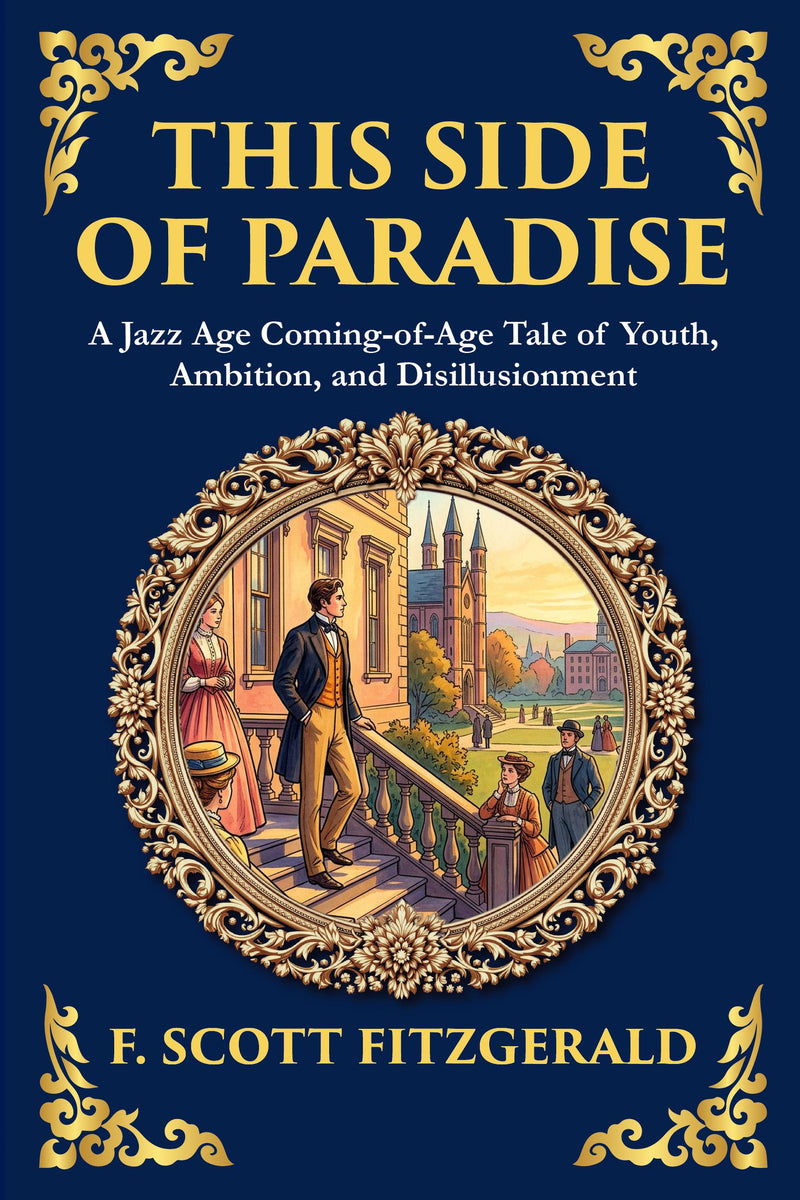
This Side of Paradise
From ivy-covered colleges to the glitter of New York salons, This Side of Paradise follows Amory Blaine—a handsome, self-absorbed young man searching for meaning in a world of parties, poetry, and heartbreak.
or free app
10,000+ hrs library
30-day guarantee
The complete This Side of Paradise appears in modern English through Library of Alexandria Press, available online with audiobook narration included for members.
Have you ever wondered why the pursuit of greatness can leave you feeling empty? In This Side of Paradise, F. Scott Fitzgerald delivers a groundbreaking coming-of-age novel that defined a generation. With lyrical brilliance and biting social commentary, he introduces us to Amory Blaine, a privileged yet insecure Princeton student whose journey mirrors the aspirations and disillusionments of the post–World War I generation.
Amory is intelligent, vain, romantic—and doomed to learn that life does not follow the arc of a perfectly penned poem. From early prep school confidence to failed love affairs and ideological drift, Amory stumbles through life, confronting the spiritual emptiness beneath society’s glittering surface. His evolution is both personal and symbolic of the broader disillusionment of America’s Lost Generation.
This modern adaptation of Fitzgerald’s first novel preserves the wit, introspection, and historical richness of the original while providing clarity for today’s readers. At once a portrait of youthful arrogance and a critique of the American Dream, This Side of Paradise remains a timeless exploration of identity, ambition, and the bittersweet search for self.
What you’ll discover in this modern edition
- A Jazz Age Portrait of a Generation – Dive into the cultural, intellectual, and emotional world of postwar youth.
- The Rise and Fall of Amory Blaine – Follow a brilliant, flawed protagonist as he confronts love, failure, and the limits of self-importance.
- A Critical Look at Social Class and Privilege – Examine the tensions between idealism and materialism, status and authenticity.
- Themes of Love, Identity, and Disillusionment – Explore Fitzgerald’s timeless commentary on youth, hope, and heartbreak.
- An Accessible Modern Edition – Fitzgerald’s dazzling prose is made clear and vivid for today’s reader while honoring his artistic voice.
| Formats | eBook (EPUB + PDF) · Audiobook · Paperback · Hardcover · Large Print |
| Language | English |
| Trim size (print) | 6 × 9 in |
| Binding | Paperback — perfect-bound · Hardcover — casewrap |
| Large Print edition | Same text in a larger, easy-read type — a larger font, not a larger trim |
| Print pricing | Every physical book at our true cost — at-cost, no profit (members) |
| Library | 873 restored titles, always growing |
| Length | 81,506 words · ~5 hr 26 min reading |
| Reading level | Grade 3 · an easy, flowing read (this modern-English edition) |
| Edition | Modern English translation · 2026 |
Member reviews for this edition are collected as readers finish it — be the first. Across the library: 12,000+ books shipped, every plan covered by a 365-day print guarantee.
About this edition
A faithful, unabridged modern-English edition by The Library of Alexandria — carefully rendered for today's reader and verified paragraph-by-paragraph against the public-domain source. Available as eBook, audiobook, paperback, hardcover, and large print.
- Complete & unabridgedVerified paragraph by paragraph against the source — never a scan, never abridged.
- Modern English, faithfulReadable today, with the author’s meaning kept intact. Readable — not simplified.
- Every format, one membershipRead in your browser or the free app, or listen to the full audiobook.
Included free with your membership
Cancel anytime, one click · 30-day money-back guarantee
Edition last updated July 2026
What’s inside
This Side of Paradise — complete and unabridged: all 9 sections included with membership, plus the full audiobook.
Begin reading This Side of Paradise
In clear modern English — the complete text is included with membership.
Introduction
When This Side of Paradise appeared on bookshelves in March of 1920, it did something that very few novels manage to do: it announced not merely the arrival of a writer but the dawning of an entire era. The book sold out its first printing within days, and a twenty-three-year-old author who had been scribbling and dreaming and failing and trying again suddenly found himself famous, courted, quoted, and—most importantly to him at that moment—able to marry the woman he loved. The novel that you are about to read is therefore something rare and precious: a debut that captures, almost by accident, the exact instant when one generation slipped away and another came roaring into the light. It is a book written by a young man about young men and women, and it pulses with all the urgency, the arrogance, the tenderness, and the confusion of being twenty years old and convinced that the world is yours to win, if only you can figure out the rules of the game.
F. Scott Fitzgerald wrote this novel out of his own life with a frankness that startled his contemporaries. He drew on his years at Princeton, on his romances and heartbreaks, on his ambition and his self-doubt, and he poured all of it onto the page with the conviction that his own experience was somehow representative of something larger. He was right. The hero of the book, a young man named Amory Blaine, became a kind of avatar for an entire generation of restless, intelligent, privileged young Americans who came of age in the shadow of the First World War and emerged into a world that seemed to have lost its old certainties. Reading this book is like opening a window directly into the mind of someone learning, in real time, how to be alive—how to want things, how to lose them, how to reconcile the dazzling promises of youth with the harder education of experience.
This modern adaptation has been prepared with a single guiding purpose: to make that window as clear as possible for you, the contemporary reader. Fitzgerald’s original prose, for all its beauty, was written more than a century ago, and it carried with it the particular vocabulary, references, and rhythms of a vanished world. Some of those textures have aged into puzzles; some of the slang of 1920 means nothing to us now, and certain digressions that delighted readers in their day can feel like obstacles to us. The aim here has been to preserve everything that makes the novel sing—its wit, its emotional truth, its restless intelligence—while gently smoothing the path so that you can walk it without stumbling. What you hold is not a watered-down version but a clarified one, a book that lets Fitzgerald’s voice reach you as freshly as it reached the eager young readers who made him a star.
To understand what makes this novel so enduring, it helps to understand the moment that produced it. The 1910s had ended in catastrophe. The Great War, as it was then called, had consumed millions of young men and shattered the comfortable assumption that civilization was marching steadily toward progress. The young people who survived it, or who came of age just as it ended, inherited a world that seemed both newly free and newly unmoored. The old Victorian rules about morality, ambition, courtship, and success had not so much been abolished as quietly emptied of their authority. Into this vacuum rushed a new spirit—reckless, hungry, skeptical, and determined to live fully and immediately rather than defer to the patient pieties of their elders. Fitzgerald gave this spirit a name and a face, and he did it so vividly that he is often credited with coining the term “the Jazz Age” itself.
But it would be a mistake to read this book merely as a historical document, a curiosity preserved under glass. What makes it live is that it is fundamentally a story about growing up, and growing up does not change very much from one century to the next. The central figure begins the novel as a boy of immense self-regard, brilliant and lazy, charming and selfish, certain that he is destined for some glittering greatness without having the slightest idea of what form that greatness might take or what it might cost him. Over the course of the book he is tested—by school, by friendship, by love, by ambition, by grief, by failure—and each test strips away a little more of his comfortable illusions about himself and the world. Anyone who has ever been young and ambitious, who has ever believed themselves special and then discovered the painful gap between their self-image and reality, will recognize themselves in this journey. The settings may be Princeton dormitories and New York parties and the manicured estates of the wealthy, but the emotional landscape is universal.
The novel is, at its heart, an education—not the kind that happens in classrooms, though there is plenty of that, but the deeper and harder kind that happens when life refuses to conform to our expectations. Our protagonist must learn that intelligence is not the same as wisdom, that charm is not the same as character, that being loved is not the same as deserving love, and that the world owes him nothing simply because he is clever and well-born. These are lessons that everyone must learn eventually, and the particular drama of this book lies in watching a young man learn them slowly, painfully, and incompletely. Fitzgerald does not flatter his hero. He shows us his vanity and his cruelty alongside his idealism and his yearning, and this honesty is part of what makes the portrait so compelling. We are not asked to admire a flawless figure; we are asked to recognize a real one.
It is worth pausing on the women in this story, because they are among its most memorable creations. The young women whom the hero loves and pursues and loses are not mere objects of his affection; they are forces in their own right, intelligent and willful, products of the same restless new spirit that animates the men. They smoke, they kiss whom they please, they speak their minds, and they refuse to be confined by the expectations that bound their mothers. Fitzgerald based many of them on women he knew, and especially on the woman who would become his wife, and there is in his portrayal of them a mixture of fascination, frustration, and genuine respect. These were the “flappers,” as the era would come to call them, and through them the novel captures a profound shift in the way an entire society thought about womanhood, desire, and freedom. The romantic entanglements at the center of the book are not just love stories; they are studies in how two people from the same restless generation try, and often fail, to understand one another.
There is also throughout the novel a current of melancholy that gives it surprising depth. For all its youthful energy and its surface glamour, this is not a happy book. It is shadowed by loss, by the deaths of friends, by the collapse of expectations, by the slow dawning realization that the world is not arranged for one’s personal benefit. Fitzgerald understood, even at twenty-three, that the most exhilarating thing about youth—its sense of infinite possibility—is also the source of its deepest sorrow, because possibility is something we lose a little of every day. The book’s famous closing pages, which we will not spoil here, distill this bittersweet wisdom into some of the most quoted lines in American literature. They have the quality of a young man’s hard-won truth, spoken at the very moment when the door of youth is beginning to swing shut behind him.
It is one of the small miracles of literary history that this book exists at all. Fitzgerald had been working on a version of it for years, under different titles and in different forms, and it had been rejected by publishers more than once. He was, at the time, a young man whose life seemed to be coming apart: he had left Princeton without graduating, he had served in the army during the war without ever being sent overseas, and he had fallen desperately in love with a beautiful and willful young woman named Zelda Sayre, who refused to marry him until he could prove that he could support her in the style she expected. He was, in short, a failure by the only measures that seemed to matter to him—and he knew it, and it ate at him.
He retreated to his parents’ home and rewrote the book in a feverish burst of creativity, transforming an earlier, more formless manuscript into the novel you now hold. When it was finally accepted by the editor Maxwell Perkins at Scribner’s—an editor who would go on to shape American literature for decades—Fitzgerald’s life changed overnight. The book’s immediate success gave him the money and the fame he had craved, won him Zelda’s hand, and launched him into a decade of dazzling productivity and equally dazzling self-destruction. He and Zelda became the most famous couple of the Jazz Age, the very embodiment of its glamour and its excess, and the trajectory of their lives—from the heights of celebrity to the depths of breakdown, debt, and disillusionment—would mirror the trajectory of the era itself.
This biographical context matters because it tells us something important about how to read the novel. It is not a detached, polished work of mature craftsmanship; it is the raw and brilliant outpouring of a young genius writing about himself with very little distance and very little disguise. The protagonist is not Fitzgerald exactly, but the two share a great deal: the same Midwestern background, the same Princeton years, the same ambitions and insecurities, the same intoxication with beauty and money and success. When you read this book, you are reading a young man trying to understand his own life by transforming it into art, and the urgency of that effort gives the prose its peculiar electricity. There are passages that feel almost too personal, confessions that seem to escape the author against his will, and these are often the most powerful moments in the book.
The novel’s structure is also worth a word of preparation, because it is unconventional and was so even in its own time. Fitzgerald was an experimentalist at heart, and rather than telling a single, smoothly flowing story, he assembled his book out of a variety of pieces and styles. There are stretches of conventional narrative, but there are also poems, letters, fragments of plays, lists, and lyrical interludes that interrupt the action. Some early critics found this messy or undisciplined, and there is some truth to that complaint—this is the work of a young writer who had not yet mastered all the tools of his craft. But the messiness is also part of the book’s charm and its meaning. The fragmented, restless form mirrors the fragmented, restless inner life of its hero and of the generation he represents. Reading it is a little like leafing through the journal of a brilliant and self-obsessed young man, full of false starts and sudden insights and showy displays of cleverness. If you approach it with this expectation, you will find its variety delightful rather than confusing.
This modern adaptation has taken particular care with the novel’s experimental passages, clarifying obscure references and updating language that would otherwise send readers reaching for a dictionary or an encyclopedia. Fitzgerald loved to display his erudition, and the original text is studded with allusions to writers, books, songs, and public figures of his day, many of whom have been forgotten by everyone but specialists. Where these references illuminate the story, they have been preserved and made accessible; where they merely clutter the page, they have been gently streamlined. The goal throughout has been to keep you, the reader, inside the emotional flow of the story rather than constantly halting you at the threshold of some forgotten name. Fitzgerald wrote to be read and enjoyed by ordinary intelligent readers of his own time, not by scholars of a later age, and this version aims to restore that original ease of access.
Cancel anytime, one click · 30-day money-back guarantee
Founding annual rate available now — your price locks for life when you join.
Not ready? Get this free chapter by email — read it anytime.
✓ Sent — check your inbox for This Side of Paradise.
Questions about This Side of Paradise
What is This Side of Paradise about?
From ivy-covered colleges to the glitter of New York salons, This Side of Paradise follows Amory Blaine—a handsome, self-absorbed young man searching for meaning in a world of parties, poetry, and heartbreak. Set against the dazzling backdrop of the Roaring Twenties, Fitzgerald’s debut novel captures the restlessness of youth caught between romantic dreams and harsh realities. Step into a world of intellect, charm, and illusion—and discover the price of chasing brilliance in an era drunk on ambition.
Who wrote This Side of Paradise?
This Side of Paradise was written by F. Scott Fitzgerald. This edition presents the complete work in clear modern English, faithfully rendered from the public-domain original by Library of Alexandria Press.
Is This Side of Paradise free to read?
The opening chapter is free to read on this page. Members read and listen to the complete work — and the entire library — free, and can order any physical book at our true print cost.
How long is This Side of Paradise?
9 chapters (~81,506 words) — about 5 hr 26 min of reading in this modern-English edition.
Is this an abridged version of This Side of Paradise?
No. This is the complete, unabridged This Side of Paradise, carefully rendered into clear modern English and verified paragraph-by-paragraph against the public-domain source — nothing is cut or summarised.
What formats does This Side of Paradise come in?
This Side of Paradise is available as eBook, paperback, hardcover and large print. eBook and audiobook are included with membership; printed editions ship at our true print cost.
Shipping & returns
Billing & membership
More from the library


Explore Children's Classics
- Peter and Wendy · J. M. Barrie
- Jack and Jill · Louisa May Alcott
- The Wonderful Wizard of Oz · L. Frank Baum
- Anne of Green Gables · L. M. Montgomery
- The Secret Garden · Frances Hodgson Burnett
- The Tale of Peter Rabbit · Beatrix Potter
- Peter Pan · J. M. Barrie
- The Prince and the Pauper · Mark Twain
- The Red Fairy Book · Andrew Lang
- Old Christmas: from the Sketch Book of Washington Irving · Washington Irving
- A Houseful of Girls · Sarah Tytler
- In the hollow of His hand · Hesba Stretton
- Miss Primrose · Agnes Giberne
- Five Little Peppers and How They Grew · Margaret Sidney
- The Loss of the Swansea: A Story of the Florida Coast · W. L. Alden
- Sky Island · L. Frank Baum
- The Book of Dragons · E. Nesbit
- Wild Animals I Have Known · Ernest Thompson Seton
- Skinny McCord · Percy Keese Fitzhugh
- The Hunniwell Boys and the Platinum Mystery · L. P. Wyman
- Rainbow Valley · L. M. Montgomery
- "Us and Our Donkey" · Amy Le Feuvre
- Dorothy and the Wizard in Oz · L. Frank Baum
- The Home Book of Verse — Volume 4 · Burton Egbert Stevenson
- The Story of Doctor Dolittle · Hugh Lofting
- The Tale of Benjamin Bunny · Beatrix Potter
- Fifty Famous Stories Retold · James Baldwin
- Rilla of Ingleside · L. M. Montgomery
- The House at Pooh Corner · A. A. Milne
- Rich and Humble: A Story for Young People · Oliver Optic
This Side of Paradise
This Side of Paradise
A Jazz Age Coming-of-Age Tale of Youth, Ambition, and Disillusionment
F. Scott Fitzgerald
Contents
- Introduction
- Book 1
- Chapter 1
- Chapter 2
- Chapter 3
- Chapter 4
- Interlude
- Book 2
- Chapter 5
Introduction
When This Side of Paradise appeared on bookshelves in March of 1920, it did something that very few novels manage to do: it announced not merely the arrival of a writer but the dawning of an entire era. The book sold out its first printing within days, and a twenty-three-year-old author who had been scribbling and dreaming and failing and trying again suddenly found himself famous, courted, quoted, and—most importantly to him at that moment—able to marry the woman he loved. The novel that you are about to read is therefore something rare and precious: a debut that captures, almost by accident, the exact instant when one generation slipped away and another came roaring into the light. It is a book written by a young man about young men and women, and it pulses with all the urgency, the arrogance, the tenderness, and the confusion of being twenty years old and convinced that the world is yours to win, if only you can figure out the rules of the game.
F. Scott Fitzgerald wrote this novel out of his own life with a frankness that startled his contemporaries. He drew on his years at Princeton, on his romances and heartbreaks, on his ambition and his self-doubt, and he poured all of it onto the page with the conviction that his own experience was somehow representative of something larger. He was right. The hero of the book, a young man named Amory Blaine, became a kind of avatar for an entire generation of restless, intelligent, privileged young Americans who came of age in the shadow of the First World War and emerged into a world that seemed to have lost its old certainties. Reading this book is like opening a window directly into the mind of someone learning, in real time, how to be alive—how to want things, how to lose them, how to reconcile the dazzling promises of youth with the harder education of experience.
This modern adaptation has been prepared with a single guiding purpose: to make that window as clear as possible for you, the contemporary reader. Fitzgerald’s original prose, for all its beauty, was written more than a century ago, and it carried with it the particular vocabulary, references, and rhythms of a vanished world. Some of those textures have aged into puzzles; some of the slang of 1920 means nothing to us now, and certain digressions that delighted readers in their day can feel like obstacles to us. The aim here has been to preserve everything that makes the novel sing—its wit, its emotional truth, its restless intelligence—while gently smoothing the path so that you can walk it without stumbling. What you hold is not a watered-down version but a clarified one, a book that lets Fitzgerald’s voice reach you as freshly as it reached the eager young readers who made him a star.
To understand what makes this novel so enduring, it helps to understand the moment that produced it. The 1910s had ended in catastrophe. The Great War, as it was then called, had consumed millions of young men and shattered the comfortable assumption that civilization was marching steadily toward progress. The young people who survived it, or who came of age just as it ended, inherited a world that seemed both newly free and newly unmoored. The old Victorian rules about morality, ambition, courtship, and success had not so much been abolished as quietly emptied of their authority. Into this vacuum rushed a new spirit—reckless, hungry, skeptical, and determined to live fully and immediately rather than defer to the patient pieties of their elders. Fitzgerald gave this spirit a name and a face, and he did it so vividly that he is often credited with coining the term “the Jazz Age” itself.
But it would be a mistake to read this book merely as a historical document, a curiosity preserved under glass. What makes it live is that it is fundamentally a story about growing up, and growing up does not change very much from one century to the next. The central figure begins the novel as a boy of immense self-regard, brilliant and lazy, charming and selfish, certain that he is destined for some glittering greatness without having the slightest idea of what form that greatness might take or what it might cost him. Over the course of the book he is tested—by school, by friendship, by love, by ambition, by grief, by failure—and each test strips away a little more of his comfortable illusions about himself and the world. Anyone who has ever been young and ambitious, who has ever believed themselves special and then discovered the painful gap between their self-image and reality, will recognize themselves in this journey. The settings may be Princeton dormitories and New York parties and the manicured estates of the wealthy, but the emotional landscape is universal.
The novel is, at its heart, an education—not the kind that happens in classrooms, though there is plenty of that, but the deeper and harder kind that happens when life refuses to conform to our expectations. Our protagonist must learn that intelligence is not the same as wisdom, that charm is not the same as character, that being loved is not the same as deserving love, and that the world owes him nothing simply because he is clever and well-born. These are lessons that everyone must learn eventually, and the particular drama of this book lies in watching a young man learn them slowly, painfully, and incompletely. Fitzgerald does not flatter his hero. He shows us his vanity and his cruelty alongside his idealism and his yearning, and this honesty is part of what makes the portrait so compelling. We are not asked to admire a flawless figure; we are asked to recognize a real one.
It is worth pausing on the women in this story, because they are among its most memorable creations. The young women whom the hero loves and pursues and loses are not mere objects of his affection; they are forces in their own right, intelligent and willful, products of the same restless new spirit that animates the men. They smoke, they kiss whom they please, they speak their minds, and they refuse to be confined by the expectations that bound their mothers. Fitzgerald based many of them on women he knew, and especially on the woman who would become his wife, and there is in his portrayal of them a mixture of fascination, frustration, and genuine respect. These were the “flappers,” as the era would come to call them, and through them the novel captures a profound shift in the way an entire society thought about womanhood, desire, and freedom. The romantic entanglements at the center of the book are not just love stories; they are studies in how two people from the same restless generation try, and often fail, to understand one another.
There is also throughout the novel a current of melancholy that gives it surprising depth. For all its youthful energy and its surface glamour, this is not a happy book. It is shadowed by loss, by the deaths of friends, by the collapse of expectations, by the slow dawning realization that the world is not arranged for one’s personal benefit. Fitzgerald understood, even at twenty-three, that the most exhilarating thing about youth—its sense of infinite possibility—is also the source of its deepest sorrow, because possibility is something we lose a little of every day. The book’s famous closing pages, which we will not spoil here, distill this bittersweet wisdom into some of the most quoted lines in American literature. They have the quality of a young man’s hard-won truth, spoken at the very moment when the door of youth is beginning to swing shut behind him.
It is one of the small miracles of literary history that this book exists at all. Fitzgerald had been working on a version of it for years, under different titles and in different forms, and it had been rejected by publishers more than once. He was, at the time, a young man whose life seemed to be coming apart: he had left Princeton without graduating, he had served in the army during the war without ever being sent overseas, and he had fallen desperately in love with a beautiful and willful young woman named Zelda Sayre, who refused to marry him until he could prove that he could support her in the style she expected. He was, in short, a failure by the only measures that seemed to matter to him—and he knew it, and it ate at him.
He retreated to his parents’ home and rewrote the book in a feverish burst of creativity, transforming an earlier, more formless manuscript into the novel you now hold. When it was finally accepted by the editor Maxwell Perkins at Scribner’s—an editor who would go on to shape American literature for decades—Fitzgerald’s life changed overnight. The book’s immediate success gave him the money and the fame he had craved, won him Zelda’s hand, and launched him into a decade of dazzling productivity and equally dazzling self-destruction. He and Zelda became the most famous couple of the Jazz Age, the very embodiment of its glamour and its excess, and the trajectory of their lives—from the heights of celebrity to the depths of breakdown, debt, and disillusionment—would mirror the trajectory of the era itself.
This biographical context matters because it tells us something important about how to read the novel. It is not a detached, polished work of mature craftsmanship; it is the raw and brilliant outpouring of a young genius writing about himself with very little distance and very little disguise. The protagonist is not Fitzgerald exactly, but the two share a great deal: the same Midwestern background, the same Princeton years, the same ambitions and insecurities, the same intoxication with beauty and money and success. When you read this book, you are reading a young man trying to understand his own life by transforming it into art, and the urgency of that effort gives the prose its peculiar electricity. There are passages that feel almost too personal, confessions that seem to escape the author against his will, and these are often the most powerful moments in the book.
The novel’s structure is also worth a word of preparation, because it is unconventional and was so even in its own time. Fitzgerald was an experimentalist at heart, and rather than telling a single, smoothly flowing story, he assembled his book out of a variety of pieces and styles. There are stretches of conventional narrative, but there are also poems, letters, fragments of plays, lists, and lyrical interludes that interrupt the action. Some early critics found this messy or undisciplined, and there is some truth to that complaint—this is the work of a young writer who had not yet mastered all the tools of his craft. But the messiness is also part of the book’s charm and its meaning. The fragmented, restless form mirrors the fragmented, restless inner life of its hero and of the generation he represents. Reading it is a little like leafing through the journal of a brilliant and self-obsessed young man, full of false starts and sudden insights and showy displays of cleverness. If you approach it with this expectation, you will find its variety delightful rather than confusing.
This modern adaptation has taken particular care with the novel’s experimental passages, clarifying obscure references and updating language that would otherwise send readers reaching for a dictionary or an encyclopedia. Fitzgerald loved to display his erudition, and the original text is studded with allusions to writers, books, songs, and public figures of his day, many of whom have been forgotten by everyone but specialists. Where these references illuminate the story, they have been preserved and made accessible; where they merely clutter the page, they have been gently streamlined. The goal throughout has been to keep you, the reader, inside the emotional flow of the story rather than constantly halting you at the threshold of some forgotten name. Fitzgerald wrote to be read and enjoyed by ordinary intelligent readers of his own time, not by scholars of a later age, and this version aims to restore that original ease of access.
Amory Blaine inherited almost every trait from his mother that made him a compelling person. His father was an ineffective, soft-spoken man who liked Byron and spent his time dozing over the Encyclopedia Britannica. He became wealthy at thirty after his two older brothers—both successful Chicago brokers—passed away. In the first rush of feeling that the world was his for the taking, he went to Bar Harbor and met Beatrice O’Hara. As a result, Stephen Blaine passed down to his son a height of just under six feet and a tendency to hesitate at critical moments. For years, Stephen remained a background figure in his family’s life—an unassertive man with a face hidden by limp, silky hair, constantly trying to “take care” of his wife while haunted by the feeling that he didn’t and couldn’t truly understand her.
But Beatrice Blaine was a force of nature. Early photos taken at her father’s estate in Lake Geneva, Wisconsin, or at the Sacred Heart Convent in Rome—an expensive education reserved for the daughters of the ultra-wealthy—showed her delicate features and the effortless elegance of her clothes. She was brilliantly educated; she spent her youth immersed in the glory of the Renaissance and was well-versed in the latest gossip of Rome’s old aristocratic families. Cardinal Vitori, Queen Margherita, and other high-society figures knew her as a fabulously wealthy American girl—the kind of people you’d have to be truly cultured just to recognize. In England, she developed a preference for whiskey and soda over wine, and a winter in Vienna expanded her social skills in more than one way. Overall, Beatrice O’Hara received the kind of education that is impossible to find today—a training measured by how many people and things one could look down upon while remaining charming. Her culture was rich in art and tradition but empty of actual ideas, a product of those final days when the great gardeners pruned away every inferior rose to produce a single perfect bud.
End of the free sample
Keep reading, free
Members read and listen to the complete book — and the entire library. Cancel anytime, one click · 30-day money-back guarantee.