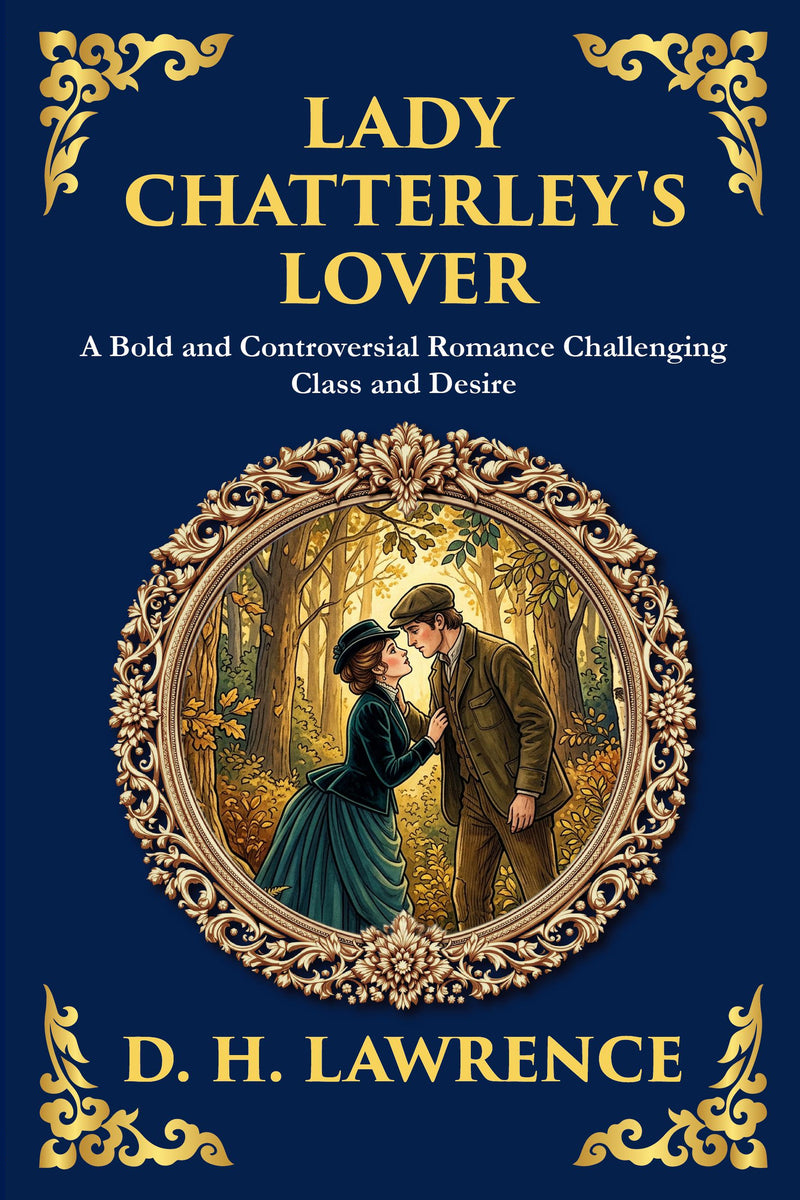
Lady Chatterley’s Lover
Banned. Burned. Beloved. Lady Chatterley’s Lover ignited a literary firestorm upon its release—yet beneath its scandalous reputation lies a profound exploration of love, class, sensuality, and the raw human need for connection.
or free app
10,000+ hrs library
30-day guarantee
The complete Lady Chatterley's Lover appears in modern English through Library of Alexandria Press, available online with audiobook narration included for members.
Have you ever wondered why true love defies both social class and societal expectation? D. H. Lawrence’s Lady Chatterley’s Lover is not just a love story—it is a literary revolution. Shocking readers and critics alike with its frank portrayal of physical love and emotional awakening, this novel boldly confronts the artificial constraints imposed by a repressive society.
At the heart of the story is Lady Constance Chatterley, a woman of sensitivity and intellect whose marriage to the paralyzed Sir Clifford Chatterley has become emotionally and physically barren. In her isolation, she encounters Oliver Mellors, the estate’s rugged, introspective gamekeeper. Their relationship blossoms into something far deeper than mere attraction—it is a raw, healing communion of two souls divided by class, but united by need and truth.
Lawrence uses this passionate bond to lay bare the damaging effects of industrialization, emotional detachment, and social hypocrisy. His poetic language, searing insight, and unflinching honesty bring to life a story that is not just about passion—but about becoming fully alive.
What you’ll discover in this modern edition
- A Groundbreaking Love Story – A fearless romance that challenges social boundaries and moral codes.
- A Powerful Exploration of Class and Connection – The deep divide between aristocracy and working class laid bare.
- The Liberation of Female Desire – A revolutionary portrayal of womanhood, independence, and sensual selfhood.
- A Critique of Post-War Society – Lawrence’s commentary on emotional sterility in the modern world.
- A Literary Classic Reclaimed – Once banned for obscenity, now revered for its truth, courage, and beauty.
| Formats | eBook (EPUB + PDF) · Audiobook · Paperback · Hardcover · Large Print |
| Language | English |
| Trim size (print) | 6 × 9 in |
| Binding | Paperback — perfect-bound · Hardcover — casewrap |
| Large Print edition | Same text in a larger, easy-read type — a larger font, not a larger trim |
| Print pricing | Every physical book at our true cost — at-cost, no profit (members) |
| Library | 873 restored titles, always growing |
| Length | 115,730 words · ~7 hr 43 min reading |
| Reading level | Grade 3 · an easy, flowing read (this modern-English edition) |
| Edition | Modern English translation · 2026 |
Member reviews for this edition are collected as readers finish it — be the first. Across the library: 12,000+ books shipped, every plan covered by a 365-day print guarantee.
About this edition
A faithful, unabridged modern-English edition by The Library of Alexandria — carefully rendered for today's reader and verified paragraph-by-paragraph against the public-domain source. Available as eBook, audiobook, paperback, hardcover, and large print.
- Complete & unabridgedVerified paragraph by paragraph against the source — never a scan, never abridged.
- Modern English, faithfulReadable today, with the author’s meaning kept intact. Readable — not simplified.
- Every format, one membershipRead in your browser or the free app, or listen to the full audiobook.
Included free with your membership
Cancel anytime, one click · 30-day money-back guarantee
Edition last updated July 2026
What’s inside
Lady Chatterley’s Lover — complete and unabridged: all 20 sections included with membership, plus the full audiobook.
Begin reading Lady Chatterley’s Lover
In clear modern English — the complete text is included with membership.
Introduction
When Lady Chatterley’s Lover first appeared in print in 1928, it did not so much enter the literary world as detonate within it. Privately published in Florence because no respectable English or American house would touch it, the novel circulated like contraband, smuggled across borders, copied in pirated editions, whispered about in drawing rooms and condemned from pulpits. For more than three decades it would remain officially unavailable in its unexpurgated form in Britain and the United States, its full text reaching ordinary readers only after a landmark obscenity trial in 1960 — a trial that became, in retrospect, one of the defining cultural moments of the twentieth century. Few books have been so thoroughly weighed down by their own reputation. Fewer still have survived that reputation to reveal themselves, on the page, as something far gentler, far stranger, and far more searching than the scandal suggested.
This edition presents D. H. Lawrence’s final and most notorious novel in a form adapted for the contemporary reader: a modern rendering that preserves the heart, the ambition, and the unmistakable voice of the original while easing some of the period’s stylistic thickets for readers a century removed from its first appearance. The aim is not to sanitize or simplify what Lawrence accomplished — quite the opposite. It is to clear away the dust of intervening decades so that the novel’s genuine power, so often obscured by the noise surrounding it, can be felt freshly and directly. What you are about to read is, at its core, a love story. But it is also a meditation on what it means to be fully alive in a world that seems determined to deaden us, and a fierce, almost desperate argument that tenderness between human beings might be the last form of honesty left to us.
David Herbert Lawrence was born in 1885 in Eastwood, a coal-mining town in Nottinghamshire, England. The geography matters enormously, because Lawrence never stopped writing about the landscape of his childhood: the green Midlands countryside being steadily devoured by industry, the collieries belching smoke over fields that had once been beautiful, the men descending each day into the dark earth to extract the fuel that powered an empire. His father was a miner, barely literate, sensual and instinctive, fond of the pub and the company of his fellow workers. His mother was a former schoolteacher, refined, ambitious, and bitterly disappointed in the marriage she had made. The tension between them — between the body and the mind, the earthy and the genteel, instinct and aspiration — was the great drama of Lawrence’s early life, and it would echo through everything he ever wrote.
He was a sickly child who grew into a tubercular adult, and the threat of illness shadowed him always. Yet he possessed a ferocious vitality, an almost violent appetite for experience and feeling. After training as a teacher and publishing his first novels to growing acclaim — Sons and Lovers, his great autobiographical work, appeared in 1913 — he made a decision that would shape the rest of his existence. In 1912 he met Frieda Weekley, the German aristocrat wife of one of his former professors. She was six years his senior and the mother of three children. They fell into a passionate, combative love almost instantly, and within weeks she had abandoned her family to run away with him across Europe. They married in 1914 and remained together, quarrelling and reconciling with operatic intensity, until his death.
Their relationship is impossible to separate from Lawrence’s fiction. He believed, with an intensity that bordered on the religious, that the union between a man and a woman was the central fact of human existence — that in the meeting of two bodies and two souls lay the possibility of genuine regeneration, of becoming whole in a world that fragmented and mechanized everything it touched. This conviction is the philosophical engine behind Lady Chatterley’s Lover. To read the book as mere titillation, as its early prosecutors did, is to miss it entirely. For Lawrence, physical love was sacred precisely because it was physical; the body was not the enemy of the spirit but its truest expression.
The First World War devastated Lawrence, as it devastated his entire generation. He and Frieda, with her German origins, were treated as suspect, even spied upon and expelled from their cottage in Cornwall under suspicion of signalling to enemy submarines. The humiliation and the horror of the war confirmed his deepest fears about modern civilization — that it had become a vast machine for the destruction of life, a system that valued production and profit and abstraction over the warm, living reality of human beings. After the war he and Frieda became wanderers, restless exiles who never again settled for long. They lived in Italy, in Australia, in Ceylon, in Mexico, on a ranch in New Mexico. Lawrence was always searching for a place where life might still be lived authentically, close to the earth and the blood and the instincts that industrial society seemed to crush.
By the time he came to write Lady Chatterley’s Lover, in the late 1920s, he was a dying man. His tuberculosis was advancing rapidly, and he knew his time was short. He wrote the novel three separate times, in three substantially different versions, refining and deepening it with each attempt. The final version is the work of a man staring at his own mortality and pouring everything he believed into one last, defiant statement. He died in 1930 in the south of France, at the age of forty-four, and never lived to see his novel published freely or vindicated. He died, in fact, believing it suppressed and misunderstood — a final irony in a life full of them.
It is worth pausing on the courage this represents. Lawrence knew exactly what would happen when he published this book. He had already seen another of his novels, The Rainbow, banned and burned for obscenity in 1915. He understood that he was inviting ridicule, censorship, and the destruction of what remained of his reputation. He did it anyway, because he believed the thing he had to say was too important to soften. “I want men and women,” he wrote, “to be able to think sex, fully, completely, honestly, and cleanly.” Whatever one makes of his philosophy, the integrity of that ambition deserves respect. He was not trying to shock for shock’s sake. He was trying to tell a truth that polite society had agreed, for centuries, not to tell.
The premise of the novel is deceptively simple. Constance — Connie — is a young woman of intelligence and sensitivity, married to Sir Clifford Chatterley, a wealthy aristocrat and the owner of a grand estate called Wragby in the industrial Midlands. Clifford has returned from the war paralyzed from the waist down, confined to a wheelchair, unable to walk or to father children. He is a clever, cultivated man, a writer of clever, cultivated stories, surrounded by clever, cultivated friends who talk endlessly about ideas and art and the modern condition. And Connie, married to him, finds herself slowly suffocating — not from cruelty, for Clifford is not cruel, but from a kind of spiritual desiccation, a life lived entirely in the head, drained of warmth, of touch, of genuine human contact.
Around the great house lie the woods, the last surviving fragment of old England, and beyond them the collieries and the grim mining village where Clifford’s wealth is generated. Into this world comes Oliver Mellors, the gamekeeper who tends the estate’s woods and pheasants. He is a man of the working class who has nonetheless seen something of the wider world, an educated man who has chosen to retreat into solitude and silence, nursing his own wounds and disappointments. The encounter between Connie and Mellors, unfolding gradually amid the trees and the changing seasons, forms the living center of the book.
I will say no more about what passes between them, because the experience of discovering it for yourself is precisely what gives the novel its force. What I want to emphasize is the architecture of meaning Lawrence builds around this central relationship. Wragby Hall and its inhabitants represent one vision of human life: refined, intellectual, materially comfortable, and utterly cut off from the sources of vitality. The wood, with its growing things and its keeper, represents another: instinctive, embodied, tender, fragile, and continually threatened by the encroaching machinery of industry. The novel is, among many other things, a profound lament for a vanishing world — for a way of being human that mechanization and money were rapidly destroying.
Clifford’s paralysis is, of course, more than a physical fact. Lawrence uses it as a symbol of something he saw spreading through the whole of modern civilization: a paralysis of feeling, a numbing of the living self, a retreat into the abstractions of the mind at the expense of the body and the heart. The men who run the mines, who reduce living workers to units of labor and living forests to so much real estate, are spiritually paralyzed in the same way. And Connie’s journey is an awakening from this paralysis — a slow, painful, joyful recovery of her own capacity to feel, to touch, to be present in her own flesh and in the natural world around her.
This is why the explicit passages, which caused such uproar, are not gratuitous and cannot simply be removed without gutting the book. For Lawrence, the physical union of Connie and Mellors is the very thing that brings her back to life. It is, in his cosmology, a kind of sacrament — the rediscovery of a wholeness that the modern world had taught her to deny. He writes about the body with a seriousness, a reverence even, that was utterly unprecedented in English fiction. He was not interested in mere description; he was interested in conveying the inner experience of physical and emotional connection, the way it can shatter and remake a person. Whether he always succeeded is a question every reader must answer for themselves, but the ambition is undeniable, and at its best the writing achieves a lyrical intensity that has rarely been matched.
It is also worth noting how radical the class dimension of the story was, and remains. Connie is an aristocrat by marriage; Mellors is a servant, a working man. For a woman of her station to cross that boundary was, in the rigid hierarchy of the period, almost as scandalous as the physical relationship itself. Lawrence, the miner’s son who had married into a higher class than his own, understood these divisions from the inside, and he attacks them with real anger. The novel insists that the things that truly matter between human beings — tenderness, honesty, the meeting of bodies and souls — have nothing to do with rank or money or education. In this sense the book is genuinely subversive, not merely sexually but socially, and the establishment that sought to suppress it understood, perhaps better than its defenders, exactly how dangerous its message was.
The natural world deserves special mention. Lawrence was one of the great nature writers in the English language, and the woods of Wragby are rendered with extraordinary tenderness and precision. The daffodils, the bluebells, the pheasant chicks, the changing light through the trees, the cold rain and the first warmth of spring — these are not mere backdrop. They are characters in the drama, the living embodiment of everything the industrial world is destroying, and the medium through which Connie rediscovers her own aliveness. Some of the most beautiful passages in the book are simply descriptions of the forest in different seasons, and they reward slow, attentive reading. Lawrence wanted his readers to feel the green, breathing reality of the natural world as something precious and endangered, and a century later, in our own age of ecological crisis, his vision feels more prophetic than ever.
A modern reader approaches Lady Chatterley’s Lover from a peculiar vantage point. The explicit content that once made it unpublishable is, by the standards of contemporary literature and entertainment, remarkably mild. We live in a world saturated with sexual imagery to a degree Lawrence could scarcely have imagined. This creates both an opportunity and a risk. The opportunity is that we can finally read the book without the prurient distraction that bedeviled its early reception — we can see past the scandal to the art. The risk is that we may wonder what all the fuss was about, and miss the genuine courage and originality of what Lawrence was attempting.
Cancel anytime, one click · 30-day money-back guarantee
Founding annual rate available now — your price locks for life when you join.
Not ready? Get this free chapter by email — read it anytime.
✓ Sent — check your inbox for Lady Chatterley’s Lover.
Questions about Lady Chatterley’s Lover
Who wrote Lady Chatterley's Lover?
Lady Chatterley's Lover was written by D. H. Lawrence. This edition presents the complete work in clear modern English, faithfully rendered from the public-domain original by Library of Alexandria Press.
Is Lady Chatterley's Lover free to read?
The opening chapter is free to read on this page. Members read and listen to the complete work — and the entire library — free, and can order any physical book at our true print cost.
How long is Lady Chatterley's Lover?
20 chapters (~115,730 words) — about 7 hr 43 min of reading in this modern-English edition.
Is this an abridged version of Lady Chatterley's Lover?
No. This is the complete, unabridged Lady Chatterley's Lover, carefully rendered into clear modern English and verified paragraph-by-paragraph against the public-domain source — nothing is cut or summarised.
What formats does Lady Chatterley's Lover come in?
Lady Chatterley's Lover is available as eBook, paperback, hardcover and large print. eBook and audiobook are included with membership; printed editions ship at our true print cost.
Shipping & returns
Billing & membership
More from the library


Explore Romance
- As You Like It · William Shakespeare
- Anna Karenina · Leo Tolstoy
- A Midsummer Night’s Dream · William Shakespeare
- Romeo and Juliet · William Shakespeare
- Sonnets from the Portuguese · Elizabeth Barrett Browning
- Miss Primrose · Agnes Giberne
- The Gay Adventure: A Romance · Richard Bird
- The Belle of Bowling Green · Amelia E. Barr
- The Monk: A Romance · M. G. Lewis
- She · H. Rider Haggard
- The Mill on the Floss · George Eliot
- The Glad Lady · Amy Ella Blanchard
- The Red Lily — Complete · Anatole France
- The Blue Goose · Frank Lewis Nason
- The History of Sir Richard Calmady: A Romance · Lucas Malet
- The Quest of the Silver Fleece: A Novel · W. E. B. Du Bois
- The Love Letters of Mary Wollstonecraft to Gilbert Imlay · Mary Wollstonecraft
- Daddy-Long-Legs · Jean Webster
- The Age of Innocence · Edith Wharton
- The Portrait of a Lady — Volume 1 · Henry James
- Wuthering Heights · Emily Brontë
- The Lady of the Lake · Walter Scott
- Jane Eyre: An Autobiography · Charlotte Brontë
- A Connecticut Yankee in King Arthur’s Court · Mark Twain
- Northanger Abbey · Jane Austen
- Mansfield Park · Jane Austen
- Anthem · Ayn Rand
- This Side of Paradise · F. Scott Fitzgerald
- Persuasion · Jane Austen
- The Blue Castle: A Novel · L. M. Montgomery
Lady Chatterley’s Lover
Lady Chatterley’s Lover
A Bold and Controversial Romance Challenging Class and Desire
D. H. Lawrence
Contents
- Introduction
- Chapter 1
- Chapter 2
- Chapter 3
- Chapter 4
- Chapter 5
- Chapter 6
- Chapter 7
- Chapter 8
- Chapter 9
- Chapter 10
- Chapter 11
- Chapter 12
- Chapter 13
- Chapter 14
- Chapter 15
- Chapter 16
- Chapter 17
- Chapter 18
- Chapter 19
Introduction
When Lady Chatterley’s Lover first appeared in print in 1928, it did not so much enter the literary world as detonate within it. Privately published in Florence because no respectable English or American house would touch it, the novel circulated like contraband, smuggled across borders, copied in pirated editions, whispered about in drawing rooms and condemned from pulpits. For more than three decades it would remain officially unavailable in its unexpurgated form in Britain and the United States, its full text reaching ordinary readers only after a landmark obscenity trial in 1960 — a trial that became, in retrospect, one of the defining cultural moments of the twentieth century. Few books have been so thoroughly weighed down by their own reputation. Fewer still have survived that reputation to reveal themselves, on the page, as something far gentler, far stranger, and far more searching than the scandal suggested.
This edition presents D. H. Lawrence’s final and most notorious novel in a form adapted for the contemporary reader: a modern rendering that preserves the heart, the ambition, and the unmistakable voice of the original while easing some of the period’s stylistic thickets for readers a century removed from its first appearance. The aim is not to sanitize or simplify what Lawrence accomplished — quite the opposite. It is to clear away the dust of intervening decades so that the novel’s genuine power, so often obscured by the noise surrounding it, can be felt freshly and directly. What you are about to read is, at its core, a love story. But it is also a meditation on what it means to be fully alive in a world that seems determined to deaden us, and a fierce, almost desperate argument that tenderness between human beings might be the last form of honesty left to us.
David Herbert Lawrence was born in 1885 in Eastwood, a coal-mining town in Nottinghamshire, England. The geography matters enormously, because Lawrence never stopped writing about the landscape of his childhood: the green Midlands countryside being steadily devoured by industry, the collieries belching smoke over fields that had once been beautiful, the men descending each day into the dark earth to extract the fuel that powered an empire. His father was a miner, barely literate, sensual and instinctive, fond of the pub and the company of his fellow workers. His mother was a former schoolteacher, refined, ambitious, and bitterly disappointed in the marriage she had made. The tension between them — between the body and the mind, the earthy and the genteel, instinct and aspiration — was the great drama of Lawrence’s early life, and it would echo through everything he ever wrote.
He was a sickly child who grew into a tubercular adult, and the threat of illness shadowed him always. Yet he possessed a ferocious vitality, an almost violent appetite for experience and feeling. After training as a teacher and publishing his first novels to growing acclaim — Sons and Lovers, his great autobiographical work, appeared in 1913 — he made a decision that would shape the rest of his existence. In 1912 he met Frieda Weekley, the German aristocrat wife of one of his former professors. She was six years his senior and the mother of three children. They fell into a passionate, combative love almost instantly, and within weeks she had abandoned her family to run away with him across Europe. They married in 1914 and remained together, quarrelling and reconciling with operatic intensity, until his death.
Their relationship is impossible to separate from Lawrence’s fiction. He believed, with an intensity that bordered on the religious, that the union between a man and a woman was the central fact of human existence — that in the meeting of two bodies and two souls lay the possibility of genuine regeneration, of becoming whole in a world that fragmented and mechanized everything it touched. This conviction is the philosophical engine behind Lady Chatterley’s Lover. To read the book as mere titillation, as its early prosecutors did, is to miss it entirely. For Lawrence, physical love was sacred precisely because it was physical; the body was not the enemy of the spirit but its truest expression.
The First World War devastated Lawrence, as it devastated his entire generation. He and Frieda, with her German origins, were treated as suspect, even spied upon and expelled from their cottage in Cornwall under suspicion of signalling to enemy submarines. The humiliation and the horror of the war confirmed his deepest fears about modern civilization — that it had become a vast machine for the destruction of life, a system that valued production and profit and abstraction over the warm, living reality of human beings. After the war he and Frieda became wanderers, restless exiles who never again settled for long. They lived in Italy, in Australia, in Ceylon, in Mexico, on a ranch in New Mexico. Lawrence was always searching for a place where life might still be lived authentically, close to the earth and the blood and the instincts that industrial society seemed to crush.
By the time he came to write Lady Chatterley’s Lover, in the late 1920s, he was a dying man. His tuberculosis was advancing rapidly, and he knew his time was short. He wrote the novel three separate times, in three substantially different versions, refining and deepening it with each attempt. The final version is the work of a man staring at his own mortality and pouring everything he believed into one last, defiant statement. He died in 1930 in the south of France, at the age of forty-four, and never lived to see his novel published freely or vindicated. He died, in fact, believing it suppressed and misunderstood — a final irony in a life full of them.
It is worth pausing on the courage this represents. Lawrence knew exactly what would happen when he published this book. He had already seen another of his novels, The Rainbow, banned and burned for obscenity in 1915. He understood that he was inviting ridicule, censorship, and the destruction of what remained of his reputation. He did it anyway, because he believed the thing he had to say was too important to soften. “I want men and women,” he wrote, “to be able to think sex, fully, completely, honestly, and cleanly.” Whatever one makes of his philosophy, the integrity of that ambition deserves respect. He was not trying to shock for shock’s sake. He was trying to tell a truth that polite society had agreed, for centuries, not to tell.
The premise of the novel is deceptively simple. Constance — Connie — is a young woman of intelligence and sensitivity, married to Sir Clifford Chatterley, a wealthy aristocrat and the owner of a grand estate called Wragby in the industrial Midlands. Clifford has returned from the war paralyzed from the waist down, confined to a wheelchair, unable to walk or to father children. He is a clever, cultivated man, a writer of clever, cultivated stories, surrounded by clever, cultivated friends who talk endlessly about ideas and art and the modern condition. And Connie, married to him, finds herself slowly suffocating — not from cruelty, for Clifford is not cruel, but from a kind of spiritual desiccation, a life lived entirely in the head, drained of warmth, of touch, of genuine human contact.
Around the great house lie the woods, the last surviving fragment of old England, and beyond them the collieries and the grim mining village where Clifford’s wealth is generated. Into this world comes Oliver Mellors, the gamekeeper who tends the estate’s woods and pheasants. He is a man of the working class who has nonetheless seen something of the wider world, an educated man who has chosen to retreat into solitude and silence, nursing his own wounds and disappointments. The encounter between Connie and Mellors, unfolding gradually amid the trees and the changing seasons, forms the living center of the book.
I will say no more about what passes between them, because the experience of discovering it for yourself is precisely what gives the novel its force. What I want to emphasize is the architecture of meaning Lawrence builds around this central relationship. Wragby Hall and its inhabitants represent one vision of human life: refined, intellectual, materially comfortable, and utterly cut off from the sources of vitality. The wood, with its growing things and its keeper, represents another: instinctive, embodied, tender, fragile, and continually threatened by the encroaching machinery of industry. The novel is, among many other things, a profound lament for a vanishing world — for a way of being human that mechanization and money were rapidly destroying.
Clifford’s paralysis is, of course, more than a physical fact. Lawrence uses it as a symbol of something he saw spreading through the whole of modern civilization: a paralysis of feeling, a numbing of the living self, a retreat into the abstractions of the mind at the expense of the body and the heart. The men who run the mines, who reduce living workers to units of labor and living forests to so much real estate, are spiritually paralyzed in the same way. And Connie’s journey is an awakening from this paralysis — a slow, painful, joyful recovery of her own capacity to feel, to touch, to be present in her own flesh and in the natural world around her.
This is why the explicit passages, which caused such uproar, are not gratuitous and cannot simply be removed without gutting the book. For Lawrence, the physical union of Connie and Mellors is the very thing that brings her back to life. It is, in his cosmology, a kind of sacrament — the rediscovery of a wholeness that the modern world had taught her to deny. He writes about the body with a seriousness, a reverence even, that was utterly unprecedented in English fiction. He was not interested in mere description; he was interested in conveying the inner experience of physical and emotional connection, the way it can shatter and remake a person. Whether he always succeeded is a question every reader must answer for themselves, but the ambition is undeniable, and at its best the writing achieves a lyrical intensity that has rarely been matched.
It is also worth noting how radical the class dimension of the story was, and remains. Connie is an aristocrat by marriage; Mellors is a servant, a working man. For a woman of her station to cross that boundary was, in the rigid hierarchy of the period, almost as scandalous as the physical relationship itself. Lawrence, the miner’s son who had married into a higher class than his own, understood these divisions from the inside, and he attacks them with real anger. The novel insists that the things that truly matter between human beings — tenderness, honesty, the meeting of bodies and souls — have nothing to do with rank or money or education. In this sense the book is genuinely subversive, not merely sexually but socially, and the establishment that sought to suppress it understood, perhaps better than its defenders, exactly how dangerous its message was.
The natural world deserves special mention. Lawrence was one of the great nature writers in the English language, and the woods of Wragby are rendered with extraordinary tenderness and precision. The daffodils, the bluebells, the pheasant chicks, the changing light through the trees, the cold rain and the first warmth of spring — these are not mere backdrop. They are characters in the drama, the living embodiment of everything the industrial world is destroying, and the medium through which Connie rediscovers her own aliveness. Some of the most beautiful passages in the book are simply descriptions of the forest in different seasons, and they reward slow, attentive reading. Lawrence wanted his readers to feel the green, breathing reality of the natural world as something precious and endangered, and a century later, in our own age of ecological crisis, his vision feels more prophetic than ever.
A modern reader approaches Lady Chatterley’s Lover from a peculiar vantage point. The explicit content that once made it unpublishable is, by the standards of contemporary literature and entertainment, remarkably mild. We live in a world saturated with sexual imagery to a degree Lawrence could scarcely have imagined. This creates both an opportunity and a risk. The opportunity is that we can finally read the book without the prurient distraction that bedeviled its early reception — we can see past the scandal to the art. The risk is that we may wonder what all the fuss was about, and miss the genuine courage and originality of what Lawrence was attempting.
We live in a fundamentally tragic age, which is why we refuse to treat it as such. The disaster has already happened, and we are left standing among the ruins, trying to build small new homes and find small new hopes. It’s hard work. There is no easy path into the future anymore, so we find detours or scramble over the obstacles. We have to keep living, no matter how much our world has fallen apart.
This was essentially Constance Chatterley’s situation. The war had destroyed everything she knew. She realized that the only way forward was to live and learn.
She married Clifford Chatterley in 1917 while he was home on a month’s leave. They had a month-long honeymoon, and then he returned to Flanders. Six months later, he was shipped back to England, his body more or less shattered. Constance was twenty-three at the time, and he was twenty-nine.
His will to live was incredible. He survived, and his injuries slowly healed. He spent two years under medical care before he was declared recovered. He could return to his life, though he was permanently paralyzed from the hips down.
This happened in 1920. Clifford and Constance returned to his family estate, Wragby Hall. His father had passed away, so Clifford was now a baronet—Sir Clifford—and Constance became Lady Chatterley. They began their married life and managed the household in the somewhat bleak family home, living on a fairly tight budget. Clifford had a sister, but she had already left. Aside from her, there were no close relatives; his older brother had been killed in the war. Permanently disabled and knowing he could never have children, Clifford returned to the smoky Midlands to keep the Chatterley name going as long as he could.
End of the free sample
Keep reading, free
Members read and listen to the complete book — and the entire library. Cancel anytime, one click · 30-day money-back guarantee.