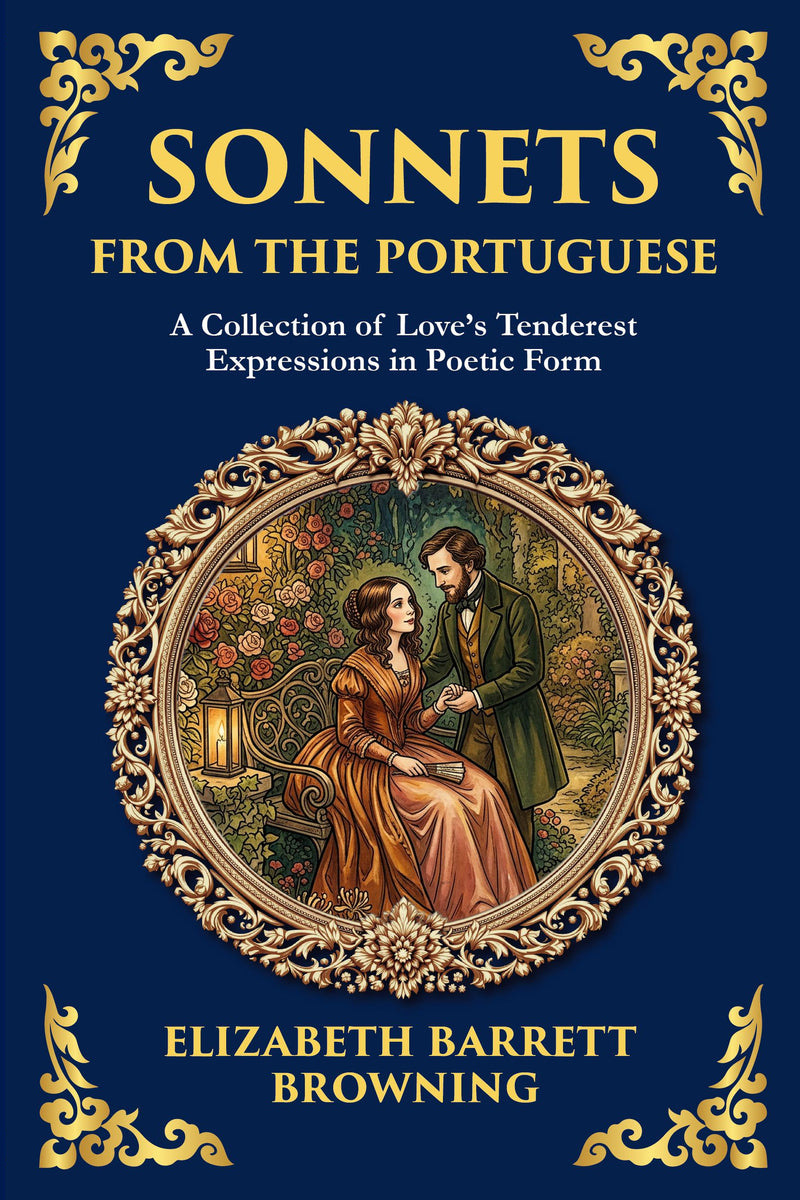
Sonnets from the Portuguese
One of the most beloved love poems in English literature was born not from fiction, but from a real and passionate romance.
or free app
10,000+ hrs library
30-day guarantee
The complete Sonnets from the Portuguese appears in modern English through Library of Alexandria Press, available online with audiobook narration included for members.
Have you ever wondered why the most powerful love stories are whispered from the heart? In Sonnets from the Portuguese, Elizabeth Barrett Browning reveals one of the most poignant and enduring portrayals of romantic love in Western literature. Originally written in the mid-19th century as private sonnets for her husband, poet Robert Browning, this collection captures the evolution of affection—from the first stirrings of love, through self-doubt and surrender, to a powerful, spiritual bond.
Browning’s words—eloquent yet intimate—speak across generations. Each sonnet is a window into the soul of a woman who overcame personal suffering and isolation through the transformative force of love. This deeply moving collection offers not only literary beauty, but a glimpse into a love story that continues to inspire readers and writers alike.
What you’ll discover in this modern edition
- The Complete Series of 44 Love Sonnets From tentative beginnings to immortal declarations—each poem is a milestone in an emotional and spiritual journey.
- An Intimate Glimpse into Real-Life Romance Written during the courtship of Elizabeth and Robert Browning—one of literature’s greatest love stories.
- Timeless Language of Affection and Devotion Ideal for poetry lovers, romantics, and anyone seeking the purest expressions of heartfelt love.
- Themes of Vulnerability, Trust, and Emotional Awakening Explore the inner landscape of a woman giving herself over to love while confronting fear and fragility.
- A Lasting Literary Treasure One of the crown jewels of Victorian poetry—beautiful, accessible, and endlessly quotable.
| Formats | eBook (EPUB + PDF) · Audiobook · Paperback · Hardcover · Large Print |
| Language | English |
| Trim size (print) | 6 × 9 in |
| Binding | Paperback — perfect-bound · Hardcover — casewrap |
| Large Print edition | Same text in a larger, easy-read type — a larger font, not a larger trim |
| Print pricing | Every physical book at our true cost — at-cost, no profit (members) |
| Library | 873 restored titles, always growing |
| Length | 8,071 words · ~32 min reading |
| Reading level | Grade 10 · a comfortable read (this modern-English edition) |
| Edition | Modern English translation · 2026 |
Member reviews for this edition are collected as readers finish it — be the first. Across the library: 12,000+ books shipped, every plan covered by a 365-day print guarantee.
About this edition
A faithful, unabridged modern-English edition by The Library of Alexandria — carefully rendered for today's reader and verified paragraph-by-paragraph against the public-domain source. Available as eBook, audiobook, paperback, hardcover, and large print.
- Complete & unabridgedVerified paragraph by paragraph against the source — never a scan, never abridged.
- Modern English, faithfulReadable today, with the author’s meaning kept intact. Readable — not simplified.
- Every format, one membershipRead in your browser or the free app, or listen to the full audiobook.
Included free with your membership
Cancel anytime, one click · 30-day money-back guarantee
Edition last updated July 2026
What’s inside
Sonnets from the Portuguese — complete and unabridged: all 45 sections included with membership, plus the full audiobook.
Begin reading Sonnets from the Portuguese
In clear modern English — the complete text is included with membership.
Introduction
There are very few works in the English language that have so completely entered the bloodstream of how we speak about love. We quote them at weddings without knowing where the words came from. We find them embroidered on cushions, printed on greeting cards, inscribed in rings, and whispered between people who have never read a line of poetry in their lives. “How do I love thee? Let me count the ways.” That single phrase has traveled farther than its author could ever have imagined, becoming a kind of universal shorthand for devotion itself. And yet, behind these familiar fragments lies a sequence of poems so personal, so vulnerable, and so quietly revolutionary that to read them in full — slowly, attentively, and as their author intended — is to discover something far richer than any quotation could suggest.
This collection brings together a sequence of forty-four sonnets that trace the inner experience of a woman who did not believe she would ever love or be loved, and who found, to her astonishment, that both were possible. What you hold is not a poem about love in the abstract. It is a record of love as it actually unfolds in a human heart: the disbelief, the fear, the reluctance to hope, the slow surrender, the gratitude that borders on terror, and finally the deep and settled joy of belonging to another person completely. It is one of the most honest accounts of falling in love ever committed to paper, and it has the rare distinction of being both immensely popular and genuinely great — two things that do not always go together.
This edition has been prepared with the contemporary reader in mind. The poems are presented in a form that preserves their music and meaning while smoothing away the obstacles that can sometimes make nineteenth-century verse feel distant or difficult. The aim has never been to replace the original beauty of the language but to clear a path to it, so that a reader coming to these poems for the first time can feel their emotional force without first having to translate the diction in their head. What remains is the essential thing: the voice of a real woman, speaking to a real man, about the most universal experience there is. Before you begin, it is worth taking a little time to understand where these poems came from, what they meant to the woman who wrote them, and why they have endured for so long.
The first thing many readers wonder is why a sequence of intensely personal English love poems should be called “Sonnets from the Portuguese.” The title is, in fact, a kind of loving disguise — and the story behind it tells us a great deal about the relationship that produced these poems.
Elizabeth Barrett Browning wrote these sonnets in secret during her courtship and the early years of her marriage. They were not intended for publication at all. They were a private gift, written in the dark of her own uncertainty, and she kept them hidden even from the man who had inspired them. When she at last showed them to her husband, the poet Robert Browning, he recognized immediately that they were too fine, too important, to remain unseen by the world. He insisted they be published. But Elizabeth was deeply reluctant. These were not literary exercises; they were her heart laid bare, the most intimate confessions she had ever made. To publish them openly under her own name would have felt like undressing in public.
The solution they arrived at was a gentle fiction. The poems would be presented as if they were translations of sonnets written in Portuguese by some other, unnamed poet. This gave Elizabeth a measure of protection — readers could enjoy the poems without assuming they described the author’s own life. The choice of “Portuguese” carried a private meaning known only to the couple. Robert had a pet name for Elizabeth: he called her his “little Portuguese,” partly because of her dark complexion and partly in affectionate reference to a poem she had written earlier about a Portuguese woman. So the title was a kind of inside joke, a tender secret folded into the public presentation. The poems were “from the Portuguese” because they were from her — his Portuguese — though the wider world was not meant to know it.
Of course, the disguise did not last. Readers and critics quickly understood that these were no translations but original poems, and that they recorded a real and recent love story. By then it hardly mattered. The poems had found their audience, and the title remained, a charming relic of the modesty and intimacy from which they sprang. Today the title functions almost as an emblem of the whole sequence: a love so private it had to be hidden, yet so true it could not stay hidden for long.
Understanding this origin changes the way we read. These are not poems written to impress an audience or to demonstrate skill. They were written in solitude, by a woman who genuinely did not expect anyone but herself ever to read them, and perhaps not even herself again. That is the source of their startling honesty. When the speaker admits to fear, to unworthiness, to the strange grief that comes when joy arrives unexpectedly, she is not performing these feelings for effect. She is recording them as a way of understanding them. The reader becomes a kind of accidental witness to a private reckoning — and that sense of overhearing something real is part of what gives the sequence its enduring power.
It helps, too, to understand something of the circumstances that made this love so improbable in the first place. The woman who wrote these poems had spent years as an invalid, confined largely to a single room, in delicate health and under the shadow of a controlling father who did not wish any of his children to marry. She was already a published and respected poet — more famous, in fact, than the man who would become her husband — but she thought of herself as someone whose life of the body and the heart was essentially over. She expected to live out her days in illness and seclusion, with poetry as her only companion. When love arrived, it arrived as an intruder, almost an impossibility, and her first instinct was not to welcome it but to resist it. She felt she had nothing to offer: a frail body, a constricted life, a heart she believed had already grown old before its time.
This is the emotional landscape from which the sonnets emerge, and knowing it allows us to feel the full weight of their drama. The sequence is not the story of two carefree young people tumbling happily into romance. It is the story of a woman who must overcome her own conviction that she is unfit to be loved — who must be persuaded, gently and persistently, that the door she had closed on life might be opened again. The arc of the poems is the arc of that persuasion: from refusal to hesitation, from hesitation to wonder, from wonder to acceptance, and finally to a love so secure that the speaker can offer herself wholly without fear. It is one of the great journeys in all of poetry, and it is made all the more moving by the fact that it actually happened.
How to Read These Poems for the Fullest Pleasure
A modern reader picking up a sequence of forty-four sonnets may feel a moment of hesitation. Poetry can seem intimidating, especially the formal poetry of an earlier age, with its careful rhymes and measured rhythms. But these poems reward patience far more than they demand expertise, and a few simple suggestions can transform the experience from a duty into a delight.
The first and most important thing to understand is that this is a sequence, not a random gathering. The forty-four sonnets are arranged to tell a story, and they are best read in order, from the first to the last. Each individual sonnet is complete in itself — you could read any one of them and find it beautiful — but read in sequence they accumulate meaning and emotional momentum. The first poems are full of darkness, doubt, and self-protective resistance. As you move through the collection, the light gradually grows. By the time you reach the final, famous sonnets, the speaker has traveled an enormous distance from where she began, and that journey is only fully felt if you have traveled it with her. So resist the temptation to flip to the famous ones first. Begin at the beginning, and let the love grow as she did.
The second suggestion is to read slowly, and ideally to read aloud. A sonnet is a compressed thing. Fourteen lines must do the work that a chapter of prose might do, and so every word carries weight. When you race through a sonnet, you skim across the surface and miss the depths beneath. When you read it slowly — pausing at the punctuation, letting the lines breathe — the meaning opens up and the music becomes audible. These poems were written to be heard, not merely scanned. Reading them aloud, even in a quiet murmur to yourself, brings out their rhythm and reveals subtleties that the silent eye misses. You will find that the sound and the sense are bound together, that the way a line falls on the ear is part of how it means what it means.
The third thing worth knowing is what a sonnet actually is, because a little understanding of the form deepens the pleasure of it. A sonnet is a fourteen-line poem, and the kind used throughout this sequence follows a particular structure inherited from the Italian tradition. The first eight lines, called the octave, usually set out a thought, a feeling, or a problem. Then there is a turn — a shift in direction, a moment where the poem pivots — and the final six lines, called the sestet, respond to or resolve what came before. You do not need to memorize these terms or count syllables to enjoy the poems. But if you keep a gentle awareness of this shape, you will start to feel the moment in each sonnet where the speaker changes her mind, or deepens her insight, or moves from question to answer. That turn is where much of the emotional drama lives. Watching for it is like learning to notice the moment a wave crests before it falls.
It is also worth remembering that this is an adapted edition, prepared to make the poems more accessible to a modern reader. The language of the original was sometimes dense, ornate, and studded with constructions that can trip up a contemporary eye. This edition aims to keep the emotional truth and the essential beauty intact while easing the way for readers who might otherwise be discouraged. The goal is not to dilute the poetry but to deliver it — to ensure that the feelings reach you directly, without the friction that can sometimes come between a modern reader and an older text. If, having read and loved these poems here, you feel drawn to seek out the original wording, that is a wonderful instinct, and you will find the original phrasing has its own particular splendor. But this edition is designed to be a complete and satisfying experience in itself, and a fine place to fall in love with these poems for the first time.
A fourth piece of advice: do not be discouraged if a particular poem does not yield its full meaning on a first reading. Some of these sonnets are crystal clear and strike home immediately. Others are more layered, more inward, and require a second or third pass before they open. This is not a flaw in the poems or a failure in you. Great poetry is meant to be returned to. A sonnet that seems merely pleasant on a first reading may, on a second reading weeks or months later, suddenly become the one that means the most to you, because something in your own life has changed and now you understand it from the inside. These poems will grow with you. They are not a destination to be reached once and left behind; they are a companion to return to across the seasons of a life.
Finally, let yourself feel them. This may sound obvious, but it is the easiest advice to forget. We are sometimes trained to approach poetry as a puzzle to be solved, an intellectual exercise to be performed correctly. These poems are not puzzles. They are a heart speaking to another heart. The right way to read them is not to ask “What does this mean?” so much as “What does this feel like? Where in my own life have I felt this?” The speaker’s doubts about whether she deserves love, her fear of trusting something so good, her gratitude that overflows into something almost painful, her wish to give everything she has and her worry that it will not be enough — these are not antique emotions. They are the emotions of anyone who has ever loved, or wanted to, or been afraid to. When you read with an open heart, you will find your own experiences mirrored in these lines, and that act of recognition is the deepest pleasure poetry can offer.
Cancel anytime, one click · 30-day money-back guarantee
Founding annual rate available now — your price locks for life when you join.
Not ready? Get this free chapter by email — read it anytime.
✓ Sent — check your inbox for Sonnets from the Portuguese.
Questions about Sonnets from the Portuguese
What is Sonnets from the Portuguese about?
One of the most beloved love poems in English literature was born not from fiction, but from a real and passionate romance. Sonnets from the Portuguese is Elizabeth Barrett Browning’s timeless expression of devotion, written in secret to her husband, the poet Robert Browning. These deeply personal sonnets transcend time with their raw emotion, delicate language, and spiritual intensity.
Who wrote Sonnets from the Portuguese?
Sonnets from the Portuguese was written by Elizabeth Barrett Browning. This edition presents the complete work in clear modern English, faithfully rendered from the public-domain original by Library of Alexandria Press.
Is Sonnets from the Portuguese free to read?
The opening chapter is free to read on this page. Members read and listen to the complete work — and the entire library — free, and can order any physical book at our true print cost.
How long is Sonnets from the Portuguese?
45 chapters (~8,071 words) — about 32 min of reading in this modern-English edition.
Is this an abridged version of Sonnets from the Portuguese?
No. This is the complete, unabridged Sonnets from the Portuguese, carefully rendered into clear modern English and verified paragraph-by-paragraph against the public-domain source — nothing is cut or summarised.
What formats does Sonnets from the Portuguese come in?
Sonnets from the Portuguese is available as eBook, paperback, hardcover and large print. eBook and audiobook are included with membership; printed editions ship at our true print cost.
Shipping & returns
Billing & membership
More from the library


Explore Poetry & Drama
- As You Like It · William Shakespeare
- The Raven · Edgar Allan Poe
- The Merchant of Venice · William Shakespeare
- A Midsummer Night’s Dream · William Shakespeare
- Romeo and Juliet · William Shakespeare
- The Imaginary Invalid · Molière
- A Woman of No Importance · Oscar Wilde
- Gitanjali · Rabindranath Tagore
- The New Life (La Vita Nuova) · Dante Alighieri
- The Rime of the Ancient Mariner · Samuel Taylor Coleridge
- Lady Windermere’s Fan · Oscar Wilde
- The Home Book of Verse — Volume 4 · Burton Egbert Stevenson
- Ghosts · Henrik Ibsen
- Mrs. Warren’s Profession · Bernard Shaw
- An Enemy of the People · Henrik Ibsen
- Gawayne and the Green Knight: A Fairy Tale · Charlton M. Lewis
- The Nibelungenlied · G. H. Needler
- Julius Caesar · William Shakespeare
- The Aeneid of Virgil · Virgil
- Troilus and Criseyde · Geoffrey Chaucer
- The Post Office · Rabindranath Tagore
- Lamia · John Keats
- The Ballad of the White Horse · G. K. Chesterton
- A Shropshire Lad · A. E. Housman
- The Birth of the War-God: A Poem by Kalidasa · Kálidása
- Riders to the Sea · J. M. Synge
- The Prophet · Kahlil Gibran
- Twelfth Night; Or, What You Will · William Shakespeare
- Othello, the Moor of Venice · William Shakespeare
- Salomé: A Tragedy in One Act · Oscar Wilde
Sonnets from the Portuguese
Sonnets from the Portuguese
A Collection of Love’s Most Tender Feelings in Poetry
Elizabeth Barrett Browning
Contents
- Introduction
- Sonnet 1
- Sonnet 2
- Sonnet 3
- Sonnet 4
- Sonnet 5
- Sonnet 6
- Sonnet 7
- Sonnet 8
- Sonnet 9
- Sonnet 10
- Sonnet 11
- Sonnet 12
- Sonnet 13
- Sonnet 14
- Sonnet 15
- Sonnet 16
- Sonnet 17
- Sonnet 18
- Sonnet 19
- Sonnet 20
- Sonnet 21
- Sonnet 22
- Sonnet 23
- Sonnet 24
- Sonnet 25
- Sonnet 26
- Sonnet 27
- Sonnet 28
- Sonnet 29
- Sonnet 30
- Sonnet 31
- Sonnet 32
- Sonnet 33
- Sonnet 34
- Sonnet 35
- Sonnet 36
- Sonnet 37
- Sonnet 38
- Sonnet 39
- … and 5 more chapters
Introduction
There are very few works in the English language that have so completely entered the bloodstream of how we speak about love. We quote them at weddings without knowing where the words came from. We find them embroidered on cushions, printed on greeting cards, inscribed in rings, and whispered between people who have never read a line of poetry in their lives. “How do I love thee? Let me count the ways.” That single phrase has traveled farther than its author could ever have imagined, becoming a kind of universal shorthand for devotion itself. And yet, behind these familiar fragments lies a sequence of poems so personal, so vulnerable, and so quietly revolutionary that to read them in full — slowly, attentively, and as their author intended — is to discover something far richer than any quotation could suggest.
This collection brings together a sequence of forty-four sonnets that trace the inner experience of a woman who did not believe she would ever love or be loved, and who found, to her astonishment, that both were possible. What you hold is not a poem about love in the abstract. It is a record of love as it actually unfolds in a human heart: the disbelief, the fear, the reluctance to hope, the slow surrender, the gratitude that borders on terror, and finally the deep and settled joy of belonging to another person completely. It is one of the most honest accounts of falling in love ever committed to paper, and it has the rare distinction of being both immensely popular and genuinely great — two things that do not always go together.
This edition has been prepared with the contemporary reader in mind. The poems are presented in a form that preserves their music and meaning while smoothing away the obstacles that can sometimes make nineteenth-century verse feel distant or difficult. The aim has never been to replace the original beauty of the language but to clear a path to it, so that a reader coming to these poems for the first time can feel their emotional force without first having to translate the diction in their head. What remains is the essential thing: the voice of a real woman, speaking to a real man, about the most universal experience there is. Before you begin, it is worth taking a little time to understand where these poems came from, what they meant to the woman who wrote them, and why they have endured for so long.
The first thing many readers wonder is why a sequence of intensely personal English love poems should be called “Sonnets from the Portuguese.” The title is, in fact, a kind of loving disguise — and the story behind it tells us a great deal about the relationship that produced these poems.
Elizabeth Barrett Browning wrote these sonnets in secret during her courtship and the early years of her marriage. They were not intended for publication at all. They were a private gift, written in the dark of her own uncertainty, and she kept them hidden even from the man who had inspired them. When she at last showed them to her husband, the poet Robert Browning, he recognized immediately that they were too fine, too important, to remain unseen by the world. He insisted they be published. But Elizabeth was deeply reluctant. These were not literary exercises; they were her heart laid bare, the most intimate confessions she had ever made. To publish them openly under her own name would have felt like undressing in public.
The solution they arrived at was a gentle fiction. The poems would be presented as if they were translations of sonnets written in Portuguese by some other, unnamed poet. This gave Elizabeth a measure of protection — readers could enjoy the poems without assuming they described the author’s own life. The choice of “Portuguese” carried a private meaning known only to the couple. Robert had a pet name for Elizabeth: he called her his “little Portuguese,” partly because of her dark complexion and partly in affectionate reference to a poem she had written earlier about a Portuguese woman. So the title was a kind of inside joke, a tender secret folded into the public presentation. The poems were “from the Portuguese” because they were from her — his Portuguese — though the wider world was not meant to know it.
Of course, the disguise did not last. Readers and critics quickly understood that these were no translations but original poems, and that they recorded a real and recent love story. By then it hardly mattered. The poems had found their audience, and the title remained, a charming relic of the modesty and intimacy from which they sprang. Today the title functions almost as an emblem of the whole sequence: a love so private it had to be hidden, yet so true it could not stay hidden for long.
Understanding this origin changes the way we read. These are not poems written to impress an audience or to demonstrate skill. They were written in solitude, by a woman who genuinely did not expect anyone but herself ever to read them, and perhaps not even herself again. That is the source of their startling honesty. When the speaker admits to fear, to unworthiness, to the strange grief that comes when joy arrives unexpectedly, she is not performing these feelings for effect. She is recording them as a way of understanding them. The reader becomes a kind of accidental witness to a private reckoning — and that sense of overhearing something real is part of what gives the sequence its enduring power.
It helps, too, to understand something of the circumstances that made this love so improbable in the first place. The woman who wrote these poems had spent years as an invalid, confined largely to a single room, in delicate health and under the shadow of a controlling father who did not wish any of his children to marry. She was already a published and respected poet — more famous, in fact, than the man who would become her husband — but she thought of herself as someone whose life of the body and the heart was essentially over. She expected to live out her days in illness and seclusion, with poetry as her only companion. When love arrived, it arrived as an intruder, almost an impossibility, and her first instinct was not to welcome it but to resist it. She felt she had nothing to offer: a frail body, a constricted life, a heart she believed had already grown old before its time.
This is the emotional landscape from which the sonnets emerge, and knowing it allows us to feel the full weight of their drama. The sequence is not the story of two carefree young people tumbling happily into romance. It is the story of a woman who must overcome her own conviction that she is unfit to be loved — who must be persuaded, gently and persistently, that the door she had closed on life might be opened again. The arc of the poems is the arc of that persuasion: from refusal to hesitation, from hesitation to wonder, from wonder to acceptance, and finally to a love so secure that the speaker can offer herself wholly without fear. It is one of the great journeys in all of poetry, and it is made all the more moving by the fact that it actually happened.
How to Read These Poems for the Fullest Pleasure
A modern reader picking up a sequence of forty-four sonnets may feel a moment of hesitation. Poetry can seem intimidating, especially the formal poetry of an earlier age, with its careful rhymes and measured rhythms. But these poems reward patience far more than they demand expertise, and a few simple suggestions can transform the experience from a duty into a delight.
The first and most important thing to understand is that this is a sequence, not a random gathering. The forty-four sonnets are arranged to tell a story, and they are best read in order, from the first to the last. Each individual sonnet is complete in itself — you could read any one of them and find it beautiful — but read in sequence they accumulate meaning and emotional momentum. The first poems are full of darkness, doubt, and self-protective resistance. As you move through the collection, the light gradually grows. By the time you reach the final, famous sonnets, the speaker has traveled an enormous distance from where she began, and that journey is only fully felt if you have traveled it with her. So resist the temptation to flip to the famous ones first. Begin at the beginning, and let the love grow as she did.
The second suggestion is to read slowly, and ideally to read aloud. A sonnet is a compressed thing. Fourteen lines must do the work that a chapter of prose might do, and so every word carries weight. When you race through a sonnet, you skim across the surface and miss the depths beneath. When you read it slowly — pausing at the punctuation, letting the lines breathe — the meaning opens up and the music becomes audible. These poems were written to be heard, not merely scanned. Reading them aloud, even in a quiet murmur to yourself, brings out their rhythm and reveals subtleties that the silent eye misses. You will find that the sound and the sense are bound together, that the way a line falls on the ear is part of how it means what it means.
The third thing worth knowing is what a sonnet actually is, because a little understanding of the form deepens the pleasure of it. A sonnet is a fourteen-line poem, and the kind used throughout this sequence follows a particular structure inherited from the Italian tradition. The first eight lines, called the octave, usually set out a thought, a feeling, or a problem. Then there is a turn — a shift in direction, a moment where the poem pivots — and the final six lines, called the sestet, respond to or resolve what came before. You do not need to memorize these terms or count syllables to enjoy the poems. But if you keep a gentle awareness of this shape, you will start to feel the moment in each sonnet where the speaker changes her mind, or deepens her insight, or moves from question to answer. That turn is where much of the emotional drama lives. Watching for it is like learning to notice the moment a wave crests before it falls.
It is also worth remembering that this is an adapted edition, prepared to make the poems more accessible to a modern reader. The language of the original was sometimes dense, ornate, and studded with constructions that can trip up a contemporary eye. This edition aims to keep the emotional truth and the essential beauty intact while easing the way for readers who might otherwise be discouraged. The goal is not to dilute the poetry but to deliver it — to ensure that the feelings reach you directly, without the friction that can sometimes come between a modern reader and an older text. If, having read and loved these poems here, you feel drawn to seek out the original wording, that is a wonderful instinct, and you will find the original phrasing has its own particular splendor. But this edition is designed to be a complete and satisfying experience in itself, and a fine place to fall in love with these poems for the first time.
A fourth piece of advice: do not be discouraged if a particular poem does not yield its full meaning on a first reading. Some of these sonnets are crystal clear and strike home immediately. Others are more layered, more inward, and require a second or third pass before they open. This is not a flaw in the poems or a failure in you. Great poetry is meant to be returned to. A sonnet that seems merely pleasant on a first reading may, on a second reading weeks or months later, suddenly become the one that means the most to you, because something in your own life has changed and now you understand it from the inside. These poems will grow with you. They are not a destination to be reached once and left behind; they are a companion to return to across the seasons of a life.
Finally, let yourself feel them. This may sound obvious, but it is the easiest advice to forget. We are sometimes trained to approach poetry as a puzzle to be solved, an intellectual exercise to be performed correctly. These poems are not puzzles. They are a heart speaking to another heart. The right way to read them is not to ask “What does this mean?” so much as “What does this feel like? Where in my own life have I felt this?” The speaker’s doubts about whether she deserves love, her fear of trusting something so good, her gratitude that overflows into something almost painful, her wish to give everything she has and her worry that it will not be enough — these are not antique emotions. They are the emotions of anyone who has ever loved, or wanted to, or been afraid to. When you read with an open heart, you will find your own experiences mirrored in these lines, and that act of recognition is the deepest pleasure poetry can offer.
Rebuilding the Greatest Library in Human History
Thousands of years ago, the Library of Alexandria was the heart of global knowledge — a sanctuary where the wisdom of every known civilization was gathered and shared freely.
Now, we’re rebuilding it — and you are invited to join us.
At the Library of Alexandria, we’ve set out to make every book available to every person on Earth — not just in print, but in every language, every format, and for every reader.
When you visit LibraryofAlexandria.com, you’re not just accessing books — you’re joining a global movement to restore, preserve, and share the wisdom of civilization.
Together, we’ll ensure the light of human wisdom never fades again.
Visit:www.libraryofalexandria.comOr scan the code below:
I once thought about how Theocritus wrote
of the beautiful years—those precious, longed-for years—each of which
hand for every human, whether old or young.
As I pondered this in his ancient language,
of my own life, which had taken turns casting a
shadow over me. Suddenly, while I was weeping,
I realized a mysterious figure was moving
As I struggled, a commanding voice asked, “Guess who
is holding you!” “Death,” I replied. But then,
a clear, silver voice answered, “Not Death, but Love.”
End of the free sample
Keep reading, free
Members read and listen to the complete book — and the entire library. Cancel anytime, one click · 30-day money-back guarantee.