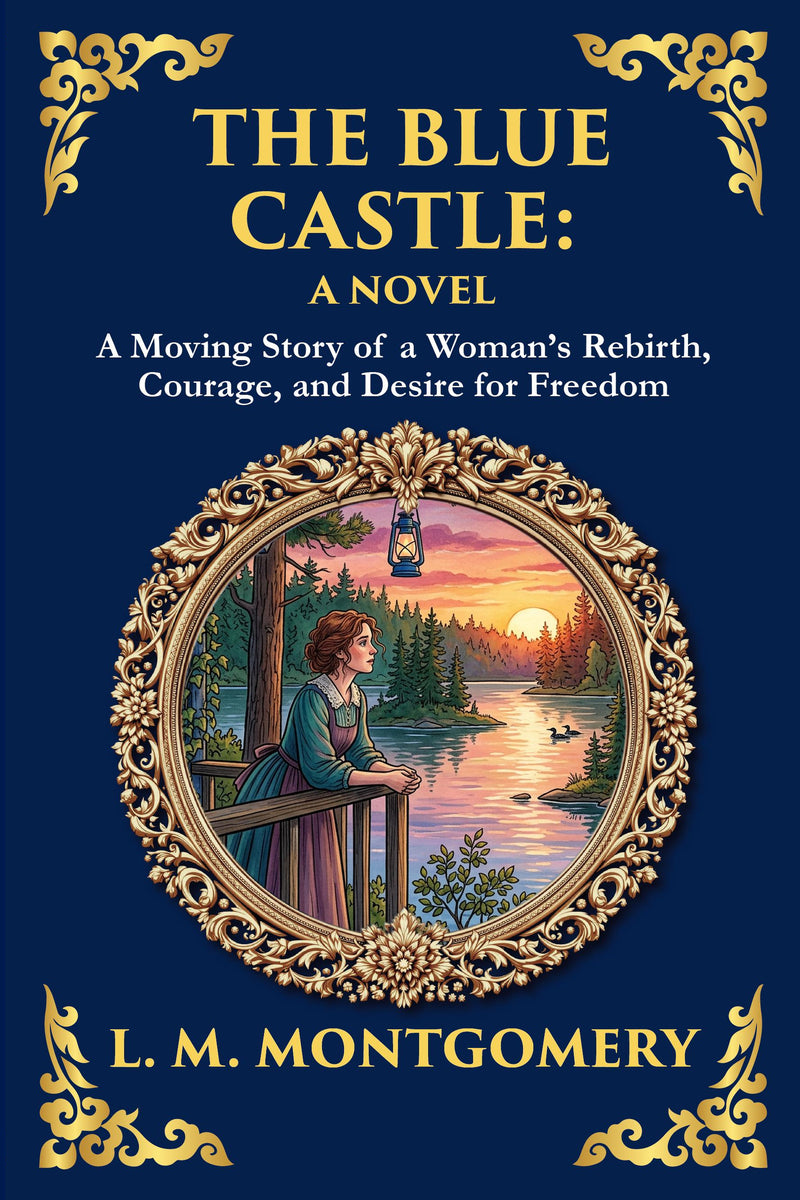
The Blue Castle: A Novel
What if the worst day of your life became the first day of your freedom? In The Blue Castle, L. M. Montgomery—best known for Anne of Green Gables—offers a bold and unexpectedly modern tale of one woman who dares to escape the prison of societal expectations.
or free app
10,000+ hrs library
30-day guarantee
The complete The Blue Castle: a novel appears in modern English through Library of Alexandria Press, available online with audiobook narration included for members.
Have you ever wondered why the life you’re meant to live begins only after you stop being afraid? In The Blue Castle, L. M. Montgomery departs from the innocent charm of Anne of Green Gables to deliver a powerful, emotional novel about one woman’s late blooming. Set in the early 20th century but pulsing with timeless themes, this is a story about breaking free—from fear, conformity, and the illusion of a "proper life." Valancy Stirling is nearly 30 and feels invisible.
Her family treats her like a burden. Her days are filled with gray routines, silent meals, and the quiet ache of wasted potential. But everything changes the day she receives a terminal medical diagnosis.
Convinced she has only a short time to live, Valancy makes a radical choice: to stop living for others and start following her heart. She defies her family. She moves out.
She falls in love. And for the first time, she tastes what freedom truly means. With lyrical prose and deep emotional insight, Montgomery charts Valancy’s transformation from meek and obedient to bold and joyful—a heroine not of youthful innocence, but of awakened adulthood.
What you’ll discover in this modern edition
- A Story of Rebirth and Liberation – Watch Valancy break free from fear and live life on her own terms.
- A Deep, Late-Blooming Romance – Experience a love that is both surprising and deeply healing.
- Montgomery’s Boldest Heroine – A rare portrait of adult transformation in a world of repression.
- A Celebration of Nature, Solitude, and Self-Reliance – Set against the wild beauty of the Canadian woods.
- A Moving Tale of Courage and Joy – Perfect for readers who long for something more from life. The Blue Castle is a quiet revolution—a romantic and soul-stirring reminder that it’s never too late to rewrite your story.
| Formats | eBook (EPUB + PDF) · Audiobook · Paperback · Hardcover · Large Print |
| Language | English |
| Trim size (print) | 6 × 9 in |
| Binding | Paperback — perfect-bound · Hardcover — casewrap |
| Large Print edition | Same text in a larger, easy-read type — a larger font, not a larger trim |
| Print pricing | Every physical book at our true cost — at-cost, no profit (members) |
| Library | 873 restored titles, always growing |
| Length | 70,872 words · ~4 hr 43 min reading |
| Reading level | Grade 7 · an easy, flowing read (this modern-English edition) |
| Edition | Modern English translation · 2026 |
Member reviews for this edition are collected as readers finish it — be the first. Across the library: 12,000+ books shipped, every plan covered by a 365-day print guarantee.
About this edition
A faithful, unabridged modern-English edition by The Library of Alexandria — carefully rendered for today's reader and verified paragraph-by-paragraph against the public-domain source. Available as eBook, audiobook, paperback, hardcover, and large print.
- Complete & unabridgedVerified paragraph by paragraph against the source — never a scan, never abridged.
- Modern English, faithfulReadable today, with the author’s meaning kept intact. Readable — not simplified.
- Every format, one membershipRead in your browser or the free app, or listen to the full audiobook.
Included free with your membership
Cancel anytime, one click · 30-day money-back guarantee
Edition last updated July 2026
What’s inside
The Blue Castle: A Novel — complete and unabridged: all 46 sections included with membership, plus the full audiobook.
Begin reading The Blue Castle: A Novel
In clear modern English — the complete text is included with membership.
Introduction
There are books we read for diversion, and there are books that seem to read us in return — that reach into some quiet, half-forgotten corner of the heart and gently switch on a light. The Blue Castle belongs unmistakably to the second category. First published in 1926, it stands as one of the most beloved and most unusual works in the long and luminous career of Lucy Maud Montgomery, the Canadian author whose name most readers associate with a red-haired orphan and a green-gabled farmhouse on Prince Edward Island. But to come to this novel expecting another Anne of Green Gables is to misunderstand both the book and the woman who wrote it. This is a story for grown-ups — written, perhaps, for the grown-up that the dreamy, imaginative child inside us all eventually becomes, the one who learns the hard truth that imagination alone cannot save us, and that at some point we must summon the courage to actually live.
This particular edition has been carefully adapted into modern English for the contemporary reader. The original 1926 prose, while gorgeous, occasionally carries the cadences, idioms, and references of a vanished era — turns of phrase that can momentarily pull a present-day reader out of the spell the story is weaving. The intention of this modern translation is never to diminish Montgomery’s voice but to clear away the small obstacles of time so that her wit, her tenderness, and her fierce belief in the possibility of personal liberation can come through as freshly as they did to readers nearly a century ago. The bones of the story remain entirely intact: the characters speak with the same warmth and barbed humor, the landscape shimmers with the same enchantment, and the central journey from suffocation to freedom unfolds with all its original emotional power. What has changed is only the ease of access. Think of it as cleaning the glass on a beloved painting — the masterpiece is the same; you can simply see it better now.
To appreciate just how remarkable The Blue Castle is, it helps to understand where it sat in its author’s life and work. By the mid-1920s, Lucy Maud Montgomery was internationally famous. Anne of Green Gables, published in 1908, had become a phenomenon, beloved by readers from Canada to Sweden to Japan, and admired by figures as distinguished as Mark Twain, who reportedly called Anne “the dearest and most moving and delightful child since the immortal Alice.” Montgomery had written sequel after sequel, building a literary empire around her sunlit visions of rural Prince Edward Island and the spirited young women who inhabited it. She was, in many ways, trapped by her own success — expected by her publishers and her public to keep producing variations on a winning formula.
The Blue Castle was her quiet act of rebellion. It is the only one of her published novels set entirely outside Prince Edward Island, taking place instead in the Muskoka region of Ontario, with its glittering lakes, pine-scented woods, and wild northern beauty — a landscape Montgomery had fallen in love with during her own travels. It is also her only novel written explicitly for adults, and its heroine is not a child or an adolescent on the cusp of life, but a woman of twenty-nine, which in the social arithmetic of her time and place meant she was considered a confirmed old maid, a faded thing, a person whose chances had quietly expired. There is something deeply moving in the knowledge that Montgomery, by then a married woman in her fifties living a life of significant private unhappiness — burdened by her husband’s mental illness, by financial worries, by the relentless demands of her public persona — poured into this book a fantasy of escape and self-determination that she could perhaps never fully claim for herself. The longing in these pages is real. So is the joy. Both feel earned.
What makes the novel so special, and so different from her other work, is its tone. There is a sharpness here, a satirical edge, that Montgomery rarely allowed herself elsewhere. Her portrait of a stifling, gossiping, hypocritical extended family is rendered with surgical precision and genuine comic savagery. These are people who weaponize respectability, who measure worth in marriages and money and propriety, and who have, without ever quite intending to, slowly smothered the life out of the one member of the clan too gentle and too dutiful to fight back. Montgomery clearly relished skewering them, and her readers will relish it too. The humor is dry, observant, and occasionally devastating. But the satire never curdles into cruelty, because beneath it runs an unwavering current of compassion — for the dreamers, the overlooked, the ones who have been told their whole lives that they are nothing.
That compassion is the beating heart of the book. For at its core, The Blue Castle is a story about a person who has never once been allowed to want anything for herself, and who discovers, almost by accident, that she has both the right and the capacity to want — and to choose, and to act. It is a story about the difference between merely existing and truly being alive. And it is a story about the courage required to leap, finally, out of the cage you have lived in so long that you have come to believe it is the whole world.
I will not, here, tell you the particulars of how that leap comes about. Part of the pure pleasure of this novel lies in the way its plot turns and surprises and delivers its revelations, and I have no intention of robbing you of a single one of those discoveries. But I can speak to the shape of the experience, and to the feeling it leaves behind, because that feeling is, I think, the real reason this book has been passed reverently from reader to reader for almost a hundred years, quietly accumulating a devoted following that crosses generations and continents.
You should know going in that the early chapters are deliberately, almost claustrophobically, oppressive. Montgomery wants you to feel the weight of the heroine’s existence — the airless rooms, the cold meals eaten under critical eyes, the years stacking up like dust on furniture nobody loves. She wants you to feel, in your own chest, the slow grey suffocation of a life spent apologizing for taking up space. This is intentional, and it is essential. Because everything that follows — every burst of freedom, every act of defiance, every moment of wild, undignified, glorious joy — derives its power from the contrast. You cannot fully appreciate the dawn until you have sat through the long night. So if the opening makes you ache a little for the heroine, if you find yourself wanting to reach into the pages and shake her relatives, that is precisely the response Montgomery is reaching for. Trust the architecture of the story. The release, when it comes, is all the sweeter for the constraint that preceded it.
There is also, woven through this novel, a strain of romance — but it is romance of a particular and unusual kind, and I think it is worth preparing the reader for it, again without giving anything away. Montgomery was not interested, here, in the conventional fairy tale of a rescue. The freedom the heroine achieves is, fundamentally, a freedom she claims for herself before any other person enters the picture in a meaningful way. Whatever happiness she ultimately finds is built upon the foundation of her own decision to start living. This matters. It is what separates The Blue Castle from a thousand lesser stories about lonely women waiting to be saved. The transformation is internal first, external second. The castle of the title — and you will come to understand exactly what that castle means as you read — is at first a place of pure imagination, a private refuge the heroine has built inside her own mind to survive the bleakness of her days. The novel’s deepest magic lies in watching the boundary between that interior dream-world and her exterior reality begin, miraculously, to dissolve.
I want to offer a few thoughts on how to read The Blue Castle in a way that will yield the richest possible experience, because this is a novel that rewards a certain quality of attention.
First, give yourself over to its pace. This is not a fast book, particularly at the start, and it should not be hurried. Montgomery was a writer of deep sensory pleasure, a woman who could spend a full paragraph on the way light falls across a stand of birch trees or the particular hush of snow in a winter wood, and these passages are not filler — they are the very substance of the book’s emotional logic. The natural world in The Blue Castle is not mere scenery. It is a living force, almost a character in its own right, and it functions as the great counterweight to the stuffy human world of parlors and proprieties. The heroine’s awakening is inseparable from her growing intimacy with wild places — with lakes and stars and forests and the changing seasons. Montgomery believed, profoundly, in the restorative and even redemptive power of the natural world, and she invites you to feel it too. So slow down. Let the descriptions breathe. Read them not as obstacles between plot points but as the oxygen the whole story needs to live.
Second, pay attention to the humor, because it is easy to miss how genuinely funny this book is. Montgomery’s comic gift was considerable, and in The Blue Castle she deploys it with particular relish against the pretensions of the heroine’s family. The dialogue crackles with sly absurdity, the family members are drawn with the precise, merciless eye of a great satirist, and there are scenes — once the heroine begins to speak her mind — of such gleeful subversion that you may find yourself laughing out loud. This humor is not a distraction from the novel’s serious themes; it is part of how those themes are delivered. There is a particular joy in watching a person who has spent her entire life biting her tongue suddenly begin to say exactly what she thinks, and Montgomery wrings every drop of comedy and catharsis from this premise. Savor it.
Third, allow yourself to feel the romance of the place. Muskoka, as Montgomery renders it, is a kind of earthly paradise — a wilderness of pine and water and granite that stands in deliberate opposition to the cramped, manicured respectability of the town. There is an island in this story, and a small house, and a stretch of lake, and these places will lodge themselves in your imagination and stay there long after you have closed the book. Many readers come away from The Blue Castle with a fierce longing to find their own blue castle, their own corner of wildness and freedom, their own place where they can be entirely themselves. That longing is the book working as it was designed to work. It is one of those rare novels that does not merely describe happiness but seems, somehow, to transmit it directly into the reader’s bloodstream.
Fourth — and this is perhaps the most important thing I can say — read this book as an invitation rather than merely a story. The Blue Castle is, at bottom, a meditation on a single piercing question: what would you do if you had one year, or one month, or one day to actually live the life you wanted, free of fear and the suffocating opinions of others? The novel poses this question through its heroine, but it is really asking it of the reader. How much of your own life have you spent waiting — for permission, for the right moment, for some future that never quite arrives? How many of your truest desires have you swallowed in the name of duty, or propriety, or simple fear? Montgomery does not lecture. She simply tells a story so emotionally true that it cannot help but turn the reader’s gaze inward. Generations of readers have reported that this book changed something in them — that it gave them courage they did not know they needed, that it nudged them toward a decision they had been postponing for years. There is a reason it has become, for so many, a kind of secret talisman, a book they return to again and again in moments of doubt.
Cancel anytime, one click · 30-day money-back guarantee
Founding annual rate available now — your price locks for life when you join.
Not ready? Get this free chapter by email — read it anytime.
✓ Sent — check your inbox for The Blue Castle: A Novel.
Questions about The Blue Castle: A Novel
What is The Blue Castle: a novel about?
What if the worst day of your life became the first day of your freedom? In The Blue Castle, L. M. Montgomery—best known for Anne of Green Gables—offers a bold and unexpectedly modern tale of one woman who dares to escape the prison of societal expectations. Valancy Stirling is 29, unmarried, and suffocating under the constant disapproval of her overbearing family.
Who wrote The Blue Castle: a novel?
The Blue Castle: a novel was written by L. M. Montgomery. This edition presents the complete work in clear modern English, faithfully rendered from the public-domain original by Library of Alexandria Press.
Is The Blue Castle: a novel free to read?
The opening chapter is free to read on this page. Members read and listen to the complete work — and the entire library — free, and can order any physical book at our true print cost.
How long is The Blue Castle: a novel?
46 chapters (~70,872 words) — about 4 hr 43 min of reading in this modern-English edition.
Is this an abridged version of The Blue Castle: a novel?
No. This is the complete, unabridged The Blue Castle: a novel, carefully rendered into clear modern English and verified paragraph-by-paragraph against the public-domain source — nothing is cut or summarised.
What formats does The Blue Castle: a novel come in?
The Blue Castle: a novel is available as eBook, paperback, hardcover and large print. eBook and audiobook are included with membership; printed editions ship at our true print cost.
Shipping & returns
Billing & membership
More from the library


Explore Romance
- As You Like It · William Shakespeare
- Anna Karenina · Leo Tolstoy
- A Midsummer Night’s Dream · William Shakespeare
- Romeo and Juliet · William Shakespeare
- Sonnets from the Portuguese · Elizabeth Barrett Browning
- Miss Primrose · Agnes Giberne
- The Gay Adventure: A Romance · Richard Bird
- The Belle of Bowling Green · Amelia E. Barr
- The Monk: A Romance · M. G. Lewis
- She · H. Rider Haggard
- The Mill on the Floss · George Eliot
- The Glad Lady · Amy Ella Blanchard
- The Red Lily — Complete · Anatole France
- The Blue Goose · Frank Lewis Nason
- The History of Sir Richard Calmady: A Romance · Lucas Malet
- The Quest of the Silver Fleece: A Novel · W. E. B. Du Bois
- The Love Letters of Mary Wollstonecraft to Gilbert Imlay · Mary Wollstonecraft
- Daddy-Long-Legs · Jean Webster
- The Age of Innocence · Edith Wharton
- The Portrait of a Lady — Volume 1 · Henry James
- Wuthering Heights · Emily Brontë
- The Lady of the Lake · Walter Scott
- Lady Chatterley’s Lover · D. H. Lawrence
- Jane Eyre: An Autobiography · Charlotte Brontë
- A Connecticut Yankee in King Arthur’s Court · Mark Twain
- Northanger Abbey · Jane Austen
- Mansfield Park · Jane Austen
- Anthem · Ayn Rand
- This Side of Paradise · F. Scott Fitzgerald
- Persuasion · Jane Austen
The Blue Castle: A Novel
The Blue Castle: A Novel
A Moving Story of a Woman’s Rebirth, Courage, and Desire for Freedom
L. M. Montgomery
Contents
- Introduction
- Chapter 1
- Chapter 2
- Chapter 3
- Chapter 4
- Chapter 5
- Chapter 6
- Chapter 7
- Chapter 8
- Chapter 9
- Chapter 10
- Chapter 11
- Chapter 12
- Chapter 13
- Chapter 14
- Chapter 15
- Chapter 16
- Chapter 17
- Chapter 18
- Chapter 19
- Chapter 20
- Chapter 21
- Chapter 22
- Chapter 23
- Chapter 24
- Chapter 25
- Chapter 26
- Chapter 27
- Chapter 28
- Chapter 29
- Chapter 30
- Chapter 31
- Chapter 32
- Chapter 33
- Chapter 34
- Chapter 35
- Chapter 36
- Chapter 37
- Chapter 38
- Chapter 39
- … and 6 more chapters
Introduction
There are books we read for diversion, and there are books that seem to read us in return — that reach into some quiet, half-forgotten corner of the heart and gently switch on a light. The Blue Castle belongs unmistakably to the second category. First published in 1926, it stands as one of the most beloved and most unusual works in the long and luminous career of Lucy Maud Montgomery, the Canadian author whose name most readers associate with a red-haired orphan and a green-gabled farmhouse on Prince Edward Island. But to come to this novel expecting another Anne of Green Gables is to misunderstand both the book and the woman who wrote it. This is a story for grown-ups — written, perhaps, for the grown-up that the dreamy, imaginative child inside us all eventually becomes, the one who learns the hard truth that imagination alone cannot save us, and that at some point we must summon the courage to actually live.
This particular edition has been carefully adapted into modern English for the contemporary reader. The original 1926 prose, while gorgeous, occasionally carries the cadences, idioms, and references of a vanished era — turns of phrase that can momentarily pull a present-day reader out of the spell the story is weaving. The intention of this modern translation is never to diminish Montgomery’s voice but to clear away the small obstacles of time so that her wit, her tenderness, and her fierce belief in the possibility of personal liberation can come through as freshly as they did to readers nearly a century ago. The bones of the story remain entirely intact: the characters speak with the same warmth and barbed humor, the landscape shimmers with the same enchantment, and the central journey from suffocation to freedom unfolds with all its original emotional power. What has changed is only the ease of access. Think of it as cleaning the glass on a beloved painting — the masterpiece is the same; you can simply see it better now.
To appreciate just how remarkable The Blue Castle is, it helps to understand where it sat in its author’s life and work. By the mid-1920s, Lucy Maud Montgomery was internationally famous. Anne of Green Gables, published in 1908, had become a phenomenon, beloved by readers from Canada to Sweden to Japan, and admired by figures as distinguished as Mark Twain, who reportedly called Anne “the dearest and most moving and delightful child since the immortal Alice.” Montgomery had written sequel after sequel, building a literary empire around her sunlit visions of rural Prince Edward Island and the spirited young women who inhabited it. She was, in many ways, trapped by her own success — expected by her publishers and her public to keep producing variations on a winning formula.
The Blue Castle was her quiet act of rebellion. It is the only one of her published novels set entirely outside Prince Edward Island, taking place instead in the Muskoka region of Ontario, with its glittering lakes, pine-scented woods, and wild northern beauty — a landscape Montgomery had fallen in love with during her own travels. It is also her only novel written explicitly for adults, and its heroine is not a child or an adolescent on the cusp of life, but a woman of twenty-nine, which in the social arithmetic of her time and place meant she was considered a confirmed old maid, a faded thing, a person whose chances had quietly expired. There is something deeply moving in the knowledge that Montgomery, by then a married woman in her fifties living a life of significant private unhappiness — burdened by her husband’s mental illness, by financial worries, by the relentless demands of her public persona — poured into this book a fantasy of escape and self-determination that she could perhaps never fully claim for herself. The longing in these pages is real. So is the joy. Both feel earned.
What makes the novel so special, and so different from her other work, is its tone. There is a sharpness here, a satirical edge, that Montgomery rarely allowed herself elsewhere. Her portrait of a stifling, gossiping, hypocritical extended family is rendered with surgical precision and genuine comic savagery. These are people who weaponize respectability, who measure worth in marriages and money and propriety, and who have, without ever quite intending to, slowly smothered the life out of the one member of the clan too gentle and too dutiful to fight back. Montgomery clearly relished skewering them, and her readers will relish it too. The humor is dry, observant, and occasionally devastating. But the satire never curdles into cruelty, because beneath it runs an unwavering current of compassion — for the dreamers, the overlooked, the ones who have been told their whole lives that they are nothing.
That compassion is the beating heart of the book. For at its core, The Blue Castle is a story about a person who has never once been allowed to want anything for herself, and who discovers, almost by accident, that she has both the right and the capacity to want — and to choose, and to act. It is a story about the difference between merely existing and truly being alive. And it is a story about the courage required to leap, finally, out of the cage you have lived in so long that you have come to believe it is the whole world.
I will not, here, tell you the particulars of how that leap comes about. Part of the pure pleasure of this novel lies in the way its plot turns and surprises and delivers its revelations, and I have no intention of robbing you of a single one of those discoveries. But I can speak to the shape of the experience, and to the feeling it leaves behind, because that feeling is, I think, the real reason this book has been passed reverently from reader to reader for almost a hundred years, quietly accumulating a devoted following that crosses generations and continents.
You should know going in that the early chapters are deliberately, almost claustrophobically, oppressive. Montgomery wants you to feel the weight of the heroine’s existence — the airless rooms, the cold meals eaten under critical eyes, the years stacking up like dust on furniture nobody loves. She wants you to feel, in your own chest, the slow grey suffocation of a life spent apologizing for taking up space. This is intentional, and it is essential. Because everything that follows — every burst of freedom, every act of defiance, every moment of wild, undignified, glorious joy — derives its power from the contrast. You cannot fully appreciate the dawn until you have sat through the long night. So if the opening makes you ache a little for the heroine, if you find yourself wanting to reach into the pages and shake her relatives, that is precisely the response Montgomery is reaching for. Trust the architecture of the story. The release, when it comes, is all the sweeter for the constraint that preceded it.
There is also, woven through this novel, a strain of romance — but it is romance of a particular and unusual kind, and I think it is worth preparing the reader for it, again without giving anything away. Montgomery was not interested, here, in the conventional fairy tale of a rescue. The freedom the heroine achieves is, fundamentally, a freedom she claims for herself before any other person enters the picture in a meaningful way. Whatever happiness she ultimately finds is built upon the foundation of her own decision to start living. This matters. It is what separates The Blue Castle from a thousand lesser stories about lonely women waiting to be saved. The transformation is internal first, external second. The castle of the title — and you will come to understand exactly what that castle means as you read — is at first a place of pure imagination, a private refuge the heroine has built inside her own mind to survive the bleakness of her days. The novel’s deepest magic lies in watching the boundary between that interior dream-world and her exterior reality begin, miraculously, to dissolve.
I want to offer a few thoughts on how to read The Blue Castle in a way that will yield the richest possible experience, because this is a novel that rewards a certain quality of attention.
First, give yourself over to its pace. This is not a fast book, particularly at the start, and it should not be hurried. Montgomery was a writer of deep sensory pleasure, a woman who could spend a full paragraph on the way light falls across a stand of birch trees or the particular hush of snow in a winter wood, and these passages are not filler — they are the very substance of the book’s emotional logic. The natural world in The Blue Castle is not mere scenery. It is a living force, almost a character in its own right, and it functions as the great counterweight to the stuffy human world of parlors and proprieties. The heroine’s awakening is inseparable from her growing intimacy with wild places — with lakes and stars and forests and the changing seasons. Montgomery believed, profoundly, in the restorative and even redemptive power of the natural world, and she invites you to feel it too. So slow down. Let the descriptions breathe. Read them not as obstacles between plot points but as the oxygen the whole story needs to live.
Second, pay attention to the humor, because it is easy to miss how genuinely funny this book is. Montgomery’s comic gift was considerable, and in The Blue Castle she deploys it with particular relish against the pretensions of the heroine’s family. The dialogue crackles with sly absurdity, the family members are drawn with the precise, merciless eye of a great satirist, and there are scenes — once the heroine begins to speak her mind — of such gleeful subversion that you may find yourself laughing out loud. This humor is not a distraction from the novel’s serious themes; it is part of how those themes are delivered. There is a particular joy in watching a person who has spent her entire life biting her tongue suddenly begin to say exactly what she thinks, and Montgomery wrings every drop of comedy and catharsis from this premise. Savor it.
Third, allow yourself to feel the romance of the place. Muskoka, as Montgomery renders it, is a kind of earthly paradise — a wilderness of pine and water and granite that stands in deliberate opposition to the cramped, manicured respectability of the town. There is an island in this story, and a small house, and a stretch of lake, and these places will lodge themselves in your imagination and stay there long after you have closed the book. Many readers come away from The Blue Castle with a fierce longing to find their own blue castle, their own corner of wildness and freedom, their own place where they can be entirely themselves. That longing is the book working as it was designed to work. It is one of those rare novels that does not merely describe happiness but seems, somehow, to transmit it directly into the reader’s bloodstream.
Fourth — and this is perhaps the most important thing I can say — read this book as an invitation rather than merely a story. The Blue Castle is, at bottom, a meditation on a single piercing question: what would you do if you had one year, or one month, or one day to actually live the life you wanted, free of fear and the suffocating opinions of others? The novel poses this question through its heroine, but it is really asking it of the reader. How much of your own life have you spent waiting — for permission, for the right moment, for some future that never quite arrives? How many of your truest desires have you swallowed in the name of duty, or propriety, or simple fear? Montgomery does not lecture. She simply tells a story so emotionally true that it cannot help but turn the reader’s gaze inward. Generations of readers have reported that this book changed something in them — that it gave them courage they did not know they needed, that it nudged them toward a decision they had been postponing for years. There is a reason it has become, for so many, a kind of secret talisman, a book they return to again and again in moments of doubt.
If it hadn’t rained on a certain May morning, Valancy Stirling’s entire life would have been different. She would have gone to Aunt Wellington’s engagement picnic with the rest of her family, and Dr. Trent would have gone to Montreal. But it did rain, and this is the story of what happened to her because of it.
Valancy woke up early, during that lifeless, hopeless hour just before dawn. She hadn’t slept well. Sometimes, you don’t sleep well when you’re about to turn twenty-nine and are still unmarried—especially in a community and a family where being single is seen simply as a failure to land a man.
The people of Deerwood and the Stirling family had long since written Valancy off as a hopeless old maid. But Valancy had never quite given up a small, shameful, pitiful hope that romance might still find her—at least, not until this miserable, rainy morning, when she woke up to the reality that she was twenty-nine and no man wanted her.
That was the real sting. Valancy didn’t mind being single that much. After all, she figured being an old maid couldn’t be as terrible as being married to someone like Uncle Wellington, Uncle Benjamin, or even Uncle Herbert. What hurt was that she’d never had the chance to be anything else. No man had ever desired her.
Tears filled her eyes as she lay alone in the dim, graying light. She didn’t dare cry as hard as she wanted for two reasons. First, she was afraid that sobbing might trigger another bout of that pain around her heart; she’d had a spell of it after getting into bed, and it was worse than any she’d experienced before. Second, she was afraid her mother would notice her red eyes at breakfast and pester her with a million persistent, mosquito-like questions about why she was crying.
End of the free sample
Keep reading, free
Members read and listen to the complete book — and the entire library. Cancel anytime, one click · 30-day money-back guarantee.