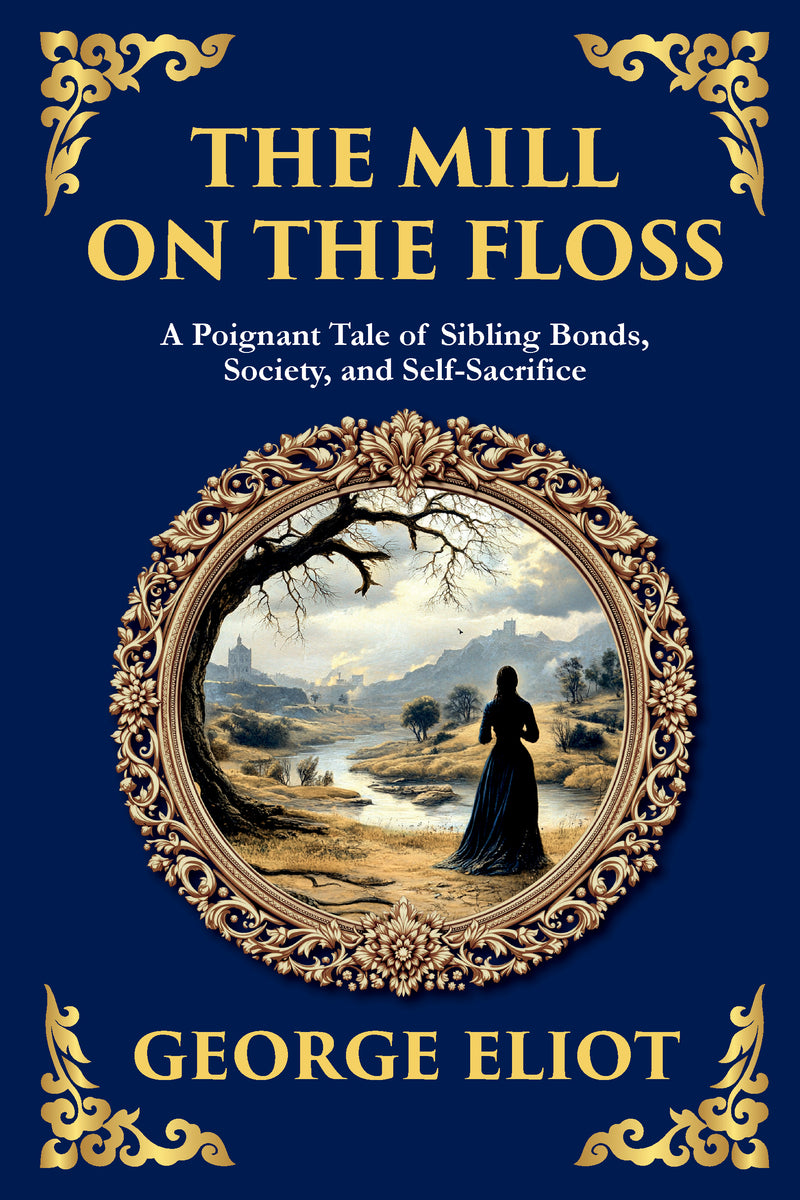
The Mill on the Floss — Large Print
In a small English village on the River Floss, a passionate and intelligent young girl named Maggie Tulliver grows up facing constant trials—at home, at school, and in society.
or free app
10,000+ hrs library
30-day guarantee
The complete The Mill on the Floss appears in modern English through Library of Alexandria Press, available online with audiobook narration included for members.
Have you ever wondered why the ones we love most can also wound us the deepest? In The Mill on the Floss, George Eliot crafts a timeless and emotionally powerful tale of sibling devotion, societal constraint, and inner longing. Set in the rural English countryside, this semi- autobiographical novel traces the journey of Maggie Tulliver, a spirited and thoughtful young woman raised under the stern gaze of a traditional family and a judgmental community.
From the early days of childhood mischief with her brother Tom to the intense moral conflicts of adulthood, Maggie’s life unfolds as a story of tension between personal identity and external expectation. With every decision, she must weigh the cost of self-sacrifice against the hope of fulfillment.
What you’ll discover in this modern edition
- A Heartbreaking Story of Sibling Love and Conflict Follow Maggie and Tom as their childhood closeness is challenged by pride, ideology, and the burdens of inheritance.
- The Struggles of a Woman Ahead of Her Time Witness Maggie’s attempts to assert independence, education, and emotional freedom in a world that offers little room for a woman’s voice.
- A Vivid Depiction of 19th-Century English Life Experience the texture of village life, the sway of tradition, and the influence of religion and respectability on personal choice.
- Themes That Resonate Across Generations Explore questions of loyalty, guilt, duty, rebellion, and whether redemption can be found through love or sacrifice.
| Formats | eBook (EPUB + PDF) · Audiobook · Paperback · Hardcover · Large Print |
| Language | English |
| Trim size (print) | 6 × 9 in |
| Binding | Paperback — perfect-bound · Hardcover — casewrap |
| Large Print edition | Same text in a larger, easy-read type — a larger font, not a larger trim |
| Print pricing | Every physical book at our true cost — at-cost, no profit (members) |
| Library | 873 restored titles, always growing |
| Length | 199,994 words · ~13 hr 20 min reading |
| Reading level | Grade 6 · an easy, flowing read (this modern-English edition) |
| Edition | Modern English translation · 2026 |
Member reviews for this edition are collected as readers finish it — be the first. Across the library: 12,000+ books shipped, every plan covered by a 365-day print guarantee.
About this edition
A faithful, unabridged modern-English edition by The Library of Alexandria — carefully rendered for today's reader and verified paragraph-by-paragraph against the public-domain source. Available as eBook, audiobook, paperback, hardcover, and large print.
- Complete & unabridgedVerified paragraph by paragraph against the source — never a scan, never abridged.
- Modern English, faithfulReadable today, with the author’s meaning kept intact. Readable — not simplified.
- Every format, one membershipRead in your browser or the free app, or listen to the full audiobook.
Included free with your membership
Cancel anytime, one click · 30-day money-back guarantee
Edition last updated July 2026
What’s inside
The Mill on the Floss — Large Print — complete and unabridged: all 22 sections included with membership, plus the full audiobook.
Begin reading The Mill on the Floss — Large Print
In clear modern English — the complete text is included with membership.
Introduction
There are novels that entertain us, and there are novels that seem to know us. The Mill on the Floss belongs unmistakably to the second category. From its very first pages, with their dreamlike vision of a river winding toward the sea and a watermill nestled on its bank, George Eliot draws us into a world so vividly remembered that it feels less like fiction than recollection. This is a book about childhood and its long shadow, about the fierce loyalties that bind brothers and sisters, about the way small communities can both nurture and suffocate, and about the impossible negotiations between what we owe ourselves and what we owe to others. Few books have understood so deeply the ache of growing up, the cost of being misunderstood, and the desperate human hunger to be loved exactly as we are.
Published in 1860, the novel appeared at the height of George Eliot’s powers, just two years before Silas Marner and seven years before her masterpiece Middlemarch. It came at a moment when Eliot—whose real name was Mary Ann Evans—was establishing herself as one of the most psychologically penetrating voices in the English language. Readers who come to this story expecting a quaint Victorian tale of country life will quickly discover something far more searching and unsettling: a profound meditation on the inner lives of ordinary people, told with an intelligence so generous and a sympathy so wide that it continues to feel astonishingly modern more than a century and a half later. This edition has been carefully adapted for the contemporary reader, preserving the emotional power and intellectual richness of Eliot’s vision while easing the path through some of the denser thickets of Victorian prose. The aim is not to replace the original but to open a door to it—to let modern readers experience the full force of this remarkable story without the friction that sometimes keeps us at arm’s length from books of this period.
What awaits you is a story rooted in the small world of a provincial English town, yet expansive enough to contain the whole drama of a human soul trying to find its place. It is, at heart, the story of a girl—bright, passionate, fiercely affectionate, and continually at odds with the narrow expectations placed upon her—and of the family and community that shape her, constrain her, and ultimately judge her. To read it is to be reminded of what it felt like to be young and full of feeling in a world that did not quite know what to do with you. It is also, more quietly, to be reminded of how much of our adult selves is forged in the crucible of those early years, and how the loves and wounds of childhood never truly leave us.
To understand the depth and daring of this novel, it helps to know something of the woman who wrote it. Mary Ann Evans was born in 1819 in rural Warwickshire, the daughter of a land agent, and grew up in a world not unlike the one she would later immortalize in her fiction—a world of mills and farms, of market towns and parish churches, of rigid social codes and the deep, unspoken assumptions of provincial life. She was a precociously intelligent child, devouring books with an appetite that set her apart from those around her, and her education, though it ended formally when she was a teenager, never truly stopped. She taught herself languages, read voraciously in philosophy and theology, and gradually developed a mind of extraordinary range and rigor.
Her path through life was anything but conventional. She moved to London and became a translator, an editor, and a respected figure in intellectual circles at a time when such roles were almost unimaginable for a woman. She translated demanding works of German philosophy, wrote incisive essays, and helped run one of the leading periodicals of the day. Most scandalously for her era, she entered into a long and devoted relationship with George Henry Lewes, a brilliant and generous man who was already married and unable to obtain a divorce. Their union, which lasted until his death, defied the moral conventions of Victorian society and cost her dearly in terms of social acceptance. It is impossible to read The Mill on the Floss without sensing how intimately its author understood what it meant to be judged by a community, to be cast out for the crime of following one’s own heart against the dictates of respectability.
She adopted the pen name “George Eliot” partly to ensure her fiction would be taken seriously in a literary marketplace that tended to dismiss women writers as producers of light romances, and partly to keep her authorship separate from the public scandal of her private life. The disguise worked: when her early stories appeared, readers and critics alike assumed they had been written by a man, and the work was praised for a depth and seriousness that few would have credited to a woman. By the time the truth emerged, her reputation as a major novelist was secure. She went on to become one of the most admired and influential writers of the nineteenth century, and her novels continue to be regarded as among the finest in the English language.
What makes Eliot so remarkable, and what gives this novel its enduring power, is her unique combination of intellectual sophistication and emotional warmth. She was steeped in the most advanced philosophical and scientific thought of her day, deeply interested in the moral consequences of how we live and how we treat one another. Yet she never let her ideas overwhelm her characters. Instead, she used her formidable intelligence in service of compassion. Her great gift was the ability to enter into the minds and hearts of people very different from herself—the petty and the noble, the foolish and the wise, the cruel and the kind—and to show us the human logic behind even the most exasperating behavior. She believed, profoundly, that understanding leads to forgiveness, and that the highest purpose of art was to enlarge our capacity for sympathy.
This conviction is everywhere in The Mill on the Floss. The novel is, in many ways, the most personal of all her books. Readers and scholars have long noted the autobiographical threads woven through it—the intense bond between a sensitive girl and her practical, sometimes unyielding brother; the experience of being an intellectually hungry child in a world that valued conformity over imagination; the painful tension between individual desire and family duty. Eliot poured into this story her own memories of childhood, her own sense of having been an outsider, her own hard-won understanding of how the past shapes us. The result is a work of extraordinary intimacy, in which we feel the author’s lived experience pulsing beneath every page.
At the center of this novel stands one of the most unforgettable characters in all of literature: a girl whose vividness, intelligence, and capacity for love leap off the page and lodge themselves permanently in the reader’s memory. From her earliest appearances—impulsive, affectionate, hungry for approval, and forever stumbling into trouble—she captures something essential about what it means to be a child who feels too much and thinks too much for the world she has been born into. She wants, above all, to be loved, and she gives her love with a ferocity that the people around her can rarely match or even comprehend. Her story is the beating heart of the book, and following her journey from childhood into the complexities of young adulthood is one of the great pleasures—and great sorrows—that this novel offers.
Eliot understood, perhaps better than any novelist before her, that the dramas of childhood are not trivial preludes to “real” life but are themselves matters of the highest emotional stakes. The early sections of the book, which immerse us in the small triumphs and devastating humiliations of growing up, are among the finest evocations of childhood ever written. The longing to please a beloved sibling, the unbearable weight of a parent’s disapproval, the way a single careless word can wound for days, the intensity of friendships and rivalries, the sense that the whole world hangs on the outcome of some small domestic event—all of this Eliot renders with such precision and tenderness that we are transported back into our own earliest years. She takes children seriously as moral and emotional beings, and in doing so she invites us to take our own remembered selves seriously too.
But this is not merely a book about childhood. As the story moves forward, it grows into a searching exploration of the conflicts that define adult life: the clash between love and duty, between personal happiness and social respectability, between the demands of the self and the claims of others. The bond between the central character and her brother—a relationship of immense tenderness shadowed by misunderstanding and incompatibility of temperament—becomes the lens through which Eliot examines the deepest questions of loyalty, forgiveness, and the limits of love. The brother and sister are bound together by ties that nothing can fully sever, yet they are divided by fundamental differences in how they see the world. He is practical, proud, conventional, and unforgiving; she is imaginative, passionate, and ruled by her heart. Watching these two people, who love each other and yet cannot fully understand each other, navigate the trials that life throws at them is to witness one of literature’s truest and most painful portraits of family.
The novel also offers a richly detailed portrait of the society in which these characters live—a provincial world governed by money, property, reputation, and an iron code of what is and is not “done.” Eliot is both affectionate and clear-eyed in her depiction of this world. She knows its narrowness, its hypocrisies, its capacity for cruelty toward anyone who fails to conform. She gives us a whole gallery of aunts and uncles, neighbors and acquaintances, whose petty preoccupations and unexamined prejudices form the social atmosphere in which her heroine must struggle to breathe. These secondary characters, drawn with a satirical wit that can be laugh-out-loud funny, are never mere caricatures; Eliot always shows us the human reasoning, however limited, behind their attitudes. The comedy of provincial manners that fills these pages is one of the book’s great delights, even as it deepens our understanding of the forces arrayed against the central character’s longing for a larger life.
As the story builds toward its climax, it confronts head-on the question that lies at its moral core: what do we owe to ourselves, and what do we owe to those we love? Can we be true to our own deepest desires without betraying the people and the community that have shaped us? Is self-sacrifice a virtue or a tragedy? Eliot does not offer easy answers. She refuses the consolations of conventional moralizing, and she refuses, too, the cheap satisfactions of a tidy resolution. Instead, she follows her characters into the most difficult and painful territory of human experience, where every choice carries a cost and where doing the “right” thing may bring as much suffering as doing the wrong one. This unflinching honesty is part of what makes the novel so powerful and so enduring. Eliot trusts her readers to grapple with genuine moral complexity, and she rewards that trust with a story of remarkable emotional and ethical depth.
It would be a disservice to reveal where this story ultimately leads. Part of the experience of reading this book is the gradual, almost imperceptible way it tightens its grip on us, drawing us deeper into the lives of its characters until their fate becomes a matter of urgent personal concern. What can be said is that the journey is unforgettable, and that its conclusion has the power to move readers to tears even on a second or third reading. Eliot was not interested in providing escape; she was interested in illuminating the truth of human experience in all its tangled difficulty. And the truth she offers here—about love and loss, about the persistence of the past, about the way our deepest bonds both sustain us and constrain us—has lost none of its force in the years since the book first appeared.
Cancel anytime, one click · 30-day money-back guarantee
Founding annual rate available now — your price locks for life when you join.
Not ready? Get this free chapter by email — read it anytime.
✓ Sent — check your inbox for The Mill on the Floss — Large Print.
Questions about The Mill on the Floss — Large Print
What is The Mill on the Floss about?
In a small English village on the River Floss, a passionate and intelligent young girl named Maggie Tulliver grows up facing constant trials—at home, at school, and in society. Torn between duty and desire, intellect and emotion, she struggles to remain true to herself in a world that demands conformity. Her close bond with her brother Tom is tested as their paths diverge —one toward rigid morality, the other toward tragic freedom.
Who wrote The Mill on the Floss?
The Mill on the Floss was written by George Eliot. This edition presents the complete work in clear modern English, faithfully rendered from the public-domain original by Library of Alexandria Press.
Is The Mill on the Floss free to read?
The opening chapter is free to read on this page. Members read and listen to the complete work — and the entire library — free, and can order any physical book at our true print cost.
How long is The Mill on the Floss?
22 chapters (~199,994 words) — about 13 hr 20 min of reading in this modern-English edition.
Is this an abridged version of The Mill on the Floss?
No. This is the complete, unabridged The Mill on the Floss, carefully rendered into clear modern English and verified paragraph-by-paragraph against the public-domain source — nothing is cut or summarised.
What formats does The Mill on the Floss come in?
The Mill on the Floss is available as eBook, paperback and hardcover. eBook and audiobook are included with membership; printed editions ship at our true print cost.
Shipping & returns
Billing & membership
More from the library


Explore Romance
- As You Like It · William Shakespeare
- Anna Karenina · Leo Tolstoy
- A Midsummer Night’s Dream · William Shakespeare
- Romeo and Juliet · William Shakespeare
- Sonnets from the Portuguese · Elizabeth Barrett Browning
- Miss Primrose · Agnes Giberne
- The Gay Adventure: A Romance · Richard Bird
- The Belle of Bowling Green · Amelia E. Barr
- The Monk: A Romance · M. G. Lewis
- She · H. Rider Haggard
- The Mill on the Floss · George Eliot
- The Glad Lady · Amy Ella Blanchard
- The Red Lily — Complete · Anatole France
- The Blue Goose · Frank Lewis Nason
- The History of Sir Richard Calmady: A Romance · Lucas Malet
- The Quest of the Silver Fleece: A Novel · W. E. B. Du Bois
- The Love Letters of Mary Wollstonecraft to Gilbert Imlay · Mary Wollstonecraft
- Daddy-Long-Legs · Jean Webster
- The Age of Innocence · Edith Wharton
- The Portrait of a Lady — Volume 1 · Henry James
- Wuthering Heights · Emily Brontë
- The Lady of the Lake · Walter Scott
- Lady Chatterley’s Lover · D. H. Lawrence
- Jane Eyre: An Autobiography · Charlotte Brontë
- A Connecticut Yankee in King Arthur’s Court · Mark Twain
- Northanger Abbey · Jane Austen
- Mansfield Park · Jane Austen
- Anthem · Ayn Rand
- This Side of Paradise · F. Scott Fitzgerald
- Persuasion · Jane Austen
The Mill on the Floss — Large Print
The Mill on the Floss — Large Print
A Touching Story of Sibling Bonds, Society, and Self-Sacrifice
George Eliot
Contents
- Introduction
- Book 1
- Chapter 1
- Chapter 2
- Chapter 3
- Chapter 4
- Chapter 5
- Chapter 6
- Chapter 7
- Chapter 8
- Chapter 9
- Chapter 10
- Chapter 11
- Chapter 12
- Chapter 13
- Book 2
- Book 3
- Book 4
- Book 5
- Book 6
- Chapter 14
- Book 7
Introduction
There are novels that entertain us, and there are novels that seem to know us. The Mill on the Floss belongs unmistakably to the second category. From its very first pages, with their dreamlike vision of a river winding toward the sea and a watermill nestled on its bank, George Eliot draws us into a world so vividly remembered that it feels less like fiction than recollection. This is a book about childhood and its long shadow, about the fierce loyalties that bind brothers and sisters, about the way small communities can both nurture and suffocate, and about the impossible negotiations between what we owe ourselves and what we owe to others. Few books have understood so deeply the ache of growing up, the cost of being misunderstood, and the desperate human hunger to be loved exactly as we are.
Published in 1860, the novel appeared at the height of George Eliot’s powers, just two years before Silas Marner and seven years before her masterpiece Middlemarch. It came at a moment when Eliot—whose real name was Mary Ann Evans—was establishing herself as one of the most psychologically penetrating voices in the English language. Readers who come to this story expecting a quaint Victorian tale of country life will quickly discover something far more searching and unsettling: a profound meditation on the inner lives of ordinary people, told with an intelligence so generous and a sympathy so wide that it continues to feel astonishingly modern more than a century and a half later. This edition has been carefully adapted for the contemporary reader, preserving the emotional power and intellectual richness of Eliot’s vision while easing the path through some of the denser thickets of Victorian prose. The aim is not to replace the original but to open a door to it—to let modern readers experience the full force of this remarkable story without the friction that sometimes keeps us at arm’s length from books of this period.
What awaits you is a story rooted in the small world of a provincial English town, yet expansive enough to contain the whole drama of a human soul trying to find its place. It is, at heart, the story of a girl—bright, passionate, fiercely affectionate, and continually at odds with the narrow expectations placed upon her—and of the family and community that shape her, constrain her, and ultimately judge her. To read it is to be reminded of what it felt like to be young and full of feeling in a world that did not quite know what to do with you. It is also, more quietly, to be reminded of how much of our adult selves is forged in the crucible of those early years, and how the loves and wounds of childhood never truly leave us.
To understand the depth and daring of this novel, it helps to know something of the woman who wrote it. Mary Ann Evans was born in 1819 in rural Warwickshire, the daughter of a land agent, and grew up in a world not unlike the one she would later immortalize in her fiction—a world of mills and farms, of market towns and parish churches, of rigid social codes and the deep, unspoken assumptions of provincial life. She was a precociously intelligent child, devouring books with an appetite that set her apart from those around her, and her education, though it ended formally when she was a teenager, never truly stopped. She taught herself languages, read voraciously in philosophy and theology, and gradually developed a mind of extraordinary range and rigor.
Her path through life was anything but conventional. She moved to London and became a translator, an editor, and a respected figure in intellectual circles at a time when such roles were almost unimaginable for a woman. She translated demanding works of German philosophy, wrote incisive essays, and helped run one of the leading periodicals of the day. Most scandalously for her era, she entered into a long and devoted relationship with George Henry Lewes, a brilliant and generous man who was already married and unable to obtain a divorce. Their union, which lasted until his death, defied the moral conventions of Victorian society and cost her dearly in terms of social acceptance. It is impossible to read The Mill on the Floss without sensing how intimately its author understood what it meant to be judged by a community, to be cast out for the crime of following one’s own heart against the dictates of respectability.
She adopted the pen name “George Eliot” partly to ensure her fiction would be taken seriously in a literary marketplace that tended to dismiss women writers as producers of light romances, and partly to keep her authorship separate from the public scandal of her private life. The disguise worked: when her early stories appeared, readers and critics alike assumed they had been written by a man, and the work was praised for a depth and seriousness that few would have credited to a woman. By the time the truth emerged, her reputation as a major novelist was secure. She went on to become one of the most admired and influential writers of the nineteenth century, and her novels continue to be regarded as among the finest in the English language.
What makes Eliot so remarkable, and what gives this novel its enduring power, is her unique combination of intellectual sophistication and emotional warmth. She was steeped in the most advanced philosophical and scientific thought of her day, deeply interested in the moral consequences of how we live and how we treat one another. Yet she never let her ideas overwhelm her characters. Instead, she used her formidable intelligence in service of compassion. Her great gift was the ability to enter into the minds and hearts of people very different from herself—the petty and the noble, the foolish and the wise, the cruel and the kind—and to show us the human logic behind even the most exasperating behavior. She believed, profoundly, that understanding leads to forgiveness, and that the highest purpose of art was to enlarge our capacity for sympathy.
This conviction is everywhere in The Mill on the Floss. The novel is, in many ways, the most personal of all her books. Readers and scholars have long noted the autobiographical threads woven through it—the intense bond between a sensitive girl and her practical, sometimes unyielding brother; the experience of being an intellectually hungry child in a world that valued conformity over imagination; the painful tension between individual desire and family duty. Eliot poured into this story her own memories of childhood, her own sense of having been an outsider, her own hard-won understanding of how the past shapes us. The result is a work of extraordinary intimacy, in which we feel the author’s lived experience pulsing beneath every page.
At the center of this novel stands one of the most unforgettable characters in all of literature: a girl whose vividness, intelligence, and capacity for love leap off the page and lodge themselves permanently in the reader’s memory. From her earliest appearances—impulsive, affectionate, hungry for approval, and forever stumbling into trouble—she captures something essential about what it means to be a child who feels too much and thinks too much for the world she has been born into. She wants, above all, to be loved, and she gives her love with a ferocity that the people around her can rarely match or even comprehend. Her story is the beating heart of the book, and following her journey from childhood into the complexities of young adulthood is one of the great pleasures—and great sorrows—that this novel offers.
Eliot understood, perhaps better than any novelist before her, that the dramas of childhood are not trivial preludes to “real” life but are themselves matters of the highest emotional stakes. The early sections of the book, which immerse us in the small triumphs and devastating humiliations of growing up, are among the finest evocations of childhood ever written. The longing to please a beloved sibling, the unbearable weight of a parent’s disapproval, the way a single careless word can wound for days, the intensity of friendships and rivalries, the sense that the whole world hangs on the outcome of some small domestic event—all of this Eliot renders with such precision and tenderness that we are transported back into our own earliest years. She takes children seriously as moral and emotional beings, and in doing so she invites us to take our own remembered selves seriously too.
But this is not merely a book about childhood. As the story moves forward, it grows into a searching exploration of the conflicts that define adult life: the clash between love and duty, between personal happiness and social respectability, between the demands of the self and the claims of others. The bond between the central character and her brother—a relationship of immense tenderness shadowed by misunderstanding and incompatibility of temperament—becomes the lens through which Eliot examines the deepest questions of loyalty, forgiveness, and the limits of love. The brother and sister are bound together by ties that nothing can fully sever, yet they are divided by fundamental differences in how they see the world. He is practical, proud, conventional, and unforgiving; she is imaginative, passionate, and ruled by her heart. Watching these two people, who love each other and yet cannot fully understand each other, navigate the trials that life throws at them is to witness one of literature’s truest and most painful portraits of family.
The novel also offers a richly detailed portrait of the society in which these characters live—a provincial world governed by money, property, reputation, and an iron code of what is and is not “done.” Eliot is both affectionate and clear-eyed in her depiction of this world. She knows its narrowness, its hypocrisies, its capacity for cruelty toward anyone who fails to conform. She gives us a whole gallery of aunts and uncles, neighbors and acquaintances, whose petty preoccupations and unexamined prejudices form the social atmosphere in which her heroine must struggle to breathe. These secondary characters, drawn with a satirical wit that can be laugh-out-loud funny, are never mere caricatures; Eliot always shows us the human reasoning, however limited, behind their attitudes. The comedy of provincial manners that fills these pages is one of the book’s great delights, even as it deepens our understanding of the forces arrayed against the central character’s longing for a larger life.
As the story builds toward its climax, it confronts head-on the question that lies at its moral core: what do we owe to ourselves, and what do we owe to those we love? Can we be true to our own deepest desires without betraying the people and the community that have shaped us? Is self-sacrifice a virtue or a tragedy? Eliot does not offer easy answers. She refuses the consolations of conventional moralizing, and she refuses, too, the cheap satisfactions of a tidy resolution. Instead, she follows her characters into the most difficult and painful territory of human experience, where every choice carries a cost and where doing the “right” thing may bring as much suffering as doing the wrong one. This unflinching honesty is part of what makes the novel so powerful and so enduring. Eliot trusts her readers to grapple with genuine moral complexity, and she rewards that trust with a story of remarkable emotional and ethical depth.
It would be a disservice to reveal where this story ultimately leads. Part of the experience of reading this book is the gradual, almost imperceptible way it tightens its grip on us, drawing us deeper into the lives of its characters until their fate becomes a matter of urgent personal concern. What can be said is that the journey is unforgettable, and that its conclusion has the power to move readers to tears even on a second or third reading. Eliot was not interested in providing escape; she was interested in illuminating the truth of human experience in all its tangled difficulty. And the truth she offers here—about love and loss, about the persistence of the past, about the way our deepest bonds both sustain us and constrain us—has lost none of its force in the years since the book first appeared.
A wide plain stretches out where the widening Floss river rushes between green banks toward the sea, and the welcoming tide, rushing to meet it, slows its progress with a powerful embrace. On this strong tide, black ships—carrying fragrant fir planks, rounded sacks of oil seeds, or the dark shimmer of coal—are carried toward the town of St Ogg’s. The town’s old, ridged red roofs and the wide gables of its docks are visible between the low, wooded hill and the riverbank, casting a soft purple glow on the water under the fleeting February sun. Far off on both sides lie rich pastures and patches of dark soil prepared for broad-leaved green crops, or already showing the color of young autumn-sown corn. A few of last year’s golden haystacks still stand here and there beyond the hedges; and trees are scattered everywhere along those hedges. The distant ships look as if they are raising their masts and spreading their reddish-brown sails right among the branches of the wide ash trees. Just beside the red-roofed town, the Ripple tributary flows with a brisk current into the Floss. How lovely the little river is, with its dark, shifting ripples! As I wander along the bank and listen to its low, calm voice, it feels like a living companion, like the voice of someone who is loving and serene. I remember those large, drooping willows. I remember the stone bridge.
And here is Dorlcote Mill. I must stop for a few minutes on the bridge to look at it, even though the clouds look threatening and it is late in the afternoon. Even now, in the leafless end of February, it is pleasant to see—perhaps the cold, damp season adds a certain charm to the neat, comfortable house, which is as old as the elms and chestnuts that protect it from the northern wind. The stream is full now, rising high in this small willow grove and half-submerging the grassy edge of the garden in front of the house. As I look at the full stream, the bright grass, and the delicate light-green buds softening the shapes of the massive trunks and branches gleaming beneath the bare purple boughs, I find myself loving the dampness. I envy the white ducks dipping their heads deep into the water among the willows, ignoring how awkward they look to anyone in the drier world above.
End of the free sample
Keep reading, free
Members read and listen to the complete book — and the entire library. Cancel anytime, one click · 30-day money-back guarantee.