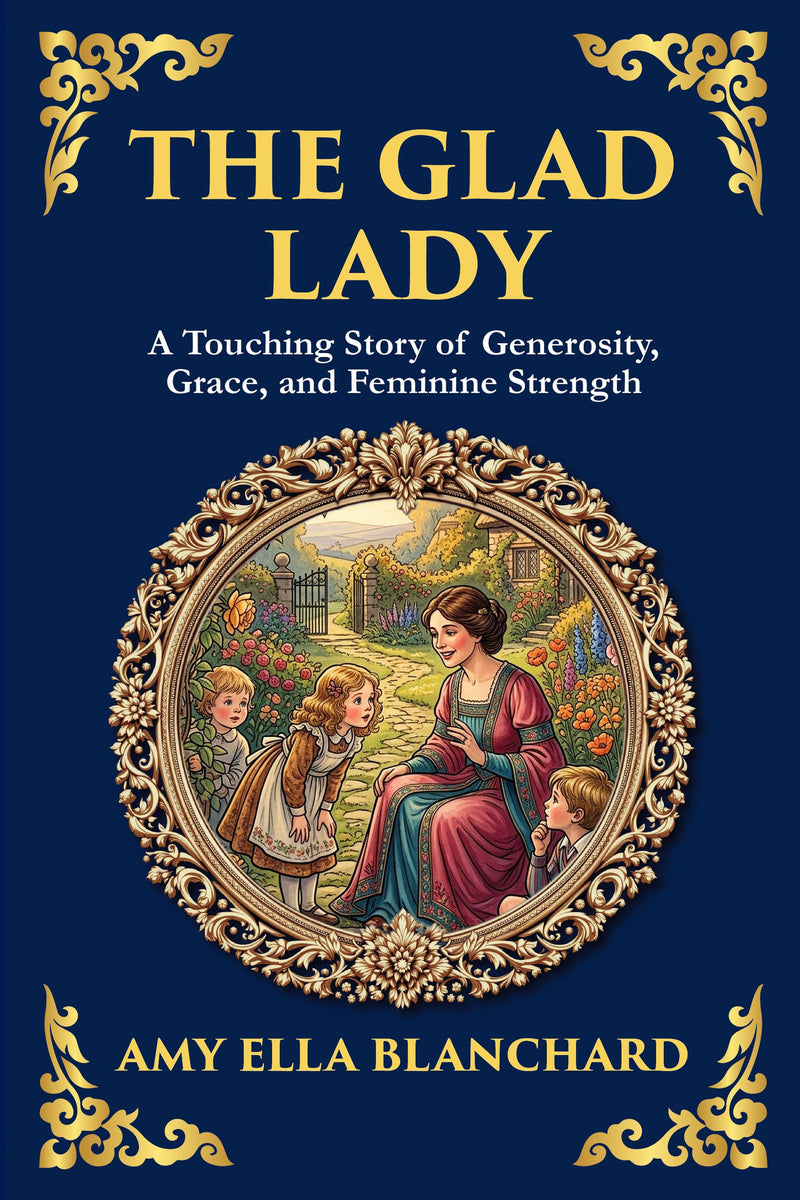
The Glad Lady — Large Print
In a quiet town where appearances often mask true character, one woman’s radiant kindness and quiet strength shine through adversity.
or free app
10,000+ hrs library
30-day guarantee
The complete The Glad Lady appears in modern English through Library of Alexandria Press, available online with audiobook narration included for members.
Have you ever wondered why quiet kindness can be more powerful than grand gestures? In The Glad Lady, Amy Ella Blanchard presents a tender and unforgettable portrait of a woman whose joy, strength, and grace ripple through the lives of those around her. At the heart of the story is a seemingly unremarkable lady whose cheerful disposition and quiet acts of kindness defy society’s expectations.
Her presence, though unassuming, has a profound effect on friends and strangers alike. Through moments of subtle tension, personal sacrifice, and gentle resilience, The Glad Lady reveals how true strength lies not in confrontation, but in the courage to be consistently kind. This beautifully written novel celebrates the power of empathy, the value of sincerity, and the quiet dignity of women who uplift the world in quiet ways.
Whether read as an inspiring character study or a nostalgic glimpse into turn-of-the-century life, this modern re-release will leave readers moved and deeply enriched.
What you’ll discover in this modern edition
- A Story of Unshakable Kindness Follow a woman whose every act radiates compassion, reminding us of the enduring power of good will.
- Feminine Strength Through Grace Discover how inner resolve, grace, and empathy can challenge expectations and heal hearts.
- Everyday Heroism and Selflessness Witness how a simple life lived with integrity can become extraordinary through quiet action.
- A Glimpse Into a Gentler Era Step into a nostalgic world where dignity, manners, and heart still rule the day.
- A Classic Reimagined for Modern Readers This updated edition maintains the charm and warmth of Blanchard’s original text while inviting new generations to experience her timeless wisdom.
| Formats | eBook (EPUB + PDF) · Audiobook · Paperback · Hardcover · Large Print |
| Language | English |
| Trim size (print) | 6 × 9 in |
| Binding | Paperback — perfect-bound · Hardcover — casewrap |
| Large Print edition | Same text in a larger, easy-read type — a larger font, not a larger trim |
| Print pricing | Every physical book at our true cost — at-cost, no profit (members) |
| Library | 873 restored titles, always growing |
| Length | 65,512 words · ~4 hr 22 min reading |
| Reading level | Grade 7 · an easy, flowing read (this modern-English edition) |
| Edition | Modern English translation · 2026 |
Member reviews for this edition are collected as readers finish it — be the first. Across the library: 12,000+ books shipped, every plan covered by a 365-day print guarantee.
About this edition
A faithful, unabridged modern-English edition by The Library of Alexandria — carefully rendered for today's reader and verified paragraph-by-paragraph against the public-domain source. Available as eBook, audiobook, paperback, hardcover, and large print.
- Complete & unabridgedVerified paragraph by paragraph against the source — never a scan, never abridged.
- Modern English, faithfulReadable today, with the author’s meaning kept intact. Readable — not simplified.
- Every format, one membershipRead in your browser or the free app, or listen to the full audiobook.
Included free with your membership
Cancel anytime, one click · 30-day money-back guarantee
Edition last updated July 2026
What’s inside
The Glad Lady — Large Print — complete and unabridged: all 21 sections included with membership, plus the full audiobook.
Begin reading The Glad Lady — Large Print
In clear modern English — the complete text is included with membership.
Introduction
There is a particular kind of story that seems to belong to no single era. It rises out of the warmth of human feeling, the small daily acts of generosity that knit communities together, and the quiet courage of people—often women—who choose to meet hardship with grace rather than bitterness. The Glad Lady is one of these stories. Written by Amy Ella Blanchard, an author whose career spanned the late nineteenth and early twentieth centuries, it carries within it the gentle moral clarity of its age while speaking to concerns that remain entirely familiar to us: how we treat one another, how we endure loss, how we find joy in circumstances that might just as easily crush us, and how the strength of a single steadfast heart can ripple outward to change the lives of everyone it touches.
This edition presents Blanchard’s work in a modern translation, carefully adapted for the contemporary reader. That phrase deserves a word of explanation before we go further, because the experience you are about to have differs in important ways from reading the original text exactly as it first appeared. The aim of this adaptation has never been to alter the soul of the book or to rewrite Blanchard’s intentions. Rather, it has been to smooth the path between her century and ours—to gently update phrasings, modernize certain constructions, and clarify expressions that, while perfectly natural to readers of her own time, might today cause a modern reader to stumble or pause unnecessarily. The result is a reading experience that flows with the ease we now expect, while preserving the tenderness, the humor, and the moral seriousness that made Blanchard a beloved writer in her day. You will find the story’s heart entirely intact. What has changed is only the occasional scaffolding of language, adjusted so that nothing stands between you and the emotional currents the author worked so hard to create.
To understand why this story rewards a reader’s attention, it helps to know something of the woman who wrote it and the literary world she inhabited. Amy Ella Blanchard was an American author who wrote prolifically across several decades, producing a remarkable body of fiction that ranged from books for young children to novels intended for adult and family audiences. She belonged to a generation of writers who took seriously the idea that fiction could instruct as well as delight—that a story might do more than merely entertain, that it might shape character, encourage kindness, and offer readers a moral compass dressed in the appealing clothing of narrative.
This was not a heavy-handed enterprise in Blanchard’s hands. She possessed a light touch, an evident affection for her characters, and an instinct for the kind of warm domestic detail that makes a fictional household feel like a real place one might wish to visit. Her stories often unfold in settings where the ordinary rhythms of life—meals shared, gardens tended, neighbors greeted, small kindnesses exchanged—form the backdrop against which larger questions of love, duty, and resilience are explored. There is a coziness to her fictional worlds that should not be mistaken for triviality. Beneath the gentle surface, Blanchard was deeply interested in the inner lives of her characters, particularly the women, and in the ways that emotional and moral strength express themselves not through grand gestures but through patient, consistent goodness.
The era in which she wrote was one of enormous change for women in America and beyond. The decades surrounding the turn of the twentieth century saw shifting ideas about a woman’s place in the home and the wider world, about education, about independence, about the kinds of work and influence women might claim as their own. Blanchard’s fiction reflects these currents in its own quiet way. Her female characters are rarely passive ornaments. They are active agents in their own lives and in the lives of those around them—solving problems, providing comfort, holding families and communities together, and modeling a form of strength that the culture of the time often overlooked or undervalued precisely because it was expressed through warmth rather than force.
The subtitle of this edition—A Moving Story of Kindness, Grace, and Women’s Strength—captures these themes with admirable precision. They are not incidental to the book; they are its very substance. Kindness, in Blanchard’s vision, is not weakness but a deliberate choice, often a difficult one, requiring more courage than cruelty ever does. Grace is the quality that allows a person to bear disappointment, injustice, or sorrow without being diminished by it. And women’s strength, in this story as in so much of Blanchard’s work, is the quiet engine that drives the narrative forward, demonstrating again and again that the most enduring forms of power are those rooted in love, patience, and an unwavering commitment to doing right.
It is worth noting, too, that Blanchard wrote in a tradition that prized clarity, sentiment, and a certain moral generosity toward both characters and readers. This was the age of writers who believed that literature ought to leave its audience better than it found them—not through preaching, but through the gentle persuasion of a story well told. Readers familiar with the comfort and emotional satisfaction of authors such as Louisa May Alcott, Kate Douglas Wiggin, or Eleanor H. Porter will find in Blanchard a kindred spirit. Her work occupies that warm and welcoming corner of literary history where the home is a sanctuary, where goodness is rewarded not always with material gain but with the deeper currency of love and belonging, and where the reader is invited to believe, if only for the duration of the book, that human beings are capable of remarkable tenderness toward one another.
The very title—The Glad Lady—announces the spirit of the work. Gladness here is not naïve cheerfulness, nor a refusal to acknowledge the difficulties of life. It is something far more substantial: a chosen disposition, a way of facing the world that finds light even in shadowed places and that radiates outward to lift the spirits of others. To be glad, in the sense the title intends, is to possess a kind of inner wealth that no external misfortune can entirely take away. This is one of the oldest and most resilient ideas in human thought, and Blanchard explores it here with a delicacy and conviction that make it feel newly minted.
When a book has survived for a century or more, it accumulates a certain patina of distance. The language of its original moment, however beautiful, can begin to feel like a barrier rather than a window. Sentence structures that once seemed natural may strike a modern ear as ornate or roundabout. Vocabulary that was common in everyday speech may have faded from use. Cultural references and social assumptions that needed no explanation for the original audience may require a moment of mental translation for us. None of this diminishes the value of the original; it simply reflects the inevitable passage of time and the way language continually evolves.
This edition has been prepared with a clear and consistent philosophy: to honor the author’s voice while removing the unnecessary friction that can accumulate between a text and its modern readers. The adaptation involves the gentle modernization of phrasing, the smoothing of constructions that might otherwise slow the reader down, and careful attention to clarity throughout. Where the original might have employed a turn of phrase that has since become obscure, this version offers a more transparent equivalent. Where a sentence might have wound through several clauses in the leisurely manner of an earlier century’s prose, it has been shaped to move with greater ease. The goal at every turn has been to let the story breathe and to let its emotional power reach you unobstructed.
It is important to be candid about what this means for the reading experience, so that you can approach the book with appropriate expectations. This is not a scholarly edition reproducing every comma of the original manuscript for the purposes of academic study. Nor is it a wholesale rewriting that imposes contemporary sensibilities upon a story that belongs to another time. It occupies a thoughtful middle ground—a version intended above all for pleasure, for immersion, for the simple and profound joy of being carried away by a good story. The voice you will hear is recognizably Blanchard’s: the warmth, the humor, the moral seriousness, the affection for her characters. But that voice now speaks in a register that the modern ear receives more readily, allowing the listening to become effortless and the feeling to come through whole.
Readers who care deeply about historical authenticity may wonder whether something is lost in this process. It is a fair question, and the honest answer is that any adaptation involves trade-offs. What is gained is accessibility, flow, and the removal of obstacles that might otherwise discourage a reader from finishing—or even beginning—a worthy book. What is preserved is everything that matters most: the plot, the characters, the themes, the emotional arc, and the essential spirit of the original. The choice this edition makes is to prioritize the living connection between a reader and a story over the museum-piece preservation of every archaic detail. For those who wish to encounter Blanchard’s prose exactly as her contemporaries did, the original texts remain available and treasured. This edition offers something complementary: an invitation extended specifically to the reader of today, opening a door that might otherwise have remained closed.
There is a real virtue in this approach when it comes to a writer like Blanchard, whose gifts lay precisely in the realm of feeling and human connection rather than in dazzling verbal pyrotechnics. Her prose was never meant to call attention to itself. It was meant to serve the story, to draw the reader gently into the lives of her characters, and to create that sense of intimacy and trust that allows a reader to be genuinely moved. Because her writing was always in service of emotional clarity rather than stylistic complexity, it adapts beautifully to a modern register. The translation does not fight against the grain of her work; it works with it, amplifying exactly the qualities Blanchard herself prized most.
As you settle into the pages ahead, you may find it helpful to read with a certain generosity of spirit—the same generosity that animates the story itself. The values and rhythms of the world Blanchard depicts will sometimes differ from our own. The pace of life moves more slowly. The concerns of the characters may at times reflect the particular preoccupations of their era. But these differences are part of the pleasure. To enter an older story is to be granted a kind of time travel, a chance to inhabit a sensibility not quite our own and to discover, often with surprise, how much we still share with people who lived in circumstances so different from ours. The longing for love, the fear of loss, the hunger for belonging, the deep human need to be treated with kindness and to extend kindness in return—these things do not change. Blanchard understood them perfectly, and she wrote about them with a sincerity that survives every passage across the decades.
Themes That Endure and Why They Still Matter
The greatest stories are those that continue to find new readers in every generation because they speak to something permanent in human experience. The Glad Lady belongs to this category not because it is grand or sweeping in its ambitions, but because it is true—true to the textures of ordinary life, true to the workings of the human heart, and true to the conviction that goodness, however quiet, is the most powerful force a person can wield.
Consider first the theme of kindness, which runs through this book like a golden thread. We live in an age that often treats kindness as a soft virtue, secondary to ambition, cleverness, or success. Blanchard would have disagreed, and her story makes the case eloquently. In her vision, kindness is the very foundation upon which a meaningful life is built. It is what transforms a house into a home, a stranger into a friend, a moment of crisis into an opportunity for connection. The kindness depicted in these pages is never sentimental or easy; it costs something, it requires sacrifice, and it is often extended toward those who can offer nothing in return. This is kindness understood as a moral practice rather than a mere feeling—a discipline of the heart that must be cultivated and chosen again and again. In showing us this, the book offers a quiet rebuke to any worldview that mistakes hardness for strength, and it reminds us, in an age that badly needs reminding, that the small daily decencies we extend to one another are not trivial but the very stuff of a good life.
Cancel anytime, one click · 30-day money-back guarantee
Founding annual rate available now — your price locks for life when you join.
Not ready? Get this free chapter by email — read it anytime.
✓ Sent — check your inbox for The Glad Lady — Large Print.
Questions about The Glad Lady — Large Print
What is The Glad Lady about?
In a quiet town where appearances often mask true character, one woman’s radiant kindness and quiet strength shine through adversity. The Glad Lady tells the heartwarming tale of a gentle soul whose unwavering generosity touches the lives around her. In a world weighed down by hardship, her compassion becomes a beacon of hope, reminding us that grace and goodness can transform even the most ordinary lives.
Who wrote The Glad Lady?
The Glad Lady was written by Amy Ella Blanchard. This edition presents the complete work in clear modern English, faithfully rendered from the public-domain original by Library of Alexandria Press.
Is The Glad Lady free to read?
The opening chapter is free to read on this page. Members read and listen to the complete work — and the entire library — free, and can order any physical book at our true print cost.
How long is The Glad Lady?
21 chapters (~65,512 words) — about 4 hr 22 min of reading in this modern-English edition.
Is this an abridged version of The Glad Lady?
No. This is the complete, unabridged The Glad Lady, carefully rendered into clear modern English and verified paragraph-by-paragraph against the public-domain source — nothing is cut or summarised.
What formats does The Glad Lady come in?
The Glad Lady is available as eBook, paperback, hardcover and large print. eBook and audiobook are included with membership; printed editions ship at our true print cost.
Shipping & returns
Billing & membership
More from the library


Explore Romance
- As You Like It · William Shakespeare
- Anna Karenina · Leo Tolstoy
- A Midsummer Night’s Dream · William Shakespeare
- Romeo and Juliet · William Shakespeare
- Sonnets from the Portuguese · Elizabeth Barrett Browning
- Miss Primrose · Agnes Giberne
- The Gay Adventure: A Romance · Richard Bird
- The Belle of Bowling Green · Amelia E. Barr
- The Monk: A Romance · M. G. Lewis
- She · H. Rider Haggard
- The Mill on the Floss · George Eliot
- The Glad Lady · Amy Ella Blanchard
- The Red Lily — Complete · Anatole France
- The Blue Goose · Frank Lewis Nason
- The History of Sir Richard Calmady: A Romance · Lucas Malet
- The Quest of the Silver Fleece: A Novel · W. E. B. Du Bois
- The Love Letters of Mary Wollstonecraft to Gilbert Imlay · Mary Wollstonecraft
- Daddy-Long-Legs · Jean Webster
- The Age of Innocence · Edith Wharton
- The Portrait of a Lady — Volume 1 · Henry James
- Wuthering Heights · Emily Brontë
- The Lady of the Lake · Walter Scott
- Lady Chatterley’s Lover · D. H. Lawrence
- Jane Eyre: An Autobiography · Charlotte Brontë
- A Connecticut Yankee in King Arthur’s Court · Mark Twain
- Northanger Abbey · Jane Austen
- Mansfield Park · Jane Austen
- Anthem · Ayn Rand
- This Side of Paradise · F. Scott Fitzgerald
- Persuasion · Jane Austen
The Glad Lady — Large Print
The Glad Lady — Large Print
A Moving Story of Kindness, Grace, and Women's Strength
Amy Ella Blanchard
Contents
- Introduction
- Chapter 1
- Chapter 2
- Chapter 3
- Chapter 4
- Chapter 5
- Chapter 6
- Chapter 7
- Chapter 8
- Chapter 9
- Chapter 10
- Chapter 11
- Chapter 12
- Chapter 13
- Chapter 14
- Chapter 15
- Chapter 16
- Chapter 17
- Chapter 18
- Chapter 19
- Chapter 20
Introduction
There is a particular kind of story that seems to belong to no single era. It rises out of the warmth of human feeling, the small daily acts of generosity that knit communities together, and the quiet courage of people—often women—who choose to meet hardship with grace rather than bitterness. The Glad Lady is one of these stories. Written by Amy Ella Blanchard, an author whose career spanned the late nineteenth and early twentieth centuries, it carries within it the gentle moral clarity of its age while speaking to concerns that remain entirely familiar to us: how we treat one another, how we endure loss, how we find joy in circumstances that might just as easily crush us, and how the strength of a single steadfast heart can ripple outward to change the lives of everyone it touches.
This edition presents Blanchard’s work in a modern translation, carefully adapted for the contemporary reader. That phrase deserves a word of explanation before we go further, because the experience you are about to have differs in important ways from reading the original text exactly as it first appeared. The aim of this adaptation has never been to alter the soul of the book or to rewrite Blanchard’s intentions. Rather, it has been to smooth the path between her century and ours—to gently update phrasings, modernize certain constructions, and clarify expressions that, while perfectly natural to readers of her own time, might today cause a modern reader to stumble or pause unnecessarily. The result is a reading experience that flows with the ease we now expect, while preserving the tenderness, the humor, and the moral seriousness that made Blanchard a beloved writer in her day. You will find the story’s heart entirely intact. What has changed is only the occasional scaffolding of language, adjusted so that nothing stands between you and the emotional currents the author worked so hard to create.
To understand why this story rewards a reader’s attention, it helps to know something of the woman who wrote it and the literary world she inhabited. Amy Ella Blanchard was an American author who wrote prolifically across several decades, producing a remarkable body of fiction that ranged from books for young children to novels intended for adult and family audiences. She belonged to a generation of writers who took seriously the idea that fiction could instruct as well as delight—that a story might do more than merely entertain, that it might shape character, encourage kindness, and offer readers a moral compass dressed in the appealing clothing of narrative.
This was not a heavy-handed enterprise in Blanchard’s hands. She possessed a light touch, an evident affection for her characters, and an instinct for the kind of warm domestic detail that makes a fictional household feel like a real place one might wish to visit. Her stories often unfold in settings where the ordinary rhythms of life—meals shared, gardens tended, neighbors greeted, small kindnesses exchanged—form the backdrop against which larger questions of love, duty, and resilience are explored. There is a coziness to her fictional worlds that should not be mistaken for triviality. Beneath the gentle surface, Blanchard was deeply interested in the inner lives of her characters, particularly the women, and in the ways that emotional and moral strength express themselves not through grand gestures but through patient, consistent goodness.
The era in which she wrote was one of enormous change for women in America and beyond. The decades surrounding the turn of the twentieth century saw shifting ideas about a woman’s place in the home and the wider world, about education, about independence, about the kinds of work and influence women might claim as their own. Blanchard’s fiction reflects these currents in its own quiet way. Her female characters are rarely passive ornaments. They are active agents in their own lives and in the lives of those around them—solving problems, providing comfort, holding families and communities together, and modeling a form of strength that the culture of the time often overlooked or undervalued precisely because it was expressed through warmth rather than force.
The subtitle of this edition—A Moving Story of Kindness, Grace, and Women’s Strength—captures these themes with admirable precision. They are not incidental to the book; they are its very substance. Kindness, in Blanchard’s vision, is not weakness but a deliberate choice, often a difficult one, requiring more courage than cruelty ever does. Grace is the quality that allows a person to bear disappointment, injustice, or sorrow without being diminished by it. And women’s strength, in this story as in so much of Blanchard’s work, is the quiet engine that drives the narrative forward, demonstrating again and again that the most enduring forms of power are those rooted in love, patience, and an unwavering commitment to doing right.
It is worth noting, too, that Blanchard wrote in a tradition that prized clarity, sentiment, and a certain moral generosity toward both characters and readers. This was the age of writers who believed that literature ought to leave its audience better than it found them—not through preaching, but through the gentle persuasion of a story well told. Readers familiar with the comfort and emotional satisfaction of authors such as Louisa May Alcott, Kate Douglas Wiggin, or Eleanor H. Porter will find in Blanchard a kindred spirit. Her work occupies that warm and welcoming corner of literary history where the home is a sanctuary, where goodness is rewarded not always with material gain but with the deeper currency of love and belonging, and where the reader is invited to believe, if only for the duration of the book, that human beings are capable of remarkable tenderness toward one another.
The very title—The Glad Lady—announces the spirit of the work. Gladness here is not naïve cheerfulness, nor a refusal to acknowledge the difficulties of life. It is something far more substantial: a chosen disposition, a way of facing the world that finds light even in shadowed places and that radiates outward to lift the spirits of others. To be glad, in the sense the title intends, is to possess a kind of inner wealth that no external misfortune can entirely take away. This is one of the oldest and most resilient ideas in human thought, and Blanchard explores it here with a delicacy and conviction that make it feel newly minted.
When a book has survived for a century or more, it accumulates a certain patina of distance. The language of its original moment, however beautiful, can begin to feel like a barrier rather than a window. Sentence structures that once seemed natural may strike a modern ear as ornate or roundabout. Vocabulary that was common in everyday speech may have faded from use. Cultural references and social assumptions that needed no explanation for the original audience may require a moment of mental translation for us. None of this diminishes the value of the original; it simply reflects the inevitable passage of time and the way language continually evolves.
This edition has been prepared with a clear and consistent philosophy: to honor the author’s voice while removing the unnecessary friction that can accumulate between a text and its modern readers. The adaptation involves the gentle modernization of phrasing, the smoothing of constructions that might otherwise slow the reader down, and careful attention to clarity throughout. Where the original might have employed a turn of phrase that has since become obscure, this version offers a more transparent equivalent. Where a sentence might have wound through several clauses in the leisurely manner of an earlier century’s prose, it has been shaped to move with greater ease. The goal at every turn has been to let the story breathe and to let its emotional power reach you unobstructed.
It is important to be candid about what this means for the reading experience, so that you can approach the book with appropriate expectations. This is not a scholarly edition reproducing every comma of the original manuscript for the purposes of academic study. Nor is it a wholesale rewriting that imposes contemporary sensibilities upon a story that belongs to another time. It occupies a thoughtful middle ground—a version intended above all for pleasure, for immersion, for the simple and profound joy of being carried away by a good story. The voice you will hear is recognizably Blanchard’s: the warmth, the humor, the moral seriousness, the affection for her characters. But that voice now speaks in a register that the modern ear receives more readily, allowing the listening to become effortless and the feeling to come through whole.
Readers who care deeply about historical authenticity may wonder whether something is lost in this process. It is a fair question, and the honest answer is that any adaptation involves trade-offs. What is gained is accessibility, flow, and the removal of obstacles that might otherwise discourage a reader from finishing—or even beginning—a worthy book. What is preserved is everything that matters most: the plot, the characters, the themes, the emotional arc, and the essential spirit of the original. The choice this edition makes is to prioritize the living connection between a reader and a story over the museum-piece preservation of every archaic detail. For those who wish to encounter Blanchard’s prose exactly as her contemporaries did, the original texts remain available and treasured. This edition offers something complementary: an invitation extended specifically to the reader of today, opening a door that might otherwise have remained closed.
There is a real virtue in this approach when it comes to a writer like Blanchard, whose gifts lay precisely in the realm of feeling and human connection rather than in dazzling verbal pyrotechnics. Her prose was never meant to call attention to itself. It was meant to serve the story, to draw the reader gently into the lives of her characters, and to create that sense of intimacy and trust that allows a reader to be genuinely moved. Because her writing was always in service of emotional clarity rather than stylistic complexity, it adapts beautifully to a modern register. The translation does not fight against the grain of her work; it works with it, amplifying exactly the qualities Blanchard herself prized most.
As you settle into the pages ahead, you may find it helpful to read with a certain generosity of spirit—the same generosity that animates the story itself. The values and rhythms of the world Blanchard depicts will sometimes differ from our own. The pace of life moves more slowly. The concerns of the characters may at times reflect the particular preoccupations of their era. But these differences are part of the pleasure. To enter an older story is to be granted a kind of time travel, a chance to inhabit a sensibility not quite our own and to discover, often with surprise, how much we still share with people who lived in circumstances so different from ours. The longing for love, the fear of loss, the hunger for belonging, the deep human need to be treated with kindness and to extend kindness in return—these things do not change. Blanchard understood them perfectly, and she wrote about them with a sincerity that survives every passage across the decades.
Themes That Endure and Why They Still Matter
The greatest stories are those that continue to find new readers in every generation because they speak to something permanent in human experience. The Glad Lady belongs to this category not because it is grand or sweeping in its ambitions, but because it is true—true to the textures of ordinary life, true to the workings of the human heart, and true to the conviction that goodness, however quiet, is the most powerful force a person can wield.
Consider first the theme of kindness, which runs through this book like a golden thread. We live in an age that often treats kindness as a soft virtue, secondary to ambition, cleverness, or success. Blanchard would have disagreed, and her story makes the case eloquently. In her vision, kindness is the very foundation upon which a meaningful life is built. It is what transforms a house into a home, a stranger into a friend, a moment of crisis into an opportunity for connection. The kindness depicted in these pages is never sentimental or easy; it costs something, it requires sacrifice, and it is often extended toward those who can offer nothing in return. This is kindness understood as a moral practice rather than a mere feeling—a discipline of the heart that must be cultivated and chosen again and again. In showing us this, the book offers a quiet rebuke to any worldview that mistakes hardness for strength, and it reminds us, in an age that badly needs reminding, that the small daily decencies we extend to one another are not trivial but the very stuff of a good life.
The different members of the group finally came together in San Sebastian. When apart, they were as different from one another as the separate elements in a chemical compound. The group was led by Dr. Juan Estradas. As a young man, he had rushed off to fight in the war in Cuba, later moved to the United States to study medicine, and married an American woman, referred to in this story as Doña Martina. The third person was Don Tomás, the doctor’s younger brother. Since he had never left Spain, he spoke only Spanish, unless you count the phrases “Shocking” and “Awful badth form” as evidence of his English skills. The fourth member was Miss Patience Blake, better known as Patty, Doña Martina’s pretty sister. Finally, the group was completed by Paulette Delambre, a former schoolmate of Patty’s.
The two girls had recently arrived from a convent in France. There, they had studied subjects deemed useful for young women: a bit of embroidery, some music, and watercolor painting; in Patty’s case, French was also added to the list. Neither girl knew more than three words of Spanish, so they usually spoke to each other in French, even though Paulette spoke English quite well. They had just reached their hotel. Patty was feeling frustrated because the customs officers at Irun had spent so much time searching their luggage that they almost missed their train; moreover, the officers had questioned why they had so many new dresses.
“They actually questioned whether I was telling the truth,” she told her sister, “and it didn’t help that someone suggested they probably thought we were dressmakers. I want to know, do we actually look like dressmakers? I wish we had never visited your stupid old Spain.”
End of the free sample
Keep reading, free
Members read and listen to the complete book — and the entire library. Cancel anytime, one click · 30-day money-back guarantee.