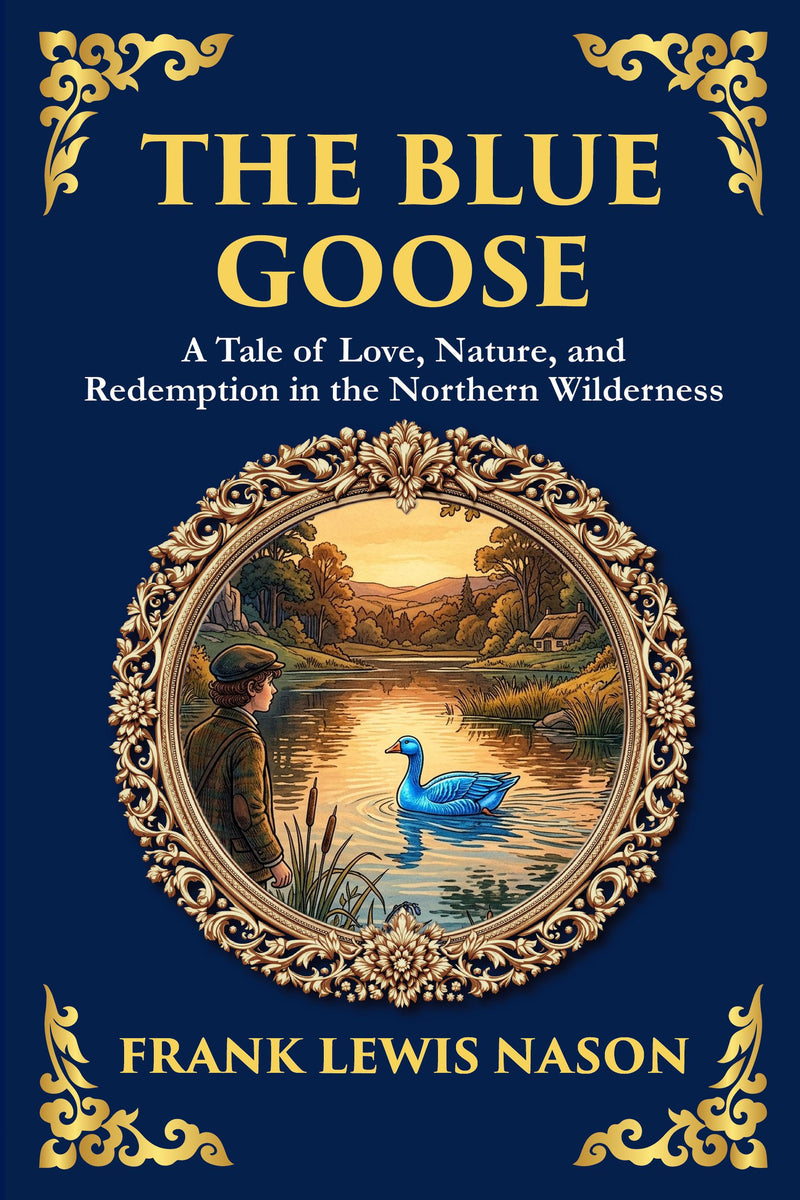
The Blue Goose — Large Print
Set in the untamed wilds of the northern frontier, The Blue Goose is a stirring tale of love, transformation, and the quiet power of nature.
or free app
10,000+ hrs library
30-day guarantee
The complete The Blue Goose appears in modern English through Library of Alexandria Press, available online with audiobook narration included for members.
Have you ever wondered why the wild can reveal the truest parts of ourselves? In The Blue Goose, Frank Lewis Nason presents a hauntingly beautiful story set against the vast, untouched backdrop of the northern wilderness. At its center is Carl—an introspective naturalist who has turned his back on society to study the elusive and majestic blue goose.
Living in solitude, his days are spent in communion with the rhythms of the natural world… until a chance encounter with Hilda, a resilient and passionate young woman, shatters his quiet existence. What begins as mutual curiosity blossoms into something deeper, even as past regrets and the wild’s unforgiving conditions test the fragile peace they begin to build. Part love story, part exploration of identity and redemption, this novel captures the spiritual intimacy of the natural world in a way few works dare to attempt.
What you’ll discover in this modern edition
- A Quiet Yet Powerful Love Story – Watch two unlikely souls connect in the unlikeliest of places
| Formats | eBook (EPUB + PDF) · Audiobook · Paperback · Hardcover · Large Print |
| Language | English |
| Trim size (print) | 6 × 9 in |
| Binding | Paperback — perfect-bound · Hardcover — casewrap |
| Large Print edition | Same text in a larger, easy-read type — a larger font, not a larger trim |
| Print pricing | Every physical book at our true cost — at-cost, no profit (members) |
| Library | 873 restored titles, always growing |
| Length | 60,992 words · ~4 hr 4 min reading |
| Reading level | Grade 7 · an easy, flowing read (this modern-English edition) |
| Edition | Modern English translation · 2026 |
Member reviews for this edition are collected as readers finish it — be the first. Across the library: 12,000+ books shipped, every plan covered by a 365-day print guarantee.
About this edition
A faithful, unabridged modern-English edition by The Library of Alexandria — carefully rendered for today's reader and verified paragraph-by-paragraph against the public-domain source. Available as eBook, audiobook, paperback, hardcover, and large print.
- Complete & unabridgedVerified paragraph by paragraph against the source — never a scan, never abridged.
- Modern English, faithfulReadable today, with the author’s meaning kept intact. Readable — not simplified.
- Every format, one membershipRead in your browser or the free app, or listen to the full audiobook.
Included free with your membership
Cancel anytime, one click · 30-day money-back guarantee
Edition last updated July 2026
What’s inside
The Blue Goose — Large Print — complete and unabridged: all 28 sections included with membership, plus the full audiobook.
Begin reading The Blue Goose — Large Print
In clear modern English — the complete text is included with membership.
Introduction
There are certain books that seem to carry the scent of the places they describe. Open their pages and you can almost smell the pine resin and cold mountain air, hear the distant clatter of machinery against rock, feel the grit of ore dust on your fingertips. The novel you are about to read belongs to this rare category. It is a work rooted so firmly in a particular landscape, and so deeply concerned with the moral weather of the human soul, that it transcends the simple category of “adventure fiction” to become something more enduring: a meditation on integrity, ambition, and the quiet redemptive power of love set against the unforgiving grandeur of the American mining frontier.
Frank Lewis Nason wrote at the turn of the twentieth century, a period when the United States was still wrestling with the meaning of its own expansion. The great western mining booms had reshaped the map of the continent, drawing engineers, speculators, laborers, and dreamers into the high country in search of fortune. Out of that turbulent world Nason fashioned a story that is at once intimate and elemental—a tale of a single mining community, the men who run it, the woman whose presence transforms it, and the moral reckoning that comes when honesty and corruption are forced to share the same narrow valley. This modern translation and adaptation has been prepared with great care to bring that world vividly to a contemporary reader, smoothing the archaisms of the original prose while preserving the integrity of its vision, its characters, and the particular flavor of its setting.
Before you begin, it is worth pausing to consider what makes this book special, and why it rewards the patient, attentive reader. What follows is intended not to summarize the plot—which deserves to unfold with all its surprises intact—but to prepare you for the experience, to sharpen your senses for what lies ahead, and to deepen your appreciation of the craftsmanship at work in these pages.
To understand this novel, it helps to understand the unusual man who wrote it. Frank Lewis Nason was not a professional novelist in the ordinary sense, dreaming up his settings from the comfort of a study. He was a trained geologist and mining engineer, a man who had walked the very kind of terrain he describes, who had examined ore samples under the lamp, who had known the camaraderie and the rivalries of mining camps firsthand. This professional background gives his fiction a texture and authority that few writers of his era could match. When his characters speak of assays and ledges, of stamp mills and tailings, of the chemistry of separating valuable metal from worthless rock, they are speaking a language their author knew intimately. The result is a kind of authenticity that cannot be faked—a sense that the world of the book is not a stage set but a living, working place.
Yet Nason was far more than a technical writer transcribing what he knew. He possessed a genuine literary imagination and a moral seriousness that elevated his work above mere documentary detail. He was fascinated by the way character is revealed under pressure, by the contest between the man who does honest work and the man who cuts corners, by the way a single individual’s integrity can either ennoble or poison the community around him. In the mining camp he found the perfect crucible for these themes. Here was a place where money and danger were intimately mixed, where the difference between an honest report and a dishonest one could mean the difference between a fortune and a ruin, where men were tested daily by the temptations of greed and the demands of duty.
Nason wrote during what we now call the Progressive Era, a time of intense national soul-searching about the ethics of business, the responsibilities of the powerful, and the rights of ordinary working people. The great industrial enterprises of the late nineteenth century had produced enormous wealth, but they had also produced exploitation, deception, and corruption on a scale that troubled many thoughtful Americans. Writers of the period increasingly turned their attention to these problems, and Nason was very much a part of this movement. His fiction reflects a deep concern with the question of how a person ought to behave in a world where the easy path and the right path so often diverge. The mining setting, with its mingled possibilities of honest labor and fraudulent scheming, allowed him to dramatize this question with unusual force.
It is also worth remembering the role that nature plays in Nason’s imagination. The mountains of his fiction are never merely a backdrop. They are a presence, a force, almost a character in their own right. The high peaks, the snow-fed streams, the deep forests and exposed rock faces—these are rendered with the loving precision of a man who understood the geology beneath the beauty and loved the beauty all the more for that understanding. In Nason’s work, the natural world stands as a kind of moral standard, a vast and indifferent witness to the small human dramas played out in its shadow. The honesty of the mountains, their refusal to lie about what they contain, serves as a quiet rebuke to the dishonesty of certain men. This interplay between the human and the natural, between moral and physical landscape, is one of the deepest pleasures the book has to offer.
The subtitle of this edition—“A Story of Love, Nature, and Redemption in the Northern Wilderness”—captures these three great threads with admirable economy. Love, in its various forms, runs through the narrative as a transforming power. Nature presides over everything, beautiful and unyielding. And redemption—the possibility that a person who has fallen, or who has been falsely judged, might be restored to wholeness and honor—gives the story its emotional and spiritual center. To read this book is to watch these three forces work upon one another, and upon the men and women caught in their currents.
The Craft of the Story and What to Watch for
One of the great rewards of approaching an older novel with fresh attention is discovering how skillfully its author built it. Nason was a careful craftsman, and the architecture of this story repays close reading. He understood that suspense in fiction need not come only from external dangers—though there are dangers enough in these pages—but can arise just as powerfully from moral uncertainty, from the reader’s growing investment in the fate of characters whose true natures are slowly revealed. As you read, pay attention to the way Nason withholds and discloses information, the way he lets you form impressions of his characters and then complicates those impressions, the way appearances and realities are made to diverge.
The central tension of the book turns on the contrast between two kinds of men: those who work and report honestly, and those who scheme and deceive. This sounds simple, perhaps even simplistic, but Nason is too good a writer to let it remain so. He understood that the line between honesty and dishonesty runs not only between people but through them, that good men can be tempted and weak men can rise, that the truth is sometimes obscured by misunderstanding rather than malice. Watch how the various characters respond to pressure, to opportunity, to suspicion. Watch how reputation—that fragile, precious thing—is built up and torn down, often unjustly. One of the most affecting dimensions of the story is its concern with the way a person can be wrongly judged, can carry the weight of an unearned bad name, and can endure that injustice with dignity while waiting for the truth to emerge.
The setting of the mining camp serves Nason’s purposes beautifully. A mine is a place of secrets. What lies hidden in the rock is unknown until it is dug out and tested; the value of a claim depends on information that only a few possess, and that information can be honestly reported or fraudulently manipulated. This makes the mine a natural arena for stories of trust and betrayal, of knowledge and ignorance, of the conflict between those who deal in truth and those who deal in lies. The “blue goose” of the title—a name whose full significance you will discover in the reading—becomes a kind of gathering point for these tensions, a place where the moral currents of the community swirl and collide.
Notice, too, how Nason handles the social world of the camp. A mining community in the high country was a peculiar society, isolated from the larger world, governed by its own codes and hierarchies, populated by people of widely varying backgrounds thrown together by the common pursuit of metal and money. There are the managers and engineers, educated men with responsibilities and reputations to protect. There are the laborers, often immigrants, whose hard and dangerous work makes the whole enterprise possible. There are the figures who occupy the margins of respectable society, dealing in vice and easy profit. And into this world comes the feminine presence whose arrival changes the moral atmosphere of the place—for in Nason’s vision, as in much fiction of his era, the coming of a woman of grace and goodness has the power to soften, civilize, and redeem the rough masculine world of the frontier. The love story that develops is handled with restraint and tenderness, and it is woven so tightly into the larger themes of the book that it never feels like a mere romantic interlude but rather an essential part of the whole moral design.
The pacing of the novel is worth a word as well. Readers accustomed to the breathless rhythms of contemporary fiction may find that Nason takes his time, building his world and his characters with deliberate care before the central conflicts come to their crisis. This is not a flaw but a virtue. The slow accumulation of detail, the gradual deepening of our acquaintance with the people of the camp, makes the eventual reckoning all the more powerful. Give yourself over to the rhythm of the book. Let the world settle around you. Allow yourself to feel the isolation of the mountain valley, the weight of the long days of labor, the slow turning of the seasons. The patience the book asks of you is richly repaid.
This modern translation has been undertaken with a clear and respectful purpose: to remove the barriers that might otherwise stand between a contemporary reader and the genuine pleasures of the story. The English of Nason’s original, while often vivid and graceful, carries the marks of its time—certain turns of phrase, certain rhythms of sentence construction, certain conventions of dialogue that can feel stiff or distant to a modern ear. Technical terms from the world of mining, once familiar to a broad readership, have grown obscure with the passing of more than a century. The aim of this adaptation has been to clarify and freshen the language, to make the prose flow naturally for today’s reader, while preserving everything that gives the book its distinctive character—its moral seriousness, its sense of place, its memorable characters, and the essential shape of its story. Nothing of importance has been lost; rather, the dust has been gently cleared away so that the original brightness can shine through. Readers who come to this edition can be confident that they are encountering the true substance of Nason’s work, made accessible without being diminished.
It is also worth dwelling, before you begin, on the particular emotional register of the book. There is in Nason’s writing a quality of moral earnestness that may strike the modern reader as old-fashioned, but which, given a chance, proves deeply moving. He believed—and his fiction insists—that character matters, that honesty matters, that the way a person conducts himself when no one is watching is the truest measure of his worth. In our own age, which can be cynical about such things, there is something bracing and even comforting about a story that takes virtue seriously without being naive about the obstacles it faces. Nason knew that the honest path is often the hard one, that good people suffer unjustly, that corruption frequently wears the mask of respectability. But he also believed in the eventual triumph of truth, in the possibility of redemption, in the power of love and integrity to prevail. This is the faith that animates the book, and it gives the story a warmth and hopefulness that lingers long after the final page.
Cancel anytime, one click · 30-day money-back guarantee
Founding annual rate available now — your price locks for life when you join.
Not ready? Get this free chapter by email — read it anytime.
✓ Sent — check your inbox for The Blue Goose — Large Print.
Questions about The Blue Goose — Large Print
What is The Blue Goose about?
Set in the untamed wilds of the northern frontier, The Blue Goose is a stirring tale of love, transformation, and the quiet power of nature. When a reclusive ornithologist retreats to study a rare and beautiful goose, he finds himself unexpectedly entangled with a spirited woman whose presence challenges his solitude—and awakens his heart. With poetic prose and an immersive portrayal of wilderness life, Frank Lewis Nason weaves a lyrical novel where man, nature, and the soul converge.
Who wrote The Blue Goose?
The Blue Goose was written by Frank Lewis Nason. This edition presents the complete work in clear modern English, faithfully rendered from the public-domain original by Library of Alexandria Press.
Is The Blue Goose free to read?
The opening chapter is free to read on this page. Members read and listen to the complete work — and the entire library — free, and can order any physical book at our true print cost.
How long is The Blue Goose?
28 chapters (~60,992 words) — about 4 hr 4 min of reading in this modern-English edition.
Is this an abridged version of The Blue Goose?
No. This is the complete, unabridged The Blue Goose, carefully rendered into clear modern English and verified paragraph-by-paragraph against the public-domain source — nothing is cut or summarised.
What formats does The Blue Goose come in?
The Blue Goose is available as eBook, paperback, hardcover and large print. eBook and audiobook are included with membership; printed editions ship at our true print cost.
Shipping & returns
Billing & membership
More from the library


Explore Romance
- As You Like It · William Shakespeare
- Anna Karenina · Leo Tolstoy
- A Midsummer Night’s Dream · William Shakespeare
- Romeo and Juliet · William Shakespeare
- Sonnets from the Portuguese · Elizabeth Barrett Browning
- Miss Primrose · Agnes Giberne
- The Gay Adventure: A Romance · Richard Bird
- The Belle of Bowling Green · Amelia E. Barr
- The Monk: A Romance · M. G. Lewis
- She · H. Rider Haggard
- The Mill on the Floss · George Eliot
- The Glad Lady · Amy Ella Blanchard
- The Red Lily — Complete · Anatole France
- The Blue Goose · Frank Lewis Nason
- The History of Sir Richard Calmady: A Romance · Lucas Malet
- The Quest of the Silver Fleece: A Novel · W. E. B. Du Bois
- The Love Letters of Mary Wollstonecraft to Gilbert Imlay · Mary Wollstonecraft
- Daddy-Long-Legs · Jean Webster
- The Age of Innocence · Edith Wharton
- The Portrait of a Lady — Volume 1 · Henry James
- Wuthering Heights · Emily Brontë
- The Lady of the Lake · Walter Scott
- Lady Chatterley’s Lover · D. H. Lawrence
- Jane Eyre: An Autobiography · Charlotte Brontë
- A Connecticut Yankee in King Arthur’s Court · Mark Twain
- Northanger Abbey · Jane Austen
- Mansfield Park · Jane Austen
- Anthem · Ayn Rand
- This Side of Paradise · F. Scott Fitzgerald
- Persuasion · Jane Austen
The Blue Goose — Large Print
The Blue Goose — Large Print
A Story of Love, Nature, and Redemption in the Northern Wilderness
Frank Lewis Nason
Contents
- Introduction
- Chapter 1
- Chapter 2
- Chapter 3
- Chapter 4
- Chapter 5
- Chapter 6
- Chapter 7
- Chapter 8
- Chapter 9
- Chapter 10
- Chapter 11
- Chapter 12
- Chapter 13
- Chapter 14
- Chapter 15
- Chapter 16
- Chapter 17
- Chapter 18
- Chapter 19
- Chapter 20
- Chapter 21
- Chapter 22
- Chapter 23
- Chapter 24
- Chapter 25
- Chapter 26
- Chapter 27
Introduction
There are certain books that seem to carry the scent of the places they describe. Open their pages and you can almost smell the pine resin and cold mountain air, hear the distant clatter of machinery against rock, feel the grit of ore dust on your fingertips. The novel you are about to read belongs to this rare category. It is a work rooted so firmly in a particular landscape, and so deeply concerned with the moral weather of the human soul, that it transcends the simple category of “adventure fiction” to become something more enduring: a meditation on integrity, ambition, and the quiet redemptive power of love set against the unforgiving grandeur of the American mining frontier.
Frank Lewis Nason wrote at the turn of the twentieth century, a period when the United States was still wrestling with the meaning of its own expansion. The great western mining booms had reshaped the map of the continent, drawing engineers, speculators, laborers, and dreamers into the high country in search of fortune. Out of that turbulent world Nason fashioned a story that is at once intimate and elemental—a tale of a single mining community, the men who run it, the woman whose presence transforms it, and the moral reckoning that comes when honesty and corruption are forced to share the same narrow valley. This modern translation and adaptation has been prepared with great care to bring that world vividly to a contemporary reader, smoothing the archaisms of the original prose while preserving the integrity of its vision, its characters, and the particular flavor of its setting.
Before you begin, it is worth pausing to consider what makes this book special, and why it rewards the patient, attentive reader. What follows is intended not to summarize the plot—which deserves to unfold with all its surprises intact—but to prepare you for the experience, to sharpen your senses for what lies ahead, and to deepen your appreciation of the craftsmanship at work in these pages.
To understand this novel, it helps to understand the unusual man who wrote it. Frank Lewis Nason was not a professional novelist in the ordinary sense, dreaming up his settings from the comfort of a study. He was a trained geologist and mining engineer, a man who had walked the very kind of terrain he describes, who had examined ore samples under the lamp, who had known the camaraderie and the rivalries of mining camps firsthand. This professional background gives his fiction a texture and authority that few writers of his era could match. When his characters speak of assays and ledges, of stamp mills and tailings, of the chemistry of separating valuable metal from worthless rock, they are speaking a language their author knew intimately. The result is a kind of authenticity that cannot be faked—a sense that the world of the book is not a stage set but a living, working place.
Yet Nason was far more than a technical writer transcribing what he knew. He possessed a genuine literary imagination and a moral seriousness that elevated his work above mere documentary detail. He was fascinated by the way character is revealed under pressure, by the contest between the man who does honest work and the man who cuts corners, by the way a single individual’s integrity can either ennoble or poison the community around him. In the mining camp he found the perfect crucible for these themes. Here was a place where money and danger were intimately mixed, where the difference between an honest report and a dishonest one could mean the difference between a fortune and a ruin, where men were tested daily by the temptations of greed and the demands of duty.
Nason wrote during what we now call the Progressive Era, a time of intense national soul-searching about the ethics of business, the responsibilities of the powerful, and the rights of ordinary working people. The great industrial enterprises of the late nineteenth century had produced enormous wealth, but they had also produced exploitation, deception, and corruption on a scale that troubled many thoughtful Americans. Writers of the period increasingly turned their attention to these problems, and Nason was very much a part of this movement. His fiction reflects a deep concern with the question of how a person ought to behave in a world where the easy path and the right path so often diverge. The mining setting, with its mingled possibilities of honest labor and fraudulent scheming, allowed him to dramatize this question with unusual force.
It is also worth remembering the role that nature plays in Nason’s imagination. The mountains of his fiction are never merely a backdrop. They are a presence, a force, almost a character in their own right. The high peaks, the snow-fed streams, the deep forests and exposed rock faces—these are rendered with the loving precision of a man who understood the geology beneath the beauty and loved the beauty all the more for that understanding. In Nason’s work, the natural world stands as a kind of moral standard, a vast and indifferent witness to the small human dramas played out in its shadow. The honesty of the mountains, their refusal to lie about what they contain, serves as a quiet rebuke to the dishonesty of certain men. This interplay between the human and the natural, between moral and physical landscape, is one of the deepest pleasures the book has to offer.
The subtitle of this edition—“A Story of Love, Nature, and Redemption in the Northern Wilderness”—captures these three great threads with admirable economy. Love, in its various forms, runs through the narrative as a transforming power. Nature presides over everything, beautiful and unyielding. And redemption—the possibility that a person who has fallen, or who has been falsely judged, might be restored to wholeness and honor—gives the story its emotional and spiritual center. To read this book is to watch these three forces work upon one another, and upon the men and women caught in their currents.
The Craft of the Story and What to Watch for
One of the great rewards of approaching an older novel with fresh attention is discovering how skillfully its author built it. Nason was a careful craftsman, and the architecture of this story repays close reading. He understood that suspense in fiction need not come only from external dangers—though there are dangers enough in these pages—but can arise just as powerfully from moral uncertainty, from the reader’s growing investment in the fate of characters whose true natures are slowly revealed. As you read, pay attention to the way Nason withholds and discloses information, the way he lets you form impressions of his characters and then complicates those impressions, the way appearances and realities are made to diverge.
The central tension of the book turns on the contrast between two kinds of men: those who work and report honestly, and those who scheme and deceive. This sounds simple, perhaps even simplistic, but Nason is too good a writer to let it remain so. He understood that the line between honesty and dishonesty runs not only between people but through them, that good men can be tempted and weak men can rise, that the truth is sometimes obscured by misunderstanding rather than malice. Watch how the various characters respond to pressure, to opportunity, to suspicion. Watch how reputation—that fragile, precious thing—is built up and torn down, often unjustly. One of the most affecting dimensions of the story is its concern with the way a person can be wrongly judged, can carry the weight of an unearned bad name, and can endure that injustice with dignity while waiting for the truth to emerge.
The setting of the mining camp serves Nason’s purposes beautifully. A mine is a place of secrets. What lies hidden in the rock is unknown until it is dug out and tested; the value of a claim depends on information that only a few possess, and that information can be honestly reported or fraudulently manipulated. This makes the mine a natural arena for stories of trust and betrayal, of knowledge and ignorance, of the conflict between those who deal in truth and those who deal in lies. The “blue goose” of the title—a name whose full significance you will discover in the reading—becomes a kind of gathering point for these tensions, a place where the moral currents of the community swirl and collide.
Notice, too, how Nason handles the social world of the camp. A mining community in the high country was a peculiar society, isolated from the larger world, governed by its own codes and hierarchies, populated by people of widely varying backgrounds thrown together by the common pursuit of metal and money. There are the managers and engineers, educated men with responsibilities and reputations to protect. There are the laborers, often immigrants, whose hard and dangerous work makes the whole enterprise possible. There are the figures who occupy the margins of respectable society, dealing in vice and easy profit. And into this world comes the feminine presence whose arrival changes the moral atmosphere of the place—for in Nason’s vision, as in much fiction of his era, the coming of a woman of grace and goodness has the power to soften, civilize, and redeem the rough masculine world of the frontier. The love story that develops is handled with restraint and tenderness, and it is woven so tightly into the larger themes of the book that it never feels like a mere romantic interlude but rather an essential part of the whole moral design.
The pacing of the novel is worth a word as well. Readers accustomed to the breathless rhythms of contemporary fiction may find that Nason takes his time, building his world and his characters with deliberate care before the central conflicts come to their crisis. This is not a flaw but a virtue. The slow accumulation of detail, the gradual deepening of our acquaintance with the people of the camp, makes the eventual reckoning all the more powerful. Give yourself over to the rhythm of the book. Let the world settle around you. Allow yourself to feel the isolation of the mountain valley, the weight of the long days of labor, the slow turning of the seasons. The patience the book asks of you is richly repaid.
This modern translation has been undertaken with a clear and respectful purpose: to remove the barriers that might otherwise stand between a contemporary reader and the genuine pleasures of the story. The English of Nason’s original, while often vivid and graceful, carries the marks of its time—certain turns of phrase, certain rhythms of sentence construction, certain conventions of dialogue that can feel stiff or distant to a modern ear. Technical terms from the world of mining, once familiar to a broad readership, have grown obscure with the passing of more than a century. The aim of this adaptation has been to clarify and freshen the language, to make the prose flow naturally for today’s reader, while preserving everything that gives the book its distinctive character—its moral seriousness, its sense of place, its memorable characters, and the essential shape of its story. Nothing of importance has been lost; rather, the dust has been gently cleared away so that the original brightness can shine through. Readers who come to this edition can be confident that they are encountering the true substance of Nason’s work, made accessible without being diminished.
It is also worth dwelling, before you begin, on the particular emotional register of the book. There is in Nason’s writing a quality of moral earnestness that may strike the modern reader as old-fashioned, but which, given a chance, proves deeply moving. He believed—and his fiction insists—that character matters, that honesty matters, that the way a person conducts himself when no one is watching is the truest measure of his worth. In our own age, which can be cynical about such things, there is something bracing and even comforting about a story that takes virtue seriously without being naive about the obstacles it faces. Nason knew that the honest path is often the hard one, that good people suffer unjustly, that corruption frequently wears the mask of respectability. But he also believed in the eventual triumph of truth, in the possibility of redemption, in the power of love and integrity to prevail. This is the faith that animates the book, and it gives the story a warmth and hopefulness that lingers long after the final page.
“Of course! I’ll tell you one thing. Something important. The big man with the glass eyes is what you’d call a real sneak. That big man with the glass eyes.”
“That’s him! A total sneak! Listen to me! One day, you’ll take a great trip. Be careful!” Pierre made a gesture like a dog shaking a rat.
The total darkness of the underground lab was broken into solid blocks by beams of light shooting out from the cracks of a glowing furnace. One beam hit a row of large, open bottles. Fumes rose from these bottles, mixing together and falling in suffocating, fluffy white clouds. From another bottle in Pierre’s hands, a thick red smoke rose from a clear liquid, pushed through the neck, twisted through the beam of light, and sank into the darkness below. The darkness was eerie, the fumes were choking, and the low hum of the furnace—pushing beams of light through the cracks of the enclosing walls—felt like something out of hell.
Luna shivered. Because he lacked education, he was superstitious, and that made him imagine unnatural things. He knew that furnaces, flasks, acids, and alkalis were needed to purify gold. He was afraid of them, though he had used them before; however, he had used them in broad daylight, which took away half the terror. In the open air, acids might smoke, but the wind would blow the fumes away. Furnaces might glow, but that glow meant nothing in the sunlight. There was no darkness for devils to hide in to surprise him, and no walls to trap him. The gold he processed on his shovel belonged to him, and he didn’t fear the law. But in Pierre’s underground lab, fear was always there. The gold in the furnace was stolen, and Luna was the thief. There were other thieves, but that didn’t matter to him. He stole gold from the mill; others stole it from the mine. It all ended up with Pierre and his underground furnace. He was terrified of the supernatural, the law, and most of all, Pierre. Trapped in the darkness by harsh jets of light, enclosed by walls he couldn’t see, cut off from the fresh air of day, and choked by stinging gases that burned his throat and eyes, he felt a strange pressure—a fear of the unknown, a fear of the law, and above all, a fear of Pierre.
End of the free sample
Keep reading, free
Members read and listen to the complete book — and the entire library. Cancel anytime, one click · 30-day money-back guarantee.