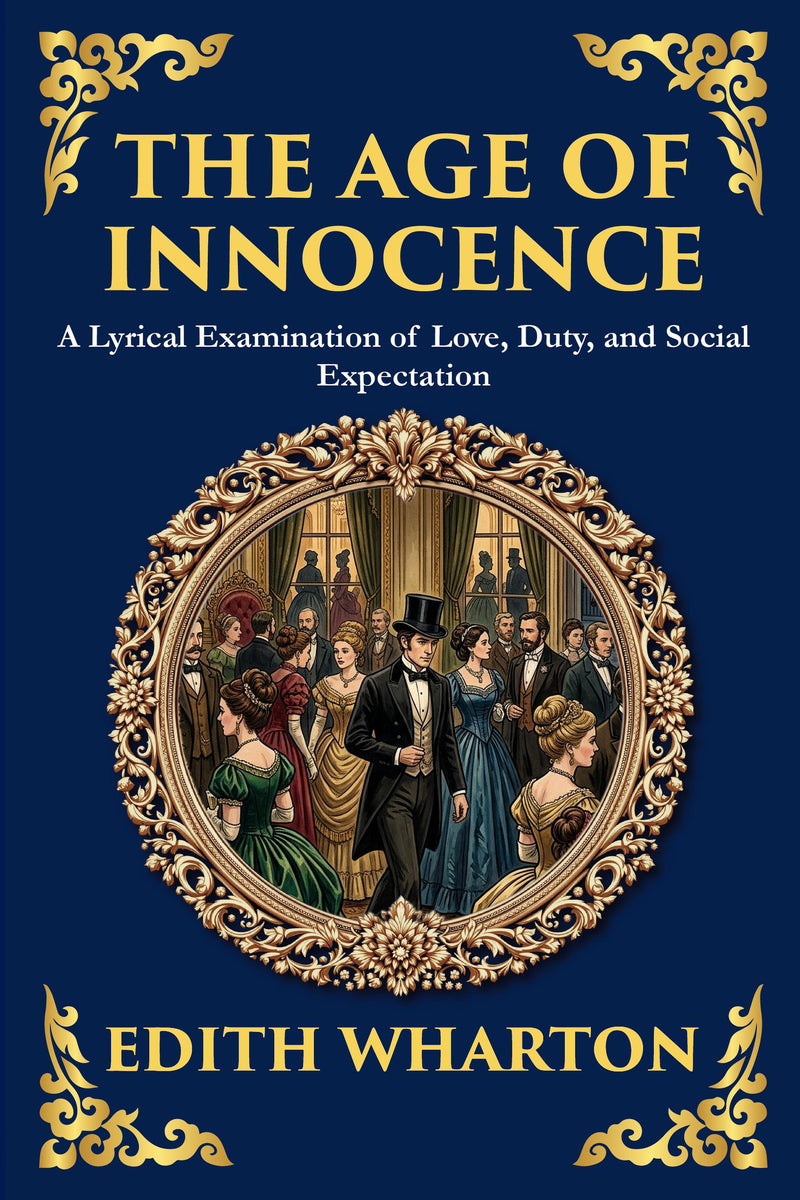
The Age of Innocence — Large Print
In the glittering halls and drawing rooms of Gilded Age New York, appearances are everything —and consequences are eternal.
or free app
10,000+ hrs library
30-day guarantee
The complete The Age of Innocence appears in modern English through Library of Alexandria Press, available online with audiobook narration included for members.
Have you ever wondered why the most dangerous decisions are made not with action, but with silence? In The Age of Innocence: A Lyrical Examination of Love, Duty, and Social Expectation, Pulitzer Prize-winning author Edith Wharton delivers a haunting and beautifully rendered novel about the inner life of a man caught between two worlds—the world he was born into, and the world he secretly desires. Set against the backdrop of Old New York's elite society in the 1870s, the story follows Newland Archer, a principled young gentleman engaged to the lovely but conventional May Welland.
Everything seems in place for a respectable, predictable life—until the arrival of May’s cousin, Countess Ellen Olenska, a bold and enigmatic woman recently returned from Europe under a cloud of scandal. What follows is a restrained yet deeply stirring exploration of moral conflict, emotional entrapment, and the price of forsaking one’s heart for the sake of appearances. Wharton’s prose is elegant and piercing, exposing the hypocrisies of high society and the human cost of unquestioned tradition.
What you’ll discover in this modern edition
- A Timeless Love Triangle with Moral Depth Explore the complex relationships between Newland, May, and Ellen, and the choices that define their lives.
- The Rigidity of Gilded Age Society Gain insight into the social codes, gender expectations, and class divisions that governed upper-crust New York.
- Wharton’s Literary Brilliance Appreciate Wharton’s subtle irony, psychological acuity, and her unmatched ability to portray emotional nuance.
- A Study in Restraint and Regret Witness how quiet conformity can be more tragic than open rebellion.
- A Mirror of Contemporary Dilemmas Though set in the 19th century, its questions of authenticity vs. acceptance remain strikingly relevant today.
| Formats | eBook (EPUB + PDF) · Audiobook · Paperback · Hardcover · Large Print |
| Language | English |
| Trim size (print) | 6 × 9 in |
| Binding | Paperback — perfect-bound · Hardcover — casewrap |
| Large Print edition | Same text in a larger, easy-read type — a larger font, not a larger trim |
| Print pricing | Every physical book at our true cost — at-cost, no profit (members) |
| Library | 873 restored titles, always growing |
| Length | 100,348 words · ~6 hr 41 min reading |
| Reading level | Grade 8 · an easy, flowing read (this modern-English edition) |
| Edition | Modern English translation · 2026 |
Member reviews for this edition are collected as readers finish it — be the first. Across the library: 12,000+ books shipped, every plan covered by a 365-day print guarantee.
About this edition
A faithful, unabridged modern-English edition by The Library of Alexandria — carefully rendered for today's reader and verified paragraph-by-paragraph against the public-domain source. Available as eBook, audiobook, paperback, hardcover, and large print.
- Complete & unabridgedVerified paragraph by paragraph against the source — never a scan, never abridged.
- Modern English, faithfulReadable today, with the author’s meaning kept intact. Readable — not simplified.
- Every format, one membershipRead in your browser or the free app, or listen to the full audiobook.
Included free with your membership
Cancel anytime, one click · 30-day money-back guarantee
Edition last updated July 2026
What’s inside
The Age of Innocence — Large Print — complete and unabridged: all 35 sections included with membership, plus the full audiobook.
Begin reading The Age of Innocence — Large Print
In clear modern English — the complete text is included with membership.
Introduction
There are novels that entertain us, novels that instruct us, and a rare few that seem to know us better than we know ourselves. Edith Wharton’s masterpiece belongs unmistakably to this last category. Published in 1920, it arrived in a world still reeling from the catastrophe of the First World War, a world that had watched an entire social order dissolve into smoke and mud and disillusionment. Yet Wharton chose to set her story not in the chaos of the present but in the gilded drawing rooms of New York in the 1870s—a world she had known intimately in her youth and one that had, by the time she sat down to write, vanished as completely as Atlantis. The result is a work suffused with a peculiar double vision: the precision of a sociologist documenting a vanished tribe, and the tenderness of a woman remembering a lost world that, for all its cruelties and constrictions, still held her in its spell.
What you hold in your hands is a story about desire and renunciation, about the invisible architecture of social expectation, and about the quiet heroism—or perhaps the quiet tragedy—of doing what is expected of you. It is a love story, yes, but one of the most unconventional ever written, for its central drama unfolds not in passionate declarations or dramatic escapes but in the small, almost imperceptible gestures of restraint. A glance held a moment too long. A letter left unwritten. A door closed gently rather than slammed. Wharton understood, as few novelists ever have, that the most consequential battles of a human life are often fought in silence, behind the polished facades of perfectly ordinary social occasions. To read this book is to learn how to read those silences—and in learning to read them, to understand something profound about the costs we pay for the lives we choose, and the lives we let slip away.
This modern adaptation has been prepared with the contemporary reader in mind, smoothing certain archaisms of phrasing and clarifying references that the passage of more than a century has rendered obscure, while taking every care to preserve the music of Wharton’s prose, the razor edge of her wit, and the emotional gravity that has made this novel endure. The aim is not to replace the original but to open a door to it—to ensure that nothing stands between you and the experience of one of the great achievements of American literature. What follows is intended to deepen your appreciation of that experience, to give you a sense of the world you are about to enter and the extraordinary woman who created it, without revealing the turns of the story itself. The pleasure of discovery is yours to keep.
To understand what Wharton accomplished, you must first understand the world she chose to anatomize. The New York society of the 1870s into which this novel plunges us was a small, intensely self-conscious aristocracy—not of blood or title, as in the older nations of Europe, but of wealth, lineage, and an almost religious devotion to the rules of conduct. It was a society of perhaps a few hundred families who all knew one another, who attended the same operas and the same dinners, who married among themselves, and who policed their boundaries with a vigilance that would have impressed any medieval guild. To belong to this world was to inherit not merely money and social standing but an entire code of behavior so intricate and so unspoken that it could never be written down, only absorbed in childhood and obeyed by instinct.
Wharton was uniquely positioned to dissect this world because she had been born into its very heart. Born Edith Newbold Jones in 1862, she belonged to precisely the kind of old, established family the novel describes—indeed, the phrase “keeping up with the Joneses” is sometimes traced, perhaps apocryphally, to her own relations. She grew up in the rarefied air of brownstone mansions and European tours, surrounded by people for whom the slightest breach of decorum was a more serious matter than any breach of genuine morality. She knew the language of this world by heart: the significance of where one sat at dinner, the meaning encoded in the cut of a gown or the timing of a social call, the difference between what was said and what was understood. And she came to see, with a clarity that grew sharper as she aged, that this elaborate apparatus of manners was at once beautiful and monstrous—a thing of genuine refinement that could also crush the human spirit with terrible, smiling efficiency.
What makes the novel so remarkable is the precision with which Wharton renders this lost civilization. She is the anthropologist of her own tribe. She notices everything: the unwritten law dictating which family owns the right to be unpunctual, the social meaning of a brougham versus a carriage, the careful gradations of respectability that separate the truly established families from the merely wealthy newcomers, and the elaborate rituals by which this society absorbs, excludes, or quietly destroys those who threaten its equilibrium. There is a famous passage, which you will encounter, in which she describes how this world communicated its most important verdicts entirely through what was not said—how a person could be cast out without a single harsh word ever being spoken aloud. This is the iron beneath the glass: a system of control so total that it required no enforcement, because everyone within it had internalized its commandments so completely that disobedience became almost unthinkable.
And yet Wharton does not write as a simple critic or satirist. This is the subtlety that elevates her work above mere social commentary. She sees the cruelty of this world, but she also sees its grace, its loyalty, its genuine standards of beauty and conduct. There is something almost elegiac in her portrait, a recognition that for all its suffocating constraint, this vanished society possessed qualities—a sense of obligation, a respect for continuity, a faith in the importance of behaving well—that its more liberated successors had carelessly thrown away. The novel was written by a woman who had escaped this world, who had divorced her husband and made a new life in France, who had achieved a freedom her younger self could scarcely have imagined. But it was also written by a woman old enough to feel the weight of what had been lost, and honest enough to admit that the question of whether the old ways were better or worse than the new is not so easily answered. This refusal of easy judgment is one of the novel’s deepest sources of power.
The central tension of the book emerges from this very ambivalence. We are introduced to a young man of impeccable social standing, a man who has done everything right, who is on the verge of a marriage that will confirm and complete his place in this ordered universe. And into his settled life comes a disruption—a figure who has lived outside the rules, who has known a wider and more dangerous world, who carries with her the faint, intoxicating scent of freedom. What follows is not melodrama but something far more searching: a slow, agonizing examination of what a person owes to the world that made him, and what he owes to himself. Can one be true to one’s own deepest nature without betraying everything one has been taught to value? Is the freedom to follow one’s heart a liberation or merely another, more painful form of imprisonment? Wharton refuses to offer simple answers, and it is precisely this refusal that gives the novel its haunting, lingering quality.
If the world Wharton describes communicates through silence and suggestion, so too does her prose. One of the great pleasures awaiting you in these pages is the discovery of how much can be conveyed without being stated outright. Wharton was a master of irony, but hers is not the cheap irony of mockery; it is a profound, structural irony in which the gap between what characters say and what they feel, between what they intend and what they accomplish, becomes the very engine of the story. A reader who skims the surface will find an elegant tale of upper-class life. A reader who attends carefully will find a devastating meditation on self-deception, on the lies we tell ourselves in order to live, and on the way that conventional virtue can shade imperceptibly into moral cowardice—or, just as easily, into a kind of nobility.
Consider how Wharton handles the inner life of her central character. We are given access to his thoughts, his rationalizations, his moments of clarity and his much more frequent moments of comfortable self-delusion. The novel becomes, in this sense, a study of consciousness itself—of how a person constructs the story of his own life, how he persuades himself that his choices are free when they may in fact be wholly determined by the invisible pressures of his upbringing. There is a terrible poignancy in watching a man believe himself to be a rebel while behaving, at every crucial juncture, exactly as his world requires. And there is an equal poignancy in the moments when genuine feeling breaks through the carefully maintained surface, when the disciplined heart suddenly reveals how much it has been forced to suppress.
Wharton’s technique here is worth pausing over, because it represents a genuine achievement in the history of the novel. She belonged to the great tradition of psychological realism—she was a close friend and admirer of Henry James, and the two writers shared a fascination with the moral life of the wealthy and the subtle dramas of consciousness. But where James could sometimes lose himself in the labyrinth of his own sentences, Wharton always keeps her grip on the concrete, the visual, the social. She grounds her psychological insights in the observable texture of life: in clothes and houses and meals and conversations, in the precise choreography of social interaction. She understood that human beings reveal themselves not through abstract introspection but through their behavior in the world, through the small choices they make about how to fill an evening or address a letter or respond to an invitation. This is why her novel, for all its interiority, never feels airless or static. It is rooted in a richly imagined material reality, every detail of which carries meaning.
Pay attention, as you read, to the recurring imagery that Wharton weaves through the narrative—the flowers, for instance, which carry an entire vocabulary of meaning, or the recurring contrast between conventional and unconventional dwellings, or the symbolic weight she attaches to objects of beauty and art. These are not mere decorations. Wharton was a connoisseur of design and architecture—she co-authored an influential book on interior decoration before she ever published a novel—and she understood that the spaces people inhabit and the objects they choose express the deepest truths about who they are and what they long for. A room, in her hands, becomes a portrait of a soul. A bouquet becomes a coded message. Learn to read these signs, and the novel will open before you like a flower itself, revealing layer upon layer of meaning beneath its lovely surface.
The novel’s emotional climax, when it comes, arrives not through any grand external event but through a profound shift in perspective—a moment in which the entire meaning of a life is suddenly cast in a new light. Without revealing what happens, it is enough to say that Wharton has prepared this moment with exquisite care, and that its power derives precisely from everything that has been withheld and unspoken throughout the book. It is the kind of ending that sends the reader back to the beginning, eager to reread in light of what has been learned. Few novels reward rereading so richly. The first time through, we experience the story as the characters experience it, swept along by hope and uncertainty. The second time, we read with the terrible knowledge of how things will unfold, and we begin to see the patterns and ironies that were invisible before. This is the mark of a truly great book: it does not exhaust itself in a single reading but deepens and ripens with each return.
Cancel anytime, one click · 30-day money-back guarantee
Founding annual rate available now — your price locks for life when you join.
Not ready? Get this free chapter by email — read it anytime.
✓ Sent — check your inbox for The Age of Innocence — Large Print.
Questions about The Age of Innocence — Large Print
What is The Age of Innocence about?
In the glittering halls and drawing rooms of Gilded Age New York, appearances are everything —and consequences are eternal. The Age of Innocence is Edith Wharton’s masterful portrait of a world bound by rigid conventions, where passion must bow to propriety and duty often stands in direct conflict with desire. Newland Archer, a promising young lawyer, finds himself torn between the expectations of his conservative society and the magnetic pull of a woman who dares to defy it.
Who wrote The Age of Innocence?
The Age of Innocence was written by Edith Wharton. This edition presents the complete work in clear modern English, faithfully rendered from the public-domain original by Library of Alexandria Press.
Is The Age of Innocence free to read?
The opening chapter is free to read on this page. Members read and listen to the complete work — and the entire library — free, and can order any physical book at our true print cost.
How long is The Age of Innocence?
35 chapters (~100,348 words) — about 6 hr 41 min of reading in this modern-English edition.
Is this an abridged version of The Age of Innocence?
No. This is the complete, unabridged The Age of Innocence, carefully rendered into clear modern English and verified paragraph-by-paragraph against the public-domain source — nothing is cut or summarised.
What formats does The Age of Innocence come in?
The Age of Innocence is available as eBook, paperback, hardcover and large print. eBook and audiobook are included with membership; printed editions ship at our true print cost.
Shipping & returns
Billing & membership
More from the library


Explore Romance
- As You Like It · William Shakespeare
- Anna Karenina · Leo Tolstoy
- A Midsummer Night’s Dream · William Shakespeare
- Romeo and Juliet · William Shakespeare
- Sonnets from the Portuguese · Elizabeth Barrett Browning
- Miss Primrose · Agnes Giberne
- The Gay Adventure: A Romance · Richard Bird
- The Belle of Bowling Green · Amelia E. Barr
- The Monk: A Romance · M. G. Lewis
- She · H. Rider Haggard
- The Mill on the Floss · George Eliot
- The Glad Lady · Amy Ella Blanchard
- The Red Lily — Complete · Anatole France
- The Blue Goose · Frank Lewis Nason
- The History of Sir Richard Calmady: A Romance · Lucas Malet
- The Quest of the Silver Fleece: A Novel · W. E. B. Du Bois
- The Love Letters of Mary Wollstonecraft to Gilbert Imlay · Mary Wollstonecraft
- Daddy-Long-Legs · Jean Webster
- The Age of Innocence · Edith Wharton
- The Portrait of a Lady — Volume 1 · Henry James
- Wuthering Heights · Emily Brontë
- The Lady of the Lake · Walter Scott
- Lady Chatterley’s Lover · D. H. Lawrence
- Jane Eyre: An Autobiography · Charlotte Brontë
- A Connecticut Yankee in King Arthur’s Court · Mark Twain
- Northanger Abbey · Jane Austen
- Mansfield Park · Jane Austen
- Anthem · Ayn Rand
- This Side of Paradise · F. Scott Fitzgerald
- Persuasion · Jane Austen
The Age of Innocence — Large Print
The Age of Innocence — Large Print
A Lyrical Examination of Love, Duty, and Social Expectation
Edith Wharton
Contents
- Introduction
- Chapter 1
- Chapter 2
- Chapter 3
- Chapter 4
- Chapter 5
- Chapter 6
- Chapter 7
- Chapter 8
- Chapter 9
- Chapter 10
- Chapter 11
- Chapter 12
- Chapter 13
- Chapter 14
- Chapter 15
- Chapter 16
- Chapter 17
- Chapter 18
- Chapter 19
- Chapter 20
- Chapter 21
- Chapter 22
- Chapter 23
- Chapter 24
- Chapter 25
- Chapter 26
- Chapter 27
- Chapter 28
- Chapter 29
- Chapter 30
- Chapter 31
- Chapter 32
- Chapter 33
- Chapter 34
Introduction
There are novels that entertain us, novels that instruct us, and a rare few that seem to know us better than we know ourselves. Edith Wharton’s masterpiece belongs unmistakably to this last category. Published in 1920, it arrived in a world still reeling from the catastrophe of the First World War, a world that had watched an entire social order dissolve into smoke and mud and disillusionment. Yet Wharton chose to set her story not in the chaos of the present but in the gilded drawing rooms of New York in the 1870s—a world she had known intimately in her youth and one that had, by the time she sat down to write, vanished as completely as Atlantis. The result is a work suffused with a peculiar double vision: the precision of a sociologist documenting a vanished tribe, and the tenderness of a woman remembering a lost world that, for all its cruelties and constrictions, still held her in its spell.
What you hold in your hands is a story about desire and renunciation, about the invisible architecture of social expectation, and about the quiet heroism—or perhaps the quiet tragedy—of doing what is expected of you. It is a love story, yes, but one of the most unconventional ever written, for its central drama unfolds not in passionate declarations or dramatic escapes but in the small, almost imperceptible gestures of restraint. A glance held a moment too long. A letter left unwritten. A door closed gently rather than slammed. Wharton understood, as few novelists ever have, that the most consequential battles of a human life are often fought in silence, behind the polished facades of perfectly ordinary social occasions. To read this book is to learn how to read those silences—and in learning to read them, to understand something profound about the costs we pay for the lives we choose, and the lives we let slip away.
This modern adaptation has been prepared with the contemporary reader in mind, smoothing certain archaisms of phrasing and clarifying references that the passage of more than a century has rendered obscure, while taking every care to preserve the music of Wharton’s prose, the razor edge of her wit, and the emotional gravity that has made this novel endure. The aim is not to replace the original but to open a door to it—to ensure that nothing stands between you and the experience of one of the great achievements of American literature. What follows is intended to deepen your appreciation of that experience, to give you a sense of the world you are about to enter and the extraordinary woman who created it, without revealing the turns of the story itself. The pleasure of discovery is yours to keep.
To understand what Wharton accomplished, you must first understand the world she chose to anatomize. The New York society of the 1870s into which this novel plunges us was a small, intensely self-conscious aristocracy—not of blood or title, as in the older nations of Europe, but of wealth, lineage, and an almost religious devotion to the rules of conduct. It was a society of perhaps a few hundred families who all knew one another, who attended the same operas and the same dinners, who married among themselves, and who policed their boundaries with a vigilance that would have impressed any medieval guild. To belong to this world was to inherit not merely money and social standing but an entire code of behavior so intricate and so unspoken that it could never be written down, only absorbed in childhood and obeyed by instinct.
Wharton was uniquely positioned to dissect this world because she had been born into its very heart. Born Edith Newbold Jones in 1862, she belonged to precisely the kind of old, established family the novel describes—indeed, the phrase “keeping up with the Joneses” is sometimes traced, perhaps apocryphally, to her own relations. She grew up in the rarefied air of brownstone mansions and European tours, surrounded by people for whom the slightest breach of decorum was a more serious matter than any breach of genuine morality. She knew the language of this world by heart: the significance of where one sat at dinner, the meaning encoded in the cut of a gown or the timing of a social call, the difference between what was said and what was understood. And she came to see, with a clarity that grew sharper as she aged, that this elaborate apparatus of manners was at once beautiful and monstrous—a thing of genuine refinement that could also crush the human spirit with terrible, smiling efficiency.
What makes the novel so remarkable is the precision with which Wharton renders this lost civilization. She is the anthropologist of her own tribe. She notices everything: the unwritten law dictating which family owns the right to be unpunctual, the social meaning of a brougham versus a carriage, the careful gradations of respectability that separate the truly established families from the merely wealthy newcomers, and the elaborate rituals by which this society absorbs, excludes, or quietly destroys those who threaten its equilibrium. There is a famous passage, which you will encounter, in which she describes how this world communicated its most important verdicts entirely through what was not said—how a person could be cast out without a single harsh word ever being spoken aloud. This is the iron beneath the glass: a system of control so total that it required no enforcement, because everyone within it had internalized its commandments so completely that disobedience became almost unthinkable.
And yet Wharton does not write as a simple critic or satirist. This is the subtlety that elevates her work above mere social commentary. She sees the cruelty of this world, but she also sees its grace, its loyalty, its genuine standards of beauty and conduct. There is something almost elegiac in her portrait, a recognition that for all its suffocating constraint, this vanished society possessed qualities—a sense of obligation, a respect for continuity, a faith in the importance of behaving well—that its more liberated successors had carelessly thrown away. The novel was written by a woman who had escaped this world, who had divorced her husband and made a new life in France, who had achieved a freedom her younger self could scarcely have imagined. But it was also written by a woman old enough to feel the weight of what had been lost, and honest enough to admit that the question of whether the old ways were better or worse than the new is not so easily answered. This refusal of easy judgment is one of the novel’s deepest sources of power.
The central tension of the book emerges from this very ambivalence. We are introduced to a young man of impeccable social standing, a man who has done everything right, who is on the verge of a marriage that will confirm and complete his place in this ordered universe. And into his settled life comes a disruption—a figure who has lived outside the rules, who has known a wider and more dangerous world, who carries with her the faint, intoxicating scent of freedom. What follows is not melodrama but something far more searching: a slow, agonizing examination of what a person owes to the world that made him, and what he owes to himself. Can one be true to one’s own deepest nature without betraying everything one has been taught to value? Is the freedom to follow one’s heart a liberation or merely another, more painful form of imprisonment? Wharton refuses to offer simple answers, and it is precisely this refusal that gives the novel its haunting, lingering quality.
If the world Wharton describes communicates through silence and suggestion, so too does her prose. One of the great pleasures awaiting you in these pages is the discovery of how much can be conveyed without being stated outright. Wharton was a master of irony, but hers is not the cheap irony of mockery; it is a profound, structural irony in which the gap between what characters say and what they feel, between what they intend and what they accomplish, becomes the very engine of the story. A reader who skims the surface will find an elegant tale of upper-class life. A reader who attends carefully will find a devastating meditation on self-deception, on the lies we tell ourselves in order to live, and on the way that conventional virtue can shade imperceptibly into moral cowardice—or, just as easily, into a kind of nobility.
Consider how Wharton handles the inner life of her central character. We are given access to his thoughts, his rationalizations, his moments of clarity and his much more frequent moments of comfortable self-delusion. The novel becomes, in this sense, a study of consciousness itself—of how a person constructs the story of his own life, how he persuades himself that his choices are free when they may in fact be wholly determined by the invisible pressures of his upbringing. There is a terrible poignancy in watching a man believe himself to be a rebel while behaving, at every crucial juncture, exactly as his world requires. And there is an equal poignancy in the moments when genuine feeling breaks through the carefully maintained surface, when the disciplined heart suddenly reveals how much it has been forced to suppress.
Wharton’s technique here is worth pausing over, because it represents a genuine achievement in the history of the novel. She belonged to the great tradition of psychological realism—she was a close friend and admirer of Henry James, and the two writers shared a fascination with the moral life of the wealthy and the subtle dramas of consciousness. But where James could sometimes lose himself in the labyrinth of his own sentences, Wharton always keeps her grip on the concrete, the visual, the social. She grounds her psychological insights in the observable texture of life: in clothes and houses and meals and conversations, in the precise choreography of social interaction. She understood that human beings reveal themselves not through abstract introspection but through their behavior in the world, through the small choices they make about how to fill an evening or address a letter or respond to an invitation. This is why her novel, for all its interiority, never feels airless or static. It is rooted in a richly imagined material reality, every detail of which carries meaning.
Pay attention, as you read, to the recurring imagery that Wharton weaves through the narrative—the flowers, for instance, which carry an entire vocabulary of meaning, or the recurring contrast between conventional and unconventional dwellings, or the symbolic weight she attaches to objects of beauty and art. These are not mere decorations. Wharton was a connoisseur of design and architecture—she co-authored an influential book on interior decoration before she ever published a novel—and she understood that the spaces people inhabit and the objects they choose express the deepest truths about who they are and what they long for. A room, in her hands, becomes a portrait of a soul. A bouquet becomes a coded message. Learn to read these signs, and the novel will open before you like a flower itself, revealing layer upon layer of meaning beneath its lovely surface.
The novel’s emotional climax, when it comes, arrives not through any grand external event but through a profound shift in perspective—a moment in which the entire meaning of a life is suddenly cast in a new light. Without revealing what happens, it is enough to say that Wharton has prepared this moment with exquisite care, and that its power derives precisely from everything that has been withheld and unspoken throughout the book. It is the kind of ending that sends the reader back to the beginning, eager to reread in light of what has been learned. Few novels reward rereading so richly. The first time through, we experience the story as the characters experience it, swept along by hope and uncertainty. The second time, we read with the terrible knowledge of how things will unfold, and we begin to see the patterns and ironies that were invisible before. This is the mark of a truly great book: it does not exhaust itself in a single reading but deepens and ripens with each return.
On a January evening in the early 1870s, Christine Nilsson was performing in Faust at the Academy of Music in New York.
There were already rumors about building a new Opera House further uptown—above 42nd Street—that would rival the luxury and grandeur of the great European capitals. Despite this, high society was still happy to gather every winter in the faded red and gold boxes of the old, friendly Academy. Conservatives loved it because it was small and inconvenient, which helped keep out the “new money” crowd that New York was beginning to fear and feel attracted to. The sentimentalists loved it for its history, and the music lovers loved it for its excellent acoustics, which were often a problem in halls designed for music.
It was Madame Nilsson’s first performance of the winter. A crowd that the newspapers already called “an exceptionally brilliant audience” had gathered to hear her. They arrived through the slippery, snowy streets in private carriages, large family landaus, or the more modest but convenient “Brown coupes.” Arriving at the Opera in a Brown coupe was almost as prestigious as arriving in one’s own carriage. Leaving in one had the huge advantage of allowing a person—with a playful nod to democratic values—to jump into the first available Brown carriage in line, rather than waiting for their own coachman, whose nose was likely glowing from the cold and gin, to appear under the Academy’s porch. One of the great livery-stable owners’ smartest insights was realizing that Americans want to leave an event even faster than they want to get to it.
When Newland Archer opened the door at the back of the club box, the curtain had just risen on the garden scene. There was no reason for the young man to be late; he had eaten dinner at seven, alone with his mother and sister, and had spent some time afterward smoking a cigar in the Gothic library. With its polished black-walnut bookcases and ornate chairs, the library was the only room in the house where Mrs. Archer allowed smoking. However, New York was a major city, and Newland was well aware that in such cities, it was “not the thing” to arrive at the opera early. In Newland Archer’s New York, following these unwritten social rules was as important as the mysterious tribal superstitions that had governed the lives of his ancestors thousands of years ago.
End of the free sample
Keep reading, free
Members read and listen to the complete book — and the entire library. Cancel anytime, one click · 30-day money-back guarantee.