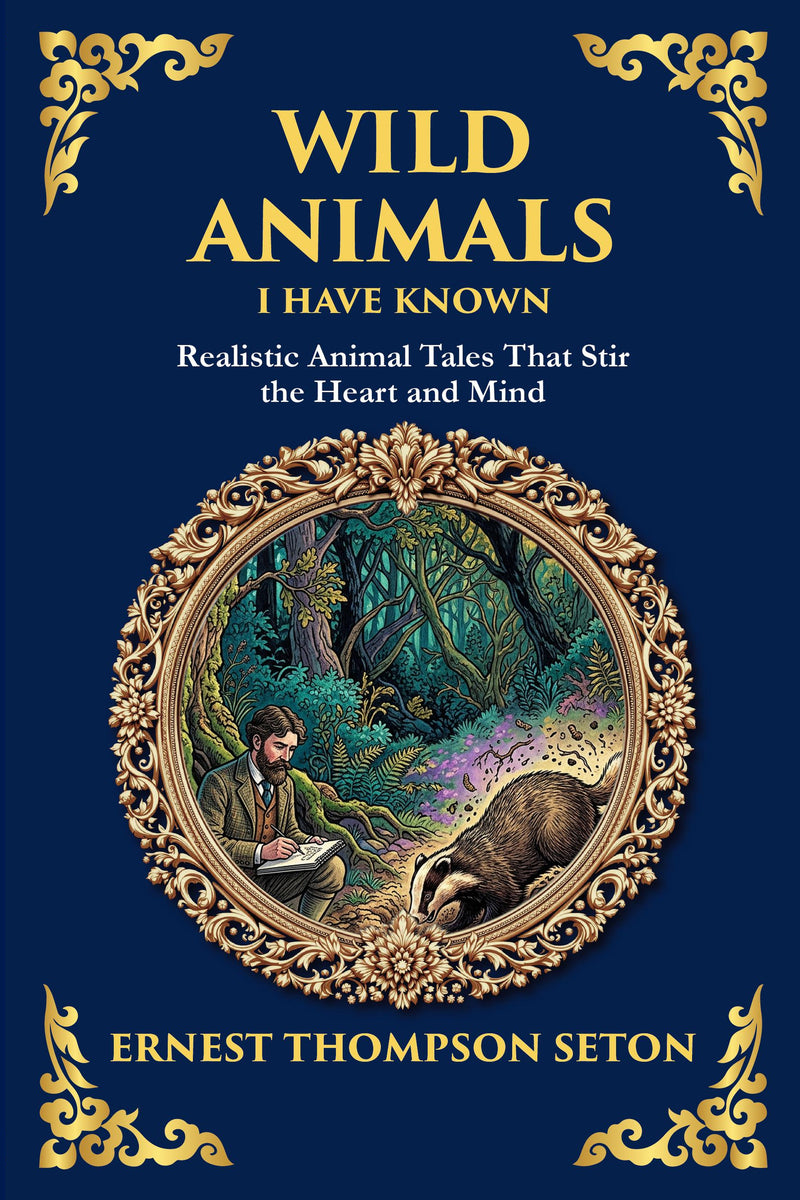
Wild Animals I Have Known — Large Print
In Wild Animals I Have Known, Ernest Thompson Seton revolutionized the way the world saw wildlife—by telling their stories not as cold facts or statistics, but as vivid, emotional narratives.
or free app
10,000+ hrs library
30-day guarantee
The complete Wild Animals I Have Known appears in modern English through Library of Alexandria Press, available online with audiobook narration included for members.
Have you ever wondered why animal stories can move us more deeply than our own? Wild Animals I Have Known by Ernest Thompson Seton is a landmark in nature writing—a collection of short stories that breathed life and soul into the animals of North America long before wildlife conservation became a global concern. These aren’t fables or fairy tales, but powerful, often heartbreaking accounts of real animals observed and immortalized by one of the founding figures of the modern wildlife movement.
In a time when animals were mostly studied, hunted, or ignored, Seton dared to do something radical: he told their stories with emotional truth. With prose both lyrical and raw, he gives voice to the silent suffering, cleverness, loyalty, and wild dignity of creatures often misunderstood. These tales include: Lobo, The King of Currumpaw – A powerful wolf hunted to extinction, and the unexpected bond between predator and pursuer Silverspot, The Story of a Crow – A cunning and wise bird whose intellect surpasses that of men Redruff, The Story of the Don Valley Partridge – A touching account of freedom, loyalty, and betrayal Bingo, The Story of My Dog – A portrait of love and loyalty in the face of cruelty And more unforgettable creatures – Each tale shining with personality, struggle, and beauty Seton’s stories changed how generations saw the natural world—paving the way for a future where animals were respected, not just studied.
With a painter’s eye and a storyteller’s heart, he captures the spirit of the wild like no other.
What you’ll discover in this modern edition
- Emotionally Resonant Animal Tales – Real stories filled with drama, sorrow, survival, and dignity
- Early Environmental Consciousness – A voice ahead of his time, calling for empathy toward wild creatures
- A Blend of Science and Sentiment – Based on Seton’s firsthand observations and deeply humane insights
- Stories that Shaped Generations – Influenced the Boy Scouts, animal rights movements, and wildlife literature
- A Legacy of Respect for Nature – A foundational text for understanding our connection to the animal world
| Formats | eBook (EPUB + PDF) · Audiobook · Paperback · Hardcover · Large Print |
| Language | English |
| Trim size (print) | 6 × 9 in |
| Binding | Paperback — perfect-bound · Hardcover — casewrap |
| Large Print edition | Same text in a larger, easy-read type — a larger font, not a larger trim |
| Print pricing | Every physical book at our true cost — at-cost, no profit (members) |
| Library | 873 restored titles, always growing |
| Length | 53,556 words · ~3 hr 34 min reading |
| Reading level | Grade 9 · a comfortable read (this modern-English edition) |
| Edition | Modern English translation · 2026 |
Member reviews for this edition are collected as readers finish it — be the first. Across the library: 12,000+ books shipped, every plan covered by a 365-day print guarantee.
About this edition
A faithful, unabridged modern-English edition by The Library of Alexandria — carefully rendered for today's reader and verified paragraph-by-paragraph against the public-domain source. Available as eBook, audiobook, paperback, hardcover, and large print.
- Complete & unabridgedVerified paragraph by paragraph against the source — never a scan, never abridged.
- Modern English, faithfulReadable today, with the author’s meaning kept intact. Readable — not simplified.
- Every format, one membershipRead in your browser or the free app, or listen to the full audiobook.
Included free with your membership
Cancel anytime, one click · 30-day money-back guarantee
Edition last updated July 2026
What’s inside
Wild Animals I Have Known — Large Print — complete and unabridged: all 40 sections included with membership, plus the full audiobook.
Begin reading Wild Animals I Have Known — Large Print
In clear modern English — the complete text is included with membership.
Introduction
When Wild Animals I Have Known first appeared in 1898, it did something that no book of its kind had quite managed before: it asked readers to look an animal in the eye and recognize, looking back, a fellow creature with a story worth telling. Ernest Thompson Seton did not merely write about wolves, rabbits, dogs, foxes, crows, and partridges. He wrote about individuals — animals with names, with histories, with cunning and courage and stubbornness and grief — and in doing so he reshaped the way an entire generation of readers thought about the wild world beyond their windows. The book became a phenomenon, selling out its first edition within weeks and going on to influence naturalists, conservationists, and storytellers for more than a century. It is no exaggeration to say that the modern nature story, the kind that treats animals as protagonists rather than props, was born here.
This edition presents Seton’s classic in a form adapted for the contemporary reader, with language gently modernized so that nothing stands between you and the heart of the storytelling. The aim throughout has been to preserve the spirit, the rhythm, and the emotional force of the original while smoothing away the occasional Victorian thicket of phrasing that might otherwise slow a present-day reader down. What remains is what mattered most to Seton: the animals themselves, rendered with such vividness and sympathy that you may find yourself, by the final page, looking at the crows on a telephone wire or the tracks in a patch of mud with entirely new eyes.
To understand why these tales carry the weight they do, it helps to know something of the remarkable man who wrote them. Ernest Thompson Seton was born in 1860 in South Shields, England, and emigrated as a child with his family to Canada, where the vast forests and prairies of Ontario and later the western frontier became the great classroom of his life. He was, by any measure, an extraordinary figure: a trained artist who studied at the Royal Academy in London, a meticulous naturalist whose field observations were respected by scientists of his day, a prolific author, and eventually one of the founding spirits of the youth outdoor movement that would shape organizations like the Boy Scouts. Few writers have ever come to the subject of wildlife with such a complete set of tools — the eye of a painter, the patience of a tracker, the discipline of a scientist, and the soul of a storyteller.
Seton spent years in the field, much of it alone, watching animals not as a hunter watches game but as a biographer watches a subject. He learned to read snow and dust and broken twigs the way a scholar reads manuscripts. He came to know the territories of particular animals, the routines of particular creatures, the personalities — and he used that word deliberately — of beings that most people of his era regarded as interchangeable members of a faceless species. This was the radical heart of his project. Where his contemporaries saw “the wolf” or “the rabbit,” Seton saw this wolf, this rabbit, with a name and a life and a fate. The stories in this collection grew out of real encounters, real observations, and in many cases real animals that Seton himself knew, pursued, studied, and in some instances came to mourn.
It is worth pausing on that last point, because it is central to the experience of reading this book. Seton was not a sentimental man in the cheap sense; he had hunted, he had killed, he understood the brutal arithmetic of survival in the wild. But he was honest about what he felt, and what he felt, again and again, was a profound respect bordering on reverence for the creatures whose lives crossed his own. That tension — between the naturalist’s clear-eyed realism and the artist’s deep tenderness — runs like an electric current through every page. It is what makes these stories ache. It is what lifts them out of the category of mere natural history and into the realm of literature.
Seton was also, it must be said, a man of strong opinions about how animals ought to be written about, and he was not shy about defending his methods. He insisted that his stories were true — true in the sense that the incidents he described were drawn from genuine observation, even where he had composited several real animals into a single representative character for the sake of the narrative. This claim would later embroil him in a famous public controversy with critics who accused certain nature writers of “humanizing” wildlife and inventing feelings that animals could not possibly possess. Seton stood his ground, and history has largely vindicated him: the modern science of animal cognition and behavior has revealed depths of emotion, intelligence, problem-solving, and even what we might call culture in the wild that would have astonished his nineteenth-century detractors. When you read his account of a wolf’s loyalty, a crow’s craftiness, or a mother bird’s desperate strategy to protect her young, you are reading something that contemporary biologists would recognize as broadly accurate, not mere fancy. Seton was, in many ways, ahead of his time.
His artistry extended beyond the written word. The original volume was illustrated throughout with Seton’s own drawings — marginal sketches, full-page illustrations, and small decorative figures that danced along the edges of the text like tracks in the snow. These were not decorations in the ordinary sense; they were extensions of his observation, visual notes that captured the precise posture of a running fox or the exact angle of a bird’s wing. Seton the artist and Seton the writer were inseparable, each feeding the other, and the visual sensibility of a trained painter is everywhere present in his prose. When he describes a landscape or the movement of an animal across it, you can almost feel him reaching for a pencil.
There is a particular kind of magic that happens when you begin one of these stories. Seton does not ask you to admire animals from a comfortable distance. He drops you directly into their world — into the ravines and thickets and snowbound plains where they live and hunt and raise their families and meet their ends. You learn the geography of their territories. You come to understand the dangers they face, not as abstractions but as immediate, mortal threats. And, crucially, you come to care. By the time you are a few pages into any of these tales, you are no longer reading about an animal; you are following a character whose fortunes you have come to feel as your own.
This is achieved through a remarkable economy of means. Seton rarely tells you what to feel. He simply shows you, with extraordinary specificity, what an animal does — and the doing reveals the being. A wolf that refuses to abandon a companion. A rabbit that learns, through hard experience, the difference between safety and danger and passes that knowledge on. A dog whose loyalty cannot be commanded but must be earned. A bird whose maternal devotion drives her to acts of breathtaking sacrifice. In each case, Seton resists the temptation to lecture. He trusts the reader to draw the conclusion, and that trust is part of what makes the stories feel so adult, so unsentimental even at their most moving.
Another source of the book’s enduring power is Seton’s refusal to soften the realities of wild life. These are not stories with guaranteed happy endings. The wild is a place of struggle, and Seton honors that truth. There is loss here, real loss, and it is rendered without flinching and without false comfort. For some readers, particularly those who come to the book expecting the gentle fables of childhood, this honesty can be startling. But it is precisely this honesty that gives the stories their moral seriousness. Seton wanted his readers to understand that animals are not toys, not symbols, not lesser beings placed on earth for our amusement — they are living creatures engaged in the same fundamental drama of survival, kinship, and mortality that defines our own existence. The losses in these stories matter because the lives mattered, and the lives matter because Seton has made them so real to us.
It would be a disservice to reveal the particular fates that befall the creatures in these pages, for much of the reading experience lies in following each story to its conclusion without knowing in advance where it will lead. What can be said is that Seton possessed an unerring instinct for the dramatic shape of a life. He understood that a story needs tension, reversal, and consequence, and he found these elements not by inventing them but by recognizing them in the genuine patterns of animal behavior. A predator’s hunt, a quarry’s escape, a courtship, a defense of territory, the long contest between a wild animal and the humans who seek to control or destroy it — these are inherently dramatic situations, and Seton had the gift of presenting them with the pacing and structure of fine fiction while keeping them anchored in the realities of the natural world.
The settings, too, deserve mention. Seton wrote at a moment when the great wildernesses of North America were undergoing rapid and often violent transformation. The frontier was closing, the prairies were being fenced and plowed, the great predators were being systematically exterminated as threats to livestock and human enterprise. Many of these stories unfold against the backdrop of that vanishing world, and they carry, beneath their immediate drama, a powerful undercurrent of elegy. Seton was writing not only about individual animals but about a wild order that was passing away before his eyes. This gives the collection a historical resonance that has only deepened with time. To read these stories now, more than a century later, is to glimpse a continent in transition — and to feel, with renewed urgency, the cost of what was lost and the value of what remains.
For all their seriousness, the stories are also full of delight. Seton had a keen appreciation for cleverness, and many of his animal protagonists are tricksters and strategists of the highest order. There is genuine pleasure in watching a wily creature outwit its pursuers, in following the intricate cat-and-mouse games between hunter and hunted, in admiring the sheer ingenuity of a wild mind solving the problems of survival. Seton’s animals are not passive victims of circumstance; they are active, intelligent agents, and watching them think their way through danger is one of the great satisfactions of the book. There is humor here, and admiration, and even a kind of sporting respect that Seton, the former hunter, extends to the creatures who outmatch their human and animal adversaries alike.
It is also impossible to read this collection without absorbing an enormous amount of genuine natural history. Seton’s observations are dense with accurate detail about how animals actually live — what they eat, how they communicate, how they raise their young, how they navigate the seasons, how they respond to threat and opportunity. He embeds this knowledge so seamlessly into the narrative that you scarcely notice you are learning; the education comes wrapped in the pleasure of story. By the end of the book you will know more about the behavior of wolves, foxes, rabbits, dogs, birds, and other creatures than many a textbook could teach you, and you will have acquired that knowledge not as dry fact but as lived, felt understanding. This is perhaps the highest achievement of nature writing — to make the reader not merely informed but transformed, to leave them seeing the world differently.
The book’s influence on the broader culture cannot be overstated. Seton effectively invented a genre, and the line of descent from these stories runs through virtually every serious work of animal-centered fiction and nonfiction that followed. Writers who would go on to shape our collective imagination of the wild — and the conservation movements that grew from that imagination — owed an enormous debt to Seton’s pioneering vision. His insistence that animals possess inner lives worthy of our attention and respect helped lay the philosophical groundwork for the modern ethic of wildlife protection. When we speak today of preserving habitat, of protecting endangered species, of recognizing the intrinsic worth of nonhuman life, we are speaking, in part, a language that Seton helped to create. He was not only a great storyteller but a moral pioneer, and these stories were among the first shots in a long campaign to change how human beings regard their fellow creatures.
Cancel anytime, one click · 30-day money-back guarantee
Founding annual rate available now — your price locks for life when you join.
Not ready? Get this free chapter by email — read it anytime.
✓ Sent — check your inbox for Wild Animals I Have Known — Large Print.
Questions about Wild Animals I Have Known — Large Print
What is Wild Animals I Have Known about?
In Wild Animals I Have Known, Ernest Thompson Seton revolutionized the way the world saw wildlife—by telling their stories not as cold facts or statistics, but as vivid, emotional narratives. Through these unforgettable tales, Seton invites readers to see animals not merely as specimens, but as individuals: brave, intelligent, feeling beings who struggle, love, and survive in a world of beauty and brutality. From the cunning wolf Lobo to the spirited little partridge Redruff, these classic stories leave an indelibl
Who wrote Wild Animals I Have Known?
Wild Animals I Have Known was written by Ernest Thompson Seton. This edition presents the complete work in clear modern English, faithfully rendered from the public-domain original by Library of Alexandria Press.
Is Wild Animals I Have Known free to read?
The opening chapter is free to read on this page. Members read and listen to the complete work — and the entire library — free, and can order any physical book at our true print cost.
How long is Wild Animals I Have Known?
40 chapters (~53,556 words) — about 3 hr 34 min of reading in this modern-English edition.
Is this an abridged version of Wild Animals I Have Known?
No. This is the complete, unabridged Wild Animals I Have Known, carefully rendered into clear modern English and verified paragraph-by-paragraph against the public-domain source — nothing is cut or summarised.
What formats does Wild Animals I Have Known come in?
Wild Animals I Have Known is available as eBook, paperback, hardcover and large print. eBook and audiobook are included with membership; printed editions ship at our true print cost.
Shipping & returns
Billing & membership
More from the library


Explore Biography & Letters
- Meditations · Marcus Aurelius
- The Confessions of St. Augustine · Saint Augustine
- The Confessions of Jean-Jacques Rousseau — Complete · Jean-Jacques Rousseau
- Ecce Homo · Friedrich Wilhelm Nietzsche
- De Profundis · Oscar Wilde
- Memoirs of Joseph Grimaldi · Joseph Grimaldi
- English Eccentrics and Eccentricities · John Timbs
- You Can’t Win · Jack Black
- Wild Animals I Have Known · Ernest Thompson Seton
- The Diary of Samuel Pepys — Complete 1665 N.S. · Samuel Pepys
- Random Reminiscences of Men and Events · John D. Rockefeller
- The Story of My Life · Helen Keller
- Elizabeth, Empress of Austria and Queen of Hungary · Carl Küchler
- Society as I Have Found It · Ward McAllister
- Autobiography of a Yogi · Paramahansa Yogananda
- Christopher Columbus and How He Received and Imparted the Spirit of Discovery
- A Portrait of the Artist as a Young Man · James Joyce
- Memoirs of the Author of a Vindication of the Rights of Woman · William Godwin
- Mary: A Fiction · Mary Wollstonecraft
- The Romance of Biography (Vol. 1 of 2) · Mrs. Jameson
- The Love Letters of Mary Wollstonecraft to Gilbert Imlay · Mary Wollstonecraft
- Selected Works of Voltairine de Cleyre · Voltairine de Cleyre
- Eighty Years and More; Reminiscences 1815–1897 · Elizabeth Cady Stanton
- Anarchism and Other Essays · Emma Goldman
- Agnes Grey · Anne Brontë
- Daddy-Long-Legs · Jean Webster
- Reminiscences of a Stock Operator · Edwin Lefèvre
- Martin Eden · Jack London
- Matthew Calbraith Perry: A Typical American Naval Officer · William Elliot Griffis
- Walden, and On the Duty of Civil Disobedience · Henry David Thoreau
Wild Animals I Have Known — Large Print
Wild Animals I Have Known — Large Print
True-to-Life Animal Stories That Move the Heart and Mind
Ernest Thompson Seton
Contents
- Introduction
- Wild Animals I Have Known
- Chapter 1
- Chapter 2
- Chapter 3
- Chapter 4
- Chapter 5
- Chapter 6
- Chapter 7
- Chapter 8
- Chapter 9
- Chapter 10
- Chapter 11
- Chapter 12
- Chapter 13
- Chapter 14
- Chapter 15
- Chapter 16
- Chapter 17
- Chapter 18
- Chapter 19
- Chapter 20
- Chapter 21
- Chapter 22
- Chapter 23
- Chapter 24
- Chapter 25
- Chapter 26
- Chapter 27
- Chapter 28
- Chapter 29
- Chapter 30
- Chapter 31
- Chapter 32
- Chapter 33
- Chapter 34
- Chapter 35
- Chapter 36
- Chapter 37
- Chapter 38
Introduction
When Wild Animals I Have Known first appeared in 1898, it did something that no book of its kind had quite managed before: it asked readers to look an animal in the eye and recognize, looking back, a fellow creature with a story worth telling. Ernest Thompson Seton did not merely write about wolves, rabbits, dogs, foxes, crows, and partridges. He wrote about individuals — animals with names, with histories, with cunning and courage and stubbornness and grief — and in doing so he reshaped the way an entire generation of readers thought about the wild world beyond their windows. The book became a phenomenon, selling out its first edition within weeks and going on to influence naturalists, conservationists, and storytellers for more than a century. It is no exaggeration to say that the modern nature story, the kind that treats animals as protagonists rather than props, was born here.
This edition presents Seton’s classic in a form adapted for the contemporary reader, with language gently modernized so that nothing stands between you and the heart of the storytelling. The aim throughout has been to preserve the spirit, the rhythm, and the emotional force of the original while smoothing away the occasional Victorian thicket of phrasing that might otherwise slow a present-day reader down. What remains is what mattered most to Seton: the animals themselves, rendered with such vividness and sympathy that you may find yourself, by the final page, looking at the crows on a telephone wire or the tracks in a patch of mud with entirely new eyes.
To understand why these tales carry the weight they do, it helps to know something of the remarkable man who wrote them. Ernest Thompson Seton was born in 1860 in South Shields, England, and emigrated as a child with his family to Canada, where the vast forests and prairies of Ontario and later the western frontier became the great classroom of his life. He was, by any measure, an extraordinary figure: a trained artist who studied at the Royal Academy in London, a meticulous naturalist whose field observations were respected by scientists of his day, a prolific author, and eventually one of the founding spirits of the youth outdoor movement that would shape organizations like the Boy Scouts. Few writers have ever come to the subject of wildlife with such a complete set of tools — the eye of a painter, the patience of a tracker, the discipline of a scientist, and the soul of a storyteller.
Seton spent years in the field, much of it alone, watching animals not as a hunter watches game but as a biographer watches a subject. He learned to read snow and dust and broken twigs the way a scholar reads manuscripts. He came to know the territories of particular animals, the routines of particular creatures, the personalities — and he used that word deliberately — of beings that most people of his era regarded as interchangeable members of a faceless species. This was the radical heart of his project. Where his contemporaries saw “the wolf” or “the rabbit,” Seton saw this wolf, this rabbit, with a name and a life and a fate. The stories in this collection grew out of real encounters, real observations, and in many cases real animals that Seton himself knew, pursued, studied, and in some instances came to mourn.
It is worth pausing on that last point, because it is central to the experience of reading this book. Seton was not a sentimental man in the cheap sense; he had hunted, he had killed, he understood the brutal arithmetic of survival in the wild. But he was honest about what he felt, and what he felt, again and again, was a profound respect bordering on reverence for the creatures whose lives crossed his own. That tension — between the naturalist’s clear-eyed realism and the artist’s deep tenderness — runs like an electric current through every page. It is what makes these stories ache. It is what lifts them out of the category of mere natural history and into the realm of literature.
Seton was also, it must be said, a man of strong opinions about how animals ought to be written about, and he was not shy about defending his methods. He insisted that his stories were true — true in the sense that the incidents he described were drawn from genuine observation, even where he had composited several real animals into a single representative character for the sake of the narrative. This claim would later embroil him in a famous public controversy with critics who accused certain nature writers of “humanizing” wildlife and inventing feelings that animals could not possibly possess. Seton stood his ground, and history has largely vindicated him: the modern science of animal cognition and behavior has revealed depths of emotion, intelligence, problem-solving, and even what we might call culture in the wild that would have astonished his nineteenth-century detractors. When you read his account of a wolf’s loyalty, a crow’s craftiness, or a mother bird’s desperate strategy to protect her young, you are reading something that contemporary biologists would recognize as broadly accurate, not mere fancy. Seton was, in many ways, ahead of his time.
His artistry extended beyond the written word. The original volume was illustrated throughout with Seton’s own drawings — marginal sketches, full-page illustrations, and small decorative figures that danced along the edges of the text like tracks in the snow. These were not decorations in the ordinary sense; they were extensions of his observation, visual notes that captured the precise posture of a running fox or the exact angle of a bird’s wing. Seton the artist and Seton the writer were inseparable, each feeding the other, and the visual sensibility of a trained painter is everywhere present in his prose. When he describes a landscape or the movement of an animal across it, you can almost feel him reaching for a pencil.
There is a particular kind of magic that happens when you begin one of these stories. Seton does not ask you to admire animals from a comfortable distance. He drops you directly into their world — into the ravines and thickets and snowbound plains where they live and hunt and raise their families and meet their ends. You learn the geography of their territories. You come to understand the dangers they face, not as abstractions but as immediate, mortal threats. And, crucially, you come to care. By the time you are a few pages into any of these tales, you are no longer reading about an animal; you are following a character whose fortunes you have come to feel as your own.
This is achieved through a remarkable economy of means. Seton rarely tells you what to feel. He simply shows you, with extraordinary specificity, what an animal does — and the doing reveals the being. A wolf that refuses to abandon a companion. A rabbit that learns, through hard experience, the difference between safety and danger and passes that knowledge on. A dog whose loyalty cannot be commanded but must be earned. A bird whose maternal devotion drives her to acts of breathtaking sacrifice. In each case, Seton resists the temptation to lecture. He trusts the reader to draw the conclusion, and that trust is part of what makes the stories feel so adult, so unsentimental even at their most moving.
Another source of the book’s enduring power is Seton’s refusal to soften the realities of wild life. These are not stories with guaranteed happy endings. The wild is a place of struggle, and Seton honors that truth. There is loss here, real loss, and it is rendered without flinching and without false comfort. For some readers, particularly those who come to the book expecting the gentle fables of childhood, this honesty can be startling. But it is precisely this honesty that gives the stories their moral seriousness. Seton wanted his readers to understand that animals are not toys, not symbols, not lesser beings placed on earth for our amusement — they are living creatures engaged in the same fundamental drama of survival, kinship, and mortality that defines our own existence. The losses in these stories matter because the lives mattered, and the lives matter because Seton has made them so real to us.
It would be a disservice to reveal the particular fates that befall the creatures in these pages, for much of the reading experience lies in following each story to its conclusion without knowing in advance where it will lead. What can be said is that Seton possessed an unerring instinct for the dramatic shape of a life. He understood that a story needs tension, reversal, and consequence, and he found these elements not by inventing them but by recognizing them in the genuine patterns of animal behavior. A predator’s hunt, a quarry’s escape, a courtship, a defense of territory, the long contest between a wild animal and the humans who seek to control or destroy it — these are inherently dramatic situations, and Seton had the gift of presenting them with the pacing and structure of fine fiction while keeping them anchored in the realities of the natural world.
The settings, too, deserve mention. Seton wrote at a moment when the great wildernesses of North America were undergoing rapid and often violent transformation. The frontier was closing, the prairies were being fenced and plowed, the great predators were being systematically exterminated as threats to livestock and human enterprise. Many of these stories unfold against the backdrop of that vanishing world, and they carry, beneath their immediate drama, a powerful undercurrent of elegy. Seton was writing not only about individual animals but about a wild order that was passing away before his eyes. This gives the collection a historical resonance that has only deepened with time. To read these stories now, more than a century later, is to glimpse a continent in transition — and to feel, with renewed urgency, the cost of what was lost and the value of what remains.
For all their seriousness, the stories are also full of delight. Seton had a keen appreciation for cleverness, and many of his animal protagonists are tricksters and strategists of the highest order. There is genuine pleasure in watching a wily creature outwit its pursuers, in following the intricate cat-and-mouse games between hunter and hunted, in admiring the sheer ingenuity of a wild mind solving the problems of survival. Seton’s animals are not passive victims of circumstance; they are active, intelligent agents, and watching them think their way through danger is one of the great satisfactions of the book. There is humor here, and admiration, and even a kind of sporting respect that Seton, the former hunter, extends to the creatures who outmatch their human and animal adversaries alike.
It is also impossible to read this collection without absorbing an enormous amount of genuine natural history. Seton’s observations are dense with accurate detail about how animals actually live — what they eat, how they communicate, how they raise their young, how they navigate the seasons, how they respond to threat and opportunity. He embeds this knowledge so seamlessly into the narrative that you scarcely notice you are learning; the education comes wrapped in the pleasure of story. By the end of the book you will know more about the behavior of wolves, foxes, rabbits, dogs, birds, and other creatures than many a textbook could teach you, and you will have acquired that knowledge not as dry fact but as lived, felt understanding. This is perhaps the highest achievement of nature writing — to make the reader not merely informed but transformed, to leave them seeing the world differently.
The book’s influence on the broader culture cannot be overstated. Seton effectively invented a genre, and the line of descent from these stories runs through virtually every serious work of animal-centered fiction and nonfiction that followed. Writers who would go on to shape our collective imagination of the wild — and the conservation movements that grew from that imagination — owed an enormous debt to Seton’s pioneering vision. His insistence that animals possess inner lives worthy of our attention and respect helped lay the philosophical groundwork for the modern ethic of wildlife protection. When we speak today of preserving habitat, of protecting endangered species, of recognizing the intrinsic worth of nonhuman life, we are speaking, in part, a language that Seton helped to create. He was not only a great storyteller but a moral pioneer, and these stories were among the first shots in a long campaign to change how human beings regard their fellow creatures.
Currumpaw is a huge cattle ranch in northern New Mexico. It is a place of lush grasslands and crowded herds of livestock, filled with rolling plateaus and valuable streams that eventually flow into the Currumpaw River, which gives the region its name. The ruler whose absolute power was felt across the entire area was an old gray wolf.
Old Lobo, or “the king,” as the Mexicans called him, was the massive leader of an extraordinary pack of gray wolves that had terrorized the Currumpaw Valley for several years. Every shepherd and rancher knew him well. Whenever he appeared with his loyal gang, the cattle were terrified, and their owners were filled with anger and hopelessness. Old Lobo was a giant compared to other wolves, and he was as clever and powerful as he was large. His nighttime howl was famous and easy to tell apart from any other wolf. A normal wolf could howl for half the night near a herdsman’s camp without being noticed much, but when the old king’s deep roar echoed through the canyon, the guard would wake up and prepare to find that the herds had been seriously attacked by morning.
Old Lobo’s pack was quite small. I never fully understood why, because usually, when a wolf reaches his level of power and status, he attracts a large following. It is possible he simply had as many companions as he wanted, or perhaps his violent temper kept the pack from growing. What is certain is that during the later part of his leadership, Lobo had only five followers. However, each of them was a famous wolf. Most were larger than average, and the second-in-command was a true giant, though even he was far smaller and less skilled than the leader. Aside from the two leaders, several other members of the pack stood out. One was a beautiful white wolf the Mexicans called Blanca; she was believed to be a female and possibly Lobo’s mate. Another was a yellow wolf of incredible speed who, according to local stories, had captured an antelope for the pack on several occasions.
End of the free sample
Keep reading, free
Members read and listen to the complete book — and the entire library. Cancel anytime, one click · 30-day money-back guarantee.