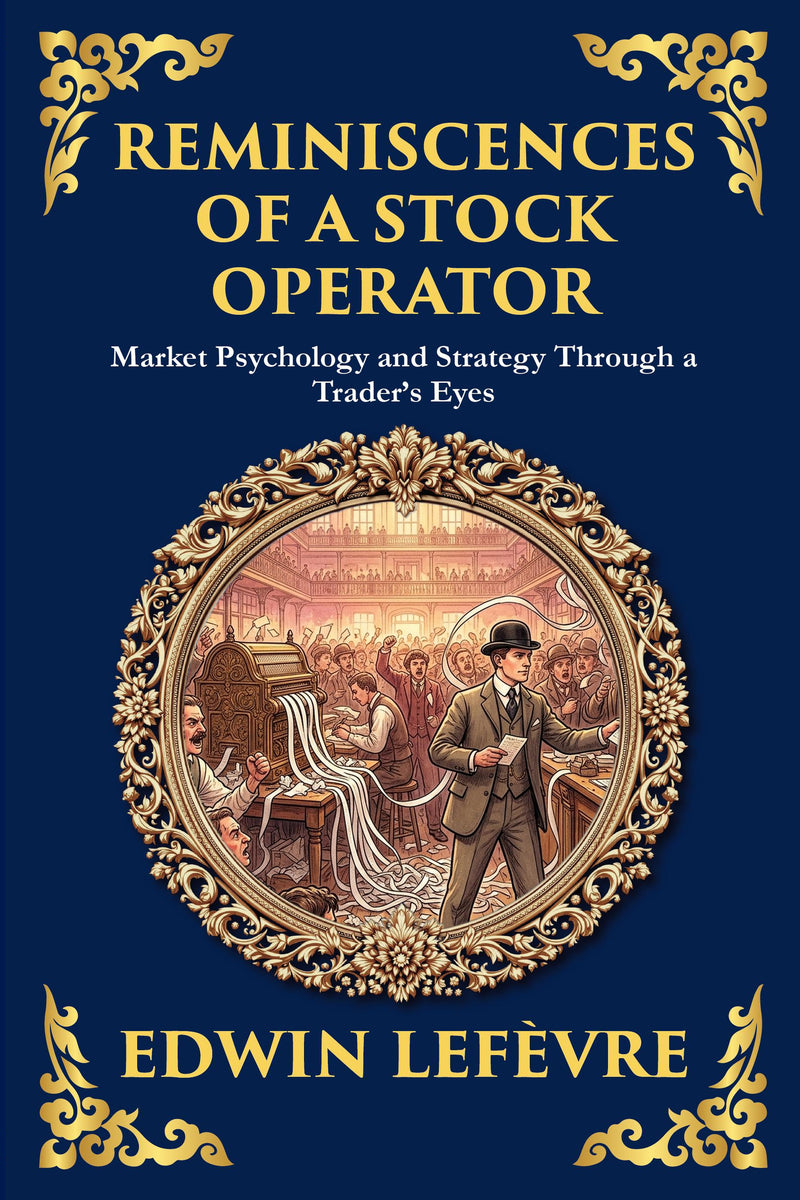
Reminiscences of a Stock Operator
Step into the mind of one of history’s greatest speculators. Reminiscences of a Stock Operator is a timeless exploration of financial markets, human psychology, and the discipline required for success.
or free app
10,000+ hrs library
30-day guarantee
The complete Reminiscences of a Stock Operator appears in modern English through Library of Alexandria Press, available online with audiobook narration included for members.
Have you ever wondered why even the smartest investors fail without mastering their emotions? Reminiscences of a Stock Operator by Edwin Lefèvre is not merely a financial memoir—it’s a psychological blueprint for understanding market behavior. Chronicling the life of the iconic trader Jesse Livermore under the pseudonym Larry Livingston, this modernized edition makes timeless lessons accessible for today’s readers.
With unmatched storytelling and razor-sharp insights, Lefèvre presents a portrait of Wall Street that is as captivating as it is instructive. From humble beginnings betting on stock prices in bucket shops to commanding millions in high-stakes trades, Livingston's journey uncovers what it truly takes to succeed—and survive—in volatile financial markets. In this definitive edition, you’ll discover: The Psychology of Market Cycles – Understand how fear, hope, and greed control the masses. Trading Tactics That Withstand Time – Follow the evolution of strategies that remain relevant today. The Power of Discipline and Timing – Learn why patience and timing are more valuable than tips. The Cost of Overtrading and Ego – Discover the personal pitfalls that destroy more fortunes than bad trades. A Candid View of Success and Ruin – A real trader’s triumphs and failures told with brutal honesty. This modern adaptation maintains the elegance of Lefèvre’s original prose while highlighting enduring principles that shape markets and traders alike.
It’s a must-read for anyone seeking wisdom in a world that runs on speculation. Whether you’re on the trading floor or managing a personal portfolio, Reminiscences of a Stock Operator is your essential guide to mastering the market mind.
| Formats | eBook (EPUB + PDF) · Audiobook · Paperback · Hardcover · Large Print |
| Language | English |
| Trim size (print) | 6 × 9 in |
| Binding | Paperback — perfect-bound · Hardcover — casewrap |
| Large Print edition | Same text in a larger, easy-read type — a larger font, not a larger trim |
| Print pricing | Every physical book at our true cost — at-cost, no profit (members) |
| Library | 873 restored titles, always growing |
| Length | 104,757 words · ~6 hr 59 min reading |
| Reading level | Grade 6 · an easy, flowing read (this modern-English edition) |
| Edition | Modern English translation · 2026 |
Member reviews for this edition are collected as readers finish it — be the first. Across the library: 12,000+ books shipped, every plan covered by a 365-day print guarantee.
About this edition
A faithful, unabridged modern-English edition by The Library of Alexandria — carefully rendered for today's reader and verified paragraph-by-paragraph against the public-domain source. Available as eBook, audiobook, paperback, hardcover, and large print.
- Complete & unabridgedVerified paragraph by paragraph against the source — never a scan, never abridged.
- Modern English, faithfulReadable today, with the author’s meaning kept intact. Readable — not simplified.
- Every format, one membershipRead in your browser or the free app, or listen to the full audiobook.
Included free with your membership
Cancel anytime, one click · 30-day money-back guarantee
Edition last updated July 2026
What’s inside
Reminiscences of a Stock Operator — complete and unabridged: all 25 sections included with membership, plus the full audiobook.
Begin reading Reminiscences of a Stock Operator
In clear modern English — the complete text is included with membership.
Introduction
There are books about money, and there are books about markets, and then there is a small, rarefied class of books that are really about the human mind under pressure — about hope and fear, discipline and recklessness, patience and the almost unbearable urge to act. Reminiscences of a Stock Operator belongs unmistakably to that last category. First published in 1923, it has survived a full century not because the prices it quotes remain accurate, nor because its specific trades can still be executed, but because it captures something timeless: what it actually feels like to risk your own conviction against the collective judgment of everyone else in the world, day after day, and to live with the consequences.
This edition — a modern translation adapted for the contemporary reader — exists to make that experience accessible to a new generation. The language of 1923 was vivid and muscular, but it was also studded with the slang of a vanished trading floor, the rhythms of a more formal age, and references to instruments, institutions, and personalities that have long since faded from memory. The aim here has been to preserve every ounce of the book’s wisdom, voice, and narrative momentum while clearing away the verbal underbrush that can make older texts feel like archaeology rather than conversation. You are meant to feel, as you read, that a brilliant and somewhat haunted practitioner is sitting across from you, telling you the truth about a craft he both loved and was nearly destroyed by.
What follows is an attempt to prepare you for that conversation — to give you the context, the questions to hold in mind, and the frame of mind that will turn a remarkable book into a genuinely transformative reading experience.
A Book Pretending to Be a Novel, a Novel Pretending to Be a Memoir
The first thing worth understanding is the curious nature of the thing you are about to read. On its face, Reminiscences of a Stock Operator is fiction. Its narrator is a man named Larry Livingston, who tells us his life story in the first person, beginning as a boy chalking stock quotations on a board in a brokerage office and rising, through ruin and recovery many times over, to become one of the most formidable speculators of his era. The author, Edwin Lefèvre, was a working journalist and writer of financial fiction — a man fluent in the world of Wall Street and gifted at rendering its texture in prose that snaps and crackles with life.
But almost no one has ever read this book as pure invention. From the moment of its publication, readers understood that Larry Livingston was a thin and barely disguised portrait of a real man: Jesse Lauriston Livermore, one of the most legendary and controversial traders in American history. Livermore made and lost several fortunes of staggering size, earned the nicknames “the Boy Plunger” and “the Great Bear of Wall Street,” and was famous — or infamous — for the audacity of his short selling and the scale of his positions. The details of Livingston’s career track Livermore’s with such fidelity that the book has long been treated as something close to an authorized autobiography channeled through a more elegant pen.
This hybrid quality is part of the book’s genius. Because it is told as a story rather than as a manual, it never lectures. There are no chapters titled “Rule Number One” or “The Seven Habits of Winning Traders.” Instead, the lessons emerge organically from lived experience — from triumphs that feel earned and disasters that feel inevitable in hindsight, even though the narrator could not see them coming at the time. You absorb the wisdom the way the narrator did: by watching it cost him something. This is why so many professional traders, decades and even a century later, still name it the single most valuable book they have ever read about the markets. It does not tell you how to behave. It shows you a man behaving, sometimes magnificently and sometimes catastrophically, and lets you draw your own conclusions.
The fictional frame also liberates the narrative. Because Lefèvre was not bound to the exact record, he could compress, dramatize, and arrange events to bring out their meaning. The result reads less like a ledger and more like a confession — intimate, reflective, occasionally rueful, and always self-aware. Livingston is not a flawless hero held up for our admiration. He is a man who repeatedly learns the same lesson, forgets it, relearns it at greater cost, and admits as much with a candor that is genuinely disarming. That honesty is what makes the book trustworthy. When a narrator is willing to tell you, in detail, about the times he was a fool, you tend to believe him when he tells you what he eventually understood.
In adapting this text for the modern reader, we have been careful to protect that confessional intimacy above all else. The voice — wry, observant, hard-won — is the true protagonist of the book, more so even than the trades it describes. You should come away feeling that you have spent time with a particular human consciousness, not merely consumed information.
Why the Markets of a Century Ago Still Speak to Us Now
A skeptical reader might reasonably ask: what could a book about speculation in the early twentieth century possibly have to teach anyone navigating today’s hyper-connected, algorithm-driven, smartphone-accessible financial world? The narrator trades in an era of ticker tape and bucket shops, of physical brokerage offices and telegraph wires, of markets that moved at a human pace and could be cornered by a handful of powerful men. The machinery has changed beyond recognition. Surely the substance must be obsolete too.
The answer — and it is the central reason this book endures — is that the machinery was never the point. The book’s enduring power lies in its diagnosis of human nature, and human nature has not been upgraded. Every emotional trap the narrator describes is exactly as live and dangerous today as it was a century ago. The investor who refuses to sell a losing position because he cannot bear to admit he was wrong; the trader who takes a small profit far too early out of nervousness, then watches the trade he abandoned run for ten times the gain; the speculator who lets a single brilliant insight inflate his ego until he believes himself infallible, and then bets the farm on something he has not actually thought through — these are not historical curiosities. They are the recurring tragedies of every trading floor, every brokerage app, every cryptocurrency forum, and every retirement account in the world right now.
What the narrator understood, and what he articulates with unusual clarity, is that the great enemy in the markets is rarely a lack of information or even a lack of intelligence. The great enemy is the trader’s own psychology. Hope makes you hold losers; fear makes you sell winners. Greed makes you overtrade; impatience makes you act before the moment is ripe. The book returns again and again to the idea that the hardest discipline is not analysis but emotional restraint — the capacity to sit still when sitting still is the right move, even though every instinct screams at you to do something. “It was never my thinking that made the big money for me,” the narrator famously reflects in substance. “It was always my sitting.” In an age when you can buy and sell an entire portfolio with a single thumb-swipe at three in the morning, that lesson has arguably never been more urgent.
There is also a profound and surprisingly modern insight in the book about the difference between being right and making money — two things that turn out to be far less connected than beginners assume. The narrator describes situations in which his fundamental judgment about a stock or a market was completely correct, and yet he lost money because his timing was wrong, or because he sized his position badly, or because he could not hold his nerve long enough for the world to come around to his view. He describes the opposite as well: occasions when being right at the wrong moment is functionally identical to being wrong. This distinction is one of the most sophisticated ideas in all of practical finance, and the book delivers it not as an abstraction but as a series of painful, instructive experiences.
Even the more dated material rewards attention. The descriptions of bucket shops — establishments where customers bet on price movements without any real shares ever changing hands — read today like a startling premonition of certain corners of the modern speculative landscape, where leverage and the appearance of trading can mask what is essentially gambling. The narrator’s running battle with these establishments, who eventually barred him because he won too consistently, is both entertaining as story and instructive as economics. Likewise, his accounts of market manipulation, of the deliberate spreading of rumors, of the games played to lure the public into buying at the top, are sobering reminders that markets have always been arenas in which the informed prey upon the credulous. The methods evolve; the dynamic persists.
In short, the technology of this book is a museum piece, but its psychology is a mirror. You will recognize yourself in it — your own temptations, your own rationalizations, your own moments of misplaced confidence — and that recognition is precisely what makes it useful. A century of readers have used this book not to learn what to buy but to learn what kind of trader, and what kind of person, they are.
How to Read This Book for the Greatest Reward
Because Reminiscences of a Stock Operator is structured as a narrative rather than as a textbook, the best way to read it is not the way you might read a how-to guide. There is no point hunting for bullet-pointed takeaways or skipping ahead to the “conclusions.” The wisdom is distributed throughout, embedded in episodes, and it lands hardest when you allow yourself to live through each episode at the narrator’s pace. With that in mind, a few suggestions may help you get the most from the journey.
First, resist the urge to read it merely as a financial document and let yourself read it as a human story. The narrator is a fully realized character — ambitious, intelligent, proud, generous, occasionally self-destructive, and deeply reflective about his own failings. His relationships, his moods, his recoveries from ruin, and his hard-won self-knowledge are as compelling as any in fiction. If you engage with him as a person rather than as a source of trading tips, the lessons will reach you more deeply, because you will care about the man learning them. The book is, at bottom, a study of character tested by extreme circumstances, and character is what you should watch.
Second, pay attention to the pattern of repetition. One of the most striking features of the narrative is how often the narrator makes the same mistake more than once. He learns a principle, states it clearly, and then — chapters later — violates it and pays the price all over again. A casual reader might find this frustrating or take it as a flaw. It is, in fact, the most truthful thing about the book. Real learning is rarely a single clean arc from ignorance to wisdom; it is a spiral, in which we relearn what we already know, each time at a higher cost, until the lesson finally burns itself permanently into us. The narrator’s willingness to show this messy reality, rather than presenting himself as a man who learned each lesson once and never forgot it, is what separates this book from the smug self-help literature that has cluttered the shelves ever since. Watch the repetitions. They are the most honest part of the education.
Third, keep a notebook, or at least a running mental list, of the principles the narrator articulates as he goes. He has a gift for compressing hard-won truth into memorable, almost aphoristic statements — about the futility of fighting the overall trend, about the difference between a tip and a conviction, about the danger of trading for excitement rather than profit, about the necessity of cutting losses quickly and letting profits run. These lines have echoed through trading culture for a hundred years because they are dense with truth. Collecting them as you read, and then reflecting on which ones speak most directly to your own temperament, will turn a passive reading into an active dialogue. The book becomes a kind of personal inventory: which of these traps am I most prone to? Which of these disciplines do I most lack?
Cancel anytime, one click · 30-day money-back guarantee
Founding annual rate available now — your price locks for life when you join.
Not ready? Get this free chapter by email — read it anytime.
✓ Sent — check your inbox for Reminiscences of a Stock Operator.
Questions about Reminiscences of a Stock Operator
What is Reminiscences of a Stock Operator about?
Step into the mind of one of history’s greatest speculators. Reminiscences of a Stock Operator is a timeless exploration of financial markets, human psychology, and the discipline required for success. Based on the life of legendary trader Jesse Livermore, this classic reveals the inner workings of Wall Street through the fictionalized voice of Larry Livingston.
Who wrote Reminiscences of a Stock Operator?
Reminiscences of a Stock Operator was written by Edwin Lefèvre. This edition presents the complete work in clear modern English, faithfully rendered from the public-domain original by Library of Alexandria Press.
Is Reminiscences of a Stock Operator free to read?
The opening chapter is free to read on this page. Members read and listen to the complete work — and the entire library — free, and can order any physical book at our true print cost.
How long is Reminiscences of a Stock Operator?
25 chapters (~104,757 words) — about 6 hr 59 min of reading in this modern-English edition.
Is this an abridged version of Reminiscences of a Stock Operator?
No. This is the complete, unabridged Reminiscences of a Stock Operator, carefully rendered into clear modern English and verified paragraph-by-paragraph against the public-domain source — nothing is cut or summarised.
What formats does Reminiscences of a Stock Operator come in?
Reminiscences of a Stock Operator is available as eBook, paperback, hardcover and large print. eBook and audiobook are included with membership; printed editions ship at our true print cost.
Shipping & returns
Billing & membership
More from the library


Explore Biography & Letters
- Meditations · Marcus Aurelius
- The Confessions of St. Augustine · Saint Augustine
- The Confessions of Jean-Jacques Rousseau — Complete · Jean-Jacques Rousseau
- Ecce Homo · Friedrich Wilhelm Nietzsche
- De Profundis · Oscar Wilde
- Memoirs of Joseph Grimaldi · Joseph Grimaldi
- English Eccentrics and Eccentricities · John Timbs
- You Can’t Win · Jack Black
- Wild Animals I Have Known · Ernest Thompson Seton
- The Diary of Samuel Pepys — Complete 1665 N.S. · Samuel Pepys
- Random Reminiscences of Men and Events · John D. Rockefeller
- The Story of My Life · Helen Keller
- Elizabeth, Empress of Austria and Queen of Hungary · Carl Küchler
- Society as I Have Found It · Ward McAllister
- Autobiography of a Yogi · Paramahansa Yogananda
- Christopher Columbus and How He Received and Imparted the Spirit of Discovery
- A Portrait of the Artist as a Young Man · James Joyce
- Memoirs of the Author of a Vindication of the Rights of Woman · William Godwin
- Mary: A Fiction · Mary Wollstonecraft
- The Romance of Biography (Vol. 1 of 2) · Mrs. Jameson
- The Love Letters of Mary Wollstonecraft to Gilbert Imlay · Mary Wollstonecraft
- Selected Works of Voltairine de Cleyre · Voltairine de Cleyre
- Eighty Years and More; Reminiscences 1815–1897 · Elizabeth Cady Stanton
- Anarchism and Other Essays · Emma Goldman
- Agnes Grey · Anne Brontë
- Daddy-Long-Legs · Jean Webster
- Martin Eden · Jack London
- Matthew Calbraith Perry: A Typical American Naval Officer · William Elliot Griffis
- Walden, and On the Duty of Civil Disobedience · Henry David Thoreau
- Little Women · Louisa May Alcott
Reminiscences of a Stock Operator
Reminiscences of a Stock Operator
Market Psychology and Strategy Through a Trader’s Eyes
Edwin Lefèvre
Contents
- Introduction
- Chapter 1
- Chapter 2
- Chapter 3
- Chapter 4
- Chapter 5
- Chapter 6
- Chapter 7
- Chapter 8
- Chapter 9
- Chapter 10
- Chapter 11
- Chapter 12
- Chapter 13
- Chapter 14
- Chapter 15
- Chapter 16
- Chapter 17
- Chapter 18
- Chapter 19
- Chapter 20
- Chapter 21
- Chapter 22
- Chapter 23
- Chapter 24
Introduction
There are books about money, and there are books about markets, and then there is a small, rarefied class of books that are really about the human mind under pressure — about hope and fear, discipline and recklessness, patience and the almost unbearable urge to act. Reminiscences of a Stock Operator belongs unmistakably to that last category. First published in 1923, it has survived a full century not because the prices it quotes remain accurate, nor because its specific trades can still be executed, but because it captures something timeless: what it actually feels like to risk your own conviction against the collective judgment of everyone else in the world, day after day, and to live with the consequences.
This edition — a modern translation adapted for the contemporary reader — exists to make that experience accessible to a new generation. The language of 1923 was vivid and muscular, but it was also studded with the slang of a vanished trading floor, the rhythms of a more formal age, and references to instruments, institutions, and personalities that have long since faded from memory. The aim here has been to preserve every ounce of the book’s wisdom, voice, and narrative momentum while clearing away the verbal underbrush that can make older texts feel like archaeology rather than conversation. You are meant to feel, as you read, that a brilliant and somewhat haunted practitioner is sitting across from you, telling you the truth about a craft he both loved and was nearly destroyed by.
What follows is an attempt to prepare you for that conversation — to give you the context, the questions to hold in mind, and the frame of mind that will turn a remarkable book into a genuinely transformative reading experience.
A Book Pretending to Be a Novel, a Novel Pretending to Be a Memoir
The first thing worth understanding is the curious nature of the thing you are about to read. On its face, Reminiscences of a Stock Operator is fiction. Its narrator is a man named Larry Livingston, who tells us his life story in the first person, beginning as a boy chalking stock quotations on a board in a brokerage office and rising, through ruin and recovery many times over, to become one of the most formidable speculators of his era. The author, Edwin Lefèvre, was a working journalist and writer of financial fiction — a man fluent in the world of Wall Street and gifted at rendering its texture in prose that snaps and crackles with life.
But almost no one has ever read this book as pure invention. From the moment of its publication, readers understood that Larry Livingston was a thin and barely disguised portrait of a real man: Jesse Lauriston Livermore, one of the most legendary and controversial traders in American history. Livermore made and lost several fortunes of staggering size, earned the nicknames “the Boy Plunger” and “the Great Bear of Wall Street,” and was famous — or infamous — for the audacity of his short selling and the scale of his positions. The details of Livingston’s career track Livermore’s with such fidelity that the book has long been treated as something close to an authorized autobiography channeled through a more elegant pen.
This hybrid quality is part of the book’s genius. Because it is told as a story rather than as a manual, it never lectures. There are no chapters titled “Rule Number One” or “The Seven Habits of Winning Traders.” Instead, the lessons emerge organically from lived experience — from triumphs that feel earned and disasters that feel inevitable in hindsight, even though the narrator could not see them coming at the time. You absorb the wisdom the way the narrator did: by watching it cost him something. This is why so many professional traders, decades and even a century later, still name it the single most valuable book they have ever read about the markets. It does not tell you how to behave. It shows you a man behaving, sometimes magnificently and sometimes catastrophically, and lets you draw your own conclusions.
The fictional frame also liberates the narrative. Because Lefèvre was not bound to the exact record, he could compress, dramatize, and arrange events to bring out their meaning. The result reads less like a ledger and more like a confession — intimate, reflective, occasionally rueful, and always self-aware. Livingston is not a flawless hero held up for our admiration. He is a man who repeatedly learns the same lesson, forgets it, relearns it at greater cost, and admits as much with a candor that is genuinely disarming. That honesty is what makes the book trustworthy. When a narrator is willing to tell you, in detail, about the times he was a fool, you tend to believe him when he tells you what he eventually understood.
In adapting this text for the modern reader, we have been careful to protect that confessional intimacy above all else. The voice — wry, observant, hard-won — is the true protagonist of the book, more so even than the trades it describes. You should come away feeling that you have spent time with a particular human consciousness, not merely consumed information.
Why the Markets of a Century Ago Still Speak to Us Now
A skeptical reader might reasonably ask: what could a book about speculation in the early twentieth century possibly have to teach anyone navigating today’s hyper-connected, algorithm-driven, smartphone-accessible financial world? The narrator trades in an era of ticker tape and bucket shops, of physical brokerage offices and telegraph wires, of markets that moved at a human pace and could be cornered by a handful of powerful men. The machinery has changed beyond recognition. Surely the substance must be obsolete too.
The answer — and it is the central reason this book endures — is that the machinery was never the point. The book’s enduring power lies in its diagnosis of human nature, and human nature has not been upgraded. Every emotional trap the narrator describes is exactly as live and dangerous today as it was a century ago. The investor who refuses to sell a losing position because he cannot bear to admit he was wrong; the trader who takes a small profit far too early out of nervousness, then watches the trade he abandoned run for ten times the gain; the speculator who lets a single brilliant insight inflate his ego until he believes himself infallible, and then bets the farm on something he has not actually thought through — these are not historical curiosities. They are the recurring tragedies of every trading floor, every brokerage app, every cryptocurrency forum, and every retirement account in the world right now.
What the narrator understood, and what he articulates with unusual clarity, is that the great enemy in the markets is rarely a lack of information or even a lack of intelligence. The great enemy is the trader’s own psychology. Hope makes you hold losers; fear makes you sell winners. Greed makes you overtrade; impatience makes you act before the moment is ripe. The book returns again and again to the idea that the hardest discipline is not analysis but emotional restraint — the capacity to sit still when sitting still is the right move, even though every instinct screams at you to do something. “It was never my thinking that made the big money for me,” the narrator famously reflects in substance. “It was always my sitting.” In an age when you can buy and sell an entire portfolio with a single thumb-swipe at three in the morning, that lesson has arguably never been more urgent.
There is also a profound and surprisingly modern insight in the book about the difference between being right and making money — two things that turn out to be far less connected than beginners assume. The narrator describes situations in which his fundamental judgment about a stock or a market was completely correct, and yet he lost money because his timing was wrong, or because he sized his position badly, or because he could not hold his nerve long enough for the world to come around to his view. He describes the opposite as well: occasions when being right at the wrong moment is functionally identical to being wrong. This distinction is one of the most sophisticated ideas in all of practical finance, and the book delivers it not as an abstraction but as a series of painful, instructive experiences.
Even the more dated material rewards attention. The descriptions of bucket shops — establishments where customers bet on price movements without any real shares ever changing hands — read today like a startling premonition of certain corners of the modern speculative landscape, where leverage and the appearance of trading can mask what is essentially gambling. The narrator’s running battle with these establishments, who eventually barred him because he won too consistently, is both entertaining as story and instructive as economics. Likewise, his accounts of market manipulation, of the deliberate spreading of rumors, of the games played to lure the public into buying at the top, are sobering reminders that markets have always been arenas in which the informed prey upon the credulous. The methods evolve; the dynamic persists.
In short, the technology of this book is a museum piece, but its psychology is a mirror. You will recognize yourself in it — your own temptations, your own rationalizations, your own moments of misplaced confidence — and that recognition is precisely what makes it useful. A century of readers have used this book not to learn what to buy but to learn what kind of trader, and what kind of person, they are.
How to Read This Book for the Greatest Reward
Because Reminiscences of a Stock Operator is structured as a narrative rather than as a textbook, the best way to read it is not the way you might read a how-to guide. There is no point hunting for bullet-pointed takeaways or skipping ahead to the “conclusions.” The wisdom is distributed throughout, embedded in episodes, and it lands hardest when you allow yourself to live through each episode at the narrator’s pace. With that in mind, a few suggestions may help you get the most from the journey.
First, resist the urge to read it merely as a financial document and let yourself read it as a human story. The narrator is a fully realized character — ambitious, intelligent, proud, generous, occasionally self-destructive, and deeply reflective about his own failings. His relationships, his moods, his recoveries from ruin, and his hard-won self-knowledge are as compelling as any in fiction. If you engage with him as a person rather than as a source of trading tips, the lessons will reach you more deeply, because you will care about the man learning them. The book is, at bottom, a study of character tested by extreme circumstances, and character is what you should watch.
Second, pay attention to the pattern of repetition. One of the most striking features of the narrative is how often the narrator makes the same mistake more than once. He learns a principle, states it clearly, and then — chapters later — violates it and pays the price all over again. A casual reader might find this frustrating or take it as a flaw. It is, in fact, the most truthful thing about the book. Real learning is rarely a single clean arc from ignorance to wisdom; it is a spiral, in which we relearn what we already know, each time at a higher cost, until the lesson finally burns itself permanently into us. The narrator’s willingness to show this messy reality, rather than presenting himself as a man who learned each lesson once and never forgot it, is what separates this book from the smug self-help literature that has cluttered the shelves ever since. Watch the repetitions. They are the most honest part of the education.
Third, keep a notebook, or at least a running mental list, of the principles the narrator articulates as he goes. He has a gift for compressing hard-won truth into memorable, almost aphoristic statements — about the futility of fighting the overall trend, about the difference between a tip and a conviction, about the danger of trading for excitement rather than profit, about the necessity of cutting losses quickly and letting profits run. These lines have echoed through trading culture for a hundred years because they are dense with truth. Collecting them as you read, and then reflecting on which ones speak most directly to your own temperament, will turn a passive reading into an active dialogue. The book becomes a kind of personal inventory: which of these traps am I most prone to? Which of these disciplines do I most lack?
I started working right after I finished grammar school. I got a job as a quotation-board boy in a stock brokerage office. I was fast with numbers; in school, I finished three years of arithmetic in one. I was especially good at mental math. As the quotation-board boy, my job was to post the numbers on the big board in the customer room. Usually, one of the customers would sit by the ticker and call out the prices. They couldn’t call them out faster than I could write them. I’ve always had a knack for remembering numbers. It was easy for me.
There were plenty of other employees in that office. I made friends with the other guys, of course, but when the market was active, my work kept me too busy from 10 a.m. to 3 p.m. to talk much. I’ve never been one for chatting during business hours anyway.
Even when the market was busy, I didn’t stop thinking about the work. To me, those quotations weren’t just stock prices or dollar amounts per share—they were numbers. Of course, they meant something, and they were always changing. The changes were the only thing I cared about. Why did they change? I didn’t know, and I didn’t really care. I didn’t think about the “why”; I just noticed that they did change. For five hours every weekday and two hours on Saturdays, that was my sole focus: the fact that they were constantly shifting.
That’s how I first became interested in how prices behave. I had a great memory for numbers and could remember exactly how prices had moved the previous day right before they went up or down. My love for mental math came in very handy.
I noticed that stock prices tended to follow certain patterns, so to speak, whether they were rising or falling. I found endless similar cases, and these became the precedents that guided me. I was only fourteen, but after recording hundreds of observations in my head, I started testing their accuracy by comparing today’s stock behavior with previous days. Before long, I was predicting price movements. As I said, my only guide was past performance. I kept the “dope sheets” in my mind, expecting stock prices to follow a predictable form. I had “clocked” them, if you know what I mean.
End of the free sample
Keep reading, free
Members read and listen to the complete book — and the entire library. Cancel anytime, one click · 30-day money-back guarantee.