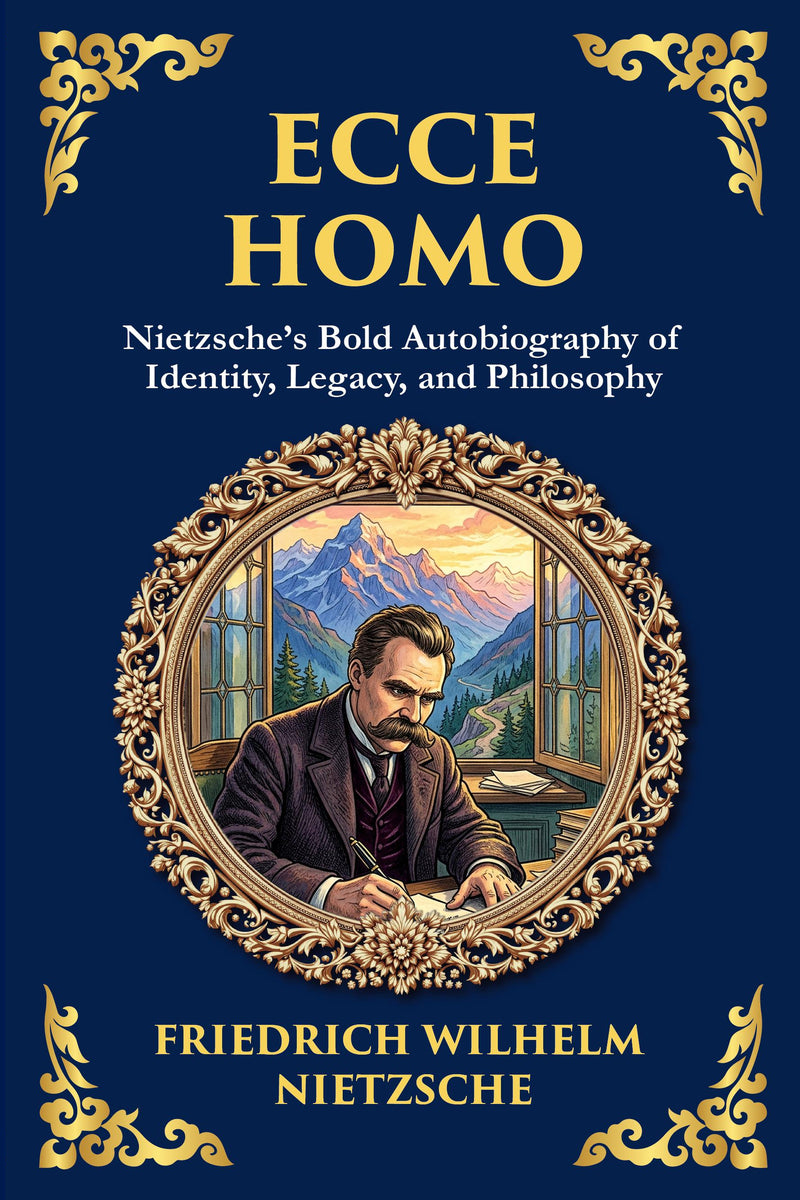
Ecce Homo
Friedrich Nietzsche Ecce Homo is not a conventional autobiography. It is a thunderous, defiant, and often shocking final statement from one of philosophy’s most audacious voices.
or free app
10,000+ hrs library
30-day guarantee
The complete Ecce Homo appears in modern English through Library of Alexandria Press, available online with audiobook narration included for members.
Have you ever wondered why the most dangerous ideas often wear the mask of genius? In Ecce Homo, Friedrich Nietzsche delivers one of the most unapologetically original autobiographies ever written. Composed at the end of his productive life, this work is part confession, part critique, and part celebration—a philosophical performance through which Nietzsche aims to immortalize himself.
With biting wit and razor-sharp intellect, Nietzsche revisits his earlier masterpieces (Thus Spoke Zarathustra, Beyond Good and Evil, The Birth of Tragedy, among others), dissecting not only what he wrote but why he wrote it. He introduces readers to his concept of “amor fati” (love of fate), boldly declares “why he is so clever,” and dares to proclaim the arrival of a new kind of thinker—one who goes beyond good and evil to forge a life of authentic power and purpose. This new translation preserves Nietzsche’s sharp tone, playful irony, and fierce intellect while offering clarity and accessibility for the modern reader.
More than a memoir, Ecce Homo is a declaration of philosophical war—against religion, morality, mediocrity, and the decay of truth.
What you’ll discover in this modern edition
- in This Modern Edition of Nietzsche’s Final Masterwork:
- A Philosophical Self-Portrait – Nietzsche explains his own psyche, challenges, and evolution as a thinker.
| Formats | eBook (EPUB + PDF) · Audiobook · Paperback · Hardcover · Large Print |
| Language | English |
| Trim size (print) | 6 × 9 in |
| Binding | Paperback — perfect-bound · Hardcover — casewrap |
| Large Print edition | Same text in a larger, easy-read type — a larger font, not a larger trim |
| Print pricing | Every physical book at our true cost — at-cost, no profit (members) |
| Library | 873 restored titles, always growing |
| Length | 34,824 words · ~2 hr 19 min reading |
| Reading level | Grade 3 · an easy, flowing read (this modern-English edition) |
| Edition | Modern English translation · 2026 |
Member reviews for this edition are collected as readers finish it — be the first. Across the library: 12,000+ books shipped, every plan covered by a 365-day print guarantee.
About this edition
A faithful, unabridged modern-English edition by The Library of Alexandria — carefully rendered for today's reader and verified paragraph-by-paragraph against the public-domain source. Available as eBook, audiobook, paperback, hardcover, and large print.
- Complete & unabridgedVerified paragraph by paragraph against the source — never a scan, never abridged.
- Modern English, faithfulReadable today, with the author’s meaning kept intact. Readable — not simplified.
- Every format, one membershipRead in your browser or the free app, or listen to the full audiobook.
Included free with your membership
Cancel anytime, one click · 30-day money-back guarantee
Edition last updated July 2026
What’s inside
Ecce Homo — complete and unabridged: all 12 sections included with membership, plus the full audiobook.
Begin reading Ecce Homo
In clear modern English — the complete text is included with membership.
Introduction
There are books that explain a philosophy, and there are books that perform one. Ecce Homo belongs unmistakably to the second category. Written in the final lucid weeks of an extraordinary intellectual life, it is at once a memoir, a manifesto, a defense, a celebration, and a provocation. It refuses to behave the way an autobiography is supposed to behave. It does not unfold modestly, chronologically, or apologetically. Instead it arrives with a kind of electric audacity, announcing in its very chapter titles that the author is wise, that he is clever, that he writes such good books, and that his life and thought are destined to split history in two. To the reader encountering it for the first time, this can feel astonishing—even unsettling. That reaction is precisely the point. The book was designed to confront the reader, to dismantle the polite distance we usually keep from authors, and to demand that we take seriously a man who insisted on being misunderstood by his own age while believing himself indispensable to the next.
The title itself, drawn from the Latin words spoken by Pontius Pilate as he presented the scourged Christ to the crowd—Ecce homo, “Behold the man”—is loaded with deliberate irony and meaning. Nietzsche, the relentless critic of Christianity and the self-styled “Antichrist,” chose for his self-portrait a phrase soaked in the imagery of the very tradition he spent his career interrogating. To “behold the man” is to confront a human being stripped of illusion, presented in full to a watching world. But where Pilate’s phrase pointed toward a figure of suffering and sacrifice, Nietzsche reclaims it to point toward a figure of affirmation, vitality, and overflowing health—or at least, toward the image of such a figure that he wished to leave behind. This single gesture tells you a great deal about what awaits inside: an author who plays with the deepest symbols of Western culture, twisting them, inverting them, and forcing them to mean something new. Reading this work well means reading it alert to these reversals, because almost nothing in it is meant to be taken at simple face value.
This modern translation, adapted for the contemporary reader, has been prepared with the conviction that Nietzsche’s voice deserves to reach today’s audience without the static of archaic phrasing or the fog of overly literal rendering. Nietzsche was, by the testimony of nearly everyone who has read him in the original, one of the greatest stylists in the German language. He wrote with rhythm, with wit, with sudden shifts of register from the lyrical to the scathing, from the philosophical to the almost conversational. A translation that flattens this into stiff academic prose does him a profound disservice. The aim here has been to preserve the energy, the daring, and the music of the original while making the sentences breathe naturally for a reader in the present century. Where older translations might have left a reader puzzling over an obscure idiom or a dated turn of phrase, this version seeks clarity without sacrificing force. The hope is that you will hear, beneath the words on the page, something close to the living voice that wrote them.
To understand why Ecce Homo reads the way it does, it helps to understand something of the circumstances in which it was composed, without spoiling the experience of the text itself. Friedrich Nietzsche was born in 1844 in a small village in the Prussian province of Saxony, the son of a Lutheran pastor who died when the boy was very young. He was a prodigy of classical scholarship, appointed to a professorship at the University of Basel at the remarkable age of twenty-four, before he had even completed his doctorate. For a time it seemed he would lead a conventional academic career. But chronic illness, mounting frustration with the limits of professional scholarship, and an ever-deepening sense of his own philosophical mission led him to abandon the university and to live the wandering, solitary life of an independent thinker. He moved restlessly between boarding houses in Switzerland, Italy, and the south of France, chasing climates that might soothe his ravaged body, writing furiously in notebooks and on long mountain walks.
He was, throughout his productive years, a deeply isolated figure. His books sold poorly. His friendships were few and often strained. The great love of his life went unrequited. He suffered from blinding headaches, near-total loss of vision at times, nausea, and bouts of debilitating sickness that would lay him low for days. And yet, against all of this, he produced a body of work of staggering originality and range—works that would, decades after his death, reshape philosophy, psychology, literature, and the arts more profoundly than perhaps any other modern thinker. Ecce Homo was written in the autumn of 1888, during an astonishing burst of creative productivity that proved to be his last. Within weeks of completing it, he suffered a mental collapse from which he never recovered, spending the final eleven years of his life in the care of his mother and sister, almost entirely silent, witnessing none of the explosive fame that would soon attach to his name.
This biographical backdrop casts a particular light over the pages you are about to read. The book’s tone of triumphant self-assertion, its insistence on the author’s own greatness and destiny, takes on a poignant and complex character when set against the reality of a man writing in obscurity, in failing health, on the very edge of darkness. Some readers and scholars have wondered whether the soaring grandiosity of certain passages reflects the early stirrings of the illness that was about to overtake him. Others insist that the book is entirely consistent with the philosophical positions Nietzsche had been developing for years, and that to dismiss its boldness as a symptom is to misunderstand both the man and his project. The truth, as is so often the case with Nietzsche, resists easy resolution. What is undeniable is that Ecce Homo represents a thinker at the very limit of his powers, attempting to gather his entire life and body of work into a single, defiant summation before the curtain fell.
It is worth dwelling for a moment on what Nietzsche thought he was doing in writing such a book. He was acutely aware that he had been ignored, that his ideas had failed to find an audience, and that he was at constant risk of being misread by the few who did encounter him. Part of his purpose was therefore corrective: he wanted to tell the world, in advance of the recognition he was certain would come, exactly who he was and what his books actually meant. He proceeds through his major works one by one, offering retrospective commentary on each, explaining what he had intended, what was misunderstood, and how each fits into the larger arc of his thought. In this sense the book functions as an extraordinary guide to his own philosophy, a kind of self-curated tour through a mind of dazzling complexity. For the reader who has already encountered some of his earlier writings, these reflections are illuminating; for the reader who is meeting Nietzsche for the first time here, they serve as a remarkable doorway into a body of work that has shaped the modern world.
Approaching Ecce Homo with the right ear makes all the difference between bewilderment and exhilaration. The first thing to understand is that Nietzsche’s apparent arrogance is not quite what it appears. He is engaged in a deliberate war against a particular ideal—the ideal of Christian humility, of self-effacement, of the small and modest soul that shrinks from affirming its own worth. Throughout his career he had argued that this ideal of meekness was, in fact, a kind of sickness, a turning of life against itself, a denial of the vital instincts that make existence rich and creative. In Ecce Homo, he sets out to embody the opposite ideal in his very mode of self-presentation. The grand claims, the celebration of his own gifts, the refusal to apologize—these are not simply expressions of personal vanity. They are a philosophical performance, an enactment of the affirmative, self-celebrating posture that he believed life demanded. When he praises himself, he is, in a sense, making an argument. He is showing rather than telling what it might look like to be a human being fully reconciled to existence, who says yes to himself and to his life without reservation or guilt.
This connects to one of the central ideas that runs beneath the surface of the entire book: the idea he called amor fati, the love of one’s fate. For Nietzsche, the highest form of human affirmation was not merely to endure one’s life, not merely to accept it grudgingly, but to love it—to want nothing about it to be different, not the suffering, not the failures, not the illness, not the loneliness. He wished to be able to look back over the whole of his existence, with all its pain, and to affirm it completely, to declare that he would live it again exactly as it had been. Ecce Homo is, in many ways, the supreme expression of this attitude. It is an attempt to gather an entire life, including its considerable hardships, and to transform it through the act of writing into something triumphant, something willed, something loved. When you read his accounts of his health, his diet, his climate, his solitude—accounts that might otherwise seem trivial or self-absorbed—it helps to remember that for him these were not trivialities. They were the raw material of a life he was determined to affirm in full.
The second thing to listen for is the humor. Ecce Homo is, surprisingly, a very funny book. Nietzsche had a sharp and often wicked sense of comedy, and much of the book’s apparent self-aggrandizement is laced with irony, exaggeration, and self-aware playfulness. He is performing a role, and part of the pleasure of reading him lies in catching the wink behind the boast. Those chapter titles—“Why I Am So Wise,” “Why I Am So Clever,” “Why I Write Such Good Books”—are not the titles of a man who has lost his sense of proportion. They are the titles of a man who knows exactly how outrageous he is being and who delights in the outrage. He is daring you to be scandalized, and then daring you to laugh. The reader who approaches the book grimly, expecting only solemn philosophical pronouncements, will miss half of what makes it remarkable. There is a lightness, a mischief, a sense of dance in these pages that coexists with the deepest seriousness.
The third thing to attend to is the way Nietzsche talks about his own books. As he moves through his major works, commenting on each, he offers some of his clearest statements about what he was trying to achieve across his whole career. He addresses the great themes that occupied him: the critique of conventional morality, the rejection of the comforting illusions he believed religion and metaphysics had foisted upon humanity, the celebration of art and creativity as the highest human activities, the call for human beings to become something greater than they currently are. These passages are invaluable precisely because they come from the man himself, looking back over decades of thought and trying to articulate the unity beneath the diversity of his writings. Even readers who have spent years studying Nietzsche find these self-commentaries clarifying, because they reveal what he himself considered most essential, what he believed he had accomplished, and where he feared he might be misunderstood.
It is also worth being prepared for the book’s most pointed and uncomfortable moments. Nietzsche does not pull his punches when it comes to Christianity, to German nationalism, to the political and cultural currents of his age, or to various individuals he regarded as his opponents. Some of what he writes is deliberately provocative, designed to shock the reader out of complacency. Modern readers will find some of his judgments brilliant, others questionable, and a few genuinely troubling. It is important to read him as a thinker in dialogue with us across more than a century, neither swallowing his every pronouncement whole nor dismissing him because he offends contemporary sensibilities. The richest reading of Nietzsche is an argumentative one, in which the reader pushes back, questions, and tests his claims against their own experience and judgment. He would have wanted nothing less. He had nothing but contempt for disciples who merely repeated his views; he wanted readers who would think for themselves, who would take what was useful and discard the rest, who would use his books as a means of becoming more fully themselves.
Cancel anytime, one click · 30-day money-back guarantee
Founding annual rate available now — your price locks for life when you join.
Not ready? Get this free chapter by email — read it anytime.
✓ Sent — check your inbox for Ecce Homo.
Questions about Ecce Homo
What is Ecce Homo about?
Friedrich Nietzsche Ecce Homo is not a conventional autobiography. It is a thunderous, defiant, and often shocking final statement from one of philosophy’s most audacious voices. With characteristic brilliance and irony, Nietzsche recounts the making of his most famous works, dissects his own mind, and provocatively redefines what it means to live, to suffer, and to think.
Who wrote Ecce Homo?
Ecce Homo was written by Friedrich Wilhelm Nietzsche. This edition presents the complete work in clear modern English, faithfully rendered from the public-domain original by Library of Alexandria Press.
Is Ecce Homo free to read?
The opening chapter is free to read on this page. Members read and listen to the complete work — and the entire library — free, and can order any physical book at our true print cost.
How long is Ecce Homo?
12 chapters (~34,824 words) — about 2 hr 19 min of reading in this modern-English edition.
Is this an abridged version of Ecce Homo?
No. This is the complete, unabridged Ecce Homo, carefully rendered into clear modern English and verified paragraph-by-paragraph against the public-domain source — nothing is cut or summarised.
What formats does Ecce Homo come in?
Ecce Homo is available as eBook, paperback, hardcover and large print. eBook and audiobook are included with membership; printed editions ship at our true print cost.
Shipping & returns
Billing & membership
More from the library


Explore Biography & Letters
- Meditations · Marcus Aurelius
- The Confessions of St. Augustine · Saint Augustine
- The Confessions of Jean-Jacques Rousseau — Complete · Jean-Jacques Rousseau
- De Profundis · Oscar Wilde
- Memoirs of Joseph Grimaldi · Joseph Grimaldi
- English Eccentrics and Eccentricities · John Timbs
- You Can’t Win · Jack Black
- Wild Animals I Have Known · Ernest Thompson Seton
- The Diary of Samuel Pepys — Complete 1665 N.S. · Samuel Pepys
- Random Reminiscences of Men and Events · John D. Rockefeller
- The Story of My Life · Helen Keller
- Elizabeth, Empress of Austria and Queen of Hungary · Carl Küchler
- Society as I Have Found It · Ward McAllister
- Autobiography of a Yogi · Paramahansa Yogananda
- Christopher Columbus and How He Received and Imparted the Spirit of Discovery
- A Portrait of the Artist as a Young Man · James Joyce
- Memoirs of the Author of a Vindication of the Rights of Woman · William Godwin
- Mary: A Fiction · Mary Wollstonecraft
- The Romance of Biography (Vol. 1 of 2) · Mrs. Jameson
- The Love Letters of Mary Wollstonecraft to Gilbert Imlay · Mary Wollstonecraft
- Selected Works of Voltairine de Cleyre · Voltairine de Cleyre
- Eighty Years and More; Reminiscences 1815–1897 · Elizabeth Cady Stanton
- Anarchism and Other Essays · Emma Goldman
- Agnes Grey · Anne Brontë
- Daddy-Long-Legs · Jean Webster
- Reminiscences of a Stock Operator · Edwin Lefèvre
- Martin Eden · Jack London
- Matthew Calbraith Perry: A Typical American Naval Officer · William Elliot Griffis
- Walden, and On the Duty of Civil Disobedience · Henry David Thoreau
- Little Women · Louisa May Alcott
Ecce Homo
Ecce Homo
Nietzsche’s Bold Autobiography of Identity, Legacy, and Philosophy
Friedrich Wilhelm Nietzsche
Contents
- Introduction
- Ecce homo: how one becomes what one is
- Chapter 1
- Chapter 2
- Chapter 3
- Chapter 4
- Chapter 5
- Chapter 6
- Chapter 7
- Chapter 8
- Chapter 9
- Chapter 10
Introduction
There are books that explain a philosophy, and there are books that perform one. Ecce Homo belongs unmistakably to the second category. Written in the final lucid weeks of an extraordinary intellectual life, it is at once a memoir, a manifesto, a defense, a celebration, and a provocation. It refuses to behave the way an autobiography is supposed to behave. It does not unfold modestly, chronologically, or apologetically. Instead it arrives with a kind of electric audacity, announcing in its very chapter titles that the author is wise, that he is clever, that he writes such good books, and that his life and thought are destined to split history in two. To the reader encountering it for the first time, this can feel astonishing—even unsettling. That reaction is precisely the point. The book was designed to confront the reader, to dismantle the polite distance we usually keep from authors, and to demand that we take seriously a man who insisted on being misunderstood by his own age while believing himself indispensable to the next.
The title itself, drawn from the Latin words spoken by Pontius Pilate as he presented the scourged Christ to the crowd—Ecce homo, “Behold the man”—is loaded with deliberate irony and meaning. Nietzsche, the relentless critic of Christianity and the self-styled “Antichrist,” chose for his self-portrait a phrase soaked in the imagery of the very tradition he spent his career interrogating. To “behold the man” is to confront a human being stripped of illusion, presented in full to a watching world. But where Pilate’s phrase pointed toward a figure of suffering and sacrifice, Nietzsche reclaims it to point toward a figure of affirmation, vitality, and overflowing health—or at least, toward the image of such a figure that he wished to leave behind. This single gesture tells you a great deal about what awaits inside: an author who plays with the deepest symbols of Western culture, twisting them, inverting them, and forcing them to mean something new. Reading this work well means reading it alert to these reversals, because almost nothing in it is meant to be taken at simple face value.
This modern translation, adapted for the contemporary reader, has been prepared with the conviction that Nietzsche’s voice deserves to reach today’s audience without the static of archaic phrasing or the fog of overly literal rendering. Nietzsche was, by the testimony of nearly everyone who has read him in the original, one of the greatest stylists in the German language. He wrote with rhythm, with wit, with sudden shifts of register from the lyrical to the scathing, from the philosophical to the almost conversational. A translation that flattens this into stiff academic prose does him a profound disservice. The aim here has been to preserve the energy, the daring, and the music of the original while making the sentences breathe naturally for a reader in the present century. Where older translations might have left a reader puzzling over an obscure idiom or a dated turn of phrase, this version seeks clarity without sacrificing force. The hope is that you will hear, beneath the words on the page, something close to the living voice that wrote them.
To understand why Ecce Homo reads the way it does, it helps to understand something of the circumstances in which it was composed, without spoiling the experience of the text itself. Friedrich Nietzsche was born in 1844 in a small village in the Prussian province of Saxony, the son of a Lutheran pastor who died when the boy was very young. He was a prodigy of classical scholarship, appointed to a professorship at the University of Basel at the remarkable age of twenty-four, before he had even completed his doctorate. For a time it seemed he would lead a conventional academic career. But chronic illness, mounting frustration with the limits of professional scholarship, and an ever-deepening sense of his own philosophical mission led him to abandon the university and to live the wandering, solitary life of an independent thinker. He moved restlessly between boarding houses in Switzerland, Italy, and the south of France, chasing climates that might soothe his ravaged body, writing furiously in notebooks and on long mountain walks.
He was, throughout his productive years, a deeply isolated figure. His books sold poorly. His friendships were few and often strained. The great love of his life went unrequited. He suffered from blinding headaches, near-total loss of vision at times, nausea, and bouts of debilitating sickness that would lay him low for days. And yet, against all of this, he produced a body of work of staggering originality and range—works that would, decades after his death, reshape philosophy, psychology, literature, and the arts more profoundly than perhaps any other modern thinker. Ecce Homo was written in the autumn of 1888, during an astonishing burst of creative productivity that proved to be his last. Within weeks of completing it, he suffered a mental collapse from which he never recovered, spending the final eleven years of his life in the care of his mother and sister, almost entirely silent, witnessing none of the explosive fame that would soon attach to his name.
This biographical backdrop casts a particular light over the pages you are about to read. The book’s tone of triumphant self-assertion, its insistence on the author’s own greatness and destiny, takes on a poignant and complex character when set against the reality of a man writing in obscurity, in failing health, on the very edge of darkness. Some readers and scholars have wondered whether the soaring grandiosity of certain passages reflects the early stirrings of the illness that was about to overtake him. Others insist that the book is entirely consistent with the philosophical positions Nietzsche had been developing for years, and that to dismiss its boldness as a symptom is to misunderstand both the man and his project. The truth, as is so often the case with Nietzsche, resists easy resolution. What is undeniable is that Ecce Homo represents a thinker at the very limit of his powers, attempting to gather his entire life and body of work into a single, defiant summation before the curtain fell.
It is worth dwelling for a moment on what Nietzsche thought he was doing in writing such a book. He was acutely aware that he had been ignored, that his ideas had failed to find an audience, and that he was at constant risk of being misread by the few who did encounter him. Part of his purpose was therefore corrective: he wanted to tell the world, in advance of the recognition he was certain would come, exactly who he was and what his books actually meant. He proceeds through his major works one by one, offering retrospective commentary on each, explaining what he had intended, what was misunderstood, and how each fits into the larger arc of his thought. In this sense the book functions as an extraordinary guide to his own philosophy, a kind of self-curated tour through a mind of dazzling complexity. For the reader who has already encountered some of his earlier writings, these reflections are illuminating; for the reader who is meeting Nietzsche for the first time here, they serve as a remarkable doorway into a body of work that has shaped the modern world.
Approaching Ecce Homo with the right ear makes all the difference between bewilderment and exhilaration. The first thing to understand is that Nietzsche’s apparent arrogance is not quite what it appears. He is engaged in a deliberate war against a particular ideal—the ideal of Christian humility, of self-effacement, of the small and modest soul that shrinks from affirming its own worth. Throughout his career he had argued that this ideal of meekness was, in fact, a kind of sickness, a turning of life against itself, a denial of the vital instincts that make existence rich and creative. In Ecce Homo, he sets out to embody the opposite ideal in his very mode of self-presentation. The grand claims, the celebration of his own gifts, the refusal to apologize—these are not simply expressions of personal vanity. They are a philosophical performance, an enactment of the affirmative, self-celebrating posture that he believed life demanded. When he praises himself, he is, in a sense, making an argument. He is showing rather than telling what it might look like to be a human being fully reconciled to existence, who says yes to himself and to his life without reservation or guilt.
This connects to one of the central ideas that runs beneath the surface of the entire book: the idea he called amor fati, the love of one’s fate. For Nietzsche, the highest form of human affirmation was not merely to endure one’s life, not merely to accept it grudgingly, but to love it—to want nothing about it to be different, not the suffering, not the failures, not the illness, not the loneliness. He wished to be able to look back over the whole of his existence, with all its pain, and to affirm it completely, to declare that he would live it again exactly as it had been. Ecce Homo is, in many ways, the supreme expression of this attitude. It is an attempt to gather an entire life, including its considerable hardships, and to transform it through the act of writing into something triumphant, something willed, something loved. When you read his accounts of his health, his diet, his climate, his solitude—accounts that might otherwise seem trivial or self-absorbed—it helps to remember that for him these were not trivialities. They were the raw material of a life he was determined to affirm in full.
The second thing to listen for is the humor. Ecce Homo is, surprisingly, a very funny book. Nietzsche had a sharp and often wicked sense of comedy, and much of the book’s apparent self-aggrandizement is laced with irony, exaggeration, and self-aware playfulness. He is performing a role, and part of the pleasure of reading him lies in catching the wink behind the boast. Those chapter titles—“Why I Am So Wise,” “Why I Am So Clever,” “Why I Write Such Good Books”—are not the titles of a man who has lost his sense of proportion. They are the titles of a man who knows exactly how outrageous he is being and who delights in the outrage. He is daring you to be scandalized, and then daring you to laugh. The reader who approaches the book grimly, expecting only solemn philosophical pronouncements, will miss half of what makes it remarkable. There is a lightness, a mischief, a sense of dance in these pages that coexists with the deepest seriousness.
The third thing to attend to is the way Nietzsche talks about his own books. As he moves through his major works, commenting on each, he offers some of his clearest statements about what he was trying to achieve across his whole career. He addresses the great themes that occupied him: the critique of conventional morality, the rejection of the comforting illusions he believed religion and metaphysics had foisted upon humanity, the celebration of art and creativity as the highest human activities, the call for human beings to become something greater than they currently are. These passages are invaluable precisely because they come from the man himself, looking back over decades of thought and trying to articulate the unity beneath the diversity of his writings. Even readers who have spent years studying Nietzsche find these self-commentaries clarifying, because they reveal what he himself considered most essential, what he believed he had accomplished, and where he feared he might be misunderstood.
It is also worth being prepared for the book’s most pointed and uncomfortable moments. Nietzsche does not pull his punches when it comes to Christianity, to German nationalism, to the political and cultural currents of his age, or to various individuals he regarded as his opponents. Some of what he writes is deliberately provocative, designed to shock the reader out of complacency. Modern readers will find some of his judgments brilliant, others questionable, and a few genuinely troubling. It is important to read him as a thinker in dialogue with us across more than a century, neither swallowing his every pronouncement whole nor dismissing him because he offends contemporary sensibilities. The richest reading of Nietzsche is an argumentative one, in which the reader pushes back, questions, and tests his claims against their own experience and judgment. He would have wanted nothing less. He had nothing but contempt for disciples who merely repeated his views; he wanted readers who would think for themselves, who would take what was useful and discard the rest, who would use his books as a means of becoming more fully themselves.
The happiness of my life, and perhaps its unique quality, lies in its sense of destiny: to put it as a riddle, I am already dead as my own father, yet I still live and grow old as my own mother. This double origin—coming from both the highest and lowest steps of the ladder of life, being both a decline and a beginning—explains my neutrality. It gives me a freedom from bias regarding the general problem of existence that perhaps sets me apart. I am more sensitive than any other human who has lived to the first signs of life either rising or falling. In this area, I am a complete master—I know both sides because I am both sides. My father died at thirty-six; he was fragile, lovable, and sickly, like someone destined only for a brief visit—a gentle reminder of life rather than life itself. In the same year his life faded, mine also declined: at thirty-six, I hit the lowest point of my vitality. I was still alive, but my eyes could not see anything more than three paces away. At that time—it was 1879—I resigned my professorship at Basel, spent the summer like a ghost in St. Moritz, and spent the following winter, the darkest of my life, like a ghost in Naumburg. This was my lowest point. During this time, I wrote The Wanderer and His Shadow. I was certainly well-acquainted with shadows then. The following winter, my first in Genoa, produced a sweetness and spirituality that almost always comes from extreme physical and blood exhaustion, appearing in the form of The Dawn. The perfect clarity, cheerfulness, and even intellectual energy reflected in that work coincided, in my case, not only with profound physical weakness but also with intense suffering. In the middle of a three-day migraine accompanied by severe nausea, I possessed a strange and sharp mental clarity. In a state of total coldness, I thought through things that I am not skilled or subtle enough to handle when I am healthier. My readers may know how much I view dialectics as a sign of decline, as seen in the most famous example—Socrates. To this day, all the typical mental disturbances of illness, even the half-stupor that comes with fever, have been completely foreign to me; to learn about them, I had to rely on scholarly books. My circulation is slow. No one has ever found a fever in me. A doctor who treated me as a nerve patient for a while finally admitted: “No! There is nothing wrong with your nerves; it is simply I who am nervous.” It was impossible to find any local degeneration or organic stomach problems in me, even though I suffered from severe gastric weakness due to general exhaustion. Even my eye problems, which almost led to blindness, were a result and not a cause; whenever my general health improved, my vision improved too. Given all this, do I need to say that I am an expert on decadence? I know it inside and out. That delicate art of grasping and understanding, that feeling for subtle differences, that psychology of “seeing through walls,” and everything else I can do was first learned then. It is the specific gift of that period when everything in me became refined—including my power of observation. To look at healthy concepts and values from the perspective of the sick, and conversely, to look down at the secret workings of decadence from the perspective of someone full of life—this has been my longest practice and my main experience. If I became a master of anything, it was this. Today, I know the trick; I have the knack for reversing perspectives. This is perhaps the primary reason why a Revaluation of All Values was possible for me alone.
End of the free sample
Keep reading, free
Members read and listen to the complete book — and the entire library. Cancel anytime, one click · 30-day money-back guarantee.