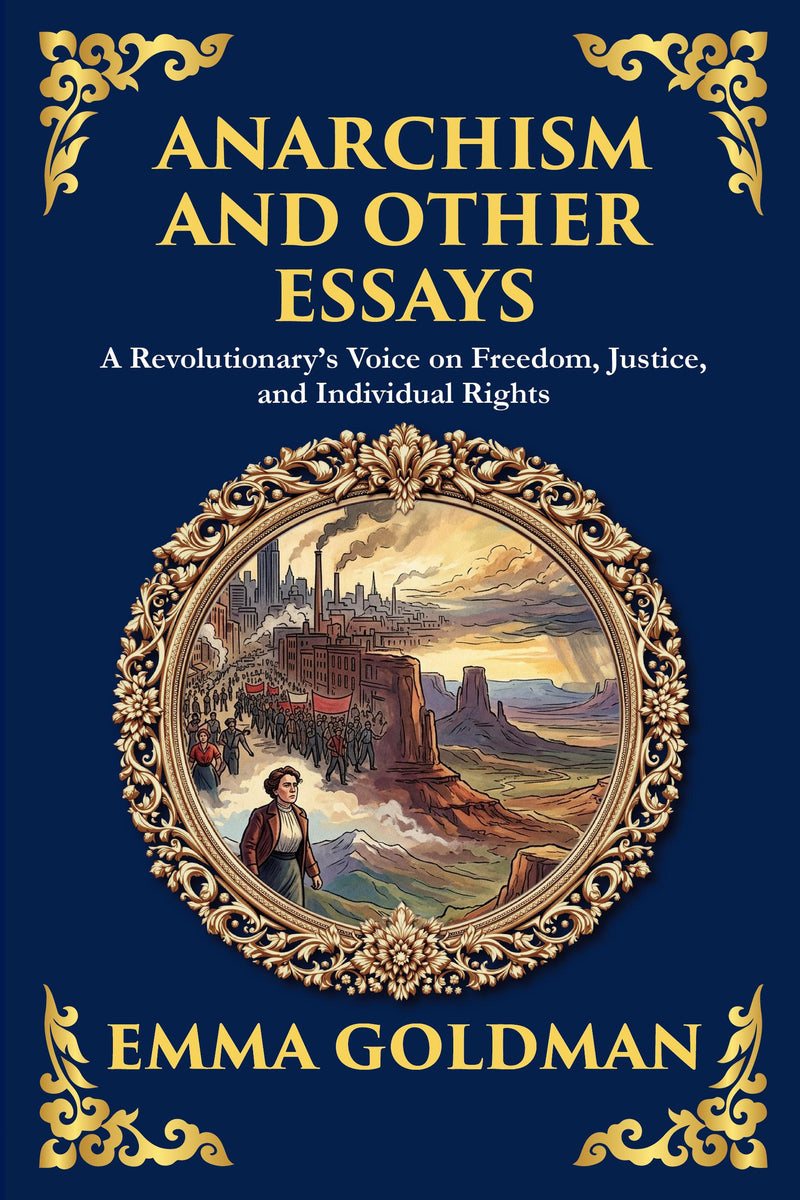
Anarchism and Other Essays
In a world bound by conformity and control, Emma Goldman dared to speak the unspeakable. Anarchism and Other Essays is a groundbreaking collection of fiery and fearless writings that challenge political dogma, question institutional power, and advocate for the dignity of the individual above all else.
or free app
10,000+ hrs library
30-day guarantee
The complete Anarchism and Other Essays appears in modern English through Library of Alexandria Press, available online with audiobook narration included for members.
Have you ever wondered why true freedom always threatens the status quo? Anarchism and Other Essays by Emma Goldman is one of the most powerful and provocative works of political thought ever published. First released in 1910, this collection of eleven essays captures the mind of one of the most radical and influential thinkers of the modern age.
Through lucid, passionate, and unyielding prose, Goldman confronts the systems that oppress and dehumanize, while calling for an alternative rooted in compassion, justice, and liberty. Far more than abstract theory, these essays stem from Goldman’s lived experience as a political agitator, lecturer, and defender of the disenfranchised. She speaks to those disillusioned with empty promises of democracy and dares to ask: What does it mean to be truly free?
What you’ll discover in this modern edition
- “Anarchism: What It Really Stands For” A clarifying and impassioned defense of anarchist philosophy—far from chaos, closer to human flourishing.
| Formats | eBook (EPUB + PDF) · Audiobook · Paperback · Hardcover · Large Print |
| Language | English |
| Trim size (print) | 6 × 9 in |
| Binding | Paperback — perfect-bound · Hardcover — casewrap |
| Large Print edition | Same text in a larger, easy-read type — a larger font, not a larger trim |
| Print pricing | Every physical book at our true cost — at-cost, no profit (members) |
| Library | 873 restored titles, always growing |
| Length | 66,137 words · ~4 hr 25 min reading |
| Reading level | Grade 7 · an easy, flowing read (this modern-English edition) |
| Edition | Modern English translation · 2026 |
Member reviews for this edition are collected as readers finish it — be the first. Across the library: 12,000+ books shipped, every plan covered by a 365-day print guarantee.
About this edition
A faithful, unabridged modern-English edition by The Library of Alexandria — carefully rendered for today's reader and verified paragraph-by-paragraph against the public-domain source. Available as eBook, audiobook, paperback, hardcover, and large print.
- Complete & unabridgedVerified paragraph by paragraph against the source — never a scan, never abridged.
- Modern English, faithfulReadable today, with the author’s meaning kept intact. Readable — not simplified.
- Every format, one membershipRead in your browser or the free app, or listen to the full audiobook.
Included free with your membership
Cancel anytime, one click · 30-day money-back guarantee
Edition last updated July 2026
What’s inside
Anarchism and Other Essays — complete and unabridged: all 15 sections included with membership, plus the full audiobook.
Begin reading Anarchism and Other Essays
In clear modern English — the complete text is included with membership.
Introduction
When Emma Goldman stepped onto a lecture stage in the early twentieth century, audiences came prepared for a spectacle. Some arrived to be scandalized, others to be inspired, and more than a few simply to see for themselves whether the woman the newspapers called “the most dangerous woman in America” could possibly live up to her reputation. What they encountered was not the wild-eyed bomb-thrower of editorial cartoons, but a fiercely intelligent, sharply witty, deeply humane thinker who spoke with the conviction of someone who had staked her entire life on her beliefs. The essays collected in this volume capture that voice at its most powerful—uncompromising, eloquent, and alive with a passion for human freedom that has lost none of its urgency in the century since the words were first set down.
This collection brings together some of Goldman’s most important writings on the subjects that defined her life and career: the meaning of anarchism, the nature of freedom, the rights of the individual against the demands of the state, the condition of women, the institution of marriage, the function of prisons, the seductions and dangers of patriotism, and the role of art and ideas in a free society. To read these essays is to encounter one of the most original political minds of the modern age, a woman who refused to accept that the way things were was the way things had to be, and who insisted—against enormous opposition—that ordinary people deserved far more than the cramped lives that economic exploitation and political coercion had assigned to them.
This edition has been carefully prepared as a modern translation and adaptation, with the language gently updated for the contemporary reader. The aim throughout has been to preserve the fire and precision of Goldman’s prose while smoothing away the obstacles that can make century-old writing feel distant or laborious. The result is a version that allows the modern reader to engage directly with the ideas, free from the friction of dated phrasing, without sacrificing the distinctive force of Goldman’s voice. What remains is the essential Emma Goldman: the moral seriousness, the dazzling rhetorical command, the refusal to flatter or console, and above all the unshakable belief that the human spirit deserves to be free.
To understand the power of these essays, it helps to know something of the extraordinary life from which they emerged. Emma Goldman was born in 1869 in Kovno, in what was then part of the Russian Empire, into a Jewish family that knew firsthand the cruelties of poverty and persecution. Her childhood was marked by an authoritarian father, the suffocating restrictions placed on women and Jews under the Tsarist regime, and an early and acute awareness of injustice. As a young teenager she moved with her family to St. Petersburg, where she was exposed to the revolutionary ferment then sweeping through Russia—the radical literature, the populist movements, the heroic and tragic figures who gave their lives in the struggle against tyranny. These early impressions never left her.
In 1885, at the age of sixteen, she emigrated to the United States, settling first in Rochester, New York, where she went to work in a clothing factory. The promise of America—the land of liberty and opportunity—collided almost immediately with the grim reality of industrial labor: long hours, miserable wages, and the dehumanizing conditions endured by millions of workers. It was a disillusionment shared by countless immigrants of her generation, but Goldman responded to it not with resignation but with a hunger to understand and to change the world she had entered.
The turning point came in 1886 with the Haymarket affair in Chicago, when a bomb thrown during a labor demonstration led to the trial and execution of several anarchists on evidence that many regarded as flimsy at best. The case became a cause célèbre that radicalized a generation, and for Goldman it was transformative. The men who died at Haymarket became, in her eyes, martyrs to the cause of human liberation, and their deaths set her on the path that would define the rest of her life. She moved to New York City, immersed herself in the radical immigrant community of the Lower East Side, and fell under the influence of older anarchist thinkers and organizers. Soon she emerged as a formidable presence in her own right—an organizer, an editor, and above all an orator of remarkable power.
For more than three decades, Goldman criss-crossed the United States delivering lectures on an astonishing range of subjects: not only politics and economics but also modern drama, literature, education, sexuality, and the rights of women. She was arrested repeatedly, often simply for speaking. She founded and edited the influential journal Mother Earth, which became a vital forum for radical thought and avant-garde culture. She campaigned tirelessly for free speech, for workers’ rights, for access to birth control—a cause for which she was imprisoned—and against the militarism and conscription that accompanied the First World War. It was her opposition to the draft that ultimately led, in 1919, to her deportation from the United States along with hundreds of others during the Red Scare.
Her later years were marked by disillusionment and exile. She went initially to Soviet Russia, full of hope for the revolution she had championed from afar, only to be horrified by the authoritarianism and repression she found under the new Bolshevik regime. Her honest and devastating critique of Soviet tyranny cost her the support of many on the left who were unwilling to hear it, but it confirmed the consistency of her principles: she opposed tyranny wherever she found it, whether it wore the mask of capitalism or of communism. She spent her remaining years moving across Europe, writing, lecturing, and supporting the anarchist cause in the Spanish Civil War, until her death in 1940.
This was a woman who lived her ideas. She did not theorize about freedom from the safety of an academic study; she suffered for it, was imprisoned for it, was driven into exile for it, and never once abandoned it. When she writes in these essays about the cost of dissent, about the courage required to stand against the crowd, about the loneliness of holding unpopular truths, she writes from direct and painful experience. That authenticity gives her prose a moral weight that mere cleverness could never achieve. Reading her, one is constantly aware that here is someone who has put her body and her freedom on the line for the convictions she defends.
It is worth pausing on what kind of thinker Goldman actually was, because she has often been caricatured—both in her own time and since. The popular image of the anarchist as a chaotic destroyer, a sower of disorder, could hardly be further from the philosophy she actually held. For Goldman, anarchism was not a program of violence or mayhem but a deeply moral and almost spiritual vision of human possibility. It was the belief that human beings, freed from coercion and exploitation, were capable of organizing their lives cooperatively, creatively, and harmoniously. It rested on a fundamentally optimistic view of human nature—a faith that people, when not deformed by oppressive institutions, would tend toward solidarity rather than domination. In this sense, her anarchism was less a set of policy proposals than a faith in the latent goodness and creative power of ordinary individuals.
She drew on a wide range of influences in developing this vision—the great Russian and European anarchist thinkers, the radical labor movement, the freethinking and feminist currents of her era, and the literature and drama she loved so passionately. But she was no mere disciple. She synthesized these influences into something distinctly her own, integrating questions of personal liberation and sexual freedom into the broader political struggle in ways that were genuinely ahead of her time. Long before such ideas became commonplace, she insisted that the liberation of women could not be achieved through the vote alone, that true emancipation required a transformation of the most intimate aspects of life, and that the personal and the political were inseparable. In this she anticipated insights that would not become mainstream for generations.
The Ideas at the Heart of This Collection
The essays gathered here range across the full breadth of Goldman’s concerns, and each repays close and thoughtful reading. While it would spoil the experience to summarize their arguments in detail, it is worth offering the reader a sense of the territory they cover, so that you can approach them with the context that will make them most rewarding.
At the foundation of the collection stands her exploration of anarchism itself—what it actually means, as opposed to the distortions and slanders that have attached themselves to the word. Here Goldman undertakes the difficult task of explaining a philosophy that her contemporaries largely understood through fear and prejudice. She strips away the misconceptions and presents anarchism as a positive vision rather than a negative one: not the absence of order but the presence of a freer, more humane order arising from voluntary cooperation rather than from force. This is essential reading for anyone who wants to understand what the word truly meant to those who lived and died for it, and it provides the philosophical key to everything else in the volume.
From this foundation, Goldman turns her critical eye on the great institutions of her age—and ours. She examines the relationship between the individual and the organized power of the state, raising questions about authority, obedience, and the conditions under which human beings can be said to be genuinely free. She probes the machinery of government and asks whether the protections it claims to offer are worth the freedoms it demands in return. These are not abstract academic exercises; they are urgent inquiries into how we live and how we might live differently.
Among the most powerful pieces in the collection are those dealing with patriotism and militarism. Goldman lived through an era of rising nationalism and the catastrophe of the First World War, and she developed a searing critique of the way patriotic sentiment could be manipulated to lead ordinary people into supporting wars that served the interests of the powerful while costing the lives of the powerless. Her analysis of how loyalty to the nation can be exploited to suppress critical thinking and to justify violence remains startlingly relevant in our own time. Few writers have dissected the psychology of mass conformity and the dangers of unexamined patriotism with such clarity and courage.
The collection also contains some of Goldman’s most influential writing on the condition of women. Long before the modern feminist movement, she was arguing that women’s emancipation involved far more than the right to vote or the right to work. She challenged the conventions surrounding marriage, examining the economic and emotional dependencies it could create and asking whether the institution as it then existed served women’s genuine interests. She wrote with remarkable frankness about love, intimacy, and personal autonomy, insisting that a woman’s freedom to determine the shape of her own life was a fundamental requirement of any truly free society. These essays were considered shocking in their day, and their boldness still has the power to provoke and to illuminate.
Goldman also turns her attention to the question of crime and punishment, offering a critique of the prison system that anticipates many of the arguments made by reformers and abolitionists today. She asks what prisons actually accomplish, whom they truly serve, and whether a system built on punishment and confinement can ever genuinely address the social conditions that give rise to crime. Her compassion for the imprisoned and her analysis of the social roots of criminal behavior reflect the consistent humanism that runs through all her work.
Cancel anytime, one click · 30-day money-back guarantee
Founding annual rate available now — your price locks for life when you join.
Not ready? Get this free chapter by email — read it anytime.
✓ Sent — check your inbox for Anarchism and Other Essays.
Questions about Anarchism and Other Essays
What is Anarchism and Other Essays about?
In a world bound by conformity and control, Emma Goldman dared to speak the unspeakable. Anarchism and Other Essays is a groundbreaking collection of fiery and fearless writings that challenge political dogma, question institutional power, and advocate for the dignity of the individual above all else. With unflinching clarity and moral conviction, Goldman tackles issues that remain deeply relevant today—freedom of speech, women's rights, prisons, education, labor, patriotism, and more.
Who wrote Anarchism and Other Essays?
Anarchism and Other Essays was written by Emma Goldman. This edition presents the complete work in clear modern English, faithfully rendered from the public-domain original by Library of Alexandria Press.
Is Anarchism and Other Essays free to read?
The opening chapter is free to read on this page. Members read and listen to the complete work — and the entire library — free, and can order any physical book at our true print cost.
How long is Anarchism and Other Essays?
15 chapters (~66,137 words) — about 4 hr 25 min of reading in this modern-English edition.
Is this an abridged version of Anarchism and Other Essays?
No. This is the complete, unabridged Anarchism and Other Essays, carefully rendered into clear modern English and verified paragraph-by-paragraph against the public-domain source — nothing is cut or summarised.
What formats does Anarchism and Other Essays come in?
Anarchism and Other Essays is available as eBook, paperback, hardcover and large print. eBook and audiobook are included with membership; printed editions ship at our true print cost.
Shipping & returns
Billing & membership
More from the library


Explore Biography & Letters
- Meditations · Marcus Aurelius
- The Confessions of St. Augustine · Saint Augustine
- The Confessions of Jean-Jacques Rousseau — Complete · Jean-Jacques Rousseau
- Ecce Homo · Friedrich Wilhelm Nietzsche
- De Profundis · Oscar Wilde
- Memoirs of Joseph Grimaldi · Joseph Grimaldi
- English Eccentrics and Eccentricities · John Timbs
- You Can’t Win · Jack Black
- Wild Animals I Have Known · Ernest Thompson Seton
- The Diary of Samuel Pepys — Complete 1665 N.S. · Samuel Pepys
- Random Reminiscences of Men and Events · John D. Rockefeller
- The Story of My Life · Helen Keller
- Elizabeth, Empress of Austria and Queen of Hungary · Carl Küchler
- Society as I Have Found It · Ward McAllister
- Autobiography of a Yogi · Paramahansa Yogananda
- Christopher Columbus and How He Received and Imparted the Spirit of Discovery
- A Portrait of the Artist as a Young Man · James Joyce
- Memoirs of the Author of a Vindication of the Rights of Woman · William Godwin
- Mary: A Fiction · Mary Wollstonecraft
- The Romance of Biography (Vol. 1 of 2) · Mrs. Jameson
- The Love Letters of Mary Wollstonecraft to Gilbert Imlay · Mary Wollstonecraft
- Selected Works of Voltairine de Cleyre · Voltairine de Cleyre
- Eighty Years and More; Reminiscences 1815–1897 · Elizabeth Cady Stanton
- Agnes Grey · Anne Brontë
- Daddy-Long-Legs · Jean Webster
- Reminiscences of a Stock Operator · Edwin Lefèvre
- Martin Eden · Jack London
- Matthew Calbraith Perry: A Typical American Naval Officer · William Elliot Griffis
- Walden, and On the Duty of Civil Disobedience · Henry David Thoreau
- Little Women · Louisa May Alcott
Anarchism and Other Essays
Anarchism and Other Essays
A Revolutionary’s Voice on Freedom, Justice, and Individual Rights
Emma Goldman
Contents
- Introduction
- Chapter 1
- Preface by the Author
- Chapter 2
- Chapter 3
- Chapter 4
- Chapter 5
- Chapter 6
- Chapter 7
- Chapter 8
- Chapter 9
- Chapter 10
- Chapter 11
- Chapter 12
- Chapter 13
Introduction
When Emma Goldman stepped onto a lecture stage in the early twentieth century, audiences came prepared for a spectacle. Some arrived to be scandalized, others to be inspired, and more than a few simply to see for themselves whether the woman the newspapers called “the most dangerous woman in America” could possibly live up to her reputation. What they encountered was not the wild-eyed bomb-thrower of editorial cartoons, but a fiercely intelligent, sharply witty, deeply humane thinker who spoke with the conviction of someone who had staked her entire life on her beliefs. The essays collected in this volume capture that voice at its most powerful—uncompromising, eloquent, and alive with a passion for human freedom that has lost none of its urgency in the century since the words were first set down.
This collection brings together some of Goldman’s most important writings on the subjects that defined her life and career: the meaning of anarchism, the nature of freedom, the rights of the individual against the demands of the state, the condition of women, the institution of marriage, the function of prisons, the seductions and dangers of patriotism, and the role of art and ideas in a free society. To read these essays is to encounter one of the most original political minds of the modern age, a woman who refused to accept that the way things were was the way things had to be, and who insisted—against enormous opposition—that ordinary people deserved far more than the cramped lives that economic exploitation and political coercion had assigned to them.
This edition has been carefully prepared as a modern translation and adaptation, with the language gently updated for the contemporary reader. The aim throughout has been to preserve the fire and precision of Goldman’s prose while smoothing away the obstacles that can make century-old writing feel distant or laborious. The result is a version that allows the modern reader to engage directly with the ideas, free from the friction of dated phrasing, without sacrificing the distinctive force of Goldman’s voice. What remains is the essential Emma Goldman: the moral seriousness, the dazzling rhetorical command, the refusal to flatter or console, and above all the unshakable belief that the human spirit deserves to be free.
To understand the power of these essays, it helps to know something of the extraordinary life from which they emerged. Emma Goldman was born in 1869 in Kovno, in what was then part of the Russian Empire, into a Jewish family that knew firsthand the cruelties of poverty and persecution. Her childhood was marked by an authoritarian father, the suffocating restrictions placed on women and Jews under the Tsarist regime, and an early and acute awareness of injustice. As a young teenager she moved with her family to St. Petersburg, where she was exposed to the revolutionary ferment then sweeping through Russia—the radical literature, the populist movements, the heroic and tragic figures who gave their lives in the struggle against tyranny. These early impressions never left her.
In 1885, at the age of sixteen, she emigrated to the United States, settling first in Rochester, New York, where she went to work in a clothing factory. The promise of America—the land of liberty and opportunity—collided almost immediately with the grim reality of industrial labor: long hours, miserable wages, and the dehumanizing conditions endured by millions of workers. It was a disillusionment shared by countless immigrants of her generation, but Goldman responded to it not with resignation but with a hunger to understand and to change the world she had entered.
The turning point came in 1886 with the Haymarket affair in Chicago, when a bomb thrown during a labor demonstration led to the trial and execution of several anarchists on evidence that many regarded as flimsy at best. The case became a cause célèbre that radicalized a generation, and for Goldman it was transformative. The men who died at Haymarket became, in her eyes, martyrs to the cause of human liberation, and their deaths set her on the path that would define the rest of her life. She moved to New York City, immersed herself in the radical immigrant community of the Lower East Side, and fell under the influence of older anarchist thinkers and organizers. Soon she emerged as a formidable presence in her own right—an organizer, an editor, and above all an orator of remarkable power.
For more than three decades, Goldman criss-crossed the United States delivering lectures on an astonishing range of subjects: not only politics and economics but also modern drama, literature, education, sexuality, and the rights of women. She was arrested repeatedly, often simply for speaking. She founded and edited the influential journal Mother Earth, which became a vital forum for radical thought and avant-garde culture. She campaigned tirelessly for free speech, for workers’ rights, for access to birth control—a cause for which she was imprisoned—and against the militarism and conscription that accompanied the First World War. It was her opposition to the draft that ultimately led, in 1919, to her deportation from the United States along with hundreds of others during the Red Scare.
Her later years were marked by disillusionment and exile. She went initially to Soviet Russia, full of hope for the revolution she had championed from afar, only to be horrified by the authoritarianism and repression she found under the new Bolshevik regime. Her honest and devastating critique of Soviet tyranny cost her the support of many on the left who were unwilling to hear it, but it confirmed the consistency of her principles: she opposed tyranny wherever she found it, whether it wore the mask of capitalism or of communism. She spent her remaining years moving across Europe, writing, lecturing, and supporting the anarchist cause in the Spanish Civil War, until her death in 1940.
This was a woman who lived her ideas. She did not theorize about freedom from the safety of an academic study; she suffered for it, was imprisoned for it, was driven into exile for it, and never once abandoned it. When she writes in these essays about the cost of dissent, about the courage required to stand against the crowd, about the loneliness of holding unpopular truths, she writes from direct and painful experience. That authenticity gives her prose a moral weight that mere cleverness could never achieve. Reading her, one is constantly aware that here is someone who has put her body and her freedom on the line for the convictions she defends.
It is worth pausing on what kind of thinker Goldman actually was, because she has often been caricatured—both in her own time and since. The popular image of the anarchist as a chaotic destroyer, a sower of disorder, could hardly be further from the philosophy she actually held. For Goldman, anarchism was not a program of violence or mayhem but a deeply moral and almost spiritual vision of human possibility. It was the belief that human beings, freed from coercion and exploitation, were capable of organizing their lives cooperatively, creatively, and harmoniously. It rested on a fundamentally optimistic view of human nature—a faith that people, when not deformed by oppressive institutions, would tend toward solidarity rather than domination. In this sense, her anarchism was less a set of policy proposals than a faith in the latent goodness and creative power of ordinary individuals.
She drew on a wide range of influences in developing this vision—the great Russian and European anarchist thinkers, the radical labor movement, the freethinking and feminist currents of her era, and the literature and drama she loved so passionately. But she was no mere disciple. She synthesized these influences into something distinctly her own, integrating questions of personal liberation and sexual freedom into the broader political struggle in ways that were genuinely ahead of her time. Long before such ideas became commonplace, she insisted that the liberation of women could not be achieved through the vote alone, that true emancipation required a transformation of the most intimate aspects of life, and that the personal and the political were inseparable. In this she anticipated insights that would not become mainstream for generations.
The Ideas at the Heart of This Collection
The essays gathered here range across the full breadth of Goldman’s concerns, and each repays close and thoughtful reading. While it would spoil the experience to summarize their arguments in detail, it is worth offering the reader a sense of the territory they cover, so that you can approach them with the context that will make them most rewarding.
At the foundation of the collection stands her exploration of anarchism itself—what it actually means, as opposed to the distortions and slanders that have attached themselves to the word. Here Goldman undertakes the difficult task of explaining a philosophy that her contemporaries largely understood through fear and prejudice. She strips away the misconceptions and presents anarchism as a positive vision rather than a negative one: not the absence of order but the presence of a freer, more humane order arising from voluntary cooperation rather than from force. This is essential reading for anyone who wants to understand what the word truly meant to those who lived and died for it, and it provides the philosophical key to everything else in the volume.
From this foundation, Goldman turns her critical eye on the great institutions of her age—and ours. She examines the relationship between the individual and the organized power of the state, raising questions about authority, obedience, and the conditions under which human beings can be said to be genuinely free. She probes the machinery of government and asks whether the protections it claims to offer are worth the freedoms it demands in return. These are not abstract academic exercises; they are urgent inquiries into how we live and how we might live differently.
Among the most powerful pieces in the collection are those dealing with patriotism and militarism. Goldman lived through an era of rising nationalism and the catastrophe of the First World War, and she developed a searing critique of the way patriotic sentiment could be manipulated to lead ordinary people into supporting wars that served the interests of the powerful while costing the lives of the powerless. Her analysis of how loyalty to the nation can be exploited to suppress critical thinking and to justify violence remains startlingly relevant in our own time. Few writers have dissected the psychology of mass conformity and the dangers of unexamined patriotism with such clarity and courage.
The collection also contains some of Goldman’s most influential writing on the condition of women. Long before the modern feminist movement, she was arguing that women’s emancipation involved far more than the right to vote or the right to work. She challenged the conventions surrounding marriage, examining the economic and emotional dependencies it could create and asking whether the institution as it then existed served women’s genuine interests. She wrote with remarkable frankness about love, intimacy, and personal autonomy, insisting that a woman’s freedom to determine the shape of her own life was a fundamental requirement of any truly free society. These essays were considered shocking in their day, and their boldness still has the power to provoke and to illuminate.
Goldman also turns her attention to the question of crime and punishment, offering a critique of the prison system that anticipates many of the arguments made by reformers and abolitionists today. She asks what prisons actually accomplish, whom they truly serve, and whether a system built on punishment and confinement can ever genuinely address the social conditions that give rise to crime. Her compassion for the imprisoned and her analysis of the social roots of criminal behavior reflect the consistent humanism that runs through all her work.
Propaganda isn’t a “business,” as some people think. No one would choose a career where they work as hard as a slave only to die with the reputation of a beggar. The reasons someone chooses this profession must be different from business motives; they must be deeper than pride and more powerful than self-interest.
Few people in American public life are mentioned as often as Emma Goldman. Yet, the real Emma Goldman remains almost completely unknown. The tabloid press has surrounded her name with so much slander and misinformation that it seems like a miracle that the truth is finally emerging, and people are beginning to appreciate this unfairly attacked idealist. There is little comfort in the fact that almost every pioneer of a new idea has faced similar struggles. Does it matter that a former president once honored the memory of John Brown at Osawatomie? Or that the president of another republic helped unveil a statue of Pierre Proudhon, holding him up as a model for the French people to follow? None of this matters while the living John Browns and Proudhons of today are being persecuted. The legacies of Mary Wollstonecraft or Louise Michel aren’t improved because city officials in London or Paris named a street after them—the current generation should focus on treating the living Mary Wollstonecrafts and Louise Michels fairly. Future generations will give men like Wendel Phillips and Lloyd Garrison their rightful place of honor in the history of human freedom, but it is the responsibility of their contemporaries to recognize and appreciate them while they are still alive.
The path of a social justice advocate is full of hardships. Those who profit from darkness and injustice do everything they can to keep any glimmer of hope from entering his bleak life. Even his own allies—often his closest friends—rarely understand the personal toll on a pioneer. Envy, which sometimes turns into hatred, vanity, and jealousy block his path and leave him heartbroken. It takes an iron will and incredible passion to keep believing in the Cause under these conditions. A leader of a revolutionary idea is caught between two fires: on one side, he is persecuted by the ruling powers, who blame him for every problem caused by social conditions; on the other, he is misunderstood by his own followers, who often judge his actions through a narrow lens. As a result, the activist often feels completely alone, even when surrounded by a crowd. Even his closest friends rarely realize how isolated and abandoned he feels. That is the tragedy of being a public figure.
End of the free sample
Keep reading, free
Members read and listen to the complete book — and the entire library. Cancel anytime, one click · 30-day money-back guarantee.