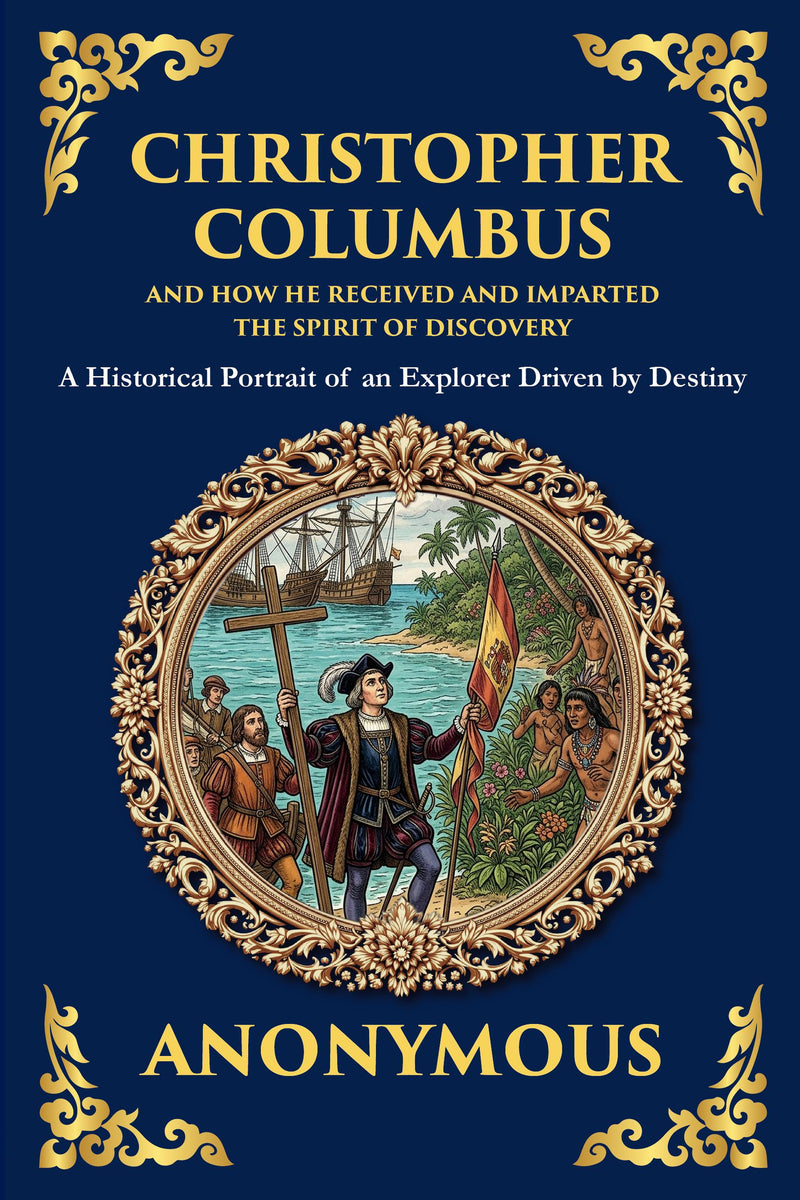
Christopher Columbus and How He Received and Imparted the Spirit of Discovery
Before the maps were drawn and the oceans were charted, one man dared to believe in a world that lay beyond the horizon.
or free app
10,000+ hrs library
30-day guarantee
The complete Christopher Columbus and How He appears in modern English through Library of Alexandria Press, available online with audiobook narration included for members.
Have you ever wondered why some are destined to explore while others remain behind? Christopher Columbus and How He Received and Imparted the Spirit of Discovery is more than a historical chronicle—it is a psychological and spiritual portrait of one of the world’s most transformative figures. This rare work offers readers a deeply reflective look at the personal drive, philosophical influences, and divine conviction that shaped Columbus’s vision of the world.
Drawing from contemporary sources, personal letters, and historical insight, this book goes beyond the surface of Columbus's voyages to uncover the force behind the man—a force not only of ambition, but of spiritual clarity and unshakable purpose. His journey was not merely westward—it was inward, a quest to reconcile faith, destiny, and the human urge to reach beyond the known.
What you’ll discover in this modern edition
- An Intimate Look at Columbus's Inner World – Understand the dreams, doubts, and spiritual visions that shaped his journey
| Formats | eBook (EPUB + PDF) · Audiobook · Paperback · Hardcover · Large Print |
| Language | English |
| Trim size (print) | 6 × 9 in |
| Binding | Paperback — perfect-bound · Hardcover — casewrap |
| Large Print edition | Same text in a larger, easy-read type — a larger font, not a larger trim |
| Print pricing | Every physical book at our true cost — at-cost, no profit (members) |
| Library | 873 restored titles, always growing |
| Length | 154,456 words · ~10 hr 18 min reading |
| Reading level | Grade 3 · an easy, flowing read (this modern-English edition) |
| Edition | Modern English translation · 2026 |
Member reviews for this edition are collected as readers finish it — be the first. Across the library: 12,000+ books shipped, every plan covered by a 365-day print guarantee.
About this edition
A faithful, unabridged modern-English edition by The Library of Alexandria — carefully rendered for today's reader and verified paragraph-by-paragraph against the public-domain source. Available as eBook, audiobook, paperback, hardcover, and large print.
- Complete & unabridgedVerified paragraph by paragraph against the source — never a scan, never abridged.
- Modern English, faithfulReadable today, with the author’s meaning kept intact. Readable — not simplified.
- Every format, one membershipRead in your browser or the free app, or listen to the full audiobook.
Included free with your membership
Cancel anytime, one click · 30-day money-back guarantee
Edition last updated July 2026
What’s inside
Christopher Columbus and How He Received and Imparted the Spirit of Discovery — complete and unabridged: all 22 sections included with membership, plus the full audiobook.
Begin reading Christopher Columbus and How He Received and Imparted the Spirit of Discovery
In clear modern English — the complete text is included with membership.
Introduction
There are figures in human history whose names become larger than the men and women who bore them—names that gather around themselves a weight of meaning, a swirl of legend, controversy, admiration, and reproach, until the actual human being almost disappears beneath the accumulation. Christopher Columbus is perhaps the supreme example of this phenomenon. To speak his name is to summon at once an entire continent of associations: a small fleet of ships pushing westward into an unknown ocean, a banner planted on an unfamiliar shore, a date memorized by schoolchildren across generations, and a transformation of the world so total that we still live within its consequences five centuries later. Yet behind that name there was a man—ambitious, devout, stubborn, brilliant, flawed, and deeply human—whose inner life and outer struggles are far more interesting than the simplified portraits that have hardened into received wisdom.
This book invites you to step behind the legend and to meet that man as he was understood by those who sought, in an earlier age, to render his story with both reverence and care. It is a historical portrait, as the subtitle promises, of an explorer driven by something he himself believed to be destiny. And it is presented here in a modern translation, adapted so that the contemporary reader may move through its pages without the friction of archaic phrasing or the obscurity of references that have faded with time. The aim has been to preserve the dignity and the narrative power of the original while removing the obstacles that too often stand between a modern audience and a worthy older work. What remains is a story told with momentum, with attention to character, and with a sense of the grandeur and tragedy of the events it describes.
The Spirit of Discovery and the Man Who Carried It
The title of this work is unusually precise about its theme, and that precision rewards a moment of reflection before you begin. It does not promise merely an account of voyages, nor a dry chronicle of dates and landfalls. It speaks instead of how Columbus “received and imparted the spirit of discovery.” That phrasing carries a quiet but profound idea: that discovery is not simply a matter of geography, of finding what was previously unknown on a map. It is also a matter of disposition, of a certain restless hunger to push past the boundaries of the accepted and the comfortable. And crucially, that spirit is described as something received and then imparted—something that flowed into Columbus from the currents of his age, and that flowed out of him into the centuries that followed.
To understand this, it helps to consider the world into which Columbus was born and in which he came of age. The Europe of the fifteenth century was a place of tremendous ferment, poised between the medieval and the modern. The old certainties of the feudal order were loosening; the rediscovery of classical learning was reshaping how educated people thought about the natural world and humanity’s place within it; the printing press was beginning to spread ideas with unprecedented speed; and the great maritime nations of the Iberian Peninsula were probing ever farther down the coast of Africa, driven by the desire for trade routes to the fabulous riches of the East. The known world was expanding at its edges, and with that expansion came a heady sense that the limits of human knowledge might not be fixed after all.
It was into this atmosphere that Columbus absorbed the spirit of discovery. He did not invent it; he inherited it. He read the accounts of earlier travelers, studied the maps and charts available to him, listened to the talk of sailors who had ventured into distant waters, and steeped himself in the cosmographical theories of his time. From all of this he distilled a conviction—part scholarly, part intuitive, part almost mystical—that the ocean to the west could be crossed, and that beyond it lay a path to the wealth and wonders of Asia. This conviction was not entirely correct in its details; the geography he imagined was flawed, and the lands he reached were not the ones he expected. But the conviction itself was a powerful and creative force, and it propelled him across an expanse of water that no one in his world had ever attempted to cross with such deliberate purpose.
The genius of this book lies in the way it treats Columbus not as a static icon but as a vessel through which a great historical impulse passed. The author is interested in the question of where his determination came from—how it was nourished by the intellectual climate, by his own temperament, by his faith, and by the long years of disappointment and rejection he endured before any monarch would back his enterprise. We meet a man who spent the better part of his adult life arguing his case, pleading at courts, suffering the contempt of learned committees who dismissed his calculations, and refusing, year after weary year, to abandon the vision that animated him. There is something almost heroic in this persistence, and something almost tragic, for the very intensity that made him capable of his great achievement also made him difficult, proud, and at times blind to the realities around him.
And then there is the second half of the theme: how he imparted the spirit of discovery. For whatever his personal triumphs and failures, the consequence of his voyages was to fling open a door that could never again be closed. After Columbus, the European imagination could no longer rest within its old boundaries. A whole age of exploration followed in his wake—mariners and adventurers and ambitious sovereigns who took up the spirit he embodied and carried it to every corner of the globe. He became, in a sense, the herald of a new era, the man whose example set in motion forces that would reshape the entire planet. This book traces that transmission with a thoughtful eye, helping you to see Columbus not merely as an individual but as a hinge on which history turned.
It would be dishonest to suggest that the consequences of that turning were uniformly glorious. The encounter between the Old World and the New brought with it suffering as well as wonder, conquest as well as discovery, and the profound disruption of peoples and cultures whose existence had been entirely unknown to Europe. The work you are about to read reflects the perspective and the sensibilities of the age in which it was composed, and a thoughtful modern reader will naturally hold its judgments up against the fuller understanding we have today. This is not a weakness of the book but rather an invitation to active reading. To engage with a historical portrait is always to engage with two histories at once: the history of the events themselves, and the history of how those events were remembered and interpreted. Part of the pleasure and the value of reading a work like this lies precisely in that double awareness.
A Story of Vision, Endurance, and the Sea
Beyond its themes and its historical significance, this is, at its heart, a tremendously compelling story, and it is worth pausing to appreciate why the life of Columbus continues to grip the imagination so powerfully across the centuries. It contains all the elements of the most enduring narratives: a protagonist with a consuming dream, a long and difficult struggle against indifference and ridicule, a moment of breathtaking gamble against overwhelming odds, an extraordinary success, and then a slow descent into disappointment, conflict, and the bitter discovery that the world rarely rewards its visionaries in the way they hope to be rewarded.
Consider the central act of the drama: the decision to sail. Try to imagine, for a moment, what it actually meant to push a small wooden vessel out onto an open ocean whose far shore no one had ever seen, with no certainty of what lay ahead, no possibility of rescue, and only the crudest instruments to find one’s way. The men who undertook such a voyage were entrusting their lives to a theory, to a calculation, to the unshakable confidence of a leader whom many of them did not fully trust. As the days stretched into weeks and the familiar coastline of home sank forever below the horizon, the strain on every soul aboard those ships must have been almost unbearable. There is a particular kind of courage—or perhaps a particular kind of obsession—required to hold a crew together under such conditions, to soothe their fears, to suppress the murmurs of mutiny, and to keep the prows pointed steadily into the unknown. The book brings these tensions vividly to life, and you will feel, as you read, something of the terror and the exhilaration of that first great crossing.
And then comes the moment that has been engraved into the collective memory of the Western world: the cry of land, the sighting of a shore where no European had ever set foot, the realization that the great gamble had not ended in death and oblivion but in the opening of an entirely new chapter of human history. Whatever one makes of all that followed, there is no denying the sheer drama of that instant—the conjunction of one man’s lifelong dream with the vast indifferent reality of the planet, and the discovery that the dream and the reality, though they did not perfectly match, had collided in a way that would change everything.
The narrative does not end there, of course, and one of the strengths of this account is that it refuses to leave Columbus frozen at the summit of his triumph. The later voyages, the troubled administration of the lands he claimed, the rivalries and accusations, the deterioration of his standing at court, the physical sufferings of his final years—all of this forms an essential part of the portrait, and all of it deepens our understanding of the man. There is a poignancy in watching the great discoverer, who had unlocked a hemisphere, struggle to govern, struggle to be believed, struggle to secure the honors and rewards he felt were his due. The arc of his life has the shape of genuine tragedy: the very qualities that made his achievement possible were also the seeds of his later misfortunes. He was a dreamer in an age of hard practical men; a man of soaring vision who proved ill-suited to the grubby business of colonial management; a believer in his own destiny who could not understand why the world did not share his conviction.
This combination of grandeur and pathos is what lifts the story above mere chronicle. It is the stuff of which great human dramas are made, and the author handles it with a sure narrative hand, knowing when to linger over a scene of high tension, when to step back and offer a broader view of the historical landscape, and when to focus our attention on the inner experience of the man at the center of it all. The result is a book that reads with the momentum of a novel while retaining the substance and seriousness of history.
The sea itself is almost a character in these pages, and rightly so. For Columbus, as for all the great navigators of his era, the ocean was both the obstacle and the path, the adversary and the ally. To read this book is to be reminded of an age when the sea was the great frontier, the medium through which empires reached out toward one another and through which the fate of nations was decided. The descriptions of life aboard ship, the dependence on wind and current, the constant negotiation with the elements, the way that distance and isolation pressed upon the human spirit—all of this gives the narrative a tang of salt and a sense of physical reality that grounds the grander historical themes in lived experience. You will come away from these pages with a renewed appreciation for the extraordinary boldness of the men who first ventured beyond the edge of the known.
A word is in order about the nature of this edition and about how it might best be approached, for understanding the character of the book will help you to draw the fullest enjoyment and benefit from it. This is described as a modern translation, adapted for the contemporary reader, and that description deserves to be taken seriously. The original work belongs to an older tradition of historical writing, one that often employed a more elaborate and formal style than we are accustomed to today. Sentences could be long and ornate; vocabulary could be archaic; references could assume a familiarity with classical and biblical allusion that the modern reader may not possess. The labor of adaptation has been to carry the substance and the spirit of that original across the gulf of time and idiom, so that what reaches you is clear, readable, and engaging, without sacrificing the texture and the dignity of the source.
Cancel anytime, one click · 30-day money-back guarantee
Founding annual rate available now — your price locks for life when you join.
Not ready? Get this free chapter by email — read it anytime.
✓ Sent — check your inbox for Christopher Columbus and How He Received and Imparted the Spirit of Discovery.
Questions about Christopher Columbus and How He Received and Imparted the Spirit of Discovery
What is Christopher Columbus and How He about?
Before the maps were drawn and the oceans were charted, one man dared to believe in a world that lay beyond the horizon. Christopher Columbus and How He Received and Imparted the Spirit of Discovery chronicles the life, vision, and daring voyages of the explorer who forever changed the course of history. This unique account reveals not only the historical impact of Columbus but the passionate spirit that drove him to seek the unknown—and to inspire generations to follow.
Is Christopher Columbus and How He free to read?
The opening chapter is free to read on this page. Members read and listen to the complete work — and the entire library — free, and can order any physical book at our true print cost.
How long is Christopher Columbus and How He?
22 chapters (~154,456 words) — about 10 hr 18 min of reading in this modern-English edition.
Is this an abridged version of Christopher Columbus and How He?
No. This is the complete, unabridged Christopher Columbus and How He, carefully rendered into clear modern English and verified paragraph-by-paragraph against the public-domain source — nothing is cut or summarised.
What formats does Christopher Columbus and How He come in?
Christopher Columbus and How He is available as eBook, paperback, hardcover and large print. eBook and audiobook are included with membership; printed editions ship at our true print cost.
Shipping & returns
Billing & membership
More from the library


Explore Biography & Letters
- Meditations · Marcus Aurelius
- The Confessions of St. Augustine · Saint Augustine
- The Confessions of Jean-Jacques Rousseau — Complete · Jean-Jacques Rousseau
- Ecce Homo · Friedrich Wilhelm Nietzsche
- De Profundis · Oscar Wilde
- Memoirs of Joseph Grimaldi · Joseph Grimaldi
- English Eccentrics and Eccentricities · John Timbs
- You Can’t Win · Jack Black
- Wild Animals I Have Known · Ernest Thompson Seton
- The Diary of Samuel Pepys — Complete 1665 N.S. · Samuel Pepys
- Random Reminiscences of Men and Events · John D. Rockefeller
- The Story of My Life · Helen Keller
- Elizabeth, Empress of Austria and Queen of Hungary · Carl Küchler
- Society as I Have Found It · Ward McAllister
- Autobiography of a Yogi · Paramahansa Yogananda
- A Portrait of the Artist as a Young Man · James Joyce
- Memoirs of the Author of a Vindication of the Rights of Woman · William Godwin
- Mary: A Fiction · Mary Wollstonecraft
- The Romance of Biography (Vol. 1 of 2) · Mrs. Jameson
- The Love Letters of Mary Wollstonecraft to Gilbert Imlay · Mary Wollstonecraft
- Selected Works of Voltairine de Cleyre · Voltairine de Cleyre
- Eighty Years and More; Reminiscences 1815–1897 · Elizabeth Cady Stanton
- Anarchism and Other Essays · Emma Goldman
- Agnes Grey · Anne Brontë
- Daddy-Long-Legs · Jean Webster
- Reminiscences of a Stock Operator · Edwin Lefèvre
- Martin Eden · Jack London
- Matthew Calbraith Perry: A Typical American Naval Officer · William Elliot Griffis
- Walden, and On the Duty of Civil Disobedience · Henry David Thoreau
- Little Women · Louisa May Alcott
Christopher Columbus and How He Received and Imparted the Spirit of Discovery
Christopher Columbus and How He Received and Imparted the Spirit of Discovery
A Historical Portrait of an Explorer Driven by Destiny
Anonymous
Contents
- Introduction
- Chapter 1
- Chapter 2
- Chapter 3
- Chapter 4
- Chapter 5
- Chapter 6
- Chapter 7
- Chapter 8
- Chapter 9
- Chapter 10
- Chapter 11
- Chapter 12
- Chapter 13
- Chapter 14
- Chapter 15
- Chapter 16
- Chapter 17
- Chapter 18
- Chapter 19
- Chapter 20
- Chapter 21
Introduction
There are figures in human history whose names become larger than the men and women who bore them—names that gather around themselves a weight of meaning, a swirl of legend, controversy, admiration, and reproach, until the actual human being almost disappears beneath the accumulation. Christopher Columbus is perhaps the supreme example of this phenomenon. To speak his name is to summon at once an entire continent of associations: a small fleet of ships pushing westward into an unknown ocean, a banner planted on an unfamiliar shore, a date memorized by schoolchildren across generations, and a transformation of the world so total that we still live within its consequences five centuries later. Yet behind that name there was a man—ambitious, devout, stubborn, brilliant, flawed, and deeply human—whose inner life and outer struggles are far more interesting than the simplified portraits that have hardened into received wisdom.
This book invites you to step behind the legend and to meet that man as he was understood by those who sought, in an earlier age, to render his story with both reverence and care. It is a historical portrait, as the subtitle promises, of an explorer driven by something he himself believed to be destiny. And it is presented here in a modern translation, adapted so that the contemporary reader may move through its pages without the friction of archaic phrasing or the obscurity of references that have faded with time. The aim has been to preserve the dignity and the narrative power of the original while removing the obstacles that too often stand between a modern audience and a worthy older work. What remains is a story told with momentum, with attention to character, and with a sense of the grandeur and tragedy of the events it describes.
The Spirit of Discovery and the Man Who Carried It
The title of this work is unusually precise about its theme, and that precision rewards a moment of reflection before you begin. It does not promise merely an account of voyages, nor a dry chronicle of dates and landfalls. It speaks instead of how Columbus “received and imparted the spirit of discovery.” That phrasing carries a quiet but profound idea: that discovery is not simply a matter of geography, of finding what was previously unknown on a map. It is also a matter of disposition, of a certain restless hunger to push past the boundaries of the accepted and the comfortable. And crucially, that spirit is described as something received and then imparted—something that flowed into Columbus from the currents of his age, and that flowed out of him into the centuries that followed.
To understand this, it helps to consider the world into which Columbus was born and in which he came of age. The Europe of the fifteenth century was a place of tremendous ferment, poised between the medieval and the modern. The old certainties of the feudal order were loosening; the rediscovery of classical learning was reshaping how educated people thought about the natural world and humanity’s place within it; the printing press was beginning to spread ideas with unprecedented speed; and the great maritime nations of the Iberian Peninsula were probing ever farther down the coast of Africa, driven by the desire for trade routes to the fabulous riches of the East. The known world was expanding at its edges, and with that expansion came a heady sense that the limits of human knowledge might not be fixed after all.
It was into this atmosphere that Columbus absorbed the spirit of discovery. He did not invent it; he inherited it. He read the accounts of earlier travelers, studied the maps and charts available to him, listened to the talk of sailors who had ventured into distant waters, and steeped himself in the cosmographical theories of his time. From all of this he distilled a conviction—part scholarly, part intuitive, part almost mystical—that the ocean to the west could be crossed, and that beyond it lay a path to the wealth and wonders of Asia. This conviction was not entirely correct in its details; the geography he imagined was flawed, and the lands he reached were not the ones he expected. But the conviction itself was a powerful and creative force, and it propelled him across an expanse of water that no one in his world had ever attempted to cross with such deliberate purpose.
The genius of this book lies in the way it treats Columbus not as a static icon but as a vessel through which a great historical impulse passed. The author is interested in the question of where his determination came from—how it was nourished by the intellectual climate, by his own temperament, by his faith, and by the long years of disappointment and rejection he endured before any monarch would back his enterprise. We meet a man who spent the better part of his adult life arguing his case, pleading at courts, suffering the contempt of learned committees who dismissed his calculations, and refusing, year after weary year, to abandon the vision that animated him. There is something almost heroic in this persistence, and something almost tragic, for the very intensity that made him capable of his great achievement also made him difficult, proud, and at times blind to the realities around him.
And then there is the second half of the theme: how he imparted the spirit of discovery. For whatever his personal triumphs and failures, the consequence of his voyages was to fling open a door that could never again be closed. After Columbus, the European imagination could no longer rest within its old boundaries. A whole age of exploration followed in his wake—mariners and adventurers and ambitious sovereigns who took up the spirit he embodied and carried it to every corner of the globe. He became, in a sense, the herald of a new era, the man whose example set in motion forces that would reshape the entire planet. This book traces that transmission with a thoughtful eye, helping you to see Columbus not merely as an individual but as a hinge on which history turned.
It would be dishonest to suggest that the consequences of that turning were uniformly glorious. The encounter between the Old World and the New brought with it suffering as well as wonder, conquest as well as discovery, and the profound disruption of peoples and cultures whose existence had been entirely unknown to Europe. The work you are about to read reflects the perspective and the sensibilities of the age in which it was composed, and a thoughtful modern reader will naturally hold its judgments up against the fuller understanding we have today. This is not a weakness of the book but rather an invitation to active reading. To engage with a historical portrait is always to engage with two histories at once: the history of the events themselves, and the history of how those events were remembered and interpreted. Part of the pleasure and the value of reading a work like this lies precisely in that double awareness.
A Story of Vision, Endurance, and the Sea
Beyond its themes and its historical significance, this is, at its heart, a tremendously compelling story, and it is worth pausing to appreciate why the life of Columbus continues to grip the imagination so powerfully across the centuries. It contains all the elements of the most enduring narratives: a protagonist with a consuming dream, a long and difficult struggle against indifference and ridicule, a moment of breathtaking gamble against overwhelming odds, an extraordinary success, and then a slow descent into disappointment, conflict, and the bitter discovery that the world rarely rewards its visionaries in the way they hope to be rewarded.
Consider the central act of the drama: the decision to sail. Try to imagine, for a moment, what it actually meant to push a small wooden vessel out onto an open ocean whose far shore no one had ever seen, with no certainty of what lay ahead, no possibility of rescue, and only the crudest instruments to find one’s way. The men who undertook such a voyage were entrusting their lives to a theory, to a calculation, to the unshakable confidence of a leader whom many of them did not fully trust. As the days stretched into weeks and the familiar coastline of home sank forever below the horizon, the strain on every soul aboard those ships must have been almost unbearable. There is a particular kind of courage—or perhaps a particular kind of obsession—required to hold a crew together under such conditions, to soothe their fears, to suppress the murmurs of mutiny, and to keep the prows pointed steadily into the unknown. The book brings these tensions vividly to life, and you will feel, as you read, something of the terror and the exhilaration of that first great crossing.
And then comes the moment that has been engraved into the collective memory of the Western world: the cry of land, the sighting of a shore where no European had ever set foot, the realization that the great gamble had not ended in death and oblivion but in the opening of an entirely new chapter of human history. Whatever one makes of all that followed, there is no denying the sheer drama of that instant—the conjunction of one man’s lifelong dream with the vast indifferent reality of the planet, and the discovery that the dream and the reality, though they did not perfectly match, had collided in a way that would change everything.
The narrative does not end there, of course, and one of the strengths of this account is that it refuses to leave Columbus frozen at the summit of his triumph. The later voyages, the troubled administration of the lands he claimed, the rivalries and accusations, the deterioration of his standing at court, the physical sufferings of his final years—all of this forms an essential part of the portrait, and all of it deepens our understanding of the man. There is a poignancy in watching the great discoverer, who had unlocked a hemisphere, struggle to govern, struggle to be believed, struggle to secure the honors and rewards he felt were his due. The arc of his life has the shape of genuine tragedy: the very qualities that made his achievement possible were also the seeds of his later misfortunes. He was a dreamer in an age of hard practical men; a man of soaring vision who proved ill-suited to the grubby business of colonial management; a believer in his own destiny who could not understand why the world did not share his conviction.
This combination of grandeur and pathos is what lifts the story above mere chronicle. It is the stuff of which great human dramas are made, and the author handles it with a sure narrative hand, knowing when to linger over a scene of high tension, when to step back and offer a broader view of the historical landscape, and when to focus our attention on the inner experience of the man at the center of it all. The result is a book that reads with the momentum of a novel while retaining the substance and seriousness of history.
The sea itself is almost a character in these pages, and rightly so. For Columbus, as for all the great navigators of his era, the ocean was both the obstacle and the path, the adversary and the ally. To read this book is to be reminded of an age when the sea was the great frontier, the medium through which empires reached out toward one another and through which the fate of nations was decided. The descriptions of life aboard ship, the dependence on wind and current, the constant negotiation with the elements, the way that distance and isolation pressed upon the human spirit—all of this gives the narrative a tang of salt and a sense of physical reality that grounds the grander historical themes in lived experience. You will come away from these pages with a renewed appreciation for the extraordinary boldness of the men who first ventured beyond the edge of the known.
A word is in order about the nature of this edition and about how it might best be approached, for understanding the character of the book will help you to draw the fullest enjoyment and benefit from it. This is described as a modern translation, adapted for the contemporary reader, and that description deserves to be taken seriously. The original work belongs to an older tradition of historical writing, one that often employed a more elaborate and formal style than we are accustomed to today. Sentences could be long and ornate; vocabulary could be archaic; references could assume a familiarity with classical and biblical allusion that the modern reader may not possess. The labor of adaptation has been to carry the substance and the spirit of that original across the gulf of time and idiom, so that what reaches you is clear, readable, and engaging, without sacrificing the texture and the dignity of the source.
When examining our information, we must distinguish between original sources and those based on other works. The most important are the writings of Columbus himself. Next, we should consider the official documents found in private and public archives.
Harrisse notes that in his own time, Columbus was well-known for being long-winded. In fact, a court jester for Charles V joked that the discoverer of the Indies and Ptolemy were like twins in their habit of rambling. Columbus wrote with the ease of someone driven by quick impulses, lacking the habit of careful, organized thought. He left behind a chaotic collection of thoughts and experiences; while these are essential for the historian, they are often confusing.
There are ninety-seven known pieces of writing authored by Columbus. Of these—including memoirs, reports, and letters—sixty-four have survived in full. Twenty-four of those are entirely or partially in his own handwriting. All of them have been published in full, except for one found in the Biblioteca Colombina in Seville: the Libro de las Proficias. Written likely between 1501 and 1504, only part of it is in Columbus’s hand. A second document, a memoir written to Ferdinand and Isabella before June 1497, is currently in the collection of the Marquis of San Roman in Madrid and was first printed by Harrisse in his work, Christophe Colomb. A third and fourth document are letters to the Spanish monarchs located in the Madrid public archives: one is undated from around 1493, 1496, or 1497, and the other is dated February 6, 1502. Both were printed and reproduced as facsimiles in the Cartas de Indias, a collection released by the Spanish government in 1877. Most of Columbus’s surviving private papers are in Spain, held by his current representative, the Duke of Veragua, and were all printed in the extensive Navarrete collection. As listed by Harrisse in his work on Columbus and the Bank of Saint George, these include: one letter to Ferdinand and Isabella from around 1500; four letters to Father Gaspar Gorricio—one from San Lucar on April 4, 1502; one from Gran Canaria in May 1502; one from Jamaica on July 7, 1503; and one from Seville on January 4, 1505; a memo to his son, Diego, written in either December 1504 or January 1505; and eleven letters also to Diego, all sent from Seville in late 1504 or early 1505.
End of the free sample
Keep reading, free
Members read and listen to the complete book — and the entire library. Cancel anytime, one click · 30-day money-back guarantee.