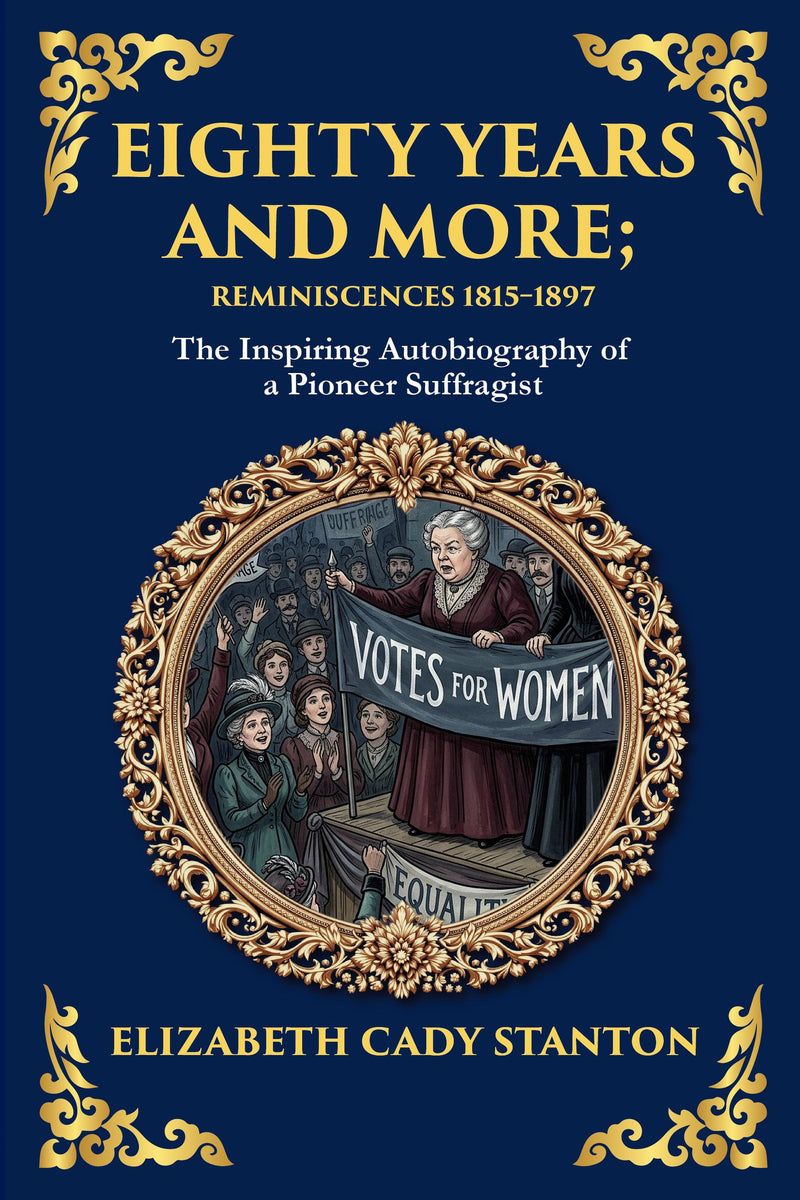
Eighty Years and More; Reminiscences 1815–1897
Trailblazer. Reformer. Revolutionary. In Eighty Years and More, Elizabeth Cady Stanton recounts her extraordinary life in her own words—revealing the personal, political, and philosophical journey of one of the most powerful voices in American history.
or free app
10,000+ hrs library
30-day guarantee
The complete Eighty Years and More; Reminiscences 1815–1897 appears in modern English through Library of Alexandria Press, available online with audiobook narration included for members.
Have you ever wondered why one woman’s voice could ignite a movement that changed history? In Eighty Years and More: Reminiscences 1815–1897, Elizabeth Cady Stanton delivers a bold and candid account of her life as one of the foundational architects of the women’s suffrage movement. Spanning nearly a century of seismic social change, this autobiography is both a personal reflection and a political manifesto from a woman whose courage and intellect helped shape modern democracy.
Born in a time when women were denied education, property rights, and the vote, Stanton dared to challenge every restriction placed on her sex. In these pages, she recalls her upbringing in a conservative household, her groundbreaking education, her marriage and motherhood, and her relentless advocacy for justice—especially for women’s equality. With a sharp pen and a fearless mind, she chronicles her partnerships with fellow reformers like Susan B. Anthony, her role in the Seneca Falls Convention, and her lifelong fight for legal, educational, and political change.
What you’ll discover in this modern edition
- A Personal Chronicle of Feminist Awakening Follow Stanton’s intellectual journey from childhood curiosity to radical reform.
| Formats | eBook (EPUB + PDF) · Audiobook · Paperback · Hardcover · Large Print |
| Language | English |
| Trim size (print) | 6 × 9 in |
| Binding | Paperback — perfect-bound · Hardcover — casewrap |
| Large Print edition | Same text in a larger, easy-read type — a larger font, not a larger trim |
| Print pricing | Every physical book at our true cost — at-cost, no profit (members) |
| Library | 873 restored titles, always growing |
| Length | 129,575 words · ~8 hr 38 min reading |
| Reading level | Grade 8 · an easy, flowing read (this modern-English edition) |
| Edition | Modern English translation · 2026 |
Member reviews for this edition are collected as readers finish it — be the first. Across the library: 12,000+ books shipped, every plan covered by a 365-day print guarantee.
About this edition
A faithful, unabridged modern-English edition by The Library of Alexandria — carefully rendered for today's reader and verified paragraph-by-paragraph against the public-domain source. Available as eBook, audiobook, paperback, hardcover, and large print.
- Complete & unabridgedVerified paragraph by paragraph against the source — never a scan, never abridged.
- Modern English, faithfulReadable today, with the author’s meaning kept intact. Readable — not simplified.
- Every format, one membershipRead in your browser or the free app, or listen to the full audiobook.
Included free with your membership
Cancel anytime, one click · 30-day money-back guarantee
Edition last updated July 2026
What’s inside
Eighty Years and More; Reminiscences 1815–1897 — complete and unabridged: all 29 sections included with membership, plus the full audiobook.
Begin reading Eighty Years and More; Reminiscences 1815–1897
In clear modern English — the complete text is included with membership.
Introduction
There are some lives that, once examined, refuse to be reduced to a single sentence. Elizabeth Cady Stanton lived such a life. Across more than eight decades that spanned the better part of the nineteenth century, she stood at the center of a revolution so profound and so quiet in its early stirrings that many of her contemporaries scarcely understood its dimensions until it had already changed the world. The memoir you are about to read is her own accounting of those years — written near the end of her long journey, with the clarity of hindsight and the warmth of a woman who never lost her appetite for living, laughing, debating, and dreaming. It is a document of immense historical importance, yes, but it is also, and perhaps more surprisingly, a delightful read: full of mischief, candor, intellectual fire, and an unmistakable joy in the company of other human beings.
This edition has been carefully adapted for the contemporary reader. The aim of that adaptation is not to flatten Stanton’s voice or to dilute the texture of her age, but to remove the small obstacles that can stand between a modern reader and a nineteenth-century text — the archaic constructions, the now-obscure references, the occasional density of Victorian prose that can make even the most rewarding writing feel like a climb. What remains is Stanton herself: her wit, her warmth, her steely conviction, her capacity for self-deprecation, and her remarkable gift for storytelling. You will find, as you turn these pages, that you are in the company of one of the most engaging and formidable women who ever set her recollections to paper.
To understand why this autobiography matters, it helps to understand the world into which Elizabeth Cady was born in 1815. It was a world in which a married woman, in the eyes of the law, scarcely existed as a separate person. Under the legal doctrine known as coverture — inherited from English common law — a wife’s legal identity was absorbed into that of her husband. She could not own property in her own name. She could not keep her own wages. She had no claim to her own children in the event of a separation. She could not vote, could not sit on a jury, could not enter most professions, and in countless smaller ways was reminded daily that the public sphere belonged to men. A woman of intelligence and ambition was expected to channel those gifts entirely into the domestic realm, and to be grateful for the privilege.
Into this world came a girl who, from her earliest years, sensed the profound unfairness of these arrangements and refused to accept that they were ordained by nature or by God. As a child in Johnstown, New York, she watched her father, a respected judge, counsel distressed women who came to his office seeking relief from cruel or improvident husbands — and watched him explain, again and again, that the law offered them no remedy. These early scenes lodged themselves in her mind. They were not abstractions to her; they were living injuries inflicted on real women whose faces she could see. The conviction that grew out of those observations would animate the rest of her life.
The famous turning point came in 1848, in the small town of Seneca Falls, New York. There, alongside Lucretia Mott and a handful of other reformers, Stanton helped organize the first women’s rights convention ever held in the United States. It was she who drafted the document that would become its centerpiece — the Declaration of Sentiments — modeled deliberately on the Declaration of Independence and beginning with the audacious revision: “We hold these truths to be self-evident: that all men and women are created equal.” It was she who insisted, against the cautious advice of friends who feared they would be ridiculed, that the document include a demand for women’s right to vote. That demand, considered impossibly radical at the time, would define the movement for the next seventy years and would not be fully realized in her own country until 1920 — eighteen years after her death.
Stanton’s partnership with Susan B. Anthony, which runs like a golden thread through the second half of this book, became one of the most consequential collaborations in American history. The two women were a study in complementary genius. Stanton, the brilliant writer and theorist, was tied down for years by the demands of a large household and a brood of children; Anthony, unmarried and tireless, was free to travel, to organize, to carry their shared ideas into the wider world. “I forged the thunderbolts,” Stanton once said, “and she fired them.” Their friendship endured for half a century, through disagreements and disappointments, through the bitter divisions that splintered the suffrage movement after the Civil War, and through the long, often discouraging decades when victory seemed perpetually out of reach. The portrait of that friendship in these pages is one of the book’s great pleasures.
But it would be a mistake to think of Stanton solely as a suffragist, important as that work was. She was a radical thinker across an extraordinary range of subjects. She argued for liberalized divorce laws at a time when such a position was considered scandalous even within the reform community. She campaigned for women’s property rights and for the right of women to control their own earnings. She challenged the religious orthodoxy of her day, culminating late in life in the controversial Woman’s Bible, a critical commentary that questioned the scriptural foundations used to justify women’s subordination. She thought deeply about education, about dress reform, about the rearing of children, about temperance, about the abolition of slavery. She was, in the truest sense, a philosopher of human equality, and the women’s cause was for her one expression of a much larger faith in the dignity and potential of every individual.
What makes her autobiography so valuable is that it allows us to watch these convictions form. We meet the child who envied her brothers their freedom and their formal education, and who studied Greek and mathematics with fierce determination in part to prove that a girl could excel at the subjects reserved for boys. We meet the young bride who, attending the World’s Anti-Slavery Convention in London in 1840, was scandalized to discover that the women delegates were forced to sit behind a curtain, excluded from participation — an episode that helped crystallize her sense that the fight for human freedom could not be selective. We meet the harried young mother managing a household of children in Seneca Falls, channeling her frustration and her formidable energy into the cause that would consume her life. And we meet the grand old woman of the movement, looking back across the decades with humor, with pride, and with the wisdom of someone who has lived long enough to see the world begin, however slowly, to bend toward her vision.
A Memoir Full of Life, Not Merely Importance
If all this makes Eighty Years and More sound like a worthy but somber book — a dutiful chronicle of committees and conventions — let me correct that impression at once. One of the most striking things about this memoir is how thoroughly enjoyable it is to read. Stanton was a born storyteller, and she had an eye for the comic, the human, and the absurd that never deserted her.
She writes with infectious enthusiasm about the simple pleasures of life: about good food and good conversation, about the natural beauty of the places she lived, about the games and pranks of her childhood, about the joys and exasperations of raising seven children. She is frankly, refreshingly honest about her own failings and follies. She pokes fun at herself with the same wit she turns on the pompous and the self-important men who tried to stand in her way. When she recounts a debate in which she demolished an opponent’s argument, she does so with evident relish, and the reader cannot help but cheer her on.
She had, too, a genuine love of people, and her memoir is populated by an enormous cast of vivid characters — reformers and writers, politicians and preachers, eccentrics and saints. Some of the most famous figures of the nineteenth century walk through these pages, and Stanton sketches them with a few deft, often mischievous strokes. She knew the great abolitionists and the great suffragists; she crossed paths with statesmen and philosophers on both sides of the Atlantic; she corresponded and conversed with many of the leading minds of her time. Her descriptions of these encounters are never reverent for its own sake. She tells us what people were actually like — their kindnesses and their vanities, their courage and their occasional smallness — and in doing so she brings an entire vanished world to life.
There is, running beneath all the wit and warmth, a current of real moral seriousness. Stanton was a fighter, and she did not pretend that the struggles she chronicles were easy or that the opposition she faced was always polite. She knew what it was to be mocked in the press, denounced from the pulpit, and abandoned by erstwhile allies. She knew the loneliness of being decades ahead of public opinion. She experienced, in the painful aftermath of the Civil War, the agonizing division within the reform movement over whether to support constitutional amendments that enfranchised Black men while continuing to exclude all women — a controversy that strained her closest friendships and forced her to choose among loyalties she held dear. The autobiography does not gloss over these difficulties. But Stanton’s fundamental disposition was one of hope and good humor, and even her accounts of defeat are infused with a sense that the larger cause would ultimately prevail.
It should be said, in the interest of honesty, that Stanton was a woman of her century as well as a woman who transcended it. Modern readers will encounter, in her own reflections, some attitudes and assumptions that we now recognize as the limitations of her time and circumstance. The disputes over the postwar amendments, in particular, exposed tensions and prejudices within the early women’s movement that later generations have had to reckon with honestly. Reading her in full — including the passages where her perspective was shaped, and sometimes narrowed, by the world she inhabited — is part of understanding her as a real and complex human being rather than a flawless icon. It is also part of understanding the difficult, halting, often contradictory way that movements for justice actually progress. The greatness of Stanton’s vision and the reality of her blind spots can, and should, be held together. Her own honesty in recording her life invites exactly that kind of thoughtful, generous reading.
What you will find above all, though, is a woman utterly alive on the page — opinionated, funny, brilliant, tender, occasionally vain, frequently right, and always, always interesting. She wrote this book not primarily to instruct or to lecture, but to share the experience of a long and remarkable life with those who would come after her. “The story of my private life,” she tells us at the outset, is offered alongside the public record, because she understood that a woman is more than her causes — that she is also a daughter and a sister, a wife and a mother, a friend and a traveler, a reader and a thinker, a being of appetite and affection and intellect. It is precisely this fullness that makes the memoir so satisfying. We come to know Stanton not as a marble statue but as a person we might wish we could have met.
For the modern reader, there is an additional layer of pleasure and instruction in encountering this book. We live in a world that Stanton helped to make — a world in which women vote, own property, attend universities, enter every profession, and serve at the highest levels of government and business. So much of what she fought for now seems so obviously just that it is difficult to remember it was ever in doubt. Reading her memoir restores that sense of historical perspective. It reminds us that the freedoms we take for granted were not handed down from on high but won, inch by inch, through the labor and sacrifice and stubborn courage of people like her. There is no better antidote to complacency than to spend time in the company of those who fought the early battles, when victory was far from certain and the costs of dissent were real.
Cancel anytime, one click · 30-day money-back guarantee
Founding annual rate available now — your price locks for life when you join.
Not ready? Get this free chapter by email — read it anytime.
✓ Sent — check your inbox for Eighty Years and More; Reminiscences 1815–1897.
Questions about Eighty Years and More; Reminiscences 1815–1897
Who wrote Eighty Years and More; Reminiscences 1815–1897?
Eighty Years and More; Reminiscences 1815–1897 was written by Elizabeth Cady Stanton. This edition presents the complete work in clear modern English, faithfully rendered from the public-domain original by Library of Alexandria Press.
Is Eighty Years and More; Reminiscences 1815–1897 free to read?
The opening chapter is free to read on this page. Members read and listen to the complete work — and the entire library — free, and can order any physical book at our true print cost.
How long is Eighty Years and More; Reminiscences 1815–1897?
29 chapters (~129,575 words) — about 8 hr 38 min of reading in this modern-English edition.
Is this an abridged version of Eighty Years and More; Reminiscences 1815–1897?
No. This is the complete, unabridged Eighty Years and More; Reminiscences 1815–1897, carefully rendered into clear modern English and verified paragraph-by-paragraph against the public-domain source — nothing is cut or summarised.
What formats does Eighty Years and More; Reminiscences 1815–1897 come in?
Eighty Years and More; Reminiscences 1815–1897 is available as eBook, paperback, hardcover and large print. eBook and audiobook are included with membership; printed editions ship at our true print cost.
Shipping & returns
Billing & membership
More from the library


Explore Biography & Letters
- Meditations · Marcus Aurelius
- The Confessions of St. Augustine · Saint Augustine
- The Confessions of Jean-Jacques Rousseau — Complete · Jean-Jacques Rousseau
- Ecce Homo · Friedrich Wilhelm Nietzsche
- De Profundis · Oscar Wilde
- Memoirs of Joseph Grimaldi · Joseph Grimaldi
- English Eccentrics and Eccentricities · John Timbs
- You Can’t Win · Jack Black
- Wild Animals I Have Known · Ernest Thompson Seton
- The Diary of Samuel Pepys — Complete 1665 N.S. · Samuel Pepys
- Random Reminiscences of Men and Events · John D. Rockefeller
- The Story of My Life · Helen Keller
- Elizabeth, Empress of Austria and Queen of Hungary · Carl Küchler
- Society as I Have Found It · Ward McAllister
- Autobiography of a Yogi · Paramahansa Yogananda
- Christopher Columbus and How He Received and Imparted the Spirit of Discovery
- A Portrait of the Artist as a Young Man · James Joyce
- Memoirs of the Author of a Vindication of the Rights of Woman · William Godwin
- Mary: A Fiction · Mary Wollstonecraft
- The Romance of Biography (Vol. 1 of 2) · Mrs. Jameson
- The Love Letters of Mary Wollstonecraft to Gilbert Imlay · Mary Wollstonecraft
- Selected Works of Voltairine de Cleyre · Voltairine de Cleyre
- Anarchism and Other Essays · Emma Goldman
- Agnes Grey · Anne Brontë
- Daddy-Long-Legs · Jean Webster
- Reminiscences of a Stock Operator · Edwin Lefèvre
- Martin Eden · Jack London
- Matthew Calbraith Perry: A Typical American Naval Officer · William Elliot Griffis
- Walden, and On the Duty of Civil Disobedience · Henry David Thoreau
- Little Women · Louisa May Alcott
Eighty Years and More; Reminiscences 1815–1897
Eighty Years and More; Reminiscences 1815–1897
The Inspiring Autobiography of a Pioneer Suffragist
Elizabeth Cady Stanton
Contents
- Introduction
- Chapter 1
- Chapter 2
- Chapter 3
- Chapter 4
- Chapter 5
- Chapter 6
- Chapter 7
- Chapter 8
- Chapter 9
- Chapter 10
- Chapter 11
- Chapter 12
- Chapter 13
- Chapter 14
- Chapter 15
- Chapter 16
- Chapter 17
- Chapter 18
- Chapter 19
- Chapter 20
- Chapter 21
- Chapter 22
- Chapter 23
- Chapter 24
- Chapter 25
- Chapter 26
- Chapter 27
- Chapter 28
Introduction
There are some lives that, once examined, refuse to be reduced to a single sentence. Elizabeth Cady Stanton lived such a life. Across more than eight decades that spanned the better part of the nineteenth century, she stood at the center of a revolution so profound and so quiet in its early stirrings that many of her contemporaries scarcely understood its dimensions until it had already changed the world. The memoir you are about to read is her own accounting of those years — written near the end of her long journey, with the clarity of hindsight and the warmth of a woman who never lost her appetite for living, laughing, debating, and dreaming. It is a document of immense historical importance, yes, but it is also, and perhaps more surprisingly, a delightful read: full of mischief, candor, intellectual fire, and an unmistakable joy in the company of other human beings.
This edition has been carefully adapted for the contemporary reader. The aim of that adaptation is not to flatten Stanton’s voice or to dilute the texture of her age, but to remove the small obstacles that can stand between a modern reader and a nineteenth-century text — the archaic constructions, the now-obscure references, the occasional density of Victorian prose that can make even the most rewarding writing feel like a climb. What remains is Stanton herself: her wit, her warmth, her steely conviction, her capacity for self-deprecation, and her remarkable gift for storytelling. You will find, as you turn these pages, that you are in the company of one of the most engaging and formidable women who ever set her recollections to paper.
To understand why this autobiography matters, it helps to understand the world into which Elizabeth Cady was born in 1815. It was a world in which a married woman, in the eyes of the law, scarcely existed as a separate person. Under the legal doctrine known as coverture — inherited from English common law — a wife’s legal identity was absorbed into that of her husband. She could not own property in her own name. She could not keep her own wages. She had no claim to her own children in the event of a separation. She could not vote, could not sit on a jury, could not enter most professions, and in countless smaller ways was reminded daily that the public sphere belonged to men. A woman of intelligence and ambition was expected to channel those gifts entirely into the domestic realm, and to be grateful for the privilege.
Into this world came a girl who, from her earliest years, sensed the profound unfairness of these arrangements and refused to accept that they were ordained by nature or by God. As a child in Johnstown, New York, she watched her father, a respected judge, counsel distressed women who came to his office seeking relief from cruel or improvident husbands — and watched him explain, again and again, that the law offered them no remedy. These early scenes lodged themselves in her mind. They were not abstractions to her; they were living injuries inflicted on real women whose faces she could see. The conviction that grew out of those observations would animate the rest of her life.
The famous turning point came in 1848, in the small town of Seneca Falls, New York. There, alongside Lucretia Mott and a handful of other reformers, Stanton helped organize the first women’s rights convention ever held in the United States. It was she who drafted the document that would become its centerpiece — the Declaration of Sentiments — modeled deliberately on the Declaration of Independence and beginning with the audacious revision: “We hold these truths to be self-evident: that all men and women are created equal.” It was she who insisted, against the cautious advice of friends who feared they would be ridiculed, that the document include a demand for women’s right to vote. That demand, considered impossibly radical at the time, would define the movement for the next seventy years and would not be fully realized in her own country until 1920 — eighteen years after her death.
Stanton’s partnership with Susan B. Anthony, which runs like a golden thread through the second half of this book, became one of the most consequential collaborations in American history. The two women were a study in complementary genius. Stanton, the brilliant writer and theorist, was tied down for years by the demands of a large household and a brood of children; Anthony, unmarried and tireless, was free to travel, to organize, to carry their shared ideas into the wider world. “I forged the thunderbolts,” Stanton once said, “and she fired them.” Their friendship endured for half a century, through disagreements and disappointments, through the bitter divisions that splintered the suffrage movement after the Civil War, and through the long, often discouraging decades when victory seemed perpetually out of reach. The portrait of that friendship in these pages is one of the book’s great pleasures.
But it would be a mistake to think of Stanton solely as a suffragist, important as that work was. She was a radical thinker across an extraordinary range of subjects. She argued for liberalized divorce laws at a time when such a position was considered scandalous even within the reform community. She campaigned for women’s property rights and for the right of women to control their own earnings. She challenged the religious orthodoxy of her day, culminating late in life in the controversial Woman’s Bible, a critical commentary that questioned the scriptural foundations used to justify women’s subordination. She thought deeply about education, about dress reform, about the rearing of children, about temperance, about the abolition of slavery. She was, in the truest sense, a philosopher of human equality, and the women’s cause was for her one expression of a much larger faith in the dignity and potential of every individual.
What makes her autobiography so valuable is that it allows us to watch these convictions form. We meet the child who envied her brothers their freedom and their formal education, and who studied Greek and mathematics with fierce determination in part to prove that a girl could excel at the subjects reserved for boys. We meet the young bride who, attending the World’s Anti-Slavery Convention in London in 1840, was scandalized to discover that the women delegates were forced to sit behind a curtain, excluded from participation — an episode that helped crystallize her sense that the fight for human freedom could not be selective. We meet the harried young mother managing a household of children in Seneca Falls, channeling her frustration and her formidable energy into the cause that would consume her life. And we meet the grand old woman of the movement, looking back across the decades with humor, with pride, and with the wisdom of someone who has lived long enough to see the world begin, however slowly, to bend toward her vision.
A Memoir Full of Life, Not Merely Importance
If all this makes Eighty Years and More sound like a worthy but somber book — a dutiful chronicle of committees and conventions — let me correct that impression at once. One of the most striking things about this memoir is how thoroughly enjoyable it is to read. Stanton was a born storyteller, and she had an eye for the comic, the human, and the absurd that never deserted her.
She writes with infectious enthusiasm about the simple pleasures of life: about good food and good conversation, about the natural beauty of the places she lived, about the games and pranks of her childhood, about the joys and exasperations of raising seven children. She is frankly, refreshingly honest about her own failings and follies. She pokes fun at herself with the same wit she turns on the pompous and the self-important men who tried to stand in her way. When she recounts a debate in which she demolished an opponent’s argument, she does so with evident relish, and the reader cannot help but cheer her on.
She had, too, a genuine love of people, and her memoir is populated by an enormous cast of vivid characters — reformers and writers, politicians and preachers, eccentrics and saints. Some of the most famous figures of the nineteenth century walk through these pages, and Stanton sketches them with a few deft, often mischievous strokes. She knew the great abolitionists and the great suffragists; she crossed paths with statesmen and philosophers on both sides of the Atlantic; she corresponded and conversed with many of the leading minds of her time. Her descriptions of these encounters are never reverent for its own sake. She tells us what people were actually like — their kindnesses and their vanities, their courage and their occasional smallness — and in doing so she brings an entire vanished world to life.
There is, running beneath all the wit and warmth, a current of real moral seriousness. Stanton was a fighter, and she did not pretend that the struggles she chronicles were easy or that the opposition she faced was always polite. She knew what it was to be mocked in the press, denounced from the pulpit, and abandoned by erstwhile allies. She knew the loneliness of being decades ahead of public opinion. She experienced, in the painful aftermath of the Civil War, the agonizing division within the reform movement over whether to support constitutional amendments that enfranchised Black men while continuing to exclude all women — a controversy that strained her closest friendships and forced her to choose among loyalties she held dear. The autobiography does not gloss over these difficulties. But Stanton’s fundamental disposition was one of hope and good humor, and even her accounts of defeat are infused with a sense that the larger cause would ultimately prevail.
It should be said, in the interest of honesty, that Stanton was a woman of her century as well as a woman who transcended it. Modern readers will encounter, in her own reflections, some attitudes and assumptions that we now recognize as the limitations of her time and circumstance. The disputes over the postwar amendments, in particular, exposed tensions and prejudices within the early women’s movement that later generations have had to reckon with honestly. Reading her in full — including the passages where her perspective was shaped, and sometimes narrowed, by the world she inhabited — is part of understanding her as a real and complex human being rather than a flawless icon. It is also part of understanding the difficult, halting, often contradictory way that movements for justice actually progress. The greatness of Stanton’s vision and the reality of her blind spots can, and should, be held together. Her own honesty in recording her life invites exactly that kind of thoughtful, generous reading.
What you will find above all, though, is a woman utterly alive on the page — opinionated, funny, brilliant, tender, occasionally vain, frequently right, and always, always interesting. She wrote this book not primarily to instruct or to lecture, but to share the experience of a long and remarkable life with those who would come after her. “The story of my private life,” she tells us at the outset, is offered alongside the public record, because she understood that a woman is more than her causes — that she is also a daughter and a sister, a wife and a mother, a friend and a traveler, a reader and a thinker, a being of appetite and affection and intellect. It is precisely this fullness that makes the memoir so satisfying. We come to know Stanton not as a marble statue but as a person we might wish we could have met.
For the modern reader, there is an additional layer of pleasure and instruction in encountering this book. We live in a world that Stanton helped to make — a world in which women vote, own property, attend universities, enter every profession, and serve at the highest levels of government and business. So much of what she fought for now seems so obviously just that it is difficult to remember it was ever in doubt. Reading her memoir restores that sense of historical perspective. It reminds us that the freedoms we take for granted were not handed down from on high but won, inch by inch, through the labor and sacrifice and stubborn courage of people like her. There is no better antidote to complacency than to spend time in the company of those who fought the early battles, when victory was far from certain and the costs of dissent were real.
A child’s mental growth isn’t measured by days and years, but by how passing events affect their mind. An experience that serves as a sudden awakening for one child, pushing them in a certain direction for years to come, might leave no impression at all on another. People often wonder why children from the same family are so different, even though they had the same discipline at home, the same lessons at school and church, and grew up in the same environment. It is like wondering why lilies and lilacs in the same climate aren’t all the same color or equally fragrant. Children differ just as much in the basic elements of their physical and mental lives.
Who can truly measure the power of influences before birth, or a child’s surroundings in their earliest years? A single word or sight might deeply affect one child while meaning nothing to another. One child might be miserable under a specific type of home discipline, while another is perfectly content under that same rule. The first, longing for more freedom, lives in a constant state of rebellion; the second, more easily satisfied, quietly accepts the situation. Everything is viewed from a different perspective; the world takes its color from the mind of the person seeing it.
I feel compelled to recall as much as I can about my early days—what I thought and felt—so that adults can better understand children and do more for their happiness and growth. I see so much tyranny exercised over children, even by well-meaning parents, in many different forms. Often, these parents don’t even realize they are being tyrannical. I want to describe my joys and sorrows as vividly as possible, hoping I can help protect the weak from the strong. Adults rarely imagine what is going on in a child’s mind because few adults practice introspection. Those who cannot remember how they felt when they were restrained or disappointed cannot appreciate the suffering of children, who can neither describe nor analyze their feelings. When defending themselves against injustice, children are as helpless as animals. What seems insignificant to an adult is often a source of great joy or sorrow to a child.
End of the free sample
Keep reading, free
Members read and listen to the complete book — and the entire library. Cancel anytime, one click · 30-day money-back guarantee.