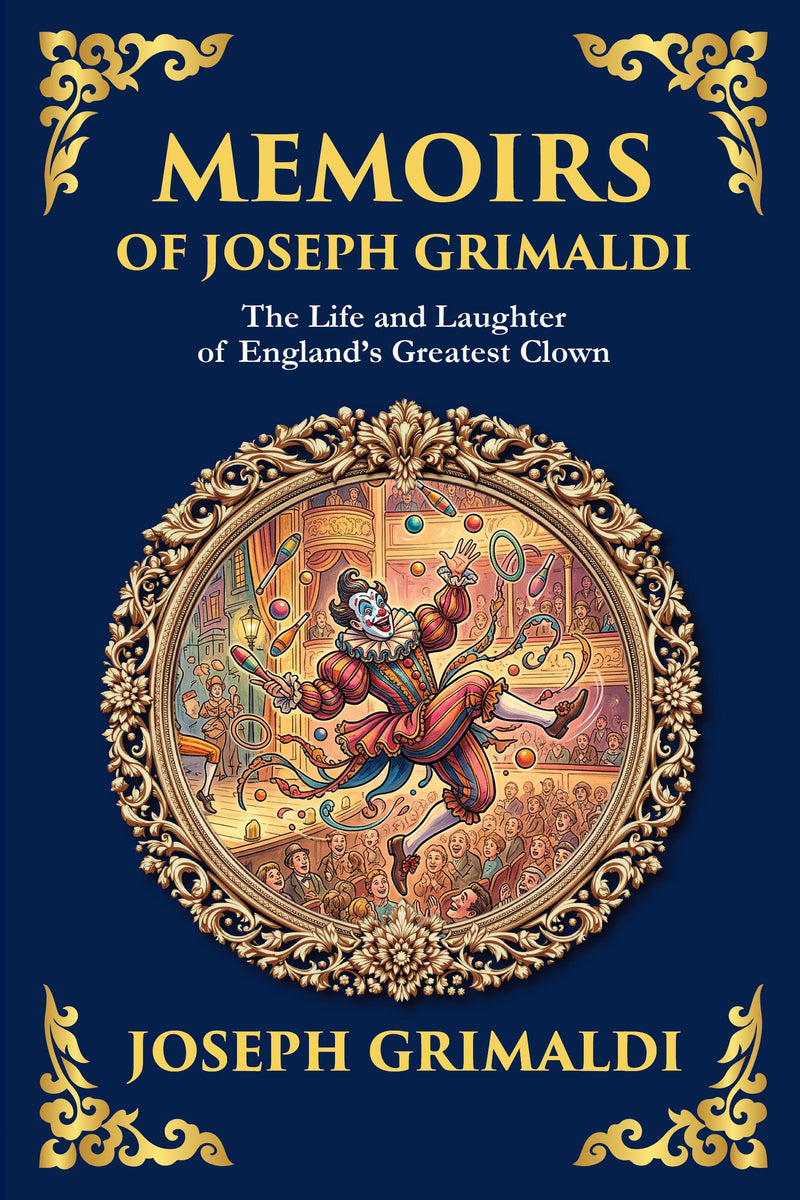
Memoirs of Joseph Grimaldi
Long before modern comedy found its voice, one man made an entire nation laugh—while quietly carrying the weight of personal sorrow.
or free app
10,000+ hrs library
30-day guarantee
The complete Memoirs of Joseph Grimaldi appears in modern English through Library of Alexandria Press, available online with audiobook narration included for members.
Have you ever wondered why those who make us laugh the loudest often carry the heaviest burdens? Memoirs of Joseph Grimaldi is more than the autobiography of Britain’s most iconic clown—it is a riveting, emotional, and richly detailed portrait of life in the theatre, drawn from the tumultuous experiences of the man who defined the modern clown. From his earliest days on stage as a child actor under the shadow of his domineering father, to his meteoric rise as the darling of the London stage, Grimaldi’s life is a story of brilliance, innovation, and sacrifice.
He transformed the art of pantomime with his physicality, wit, and expressive charm, becoming a household name and pioneering a comedic legacy that endures today. But behind the greasepaint and laughter lay a darker reality: financial instability, chronic illness, personal tragedy, and a relentless drive to perform despite it all. Charles Dickens, master of capturing both joy and suffering, shapes Grimaldi’s narrative into a deeply affecting testament to the complexities of art, identity, and endurance.
What you’ll discover in this modern edition
- The Origin of the Modern Clown Explore how Grimaldi redefined pantomime and clowning through innovation, athleticism, and timing.
- The Highs and Lows of Fame Witness the contrast between Grimaldi’s adoration on stage and the sorrow of his private life.
- A Glimpse into Georgian Theatre Life Gain insight into the colorful world of 18th and 19th-century British entertainment and its inner workings.
- The Dickensian Touch Experience how Charles Dickens brings literary weight and emotional depth to Grimaldi’s own reflections.
- A Story of Joy, Pain, and Legacy Understand why Grimaldi’s life resonates with artists and audiences alike to this very day.
| Formats | eBook (EPUB + PDF) · Audiobook · Paperback · Hardcover · Large Print |
| Language | English |
| Trim size (print) | 6 × 9 in |
| Binding | Paperback — perfect-bound · Hardcover — casewrap |
| Large Print edition | Same text in a larger, easy-read type — a larger font, not a larger trim |
| Print pricing | Every physical book at our true cost — at-cost, no profit (members) |
| Library | 873 restored titles, always growing |
| Length | 109,777 words · ~7 hr 19 min reading |
| Reading level | Grade 10 · a comfortable read (this modern-English edition) |
| Edition | Modern English translation · 2026 |
Member reviews for this edition are collected as readers finish it — be the first. Across the library: 12,000+ books shipped, every plan covered by a 365-day print guarantee.
About this edition
A faithful, unabridged modern-English edition by The Library of Alexandria — carefully rendered for today's reader and verified paragraph-by-paragraph against the public-domain source. Available as eBook, audiobook, paperback, hardcover, and large print.
- Complete & unabridgedVerified paragraph by paragraph against the source — never a scan, never abridged.
- Modern English, faithfulReadable today, with the author’s meaning kept intact. Readable — not simplified.
- Every format, one membershipRead in your browser or the free app, or listen to the full audiobook.
Included free with your membership
Cancel anytime, one click · 30-day money-back guarantee
Edition last updated July 2026
What’s inside
Memoirs of Joseph Grimaldi — complete and unabridged: all 60 sections included with membership, plus the full audiobook.
Begin reading Memoirs of Joseph Grimaldi
In clear modern English — the complete text is included with membership.
Introduction
There is a particular kind of magic that belongs exclusively to the theatre of childhood — not the polished, self-conscious theatre of adult appreciation, but the raw, gasping, wide-eyed wonder of a child who genuinely cannot tell where the performance ends and reality begins. It is the magic of a figure in white and red who seems to have stepped out of some parallel world where the laws of consequence do not apply, where sausages may be stolen without punishment, where a string of onions becomes a weapon of sublime comedy, where a policeman’s truncheon is merely an invitation to further mischief. That figure — that particular, irreplaceable, world-altering figure — was Joseph Grimaldi, and the book you are about to read is his own account of how he came to inhabit it, and what it cost him to do so.
To say that Grimaldi was the greatest clown England ever produced is to say something true but insufficient, in the way that saying Beethoven was a competent composer is technically accurate but misses the point entirely. Grimaldi did not merely excel at an existing form; he invented the form as we have come to understand it. Before him, the Clown of the English pantomime was a secondary figure, a rustic buffoon who existed largely to be outwitted and humiliated at the margins of a story that belonged to Harlequin and Columbine. Grimaldi took that marginal figure and moved him to the absolute centre of everything. He gave the Clown a face — the white-painted, red-cheeked, wildly grinning face that every subsequent clown in the Western tradition has worn in some form or another — and he gave him a soul, which was something altogether more surprising and more lasting. By the time he retired from the stage in 1828, he had so thoroughly transformed the role that the character was simply called “Joey” in his honour, a nickname that persists in circus tradition to this day. He was not a clown who happened to be famous. He was the origin point of a whole human type.
And yet, for all his fame during his lifetime — and it was extraordinary fame, the kind that filled theatres to dangerous capacity and made his name a byword for joy across the English-speaking world — Grimaldi has become, for most modern readers, a name rather than a person. We know the outline: the great clown, the physical suffering, the melancholy behind the painted smile. We have the legend. What we have not always had, in a form that is genuinely readable and alive, is the man himself — his voice, his humour, his tenderness, his resilience, his very particular way of moving through a world that was simultaneously glamorous and brutal, hilarious and heartbreaking.
This edition exists to give you that man.
The book’s origins are themselves a small drama worth understanding before you turn to the main text, because they bear directly on how you will read what follows and what kind of trust you can reasonably place in it.
Grimaldi spent roughly the last year of his life writing his memoirs. He was by then in serious physical decline — decades of acrobatic performance had destroyed his body with a thoroughness that reads, in retrospect, like a terrible irony, the instrument of so much laughter worn to pieces by the labour of producing it. He wrote, or dictated, at considerable length, with the garrulousness of an old man revisiting a life that had been, by any measure, extraordinary. The resulting manuscript was voluminous, personal, and uneven in the way that all genuinely personal documents are uneven: brilliant in places, digressive in others, raw in ways that a man in full health might have smoothed over.
That manuscript was entrusted to a Mr. Thomas Egerton Wilks, who was well acquainted with Grimaldi and his circle, and who undertook the considerable task of condensing and revising it for publication. Wilks cut substantially, reorganised, and added material drawn from his own conversations with Grimaldi — anecdotes and recollections that had not made it into the written account but that Wilks judged worth preserving. While he was still at work on this task, Grimaldi died, in May of 1837. Wilks completed his labours by September of that year and offered the manuscript to the publisher, who purchased it with the agreement of Richard Hughes, Grimaldi’s executor.
At this point, a third hand entered the process — and it is the most famous hand of all. The publisher engaged a young writer who had recently made a considerable sensation with a series of sketches published under the pen name “Boz” to edit the manuscript further. That writer was Charles Dickens, twenty-five years old, already the author of the Pickwick Papers and already possessed of a prose style so distinctive that it is almost impossible to mistake for anyone else’s. Dickens accepted the commission, reworked the manuscript substantially — changing it from first person to third, sharpening the narrative passages, and bringing his own irrepressible comic energy to bear on the material — and delivered the result in early 1838.
The question of authorship, then, is genuinely layered, and intellectual honesty requires acknowledging it plainly. The memories are Grimaldi’s. The initial shaping and some of the anecdotal material are Wilks’s. The prose style, the narrative architecture, and a great deal of the wit and energy that make the book so readable are Dickens’s. Dickens himself was careful to say, in the introductory chapter he wrote for the first edition, that he had not invented or embellished the facts — only improved the manner of their telling. Whether one takes that claim entirely at face value is a matter of individual judgment, but there is no strong reason to doubt it in its essentials. What you are reading is a genuine memoir, processed through several layers of editorial intelligence, and the result is something richer and stranger than a simple autobiography would have been.
It is also worth noting that the book was illustrated by George Cruikshank, one of the great graphic artists of the nineteenth century, whose images of Grimaldi in performance are among the most vivid visual records we have of what the man actually looked like on stage. This edition reproduces those illustrations, and they reward close attention. Cruikshank had seen Grimaldi perform, and his drawings carry the authority of direct witness — the particular angle of a leap, the precise configuration of that famous painted face, the quality of physical comedy that is almost impossible to describe in words but that Cruikshank captures with a line.
The best way to approach what follows is to resist the temptation to read it as a straightforward biography, because it is not quite that, and holding it to biographical standards will cause you to miss what it actually is. It is something more interesting: a portrait of a world, rendered from the inside, by someone who was simultaneously its greatest ornament and one of its most vulnerable inhabitants.
That world is the world of the English popular theatre in the late eighteenth and early nineteenth centuries — a world that has no precise modern equivalent, though it has partial analogies in various directions. It was a world of extraordinary creative energy and almost total institutional precariousness, where performers of genius worked for managers of varying competence and integrity, where the line between legitimate and illegitimate theatre was policed with an absurdity that the performers themselves found endlessly comic, where a single successful pantomime could make a theatre’s fortune and a single bad season could ruin a performer’s livelihood. It was a world in which physical skill of the most demanding kind was expected as a matter of course, in which injuries were routine and career-ending accidents were common, and in which the audience’s appetite for novelty was insatiable and entirely without mercy.
Grimaldi navigated this world from earliest childhood — and when we say earliest, we mean it with a literalness that will startle modern readers. He was performing on stage before he could reliably walk. His father, the dancer and pantomimist Giuseppe Grimaldi, was a figure of considerable theatrical reputation and considerable personal severity, and the picture of Grimaldi’s childhood that emerges from these pages is one that sits in genuinely uncomfortable tension with the comedy that surrounds it. There is warmth here, and there is laughter, but there is also something harder and stranger underneath, and the book is most rewarding when you allow yourself to feel both registers simultaneously.
Read the comic episodes — and there are many, and they are genuinely funny, not merely historically interesting — with full attention to their physical specificity. Dickens, editing the material, had an instinctive understanding of how comedy works on the page, and he renders Grimaldi’s escapades with a timing and a precision that repays slow reading. The famous episodes involving burglars, magistrates, eccentric travelling companions, and the various disasters of provincial touring are not merely anecdotes; they are set pieces, carefully constructed, and they deserve the same quality of attention you would give to a well-told short story.
At the same time, read the quieter passages — the moments of domestic life, the descriptions of friendship and professional loyalty, the accounts of loss — with equal care. The book has a tendency, which is partly Grimaldi’s and partly Dickens’s, to move quickly past its own emotional depths, to treat grief and hardship with a briskness that can seem like evasion but is more accurately understood as a particular cultural style: the style of a man who has learned, through long professional practice, that the show must go on and that dwelling too long on sorrow is a luxury the stage does not permit. When the book slows down, when it lingers, pay attention. Those are the moments when something is being said that the author found difficult to say quickly.
Pay attention, too, to the supporting cast. One of the great pleasures of this book is its gallery of secondary figures — the theatrical managers, the fellow performers, the magistrates and publicans and travelling companions who drift through Grimaldi’s life with the vivid particularity of characters in a novel. Some of them are famous: Richard Brinsley Sheridan appears several times, and the portrait of him is affectionate, exasperated, and entirely believable. John Kemble makes appearances that illuminate the strange social geography of the theatrical world, where a great tragic actor and a great clown might find themselves in the same room and treat each other with a wary mutual respect. Others are entirely obscure — Mr. Mackintosh with his sporting pretensions, the various eccentrics encountered on the road — but they are rendered with a sharpness that makes them feel as real as the famous names.
It is impossible to read this book without thinking about what it means to make people laugh for a living — what it costs, what it requires, what it does to a person over time. Grimaldi gave his body to his art with a completeness that was, in retrospect, devastating. The acrobatic demands of the pantomime Clown were immense: the falls, the tumbles, the physical gags that required precise timing and enormous strength, performed night after night, season after season, often at multiple theatres on the same evening. He would finish a performance at Covent Garden and travel across London to appear at Sadler’s Wells, then travel back, then do it again the next night. The cumulative physical toll of this regime was catastrophic, and the book does not hide it, though it treats it with the same brisk stoicism that it brings to other forms of suffering.
But there is another cost that the book illuminates more obliquely, and it is perhaps the more interesting one. Grimaldi was, by all accounts, a man of genuine warmth and emotional depth — a devoted friend, a loving father, a person capable of great tenderness. He was also a man whose professional identity required him to be, in public, something quite different: a figure of anarchic energy, of gleeful destructiveness, of a joy so extreme it bordered on mania. The gap between the private man and the public persona is one of the book’s persistent undertones, never quite stated directly but always present, like a bass note beneath the melody.
Cancel anytime, one click · 30-day money-back guarantee
Founding annual rate available now — your price locks for life when you join.
Not ready? Get this free chapter by email — read it anytime.
✓ Sent — check your inbox for Memoirs of Joseph Grimaldi.
Questions about Memoirs of Joseph Grimaldi
What is Memoirs of Joseph Grimaldi about?
Long before modern comedy found its voice, one man made an entire nation laugh—while quietly carrying the weight of personal sorrow. In Memoirs of Joseph Grimaldi, readers are invited behind the painted smile of England’s most celebrated clown to discover the humanity, hardship, and heart behind the laughter. Edited by Charles Dickens from Grimaldi’s own manuscript, this compelling account traces the life of the man who revolutionized pantomime and gave birth to the clown as we know it.
Who wrote Memoirs of Joseph Grimaldi?
Memoirs of Joseph Grimaldi was written by Joseph Grimaldi. This edition presents the complete work in clear modern English, faithfully rendered from the public-domain original by Library of Alexandria Press.
Is Memoirs of Joseph Grimaldi free to read?
The opening chapter is free to read on this page. Members read and listen to the complete work — and the entire library — free, and can order any physical book at our true print cost.
How long is Memoirs of Joseph Grimaldi?
60 chapters (~109,777 words) — about 7 hr 19 min of reading in this modern-English edition.
Is this an abridged version of Memoirs of Joseph Grimaldi?
No. This is the complete, unabridged Memoirs of Joseph Grimaldi, carefully rendered into clear modern English and verified paragraph-by-paragraph against the public-domain source — nothing is cut or summarised.
What formats does Memoirs of Joseph Grimaldi come in?
Memoirs of Joseph Grimaldi is available as eBook, paperback, hardcover and large print. eBook and audiobook are included with membership; printed editions ship at our true print cost.
Shipping & returns
Billing & membership
More from the library


Explore Biography & Letters
- Meditations · Marcus Aurelius
- The Confessions of St. Augustine · Saint Augustine
- The Confessions of Jean-Jacques Rousseau — Complete · Jean-Jacques Rousseau
- Ecce Homo · Friedrich Wilhelm Nietzsche
- De Profundis · Oscar Wilde
- English Eccentrics and Eccentricities · John Timbs
- You Can’t Win · Jack Black
- Wild Animals I Have Known · Ernest Thompson Seton
- The Diary of Samuel Pepys — Complete 1665 N.S. · Samuel Pepys
- Random Reminiscences of Men and Events · John D. Rockefeller
- The Story of My Life · Helen Keller
- Elizabeth, Empress of Austria and Queen of Hungary · Carl Küchler
- Society as I Have Found It · Ward McAllister
- Autobiography of a Yogi · Paramahansa Yogananda
- Christopher Columbus and How He Received and Imparted the Spirit of Discovery
- A Portrait of the Artist as a Young Man · James Joyce
- Memoirs of the Author of a Vindication of the Rights of Woman · William Godwin
- Mary: A Fiction · Mary Wollstonecraft
- The Romance of Biography (Vol. 1 of 2) · Mrs. Jameson
- The Love Letters of Mary Wollstonecraft to Gilbert Imlay · Mary Wollstonecraft
- Selected Works of Voltairine de Cleyre · Voltairine de Cleyre
- Eighty Years and More; Reminiscences 1815–1897 · Elizabeth Cady Stanton
- Anarchism and Other Essays · Emma Goldman
- Agnes Grey · Anne Brontë
- Daddy-Long-Legs · Jean Webster
- Reminiscences of a Stock Operator · Edwin Lefèvre
- Martin Eden · Jack London
- Matthew Calbraith Perry: A Typical American Naval Officer · William Elliot Griffis
- Walden, and On the Duty of Civil Disobedience · Henry David Thoreau
- Little Women · Louisa May Alcott
Memoirs of Joseph Grimaldi
Memoirs of Joseph Grimaldi
A Modern Translation
Joseph Grimaldi
Contents
- Introduction
- Chapter 1
- Chapter 2
- Chapter 3
- Chapter 4
- Chapter 5
- Chapter 6
- Chapter 7
- Chapter 8
- Chapter 9
- Chapter 10
- Chapter 11
- Chapter 12
- Chapter 13
- Chapter 14
- Chapter 15
- Chapter 16
- Chapter 17
- Chapter 18
- Chapter 19
- Chapter 20
- Chapter 21
- Chapter 22
- Chapter 23
- Chapter 24
- Chapter 25
- Chapter 26
- Chapter 27
- Chapter 28
- Chapter 29
- Chapter 30
- Chapter 31
- Chapter 32
- Chapter 33
- Chapter 34
- Chapter 35
- Chapter 36
- Chapter 37
- Chapter 38
- Chapter 39
- … and 20 more chapters
Introduction
There is a particular kind of magic that belongs exclusively to the theatre of childhood — not the polished, self-conscious theatre of adult appreciation, but the raw, gasping, wide-eyed wonder of a child who genuinely cannot tell where the performance ends and reality begins. It is the magic of a figure in white and red who seems to have stepped out of some parallel world where the laws of consequence do not apply, where sausages may be stolen without punishment, where a string of onions becomes a weapon of sublime comedy, where a policeman’s truncheon is merely an invitation to further mischief. That figure — that particular, irreplaceable, world-altering figure — was Joseph Grimaldi, and the book you are about to read is his own account of how he came to inhabit it, and what it cost him to do so.
To say that Grimaldi was the greatest clown England ever produced is to say something true but insufficient, in the way that saying Beethoven was a competent composer is technically accurate but misses the point entirely. Grimaldi did not merely excel at an existing form; he invented the form as we have come to understand it. Before him, the Clown of the English pantomime was a secondary figure, a rustic buffoon who existed largely to be outwitted and humiliated at the margins of a story that belonged to Harlequin and Columbine. Grimaldi took that marginal figure and moved him to the absolute centre of everything. He gave the Clown a face — the white-painted, red-cheeked, wildly grinning face that every subsequent clown in the Western tradition has worn in some form or another — and he gave him a soul, which was something altogether more surprising and more lasting. By the time he retired from the stage in 1828, he had so thoroughly transformed the role that the character was simply called “Joey” in his honour, a nickname that persists in circus tradition to this day. He was not a clown who happened to be famous. He was the origin point of a whole human type.
And yet, for all his fame during his lifetime — and it was extraordinary fame, the kind that filled theatres to dangerous capacity and made his name a byword for joy across the English-speaking world — Grimaldi has become, for most modern readers, a name rather than a person. We know the outline: the great clown, the physical suffering, the melancholy behind the painted smile. We have the legend. What we have not always had, in a form that is genuinely readable and alive, is the man himself — his voice, his humour, his tenderness, his resilience, his very particular way of moving through a world that was simultaneously glamorous and brutal, hilarious and heartbreaking.
This edition exists to give you that man.
The book’s origins are themselves a small drama worth understanding before you turn to the main text, because they bear directly on how you will read what follows and what kind of trust you can reasonably place in it.
Grimaldi spent roughly the last year of his life writing his memoirs. He was by then in serious physical decline — decades of acrobatic performance had destroyed his body with a thoroughness that reads, in retrospect, like a terrible irony, the instrument of so much laughter worn to pieces by the labour of producing it. He wrote, or dictated, at considerable length, with the garrulousness of an old man revisiting a life that had been, by any measure, extraordinary. The resulting manuscript was voluminous, personal, and uneven in the way that all genuinely personal documents are uneven: brilliant in places, digressive in others, raw in ways that a man in full health might have smoothed over.
That manuscript was entrusted to a Mr. Thomas Egerton Wilks, who was well acquainted with Grimaldi and his circle, and who undertook the considerable task of condensing and revising it for publication. Wilks cut substantially, reorganised, and added material drawn from his own conversations with Grimaldi — anecdotes and recollections that had not made it into the written account but that Wilks judged worth preserving. While he was still at work on this task, Grimaldi died, in May of 1837. Wilks completed his labours by September of that year and offered the manuscript to the publisher, who purchased it with the agreement of Richard Hughes, Grimaldi’s executor.
At this point, a third hand entered the process — and it is the most famous hand of all. The publisher engaged a young writer who had recently made a considerable sensation with a series of sketches published under the pen name “Boz” to edit the manuscript further. That writer was Charles Dickens, twenty-five years old, already the author of the Pickwick Papers and already possessed of a prose style so distinctive that it is almost impossible to mistake for anyone else’s. Dickens accepted the commission, reworked the manuscript substantially — changing it from first person to third, sharpening the narrative passages, and bringing his own irrepressible comic energy to bear on the material — and delivered the result in early 1838.
The question of authorship, then, is genuinely layered, and intellectual honesty requires acknowledging it plainly. The memories are Grimaldi’s. The initial shaping and some of the anecdotal material are Wilks’s. The prose style, the narrative architecture, and a great deal of the wit and energy that make the book so readable are Dickens’s. Dickens himself was careful to say, in the introductory chapter he wrote for the first edition, that he had not invented or embellished the facts — only improved the manner of their telling. Whether one takes that claim entirely at face value is a matter of individual judgment, but there is no strong reason to doubt it in its essentials. What you are reading is a genuine memoir, processed through several layers of editorial intelligence, and the result is something richer and stranger than a simple autobiography would have been.
It is also worth noting that the book was illustrated by George Cruikshank, one of the great graphic artists of the nineteenth century, whose images of Grimaldi in performance are among the most vivid visual records we have of what the man actually looked like on stage. This edition reproduces those illustrations, and they reward close attention. Cruikshank had seen Grimaldi perform, and his drawings carry the authority of direct witness — the particular angle of a leap, the precise configuration of that famous painted face, the quality of physical comedy that is almost impossible to describe in words but that Cruikshank captures with a line.
The best way to approach what follows is to resist the temptation to read it as a straightforward biography, because it is not quite that, and holding it to biographical standards will cause you to miss what it actually is. It is something more interesting: a portrait of a world, rendered from the inside, by someone who was simultaneously its greatest ornament and one of its most vulnerable inhabitants.
That world is the world of the English popular theatre in the late eighteenth and early nineteenth centuries — a world that has no precise modern equivalent, though it has partial analogies in various directions. It was a world of extraordinary creative energy and almost total institutional precariousness, where performers of genius worked for managers of varying competence and integrity, where the line between legitimate and illegitimate theatre was policed with an absurdity that the performers themselves found endlessly comic, where a single successful pantomime could make a theatre’s fortune and a single bad season could ruin a performer’s livelihood. It was a world in which physical skill of the most demanding kind was expected as a matter of course, in which injuries were routine and career-ending accidents were common, and in which the audience’s appetite for novelty was insatiable and entirely without mercy.
Grimaldi navigated this world from earliest childhood — and when we say earliest, we mean it with a literalness that will startle modern readers. He was performing on stage before he could reliably walk. His father, the dancer and pantomimist Giuseppe Grimaldi, was a figure of considerable theatrical reputation and considerable personal severity, and the picture of Grimaldi’s childhood that emerges from these pages is one that sits in genuinely uncomfortable tension with the comedy that surrounds it. There is warmth here, and there is laughter, but there is also something harder and stranger underneath, and the book is most rewarding when you allow yourself to feel both registers simultaneously.
Read the comic episodes — and there are many, and they are genuinely funny, not merely historically interesting — with full attention to their physical specificity. Dickens, editing the material, had an instinctive understanding of how comedy works on the page, and he renders Grimaldi’s escapades with a timing and a precision that repays slow reading. The famous episodes involving burglars, magistrates, eccentric travelling companions, and the various disasters of provincial touring are not merely anecdotes; they are set pieces, carefully constructed, and they deserve the same quality of attention you would give to a well-told short story.
At the same time, read the quieter passages — the moments of domestic life, the descriptions of friendship and professional loyalty, the accounts of loss — with equal care. The book has a tendency, which is partly Grimaldi’s and partly Dickens’s, to move quickly past its own emotional depths, to treat grief and hardship with a briskness that can seem like evasion but is more accurately understood as a particular cultural style: the style of a man who has learned, through long professional practice, that the show must go on and that dwelling too long on sorrow is a luxury the stage does not permit. When the book slows down, when it lingers, pay attention. Those are the moments when something is being said that the author found difficult to say quickly.
Pay attention, too, to the supporting cast. One of the great pleasures of this book is its gallery of secondary figures — the theatrical managers, the fellow performers, the magistrates and publicans and travelling companions who drift through Grimaldi’s life with the vivid particularity of characters in a novel. Some of them are famous: Richard Brinsley Sheridan appears several times, and the portrait of him is affectionate, exasperated, and entirely believable. John Kemble makes appearances that illuminate the strange social geography of the theatrical world, where a great tragic actor and a great clown might find themselves in the same room and treat each other with a wary mutual respect. Others are entirely obscure — Mr. Mackintosh with his sporting pretensions, the various eccentrics encountered on the road — but they are rendered with a sharpness that makes them feel as real as the famous names.
It is impossible to read this book without thinking about what it means to make people laugh for a living — what it costs, what it requires, what it does to a person over time. Grimaldi gave his body to his art with a completeness that was, in retrospect, devastating. The acrobatic demands of the pantomime Clown were immense: the falls, the tumbles, the physical gags that required precise timing and enormous strength, performed night after night, season after season, often at multiple theatres on the same evening. He would finish a performance at Covent Garden and travel across London to appear at Sadler’s Wells, then travel back, then do it again the next night. The cumulative physical toll of this regime was catastrophic, and the book does not hide it, though it treats it with the same brisk stoicism that it brings to other forms of suffering.
But there is another cost that the book illuminates more obliquely, and it is perhaps the more interesting one. Grimaldi was, by all accounts, a man of genuine warmth and emotional depth — a devoted friend, a loving father, a person capable of great tenderness. He was also a man whose professional identity required him to be, in public, something quite different: a figure of anarchic energy, of gleeful destructiveness, of a joy so extreme it bordered on mania. The gap between the private man and the public persona is one of the book’s persistent undertones, never quite stated directly but always present, like a bass note beneath the melody.
His Grandfather and Father—His Birth and first appearance at Drury Lane Theatre, and at Sadler’s Wells—His Father’s severity—Miss Farren—The Earl of Derby and the Wig—The Fortune-box and Charity’s reward—His Father’s pretended death, and the behaviour of himself and his brother thereupon.
Joseph Grimaldi’s paternal grandfather was well known to the French and Italian public as a distinguished dancer. He possessed an extraordinary amount of strength and agility—qualities that, sharpened by the constant physical demands of his profession, earned him the nickname “Iron Legs.” In his History of the Stage, Dibdin shares several stories about his athletic prowess. Many of these are common knowledge, though based on his grandson’s testimony, the sources for some of them seem a bit doubtful; however, the most famous story is entirely true. One night during a performance, perhaps caught up in the excitement of having the Turkish Ambassador and his entourage in the stage-box, he jumped so high that he actually broke one of the chandeliers hanging above the stage doors. One of the glass crystals hit the Turkish Ambassador’s face or eye with significant force. Because the dignity of this high-ranking official was offended, a formal complaint was filed with the French Court. The court seriously ordered “Iron Legs” to apologize, which he did formally. This was a great source of amusement for the dancer himself, the court, and the public—essentially everyone except the offended gentleman. The whole affair ended with the publication of a satirical poem, translated as follows:
Hail, Iron Legs! immortal pair, Agile, firm knit, and peerless, That skim the earth, or vault in air, Aspiring high and fearless. Glory of Paris! outdoing compeers, Brave pair! may nothing hurt ye; Scatter at will our chandeliers, And tweak the nose of Turkey. And should a too presumptuous foe But dare these shores to land on, His well-kicked men shall quickly know We’ve Iron Legs to stand on.
End of the free sample
Keep reading, free
Members read and listen to the complete book — and the entire library. Cancel anytime, one click · 30-day money-back guarantee.