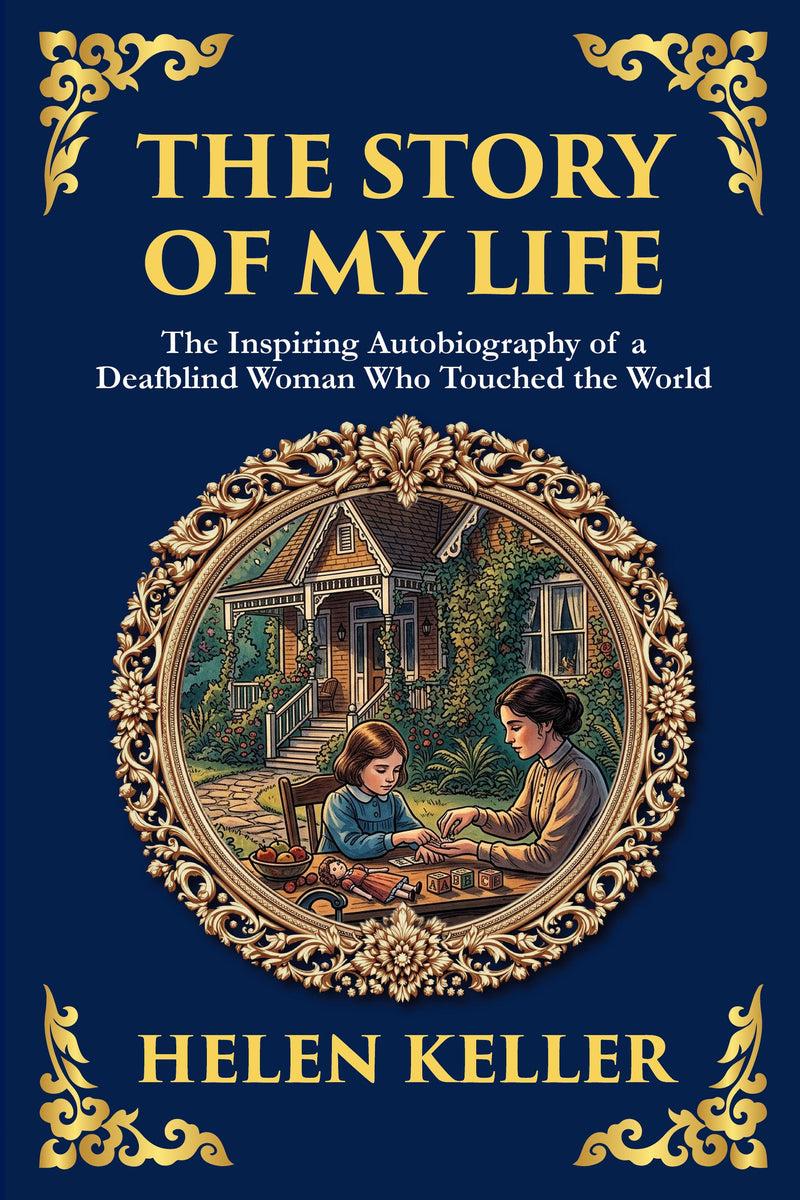
The Story of My Life
From the silent darkness of early childhood to the brilliant light of global recognition, Helen Keller’s story is one of extraordinary triumph over adversity.
or free app
10,000+ hrs library
30-day guarantee
The complete The Story of My Life appears in modern English through Library of Alexandria Press, available online with audiobook narration included for members.
Have you ever wondered why the human spirit shines brightest in the face of unimaginable obstacles? The Story of My Life by Helen Keller is one of the most remarkable autobiographies ever written—a personal journey from darkness and silence into a world of meaning, purpose, and light. Struck blind and deaf by illness before the age of two, Helen Keller’s early life seemed destined for isolation.
Yet through the patient guidance of her devoted teacher Anne Sullivan, Keller discovered language, knowledge, and her voice—both literal and figurative. This inspirational autobiography reveals more than just Keller’s own evolution—it speaks to the boundless power of perseverance, the beauty of human connection, and the capacity for greatness that lies within all of us, regardless of circumstance. Her reflections, drawn from her youth into early adulthood, paint a vivid portrait of triumph, humility, and intellectual awakening.
What you’ll discover in this modern edition
- A Journey From Darkness Into Light – Follow Helen’s powerful transformation from a frustrated child into a world-changing scholar, writer, and activist.
- The Unbreakable Bond With Anne Sullivan – Experience the life-changing relationship between Helen and her teacher, one of history’s most profound examples of mentorship.
- A Testament to the Power of Education – Discover how language and learning became Helen’s gateway to freedom and fulfillment.
- Timeless Reflections on Perseverance and Purpose – Be inspired by Keller’s insights on struggle, resilience, gratitude, and humanity.
- A Legacy That Still Inspires Millions – This book is not just about a life lived—it’s about a life that changed the world.
| Formats | eBook (EPUB + PDF) · Audiobook · Paperback · Hardcover · Large Print |
| Language | English |
| Trim size (print) | 6 × 9 in |
| Binding | Paperback — perfect-bound · Hardcover — casewrap |
| Large Print edition | Same text in a larger, easy-read type — a larger font, not a larger trim |
| Print pricing | Every physical book at our true cost — at-cost, no profit (members) |
| Library | 873 restored titles, always growing |
| Length | 131,771 words · ~8 hr 47 min reading |
| Reading level | Grade 3 · an easy, flowing read (this modern-English edition) |
| Edition | Modern English translation · 2026 |
Member reviews for this edition are collected as readers finish it — be the first. Across the library: 12,000+ books shipped, every plan covered by a 365-day print guarantee.
About this edition
A faithful, unabridged modern-English edition by The Library of Alexandria — carefully rendered for today's reader and verified paragraph-by-paragraph against the public-domain source. Available as eBook, audiobook, paperback, hardcover, and large print.
- Complete & unabridgedVerified paragraph by paragraph against the source — never a scan, never abridged.
- Modern English, faithfulReadable today, with the author’s meaning kept intact. Readable — not simplified.
- Every format, one membershipRead in your browser or the free app, or listen to the full audiobook.
Included free with your membership
Cancel anytime, one click · 30-day money-back guarantee
Edition last updated July 2026
What’s inside
The Story of My Life — complete and unabridged: all 28 sections included with membership, plus the full audiobook.
Begin reading The Story of My Life
In clear modern English — the complete text is included with membership.
Introduction
There are certain lives that, once encountered, permanently alter the way we understand what it means to be human. The life unfolded in these pages belongs to that rare company. It is the story of a child born into an ordinary American household in the years following a great national upheaval, a child who was, for the first nineteen months of her existence, an entirely ordinary baby—seeing the sun, hearing her mother’s voice, beginning to babble the first sounds of speech. And then, in a matter of days, an illness swept all of that away, leaving her sealed inside a silence and a darkness so complete that few of us can even begin to imagine it. What happened afterward—how that child found her way out of that prison, learned to communicate, learned to read and write, learned to think with extraordinary subtlety and grace, and eventually became one of the most celebrated and beloved figures of her century—is the substance of the narrative you are about to read.
This is a book written by a young woman still in her early twenties, composed during her years as a college student, at a moment when the most dramatic chapters of her education were still fresh in her memory and her astonishing achievements still seemed almost miraculous to the world around her. That youthfulness is part of what makes the account so vivid and so moving. This is not the polished retrospective of an old woman looking back across decades of fame; it is the immediate, eager, sometimes uncertain testimony of someone who has only recently emerged into the full light of language and is still marveling at the world that language has opened to her. The wonder you will feel as you read is the wonder she herself was feeling as she wrote.
To approach this autobiography well, it helps to understand a little of the situation into which its author was born and the circumstances that shaped her early years. She came into the world in a small town in the American South in the early 1880s, the daughter of a former soldier and a capable, devoted mother. Hers was a comfortable but by no means lavish household, set among orchards and gardens, and the earliest impressions she preserved were of green growing things, of warmth and color and the affectionate bustle of family life. She was, by all accounts, an alert and forward child, quick to imitate and eager to engage with everything around her. Had her life continued along its expected path, she might have grown up to be remembered by no one beyond her own circle.
But the illness that struck her in infancy changed everything. The fever that nearly killed her left her deaf and blind, and as the months and years passed, the bright, communicative baby grew into a wild, frustrated, often furious child—locked away from human contact, unable to make herself understood except through crude gestures, prone to outbursts of rage that the people who loved her had no idea how to soothe. It is important to grasp just how dire her prospects appeared at this stage. In that era, a child in her condition was very often regarded as essentially beyond reach—incapable of education, destined to live out her days in a kind of permanent infancy, dependent on others for everything and cut off forever from the life of the mind. The assumption of the age was that the doors of knowledge could not be opened to someone who could neither see nor hear.
What makes this book so extraordinary, and what has made its author’s name a permanent fixture in the history of human achievement, is that those doors were opened. The story of how this happened is at the very heart of the narrative, and it would be a disservice to the reader to lay out its particulars in advance, because so much of the book’s emotional power lies in experiencing those discoveries as they unfold. But it is no betrayal to say that the turning point arrived in the form of a teacher—a young woman, herself only partially sighted and possessed of a remarkable history of her own, who came into the household when the author was not quite seven years old. The relationship that developed between teacher and pupil is one of the great partnerships in the history of education, and the way it is depicted here, with deep affection and gratitude, is among the most affecting things in the book.
What followed the teacher’s arrival is nothing less than the dawning of a mind. The reader watches as a child who has been living in a kind of formless, nameless world gradually comes to understand that everything around her has a name, that those names can be communicated, that thoughts can be shared from one person to another across the barrier of silence and darkness. From there the progress is breathtaking. The same child who once raged in frustrated isolation learns to read, first by touch and then in several languages; she learns to write; she even, astonishingly, learns to speak with her own voice. She develops a passion for literature, for history, for the natural world, for the great currents of human thought. And eventually—a feat that struck the entire world as scarcely believable—she gains admission to one of the most prestigious colleges in the country, pursuing the same rigorous course of study as her sighted and hearing peers and succeeding brilliantly at it.
When the public of her time learned of these accomplishments, the response was something close to awe. Here was living proof that the human spirit could triumph over obstacles that had been considered insurmountable, that intelligence and sensitivity and the love of beauty did not depend upon the eyes or the ears but lived somewhere deeper, in a place that no illness could reach. The author became a symbol—of hope, of perseverance, of the boundless potential that might lie dormant in any person, however limited their circumstances might appear. She corresponded with the leading figures of her age, was sought out by writers and statesmen and inventors, and became, while still very young, an internationally recognized figure. This book, written during those college years, was the world’s first full opportunity to hear the story in her own words.
There are a number of things worth keeping in mind as you settle into this remarkable narrative, and a little preparation will deepen your appreciation of what you are about to encounter.
The first concerns the matter of perception itself. As you read, you may find yourself repeatedly startled by the richness of the author’s descriptions—the way she writes of landscapes and sunsets, of music and the colors of the seasons, of the play of light on water. You may ask yourself how someone who could not see or hear could possibly write with such evident sensory delight. The answer to this question is one of the most fascinating aspects of the entire book, and it touches on deep questions about the nature of human understanding. Some of these descriptions draw upon the faint memories she retained from her first year and a half of sight and sound. Others are built up from the immense library of literature she absorbed, the language and imagery of which she made entirely her own. And still others arise from her own deeply developed senses of touch, smell, and the subtle vibrations of the physical world, which she cultivated to a degree that most of us, relying lazily on our eyes and ears, never approach.
This raises a point that the author herself was sensitive to, and which became, in later years, the subject of some controversy and considerable reflection on her part: the question of how much of what we “know” comes directly from our own experience and how much we borrow from the words and thoughts of others. The author was acutely aware that her relationship to language was unusual, that words came to her not through the air or across a printed page seen with the eyes but through the fingers, spelled into her hand or felt in raised characters. She thought a great deal about what it meant to write of things she could not directly perceive, and her honesty on this subject is one of the quiet pleasures of the book. Read with this in mind, and you will find a remarkable meditation, woven throughout the narrative, on the very nature of knowledge, imagination, and the imaginative sympathy that allows one mind to enter into the experiences of another.
The second thing to keep in mind concerns the structure of the book. This is not a tidy, linear march from beginning to end, and you should not expect it to read like a conventional modern memoir. The narrative is organized loosely around the great milestones of the author’s early life and education, but it moves with a certain freedom, doubling back, lingering over particular episodes, sometimes pausing to reflect on a beloved book or a cherished friendship or the meaning of a particular discovery. There are passages of pure narrative excitement, and there are passages of quiet contemplation. The author was, after all, a young writer still finding her voice, and there is an unstudied, confiding quality to the way she shares her thoughts. Allow yourself to move at her pace. The rewards of this book are not the rewards of plot and suspense in the ordinary sense, though there are moments of genuine drama; they are the rewards of intimacy, of being admitted into the inner life of a most unusual and luminous mind.
The third thing worth noting is the spirit in which the book is written, which is overwhelmingly one of gratitude and joy. Given the hardships of her circumstances, one might expect a narrative full of complaint, of bitterness, of dwelling on what was lost. There is almost none of that here. The author writes again and again of her happiness, of the kindness of those around her, of the delight she takes in learning and in the natural world and in the company of her friends. This is not because her life was free of struggle—it manifestly was not—but because of a temperament and a philosophy of life that radiate from every page. She had decided, somewhere along the way, to treasure what she had rather than mourn what she lacked, and that decision suffuses the entire book with a warmth that is genuinely inspiring without ever becoming saccharine or false. There is a toughness underneath the sweetness, a determination that never flags. You will close this book not pitying its author but admiring and even envying the fullness of the inner life she built for herself.
This edition has been prepared as a modern translation and adaptation, with the contemporary reader in mind. The original was composed more than a century ago, in the formal and sometimes elaborate prose style of its era, and while that style has its own beauty, it can occasionally present obstacles to readers accustomed to the rhythms of present-day English. The aim of this adaptation has been to clear away those obstacles—to smooth the more convoluted constructions, to modernize vocabulary that has grown obscure or archaic, and to render the whole more immediately accessible—while taking the greatest care to preserve the author’s distinctive voice, her characteristic turns of thought, and the essential beauty and meaning of what she wrote. The intention throughout has been to honor the original rather than to replace it: to bring this remarkable testimony to a new generation of readers in a form they can take to their hearts without friction or strain. Those who fall in love with the story here, as many will, may well wish to seek out the original text afterward and savor it in its first form. But for the purpose of a first encounter, and for the purpose of pure reading pleasure, this adaptation is meant to open the door as wide as possible.
A word, too, about the larger significance of what you hold. This book is not merely a personal memoir, however affecting. It stands as a landmark document in the history of human dignity and the history of education. Before its author’s example became known to the world, the prevailing assumptions about people living with profound disabilities were grim and confining. Her achievements, recorded here in her own words, helped to overturn those assumptions and to establish a new understanding of human potential—one that has shaped the way we think about education, about disability, about the capacities that lie within every person regardless of their physical condition. The author went on, in the long life that followed the writing of this book, to become a tireless advocate for the rights and welfare of others who faced similar challenges, traveling the world, meeting with the powerful and the humble alike, and laboring to ensure that the kind of opportunity she had been given would be extended to as many people as possible. The young woman who wrote these pages was at the very beginning of that public mission, but the values that would animate her entire life are already fully present here.
Cancel anytime, one click · 30-day money-back guarantee
Founding annual rate available now — your price locks for life when you join.
Not ready? Get this free chapter by email — read it anytime.
✓ Sent — check your inbox for The Story of My Life.
Questions about The Story of My Life
What is The Story of My Life about?
From the silent darkness of early childhood to the brilliant light of global recognition, Helen Keller’s story is one of extraordinary triumph over adversity. The Story of My Life is Keller’s timeless autobiography, a deeply moving and inspiring account of how one woman, both deaf and blind from infancy, transcended the boundaries of physical limitation to become a beacon of courage, intelligence, and hope. This is not just a memoir—it’s a declaration of human potential, a testament to the power of education, mento
Who wrote The Story of My Life?
The Story of My Life was written by Helen Keller. This edition presents the complete work in clear modern English, faithfully rendered from the public-domain original by Library of Alexandria Press.
Is The Story of My Life free to read?
The opening chapter is free to read on this page. Members read and listen to the complete work — and the entire library — free, and can order any physical book at our true print cost.
How long is The Story of My Life?
28 chapters (~131,771 words) — about 8 hr 47 min of reading in this modern-English edition.
Is this an abridged version of The Story of My Life?
No. This is the complete, unabridged The Story of My Life, carefully rendered into clear modern English and verified paragraph-by-paragraph against the public-domain source — nothing is cut or summarised.
What formats does The Story of My Life come in?
The Story of My Life is available as eBook, paperback, hardcover and large print. eBook and audiobook are included with membership; printed editions ship at our true print cost.
Shipping & returns
Billing & membership
More from the library


Explore Biography & Letters
- Meditations · Marcus Aurelius
- The Confessions of St. Augustine · Saint Augustine
- The Confessions of Jean-Jacques Rousseau — Complete · Jean-Jacques Rousseau
- Ecce Homo · Friedrich Wilhelm Nietzsche
- De Profundis · Oscar Wilde
- Memoirs of Joseph Grimaldi · Joseph Grimaldi
- English Eccentrics and Eccentricities · John Timbs
- You Can’t Win · Jack Black
- Wild Animals I Have Known · Ernest Thompson Seton
- The Diary of Samuel Pepys — Complete 1665 N.S. · Samuel Pepys
- Random Reminiscences of Men and Events · John D. Rockefeller
- Elizabeth, Empress of Austria and Queen of Hungary · Carl Küchler
- Society as I Have Found It · Ward McAllister
- Autobiography of a Yogi · Paramahansa Yogananda
- Christopher Columbus and How He Received and Imparted the Spirit of Discovery
- A Portrait of the Artist as a Young Man · James Joyce
- Memoirs of the Author of a Vindication of the Rights of Woman · William Godwin
- Mary: A Fiction · Mary Wollstonecraft
- The Romance of Biography (Vol. 1 of 2) · Mrs. Jameson
- The Love Letters of Mary Wollstonecraft to Gilbert Imlay · Mary Wollstonecraft
- Selected Works of Voltairine de Cleyre · Voltairine de Cleyre
- Eighty Years and More; Reminiscences 1815–1897 · Elizabeth Cady Stanton
- Anarchism and Other Essays · Emma Goldman
- Agnes Grey · Anne Brontë
- Daddy-Long-Legs · Jean Webster
- Reminiscences of a Stock Operator · Edwin Lefèvre
- Martin Eden · Jack London
- Matthew Calbraith Perry: A Typical American Naval Officer · William Elliot Griffis
- Walden, and On the Duty of Civil Disobedience · Henry David Thoreau
- Little Women · Louisa May Alcott
The Story of My Life
The Story of My Life
The inspiring autobiography of a deafblind woman who touched the world
Helen Keller
Contents
- Introduction
- Chapter 1
- Chapter 2
- Chapter 3
- Chapter 4
- Chapter 5
- Chapter 6
- Chapter 7
- Chapter 8
- Chapter 9
- Chapter 10
- Chapter 11
- Chapter 12
- Chapter 13
- Chapter 14
- Chapter 15
- Chapter 16
- Chapter 17
- Chapter 18
- Chapter 19
- Chapter 20
- Chapter 21
- Chapter 22
- Chapter 23
- Chapter 24
- Chapter 25
- Speech
- Excerpts from Helen's Letter
Introduction
There are certain lives that, once encountered, permanently alter the way we understand what it means to be human. The life unfolded in these pages belongs to that rare company. It is the story of a child born into an ordinary American household in the years following a great national upheaval, a child who was, for the first nineteen months of her existence, an entirely ordinary baby—seeing the sun, hearing her mother’s voice, beginning to babble the first sounds of speech. And then, in a matter of days, an illness swept all of that away, leaving her sealed inside a silence and a darkness so complete that few of us can even begin to imagine it. What happened afterward—how that child found her way out of that prison, learned to communicate, learned to read and write, learned to think with extraordinary subtlety and grace, and eventually became one of the most celebrated and beloved figures of her century—is the substance of the narrative you are about to read.
This is a book written by a young woman still in her early twenties, composed during her years as a college student, at a moment when the most dramatic chapters of her education were still fresh in her memory and her astonishing achievements still seemed almost miraculous to the world around her. That youthfulness is part of what makes the account so vivid and so moving. This is not the polished retrospective of an old woman looking back across decades of fame; it is the immediate, eager, sometimes uncertain testimony of someone who has only recently emerged into the full light of language and is still marveling at the world that language has opened to her. The wonder you will feel as you read is the wonder she herself was feeling as she wrote.
To approach this autobiography well, it helps to understand a little of the situation into which its author was born and the circumstances that shaped her early years. She came into the world in a small town in the American South in the early 1880s, the daughter of a former soldier and a capable, devoted mother. Hers was a comfortable but by no means lavish household, set among orchards and gardens, and the earliest impressions she preserved were of green growing things, of warmth and color and the affectionate bustle of family life. She was, by all accounts, an alert and forward child, quick to imitate and eager to engage with everything around her. Had her life continued along its expected path, she might have grown up to be remembered by no one beyond her own circle.
But the illness that struck her in infancy changed everything. The fever that nearly killed her left her deaf and blind, and as the months and years passed, the bright, communicative baby grew into a wild, frustrated, often furious child—locked away from human contact, unable to make herself understood except through crude gestures, prone to outbursts of rage that the people who loved her had no idea how to soothe. It is important to grasp just how dire her prospects appeared at this stage. In that era, a child in her condition was very often regarded as essentially beyond reach—incapable of education, destined to live out her days in a kind of permanent infancy, dependent on others for everything and cut off forever from the life of the mind. The assumption of the age was that the doors of knowledge could not be opened to someone who could neither see nor hear.
What makes this book so extraordinary, and what has made its author’s name a permanent fixture in the history of human achievement, is that those doors were opened. The story of how this happened is at the very heart of the narrative, and it would be a disservice to the reader to lay out its particulars in advance, because so much of the book’s emotional power lies in experiencing those discoveries as they unfold. But it is no betrayal to say that the turning point arrived in the form of a teacher—a young woman, herself only partially sighted and possessed of a remarkable history of her own, who came into the household when the author was not quite seven years old. The relationship that developed between teacher and pupil is one of the great partnerships in the history of education, and the way it is depicted here, with deep affection and gratitude, is among the most affecting things in the book.
What followed the teacher’s arrival is nothing less than the dawning of a mind. The reader watches as a child who has been living in a kind of formless, nameless world gradually comes to understand that everything around her has a name, that those names can be communicated, that thoughts can be shared from one person to another across the barrier of silence and darkness. From there the progress is breathtaking. The same child who once raged in frustrated isolation learns to read, first by touch and then in several languages; she learns to write; she even, astonishingly, learns to speak with her own voice. She develops a passion for literature, for history, for the natural world, for the great currents of human thought. And eventually—a feat that struck the entire world as scarcely believable—she gains admission to one of the most prestigious colleges in the country, pursuing the same rigorous course of study as her sighted and hearing peers and succeeding brilliantly at it.
When the public of her time learned of these accomplishments, the response was something close to awe. Here was living proof that the human spirit could triumph over obstacles that had been considered insurmountable, that intelligence and sensitivity and the love of beauty did not depend upon the eyes or the ears but lived somewhere deeper, in a place that no illness could reach. The author became a symbol—of hope, of perseverance, of the boundless potential that might lie dormant in any person, however limited their circumstances might appear. She corresponded with the leading figures of her age, was sought out by writers and statesmen and inventors, and became, while still very young, an internationally recognized figure. This book, written during those college years, was the world’s first full opportunity to hear the story in her own words.
There are a number of things worth keeping in mind as you settle into this remarkable narrative, and a little preparation will deepen your appreciation of what you are about to encounter.
The first concerns the matter of perception itself. As you read, you may find yourself repeatedly startled by the richness of the author’s descriptions—the way she writes of landscapes and sunsets, of music and the colors of the seasons, of the play of light on water. You may ask yourself how someone who could not see or hear could possibly write with such evident sensory delight. The answer to this question is one of the most fascinating aspects of the entire book, and it touches on deep questions about the nature of human understanding. Some of these descriptions draw upon the faint memories she retained from her first year and a half of sight and sound. Others are built up from the immense library of literature she absorbed, the language and imagery of which she made entirely her own. And still others arise from her own deeply developed senses of touch, smell, and the subtle vibrations of the physical world, which she cultivated to a degree that most of us, relying lazily on our eyes and ears, never approach.
This raises a point that the author herself was sensitive to, and which became, in later years, the subject of some controversy and considerable reflection on her part: the question of how much of what we “know” comes directly from our own experience and how much we borrow from the words and thoughts of others. The author was acutely aware that her relationship to language was unusual, that words came to her not through the air or across a printed page seen with the eyes but through the fingers, spelled into her hand or felt in raised characters. She thought a great deal about what it meant to write of things she could not directly perceive, and her honesty on this subject is one of the quiet pleasures of the book. Read with this in mind, and you will find a remarkable meditation, woven throughout the narrative, on the very nature of knowledge, imagination, and the imaginative sympathy that allows one mind to enter into the experiences of another.
The second thing to keep in mind concerns the structure of the book. This is not a tidy, linear march from beginning to end, and you should not expect it to read like a conventional modern memoir. The narrative is organized loosely around the great milestones of the author’s early life and education, but it moves with a certain freedom, doubling back, lingering over particular episodes, sometimes pausing to reflect on a beloved book or a cherished friendship or the meaning of a particular discovery. There are passages of pure narrative excitement, and there are passages of quiet contemplation. The author was, after all, a young writer still finding her voice, and there is an unstudied, confiding quality to the way she shares her thoughts. Allow yourself to move at her pace. The rewards of this book are not the rewards of plot and suspense in the ordinary sense, though there are moments of genuine drama; they are the rewards of intimacy, of being admitted into the inner life of a most unusual and luminous mind.
The third thing worth noting is the spirit in which the book is written, which is overwhelmingly one of gratitude and joy. Given the hardships of her circumstances, one might expect a narrative full of complaint, of bitterness, of dwelling on what was lost. There is almost none of that here. The author writes again and again of her happiness, of the kindness of those around her, of the delight she takes in learning and in the natural world and in the company of her friends. This is not because her life was free of struggle—it manifestly was not—but because of a temperament and a philosophy of life that radiate from every page. She had decided, somewhere along the way, to treasure what she had rather than mourn what she lacked, and that decision suffuses the entire book with a warmth that is genuinely inspiring without ever becoming saccharine or false. There is a toughness underneath the sweetness, a determination that never flags. You will close this book not pitying its author but admiring and even envying the fullness of the inner life she built for herself.
This edition has been prepared as a modern translation and adaptation, with the contemporary reader in mind. The original was composed more than a century ago, in the formal and sometimes elaborate prose style of its era, and while that style has its own beauty, it can occasionally present obstacles to readers accustomed to the rhythms of present-day English. The aim of this adaptation has been to clear away those obstacles—to smooth the more convoluted constructions, to modernize vocabulary that has grown obscure or archaic, and to render the whole more immediately accessible—while taking the greatest care to preserve the author’s distinctive voice, her characteristic turns of thought, and the essential beauty and meaning of what she wrote. The intention throughout has been to honor the original rather than to replace it: to bring this remarkable testimony to a new generation of readers in a form they can take to their hearts without friction or strain. Those who fall in love with the story here, as many will, may well wish to seek out the original text afterward and savor it in its first form. But for the purpose of a first encounter, and for the purpose of pure reading pleasure, this adaptation is meant to open the door as wide as possible.
A word, too, about the larger significance of what you hold. This book is not merely a personal memoir, however affecting. It stands as a landmark document in the history of human dignity and the history of education. Before its author’s example became known to the world, the prevailing assumptions about people living with profound disabilities were grim and confining. Her achievements, recorded here in her own words, helped to overturn those assumptions and to establish a new understanding of human potential—one that has shaped the way we think about education, about disability, about the capacities that lie within every person regardless of their physical condition. The author went on, in the long life that followed the writing of this book, to become a tireless advocate for the rights and welfare of others who faced similar challenges, traveling the world, meeting with the powerful and the humble alike, and laboring to ensure that the kind of opportunity she had been given would be extended to as many people as possible. The young woman who wrote these pages was at the very beginning of that public mission, but the values that would animate her entire life are already fully present here.
I feel a sense of dread as I begin to write the story of my life. I have a superstitious hesitation about uncovering the memories of my childhood, which feel like they are wrapped in a golden mist. Writing an autobiography is a challenging task. When I try to organize my earliest memories, I find that reality and imagination blur together over the years that connect my past to the present. As an adult, I tend to color my childhood experiences with my own fantasies. A few memories from my first years remain vivid, but the rest are obscured, as if by the shadows of a prison. Furthermore, many of the joys and pains of my youth have lost their intensity, and several crucial moments from my early education have been forgotten in the excitement of my later discoveries. To avoid being boring, I will use a series of sketches to share only the episodes that seem the most interesting and significant.
I was born on June 27, 1880, in Tuscumbia, a small town in northern Alabama.
My father’s side of the family descends from Caspar Keller, a Swiss native who settled in Maryland. One of my Swiss ancestors was the first teacher for the deaf in Zurich and wrote a book about their education—a strange coincidence. However, it is true that every king has had a slave among his ancestors, and every slave has had a king among theirs.
My grandfather, Caspar Keller’s son, claimed large areas of land in Alabama and eventually settled there. I was told that once a year he rode a horse from Tuscumbia to Philadelphia to buy supplies for the plantation. My aunt still has many of the letters he wrote to his family, which provide charming and detailed accounts of those journeys.
End of the free sample
Keep reading, free
Members read and listen to the complete book — and the entire library. Cancel anytime, one click · 30-day money-back guarantee.