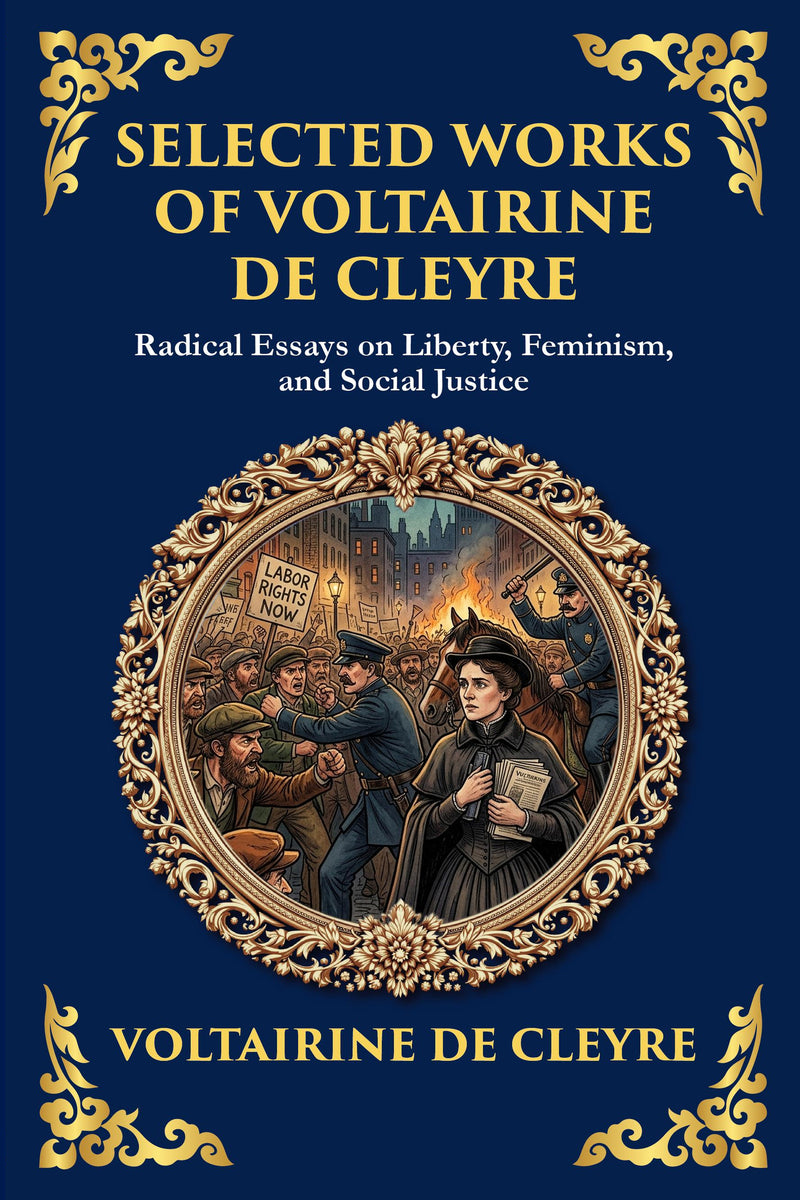
Selected Works of Voltairine de Cleyre
In a time when women’s voices were silenced and radicals were feared, Voltairine de Cleyre spoke with unmatched clarity, passion, and principle.
or free app
10,000+ hrs library
30-day guarantee
The complete Selected Works of Voltairine de appears in modern English through Library of Alexandria Press, available online with audiobook narration included for members.
Have you ever wondered why true freedom requires not just courage—but the will to challenge every chain, even the invisible ones? Voltairine de Cleyre was one of the most radical—and most eloquent—political thinkers of her time. In Selected Works of Voltairine de Cleyre: Radical Essays on Liberty, Feminism, and Social Justice, readers will discover the bold voice of a woman who challenged every form of domination: state, church, patriarchy, and capitalist exploitation.
This collection brings together her most transformative writings, from stirring essays on anarchism and economic justice to searing indictments of misogyny, marriage, militarism, and authoritarianism. De Cleyre’s essays are philosophical yet deeply personal, rooted in her own experiences of poverty, violence, and alienation. And yet, through every word shines a persistent belief in the human capacity for dignity, self-governance, and love.
What you’ll discover in this modern edition
- The Soul of an American Anarchist – Understand de Cleyre’s unique vision of individualist anarchism, infused with compassion and nuance
| Formats | eBook (EPUB + PDF) · Audiobook · Paperback · Hardcover · Large Print |
| Language | English |
| Trim size (print) | 6 × 9 in |
| Binding | Paperback — perfect-bound · Hardcover — casewrap |
| Large Print edition | Same text in a larger, easy-read type — a larger font, not a larger trim |
| Print pricing | Every physical book at our true cost — at-cost, no profit (members) |
| Library | 873 restored titles, always growing |
| Length | 124,493 words · ~8 hr 18 min reading |
| Reading level | Grade 3 · an easy, flowing read (this modern-English edition) |
| Edition | Modern English translation · 2026 |
Member reviews for this edition are collected as readers finish it — be the first. Across the library: 12,000+ books shipped, every plan covered by a 365-day print guarantee.
About this edition
A faithful, unabridged modern-English edition by The Library of Alexandria — carefully rendered for today's reader and verified paragraph-by-paragraph against the public-domain source. Available as eBook, audiobook, paperback, hardcover, and large print.
- Complete & unabridgedVerified paragraph by paragraph against the source — never a scan, never abridged.
- Modern English, faithfulReadable today, with the author’s meaning kept intact. Readable — not simplified.
- Every format, one membershipRead in your browser or the free app, or listen to the full audiobook.
Included free with your membership
Cancel anytime, one click · 30-day money-back guarantee
Edition last updated July 2026
What’s inside
Selected Works of Voltairine de Cleyre — complete and unabridged: all 6 sections included with membership, plus the full audiobook.
Begin reading Selected Works of Voltairine de Cleyre
In clear modern English — the complete text is included with membership.
Introduction
There are voices in the history of human thought that refuse to fade, that seem to grow louder rather than quieter with the passage of decades. Voltairine de Cleyre belonged, in her own lifetime, to a small circle of radicals, freethinkers, and agitators who were known to one another and to the authorities who watched them, but who lived largely outside the mainstream of public awareness. Today, more than a century after her death, her words ring with a startling clarity, as though she had somehow anticipated the questions that would haunt later generations and chosen to answer them in advance. To read her now is to encounter a mind of extraordinary independence, fierce in its convictions yet endlessly questioning, lyrical in its expression yet ruthlessly logical in its argument. This collection gathers some of the most powerful and enduring of her essays and addresses, presented in a modern adaptation designed to bring her thought to readers who may be meeting her for the first time.
The work you hold has been carefully shaped for the contemporary reader. De Cleyre wrote in the rich, ornate prose of her era, full of classical allusions, nineteenth-century rhetorical flourishes, and references to events and figures that were household names in her day but have since slipped into obscurity. The aim of this adaptation is not to dilute her thought or to soften the sharp edges of her argument, but rather to remove the barriers of dated idiom and unfamiliar context that might otherwise stand between the reader and the living force of her ideas. What remains is the substance: the passionate defense of human freedom, the searching examination of women’s place in society, the relentless critique of injustice in all its forms. Her voice survives the translation intact, perhaps even amplified, because it was always a voice that aimed at the heart of things.
To understand the writings collected here, it helps to know something of the woman who produced them, for few thinkers have so completely fused their lives with their convictions. Voltairine de Cleyre was born in 1866 in a small town in Michigan, in the years immediately following the American Civil War, into a family of modest means and freethinking inclinations. Her father, an admirer of the French philosopher Voltaire, gave her a name that would prove almost prophetic—a name that announced, before she could speak a word for herself, that she was destined to take her place among the questioners and the dissenters. Yet her early life was anything but a smooth path toward radicalism. She was sent, in her teenage years, to a Catholic convent school, an experience that left a deep and lasting mark upon her. The rigid discipline, the demand for obedience, the suppression of individual will—all of these she experienced firsthand, and all of them she would later rebel against with a ferocity born of personal memory. The convent did not make her devout; it made her a lifelong enemy of authority that demands submission rather than earning consent.
When she emerged into adulthood, de Cleyre threw herself into the intellectual ferment of the late nineteenth century. This was an age of enormous upheaval and possibility, when the industrial revolution was transforming the social landscape, when great fortunes were being amassed alongside grinding poverty, when waves of immigration were reshaping the character of American cities, and when movements for labor reform, women’s suffrage, and freethought were gathering force. She began as a freethinker, lecturing and writing against organized religion, and gradually moved toward the broader social radicalism that would define her mature thought. The pivotal event in her political development, as it was for many radicals of her generation, was the Haymarket affair of 1886, in which a group of anarchists in Chicago were convicted and executed on dubious evidence following a bombing at a labor demonstration. The injustice of their treatment radicalized her completely. From that point forward, she devoted her life to the cause of human liberation as she understood it.
It would be a mistake, however, to imagine de Cleyre as a mere follower of any single doctrine or movement. One of the most striking features of her thought is its intellectual independence. She refused to confine herself to any rigid system, declaring famously that she had moved through various schools of radical thought and had come to embrace a position she called “anarchism without adjectives”—a refusal to insist that all who sought freedom must agree on the precise economic arrangements that would follow the overthrow of oppression. What mattered to her was the principle of liberty itself, the conviction that human beings should be free to govern their own lives without coercion, and that the great institutions of her age—the state, the church, the structures of wealth and property, the conventions that bound women into subordination—stood as obstacles to that freedom. She was willing to argue endlessly about means, but she was unwavering about ends.
Her personal life mirrored the difficulty and the dignity of her ideas. She lived for most of her adult years in poverty, supporting herself by teaching English to immigrants in Philadelphia, many of them Jewish refugees from the persecutions of Eastern Europe. She learned their languages, immersed herself in their struggles, and earned their deep affection and respect. She suffered from chronic ill health, endured episodes of profound depression, and survived an assassination attempt by a former student—after which, in a gesture that captures the whole quality of her character, she refused to press charges and even tried to raise money for the young man’s defense. She held to her principles not as abstractions but as commitments that demanded everything of her. When she died in 1912, at the age of only forty-five, she was mourned by those who had known her as one of the most remarkable women of her time. The fellow anarchist Emma Goldman, herself no stranger to fierce conviction, described her as “the most gifted and brilliant anarchist woman America ever produced.”
What emerges from her life, and what the reader will find reflected throughout these pages, is a particular kind of integrity—the integrity of a person who insisted on thinking for herself, who refused the comforts of conformity, and who paid the price of that refusal without complaint. She was not a comfortable figure in her own time, and she is not always a comfortable figure now. She asks hard questions and refuses easy answers. But this is precisely what makes her worth reading. In an age that often prizes the soothing and the agreeable, her uncompromising honesty comes as a bracing tonic.
The essays collected in this volume reveal the extraordinary breadth of de Cleyre’s concerns. She was, first and foremost, a defender of liberty in the fullest sense of the word—not merely political liberty, the freedom to vote or to speak, but a deeper and more comprehensive freedom that touched every aspect of human existence. She believed that the human being possessed an inherent dignity that no institution had the right to violate, and that the great task of civilization was to clear away the accumulated obstacles to the free development of each individual. This conviction runs through everything she wrote, lending unity to a body of work that ranges across politics, economics, religion, education, and the relations between the sexes.
On the question of liberty, she was a thinker of remarkable subtlety. She understood that freedom is not simply the absence of external restraint, but requires positive conditions—education, economic independence, the cultivation of an independent spirit. She was deeply concerned with what she called the internal chains, the habits of mind and conscience that keep people in subjection even when no external force compels them. The convent of her youth had taught her how thoroughly authority can colonize the inner life, and she carried that lesson into her analysis of every form of domination. To be truly free, she argued, one must throw off not only the visible shackles imposed by others but the invisible ones we forge for ourselves through fear, habit, and the desire for approval. This insight gives her writing on liberty a psychological depth that distinguishes it from the more mechanical formulations of some of her contemporaries.
Among her most powerful and prophetic contributions was her writing on the situation of women. Here de Cleyre was decades ahead of her time. While many advocates of women’s advancement in her era focused narrowly on the question of suffrage—the right to vote—she pressed toward a far more radical and comprehensive critique. She understood that the subjection of women was woven into the very fabric of social institutions, into the structure of marriage, into the economic dependence of wives upon husbands, into the cultural assumptions that defined a woman’s worth in terms of her relations to men. She argued that no mere extension of political rights could liberate women so long as these deeper structures remained intact. Her analysis of marriage in particular was startlingly bold for its time, examining the ways in which an institution celebrated as the foundation of love and family could also function as a system of ownership and control. She insisted that women must achieve genuine independence—economic, intellectual, and emotional—if they were ever to become full human beings rather than appendages to others.
What makes her feminism so enduringly relevant is its insistence on autonomy as the highest value. She was not interested in merely improving the conditions of women’s subordination; she wanted to abolish subordination altogether. She envisioned a world in which women would be sovereign over their own lives, their own bodies, their own choices, answerable to no one but themselves and the dictates of their own conscience. This vision, radical in her day, continues to resonate, and readers who come to her expecting the cautious gradualism of much nineteenth-century reform will be surprised by the uncompromising clarity of her demands.
Her writings on social justice are similarly far-reaching. She was acutely sensitive to the sufferings of the poor, the exploited, the dispossessed, and she directed her formidable powers of argument against the systems that perpetuated their misery. Having lived among the working poor and the immigrant communities of Philadelphia, she wrote of their conditions not from the lofty distance of the theorist but from the intimate knowledge of one who shared their struggles. She examined the workings of property and wealth, the relationship between economic power and political power, and the ways in which the apparatus of the state served to protect the interests of the few against the many. Yet her social criticism was never merely material in its concerns. She was as interested in the spiritual and moral dimensions of injustice as in its economic causes, and she understood that a society that degrades the human spirit is impoverished no matter how much wealth it accumulates.
Throughout her work, de Cleyre returns again and again to the theme of direct action—the conviction that meaningful change comes not from petitioning those in power but from people taking action on their own behalf, asserting their own freedom, and refusing to wait for permission to live as they believe they ought to live. This emphasis on individual initiative and personal responsibility gives her writing a quality of urgency and immediacy. She was not content to describe the world; she wanted to change it, and she believed that change began with the decision of each person to think and act for themselves. There is in this a kind of austere optimism, a faith that human beings, freed from the institutions that diminish them, are capable of building something finer than what exists. She held this faith even in the face of enormous personal suffering, and that is perhaps the deepest source of her continuing power to move and inspire.
Cancel anytime, one click · 30-day money-back guarantee
Founding annual rate available now — your price locks for life when you join.
Not ready? Get this free chapter by email — read it anytime.
✓ Sent — check your inbox for Selected Works of Voltairine de Cleyre.
Questions about Selected Works of Voltairine de Cleyre
What is Selected Works of Voltairine de about?
In a time when women’s voices were silenced and radicals were feared, Voltairine de Cleyre spoke with unmatched clarity, passion, and principle. Selected Works of Voltairine de Cleyre brings together her most powerful essays and speeches on liberty, anarchism, feminism, and the relentless pursuit of justice. Uncompromising and fearless, de Cleyre tackled the social inequalities of her time with intellect sharpened by experience and heart fueled by compassion.
Who wrote Selected Works of Voltairine de?
Selected Works of Voltairine de was written by Voltairine de Cleyre. This edition presents the complete work in clear modern English, faithfully rendered from the public-domain original by Library of Alexandria Press.
Is Selected Works of Voltairine de free to read?
The opening chapter is free to read on this page. Members read and listen to the complete work — and the entire library — free, and can order any physical book at our true print cost.
How long is Selected Works of Voltairine de?
6 chapters (~124,493 words) — about 8 hr 18 min of reading in this modern-English edition.
Is this an abridged version of Selected Works of Voltairine de?
No. This is the complete, unabridged Selected Works of Voltairine de, carefully rendered into clear modern English and verified paragraph-by-paragraph against the public-domain source — nothing is cut or summarised.
What formats does Selected Works of Voltairine de come in?
Selected Works of Voltairine de is available as eBook, paperback, hardcover and large print. eBook and audiobook are included with membership; printed editions ship at our true print cost.
Shipping & returns
Billing & membership
More from the library


Explore Biography & Letters
- Meditations · Marcus Aurelius
- The Confessions of St. Augustine · Saint Augustine
- The Confessions of Jean-Jacques Rousseau — Complete · Jean-Jacques Rousseau
- Ecce Homo · Friedrich Wilhelm Nietzsche
- De Profundis · Oscar Wilde
- Memoirs of Joseph Grimaldi · Joseph Grimaldi
- English Eccentrics and Eccentricities · John Timbs
- You Can’t Win · Jack Black
- Wild Animals I Have Known · Ernest Thompson Seton
- The Diary of Samuel Pepys — Complete 1665 N.S. · Samuel Pepys
- Random Reminiscences of Men and Events · John D. Rockefeller
- The Story of My Life · Helen Keller
- Elizabeth, Empress of Austria and Queen of Hungary · Carl Küchler
- Society as I Have Found It · Ward McAllister
- Autobiography of a Yogi · Paramahansa Yogananda
- Christopher Columbus and How He Received and Imparted the Spirit of Discovery
- A Portrait of the Artist as a Young Man · James Joyce
- Memoirs of the Author of a Vindication of the Rights of Woman · William Godwin
- Mary: A Fiction · Mary Wollstonecraft
- The Romance of Biography (Vol. 1 of 2) · Mrs. Jameson
- The Love Letters of Mary Wollstonecraft to Gilbert Imlay · Mary Wollstonecraft
- Eighty Years and More; Reminiscences 1815–1897 · Elizabeth Cady Stanton
- Anarchism and Other Essays · Emma Goldman
- Agnes Grey · Anne Brontë
- Daddy-Long-Legs · Jean Webster
- Reminiscences of a Stock Operator · Edwin Lefèvre
- Martin Eden · Jack London
- Matthew Calbraith Perry: A Typical American Naval Officer · William Elliot Griffis
- Walden, and On the Duty of Civil Disobedience · Henry David Thoreau
- Little Women · Louisa May Alcott
Selected Works of Voltairine de Cleyre
Selected Works of Voltairine de Cleyre
Radical Essays on Liberty, Feminism, and Social Justice
Voltairine de Cleyre
Contents
- Introduction
- Poems
- Essays
- Direct Action
- Francisco Ferrer
- Sketches and Stories
Introduction
There are voices in the history of human thought that refuse to fade, that seem to grow louder rather than quieter with the passage of decades. Voltairine de Cleyre belonged, in her own lifetime, to a small circle of radicals, freethinkers, and agitators who were known to one another and to the authorities who watched them, but who lived largely outside the mainstream of public awareness. Today, more than a century after her death, her words ring with a startling clarity, as though she had somehow anticipated the questions that would haunt later generations and chosen to answer them in advance. To read her now is to encounter a mind of extraordinary independence, fierce in its convictions yet endlessly questioning, lyrical in its expression yet ruthlessly logical in its argument. This collection gathers some of the most powerful and enduring of her essays and addresses, presented in a modern adaptation designed to bring her thought to readers who may be meeting her for the first time.
The work you hold has been carefully shaped for the contemporary reader. De Cleyre wrote in the rich, ornate prose of her era, full of classical allusions, nineteenth-century rhetorical flourishes, and references to events and figures that were household names in her day but have since slipped into obscurity. The aim of this adaptation is not to dilute her thought or to soften the sharp edges of her argument, but rather to remove the barriers of dated idiom and unfamiliar context that might otherwise stand between the reader and the living force of her ideas. What remains is the substance: the passionate defense of human freedom, the searching examination of women’s place in society, the relentless critique of injustice in all its forms. Her voice survives the translation intact, perhaps even amplified, because it was always a voice that aimed at the heart of things.
To understand the writings collected here, it helps to know something of the woman who produced them, for few thinkers have so completely fused their lives with their convictions. Voltairine de Cleyre was born in 1866 in a small town in Michigan, in the years immediately following the American Civil War, into a family of modest means and freethinking inclinations. Her father, an admirer of the French philosopher Voltaire, gave her a name that would prove almost prophetic—a name that announced, before she could speak a word for herself, that she was destined to take her place among the questioners and the dissenters. Yet her early life was anything but a smooth path toward radicalism. She was sent, in her teenage years, to a Catholic convent school, an experience that left a deep and lasting mark upon her. The rigid discipline, the demand for obedience, the suppression of individual will—all of these she experienced firsthand, and all of them she would later rebel against with a ferocity born of personal memory. The convent did not make her devout; it made her a lifelong enemy of authority that demands submission rather than earning consent.
When she emerged into adulthood, de Cleyre threw herself into the intellectual ferment of the late nineteenth century. This was an age of enormous upheaval and possibility, when the industrial revolution was transforming the social landscape, when great fortunes were being amassed alongside grinding poverty, when waves of immigration were reshaping the character of American cities, and when movements for labor reform, women’s suffrage, and freethought were gathering force. She began as a freethinker, lecturing and writing against organized religion, and gradually moved toward the broader social radicalism that would define her mature thought. The pivotal event in her political development, as it was for many radicals of her generation, was the Haymarket affair of 1886, in which a group of anarchists in Chicago were convicted and executed on dubious evidence following a bombing at a labor demonstration. The injustice of their treatment radicalized her completely. From that point forward, she devoted her life to the cause of human liberation as she understood it.
It would be a mistake, however, to imagine de Cleyre as a mere follower of any single doctrine or movement. One of the most striking features of her thought is its intellectual independence. She refused to confine herself to any rigid system, declaring famously that she had moved through various schools of radical thought and had come to embrace a position she called “anarchism without adjectives”—a refusal to insist that all who sought freedom must agree on the precise economic arrangements that would follow the overthrow of oppression. What mattered to her was the principle of liberty itself, the conviction that human beings should be free to govern their own lives without coercion, and that the great institutions of her age—the state, the church, the structures of wealth and property, the conventions that bound women into subordination—stood as obstacles to that freedom. She was willing to argue endlessly about means, but she was unwavering about ends.
Her personal life mirrored the difficulty and the dignity of her ideas. She lived for most of her adult years in poverty, supporting herself by teaching English to immigrants in Philadelphia, many of them Jewish refugees from the persecutions of Eastern Europe. She learned their languages, immersed herself in their struggles, and earned their deep affection and respect. She suffered from chronic ill health, endured episodes of profound depression, and survived an assassination attempt by a former student—after which, in a gesture that captures the whole quality of her character, she refused to press charges and even tried to raise money for the young man’s defense. She held to her principles not as abstractions but as commitments that demanded everything of her. When she died in 1912, at the age of only forty-five, she was mourned by those who had known her as one of the most remarkable women of her time. The fellow anarchist Emma Goldman, herself no stranger to fierce conviction, described her as “the most gifted and brilliant anarchist woman America ever produced.”
What emerges from her life, and what the reader will find reflected throughout these pages, is a particular kind of integrity—the integrity of a person who insisted on thinking for herself, who refused the comforts of conformity, and who paid the price of that refusal without complaint. She was not a comfortable figure in her own time, and she is not always a comfortable figure now. She asks hard questions and refuses easy answers. But this is precisely what makes her worth reading. In an age that often prizes the soothing and the agreeable, her uncompromising honesty comes as a bracing tonic.
The essays collected in this volume reveal the extraordinary breadth of de Cleyre’s concerns. She was, first and foremost, a defender of liberty in the fullest sense of the word—not merely political liberty, the freedom to vote or to speak, but a deeper and more comprehensive freedom that touched every aspect of human existence. She believed that the human being possessed an inherent dignity that no institution had the right to violate, and that the great task of civilization was to clear away the accumulated obstacles to the free development of each individual. This conviction runs through everything she wrote, lending unity to a body of work that ranges across politics, economics, religion, education, and the relations between the sexes.
On the question of liberty, she was a thinker of remarkable subtlety. She understood that freedom is not simply the absence of external restraint, but requires positive conditions—education, economic independence, the cultivation of an independent spirit. She was deeply concerned with what she called the internal chains, the habits of mind and conscience that keep people in subjection even when no external force compels them. The convent of her youth had taught her how thoroughly authority can colonize the inner life, and she carried that lesson into her analysis of every form of domination. To be truly free, she argued, one must throw off not only the visible shackles imposed by others but the invisible ones we forge for ourselves through fear, habit, and the desire for approval. This insight gives her writing on liberty a psychological depth that distinguishes it from the more mechanical formulations of some of her contemporaries.
Among her most powerful and prophetic contributions was her writing on the situation of women. Here de Cleyre was decades ahead of her time. While many advocates of women’s advancement in her era focused narrowly on the question of suffrage—the right to vote—she pressed toward a far more radical and comprehensive critique. She understood that the subjection of women was woven into the very fabric of social institutions, into the structure of marriage, into the economic dependence of wives upon husbands, into the cultural assumptions that defined a woman’s worth in terms of her relations to men. She argued that no mere extension of political rights could liberate women so long as these deeper structures remained intact. Her analysis of marriage in particular was startlingly bold for its time, examining the ways in which an institution celebrated as the foundation of love and family could also function as a system of ownership and control. She insisted that women must achieve genuine independence—economic, intellectual, and emotional—if they were ever to become full human beings rather than appendages to others.
What makes her feminism so enduringly relevant is its insistence on autonomy as the highest value. She was not interested in merely improving the conditions of women’s subordination; she wanted to abolish subordination altogether. She envisioned a world in which women would be sovereign over their own lives, their own bodies, their own choices, answerable to no one but themselves and the dictates of their own conscience. This vision, radical in her day, continues to resonate, and readers who come to her expecting the cautious gradualism of much nineteenth-century reform will be surprised by the uncompromising clarity of her demands.
Her writings on social justice are similarly far-reaching. She was acutely sensitive to the sufferings of the poor, the exploited, the dispossessed, and she directed her formidable powers of argument against the systems that perpetuated their misery. Having lived among the working poor and the immigrant communities of Philadelphia, she wrote of their conditions not from the lofty distance of the theorist but from the intimate knowledge of one who shared their struggles. She examined the workings of property and wealth, the relationship between economic power and political power, and the ways in which the apparatus of the state served to protect the interests of the few against the many. Yet her social criticism was never merely material in its concerns. She was as interested in the spiritual and moral dimensions of injustice as in its economic causes, and she understood that a society that degrades the human spirit is impoverished no matter how much wealth it accumulates.
Throughout her work, de Cleyre returns again and again to the theme of direct action—the conviction that meaningful change comes not from petitioning those in power but from people taking action on their own behalf, asserting their own freedom, and refusing to wait for permission to live as they believe they ought to live. This emphasis on individual initiative and personal responsibility gives her writing a quality of urgency and immediacy. She was not content to describe the world; she wanted to change it, and she believed that change began with the decision of each person to think and act for themselves. There is in this a kind of austere optimism, a faith that human beings, freed from the institutions that diminish them, are capable of building something finer than what exists. She held this faith even in the face of enormous personal suffering, and that is perhaps the deepest source of her continuing power to move and inspire.
Poor Heart, so exhausted by your bitter grief!
So you are finally dead, silent and cold!
The long-awaited arrow of death brought you relief,
Dead eyes, pressed down by pain beneath their dark veil!
So you have passed far, far beyond any return,
And all your hopes are gone, and all your fears.
Your lips are finally closed in a lasting peace!
Pale lips! For so long they held back your sorrow,
And even now, when your time has run out,
They look heartbreakingly silent in their mournful rest.
Pressing one last solemn kiss to your brow;
Placing a single beautiful lily upon you,
A symbol of your rest;—oh, rest is bliss.
No, Heart, I would not call you back again;
No, no; you have known far too much suffering;
Because joy eventually rises out of sorrow;
Where thunder crashes, the sky soon smiles blue;
And fake sunlight fades before the real thing!
The seed must break before the plant grows,
The stars must fade before the morning wakes;
Deep in the earth, the mine holds the diamond;
A new heart beats when the old one breaks.
Let the old love die and the new one be welcome—
As vast as the space-lanes where the stars spin!
Over the sweet, quiet homes in the silent city of the dead,
The dewdrops fall softly, like tears of the night;
Spreading out like wide arms of compassion,
The star-speckled darkness covers everything.
Heroes sleep beneath wreaths of red roses,
Crowned with honor and the peace of rest,
While above you, moonlit branches gently breathe
A distant, echoing whisper: “Sleep well; you are blessed.”
At the mention of our Country, you will never be forgotten;
And until the last tiny spark of life flickers out,
End of the free sample
Keep reading, free
Members read and listen to the complete book — and the entire library. Cancel anytime, one click · 30-day money-back guarantee.