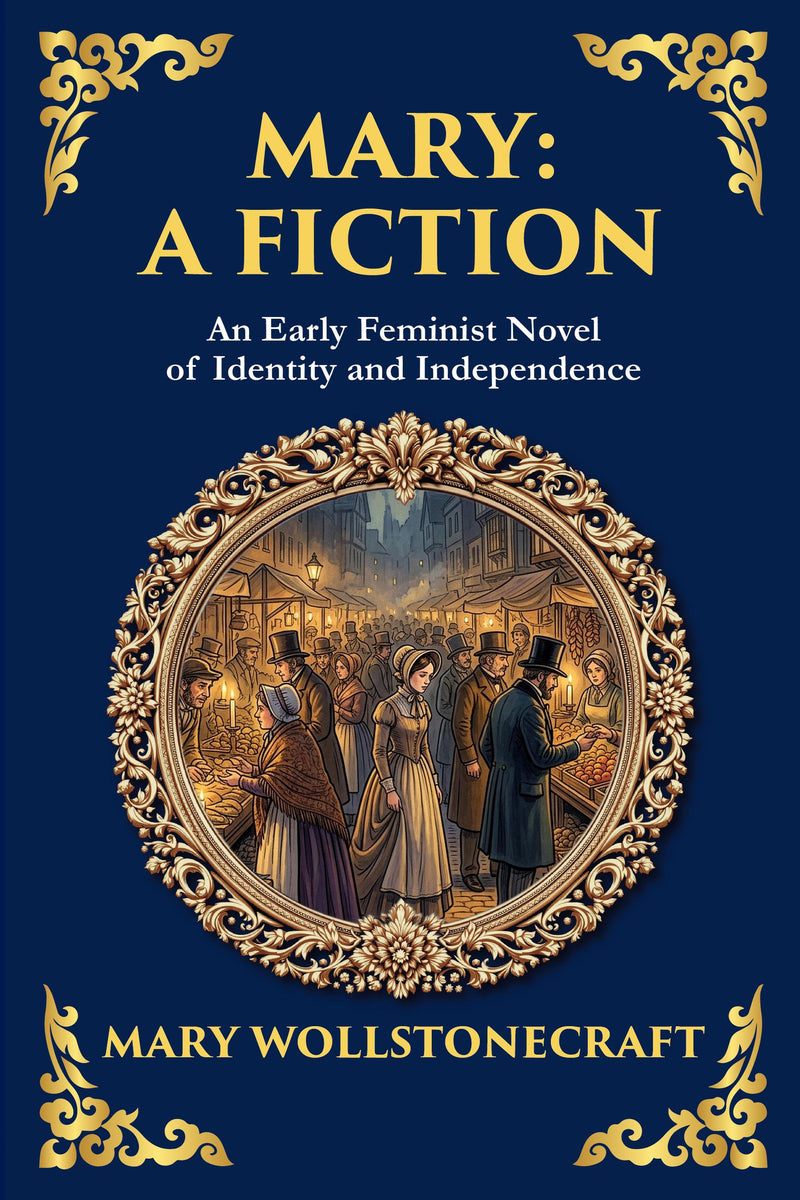
Mary: A Fiction
In Mary: A Fiction, one of the earliest feminist novels, Mary Wollstonecraft weaves a powerful narrative of love, independence, and self-discovery.
or free app
10,000+ hrs library
30-day guarantee
The complete Mary: A Fiction appears in modern English through Library of Alexandria Press, available online with audiobook narration included for members.
Have you ever wondered why the fight for independence—especially for women—has always been at the heart of true freedom? In Mary: A Fiction: An Early Feminist Novel of Identity and Independence, Mary Wollstonecraft presents a groundbreaking story that blends romance, philosophy, and social critique. First published in 1788, this daring novel boldly challenged the rigid roles imposed upon women, offering readers a portrait of a heroine who longs not for possession but for autonomy.
Mary, the protagonist, is not the passive figure typical of her time. She rejects the shallow conventions of marriage, pursues meaningful relationships based on intellect and spirit, and insists upon her right to live authentically. Wollstonecraft, later known for her seminal work A Vindication of the Rights of Woman, uses this novel to explore themes that would define feminist thought for centuries to come.
What you’ll discover in this modern edition
- A Heroine Ahead of Her Time – Mary’s bold rejection of convention marks her as one of literature’s first feminist characters.
| Formats | eBook (EPUB + PDF) · Audiobook · Paperback · Hardcover · Large Print |
| Language | English |
| Trim size (print) | 6 × 9 in |
| Binding | Paperback — perfect-bound · Hardcover — casewrap |
| Large Print edition | Same text in a larger, easy-read type — a larger font, not a larger trim |
| Print pricing | Every physical book at our true cost — at-cost, no profit (members) |
| Library | 873 restored titles, always growing |
| Length | 26,333 words · ~1 hr 45 min reading |
| Reading level | Grade 10 · a comfortable read (this modern-English edition) |
| Edition | Modern English translation · 2026 |
Member reviews for this edition are collected as readers finish it — be the first. Across the library: 12,000+ books shipped, every plan covered by a 365-day print guarantee.
About this edition
A faithful, unabridged modern-English edition by The Library of Alexandria — carefully rendered for today's reader and verified paragraph-by-paragraph against the public-domain source. Available as eBook, audiobook, paperback, hardcover, and large print.
- Complete & unabridgedVerified paragraph by paragraph against the source — never a scan, never abridged.
- Modern English, faithfulReadable today, with the author’s meaning kept intact. Readable — not simplified.
- Every format, one membershipRead in your browser or the free app, or listen to the full audiobook.
Included free with your membership
Cancel anytime, one click · 30-day money-back guarantee
Edition last updated July 2026
What’s inside
Mary: A Fiction — complete and unabridged: all 32 sections included with membership, plus the full audiobook.
Begin reading Mary: A Fiction
In clear modern English — the complete text is included with membership.
Introduction
When Mary Wollstonecraft published her slender, urgent first novel in 1788, she was a young woman of twenty-nine who had already lived through more disappointment, struggle, and reinvention than most people experience in a lifetime. She had served as a lady’s companion to a wealthy widow, run a school with her sisters, worked as a governess in an aristocratic Irish household, and watched her dearest friend waste away and die. She had supported her father, her sisters, and a constellation of dependents through sheer force of will and labor at a time when respectable women were expected to do almost nothing but wait to be chosen. Out of this crucible of experience came a book unlike anything that had come before it—a novel that took the inner life of an intelligent woman seriously, that insisted her thoughts and feelings were worthy of literary attention, and that quietly demolished the conventions of the sentimental fiction it appeared, at first glance, to imitate.
The novel you are about to read is short, but it is not slight. It carries the weight of a woman who was thinking her way toward ideas that would, four years later, explode onto the world in A Vindication of the Rights of Woman—the founding document of modern feminist thought. Reading Mary: A Fiction is, in a very real sense, watching a revolutionary intelligence rehearse its arguments in the language of story before it learned to make them in the language of philosophy. Here, in the disguise of a heroine’s emotional history, Wollstonecraft began to ask the questions that would consume the rest of her career: What is a woman for? What does she owe to others, and what does she owe to herself? Can a mind cultivated by thought and feeling find any room to breathe in a world that treats marriage as a woman’s entire destiny? And what becomes of a person—of any person—who is born with a capacity for greatness but given no soil in which to plant it?
This edition has been carefully prepared as a modern translation, adapted for the contemporary reader. That phrase deserves a moment of explanation, because what it does not mean is the dilution or simplification of Wollstonecraft’s thought. The eighteenth-century novel had its own rhythms, its own habits of phrasing, its own conventions of punctuation and sentence structure that can, for a modern reader, form a wall between the words on the page and the urgent humanity behind them. What this adaptation seeks to do is to take that wall down—to let Wollstonecraft’s voice come through with the directness and force she always intended, without the friction of archaic constructions that distract more than they illuminate. The aim is not to replace her, but to bring you closer to her: to let her fierce intelligence, her wounded tenderness, and her electrifying anger reach you as freshly as they reached her first readers, who would have recognized in this book something startlingly new.
A Voice Born of Hardship and Hunger for More
To understand why this novel feels so different from the polite fictions of its era, it helps to understand the woman who wrote it. Mary Wollstonecraft was born in 1759 into a family that was steadily descending from comfort into chaos. Her father, an unstable man with grand ambitions and no discipline, drank away the family’s money and terrorized his household; young Mary is said to have slept on the landing outside her mother’s bedroom door to protect her from his rages. From the beginning, then, she understood something that polite society preferred to keep hidden: that the home, so often celebrated as a woman’s sanctuary, could be a place of fear and powerlessness, and that a woman’s safety depended entirely on the character of the man who happened to govern her.
She received almost no formal education—certainly nothing resembling the rigorous training given to boys of her class—and yet she became one of the most formidable thinkers of her age through ferocious, self-directed reading. She devoured philosophy, history, theology, and the new literature of feeling that was sweeping across Europe. She watched her brothers receive advantages she was denied, and she felt, with a clarity that never left her, the injustice of a system that wasted half its human talent simply because that talent happened to be housed in female bodies.
The friendships of her youth shaped her as deeply as her sufferings. Her bond with Fanny Blood—an intelligent, artistic, frail young woman—was the great emotional attachment of her early life, a relationship of such intensity that it reads, across the centuries, as one of the formative loves of her existence. When Fanny married and then died in childbirth, Wollstonecraft was devastated, and the loss left a permanent mark on her imagination. Readers who know this biography will recognize echoes of it in the pages that follow, though it would spoil the experience to map the fiction too precisely onto the life. What matters is to understand that this novel was written by someone who had loved fiercely, lost catastrophically, and refused to accept the consolations that society offered her. She would not pretend that a woman’s heart was a small thing, easily satisfied by domestic routine and material comfort. She knew otherwise, because she had felt otherwise.
By the time she wrote Mary, Wollstonecraft had also made a momentous decision: she would earn her own living by her pen. This was, in the 1780s, an almost unthinkable ambition for a woman. The publisher Joseph Johnson—a generous, principled man who became one of her great supporters—took her in, gave her work, and introduced her to a circle of radical thinkers, artists, and reformers who were, in those heady years before the French Revolution, remaking the intellectual world. Wollstonecraft was, by her own proud declaration, “the first of a new genus”: a woman who would live by her ideas and her writing, dependent on no man, beholden to no patron, free to think and to speak. This novel is the first major creative product of that defiant self-fashioning, and you can feel the determination in every line. It is the work of someone who has decided that her mind is her own and intends to use it.
The literary context is worth pausing on, because it sharpens our appreciation of what she accomplished. The late eighteenth century was the great age of the “sentimental novel”—stories that prized the display of refined feeling above almost everything else, in which heroines fainted, wept, and trembled their way through plots designed to wring tears from the reader. These novels could be moving, but they often reduced their female characters to delicate instruments of sensibility, valued chiefly for their capacity to suffer beautifully. Wollstonecraft knew this genre intimately, and Mary both borrows from it and rebels against it. Her heroine certainly feels deeply—almost overwhelmingly so—but Wollstonecraft is not content to let feeling be the whole of her. She insists, in a brief but pointed preface, that her heroine possesses a mind—that her thoughts are her own, generated by her own intellect rather than borrowed from books. This was a quiet but radical claim. She was announcing that she intended to portray a woman who thinks, and that this was a subject worthy of serious literature.
In her preface, Wollstonecraft distinguishes her creation from the heroines of earlier fiction by saying she has drawn a woman whose understanding has been developed, whose reason and imagination work together, and who is, in short, a fully realized human being rather than a charming ornament. This is the seed of everything she would later argue at length: that women are rational creatures, that their souls are no different in kind from men’s, and that to deny them education, independence, and the exercise of their faculties is to commit a violence against their humanity. The novel dramatizes this conviction long before the philosophy articulated it. To read Mary is to encounter feminism in its embryonic, emotional form—not yet as systematic argument, but as a cry of the heart that something is deeply, intolerably wrong with the way the world treats thinking women.
The Inner Life as a Subject Worth Taking Seriously
What strikes most readers immediately about this novel is its interiority. We spend a great deal of time inside the heroine’s consciousness—following her reflections, her doubts, her longings, her religious questionings, and her restless search for meaning in a life that offers her few outlets. This was, for its moment, a bold artistic choice. Wollstonecraft was less interested in elaborate plotting than in the truthful representation of an intelligent woman’s inner experience, and in this she anticipates much of what we now value in psychological fiction. The novel sometimes moves more like a sequence of intense emotional and intellectual episodes than like a conventional story with a tidy beginning, middle, and end. This is not a weakness to be apologized for; it is the point. Wollstonecraft was attempting something that few novelists before her had attempted: to make the unspoken life of a woman’s mind the center of the book, to treat her solitary musings and her private agonies as the real drama.
Modern readers, attuned to character-driven narrative and to the literature of consciousness that flowered in the centuries after Wollstonecraft, may find this approach more accessible than her contemporaries did. We have learned, through the great inward-looking novels of the nineteenth and twentieth centuries, to value the kind of attention to inner life that Wollstonecraft was pioneering here. When you read this book, then, it may help to approach it not as a plot to be raced through but as an intimate acquaintance to be cultivated—a chance to sit inside the mind of a remarkable young woman as she grapples with questions that remain, astonishingly, our own.
For the questions she raises have not gone away. At the heart of the novel lies a problem that countless women—and indeed countless people of any gender—still recognize: the tension between the self one is and the role one is permitted to play. The heroine is intelligent, passionate, spiritually serious, and hungry for a life of meaning, yet she finds herself constrained at every turn by the expectations imposed on women of her time. Her capacities exceed her opportunities. Her feelings outrun the channels available to express them. She is, in a sense, too much for the world she has been born into—and the novel asks, with unflinching seriousness, what is to be done with such a person. How does a soul too large for its circumstances survive? Where does it find companionship, purpose, consolation? These are not antique concerns. Anyone who has ever felt the chafe between who they are and what they are allowed to be will find a kindred spirit in these pages.
The novel also explores, with remarkable frankness for its era, the nature of love and friendship—the difference between attachments that nourish the soul and those that merely confine it, the longing for a connection that meets us at the level of our deepest selves, and the loneliness that descends when such connection proves elusive. Wollstonecraft was deeply interested in the bonds between women, in the consolations of friendship, and in the difference between affection that is freely given and affection that is demanded by social obligation. She understood that the institutions through which her society organized love—particularly marriage, as it was then practiced—could become prisons rather than partnerships, especially for women who had no economic independence and no legal standing of their own. Without giving away the particulars of the story, it is fair to say that the novel casts a coldly clear eye on the arrangements by which women’s lives were ordered, and finds them wanting.
There is also a profound religious and philosophical dimension to the book that modern readers should not overlook. Wollstonecraft’s heroine is a seeker—someone for whom questions of faith, virtue, the meaning of suffering, and the nature of a benevolent God are matters of urgent, lived importance. The novel is shaped by the moral and spiritual seriousness of its author, who never treated these questions lightly. The heroine’s spiritual struggles are not decorative; they are central to her character and to the novel’s meaning. In an age that often relegated women’s religion to mere conventional piety, Wollstonecraft portrayed a woman whose faith was active, questioning, and integral to her sense of self. This dimension gives the novel a depth and gravity that distinguishes it sharply from the lighter sentimental fictions of its day.
Cancel anytime, one click · 30-day money-back guarantee
Founding annual rate available now — your price locks for life when you join.
Not ready? Get this free chapter by email — read it anytime.
✓ Sent — check your inbox for Mary: A Fiction.
Questions about Mary: A Fiction
What is Mary: A Fiction about?
In Mary: A Fiction, one of the earliest feminist novels, Mary Wollstonecraft weaves a powerful narrative of love, independence, and self-discovery. The heroine, Mary, defies societal expectations, yearning not for conventional romance but for personal freedom and authentic connection. Both a radical critique of 18th-century norms and a timeless meditation on identity, this bold work remains an essential milestone in feminist literature.
Who wrote Mary: A Fiction?
Mary: A Fiction was written by Mary Wollstonecraft. This edition presents the complete work in clear modern English, faithfully rendered from the public-domain original by Library of Alexandria Press.
Is Mary: A Fiction free to read?
The opening chapter is free to read on this page. Members read and listen to the complete work — and the entire library — free, and can order any physical book at our true print cost.
How long is Mary: A Fiction?
32 chapters (~26,333 words) — about 1 hr 45 min of reading in this modern-English edition.
Is this an abridged version of Mary: A Fiction?
No. This is the complete, unabridged Mary: A Fiction, carefully rendered into clear modern English and verified paragraph-by-paragraph against the public-domain source — nothing is cut or summarised.
What formats does Mary: A Fiction come in?
Mary: A Fiction is available as eBook, paperback, hardcover and large print. eBook and audiobook are included with membership; printed editions ship at our true print cost.
Shipping & returns
Billing & membership
More from the library


Explore Biography & Letters
- Meditations · Marcus Aurelius
- The Confessions of St. Augustine · Saint Augustine
- The Confessions of Jean-Jacques Rousseau — Complete · Jean-Jacques Rousseau
- Ecce Homo · Friedrich Wilhelm Nietzsche
- De Profundis · Oscar Wilde
- Memoirs of Joseph Grimaldi · Joseph Grimaldi
- English Eccentrics and Eccentricities · John Timbs
- You Can’t Win · Jack Black
- Wild Animals I Have Known · Ernest Thompson Seton
- The Diary of Samuel Pepys — Complete 1665 N.S. · Samuel Pepys
- Random Reminiscences of Men and Events · John D. Rockefeller
- The Story of My Life · Helen Keller
- Elizabeth, Empress of Austria and Queen of Hungary · Carl Küchler
- Society as I Have Found It · Ward McAllister
- Autobiography of a Yogi · Paramahansa Yogananda
- Christopher Columbus and How He Received and Imparted the Spirit of Discovery
- A Portrait of the Artist as a Young Man · James Joyce
- Memoirs of the Author of a Vindication of the Rights of Woman · William Godwin
- The Romance of Biography (Vol. 1 of 2) · Mrs. Jameson
- The Love Letters of Mary Wollstonecraft to Gilbert Imlay · Mary Wollstonecraft
- Selected Works of Voltairine de Cleyre · Voltairine de Cleyre
- Eighty Years and More; Reminiscences 1815–1897 · Elizabeth Cady Stanton
- Anarchism and Other Essays · Emma Goldman
- Agnes Grey · Anne Brontë
- Daddy-Long-Legs · Jean Webster
- Reminiscences of a Stock Operator · Edwin Lefèvre
- Martin Eden · Jack London
- Matthew Calbraith Perry: A Typical American Naval Officer · William Elliot Griffis
- Walden, and On the Duty of Civil Disobedience · Henry David Thoreau
- Little Women · Louisa May Alcott
Mary: A Fiction
Mary: A Fiction
An Early Feminist Novel about Identity and Independence
Mary Wollstonecraft
Contents
- Introduction
- Chapter 1
- Chapter 2
- Chapter 3
- Chapter 4
- Chapter 5
- Chapter 6
- Chapter 7
- Chapter 8
- Chapter 9
- Chapter 10
- Chapter 11
- Chapter 12
- Chapter 13
- Chapter 14
- Chapter 15
- Chapter 16
- Chapter 17
- Chapter 18
- Chapter 19
- Chapter 20
- Chapter 21
- Chapter 22
- Chapter 23
- Chapter 24
- Chapter 25
- Chapter 26
- Chapter 27
- Chapter 28
- Chapter 29
- Chapter 30
- Chapter 31
Introduction
When Mary Wollstonecraft published her slender, urgent first novel in 1788, she was a young woman of twenty-nine who had already lived through more disappointment, struggle, and reinvention than most people experience in a lifetime. She had served as a lady’s companion to a wealthy widow, run a school with her sisters, worked as a governess in an aristocratic Irish household, and watched her dearest friend waste away and die. She had supported her father, her sisters, and a constellation of dependents through sheer force of will and labor at a time when respectable women were expected to do almost nothing but wait to be chosen. Out of this crucible of experience came a book unlike anything that had come before it—a novel that took the inner life of an intelligent woman seriously, that insisted her thoughts and feelings were worthy of literary attention, and that quietly demolished the conventions of the sentimental fiction it appeared, at first glance, to imitate.
The novel you are about to read is short, but it is not slight. It carries the weight of a woman who was thinking her way toward ideas that would, four years later, explode onto the world in A Vindication of the Rights of Woman—the founding document of modern feminist thought. Reading Mary: A Fiction is, in a very real sense, watching a revolutionary intelligence rehearse its arguments in the language of story before it learned to make them in the language of philosophy. Here, in the disguise of a heroine’s emotional history, Wollstonecraft began to ask the questions that would consume the rest of her career: What is a woman for? What does she owe to others, and what does she owe to herself? Can a mind cultivated by thought and feeling find any room to breathe in a world that treats marriage as a woman’s entire destiny? And what becomes of a person—of any person—who is born with a capacity for greatness but given no soil in which to plant it?
This edition has been carefully prepared as a modern translation, adapted for the contemporary reader. That phrase deserves a moment of explanation, because what it does not mean is the dilution or simplification of Wollstonecraft’s thought. The eighteenth-century novel had its own rhythms, its own habits of phrasing, its own conventions of punctuation and sentence structure that can, for a modern reader, form a wall between the words on the page and the urgent humanity behind them. What this adaptation seeks to do is to take that wall down—to let Wollstonecraft’s voice come through with the directness and force she always intended, without the friction of archaic constructions that distract more than they illuminate. The aim is not to replace her, but to bring you closer to her: to let her fierce intelligence, her wounded tenderness, and her electrifying anger reach you as freshly as they reached her first readers, who would have recognized in this book something startlingly new.
A Voice Born of Hardship and Hunger for More
To understand why this novel feels so different from the polite fictions of its era, it helps to understand the woman who wrote it. Mary Wollstonecraft was born in 1759 into a family that was steadily descending from comfort into chaos. Her father, an unstable man with grand ambitions and no discipline, drank away the family’s money and terrorized his household; young Mary is said to have slept on the landing outside her mother’s bedroom door to protect her from his rages. From the beginning, then, she understood something that polite society preferred to keep hidden: that the home, so often celebrated as a woman’s sanctuary, could be a place of fear and powerlessness, and that a woman’s safety depended entirely on the character of the man who happened to govern her.
She received almost no formal education—certainly nothing resembling the rigorous training given to boys of her class—and yet she became one of the most formidable thinkers of her age through ferocious, self-directed reading. She devoured philosophy, history, theology, and the new literature of feeling that was sweeping across Europe. She watched her brothers receive advantages she was denied, and she felt, with a clarity that never left her, the injustice of a system that wasted half its human talent simply because that talent happened to be housed in female bodies.
The friendships of her youth shaped her as deeply as her sufferings. Her bond with Fanny Blood—an intelligent, artistic, frail young woman—was the great emotional attachment of her early life, a relationship of such intensity that it reads, across the centuries, as one of the formative loves of her existence. When Fanny married and then died in childbirth, Wollstonecraft was devastated, and the loss left a permanent mark on her imagination. Readers who know this biography will recognize echoes of it in the pages that follow, though it would spoil the experience to map the fiction too precisely onto the life. What matters is to understand that this novel was written by someone who had loved fiercely, lost catastrophically, and refused to accept the consolations that society offered her. She would not pretend that a woman’s heart was a small thing, easily satisfied by domestic routine and material comfort. She knew otherwise, because she had felt otherwise.
By the time she wrote Mary, Wollstonecraft had also made a momentous decision: she would earn her own living by her pen. This was, in the 1780s, an almost unthinkable ambition for a woman. The publisher Joseph Johnson—a generous, principled man who became one of her great supporters—took her in, gave her work, and introduced her to a circle of radical thinkers, artists, and reformers who were, in those heady years before the French Revolution, remaking the intellectual world. Wollstonecraft was, by her own proud declaration, “the first of a new genus”: a woman who would live by her ideas and her writing, dependent on no man, beholden to no patron, free to think and to speak. This novel is the first major creative product of that defiant self-fashioning, and you can feel the determination in every line. It is the work of someone who has decided that her mind is her own and intends to use it.
The literary context is worth pausing on, because it sharpens our appreciation of what she accomplished. The late eighteenth century was the great age of the “sentimental novel”—stories that prized the display of refined feeling above almost everything else, in which heroines fainted, wept, and trembled their way through plots designed to wring tears from the reader. These novels could be moving, but they often reduced their female characters to delicate instruments of sensibility, valued chiefly for their capacity to suffer beautifully. Wollstonecraft knew this genre intimately, and Mary both borrows from it and rebels against it. Her heroine certainly feels deeply—almost overwhelmingly so—but Wollstonecraft is not content to let feeling be the whole of her. She insists, in a brief but pointed preface, that her heroine possesses a mind—that her thoughts are her own, generated by her own intellect rather than borrowed from books. This was a quiet but radical claim. She was announcing that she intended to portray a woman who thinks, and that this was a subject worthy of serious literature.
In her preface, Wollstonecraft distinguishes her creation from the heroines of earlier fiction by saying she has drawn a woman whose understanding has been developed, whose reason and imagination work together, and who is, in short, a fully realized human being rather than a charming ornament. This is the seed of everything she would later argue at length: that women are rational creatures, that their souls are no different in kind from men’s, and that to deny them education, independence, and the exercise of their faculties is to commit a violence against their humanity. The novel dramatizes this conviction long before the philosophy articulated it. To read Mary is to encounter feminism in its embryonic, emotional form—not yet as systematic argument, but as a cry of the heart that something is deeply, intolerably wrong with the way the world treats thinking women.
The Inner Life as a Subject Worth Taking Seriously
What strikes most readers immediately about this novel is its interiority. We spend a great deal of time inside the heroine’s consciousness—following her reflections, her doubts, her longings, her religious questionings, and her restless search for meaning in a life that offers her few outlets. This was, for its moment, a bold artistic choice. Wollstonecraft was less interested in elaborate plotting than in the truthful representation of an intelligent woman’s inner experience, and in this she anticipates much of what we now value in psychological fiction. The novel sometimes moves more like a sequence of intense emotional and intellectual episodes than like a conventional story with a tidy beginning, middle, and end. This is not a weakness to be apologized for; it is the point. Wollstonecraft was attempting something that few novelists before her had attempted: to make the unspoken life of a woman’s mind the center of the book, to treat her solitary musings and her private agonies as the real drama.
Modern readers, attuned to character-driven narrative and to the literature of consciousness that flowered in the centuries after Wollstonecraft, may find this approach more accessible than her contemporaries did. We have learned, through the great inward-looking novels of the nineteenth and twentieth centuries, to value the kind of attention to inner life that Wollstonecraft was pioneering here. When you read this book, then, it may help to approach it not as a plot to be raced through but as an intimate acquaintance to be cultivated—a chance to sit inside the mind of a remarkable young woman as she grapples with questions that remain, astonishingly, our own.
For the questions she raises have not gone away. At the heart of the novel lies a problem that countless women—and indeed countless people of any gender—still recognize: the tension between the self one is and the role one is permitted to play. The heroine is intelligent, passionate, spiritually serious, and hungry for a life of meaning, yet she finds herself constrained at every turn by the expectations imposed on women of her time. Her capacities exceed her opportunities. Her feelings outrun the channels available to express them. She is, in a sense, too much for the world she has been born into—and the novel asks, with unflinching seriousness, what is to be done with such a person. How does a soul too large for its circumstances survive? Where does it find companionship, purpose, consolation? These are not antique concerns. Anyone who has ever felt the chafe between who they are and what they are allowed to be will find a kindred spirit in these pages.
The novel also explores, with remarkable frankness for its era, the nature of love and friendship—the difference between attachments that nourish the soul and those that merely confine it, the longing for a connection that meets us at the level of our deepest selves, and the loneliness that descends when such connection proves elusive. Wollstonecraft was deeply interested in the bonds between women, in the consolations of friendship, and in the difference between affection that is freely given and affection that is demanded by social obligation. She understood that the institutions through which her society organized love—particularly marriage, as it was then practiced—could become prisons rather than partnerships, especially for women who had no economic independence and no legal standing of their own. Without giving away the particulars of the story, it is fair to say that the novel casts a coldly clear eye on the arrangements by which women’s lives were ordered, and finds them wanting.
There is also a profound religious and philosophical dimension to the book that modern readers should not overlook. Wollstonecraft’s heroine is a seeker—someone for whom questions of faith, virtue, the meaning of suffering, and the nature of a benevolent God are matters of urgent, lived importance. The novel is shaped by the moral and spiritual seriousness of its author, who never treated these questions lightly. The heroine’s spiritual struggles are not decorative; they are central to her character and to the novel’s meaning. In an age that often relegated women’s religion to mere conventional piety, Wollstonecraft portrayed a woman whose faith was active, questioning, and integral to her sense of self. This dimension gives the novel a depth and gravity that distinguishes it sharply from the lighter sentimental fictions of its day.
Mary, the main character of this story, was the daughter of Edward. He had married Eliza, a gentle and trendy young woman who possessed a sort of laziness in her personality that could be described as a passive kind of kindness; indeed, all her virtues were of that nature. She focused strictly on appearances, and her opinions—or rather, her prejudices—were simply those accepted by most people. Because she was raised expecting to inherit a large fortune, she essentially became a mindless machine. Being served by attendants provided much of her childish entertainment, and she never imagined she had any actual responsibilities toward others. Consequently, her mind was filled with ideas of her own importance, and she spent her youth learning a few shallow skills without ever truly enjoying them. When she first entered high society, she danced with an officer she had a slight interest in marrying; however, after her father suggested another man of a higher social rank, she easily gave in to his wishes. As a foolish woman, she promised to love, honor, and obey him, as she believed she was required to do.
During their time in London, they lived a typical high-society lifestyle and rarely spent time together. They were no more social when they sought the peace of the countryside for more than half the year, living in a beautiful region where nature had provided stunning scenery. However, the husband, with a dull and oblivious gaze, ignored the beauty around him and instead looked for fun in outdoor sports. He went hunting in the morning, and after eating an enormous dinner, he usually fell asleep. This timely nap helped him digest the heavy meal. Afterward, he would visit some of his attractive tenants; when he compared their healthy, glowing complexions to his wife’s face, which even makeup could not brighten, it goes without saying which one a man of his tastes would prefer. Their lively, common spirits were far more appealing to him than his wife’s sickly, fading weakness. Her voice was barely a whisper, and to top off her fragility, she had become so nervous and frail that she seemed to have no presence at all.
End of the free sample
Keep reading, free
Members read and listen to the complete book — and the entire library. Cancel anytime, one click · 30-day money-back guarantee.