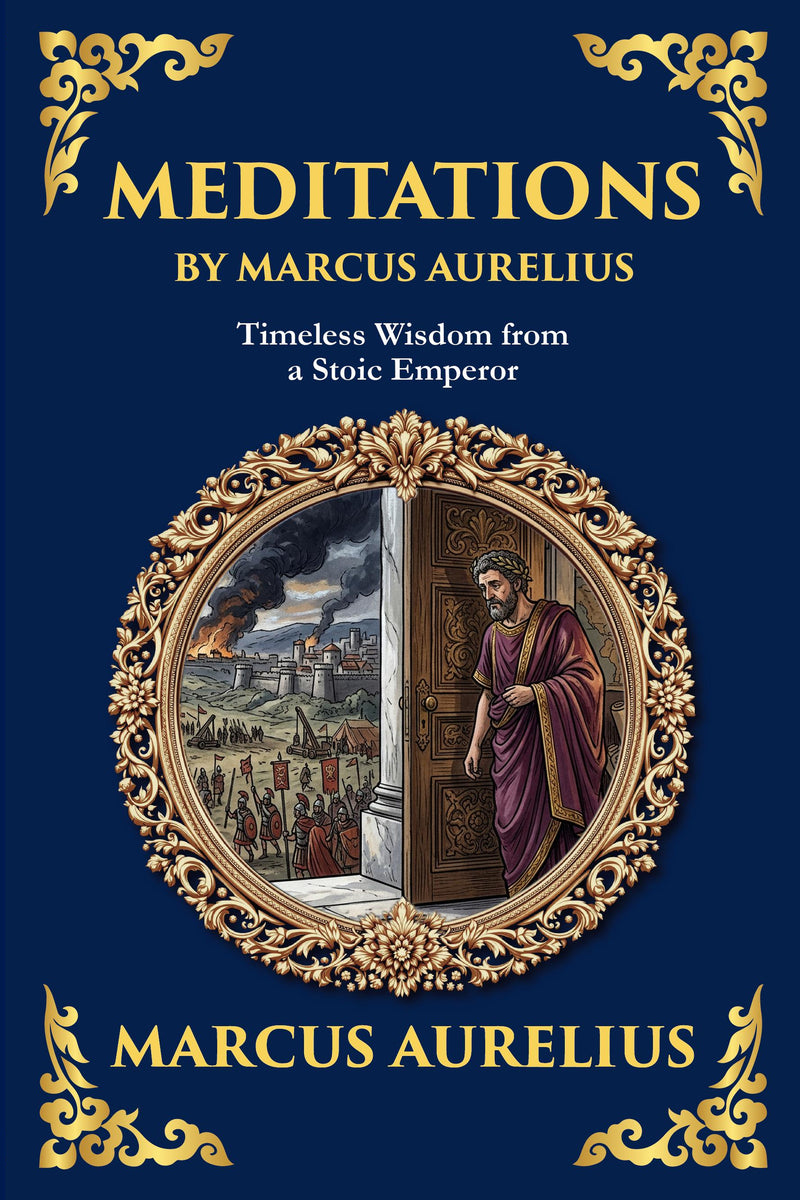
Meditations
Penned during military campaigns and moments of personal reflection, Meditations is the private journal of Roman Emperor Marcus Aurelius—a collection of deeply personal notes on life, duty, adversity, and inner peace.
or free app
10,000+ hrs library
30-day guarantee
The complete Meditations by Marcus Aurelius appears in modern English through Library of Alexandria Press, available online with audiobook narration included for members.
Have you ever wondered why ancient wisdom still holds the answers to modern problems? Meditations by Marcus Aurelius is a rare glimpse into the soul of a ruler who wielded immense power, yet sought nothing more than humility, balance, and wisdom. As the last of the “Five Good Emperors” of Rome, Aurelius did not write this Stoic masterpiece for fame or fortune—but to strengthen his own character in the face of war, grief, and political burden.
Across twelve books, Meditations blends personal reflection with practical philosophy, guiding readers through the fundamental tenets of Stoicism: self-discipline, reason, acceptance, and the importance of living in accordance with nature. This definitive modern translation revitalizes the original text for contemporary audiences, offering timeless guidance on how to live a life of purpose and inner peace in an unpredictable world.
What you’ll discover in this modern edition
- A Window into the Mind of a Philosopher-Emperor – Experience the thoughts of Marcus Aurelius as he battles doubt, ego, and the weight of leadership.
| Formats | eBook (EPUB + PDF) · Audiobook · Paperback · Hardcover · Large Print |
| Language | English |
| Trim size (print) | 6 × 9 in |
| Binding | Paperback — perfect-bound · Hardcover — casewrap |
| Large Print edition | Same text in a larger, easy-read type — a larger font, not a larger trim |
| Print pricing | Every physical book at our true cost — at-cost, no profit (members) |
| Library | 873 restored titles, always growing |
| Length | 51,425 words · ~3 hr 26 min reading |
| Reading level | Grade 8 · an easy, flowing read (this modern-English edition) |
| Edition | Modern English translation · 2026 |
Member reviews for this edition are collected as readers finish it — be the first. Across the library: 12,000+ books shipped, every plan covered by a 365-day print guarantee.
About this edition
A faithful, unabridged modern-English edition by The Library of Alexandria — carefully rendered for today's reader and verified paragraph-by-paragraph against the public-domain source. Available as eBook, audiobook, paperback, hardcover, and large print.
- Complete & unabridgedVerified paragraph by paragraph against the source — never a scan, never abridged.
- Modern English, faithfulReadable today, with the author’s meaning kept intact. Readable — not simplified.
- Every format, one membershipRead in your browser or the free app, or listen to the full audiobook.
Included free with your membership
Cancel anytime, one click · 30-day money-back guarantee
Edition last updated July 2026
What’s inside
Meditations — complete and unabridged: all 13 sections included with membership, plus the full audiobook.
Begin reading Meditations
In clear modern English — the complete text is included with membership.
Introduction
There is something almost unbearably intimate about reading words that were never meant for your eyes. Imagine discovering a leather notebook left behind by the most powerful man of his age—a man who commanded legions, presided over an empire that stretched from the misty frontiers of Britain to the deserts of the Near East, and who held the lives of millions in the balance of his judgment. Imagine that this notebook contains not decrees, not military strategies, not the calculations of statecraft, but the quiet, searching, often painful conversation a man has with himself in the dead of night. This is precisely what you hold in your hands. These pages were not composed for publication. They were not dictated to scribes for posterity. They were the private spiritual exercises of a Roman emperor writing to no one but himself, and it is one of the great accidents of history that they survived at all.
Marcus Aurelius, who ruled Rome from 161 to 180 of the common era, wrote these reflections largely during the final, exhausting decade of his life, much of it spent on the cold and dangerous northern frontier. He wrote in Greek, the language of philosophy, by lamplight in army encampments along the Danube, surrounded by the noise of war, disease, and the relentless demands of governing a vast and fractious world. He gave the work no title. The Greek phrase later attached to it, Ta eis heauton, translates roughly as “to himself,” and that phrase captures everything essential about the book. It is a record of a man trying, day after day, to remind himself how to live well, how to meet adversity with dignity, and how to remain decent and rational in a position that corrupts almost everyone who occupies it. That he largely succeeded is one of the quiet miracles of human history. That he left behind a manual showing us exactly how he did it is an extraordinary gift.
What makes this book endure—what has made it a companion to soldiers, prisoners, presidents, athletes, grieving parents, and ordinary people facing ordinary hardships for nearly two thousand years—is its complete absence of pretense. There is no audience to impress here, no reputation to defend, no argument to win. When Marcus writes, he is often scolding himself, encouraging himself, catching himself in moments of weakness and gently steering himself back toward his principles. He repeats himself constantly, because the lessons he most needed to learn were the ones he kept forgetting, just as we all do. He returns again and again to the same handful of truths because living by them, as he well knew, is the work of a lifetime and never quite finished. In this repetition lies the book’s strange power. We are watching not a finished philosophy but a philosophy in the act of being lived, struggled with, and renewed each morning.
This modern translation has been prepared with a single guiding purpose: to make Marcus speak to you as directly as he spoke to himself. Earlier translations, beautiful as many of them are, often wrapped his words in the formal, sometimes stiff English of their own eras, placing a veil of archaic vocabulary between the reader and the raw immediacy of the original. The aim here has been to lift that veil—to render his thoughts in clear, living language that a contemporary reader can absorb without constant friction, while preserving the gravity, the cadence, and the occasional flashes of dry humor that make Marcus such an unexpectedly warm presence on the page. You will find no needless ornamentation and no dumbing-down. What you will find is the man himself, thinking out loud, across the distance of two millennia, in words you can understand the first time you read them.
To read these reflections well, it helps to know a little about the life from which they emerged, though you need no expertise in Roman history to be moved by them. Marcus was born into a distinguished family in the year 121 and was marked out for greatness early. The reigning emperor, Hadrian, took an interest in the serious, studious boy and arranged the succession so that Marcus would eventually inherit the throne by way of his adoptive father, Antoninus Pius. Marcus was, by all accounts, a reluctant ruler. He had fallen in love with philosophy as a young man, adopting the simple dress of a student, sleeping on the ground in the manner of the more austere thinkers until his mother persuaded him to be gentler with himself. He would have been content, one suspects, with a quiet life of study and contemplation. Instead, duty placed upon his shoulders the heaviest burden the ancient world could offer.
His reign was not a golden age of ease. Far from it. The years of his rule were crowded with catastrophe: devastating wars along the empire’s northern and eastern borders, a plague—possibly smallpox—that swept through the population and killed an enormous number of people, financial strain so severe that he sold off imperial treasures rather than raise taxes on his exhausted citizens, the betrayal of a trusted general who declared himself emperor, and a long series of personal griefs, including the deaths of most of his children. Marcus knew loss intimately. He knew exhaustion, frustration, the bitter taste of dealing with difficult and dishonest people, and the loneliness of holding ultimate authority. When he writes about enduring pain, about not being overwhelmed by anger, about accepting the deaths of those we love and the certainty of our own, he is not theorizing from a comfortable study. He is speaking from the center of a storm.
The philosophy that sustained him through all of this was Stoicism, a school of thought founded in Athens around three centuries before his birth. It is worth pausing on what Stoicism actually meant, because the word has drifted in modern usage to suggest a cold suppression of feeling, a stiff upper lip, an emotionless endurance. That is not what the Stoics taught, and it is certainly not what Marcus practiced. Stoicism, at its heart, is a practical philosophy concerned with how to live a good and tranquil life in a world we do not control. Its central insight is deceptively simple and endlessly profound: there are things within our power and things outside our power, and nearly all human misery comes from confusing the two. Our own judgments, choices, intentions, and responses belong to us. Almost everything else—the behavior of other people, the workings of fortune, our reputation, our health, even the length of our lives—does not. The Stoic does not pretend these external things do not matter; rather, the Stoic refuses to let his inner peace depend on them. He trains himself to direct all his moral energy toward the one domain he can actually govern: his own mind.
From this foundation flows everything you will encounter in these pages. The Stoics held that we are rational creatures who flourish by living in accordance with reason and with nature—meaning both the larger order of the cosmos and our own essential nature as social beings made for cooperation. They believed that virtue, by which they meant wisdom, justice, courage, and self-discipline, was the only true good, and that vice was the only true evil, and that everything else fell into a vast middle category of things that are neither good nor bad in themselves but simply material upon which we exercise our judgment. They practiced regular reflection, the examination of one’s own conduct, the rehearsal of difficult situations before they arrived, and a kind of cosmic perspective that placed the small dramas of an individual life against the immense backdrop of time and the universe. You will see Marcus doing all of these things, often within a single short passage.
What you may not expect is how compassionate the resulting outlook is. Because the Stoic recognizes that people who behave badly do so out of ignorance—out of a mistaken idea of what is truly good for them—Marcus repeatedly counsels patience and understanding rather than resentment. When someone wrongs you, he reminds himself, remember that they acted because they thought they were doing right, that they share the same human nature you do, that you will both soon be dead, and that your anger harms you more than their offense does. He even instructs himself, in one of the book’s most touching habits, to begin each day by anticipating that he will meet people who are ungrateful, arrogant, dishonest, and unkind—not so that he can despise them, but so that he will not be surprised or shaken, and so that he can remember they cannot truly harm the only thing that matters, which is his own character. This is not coldness. It is a hard-won and deeply humane tenderness toward a flawed and struggling humanity, including toward himself.
The first thing to understand about reading this book is that it does not need to be read from front to back like a novel, and arguably should not be read that way, at least not the first time. Because Marcus wrote these notes as private exercises over a period of years, with no plan for them to form a continuous argument, the work has no plot, no chronological development, and very little organization. The traditional division into twelve books is a convenience imposed by later editors, not a structure Marcus intended. The first book stands somewhat apart from the rest: it is a long and beautiful catalogue of debts, in which Marcus lists, one by one, the people who shaped him—his family members, his teachers, his adoptive father—and names the specific virtues and lessons each gave him. It is a remarkable exercise in gratitude, and it reveals a great deal about the kind of man he aspired to be. The remaining books are collections of individual reflections, some only a sentence long, some running to a paragraph or more, arranged in no particular sequence.
This means you are free to read in whatever way serves you. You might read a few passages each morning, as Marcus likely wrote them, using them to set the tone for your day. You might open the book at random and find that whatever your eye lands upon speaks somehow to your present circumstances—readers have reported this experience for centuries, and there is a reason the book has so often functioned almost as an oracle of consolation. You might read straight through to absorb the overall rhythm and recurring themes, then return later to dwell on particular passages. There is no wrong approach. What matters is that you give yourself time. These are not words to be hurried through. A single sentence, properly considered, can occupy a thoughtful person for an entire day. The book rewards slowness and rereading more than almost any other work of its length.
You should also be prepared for the repetition, and indeed you should welcome it rather than be impatient with it. Marcus comes back, over and over, to the brevity of life, to the impermanence of all things, to the necessity of doing one’s duty, to the foolishness of seeking fame or fearing death, to the importance of governing one’s own mind. At first this may seem redundant. But consider what these notes were for. Marcus was not trying to inform himself of things he did not know; he was trying to engrave into his character truths he already understood intellectually but constantly failed to live by. Reminding ourselves of what we already know is, in fact, the central spiritual discipline. We all know we should be patient, that we should not waste our brief lives on trivial resentments, that we cannot control what others think of us. Knowing these things changes nothing. Living them requires daily, even hourly, renewal. The repetition in this book is not a flaw; it is the entire method. As you read, you may notice the same lessons beginning to take root in your own mind through sheer accumulation, which is exactly the effect Marcus was creating in himself.
A few of the recurring ideas deserve a brief word of preparation, because they can seem strange or even bleak to a first-time reader before their purpose becomes clear. Marcus dwells frequently on death—his own and everyone else’s—and on the dissolution of all things into the elements from which they came. He reminds himself constantly that everything he sees will soon vanish, that even the greatest emperors and the most celebrated names of the past are now forgotten dust, that the present moment is all anyone ever truly possesses. To a modern reader, this might initially sound morbid. But for Marcus, the contemplation of death was profoundly liberating. If life is short and uncertain, then there is no time to waste on pettiness, no point in postponing the work of becoming a good person, no sense in clinging to things we must inevitably lose. The awareness of mortality strips away illusion and concentrates the mind on what genuinely matters right now. It is, paradoxically, a philosophy intensely focused on living well, precisely because it never looks away from the fact that life ends.
Cancel anytime, one click · 30-day money-back guarantee
Founding annual rate available now — your price locks for life when you join.
Not ready? Get this free chapter by email — read it anytime.
✓ Sent — check your inbox for Meditations.
Questions about Meditations
What is Meditations by Marcus Aurelius about?
Penned during military campaigns and moments of personal reflection, Meditations is the private journal of Roman Emperor Marcus Aurelius—a collection of deeply personal notes on life, duty, adversity, and inner peace. Written not for the public eye but for his own guidance, these writings have become one of the most profound and enduring works of philosophy in human history. Rooted in the principles of Stoicism, Meditations teaches us how to face life with calm resilience, accept what we cannot control, and cultiva
Who wrote Meditations by Marcus Aurelius?
Meditations by Marcus Aurelius was written by Marcus Aurelius. This edition presents the complete work in clear modern English, faithfully rendered from the public-domain original by Library of Alexandria Press.
Is Meditations by Marcus Aurelius free to read?
The opening chapter is free to read on this page. Members read and listen to the complete work — and the entire library — free, and can order any physical book at our true print cost.
How long is Meditations by Marcus Aurelius?
13 chapters (~51,425 words) — about 3 hr 26 min of reading in this modern-English edition.
Is this an abridged version of Meditations by Marcus Aurelius?
No. This is the complete, unabridged Meditations by Marcus Aurelius, carefully rendered into clear modern English and verified paragraph-by-paragraph against the public-domain source — nothing is cut or summarised.
What formats does Meditations by Marcus Aurelius come in?
Meditations by Marcus Aurelius is available as eBook, paperback, hardcover and large print. eBook and audiobook are included with membership; printed editions ship at our true print cost.
Shipping & returns
Billing & membership
More from the library


Explore Biography & Letters
- The Confessions of St. Augustine · Saint Augustine
- The Confessions of Jean-Jacques Rousseau — Complete · Jean-Jacques Rousseau
- Ecce Homo · Friedrich Wilhelm Nietzsche
- De Profundis · Oscar Wilde
- Memoirs of Joseph Grimaldi · Joseph Grimaldi
- English Eccentrics and Eccentricities · John Timbs
- You Can’t Win · Jack Black
- Wild Animals I Have Known · Ernest Thompson Seton
- The Diary of Samuel Pepys — Complete 1665 N.S. · Samuel Pepys
- Random Reminiscences of Men and Events · John D. Rockefeller
- The Story of My Life · Helen Keller
- Elizabeth, Empress of Austria and Queen of Hungary · Carl Küchler
- Society as I Have Found It · Ward McAllister
- Autobiography of a Yogi · Paramahansa Yogananda
- Christopher Columbus and How He Received and Imparted the Spirit of Discovery
- A Portrait of the Artist as a Young Man · James Joyce
- Memoirs of the Author of a Vindication of the Rights of Woman · William Godwin
- Mary: A Fiction · Mary Wollstonecraft
- The Romance of Biography (Vol. 1 of 2) · Mrs. Jameson
- The Love Letters of Mary Wollstonecraft to Gilbert Imlay · Mary Wollstonecraft
- Selected Works of Voltairine de Cleyre · Voltairine de Cleyre
- Eighty Years and More; Reminiscences 1815–1897 · Elizabeth Cady Stanton
- Anarchism and Other Essays · Emma Goldman
- Agnes Grey · Anne Brontë
- Daddy-Long-Legs · Jean Webster
- Reminiscences of a Stock Operator · Edwin Lefèvre
- Martin Eden · Jack London
- Matthew Calbraith Perry: A Typical American Naval Officer · William Elliot Griffis
- Walden, and On the Duty of Civil Disobedience · Henry David Thoreau
- Little Women · Louisa May Alcott
Meditations
Meditations
Timeless Wisdom from a Stoic Emperor
Marcus Aurelius
Contents
- Introduction
- Book 1
- Book 2
- Book 3
- Book 4
- Book 5
- Book 6
- Book 7
- Book 8
- Book 9
- Book 10
- Book 11
- Book 12
Introduction
There is something almost unbearably intimate about reading words that were never meant for your eyes. Imagine discovering a leather notebook left behind by the most powerful man of his age—a man who commanded legions, presided over an empire that stretched from the misty frontiers of Britain to the deserts of the Near East, and who held the lives of millions in the balance of his judgment. Imagine that this notebook contains not decrees, not military strategies, not the calculations of statecraft, but the quiet, searching, often painful conversation a man has with himself in the dead of night. This is precisely what you hold in your hands. These pages were not composed for publication. They were not dictated to scribes for posterity. They were the private spiritual exercises of a Roman emperor writing to no one but himself, and it is one of the great accidents of history that they survived at all.
Marcus Aurelius, who ruled Rome from 161 to 180 of the common era, wrote these reflections largely during the final, exhausting decade of his life, much of it spent on the cold and dangerous northern frontier. He wrote in Greek, the language of philosophy, by lamplight in army encampments along the Danube, surrounded by the noise of war, disease, and the relentless demands of governing a vast and fractious world. He gave the work no title. The Greek phrase later attached to it, Ta eis heauton, translates roughly as “to himself,” and that phrase captures everything essential about the book. It is a record of a man trying, day after day, to remind himself how to live well, how to meet adversity with dignity, and how to remain decent and rational in a position that corrupts almost everyone who occupies it. That he largely succeeded is one of the quiet miracles of human history. That he left behind a manual showing us exactly how he did it is an extraordinary gift.
What makes this book endure—what has made it a companion to soldiers, prisoners, presidents, athletes, grieving parents, and ordinary people facing ordinary hardships for nearly two thousand years—is its complete absence of pretense. There is no audience to impress here, no reputation to defend, no argument to win. When Marcus writes, he is often scolding himself, encouraging himself, catching himself in moments of weakness and gently steering himself back toward his principles. He repeats himself constantly, because the lessons he most needed to learn were the ones he kept forgetting, just as we all do. He returns again and again to the same handful of truths because living by them, as he well knew, is the work of a lifetime and never quite finished. In this repetition lies the book’s strange power. We are watching not a finished philosophy but a philosophy in the act of being lived, struggled with, and renewed each morning.
This modern translation has been prepared with a single guiding purpose: to make Marcus speak to you as directly as he spoke to himself. Earlier translations, beautiful as many of them are, often wrapped his words in the formal, sometimes stiff English of their own eras, placing a veil of archaic vocabulary between the reader and the raw immediacy of the original. The aim here has been to lift that veil—to render his thoughts in clear, living language that a contemporary reader can absorb without constant friction, while preserving the gravity, the cadence, and the occasional flashes of dry humor that make Marcus such an unexpectedly warm presence on the page. You will find no needless ornamentation and no dumbing-down. What you will find is the man himself, thinking out loud, across the distance of two millennia, in words you can understand the first time you read them.
To read these reflections well, it helps to know a little about the life from which they emerged, though you need no expertise in Roman history to be moved by them. Marcus was born into a distinguished family in the year 121 and was marked out for greatness early. The reigning emperor, Hadrian, took an interest in the serious, studious boy and arranged the succession so that Marcus would eventually inherit the throne by way of his adoptive father, Antoninus Pius. Marcus was, by all accounts, a reluctant ruler. He had fallen in love with philosophy as a young man, adopting the simple dress of a student, sleeping on the ground in the manner of the more austere thinkers until his mother persuaded him to be gentler with himself. He would have been content, one suspects, with a quiet life of study and contemplation. Instead, duty placed upon his shoulders the heaviest burden the ancient world could offer.
His reign was not a golden age of ease. Far from it. The years of his rule were crowded with catastrophe: devastating wars along the empire’s northern and eastern borders, a plague—possibly smallpox—that swept through the population and killed an enormous number of people, financial strain so severe that he sold off imperial treasures rather than raise taxes on his exhausted citizens, the betrayal of a trusted general who declared himself emperor, and a long series of personal griefs, including the deaths of most of his children. Marcus knew loss intimately. He knew exhaustion, frustration, the bitter taste of dealing with difficult and dishonest people, and the loneliness of holding ultimate authority. When he writes about enduring pain, about not being overwhelmed by anger, about accepting the deaths of those we love and the certainty of our own, he is not theorizing from a comfortable study. He is speaking from the center of a storm.
The philosophy that sustained him through all of this was Stoicism, a school of thought founded in Athens around three centuries before his birth. It is worth pausing on what Stoicism actually meant, because the word has drifted in modern usage to suggest a cold suppression of feeling, a stiff upper lip, an emotionless endurance. That is not what the Stoics taught, and it is certainly not what Marcus practiced. Stoicism, at its heart, is a practical philosophy concerned with how to live a good and tranquil life in a world we do not control. Its central insight is deceptively simple and endlessly profound: there are things within our power and things outside our power, and nearly all human misery comes from confusing the two. Our own judgments, choices, intentions, and responses belong to us. Almost everything else—the behavior of other people, the workings of fortune, our reputation, our health, even the length of our lives—does not. The Stoic does not pretend these external things do not matter; rather, the Stoic refuses to let his inner peace depend on them. He trains himself to direct all his moral energy toward the one domain he can actually govern: his own mind.
From this foundation flows everything you will encounter in these pages. The Stoics held that we are rational creatures who flourish by living in accordance with reason and with nature—meaning both the larger order of the cosmos and our own essential nature as social beings made for cooperation. They believed that virtue, by which they meant wisdom, justice, courage, and self-discipline, was the only true good, and that vice was the only true evil, and that everything else fell into a vast middle category of things that are neither good nor bad in themselves but simply material upon which we exercise our judgment. They practiced regular reflection, the examination of one’s own conduct, the rehearsal of difficult situations before they arrived, and a kind of cosmic perspective that placed the small dramas of an individual life against the immense backdrop of time and the universe. You will see Marcus doing all of these things, often within a single short passage.
What you may not expect is how compassionate the resulting outlook is. Because the Stoic recognizes that people who behave badly do so out of ignorance—out of a mistaken idea of what is truly good for them—Marcus repeatedly counsels patience and understanding rather than resentment. When someone wrongs you, he reminds himself, remember that they acted because they thought they were doing right, that they share the same human nature you do, that you will both soon be dead, and that your anger harms you more than their offense does. He even instructs himself, in one of the book’s most touching habits, to begin each day by anticipating that he will meet people who are ungrateful, arrogant, dishonest, and unkind—not so that he can despise them, but so that he will not be surprised or shaken, and so that he can remember they cannot truly harm the only thing that matters, which is his own character. This is not coldness. It is a hard-won and deeply humane tenderness toward a flawed and struggling humanity, including toward himself.
The first thing to understand about reading this book is that it does not need to be read from front to back like a novel, and arguably should not be read that way, at least not the first time. Because Marcus wrote these notes as private exercises over a period of years, with no plan for them to form a continuous argument, the work has no plot, no chronological development, and very little organization. The traditional division into twelve books is a convenience imposed by later editors, not a structure Marcus intended. The first book stands somewhat apart from the rest: it is a long and beautiful catalogue of debts, in which Marcus lists, one by one, the people who shaped him—his family members, his teachers, his adoptive father—and names the specific virtues and lessons each gave him. It is a remarkable exercise in gratitude, and it reveals a great deal about the kind of man he aspired to be. The remaining books are collections of individual reflections, some only a sentence long, some running to a paragraph or more, arranged in no particular sequence.
This means you are free to read in whatever way serves you. You might read a few passages each morning, as Marcus likely wrote them, using them to set the tone for your day. You might open the book at random and find that whatever your eye lands upon speaks somehow to your present circumstances—readers have reported this experience for centuries, and there is a reason the book has so often functioned almost as an oracle of consolation. You might read straight through to absorb the overall rhythm and recurring themes, then return later to dwell on particular passages. There is no wrong approach. What matters is that you give yourself time. These are not words to be hurried through. A single sentence, properly considered, can occupy a thoughtful person for an entire day. The book rewards slowness and rereading more than almost any other work of its length.
You should also be prepared for the repetition, and indeed you should welcome it rather than be impatient with it. Marcus comes back, over and over, to the brevity of life, to the impermanence of all things, to the necessity of doing one’s duty, to the foolishness of seeking fame or fearing death, to the importance of governing one’s own mind. At first this may seem redundant. But consider what these notes were for. Marcus was not trying to inform himself of things he did not know; he was trying to engrave into his character truths he already understood intellectually but constantly failed to live by. Reminding ourselves of what we already know is, in fact, the central spiritual discipline. We all know we should be patient, that we should not waste our brief lives on trivial resentments, that we cannot control what others think of us. Knowing these things changes nothing. Living them requires daily, even hourly, renewal. The repetition in this book is not a flaw; it is the entire method. As you read, you may notice the same lessons beginning to take root in your own mind through sheer accumulation, which is exactly the effect Marcus was creating in himself.
A few of the recurring ideas deserve a brief word of preparation, because they can seem strange or even bleak to a first-time reader before their purpose becomes clear. Marcus dwells frequently on death—his own and everyone else’s—and on the dissolution of all things into the elements from which they came. He reminds himself constantly that everything he sees will soon vanish, that even the greatest emperors and the most celebrated names of the past are now forgotten dust, that the present moment is all anyone ever truly possesses. To a modern reader, this might initially sound morbid. But for Marcus, the contemplation of death was profoundly liberating. If life is short and uncertain, then there is no time to waste on pettiness, no point in postponing the work of becoming a good person, no sense in clinging to things we must inevitably lose. The awareness of mortality strips away illusion and concentrates the mind on what genuinely matters right now. It is, paradoxically, a philosophy intensely focused on living well, precisely because it never looks away from the fact that life ends.
I. From my grandfather Verus, I learned to be gentle and mild, and to avoid all anger and passion. From the reputation and memory of my father, I learned modesty and how to behave like a man. From my mother, I learned to be religious and generous; to avoid not only doing but even intending any harm; to be satisfied with a simple diet, and to shun the excesses that come with great wealth. From my great-grandfather, I learned to attend public schools and lectures, and to hire the best and most capable teachers for myself at home, understanding that I should not worry if this required a significant expense.
II. From the man who raised me, I learned not to be blindly devoted to either of the two great racing factions in the circus, the Greens or the Blues; nor to play favorites with any of the gladiators or fighters in the amphitheater, whether they were the Parmularii or the Secutores. Furthermore, I learned to endure hard work, to live with few possessions, and to do things myself rather than relying on others. I learned not to get involved in too many affairs and not to believe slanders easily.
III. From Diognetus, I learned not to waste my time on trivial things, and not to easily believe the claims of those who pretend to perform miracles, or the words of sorcerers, magicians, and frauds regarding the power of charms or the casting out of demons and evil spirits. I learned not to keep quails for hunting or to be obsessed with such hobbies. I learned not to be offended by the free speech of others and to dedicate myself to philosophy. I also owe him for introducing me to Bacchius, and later to Tandasis and Marcianus, and for encouraging me to write dialogues in my youth. Because of him, I grew fond of the simple philosopher’s couch and the animal skins—the modest lifestyle that the Greek tradition considers proper for those who practice philosophy.
End of the free sample
Keep reading, free
Members read and listen to the complete book — and the entire library. Cancel anytime, one click · 30-day money-back guarantee.